A massive rope of mass and length , as shown in the figure, rests on a horizontal table. If the coefficient of static friction between the table and the rope is , what fraction of the rope can hang over the edge of the table without the rope sliding?

- (A)
- (B)
- (C)
- (D)
- (E)
Fonte: Testo (PDF) — p.3 Topic: Newtonian Mechanics Metodi: Free-Body Diagram, Vector Decomposition Competenze: Physical Reasoning Objects: String
Una corda massiccia di massa e lunghezza , come mostrato nella figura, si posa su una tabella orizzontale. Se il coefficiente di attrito statico tra la tavola e la corda è , quale frazione della corda può appendere sul bordo della tavola senza che la corda scivoli?
- (A)
- (B)
- (C)
- (D)
- (E)
Fonte: Testo (PDF) — p.3 Topic: Newtonian Mechanics Metodi: Free-Body Diagram, Vector Decomposition Competenze: Physical Reasoning Objects: String
As shown in the figure, a rigid sphere of mass and radius is held at rest by a horizontal string on an inclined plane with an inclination . If the sphere does not move, what is the minimum coefficient of static friction between the sphere and the incline?
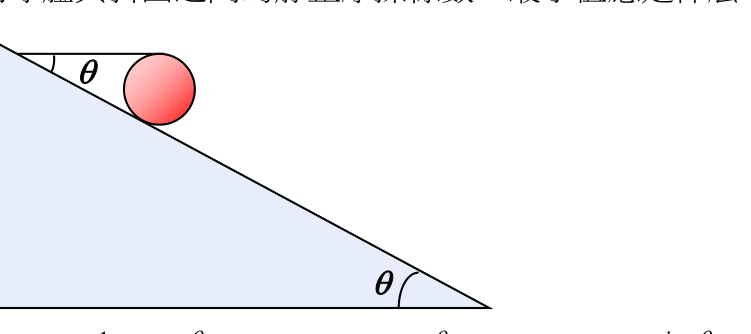
- (A)
- (B)
- (C)
- (D)
- (E)
Fonte: Testo (PDF) — p.3 Topic: Rigid Body Statics Metodi: Free-Body Diagram, Torque & Angular Momentum Analysis Competenze: Physical Reasoning Objects: Sphere, Inclined Plane, String
Come mostrato nella figura, una sfera rigida di massa e di raggio è tenuta in riposo da una corda orizzontale su un piano inclinato con inclination . Se la sfera non si muove, qual è il coefficiente minimo di attrito statico tra la sfera e l’inclinazione?
- (A)
- (B)
- (C)
- (D)
- (E)
Fonte: Testo (PDF) — p.3 Topic: Rigid Body Statics Metodi: Free-Body Diagram, Torque & Angular Momentum Analysis Competenze: Physical Reasoning Objects: Sphere, Inclined Plane, String
A simple pendulum of length is mounted in a massive cart that slides down a plane inclined at an angle with the horizontal. Find the period of small oscillations of this pendulum if the cart moves down the plane with acceleration .
- (A)
- (B)
- (C)
- (D)
- (E)
Fonte: Testo (PDF) — p.3 Topic: Oscillations & Waves Metodi: Simple Harmonic Motion Analysis, Vector Decomposition Competenze: Physical Reasoning Objects: Pendulum, Cart, Inclined Plane
Un semplice pendolo di lunghezza è montato in un carrello massiccio che scivola in un piano inclinato in un angolo con l’orizzontale. Trova il periodo di piccole oscillazioni di questo pendolo se il carrello si muove verso il basso con l’accelerazione .
- (A)
- (B)
- (C)
- (D)
- (E)
Fonte: Testo (PDF) — p.3 Topic: Oscillations & Waves Metodi: Simple Harmonic Motion Analysis, Vector Decomposition Competenze: Physical Reasoning Objects: Pendulum, Cart, Inclined Plane
A stone of mass is tied to a string. It is whirled in a vertical circle of radius . At the highest point of the circle, the speed of the stone is . Find the tension of the string.
- (A)
- (B)
- (C)
- (D)
- (E)
Fonte: Testo (PDF) — p.3 Topic: Newtonian Mechanics Metodi: Free-Body Diagram, Vector Decomposition Competenze: Physical Reasoning Objects: String
Una pietra di massa è legata a una corda. È rotolante in un cerchio verticale di raggio . Al punto più alto del cerchio, la velocità della pietra è . Trova la tensione della corda.
- (A)
- (B)
- (C)
- (D)
- (E)
Fonte: Testo (PDF) — p.3 Topic: Newtonian Mechanics Metodi: Free-Body Diagram, Vector Decomposition Competenze: Physical Reasoning Objects: String
A ring with mass is hung vertically at the lower end of a uniform chain of total mass and length . Its upper end is fixed, as shown in figure (a). The lower end is raised until it is at the same position as , and the ring slides to the midpoint of the string, as shown in figure (b). What is the minimum work required in this process?
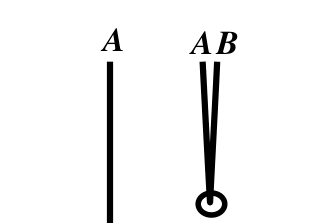
- (A)
- (B)
- (C)
- (D)
- (E)
Fonte: Testo (PDF) — p.4 Topic: Conservation of Energy Metodi: Energy Conservation Method, Calculus-Integration Competenze: Physical Reasoning Objects: String
Un anello di massa è appeso verticalmente alla fine inferiore di una catena uniforme di massa totale e lunghezza . La sua estremità superiore è fissa, come mostrato alla figura a). La parte inferiore viene sollevata fino a raggiungere la stessa posizione di e l’anello si sposta verso il punto medio della corda, come mostrato alla figura b). Qual è il minimo di lavoro richiesto in questo processo?
- (A)
- (B)
- (C)
- (D)
- (E)
Fonte: Testo (PDF) — p.4 Topic: Conservation of Energy Metodi: Energy Conservation Method, Calculus-Integration Competenze: Physical Reasoning Objects: String
In a spacecraft orbiting around the Earth, an astronaut has a feeling of weightlessness. In Earth’s reference frame, the explanation is
- (A) the weight of the astronaut becomes zero.
- (B) the gravitational field inside the spacecraft becomes zero.
- (C) the net force acting on the astronaut becomes zero.
- (D) the astronaut is falling freely.
- (E) there is no change in the momentum of the astronaut.
Fonte: Testo (PDF) — p.4 Topic: Gravitation Metodi: Newton’s Law of Gravitation, Free-Body Diagram Competenze: Physical Reasoning Objects: Satellite, Planet
In una sonda spaziale che orbita intorno alla Terra, un astronauta ha una sensazione di assenza di peso. Nel quadro di riferimento della Terra, l’esplicazione è
- **(A) ** il peso dell’astronauta diventa zero.
- **(B) ** il campo gravitazionale all’interno della sonda diventa zero.
- **(C) ** la forza netta che agisce sull’astronauta diventa zero.
- L’astronauta sta cadendo liberamente.
- **(E) ** non c’è cambiamento nell’impulso dell’astronauta.
Fonte: Testo (PDF) — p.4 Topic: Gravitation Metodi: Newton’s Law of Gravitation, Free-Body Diagram Competenze: Physical Reasoning Objects: Satellite, Planet
In the figure, a mass is hung by a light spring and a light string at the ceiling. Both the spring and the string make an angle with the horizontal at equilibrium. If the string is suddenly cut, what is the instantaneous acceleration of the mass ?
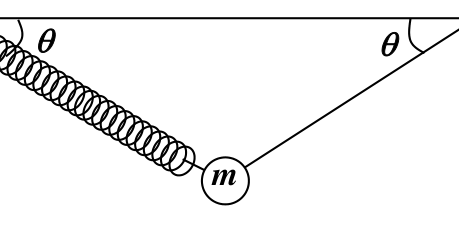
- (A)
- (B)
- (C)
- (D)
- (E)
Fonte: Testo (PDF) — p.4 Topic: Newtonian Mechanics Metodi: Free-Body Diagram, Hooke’s Law, Vector Decomposition Competenze: Physical Reasoning Objects: Spring, String, Block
Nella figura, una massa è appesa da una sorgente leggera e da una corda leggera al soffitto. Sia la molla che la corda fanno un angolo con l’orizzontale in equilibrio. Se la corda viene tagliata improvvisamente, qual è l’accelerazione istantanea della massa ?
- (A)
- (B)
- (C)
- (D)
- (E)
Fonte: Testo (PDF) — p.4 Topic: Newtonian Mechanics Metodi: Free-Body Diagram, Hooke’s Law, Vector Decomposition Competenze: Physical Reasoning Objects: Spring, String, Block
A particle is projected horizontally from the edge of a smooth table with initial speed . The particle hits the ground at a horizontal distance from the table. Different values of are used and the corresponding values of are recorded. Which of the following pair of quantities will give a straight-line curve?
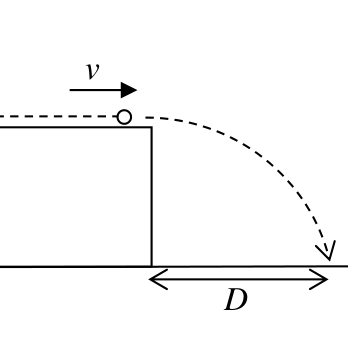
- (A) and
- (B) and
- (C) and
- (D) and
- (E) and
Fonte: Testo (PDF) — p.5 Topic: Newtonian Mechanics Metodi: Kinematic Equations, Graph Linearization Competenze: Graph Linearization Objects: Projectile
Una particella viene proiettata orizzontalmente dal bordo di una tavola liscia con velocità iniziale . La particella colpisce il terreno a distanza orizzontale dalla tabella. Si utilizzano valori diversi di e si registrano i valori corrispondenti di . Quale delle seguenti coppie di quantità darà una curva a linea retta?
- **(A) ** e
- **(B) ** e
- **(C) ** e
- **(D) ** e
- **(E) ** e
Fonte: Testo (PDF) — p.5 Topic: Newtonian Mechanics Metodi: Kinematic Equations, Graph Linearization Competenze: Graph Linearization Objects: Projectile
Which of the following facts is/are direct evidence(s) supporting Newton’s first law of motion?
(1) A feather and a coin spend equal time to reach the ground when dropped from the same height on the Moon surface. (2) A satellite orbits around the Earth with uniform speed without supply of fuel. (3) A man is thrown forward on a bus which stops suddenly.
- (A) (3) only
- (B) (1) and (2) only
- (C) (1) and (3) only
- (D) (2) and (3) only
- (E) (1), (2) and (3)
Fonte: Testo (PDF) — p.5 Topic: Newtonian Mechanics Metodi: Physical Modeling Competenze: Physical Reasoning Objects: Satellite
Quali dei seguenti fatti sono/sono prove dirette a sostegno della prima legge di movimento di Newton?
(1) Una piuma e una moneta impiegano il medesimo tempo per raggiungere il suolo quando vengono gettate dalla stessa altezza sulla superficie lunare. (2) Un satellite orbita intorno alla Terra con velocità uniforme senza fornitura di combustibile. (3) Un uomo viene gettato avanti su un autobus che si ferma improvvisamente.
- solo **(A) ** (3)
- solo **(B) ** (1) e (2)
- solo **(C) ** (1) e (3)
- solo **(D) ** (2) e (3)
- **(E) ** (1), (2) e (3)
Fonte: Testo (PDF) — p.5 Topic: Newtonian Mechanics Metodi: Physical Modeling Competenze: Physical Reasoning Objects: Satellite
Two masses, and () are put on a smooth horizontal table as shown. The maximum static friction between the two masses is . A gradually increasing horizontal force acts on and the two masses accelerate together. The masses start to slip over each other when the force attains (figure (a)). If initially the force acts on instead, the masses start to slip over each other when the force attains (figure (b)). Compare and .
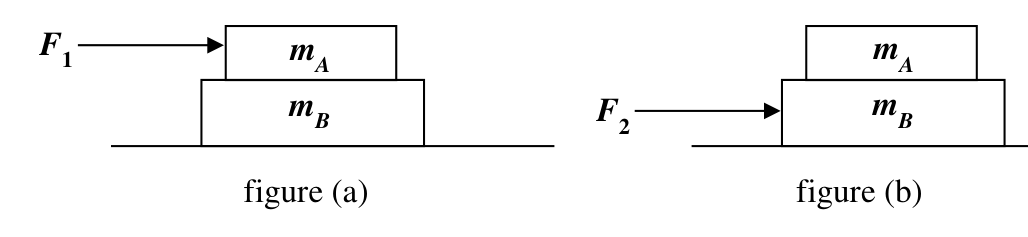
- (A)
- (B)
- (C)
- (D)
- (E)
Fonte: Testo (PDF) — p.5 Topic: Newtonian Mechanics Metodi: Free-Body Diagram, Vector Decomposition Competenze: Physical Reasoning Objects: Block
Due masse, e () sono messe su una tavola orizzontale liscia come mostrato. La massima attrito statico tra le due masse è . Una forza orizzontale che aumenta gradualmente agisce su e le due masse accelerano insieme. Le masse iniziano a scivolare l’una sull’altra quando la forza raggiunge (figura (a)). Se inizialmente la forza agisce invece su , le masse iniziano a scivolare l’una sull’altra quando la forza raggiunge (figura (b)). Confronta e .
- (A)
- (B)
- (C)
- (D)
- (E)
Fonte: Testo (PDF) — p.5 Topic: Newtonian Mechanics Metodi: Free-Body Diagram, Vector Decomposition Competenze: Physical Reasoning Objects: Block
Planet P is moving in a circular orbit around a star X, while in another stellar system, planet Q is moving in a circular orbit around a star Y. The orbital radius of P is twice that of Q and the orbital period of P is also twice that of Q. Find the ratio of mass of X to that of Y.
- (A)
- (B)
- (C)
- (D)
- (E)
Fonte: Testo (PDF) — p.5 Topic: Gravitation Metodi: Kepler’s Laws, Newton’s Law of Gravitation Competenze: Physical Reasoning Objects: Planet, Star
Il pianeta P si muove in un’orbita circolare attorno a una stella X, mentre in un altro sistema stellare il pianeta Q si muove in un’orbita circolare attorno a una stella Y. Il raggio orbitale di P è il doppio di quello di Q e il periodo orbitale di P è anche il doppio di Q. Trova il rapporto di massa di X a quella di Y.
- (A)
- (B)
- (C)
- (D)
- (E)
Fonte: Testo (PDF) — p.5 Topic: Gravitation Metodi: Kepler’s Laws, Newton’s Law of Gravitation Competenze: Physical Reasoning Objects: Planet, Star
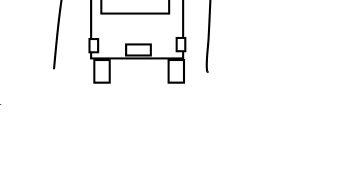
A bus is turning around a corner on a horizontal road. The diagram shows the rear view of the bus, which is turning to its right. Which of the following diagrams best shows the force diagram of the bus?
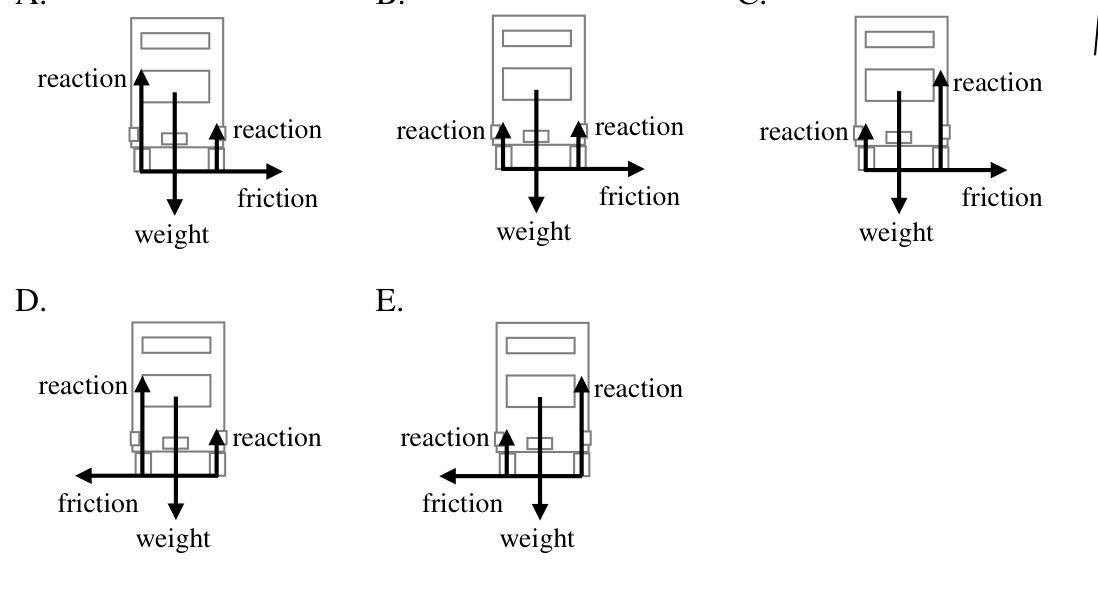
- (A) Reaction forces upward at both wheels, weight downward, friction pointing right (toward the centre of the turn).
- (B) Reaction forces upward at both wheels, weight downward, friction pointing right (toward the centre of the turn).
- (C) Reaction forces upward at both wheels, weight downward, no horizontal friction.
- (D) Reaction forces upward at both wheels, weight downward, friction pointing left.
- (E) Reaction forces upward at both wheels, weight downward, friction pointing left.
(See figure: options A–C in the top row, D–E in the bottom row.)
Fonte: Testo (PDF) — p.6 Topic: Newtonian Mechanics Metodi: Free-Body Diagram Competenze: Diagrammatic Reasoning Objects: Wheel
Un autobus gira intorno a un angolo su una strada orizzontale. Il diagramma mostra la vista posteriore dell’autobus, che gira a destra. Quale dei seguenti diagrammi mostra meglio il diagramma di forza dell’autobus?
- **(A) ** Le forze di reazione su entrambe le ruote, il peso verso il basso, l’attrito che punta a destra (in direzione del centro della curva).
- **(B) ** Le forze di reazione su entrambe le ruote, il peso verso il basso, la frizione puntando a destra (verso il centro della curva).
- **(C) ** Le forze di reazione sono verso l’alto su entrambe le ruote, il peso verso il basso, nessuna attrito orizzontale.
- **(D) ** Le forze di reazione sono in salita su entrambe le ruote, il peso in discesa, la frizione puntando a sinistra.
- **(E) ** Le forze di reazione sono verso l’alto su entrambe le ruote, il peso verso il basso, la frizione puntando a sinistra.
(Vedi figura: opzioni AC nella riga superiore, DE nella riga inferiore).
Fonte: Testo (PDF) — p.6 Topic: Newtonian Mechanics Metodi: Free-Body Diagram Competenze: Diagrammatic Reasoning Objects: Wheel
A cylindrical trough is placed on a horizontal plane. The two edges of the trough are connected with smooth inclined planes and at locations and respectively. The trough edges and the inclined planes are tangential at the connections, and , are located at the same horizontal level, as shown in the figure. A small mass slides freely down the slope from a height of above the horizontal level . It enters the trough at position , reaches and then slides upward along slope until it reaches a height of above the horizontal level . It then slides downwards along slope and enters the trough again. Neglecting air resistance, the small mass
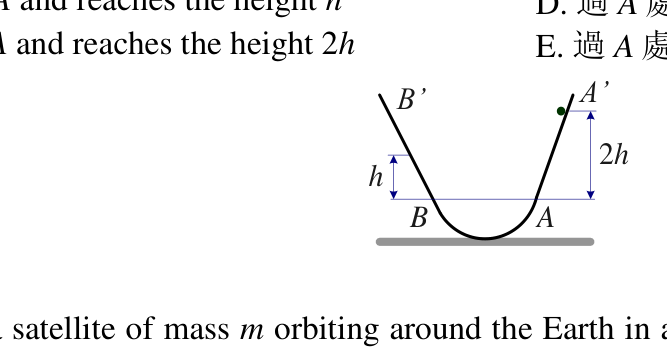
- (A) reaches a height lower than
- (B) just reaches the location
- (C) passes and reaches a height less than
- (D) passes and reaches the height
- (E) passes and reaches the height
Fonte: Testo (PDF) — p.6 Topic: Conservation of Energy Metodi: Energy Conservation Method Competenze: Physical Reasoning Objects: Inclined Plane, Block
Un fondo cilindrico è posizionato su un piano orizzontale. I due bordi della parte inferiore sono collegati con piani di inclinamento liscio e rispettivamente alle posizioni e . I bordi inferiori e i piani inclinati sono tangenziali alle connessioni e , sono situati allo stesso livello orizzontale, come mostrato nella figura. Una piccola massa scorre liberamente lungo la pendenza da un’altezza di sopra il livello orizzontale . Entrerà nella parte inferiore della posizione , raggiungerà e poi scivolerà verso l’alto lungo la pendenza fino a raggiungere un’altezza di sopra il livello orizzontale . Poi scivola verso il basso lungo la pendenza e entra nuovamente nel fondo. Negli esseri umani, la resistenza all’aria, la piccola massa
- **(A) ** raggiunge un’altezza inferiore a
- **(B) ** arriva solo alla posizione
- **(C) ** passa e raggiunge un’altezza inferiore a
- **(D) ** passa e raggiunge l’altezza
- **(E) ** passa e raggiunge l’altezza
Fonte: Testo (PDF) — p.6 Topic: Conservation of Energy Metodi: Energy Conservation Method Competenze: Physical Reasoning Objects: Inclined Plane, Block
Consider a satellite of mass orbiting around the Earth in a circular orbit of radius . Given that the radius of the Earth is , and the gravitational acceleration on Earth’s surface is , and atmospheric resistance can be neglected, then the energy required to launch the satellite from Earth’s surface is
- (A)
- (B)
- (C)
- (D)
- (E)
Fonte: Testo (PDF) — p.6 Topic: Gravitation Metodi: Newton’s Law of Gravitation, Energy Conservation Method Competenze: Physical Reasoning Objects: Satellite, Planet
Considerate un satellite di massa che orbita attorno alla Terra in un’orbita circolare di raggio . Dato che il raggio di radio della Terra è , e l’accelerazione gravitazionale sulla superficie terrestre è , e la resistenza atmosferica può essere trascurata, allora l’energia necessaria per lanciare il satellite dalla superficie terrestre è
- (A)
- (B)
- (C)
- (D)
- (E)
Fonte: Testo (PDF) — p.6 Topic: Gravitation Metodi: Newton’s Law of Gravitation, Energy Conservation Method Competenze: Physical Reasoning Objects: Satellite, Planet
The velocity vectors of an object performing projectile motion are drawn from time instants to at fixed time intervals. Which of the following gives a possible drawing?
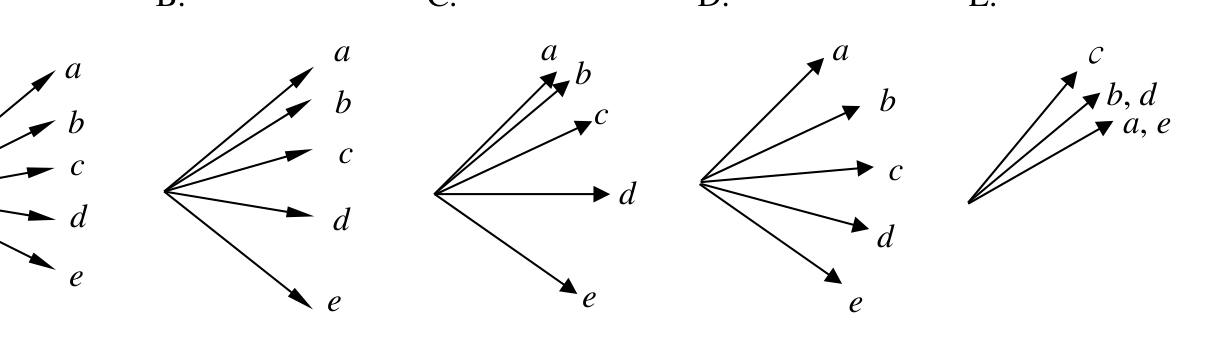
(Options A–E shown in the figure.)
Fonte: Testo (PDF) — p.7 Topic: Newtonian Mechanics Metodi: Kinematic Equations, Vector Decomposition Competenze: Diagrammatic Reasoning Objects: Projectile
I vettori di velocità di un oggetto che esegue un movimento proiettile sono tracciati dagli istanti temporali a a intervalli di tempo fissi. Quale di queste indica un possibile disegno?
(Opzioni AE mostrate nella figura).
Fonte: Testo (PDF) — p.7 Topic: Newtonian Mechanics Metodi: Kinematic Equations, Vector Decomposition Competenze: Diagrammatic Reasoning Objects: Projectile
It is known that the gravitational acceleration is and is directed vertically towards Earth’s centre. Due to Earth’s rotation, the acceleration of a freely falling object in Hong Kong has a magnitude different from , and is no longer pointing vertically downwards. In fact,
- (A) and has a Northward component
- (B) and has a Southward component
- (C) and has a Northward component
- (D) and has a Southward component
- (E) and has an Eastward component
Fonte: Testo (PDF) — p.7 Topic: Newtonian Mechanics Metodi: Physical Modeling, Vector Decomposition Competenze: Physical Reasoning Objects: Planet
Si sa che l’accelerazione gravitazionale è ed è diretta verticalmente verso il centro della Terra. A causa della rotazione terrestre, l’accelerazione di un oggetto che cade liberamente a Hong Kong ha una magnitudine diversa da , e non punta più verticalmente verso il basso. In effetti,
- **(A) ** e hanno una componente verso nord
- **(B) ** e hanno una componente sudorientale
- **(C) ** e hanno una componente verso nord
- **(D) ** e hanno una componente suddetta
- **(E) ** e hanno una componente orientata verso est
Fonte: Testo (PDF) — p.7 Topic: Newtonian Mechanics Metodi: Physical Modeling, Vector Decomposition Competenze: Physical Reasoning Objects: Planet
A uniform rod floats in water. A ball with weight is attached to one end of the rod, and the volume of the ball is negligible. This structure causes the rod to float at an inclined position, with the other end remaining above the water surface, as shown in the figure. If the part of the rod above the water surface is of the total length, calculate the weight of the rod.
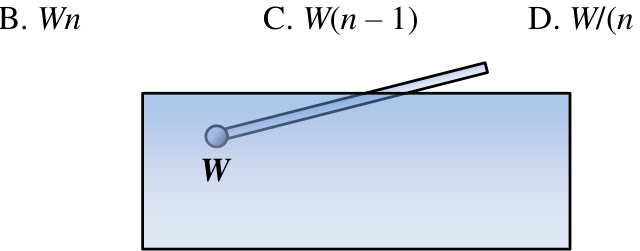
- (A)
- (B)
- (C)
- (D)
- (E)
Fonte: Testo (PDF) — p.7 Topic: Fluid Mechanics Metodi: Hydrostatic Equilibrium, Torque & Angular Momentum Analysis Competenze: Physical Reasoning Objects: Rod, Ball
Una canna uniforme galleggia nell’acqua. Una palla di peso è attaccata ad una estremità della canna e il volume della palla è trascurabile. Questa struttura fa galleggiare la canna in posizione inclinata, con l’altra estremità che rimane sopra la superficie dell’acqua, come mostrato nella figura. Se la parte della canna sopra la superficie dell’acqua è della lunghezza totale, calcolare il peso della canna.
- (A)
- (B)
- (C)
- (D)
- (E)
Fonte: Testo (PDF) — p.7 Topic: Fluid Mechanics Metodi: Hydrostatic Equilibrium, Torque & Angular Momentum Analysis Competenze: Physical Reasoning Objects: Rod, Ball
A block has an initial kinetic energy of . It slides up from point at the bottom of the inclined plane with uniform deceleration. When it passes point , its kinetic energy is reduced by , and its mechanical energy is reduced by . Calculate the work done against friction when the block moves from to the highest point on the inclined plane.
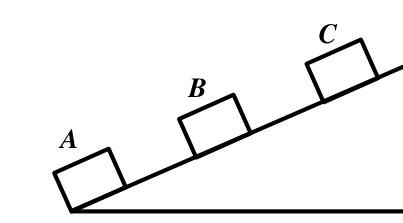
- (A)
- (B)
- (C)
- (D)
- (E)
Fonte: Testo (PDF) — p.8 Topic: Conservation of Energy Metodi: Energy Conservation Method Competenze: Physical Reasoning Objects: Block, Inclined Plane
Un blocco ha un’energia cinetica iniziale di . Scorre verso l’alto dal punto in fondo al piano inclinato con decelerazione uniforme. Quando passa il punto , la sua energia cinetica è ridotta di e la sua energia meccanica di . Calcolare il lavoro effettuato contro l’attrito quando il blocco si sposta da al punto più alto sul piano inclinato.
- (A)
- (B)
- (C)
- (D)
- (E)
Fonte: Testo (PDF) — p.8 Topic: Conservation of Energy Metodi: Energy Conservation Method Competenze: Physical Reasoning Objects: Block, Inclined Plane
A block of mass is placed on a smooth horizontal surface and is attached to a spring of force constant . When the block is pulled sideways and released, it undergoes simple harmonic motion. At the equilibrium position, its velocity is . Calculate its velocity when it moves to the position at two-thirds of the amplitude from the equilibrium position.
- (A)
- (B)
- (C)
- (D)
- (E)
Fonte: Testo (PDF) — p.8 Topic: Oscillations & Waves Metodi: Simple Harmonic Motion Analysis, Energy Conservation Method Competenze: Physical Reasoning Objects: Block, Spring
Un blocco di massa è posizionato su una superficie orizzontale liscia e è attaccato a una resina di forza costante . Quando il blocco viene tirato lateralmente e rilasciato, subisce un semplice movimento armonico. Nella posizione di equilibrio, la sua velocità è . Calcolare la sua velocità quando si muove alla posizione a due terzi dell’ampiezza dalla posizione di equilibrio.
- (A)
- (B)
- (C)
- (D)
- (E)
Fonte: Testo (PDF) — p.8 Topic: Oscillations & Waves Metodi: Simple Harmonic Motion Analysis, Energy Conservation Method Competenze: Physical Reasoning Objects: Block, Spring
As shown in the figure, a block of mass is hung from the ceiling by the system of springs consisting of two layers. The upper layer consists of 3 springs in parallel, and the lower layer consists of 2 springs in parallel. The force constants of all springs are . Calculate the frequency of the vertical oscillations of the block.
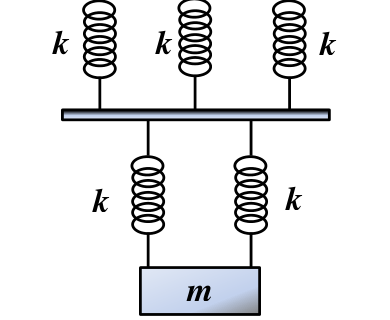
- (A)
- (B)
- (C)
- (D)
- (E)
Fonte: Testo (PDF) — p.8 Topic: Oscillations & Waves Metodi: Simple Harmonic Motion Analysis, Hooke’s Law Competenze: Physical Reasoning Objects: Block, Spring
Come illustrato nella figura, un blocco di massa è appeso al soffitto con il sistema di molla costituito da due strati. Lo strato superiore è composto da 3 sorgenti in parallelo e lo strato inferiore è composto da 2 sorgenti in parallelo. Le costanti di forza di tutte le sorgenti sono . Calcolare la frequenza delle oscillazioni verticali del blocco.
- (A)
- (B)
- (C)
- (D)
- (E)
Fonte: Testo (PDF) — p.8 Topic: Oscillations & Waves Metodi: Simple Harmonic Motion Analysis, Hooke’s Law Competenze: Physical Reasoning Objects: Block, Spring
James Bond Ski Chased by a Killer (10 marks)
In the James Bond movie “The Spy Who Loved Me”, James skied down a snowy slope in an attempt to escape from the killer. Unfortunately, the killer had a higher skiing speed than James’s; they are and respectively. Now consider an alternative version of the movie. James noted that he and the killer carried the same kind of rifle and estimated that their masses (including body mass, skis, weapon, backpack, etc.) were about the same. Recalling high school physics knowledge, James realised that each time he fired his weapon back at the killer, his momentum would change; whereas when the killer fired, the killer’s momentum would also change. Every time James fired a bullet, the killer would fire back accordingly.
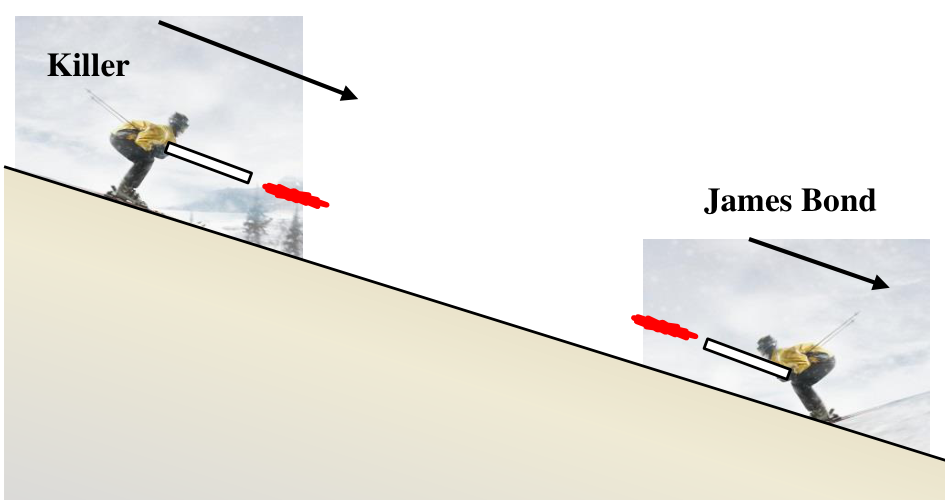
(a) How many bullets did James have to fire in order to assure that the killer couldn’t catch up with him? Assume that all bullets missed their targets (otherwise this exercise would terminate). Given , the mass and the muzzle velocity of a bullet are and respectively.
(b) Travelling with the final velocity obtained in part (a), James Bond escaped by sliding down a cliff at an inclination of . After seconds, he opened his parachute and landed safely. The average air drag during his fall is in both the vertical and horizontal directions, as long as the velocity components are nonzero. Calculate the landing position of James Bond and the height of the cliff. (Neglect the distance he travelled with a parachute.)
Fonte: Testo (PDF) — p.9 Topic: Conservation of Momentum Metodi: Conservation of Momentum, Kinematic Equations Competenze: Physical Reasoning Objects: Projectile
James Bond Ski Perseguiato da un assassino
Nel film di James Bond “The Spy Who Loved Me”, James sciò su una pendicia nevicata nel tentativo di sfuggire all’assassino. Purtroppo, l’assassino aveva una velocità di sci più alta di quella di James; sono rispettivamente e . Ora consideriamo una versione alternativa del film. James ha notato che lui e l’assassino portavano lo stesso tipo di fucile e ha stimato che le loro masse (compresi massa corporea, sci, arma, zaino, ecc.) erano circa le stesse. Ricordando le sue conoscenze di fisica al liceo, James si rese conto che ogni volta che risparmiava l’arma contro l’assassino, il suo impulso cambiava; mentre quando l’assassino sparava, il suo impulso cambiava anche. Ogni volta che James tirava un proiettile, l’assassino rispondeva di conseguenza.
Quante pallottole James ha dovuto sparare per assicurarsi che l’assassino non potesse raggiungerlo? Supponiamo che tutti i proiettili abbiano perso il bersaglio (in caso contrario questo esercizio sarebbe terminato). Se si dà , la massa e la velocità di muffa di un proiettile sono rispettivamente e .
**(b) ** Viaggiando con la velocità finale ottenuta nella parte (a), James Bond è riuscito a sfuggire scivolando giù da una scogliera ad una penetrazione di . Dopo secondi, aprì il paracadute e atterrò in sicurezza. La resistenza media dell’aria durante la caduta è sia nelle direzioni verticale che orizzontale, purché le componenti della velocità non siano zero. Calcola la posizione di atterraggio di James Bond e l’altezza della scogliera. (Non si deve considerare la distanza che ha percorso con un paracadute.)
Fonte: Testo (PDF) — p.9 Topic: Conservation of Momentum Metodi: Conservation of Momentum, Kinematic Equations Competenze: Physical Reasoning Objects: Projectile
The Bicycle (10 marks)
A student rides a bicycle on a slope of inclination . Due to air drag, he found that the bicycle can barely move down the slope without his pedaling. He would like to estimate the power he needs to drive the bicycle up the same slope at a uniform velocity.
To achieve this, he measured that during the up-slope drive, one of his feet pedaled cycles in a time interval (assuming that the pedaling is continuous and at a uniform rate). He also obtained the following data: the total mass of the bicycle and the rider , length of pedal crank , radius of gear 1 , radius of gear 2 , radius of rear wheel , as shown in the figure.
It is given that the air drags during the up-slope and down-slope drives have the same magnitude, and there are no slippings between the wheels and the slope during both the up-slope and down-slope drives. The energy loss due to the relative motion of the bicycle components is negligible.
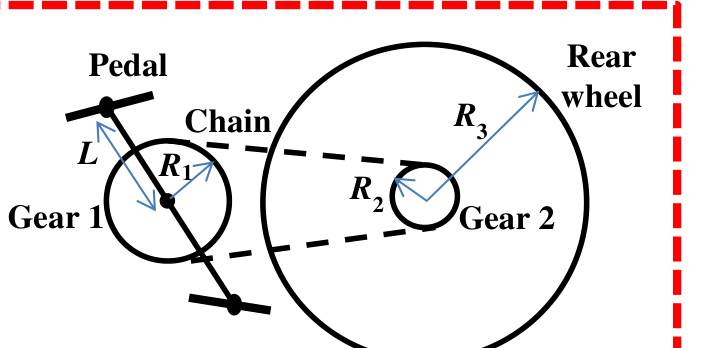
(a) Derive an expression for the force needed to drive the bicycle up-slope at uniform velocity.
(b) Derive an expression for the power needed to drive the bicycle up-slope at uniform velocity.
Fonte: Testo (PDF) — p.10 Topic: Conservation of Energy, Newtonian Mechanics Metodi: Energy Conservation Method, Torque & Angular Momentum Analysis Competenze: Mathematical Modeling Objects: Gear, Wheel
La bicicletta (10 marks)
Uno studente guida una bicicletta su una pendice di inclinazione . A causa della resistenza dell’aria, ha scoperto che la bicicletta può a malapena scendere la pendice senza pedalizzare. Vorrebbe stimare la potenza di cui ha bisogno per guidare la bicicletta verso lo stesso inclinamento a velocità uniforme.
Per raggiungere questo obiettivo, ha misurato che durante la guida verso l’alto, uno dei suoi piedi ha pedalata cicli in un intervallo di tempo (assumendo che il pedalata è continuo e a un ritmo uniforme). Ha inoltre ottenuto i seguenti dati: la massa totale della bicicletta e del pilota , la lunghezza della manopola della pedala , il raggio di ingranaggio 1 , il raggio di ingranaggio 2 , il raggio della ruota posteriore , come mostrato nella figura.
Si ritiene che le tracce d’aria durante le tracce di pendenza in su e in giù abbiano la stessa magnitudine e che non ci siano scorci tra le ruote e la pendenza sia durante le tracce di pendenza in su e in giù. La perdita di energia dovuta al movimento relativo dei componenti della bicicletta è trascurabile.
**(a) ** Derivare un’espressione per la forza necessaria per guidare la bicicletta verso l’alto a velocità uniforme.
**(b) ** Derivare un’espressione della potenza necessaria per guidare la bicicletta verso l’alto per inclinarsi a velocità uniforme.
Fonte: Testo (PDF) — p.10 Topic: Conservation of Energy, Newtonian Mechanics Metodi: Energy Conservation Method, Torque & Angular Momentum Analysis Competenze: Mathematical Modeling Objects: Gear, Wheel
The Ships (10 marks)
Consider two ships on the sea as shown in the figure. Ship A moves with velocity directed to East. Ship B moves with velocity directed to North. At time , ship B crosses the path of ship A at a distance in front of ship A.
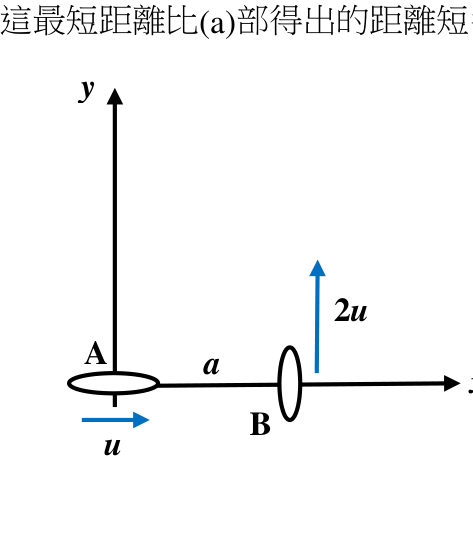
(a) Find the shortest distance between the ships, and the time they reach this position.
(b) Suppose at , the speed of ship A remains at , but its direction can be adjusted. What should be the direction of ship A such that the shortest distance between the two ships is minimum, and how much is this minimum shorter than the result obtained in part (a)?
Fonte: Testo (PDF) — p.10 Topic: Newtonian Mechanics Metodi: Kinematic Equations, Vector Decomposition Competenze: Mathematical Modeling Objects: —
Le navi (10 marks)
Considerate due navi sul mare come mostrato nella figura. La nave A si muove con velocità diretto verso est. La nave B si muove con velocità diretta verso nord. Al momento , la nave B attraversa il percorso della nave A a una distanza davanti alla nave A.
**(a) ** Trova la distanza più breve tra le navi e il tempo in cui raggiungono questa posizione.
**(b) ** Supponiamo che a la velocità della nave A rimanga a , ma la sua direzione può essere regolata. Qual è la direzione della nave A tale che la distanza più breve tra le due navi sia minima e quanto è tale distanza minima inferiore al risultato ottenuto dalla parte a)?
Fonte: Testo (PDF) — p.10 Topic: Newtonian Mechanics Metodi: Kinematic Equations, Vector Decomposition Competenze: Mathematical Modeling Objects: —
STEP (15 marks)
According to Newton’s second law of motion, , where is the inertial mass. According to Newton’s law of universal gravitation, the gravitational force between Earth and an object is , where is the gravitational mass of the object (here is the distance between Earth’s centre and the object). Presently, it is widely accepted that , but some physicists would like to test the validity of this assumption. If there is a difference between and , even as small as one part in , our present understanding about gravity has to be revised. Hence they proposed a satellite experiment called STEP to measure the mass ratio . (STEP represents Satellite Test of the Equivalence Principle.)
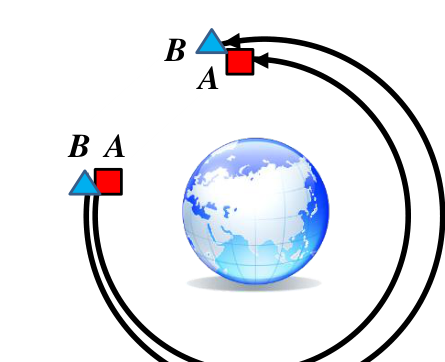
In the proposed experiment, several test bodies are enclosed in a vacuum box in a satellite that orbits around the Earth. The box protects the test bodies from outside disturbances and all forces from the satellite acting on the test bodies have been carefully eliminated, so that each test body can be considered as a mini-satellite orbiting around the Earth.
(a) The proposed satellite has a circular orbit with a period of hours. Calculate its orbital radius . Express your answer in multiples of , the radius of Earth.
(b) Consider test bodies A and B with mass ratios and respectively, as shown in the figure. Suppose the two bodies have the same position at a point on the orbit. When body A completes one orbit, what is the displacement of body B relative to body A?
(c) Simplify your result in part (b) using the approximation when . Suppose the position sensors in the satellite can detect position changes as little as . What is the duration of the satellite flight before differences in the mass ratio of the order can be detected? Express your answer in hours.
Fonte: Testo (PDF) — p.11 Topic: Gravitation Metodi: Newton’s Law of Gravitation, Kepler’s Laws, Approximation & Series Expansion Competenze: Physical Reasoning Objects: Satellite, Planet
**STEP ** (15 punti)
Secondo la seconda legge di Newton, , dove è la massa inerziale. Secondo la legge di Newton della gravitazione universale, la forza gravitazionale tra la Terra e un oggetto è , dove è la massa gravitazionale dell’oggetto (qui è la distanza tra il centro della Terra e l’oggetto). Attualmente è ampiamente accettato che , ma alcuni fisici vorrebbero testare la validità di questa ipotesi. Se c’è una differenza tra e , anche piccola come una parte di , la nostra attuale comprensione della gravità deve essere rivista. Proposero quindi un esperimento satellitare chiamato STEP per misurare il rapporto di massa . (STEP rappresenta il test satellitare del principio di equivalenza.)
Nell’esperimento proposto, diversi corpi di prova sono chiusi in una scatola a vuoto in un satellite che orbita intorno alla Terra. La scatola protegge i corpi di prova da disturbi esterni e tutte le forze del satellite che agiscono sui corpi di prova sono state accuratamente eliminate, in modo che ogni corpo di prova possa essere considerato un mini-satellite in orbita attorno alla Terra.
Il satellite proposto ha un’orbita circolare con un periodo di ore. Calcolare il suo raggio orbitale . Esprimete la vostra risposta in moltiplicati di , il raggio della Terra.
**(b) ** Considerare i corpi di prova A e B con i rapporti di massa e rispettivamente, come mostrato nella figura. Supponiamo che i due corpi abbiano la stessa posizione in un punto dell’orbita. Quando il corpo A completa un’orbita, qual è il spostamento del corpo B rispetto al corpo A?
**(c) ** Semplifica il risultato nella parte (b) usando l’approssimazione quando . Supponiamo che i sensori di posizione del satellite possano rilevare cambiamenti di posizione di . Qual è la durata del volo satellitare prima che si possano rilevare differenze nel rapporto di massa dell’ordine ? Esprimi la tua risposta in ore.
Fonte: Testo (PDF) — p.11 Topic: Gravitation Metodi: Newton’s Law of Gravitation, Kepler’s Laws, Approximation & Series Expansion Competenze: Physical Reasoning Objects: Satellite, Planet
The Floating Ice (15 marks)
As shown in the left figure, a cylindrical piece of ice floats in water. Its cross-sectional area is and its height is . The densities of ice and water are and respectively.
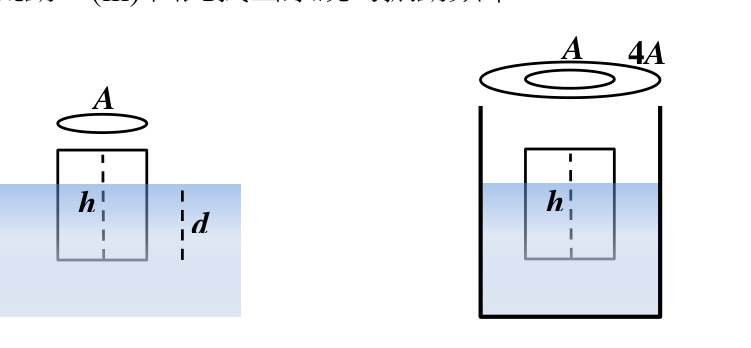
(a) Find , the depth of ice immersed in water.
(b) Suppose the ice is pushed slightly in the vertical direction. Find the frequency of oscillations. You may assume that the motion of water is negligible.
(c) Suppose the ice floats in water in a container of cross-sectional area , as shown in the right figure. The ice is displaced from equilibrium by in the vertical direction. (i) Calculate the change in the total potential energy of the system, up to order . (ii) Calculate the kinetic energy of the system during the push when the ice moves at velocity . You may assume that the water below the bottom level of the ice does not move, and the water above the bottom level of the ice moves with the same velocity. (iii) Hence find the frequency of oscillations.
Fonte: Testo (PDF) — p.12 Topic: Fluid Mechanics Metodi: Hydrostatic Equilibrium, Simple Harmonic Motion Analysis, Energy Conservation Method Competenze: Physical Reasoning Objects: Cylinder, Container
**Il ghiaccio galleggiante ** (15 punti)
Come mostra la figura a sinistra, un pezzo di ghiaccio cilindrico galleggia nell’acqua. La sua superficie trasversale è e la sua altezza è . Le densità di ghiaccio e acqua sono rispettivamente e .
**(a) ** Trova , la profondità del ghiaccio immerso nell’acqua.
**(b) ** Supponiamo che il ghiaccio sia spinto leggermente in direzione verticale. Trova la frequenza delle oscillazioni. Potreste pensare che il movimento dell’acqua sia insignificante.
**(c) ** Supponiamo che il ghiaccio galleggi in acqua in un contenitore di superficie trasversale , come mostrato nella figura destra. Il ghiaccio è spostato dall’equilibrio da nella direzione verticale. (i) Calcolare la variazione dell’energia potenziale totale del sistema, fino all’ordine . (ii) Calcolare l’energia cinetica del sistema durante la spinta quando il ghiaccio si muove a velocità . Si può supporre che l’acqua sotto il livello inferiore del ghiaccio non si muova, e l’acqua sopra il livello inferiore del ghiaccio si muove con la stessa velocità. (iii) Trova quindi la frequenza delle oscillazioni.
Fonte: Testo (PDF) — p.12 Topic: Fluid Mechanics Metodi: Hydrostatic Equilibrium, Simple Harmonic Motion Analysis, Energy Conservation Method Competenze: Physical Reasoning Objects: Cylinder, Container