An accelerometer is a device to measure acceleration. At the earth sea level, the acceleration due to gravity is . Most of the smartphones such as Android and Apple iPhone consist of a built-in accelerometer. If a smartphone is moving vertically upward at sea level with constant velocity , the instantaneous scalar readings of the , , and components from the accelerometer are:
- (A) .
- (B) .
- (C) .
- (D) .
- (E) .
Fonte: Testo (PDF) — p.4
Topic: Newtonian Mechanics Metodi: Free-Body Diagram, Physical Modeling Competenze: Physical Reasoning Objects: —
Un accelerometro è un dispositivo per misurare l’accelerazione. Al livello del mare terrestre, l’accelerazione dovuta alla gravità è . La maggior parte degli smartphone come Android e Apple iPhone sono costituiti da un accelerometro integrato. Se uno smartphone si muove verticalmente verso l’alto al livello del mare con velocità costante , le letture scalari istantanee dei componenti , e dell’acceleratore sono:
- (A) .
- (B) .
- (C) .
- (D) .
- (E) .
Fonte: Testo (PDF) — p.4
Topic: Newtonian Mechanics Metodi: Free-Body Diagram, Physical Modeling Competenze: Physical Reasoning Objects: —
A toy rocket is launched upward from rest with a net acceleration of , where is the acceleration due to gravity. The engine is turned off after 5 seconds while the rocket continues to move upward with negligible air resistance. Assume that the mass of the rocket is kept constant, what maximum elevation does the rocket reach in terms of ?
- (A)
- (B)
- (C)
- (D)
- (E)
Fonte: Testo (PDF) — p.4
Topic: Newtonian Mechanics Metodi: Kinematic Equations Competenze: Physical Reasoning Objects: Projectile
Un razzo giocattolo viene lanciato verso l’alto dal riposo con un’accelerazione netta di , dove è l’accelerazione dovuta alla gravità. Il motore si spegne dopo 5 secondi mentre il razzo continua a muoversi verso l’alto con una resistenza all’aria trascurabile. Se la massa del razzo è mantenuta costante, quale altezza massima raggiunge il razzo in termini di ?
- (A)
- (B)
- (C)
- (D)
- (E)
Fonte: Testo (PDF) — p.4
Topic: Newtonian Mechanics Metodi: Kinematic Equations Competenze: Physical Reasoning Objects: Projectile
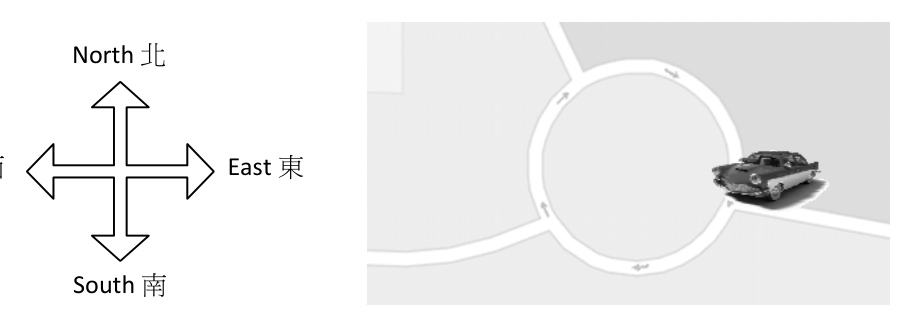
A car (mass ) is travelling clockwisely around a flat roundabout (diameter ) at a constant speed , as shown in the figure. What is the acceleration of the car?
- (A) Zero
- (B) East
- (C) West
- (D) East
- (E) West
Fonte: Testo (PDF) — p.4
Topic: Newtonian Mechanics Metodi: Vector Decomposition, Physical Modeling Competenze: Physical Reasoning Objects: —
Un’auto (massa ) si sposta con saggezza intorno a un rotonde piatto (diametro ) a velocità costante , come mostrato nella figura. Qual è l’accelerazione dell’auto?
- **(A) ** Zero
- **(B) ** Est
- **(C) ** Occidente
- **(D) ** Est
- **(E) ** Occidente
Fonte: Testo (PDF) — p.4
Topic: Newtonian Mechanics Metodi: Vector Decomposition, Physical Modeling Competenze: Physical Reasoning Objects: —
A machine gun fires bullets ( each) at a rate of 200 bullets per minute to hit a target. The speed just before hitting the target is , and the bullets are stopped in the target. The cross sectional area of the target is . Find the average force exerted on the target.
- (A) .
- (B) .
- (C) .
- (D) .
- (E) .
Fonte: Testo (PDF) — p.5
Topic: Conservation of Momentum Metodi: Impulse-Momentum Theorem Competenze: Physical Reasoning Objects: Projectile
Una mitragliatrice dispera di proiettili ( ciascuno) a una velocità di 200 proiettili al minuto per colpire un bersaglio. La velocità appena prima di colpire l’obiettivo è , e i proiettili vengono fermati nell’obiettivo. L’area trasversale dell’obiettivo è . Trova la forza media esercitata sul bersaglio.
- (A) .
- (B) .
- (C) .
- (D) .
- (E) .
Fonte: Testo (PDF) — p.5
Topic: Conservation of Momentum Metodi: Impulse-Momentum Theorem Competenze: Physical Reasoning Objects: Projectile
Tides are mainly resulted from the difference in the Moon’s gravitational field between the Earth’s near side and its far side. What is the percentage gravitational force difference?
- (A) .
- (B) .
- (C) .
- (D) .
- (E) .
Fonte: Testo (PDF) — p.5
Topic: Gravitation Metodi: Newton’s Law of Gravitation, Approximation & Series Expansion Competenze: Estimation & Approximation Objects: Planet
Le maree sono principalmente il risultato della differenza nel campo gravitazionale della Luna tra la parte vicina della Terra e la parte lontana. Qual è la differenza percentuale della forza gravitazionale?
- (A) .
- (B) .
- (C) .
- (D) .
- (E) .
Fonte: Testo (PDF) — p.5
Topic: Gravitation Metodi: Newton’s Law of Gravitation, Approximation & Series Expansion Competenze: Estimation & Approximation Objects: Planet
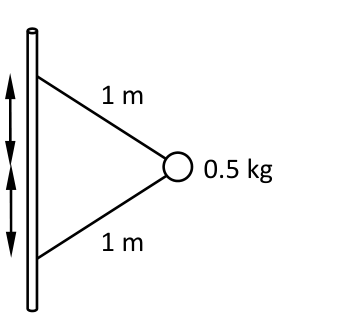
As shown in the following figure, a mass () is tied to two wires () and revolves in a horizontal circle at a constant speed of . Calculate the tension of the upper wire.
- (A)
- (B)
- (C)
- (D)
- (E)
Fonte: Testo (PDF) — p.5
Topic: Newtonian Mechanics Metodi: Free-Body Diagram, Vector Decomposition Competenze: Diagrammatic Reasoning Objects: String, Ball
Come mostrato nella figura seguente, una massa () è legata a due fili () e ruota in un cerchio orizzontale a una velocità costante di . Calcolare la tensione del filo superiore.
- (A)
- (B)
- (C)
- (D)
- (E)
Fonte: Testo (PDF) — p.5
Topic: Newtonian Mechanics Metodi: Free-Body Diagram, Vector Decomposition Competenze: Diagrammatic Reasoning Objects: String, Ball
A person is pulling a heavy box with a force on a horizontal floor at constant velocity for . He then feels exhausted and the force exerted by him decreases linearly from to near for the next . What is the total work done by the person on the box?
- (A) .
- (B) .
- (C) .
- (D) .
- (E) .
Fonte: Testo (PDF) — p.6
Topic: Newtonian Mechanics Metodi: Calculus-Integration Competenze: Physical Reasoning Objects: Block
Una persona sta tirando una scatola pesante con una forza su un pavimento orizzontale a velocità costante per . Si sente quindi esausto e la forza esercitata da lui diminuisce linearmente da a per il prossimo . Qual è il lavoro complessivo svolto dalla persona sulla scatola?
- (A) .
- (B) .
- (C) .
- (D) .
- (E) .
Fonte: Testo (PDF) — p.6
Topic: Newtonian Mechanics Metodi: Calculus-Integration Competenze: Physical Reasoning Objects: Block
A mass at one end of a spring establishes simple harmonic motion with a period . If the mass is replaced with a different mass , what is the period of this oscillation?
- (A)
- (B)
- (C)
- (D)
- (E)
Fonte: Testo (PDF) — p.6
Topic: Oscillations & Waves Metodi: Simple Harmonic Motion Analysis Competenze: Physical Reasoning Objects: Spring, Block
Una massa ad una estremità di una molla stabilisce un semplice movimento armonico con un periodo . Se la massa viene sostituita da una massa diversa , quale è il periodo di questa oscillazione?
- (A)
- (B)
- (C)
- (D)
- (E)
Fonte: Testo (PDF) — p.6
Topic: Oscillations & Waves Metodi: Simple Harmonic Motion Analysis Competenze: Physical Reasoning Objects: Spring, Block
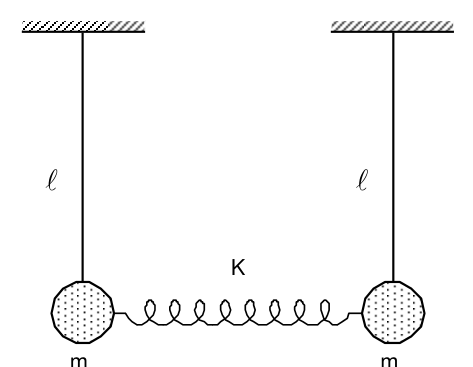
As shown in the following figure, two pendulums are constructed with identical massless springs and mass objects (mass ). The initial distance between the masses is the equilibrium length of the spring (spring constant ). What is the frequency of the system if the two balls are oscillating out of phase?
- (A)
- (B)
- (C)
- (D)
- (E)
Fonte: Testo (PDF) — p.6
Topic: Oscillations & Waves Metodi: Simple Harmonic Motion Analysis, Hooke’s Law Competenze: Physical Reasoning Objects: Pendulum, Spring, Ball
Come mostrato nella figura seguente, due penduli sono costruiti con sorgenti senza massa identiche e oggetti di massa (massa ). La distanza iniziale tra le masse è la lunghezza di equilibrio della molla (constante della molla ). Qual è la frequenza del sistema se le due palle oscilano fuori fase?
- (A)
- (B)
- (C)
- (D)
- (E)
Fonte: Testo (PDF) — p.6
Topic: Oscillations & Waves Metodi: Simple Harmonic Motion Analysis, Hooke’s Law Competenze: Physical Reasoning Objects: Pendulum, Spring, Ball
What is the minimum rotation period of a spherical neutron star with uniform mass density such that material will not fly off from the equator? ( = Universal gravitational constant)
- (A)
- (B)
- (C)
- (D)
- (E)
Fonte: Testo (PDF) — p.7
Topic: Gravitation Metodi: Newton’s Law of Gravitation, Physical Modeling Competenze: Mathematical Modeling Objects: Star
Qual è il periodo di rotazione minimo di una stella di neutroni sferica con una densità di massa uniforme tale che il materiale non possa volare dall’equatore? ( = costante gravitazionale universale)
- (A)
- (B)
- (C)
- (D)
- (E)
Fonte: Testo (PDF) — p.7
Topic: Gravitation Metodi: Newton’s Law of Gravitation, Physical Modeling Competenze: Mathematical Modeling Objects: Star
A solid ball weighs in air, but when it is submerged in water. If the ball weighs when it is submerged in an unknown liquid, find the specific gravity of the unknown liquid.
- (A) .
- (B) .
- (C) .
- (D) .
- (E) .
Fonte: Testo (PDF) — p.7
Topic: Fluid Mechanics Metodi: Hydrostatic Equilibrium Competenze: Physical Reasoning Objects: Ball
Una palla solida pesa nell’aria, ma quando è immersa in acqua. Se la palla pesa quando è immersa in un liquido sconosciuto, trova la gravità specifica del liquido sconosciuto.
- (A) .
- (B) .
- (C) .
- (D) .
- (E) .
Fonte: Testo (PDF) — p.7
Topic: Fluid Mechanics Metodi: Hydrostatic Equilibrium Competenze: Physical Reasoning Objects: Ball
A bullet (mass ) is shot vertically and upward into a brick (). The bullet is embedded in the brick, and the brick is lifted upward in a time interval of . Assume that the force on the bullet is constant during penetration and air resistance is negligible. Find the initial kinetic energy of the bullet.
- (A) .
- (B) .
- (C) .
- (D) .
- (E) .
Fonte: Testo (PDF) — p.7
Topic: Conservation of Momentum Metodi: Conservation of Momentum, Kinematic Equations Competenze: Physical Reasoning Objects: Projectile, Block
Un proiettile (massa ) viene sparato verticalmente e verso l’alto in un mattone (). Il proiettile è inserito nel mattone e il mattone viene sollevato verso l’alto in un intervallo di tempo di . Supponiamo che la forza sul proiettile sia costante durante la penetrazione e la resistenza dell’aria sia trascurabile. Trova l’energia cinetica iniziale del proiettile.
- (A) .
- (B) .
- (C) .
- (D) .
- (E) .
Fonte: Testo (PDF) — p.7
Topic: Conservation of Momentum Metodi: Conservation of Momentum, Kinematic Equations Competenze: Physical Reasoning Objects: Projectile, Block
A ball is hit from an inclined plane making an angle with the horizontal direction towards the downward direction. The ball has an initial velocity and flies at an initial angle above the horizontal direction. Assume that the air resistance is negligible, at what horizontal distance from the initial point of hitting does the ball touch the inclined plane again?
- (A)
- (B)
- (C)
- (D)
- (E)
Fonte: Testo (PDF) — p.8
Topic: Newtonian Mechanics Metodi: Kinematic Equations, Vector Decomposition Competenze: Physical Reasoning Objects: Ball, Inclined Plane, Projectile
Una palla viene colpita da un piano inclinato, facendo un angolo con la direzione orizzontale verso il basso. La palla ha una velocità iniziale e vola ad un angolo iniziale sopra la direzione orizzontale. Supponendo che la resistenza dell’aria sia trascurabile, a quale distanza orizzontale dal punto iniziale di colpimento la palla tocca di nuovo il piano inclinato?
- (A)
- (B)
- (C)
- (D)
- (E)
Fonte: Testo (PDF) — p.8
Topic: Newtonian Mechanics Metodi: Kinematic Equations, Vector Decomposition Competenze: Physical Reasoning Objects: Ball, Inclined Plane, Projectile
Three identical blocks of mass are stacked vertically. Block 1 is on top and rests on Block 2, which rests on Block 3, which rests on a table. What is the net force acting on Block 1? The weight of the 3 Blocks is measured to be .
- (A) Zero.
- (B) .
- (C) .
- (D) .
- (E) .
Fonte: Testo (PDF) — p.8
Topic: Newtonian Mechanics Metodi: Free-Body Diagram Competenze: Physical Reasoning Objects: Block
Tre blocchi identici di massa sono impilati verticalmente. Il blocco 1 è in cima e si riposa sul blocco 2, che si riposa sul blocco 3, che si riposa su un tavolo. Qual è la forza di rete che agisce sul blocco 1? Il peso dei 3 blocchi è misurato a .
- **(A) ** Zero.
- (B) .
- (C) .
- (D) .
- (E) .
Fonte: Testo (PDF) — p.8
Topic: Newtonian Mechanics Metodi: Free-Body Diagram Competenze: Physical Reasoning Objects: Block
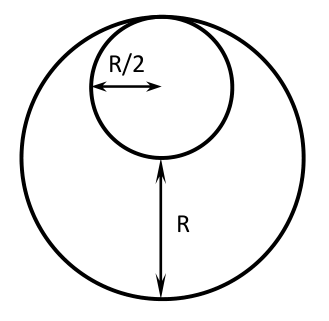
The following figure is a spherical styrofoam of radius . A cavity of radius is made in the sphere. If the cavity is filled with a solid material of density 5 times of styrofoam and with the same thickness, where is the new center of mass?
- (A) upward from the center of the styrofoam sphere.
- (B) upward from the center of the styrofoam sphere.
- (C) upward from the center of the styrofoam sphere.
- (D) upward from the center of the styrofoam sphere.
- (E) upward from the center of the styrofoam sphere.
Fonte: Testo (PDF) — p.8
Topic: Newtonian Mechanics Metodi: Superposition Principle, Physical Modeling Competenze: Physical Reasoning Objects: Sphere
La figura seguente è una schiuma di stiro sferica di raggio . Nella sfera viene realizzata una cavità di raggio . Se la cavità è riempita di un materiale solido di 5 volte la densità dello stirofoam e dello stesso spessore, dove si trova il nuovo centro di massa?
- **(A) ** verso l’alto dal centro della sfera di scopa di stiro.
- **(B) ** verso l’alto dal centro della sfera di stifola.
- **(C) ** verso l’alto dal centro della sfera di scopa di stiro.
- **(D) ** verso l’alto dal centro della sfera di stifola.
- **(E) ** verso l’alto dal centro della sfera di stifola.
Fonte: Testo (PDF) — p.8
Topic: Newtonian Mechanics Metodi: Superposition Principle, Physical Modeling Competenze: Physical Reasoning Objects: Sphere
What is the potential energy for a tide cycle per square meter of ocean surface, if the sea water level difference between a high tide and a low tide is (in meter)?
- (A) Watt-hour.
- (B) Watt-hour.
- (C) Watt-hour.
- (D) Watt-hour.
- (E) Watt-hour.
Fonte: Testo (PDF) — p.9
Topic: Gravitation Metodi: Energy Conservation Method, Physical Modeling Competenze: Unit Conversion Objects: —
Qual è l’energia potenziale per un ciclo di marea per metro quadrato di superficie oceanica, se la differenza di livello dell’acqua di marea tra una marea alta e una bassa è (in metro)?
- **(A) ** Watt-ora.
- **(B) ** Watt-ora.
- **(C) ** Watt-ora.
- **(D) ** Watt-ora.
- **(E) ** Watt-ora.
Fonte: Testo (PDF) — p.9
Topic: Gravitation Metodi: Energy Conservation Method, Physical Modeling Competenze: Unit Conversion Objects: —
The weight of an object on the Moon surface is of that on the Earth surface. A pendulum clock on the Earth environment ticks once per second. On the Moon environment, the clock would tick once every
- (A) .
- (B) .
- (C) .
- (D) .
- (E) .
Fonte: Testo (PDF) — p.9
Topic: Oscillations & Waves Metodi: Simple Harmonic Motion Analysis Competenze: Physical Reasoning Objects: Pendulum, Planet
Il peso di un oggetto sulla superficie lunare è di quello della superficie terrestre. Un pendolo in un’atmosfera terrestre ticca una volta al secondo. Sul pianeta lunare, l’orologio ticava una volta ogni volta.
- (A) .
- (B) .
- (C) .
- (D) .
- (E) .
Fonte: Testo (PDF) — p.9
Topic: Oscillations & Waves Metodi: Simple Harmonic Motion Analysis Competenze: Physical Reasoning Objects: Pendulum, Planet
Geostationary satellite is its orbital period the same as the Earth’s rotation period. Calculate the height of a geostationary satellite above the Earth’s surface in terms of (Gravitational constant), (mass of the Earth), and (radius of the Earth), where , and are in SI units.
- (A)
- (B)
- (C)
- (D)
- (E)
Fonte: Testo (PDF) — p.9
Topic: Gravitation Metodi: Newton’s Law of Gravitation, Kepler’s Laws Competenze: Mathematical Modeling Objects: Satellite, Planet
Il satellite geostazionario ha il suo periodo orbitale uguale al periodo di rotazione della Terra. Calcolare l’altezza di un satellite geostazionario sopra la superficie terrestre in termini di (constante gravitazionale), (massa della Terra) e (radio della Terra), dove , e sono in unità SI.
- (A)
- (B)
- (C)
- (D)
- (E)
Fonte: Testo (PDF) — p.9
Topic: Gravitation Metodi: Newton’s Law of Gravitation, Kepler’s Laws Competenze: Mathematical Modeling Objects: Satellite, Planet
In comparison of a pendulum with large-angle oscillations (period and magnitude , maximum tension in the string ) to a pendulum with small-angle oscillations (period and amplitude , maximum tension in the string ), which of the following is true?
- (A) and .
- (B) and .
- (C) and .
- (D) and .
- (E) and .
Fonte: Testo (PDF) — p.10
Topic: Oscillations & Waves Metodi: Simple Harmonic Motion Analysis, Energy Conservation Method Competenze: Physical Reasoning Objects: Pendulum
Nel confronto di un pendolo con oscillazioni ad angolo ampio (periodo e magnitudo , tensione massima nella corda ) con un pendolo con oscillazioni ad angolo piccolo (periodo e amplitudine , tensione massima nella corda ), quale delle seguenti è vero?
- **(A) ** e .
- **(B) ** e .
- **(C) ** e .
- **(D) ** e .
- **(E) ** e .
Fonte: Testo (PDF) — p.10
Topic: Oscillations & Waves Metodi: Simple Harmonic Motion Analysis, Energy Conservation Method Competenze: Physical Reasoning Objects: Pendulum
The following figure is most probably a plot of
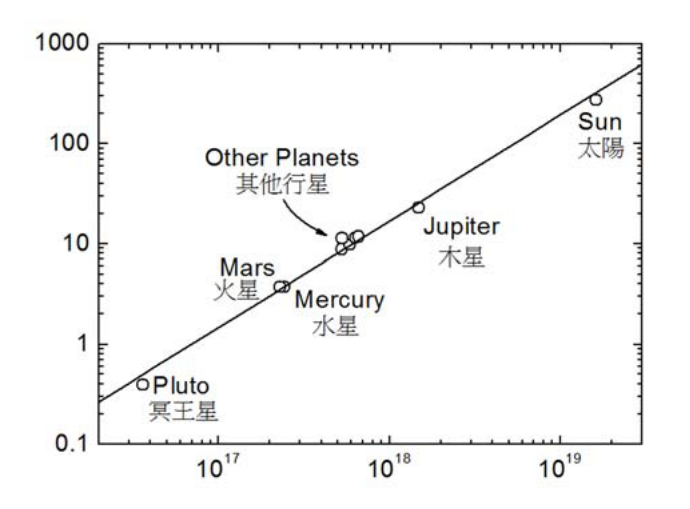
- (A) square of the orbital period of a planet against the cube of the semi-major axis of its orbit.
- (B) cube of the orbital period of a planet against the square of the semi-major axis of its orbit.
- (C) surface gravity of a planet against , where is the mass and is the equatorial radius of a planet.
- (D) surface gravity of a planet against , where is the mass and is the equatorial radius of a planet.
- (E) distance of a planet from the Galactic Center in Astronomical Unit against the mass of a planet.
Fonte: Testo (PDF) — p.10
Topic: Gravitation Metodi: Kepler’s Laws, Graph Linearization Competenze: Graph Linearization Objects: Planet
Open Problems. Total 5 Problems.
La figura seguente è probabilmente un’intesa di
- **(A) ** quadrato del periodo orbitale di un pianeta contro il cubo dell’asse semimejor della sua orbita.
- **(B) ** cubo del periodo orbitale di un pianeta contro il quadrato dell’asse semimejor della sua orbita.
- **(C) ** gravità superficiale di un pianeta contro , dove è la massa e è il raggio equatoriale di un pianeta.
- **(D) ** gravità superficiale di un pianeta contro , dove è la massa e è il raggio equatoriale di un pianeta.
- **(E) ** distanza di un pianeta dal Centro Galattico nell’Unità Astronomica rispetto alla massa di un pianeta.
Fonte: Testo (PDF) — p.10
Topic: Gravitation Metodi: Kepler’s Laws, Graph Linearization Competenze: Graph Linearization Objects: Planet
Problemi aperti. 5 problemi complessivi.
Venus Transit (15 Marks)
Venus transit is an astronomical phenomenon when the planet Venus passes directly between the Sun and Earth. As illustrated in Fig. 1, for two different observation points and on the Earth, Venus appears as two separate black dots ( and ) on the Sun surface.
(a) Suppose Venus takes 225 days to orbit the sun, calculate the ratio of , where and are the mean distances of the planets from the Sun, respectively.
(b) On a Venus transit day, two observations were made in Hong Kong and Bangkok. They are geographically separated by . Bangkok is South of West of Hong Kong. Calculate the distance .
(c) Another observation finds that the Sun diameter is 290 times the distance of the two separate black dots. Calculate the diameter of the Sun.
(d) Calculate the time difference between the exit of Venus transit as observed in Hong Kong and Bangkok. Give your answer in minutes. (Hint: calculate the velocity of Earth relative to Sun, then the velocity of Sun and Venus relative to Earth, then the velocity of the shadow of Venus projected on Sun’s surface, then the velocity of the shadow of Venus sweeping on Sun’s surface.)
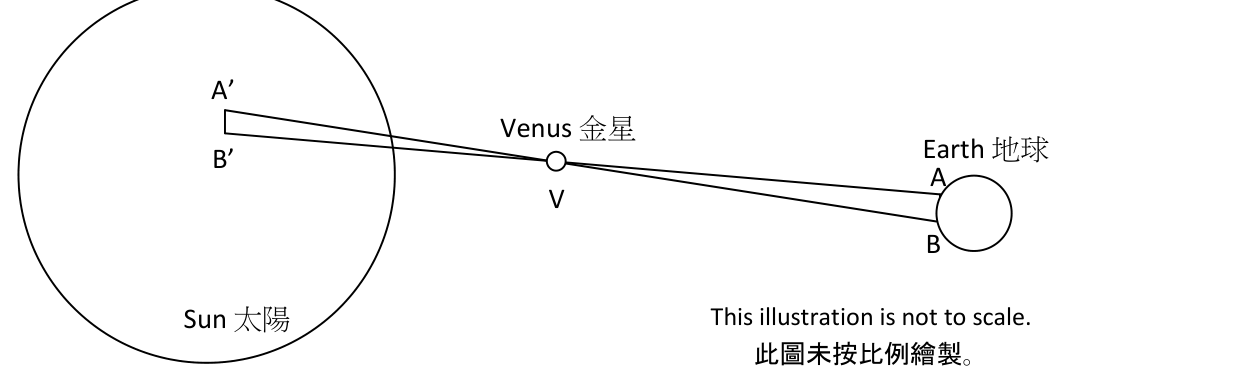
Fig. 1 – Venus Transit. This illustration is not to scale.
Fonte: Testo (PDF) — p.11
Topic: Astrophysics, Gravitation Metodi: Kepler’s Laws, Small-Angle Approximation, Physical Modeling Competenze: Mathematical Modeling, Diagrammatic Reasoning Objects: Planet, Star
**Transito di Venere (15 marchi) **
Il transito di Venere è un fenomeno astronomico quando il pianeta Venere passa direttamente tra il Sole e la Terra. Come illustrato in Figura 1. 1, per due diversi punti di osservazione e sulla Terra, Venere appare come due punti neri separati ( e ) sulla superficie del Sole.
(a) Supponiamo che Venere richieda 225 giorni per orbitare intorno al Sole, calcoli il rapporto di , dove e sono le distanze medie dei pianeti dal Sole, rispettivamente.
b) In una giornata di transito di Venere, sono state effettuate due osservazioni a Hong Kong e Bangkok. Sono separati geograficamente da . Bangkok è a sud di Hong Kong. Calcolare la distanza .
(c) Un’altra osservazione rileva che il diametro del Sole è 290 volte la distanza dei due punti neri separati. Calcola il diametro del Sole.
d) Calcolare la differenza di tempo tra l’uscita del transito di Venere osservata a Hong Kong e Bangkok. Rispondi tra pochi minuti. (Signore: calcolare la velocità della Terra rispetto al Sole, poi la velocità del Sole e Venere rispetto alla Terra, poi la velocità dell’ombra di Venere proiettata sulla superficie del Sole, poi la velocità dell’ombra di Venere che spazza sulla superficie del Sole.)
Fig. 1 Transito di Venere. Questa illustrazione non è a scala.
Fonte: Testo (PDF) — p.11
Topic: Astrophysics, Gravitation Metodi: Kepler’s Laws, Small-Angle Approximation, Physical Modeling Competenze: Mathematical Modeling, Diagrammatic Reasoning Objects: Planet, Star
Terminal Velocity of Free Falling Object (10 Marks)
A spherical styrofoam of mass and radius is released for free falling. The only forces acting on the styrofoam is the gravitational force and a drag force. The drag force is due to air resistance and is velocity () dependent. At low velocities, air resistance is negligible; but at high velocities, constant falling velocity is expected.
(a) Suppose the drag force is linear proportional to its falling velocity, write down the equation of motion. State the velocities in the limits of both low and high velocities. Sketch the graph of falling velocity against time with the indications of both the velocity limits.
(b) Suppose that the drag force is given by ; where is the drag coefficient, which is for a spherical object; is the air density; is the total cross-sectional area. Estimate the terminal velocity.
(c) Estimate the time taken by the falling styrofoam sphere to reach a velocity comparable to the terminal velocity.
Fonte: Testo (PDF) — p.12
Topic: Fluid Mechanics Metodi: Differential Equations, Free-Body Diagram, Order-of-Magnitude Estimation Competenze: Estimation & Approximation, Physical Reasoning Objects: Sphere
**Velocità terminale dell’oggetto che cade liberamente (10 punti) **
Per cadere libero viene rilasciata una schiuma di stiro sferica di massa e di raggio . Le uniche forze che agiscono sulla schiuma di stiro sono la forza gravitazionale e la forza di trazione. La forza di resistenza è dovuta alla resistenza all’aria e dipende dalla velocità (). A basse velocità, la resistenza dell’aria è trascurabile; ma ad alte velocità, si prevede una velocità di caduta costante.
(a) Supponiamo che la forza di trazione sia lineare proporzionale alla sua velocità di caduta, scrivendo l’equazione del movimento. Indicare le velocità nei limiti delle velocità basse e alte. Segna il grafico della velocità di caduta contro il tempo con le indicazioni di entrambi i limiti di velocità.
b) Supponiamo che la forza di resistenza sia data da ; dove è il coefficiente di resistenza, che è per un oggetto sferico; è la densità dell’aria; è la superficie trasversale totale. - Estima la velocità terminale.
c) Calcolare il tempo necessario per raggiungere una velocità paragonabile alla velocità terminale.
Fonte: Testo (PDF) — p.12
Topic: Fluid Mechanics Metodi: Differential Equations, Free-Body Diagram, Order-of-Magnitude Estimation Competenze: Estimation & Approximation, Physical Reasoning Objects: Sphere
Total Energy in a Surface Wave (15 Marks)
Consider a surface wave traveling on the sea (Fig. 2). At an instant, its surface profile can be approximated by , where is the amplitude and is the wavelength.
(a) Find the potential energy per unit wavelength per unit width of the surface wave in terms of (sea water density), (acceleration due to gravitation), and .
Hint: .
(b) Assume equipartition of energy, that is, the average potential energy equals the average kinetic energy of surface wave. Find the total energy over a whole wavelength.
(c) Given that the wave velocity and the relationship , derive the power of a wave period per unit width in terms of , , , (period of a wave), and (wave height).
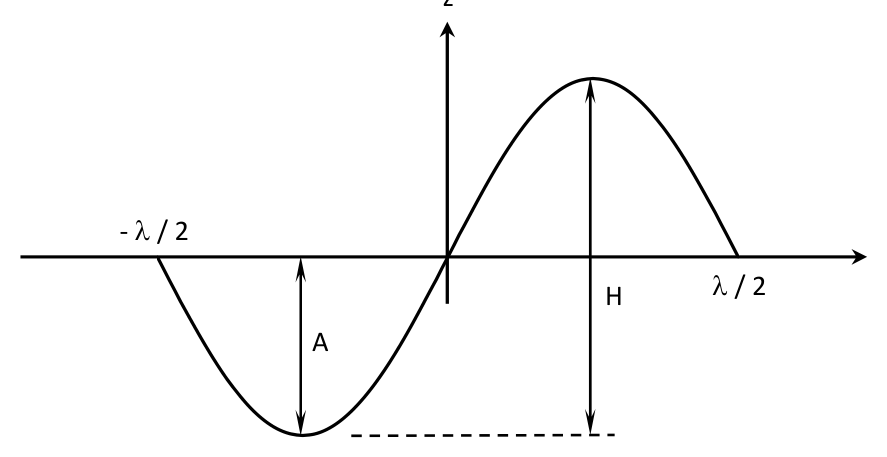
Fig. 2 – Surface Wave.
Fonte: Testo (PDF) — p.13
Topic: Oscillations & Waves Metodi: Calculus-Integration, Wave Equation, Energy Conservation Method Competenze: Mathematical Modeling Objects: —
**Energia totale in un’onda di superficie (15 Marks) **
Considerate un’onda di superficie che viaggia sul mare (Fig. 2). In un istante, il suo profilo superficiale può essere approssimato da , dove è l’ampiezza e è la lunghezza d’onda.
a) Trova l’energia potenziale per unità di lunghezza d’onda per unità di larghezza dell’onda superficiale in termini di (densità dell’acqua marina), (accelerazione dovuta alla gravità) e .
Suggerimento: .
b) Supponiamo l’equapartizione di energia, cioè che l’energia potenziale media sia uguale all’energia cinetica media dell’onda superficiale. Trova l’energia totale di un’intera lunghezza d’onda.
c) Considerato che la velocità d’onda e la relazione derivano la potenza di un periodo d’onda per unità di larghezza in termini di , , , (periodo d’onda) e (altezza d’onda).
Fig. 2 Ondata di superficie.
Fonte: Testo (PDF) — p.13
Topic: Oscillations & Waves Metodi: Calculus-Integration, Wave Equation, Energy Conservation Method Competenze: Mathematical Modeling Objects: —
A Sliding Block up a Slope Platform (10 Marks)
A solid cube (length each) of mass starts to slide up a stationary slope platform from the bottom. The slope platform has a mass , an inclination angle and the slope is smooth (Fig. 3). The slope platform is free to slide along the horizontal surface without friction.
(a) Calculate the initial velocity of the sliding block in terms of , , , , , and , such that the cube just reaches the upper end of the slope.
(b) The cube then slides down the slope platform. What is the final kinetic energy of the cube and the slope platform when the cube reaches the lower end of the slope platform?
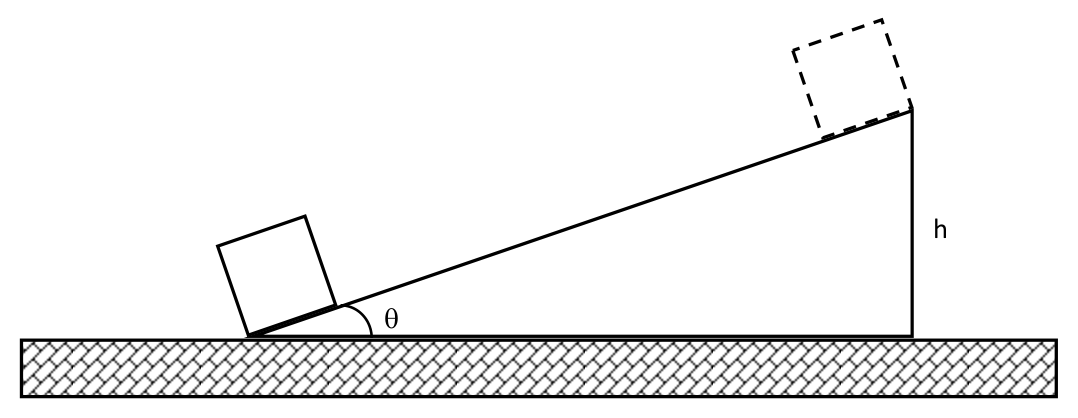
Fig. 3 – Sliding Block up a Slope Platform.
Fonte: Testo (PDF) — p.14
Topic: Conservation of Energy, Conservation of Momentum Metodi: Conservation of Energy, Conservation of Momentum Competenze: Physical Reasoning Objects: Block, Wedge
**Un blocco scorrevole su una piattaforma di pendenza (10 marks) **
Un cubo solido (lunga ciascuno) di massa inizia a scivolare su una piattaforma di pendenza stazionaria dal basso. La piattaforma di pendenza ha una massa , un angolo di inclinazione e la pendenza è liscia (Fig. 3). La piattaforma di pendenza può scivolare liberamente lungo la superficie orizzontale senza attrito.
a) Calcolare la velocità iniziale del blocco scivolante in termini di , , , , e , in modo tale che il cubo raggiunga solo l’estremità superiore della pendenza.
b) Il cubo poi scivola giù sulla piattaforma di pendenza. Qual è l’energia cinetica finale del cubo e della piattaforma di pendenza quando il cubo raggiunge l’estremità inferiore della piattaforma di pendenza?
Fig. 3 Blocco scivolante su una piattaforma di inclinazione.
Fonte: Testo (PDF) — p.14
Topic: Conservation of Energy, Conservation of Momentum Metodi: Conservation of Energy, Conservation of Momentum Competenze: Physical Reasoning Objects: Block, Wedge
A Physical Pendulum Motion (10 Marks)
Two identical uniform thin rods (mass , and length ) are connected at right angle to form a rigid upside-down “T” shape. The center of one rod is connected to one end of another rod. The upside-down “T” shape is suspended and allowed to form a pendulum motion, as shown in Fig. 4.
(a) The kinetic energy of the system is , where is the velocity of the meeting point of the two rods. Derive the equation of the pendulum motion in terms of , , and .
(b) Calculate the period of the system if is small. (Hint: when .)
(c) At , the meeting point of the two rods is displaced by . What is the time when the displacement becomes the first time?
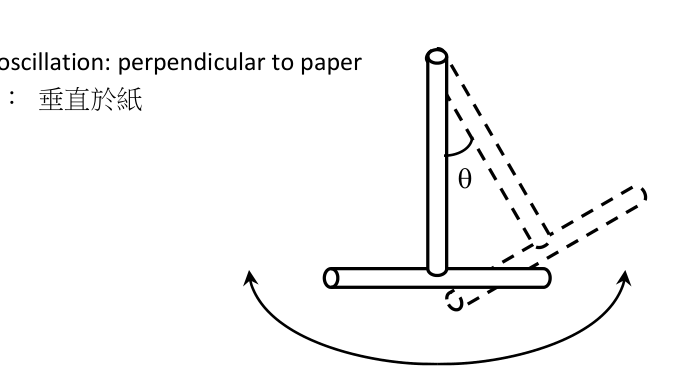
Fig. 4 – Physical Pendulum Motion. Axis of oscillation: perpendicular to paper.
Fonte: Testo (PDF) — p.15
Topic: Rotational Dynamics, Oscillations & Waves Metodi: Torque & Angular Momentum Analysis, Simple Harmonic Motion Analysis, Small-Angle Approximation Competenze: Mathematical Modeling Objects: Rod, Pendulum
**Un movimento del pendolo fisico (10 punti) **
Due barre sottili identiche (massa e lunghezza ) sono collegate in angolo retto per formare una forma rigida “T” a testa in giù. Il centro di una canna è collegato ad una estremità di un’altra. La forma “T” a testa in giù è sospesa e permette di formare un movimento di pendolo, come mostrato nella figura. 4.
a) L’energia cinetica del sistema è , dove è la velocità del punto di incontro delle due barre. Derivare l’equazione del movimento del pendolo in termini di , e .
b) Calcolare il periodo del sistema se è piccolo. (Signore: quando .)
c) Al , il punto di incontro delle due barre è sostituito da . Qual è l’ora in cui il spostamento diventa per la prima volta?
Fig. 4 Movimento fisico del pendolo. Asso di oscillazione: perpendicolare alla carta.
Fonte: Testo (PDF) — p.15
Topic: Rotational Dynamics, Oscillations & Waves Metodi: Torque & Angular Momentum Analysis, Simple Harmonic Motion Analysis, Small-Angle Approximation Competenze: Mathematical Modeling Objects: Rod, Pendulum