A board (mass ) is sandwiched between a stationary incline (angle ) and another identical board. A force acts on the outer board to keep the boards from slipping. If the coefficient of friction between all the surfaces is , what is the component of the minimum compression force, normal to the board surface?
- (A)
- (B)
- (C)
- (D)
- (E)
Fonte: Testo (PDF) — p.4
Topic: Newtonian Mechanics Metodi: Free-Body Diagram, Vector Decomposition Competenze: Physical Reasoning, Diagrammatic Reasoning Objects: Block, Inclined Plane
Una lavagna (massa ) è inserita tra una pendenza stazionaria (angolo ) e un’altra lavagna identica. Una forza agisce sulla lavagna esterna per impedire che le lavagne scivolino. Se il coefficiente di attrito tra tutte le superfici è , qual è il componente della forza di compressione minima, normale per la superficie della lavagna?
- (A)
- (B)
- (C)
- (D)
- (E)
Fonte: Testo (PDF) — p.4
Topic: Newtonian Mechanics Metodi: Free-Body Diagram, Vector Decomposition Competenze: Physical Reasoning, Diagrammatic Reasoning Objects: Block, Inclined Plane
A uniform metal ball (mass ) is tied to the end of a string (massless, length ). The other end of the string is fixed. The ball is moving in a vertical circle centered at the fixed end of the string. Suppose the velocity of the ball at the lowest point is , what is the string tension when it makes an angle to the downward vertical position?
- (A)
- (B)
- (C)
- (D)
- (E)
Fonte: Testo (PDF) — p.4
Topic: Newtonian Mechanics, Conservation of Energy Metodi: Conservation of Energy, Free-Body Diagram Competenze: Physical Reasoning, Mathematical Modeling Objects: Ball, String
Una sfera di metallo uniforme (massa ) è legata alla fine di una corda (senza massa, lunghezza ). L’altra estremità della corda è fissa. La palla si muove in un cerchio verticale centrato all’estremità fissa della corda. Supponiamo che la velocità della palla al punto più basso sia , qual è la tensione della corda quando fa un angolo alla posizione verticale verso il basso?
- (A)
- (B)
- (C)
- (D)
- (E)
Fonte: Testo (PDF) — p.4
Topic: Newtonian Mechanics, Conservation of Energy Metodi: Conservation of Energy, Free-Body Diagram Competenze: Physical Reasoning, Mathematical Modeling Objects: Ball, String
The orbital properties of a geostationary satellite include i) its orbit is directly over the Earth equator, and ii) its orbital period is the same as the Earth’s rotation period. Suppose a lunar stationary satellite (its orbital period is the same as the Moon’s rotation period) is placed over the Moon equator, what is the value of the ratio ? and are the Earth and the Moon radii, and are the satellite heights from the Earth and from the Moon surfaces, respectively. You may assume (Earth mass) / (Moon mass) and rotation period of the Moon days.
- (A)
- (B)
- (C)
- (D)
- (E)
Fonte: Testo (PDF) — p.5
Topic: Gravitation Metodi: Kepler’s Laws, Newton’s Law of Gravitation Competenze: Mathematical Modeling, Physical Reasoning Objects: Satellite, Planet
Le proprietà orbitali di un satellite geostazionario includono i) la sua orbita è direttamente sopra l’equatore terrestre e ii) il suo periodo orbitale è lo stesso del periodo di rotazione della Terra. Supponiamo che un satellite lunare stazionario (il suo periodo orbitale è lo stesso del periodo di rotazione della Luna) sia posizionato sull’equatore lunare, qual è il valore del rapporto ? e sono i raggi della Terra e della Luna, e sono rispettivamente le altezze satellitari dalla Terra e dalla superficie lunare. Si può assumere (massa terrestre) / (massa lunare) e il periodo di rotazione della Luna giorni.
- (A)
- (B)
- (C)
- (D)
- (E)
Fonte: Testo (PDF) — p.5
Topic: Gravitation Metodi: Kepler’s Laws, Newton’s Law of Gravitation Competenze: Mathematical Modeling, Physical Reasoning Objects: Satellite, Planet
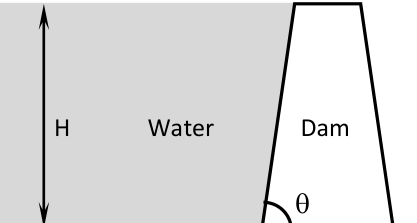
A dam (height , width , one wall inclined at angle ) is fully filled with water (density ). If is the acceleration due to gravity, the resultant force exerted by the water on the dam wall is given by
- (A)
- (B)
- (C)
- (D)
- (E)
Fonte: Testo (PDF) — p.5
Topic: Fluid Mechanics Metodi: Hydrostatic Equilibrium, Calculus-Integration Competenze: Mathematical Modeling, Diagrammatic Reasoning Objects: Container
Una diga (altezza , larghezza , una parete inclinata all’angolo ) è completamente riempita di acqua (densità ). Se è l’accelerazione dovuta alla gravità, la forza risultante esercitata dall’acqua sulla parete della diga è data da:
- (A)
- (B)
- (C)
- (D)
- (E)
Fonte: Testo (PDF) — p.5
Topic: Fluid Mechanics Metodi: Hydrostatic Equilibrium, Calculus-Integration Competenze: Mathematical Modeling, Diagrammatic Reasoning Objects: Container
Remark: Question 5 is cancelled.
A conical pendulum with 2 identical bobs on a massless rod (length ) makes an angle of with the vertical. One bob is mounted at of the wire, whereas the other is mounted at the end of the rod. The period of the rotational motion is:
- (A)
- (B)
- (C)
- (D)
- (E)
Fonte: Testo (PDF) — p.5
Topic: Newtonian Mechanics Metodi: Free-Body Diagram, Vector Decomposition Competenze: Physical Reasoning, Mathematical Modeling Objects: Pendulum, Rod
Ricordo: la domanda 5 è annullata.
Un pendolo conico con 2 bobine identiche su una barra senza massa (lenghezza ) fa un angolo di con la verticale. Un bob è montato a del filo, mentre l’altro è montato all’estremità della canna. Il periodo del movimento di rotazione è:
- (A)
- (B)
- (C)
- (D)
- (E)
Fonte: Testo (PDF) — p.5
Topic: Newtonian Mechanics Metodi: Free-Body Diagram, Vector Decomposition Competenze: Physical Reasoning, Mathematical Modeling Objects: Pendulum, Rod
Suppose you are standing in an elevator, the elevator is moving upward at a constant speed of , the net force on you is
- (A) zero.
- (B) .
- (C) .
- (D) .
- (E) your weight.
Fonte: Testo (PDF) — p.6
Topic: Newtonian Mechanics Metodi: Free-Body Diagram Competenze: Physical Reasoning Objects: —
Supponiamo che tu stia in un ascensore, che si muova verso l’alto a una velocità costante di , la forza netta su di te è
- **(A) ** zero.
- (B) .
- (C) .
- (D) .
- **(E) ** il peso.
Fonte: Testo (PDF) — p.6
Topic: Newtonian Mechanics Metodi: Free-Body Diagram Competenze: Physical Reasoning Objects: —
A pendulum has a length of . How many swings does the pendulum perform in an hour?
- (A) .
- (B) .
- (C) .
- (D) .
- (E) .
Fonte: Testo (PDF) — p.6
Topic: Oscillations & Waves Metodi: Simple Harmonic Motion Analysis Competenze: Physical Reasoning, Estimation & Approximation Objects: Pendulum
Un pendolo ha una lunghezza di . Quante oscillazioni fa il pendolo in un’ora?
- (A) .
- (B) .
- (C) .
- (D) .
- (E) .
Fonte: Testo (PDF) — p.6
Topic: Oscillations & Waves Metodi: Simple Harmonic Motion Analysis Competenze: Physical Reasoning, Estimation & Approximation Objects: Pendulum
A ball (mass ) is hanging at rest from a wire (negligible mass). A head-on elastic collision occurs when it is struck by a stone (mass , horizontal velocity before collision), the ball swings to a maximum height () above the original level. The maximum height () is
- (A)
- (B)
- (C)
- (D)
- (E)
Fonte: Testo (PDF) — p.6
Topic: Conservation of Momentum, Conservation of Energy Metodi: Conservation of Momentum, Conservation of Energy Competenze: Mathematical Modeling, Physical Reasoning Objects: Ball, String
Una palla (massa ) è appesa a riposo da un filo (massa trascurabile). Una collisione elastica frontale si verifica quando viene colpita da una pietra (massa , velocità orizzontale prima della collisione), la palla oscilla ad una altezza massima () superiore al livello originale. L’altezza massima () è
- (A)
- (B)
- (C)
- (D)
- (E)
Fonte: Testo (PDF) — p.6
Topic: Conservation of Momentum, Conservation of Energy Metodi: Conservation of Momentum, Conservation of Energy Competenze: Mathematical Modeling, Physical Reasoning Objects: Ball, String
An electric water pump draws water from a well of depth at a rate . The water is then rejected from the pump with velocity . If the efficiency of the pump is , the power consumption of the pump is
- (A) .
- (B) .
- (C) .
- (D) .
- (E) .
Fonte: Testo (PDF) — p.7
Topic: Fluid Mechanics, Conservation of Energy Metodi: Continuity Equation, Energy Conservation Method Competenze: Mathematical Modeling, Unit Conversion Objects: —
Una pompa elettrica di acqua attira acqua da un pozzo di profondità a velocità . L’acqua viene quindi respinta dalla pompa con velocità . Se l’efficienza della pompa è , il consumo di energia della pompa è
- (A) .
- (B) .
- (C) .
- (D) .
- (E) .
Fonte: Testo (PDF) — p.7
Topic: Fluid Mechanics, Conservation of Energy Metodi: Continuity Equation, Energy Conservation Method Competenze: Mathematical Modeling, Unit Conversion Objects: —
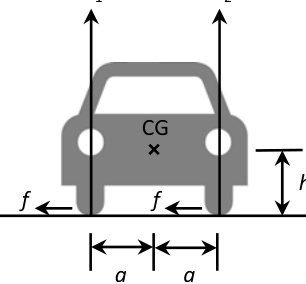
A car (mass ) undergoes a circular horizontal track (radius ) at constant speed . Suppose is the height of the center of mass (CG) above ground, and is the horizontal separations between the left/right wheels and the center of mass. What are the normal forces and ? The direction of friction force is indicated.
- (A) , .
- (B) , .
- (C) , .
- (D) , .
- (E) , .
Fonte: Testo (PDF) — p.7
Topic: Rigid Body Statics, Newtonian Mechanics Metodi: Torque & Angular Momentum Analysis, Free-Body Diagram Competenze: Physical Reasoning, Diagrammatic Reasoning Objects: Wheel
Un’auto (massa ) passa su una pista orizzontale circolare (radio ) a velocità costante . Supponiamo che sia l’altezza del centro di massa (CG) sopra il terreno e sia la separazione orizzontale tra le ruote sinistra/destra e il centro di massa. Quali sono le forze normali e ? La direzione della forza di attrito è indicata.
- (A) , .
- (B) , .
- (C) , .
- (D) , .
- (E) , .
Fonte: Testo (PDF) — p.7
Topic: Rigid Body Statics, Newtonian Mechanics Metodi: Torque & Angular Momentum Analysis, Free-Body Diagram Competenze: Physical Reasoning, Diagrammatic Reasoning Objects: Wheel
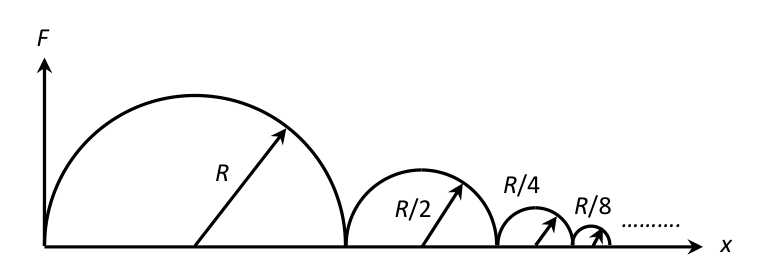
How much work is done in the following force () against distance () graph? The force is an infinite series of semi circles with radii of , , , , ……….
- (A) .
- (B) .
- (C) .
- (D) .
- (E) .
Fonte: Testo (PDF) — p.7
Topic: Conservation of Energy Metodi: Calculus-Integration, Approximation & Series Expansion Competenze: Diagrammatic Reasoning, Mathematical Modeling Objects: —
Quanto lavoro viene fatto nel seguente grafico di forza () contro distanza ()? La forza è una serie infinita di semicircoli con radii di , , , , ……….
- (A) .
- (B) .
- (C) .
- (D) .
- (E) .
Fonte: Testo (PDF) — p.7
Topic: Conservation of Energy Metodi: Calculus-Integration, Approximation & Series Expansion Competenze: Diagrammatic Reasoning, Mathematical Modeling Objects: —
A binary star system consists of 2 stars orbiting around their common center of mass. The two stars have identical mass. The orbital speed of each star is and the orbital period of each is days. Find the mass of each star.
- (A) Solar Mass
- (B) Solar Mass
- (C) Solar Mass
- (D) Solar Mass
- (E) Solar Mass
Fonte: Testo (PDF) — p.8
Topic: Astrophysics, Gravitation Metodi: Newton’s Law of Gravitation, Kepler’s Laws Competenze: Mathematical Modeling, Unit Conversion Objects: Star
Un sistema stellare binario è composto da 2 stelle che orbitano attorno al loro comune centro di massa. Le due stelle hanno massa identica. La velocità orbitale di ciascuna stella è e il periodo orbitale di ciascuna è giorni. Trova la massa di ogni stella.
- **(A) ** Massa solare
- **(B) ** Massa solare
- **(C) ** Massa solare
- **(D) ** Massa solare
- **(E) ** Massa solare
Fonte: Testo (PDF) — p.8
Topic: Astrophysics, Gravitation Metodi: Newton’s Law of Gravitation, Kepler’s Laws Competenze: Mathematical Modeling, Unit Conversion Objects: Star
A block lies on a horizontal and frictionless turntable. The block is connected to a string which is attached to the center of the turntable. The turntable is rotating with slow uniform angular speed . An observer sits on the turntable. According to the observer, which of the following is/are true?
i. The block is accelerating.
ii. The block is not accelerating.
iii. The magnitude of the string tension is proportional to .
- (A) (i) only.
- (B) (ii) only.
- (C) (i) and (iii).
- (D) (ii) and (iii).
- (E) (i), (ii), and (iii).
Fonte: Testo (PDF) — p.8
Topic: Newtonian Mechanics Metodi: Free-Body Diagram, Physical Modeling Competenze: Physical Reasoning Objects: Block, String, Disk
Un blocco si trova su una scheda rotativa orizzontale e senza attrito. Il blocco è collegato a una corda che è attaccata al centro della scheda. La scheda rotazionale è rotante con una velocità angolare uniforme lenta . Un osservatore siede sul giradischi. Secondo l’osservatore, quale delle seguenti informazioni è/sono vera?
i. Il blocco si sta accelerando.
ii. Il blocco non si sta accelerando.
iii. La grandezza della tensione della corda è proporzionale a .
- solo **(A) ** (i).
- solo **(B) ** (ii).
- **(C) ** (i) e (iii).
- **(D) ** (ii) e (iii).
- **(E) ** (i), (ii) e (iii).
Fonte: Testo (PDF) — p.8
Topic: Newtonian Mechanics Metodi: Free-Body Diagram, Physical Modeling Competenze: Physical Reasoning Objects: Block, String, Disk
A rock is launched vertically on the Earth’s surface at . Ignoring air resistance and the Earth rotation, the height of the projectile that can rise is:
- (A) .
- (B) .
- (C) .
- (D) .
- (E) .
Fonte: Testo (PDF) — p.8
Topic: Gravitation, Conservation of Energy Metodi: Newton’s Law of Gravitation, Energy Conservation Method Competenze: Mathematical Modeling, Unit Conversion Objects: Projectile, Planet
Una roccia viene lanciata verticalmente sulla superficie terrestre a . Ignorando la resistenza dell’aria e la rotazione terrestre, l’altezza del proiettile che può salire è:
- (A) .
- (B) .
- (C) .
- (D) .
- (E) .
Fonte: Testo (PDF) — p.8
Topic: Gravitation, Conservation of Energy Metodi: Newton’s Law of Gravitation, Energy Conservation Method Competenze: Mathematical Modeling, Unit Conversion Objects: Projectile, Planet
A ball is projected at angle(s) and at speed , and eventually the range of the projectile is . The possible value(s) of is/are:
- (A) .
- (B) .
- (C) .
- (D) or .
- (E) or .
Fonte: Testo (PDF) — p.9
Topic: Newtonian Mechanics Metodi: Kinematic Equations, Vector Decomposition Competenze: Mathematical Modeling, Physical Reasoning Objects: Ball, Projectile
Una palla viene proiettata all’angolo ((s) e alla velocità , e alla fine l’intervallo del proiettile è . Il valore possibile ((s) di è/sono:
- (A) .
- (B) .
- (C) .
- (D) or .
- (E) or .
Fonte: Testo (PDF) — p.9
Topic: Newtonian Mechanics Metodi: Kinematic Equations, Vector Decomposition Competenze: Mathematical Modeling, Physical Reasoning Objects: Ball, Projectile
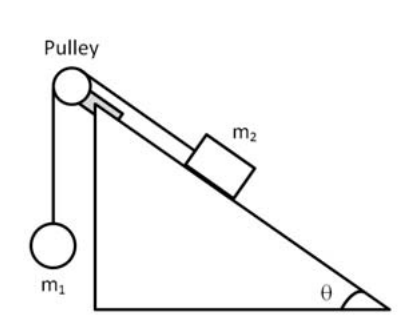
As shown in the figure, a ball (mass ) and a block (mass ) are attached by a cord (massless), which passes over a frictionless pulley. The block lies on a frictionless incline of angle . What is the condition that the block will accelerate down the incline?
- (A) .
- (B) .
- (C) .
- (D)
- (E) .
Fonte: Testo (PDF) — p.9
Topic: Newtonian Mechanics Metodi: Free-Body Diagram, Vector Decomposition Competenze: Physical Reasoning, Diagrammatic Reasoning Objects: Ball, Block, Pulley, Inclined Plane, String
Come mostrato nella figura, una palla (massa ) e un blocco (massa ) sono attaccati da un cavo (senza massa), che passa su una polla senza attrito. Il blocco si trova su un’inclinazione senza attrito di angolo . Qual è la condizione che il blocco accelererà verso il basso?
- (A) .
- (B) .
- (C) .
- (D)
- (E) .
Fonte: Testo (PDF) — p.9
Topic: Newtonian Mechanics Metodi: Free-Body Diagram, Vector Decomposition Competenze: Physical Reasoning, Diagrammatic Reasoning Objects: Ball, Block, Pulley, Inclined Plane, String
A solid sphere is attached at one end of a cord (length ) and is set into motion in a vertical circle about the other end which is fixed. Determine the speed of the sphere when it passes over the top of the circle with zero cord tension.
- (A)
- (B)
- (C)
- (D)
- (E)
Fonte: Testo (PDF) — p.9
Topic: Newtonian Mechanics Metodi: Free-Body Diagram Competenze: Physical Reasoning Objects: Sphere, String
Una sfera solida è attaccata ad una estremità di un cordone (lenghezza ) e viene messa in movimento in un cerchio verticale intorno all’altra estremità che è fissata. Determina la velocità della sfera quando passa sopra la parte superiore del cerchio con zero tensione del cavo.
- (A)
- (B)
- (C)
- (D)
- (E)
Fonte: Testo (PDF) — p.9
Topic: Newtonian Mechanics Metodi: Free-Body Diagram Competenze: Physical Reasoning Objects: Sphere, String
By considering the gravitational forces of the Moon and the Earth only, which of the following ocean tide is most possible? The diagram is not drawn to scale.
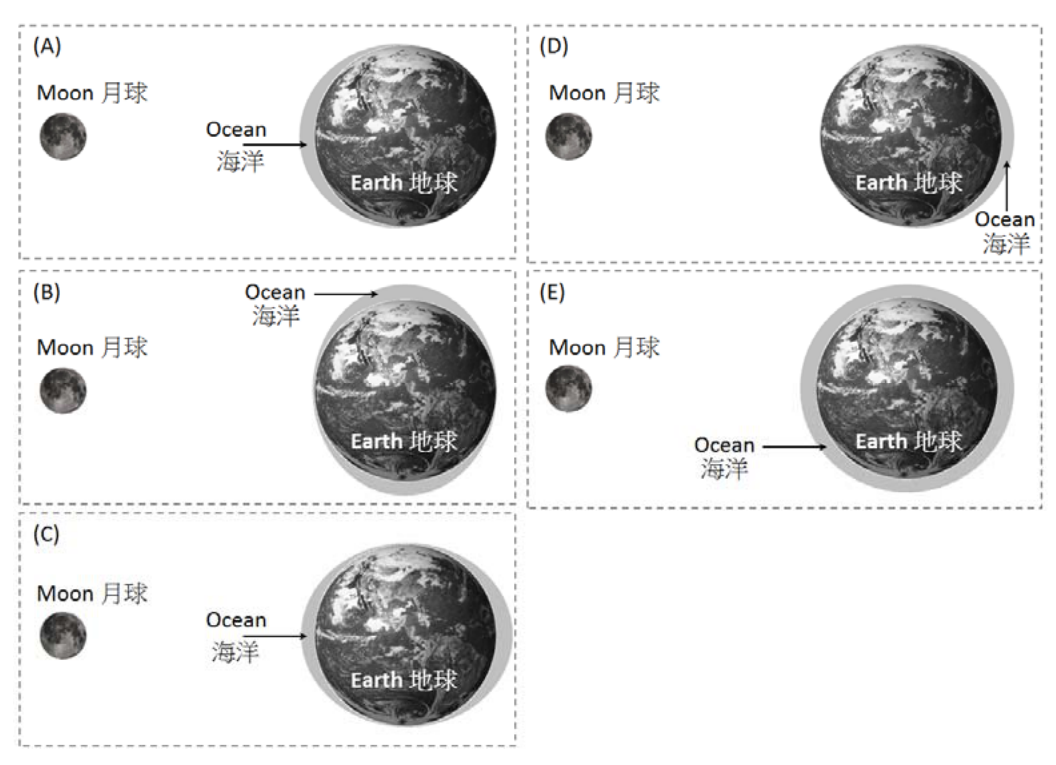
Fonte: Testo (PDF) — p.10
Topic: Gravitation Metodi: Newton’s Law of Gravitation, Physical Modeling Competenze: Physical Reasoning, Diagrammatic Reasoning Objects: Planet
Considerando solo le forze gravitazionali della Luna e della Terra, quale delle seguenti maree oceaniche è più possibile? Il diagramma non è disegnato in scala.
Fonte: Testo (PDF) — p.10
Topic: Gravitation Metodi: Newton’s Law of Gravitation, Physical Modeling Competenze: Physical Reasoning, Diagrammatic Reasoning Objects: Planet
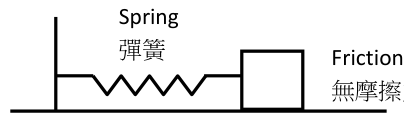
A small block (mass ) is attached to a massless spring and undergoes a simple harmonic motion on a smooth surface (amplitude , angular frequency ). The displacement of the particle at time from its equilibrium position is described by
If the potential energy of the spring at the equilibrium position is zero, what is the total energy of the system?
- (A) .
- (B) .
- (C) .
- (D) .
- (E) .
Fonte: Testo (PDF) — p.10
Topic: Oscillations & Waves Metodi: Simple Harmonic Motion Analysis, Energy Conservation Method Competenze: Mathematical Modeling, Unit Conversion Objects: Block, Spring
Un piccolo blocco (massa ) è attaccato a una molla senza massa e subisce un semplice movimento armonico su una superficie liscia (amplitudine , frequenza angolare ). Il spostamento della particella nel tempo dalla sua posizione di equilibrio è descritto da:
Se l’energia potenziale della sorgente in posizione di equilibrio è zero, qual è l’energia totale del sistema?
- (A) .
- (B) .
- (C) .
- (D) .
- (E) .
Fonte: Testo (PDF) — p.10
Topic: Oscillations & Waves Metodi: Simple Harmonic Motion Analysis, Energy Conservation Method Competenze: Mathematical Modeling, Unit Conversion Objects: Block, Spring
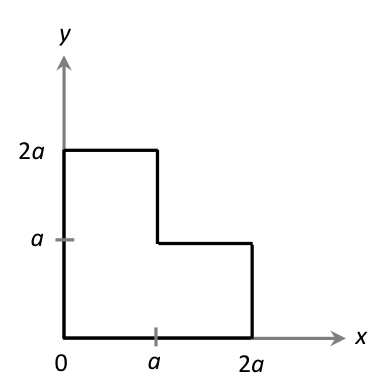
The figure shows a “L” shape object of uniform mass per unit area . Where is the center of mass ?
- (A) .
- (B) .
- (C) .
- (D) .
- (E) .
Fonte: Testo (PDF) — p.11
Topic: Rigid Body Statics Metodi: Calculus-Integration, Symmetry Argument Competenze: Mathematical Modeling, Diagrammatic Reasoning Objects: —
La figura mostra un oggetto di forma “L” di massa uniforme per unità di superficie . Dov’è il centro di massa ?
- (A) .
- (B) .
- (C) .
- (D) .
- (E) .
Fonte: Testo (PDF) — p.11
Topic: Rigid Body Statics Metodi: Calculus-Integration, Symmetry Argument Competenze: Mathematical Modeling, Diagrammatic Reasoning Objects: —
Open Problem 1 — A bouncing ball (10 Marks)
A ball is allowed to drop freely from rest and at a height above the ground. After hitting the ground, the ball bounces to a height . The bouncing process repeats continuously until the bouncing height is too small to be observed.
(a) Calculate the coefficient of restitution, , in terms of and . is defined as:
(b) Determine the total distance that the ball travels. Express your answer in terms of and .
(c) Find the total time duration that the ball travels. Express your answer in terms of and .
Hints: You may assume: i. is constant throughout all the bouncing, ii. Time of contact between the ball and the ground is negligible, and iii. Air resistance is negligible.
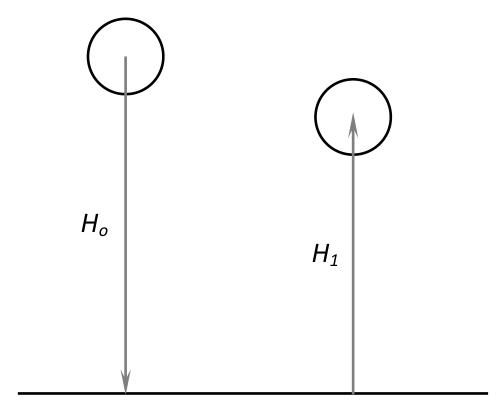 Fig. 1 – Bouncing ball
Fonte: Testo (PDF) — p.12
Topic: Conservation of Energy, Conservation of Momentum Metodi: Energy Conservation Method, Kinematic Equations, Approximation & Series Expansion Competenze: Mathematical Modeling, Physical Reasoning Objects: Ball
**Problema aperto 1 Una palla rimbalzante (10 marks) **
Una palla può cadere liberamente dal riposo e ad un’altezza sopra il suolo. Dopo aver colpito il terreno, la palla rimbalza ad un’altezza . Il processo di rimbalzo si ripete continuamente fino a quando l’altezza di rimbalzo non è troppo piccola per essere osservata.
a) Calcolare il coefficiente di restituzione, , in termini di e . è definito come:
b) Determinare la distanza totale che la palla percorre. Esprimere la risposta in termini di e .
c) Trova la durata totale del viaggio della palla. Esprimere la risposta in termini di e .
Suggerimenti: potete presumere: i. è costante durante tutto il rimbalzo, ii. Il tempo di contatto tra la palla e il terreno è trascurabile e iii. La resistenza all’aria è trascurabile.
Fig. 1 Ballon rimbalzante
Fonte: Testo (PDF) — p.12
Topic: Conservation of Energy, Conservation of Momentum Metodi: Energy Conservation Method, Kinematic Equations, Approximation & Series Expansion Competenze: Mathematical Modeling, Physical Reasoning Objects: Ball
Open Problem 2 — A suspended horizontal platform (15 Marks)
As shown in Fig. 2, a uniform rectangular platform (length , mass ) is suspended by two ropes making angle and to the vertical. In order to keep the platform horizontal, a load (mass ) is placed on the platform.
(a) Find the tensions and in terms of , , , and/or .
(b) In terms of , , , and/or , determine in order to keep the platform horizontal.
(c) If and , find and .
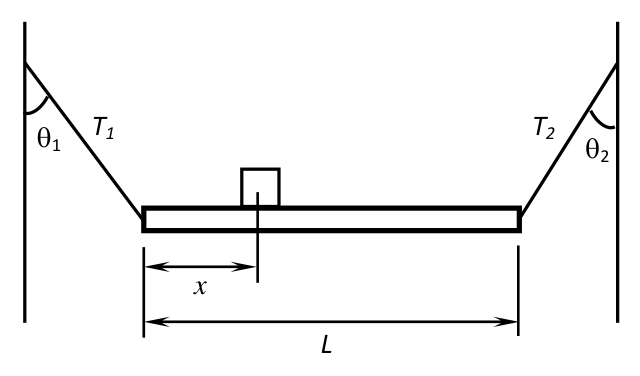 Fig. 2 – Suspended horizontal platform
Fonte: Testo (PDF) — p.13
Topic: Rigid Body Statics Metodi: Torque & Angular Momentum Analysis, Free-Body Diagram, Vector Decomposition Competenze: Mathematical Modeling, Diagrammatic Reasoning Objects: Beam, String
**Problema aperto 2 Piattaforma orizzontale sospesa (15 Marks) **
Come mostrato nella figura. 2, una piattaforma rettangolare uniforme (lunga , massa ) è sospesa da due corde che fanno angolo e verso la verticale. Per mantenere la piattaforma orizzontale, viene posto su piattaforma un carico (massa ).
(a) Trova le tensioni e in termini di , , e/o .
b) In termini di , , e/o , determinare per mantenere la piattaforma orizzontale.
c) Se e , trovare e .
Fig. 2 Piattaforma orizzontale sospesa
Fonte: Testo (PDF) — p.13
Topic: Rigid Body Statics Metodi: Torque & Angular Momentum Analysis, Free-Body Diagram, Vector Decomposition Competenze: Mathematical Modeling, Diagrammatic Reasoning Objects: Beam, String
Open Problem 3 — Oscillating sphere in a cylindrical trough (15 Marks)
A solid sphere (radius , mass , and uniform density) rolls without slipping in a cylindrical trough (radius ) with a small angle displaced from the equilibrium position. The kinetic energy of the sphere is , where is the instantaneous angular velocity.
(a) Find the potential energy of the sphere in terms of , , , and , where is the acceleration due to gravity.
(b) Find the total energy of the sphere oscillator. Express your answer in the form of energy transformation in simple harmonic mass-spring system, that is, Total Energy
where you may consider as an angular displacement.
(c) Determine the effective mass (), effective spring constant (), and period of the oscillation.
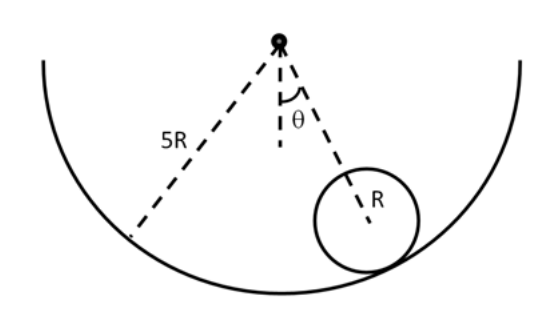 Fig. 3 – Oscillating sphere in a cylindrical trough
Fonte: Testo (PDF) — p.14
Topic: Oscillations & Waves, Rotational Dynamics Metodi: Simple Harmonic Motion Analysis, Energy Conservation Method, Small-Angle Approximation Competenze: Mathematical Modeling, Physical Reasoning Objects: Sphere, Cylinder
**Problema aperto 3 Sfera oscillante in un fondo cilindrico (15 Marks) **
Una sfera solida (radio , massa e densità uniforme) ruota senza scivolare in un fondo cilindrico (radio ) con un angolo piccolo spostato dalla posizione di equilibrio. L’energia cinetica della sfera è , dove è la velocità angolare istantanea.
(a) Trova l’energia potenziale della sfera in termini di , , e , dove è l’accelerazione dovuta alla gravità.
b) Trova l’energia totale dell’oscillatore di sfera. Esprimere la risposta sotto forma di trasformazione energetica in un semplice sistema armonico di mass-spring, cioè, Energia totale
dove si può considerare come spostamento angolare.
c) Determinare la massa effettiva (), la costante di molla effettiva () e il periodo di oscillazione.
Fig. 3 Sfera oscillante in un fondo cilindrico
Fonte: Testo (PDF) — p.14
Topic: Oscillations & Waves, Rotational Dynamics Metodi: Simple Harmonic Motion Analysis, Energy Conservation Method, Small-Angle Approximation Competenze: Mathematical Modeling, Physical Reasoning Objects: Sphere, Cylinder
Open Problem 4 — Maximum gradient that a vehicle can climb up (15 Marks)
An engineer attempts to design a road with an angle of inclination to allow a vehicle (mass ) to climb. On one hand the engineer would like to maximize the gradient; on the other hand, the design has to satisfy the specifications that the wheels have to be adhesive to the gradient when the vehicle is a
i. rear wheel drive; ii. front wheel drive; and iii. four wheel drive.
The specifications further require a vehicle
iv. to avoid overturning; and v. to avoid front and rear ends touch the road surface when climbing up a slope from a horizontal road.
A typical vehicle has the following dimensions (Fig. 4). Find the maximum gradients such that the vehicle can climb up at each of the above possibilities (i) to (v). Express your answers in terms of (the coefficient of static friction between the rear wheels and the road gradient), (the coefficient of static friction between the front wheels and the gradient), (rear under body clearance), (front under body clearance), (rear over hanging), (front over hanging), (height between center of mass and the gradient), , , and/or (). You may neglect air resistance and assume that the vehicle is moving at constant speed.
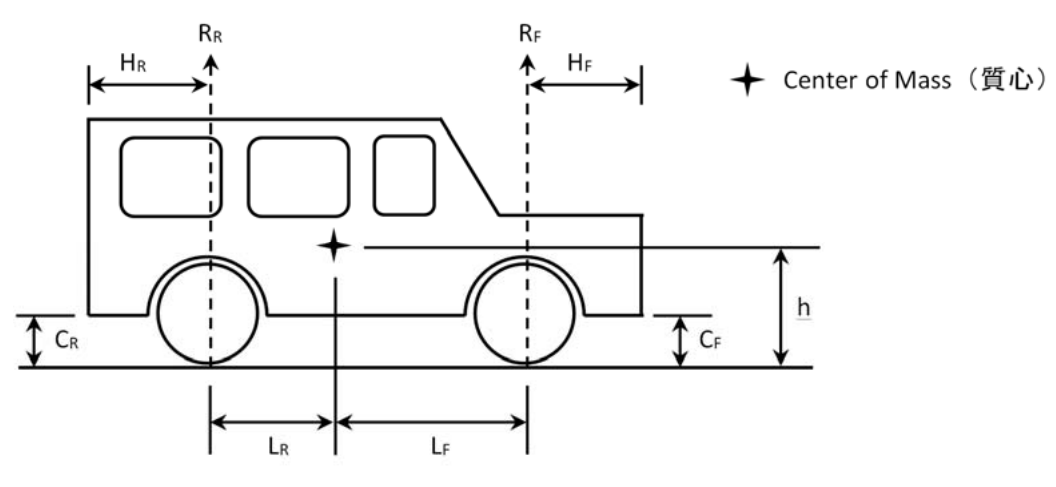 Fig. 4 – Specifications of typical vehicle
Fonte: Testo (PDF) — p.15
Topic: Rigid Body Statics, Newtonian Mechanics Metodi: Torque & Angular Momentum Analysis, Free-Body Diagram Competenze: Physical Reasoning, Diagrammatic Reasoning Objects: Inclined Plane, Wheel
**Problema aperto 4 Gradiente massimo che un veicolo può salire (15 Marks) **
Un ingegnere tenta di progettare una strada con un angolo di inclinazione per consentire al veicolo (massa ) di salire. Da un lato l’ingegnere desidera massimizzare il gradiente; dall’altro, il progetto deve soddisfare le specifiche che le ruote devono essere adesive al gradiente quando il veicolo è un
i. motore posteriore; ii. motore a trazione delle ruote anteriori; e iii. quattro ruote motrici.
Le specifiche richiedono inoltre un veicolo
iv. per evitare il rovesciamento; e v. per evitare che le estremità anteriori e posteriori toccino la superficie della strada quando si sale da una strada orizzontale.
Un veicolo tipico ha le seguenti dimensioni (Fig. 4). Trovare le gradienti massime in modo che il veicolo possa salire in ciascuna delle possibilità di cui sopra (i) a (v). Esprimere le risposte in termini di (il coefficiente di attrito statico tra le ruote posteriori e il gradiente stradale), (il coefficiente di attrito statico tra le ruote anteriori e il gradiente), (trasso sotto il rilievo del corpo), (trasso sotto il rilievo del corpo), (trasso sopra la pendenza), (trasso sopra la pendenza), (altezza tra il centro di massa e il gradiente), , e/o (). Potreste trascurare la resistenza dell’aria e presumere che il veicolo si muova a velocità costante.
Fig. 4 Specifiche del veicolo tipico
Fonte: Testo (PDF) — p.15
Topic: Rigid Body Statics, Newtonian Mechanics Metodi: Torque & Angular Momentum Analysis, Free-Body Diagram Competenze: Physical Reasoning, Diagrammatic Reasoning Objects: Inclined Plane, Wheel
Open Problem 5 — Fuel for rocket propulsion (5 Marks)
Consider a rocket in outer space (gravitational forces are negligible). The combustion products are ejected at a constant speed relative to the rocket (total initial mass ).
(a) By considering the conservation of momentum only, derive the equation of the rocket velocity change in terms of , total mass change of the rocket, and .
Hint: You may ignore higher order terms.
(b) Given that , and that the rocket generates a constant force during the fuel burn, calculate the rate of fuel mass change.
Fonte: Testo (PDF) — p.16
Topic: Conservation of Momentum Metodi: Conservation of Momentum, Approximation & Series Expansion Competenze: Mathematical Modeling, Unit Conversion Objects: —
**Problema aperto 5 Carburante per propulsione a razzo (5 Marks) **
Considerate un razzo nello spazio (le forze gravitazionali sono insignificanti). I prodotti di combustione vengono espulsi a velocità costante rispetto al razzo (massa iniziale totale ).
(a) Considerando solo la conservazione del momento, derivare l’equazione del cambiamento di velocità del razzo in termini di , cambiamento totale di massa del razzo e .
Potresti ignorare i termini di ordine superiore.
b) Considerando che e che il razzo genera una forza costante durante la combustione del carburante, calcolare il tasso di variazione della massa del carburante.
Fonte: Testo (PDF) — p.16
Topic: Conservation of Momentum Metodi: Conservation of Momentum, Approximation & Series Expansion Competenze: Mathematical Modeling, Unit Conversion Objects: —