Multiple Choice Questions. Select one answer in each question. For each question, 2 marks for correct answer, 0 mark for no answer, minus 0.25 mark for wrong answer, but the lowest mark of the multiple choice section is 0 mark.
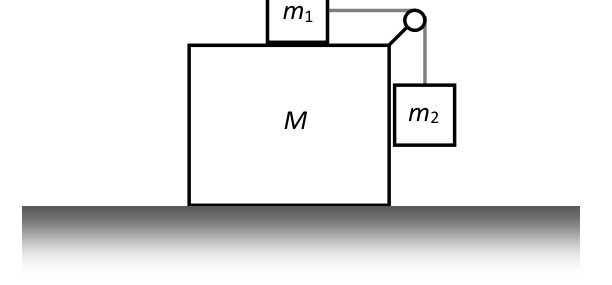
The following figure illustrates a pulley system with masses and , and is supported by a block (mass ) on a horizontal ground. All frictions and inertia of the pulley are negligible, and the rope in the pulley system is massless. Find the horizontal force on block such that there is no relative motion between , , and .
- (A)
- (B)
- (C)
- (D)
- (E) None of the above, because relative motion exists between , , and/or .
Fonte: Testo (PDF) — p.5 Topic: Newtonian Mechanics Metodi: Free-Body Diagram, Vector Decomposition Competenze: Physical Reasoning Objects: Pulley, Block, String
Questioni di scelta multipla. Selezionare una risposta in ogni domanda. Per ogni domanda, 2 punti per la risposta corretta, 0 punti per la risposta negativa, meno 0,25 punti per la risposta sbagliata, ma il punto più basso della sezione multiple choice è 0 punti.
La figura seguente illustra un sistema di pollice con masse e , e è supportato da un blocco (massa ) su un terreno orizzontale. Tutte le frizioni e l’inerzia della pollice sono trascurabili, e la corda nel sistema di pollice è senza massa. Trova la forza orizzontale sul blocco in modo tale che non vi sia movimento relativo tra , e .
- (A)
- (B)
- (C)
- (D)
- **(E) ** Nessuno di questi, poiché esiste un movimento relativo tra , e/o .
Fonte: Testo (PDF) — p.5 Topic: Newtonian Mechanics Metodi: Free-Body Diagram, Vector Decomposition Competenze: Physical Reasoning Objects: Pulley, Block, String
A man can generate a maximum propulsive power of 500 W during cycling. The air resistance has the force of when the velocity of the bicycle is , where is a constant given by 5 N·s/m. Without wind, what is the maximum speed of the bicycle when cycling is conducted on a horizontal ground?
- (A) .
- (B) .
- (C) .
- (D) .
- (E) .
Fonte: Testo (PDF) — p.5 Topic: Newtonian Mechanics Metodi: Physical Modeling, Free-Body Diagram Competenze: Physical Reasoning Objects: —
Un uomo può generare una potenza propulsiva massima di 500 W durante il ciclismo. La resistenza all’aria è di quando la velocità della bicicletta è , dove è una costante data da 5 N·s/m. Senza vento, qual è la velocità massima della bicicletta quando si fa il ciclismo su un terreno orizzontale?
- (A) .
- (B) .
- (C) .
- (D) .
- (E) .
Fonte: Testo (PDF) — p.5 Topic: Newtonian Mechanics Metodi: Physical Modeling, Free-Body Diagram Competenze: Physical Reasoning Objects: —
Questions 3 to 4. A spacecraft is orbiting in an elliptical orbit about the Sun with perihelion at the Earth’s orbit, and aphelion at the Venus’ orbit. The orbit equation with the Sun as the origin is given by where is the distance in AU (Astronomical Unit) from the Sun, and are the orbital parameters. The mean distances of Venus and the Earth from the Sun are 0.73 AU and 1.0 AU, respectively.
The orbital parameters and , respectively, are:
- (A) , AU.
- (B) , AU.
- (C) , AU.
- (D) , AU.
- (E) , AU.
Fonte: Testo (PDF) — p.6 Topic: Gravitation Metodi: Kepler’s Laws, Approximation & Series Expansion Competenze: Physical Reasoning Objects: Satellite, Star
*Domande 3 a 4. * Una sonda spaziale sta orbitando in un’orbita ellittica attorno al Sole con perihelione nell’orbita terrestre e afelione nell’orbita di Venere. L’equazione orbitale con il Sole come origine è data da se è la distanza in AU (Unità Astronomica) dal Sole, e sono i parametri orbiti. Le distanze medie di Venere e Terra dal Sole sono rispettivamente di 0,73 UA e 1,0 UA.
I parametri orbitali e sono:
- (A) , AU.
- (B) , AU.
- (C) , AU.
- (D) , AU.
- (E) , AU.
Fonte: Testo (PDF) — p.6 Topic: Gravitation Metodi: Kepler’s Laws, Approximation & Series Expansion Competenze: Physical Reasoning Objects: Satellite, Star
What is the period of the spacecraft as mentioned above (Problema 3)?
- (A) 0.4 year.
- (B) 0.8 year.
- (C) 1.2 years.
- (D) 1.6 years.
- (E) 2.0 years.
Fonte: Testo (PDF) — p.6 Topic: Gravitation Metodi: Kepler’s Laws Competenze: Physical Reasoning Objects: Satellite
Qual è il periodo della sonda spaziale come accennato sopra (problema 3)?
- **(A) ** 0,4 anni.
- **(B) ** 0,8 anni.
- **(C) ** 1,2 anni.
- **(D) ** 1,6 anni.
- **(E) ** 2,0 anni.
Fonte: Testo (PDF) — p.6 Topic: Gravitation Metodi: Kepler’s Laws Competenze: Physical Reasoning Objects: Satellite
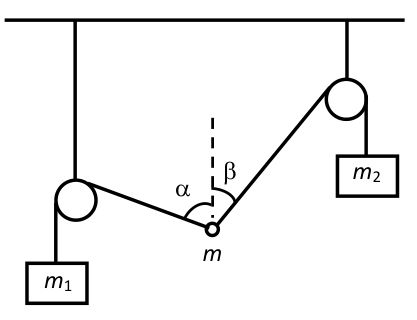
A point mass is hanged by 2 massless ropes, which make angles and to the vertical. The ropes are further connected to two masses and through frictionless and massless pulleys. Find the ratio such that the point mass hangs in equilibrium.
- (A) .
- (B) .
- (C) .
- (D) .
- (E) .
Fonte: Testo (PDF) — p.6 Topic: Rigid Body Statics Metodi: Free-Body Diagram, Vector Decomposition Competenze: Physical Reasoning Objects: String, Pulley, Block
Una massa puntaria è appesa da due corde senza massa, che rendono gli angoli e verticali. Le corde sono ulteriormente collegate a due masse e attraverso polli senza attrito e senza massa. Trova il rapporto in modo tale che la massa del punto sia in equilibrio.
- (A) .
- (B) .
- (C) .
- (D) .
- (E) .
Fonte: Testo (PDF) — p.6 Topic: Rigid Body Statics Metodi: Free-Body Diagram, Vector Decomposition Competenze: Physical Reasoning Objects: String, Pulley, Block
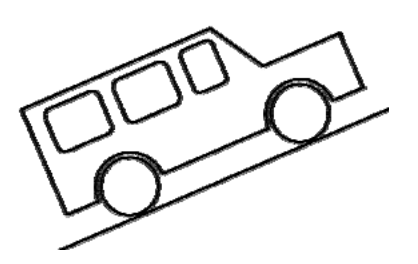
A 4-wheel car is moving uphill without slipping, as shown in the figure. If the car is driven by the rear wheels, in which direction(s) does friction(s) act on the rear and the front wheels?
- (A) Rear wheels: uphill, front wheels: uphill.
- (B) Rear wheels: downhill, front wheels: uphill.
- (C) Rear wheels: uphill, front wheels: downhill.
- (D) Rear wheels: downhill, front wheels: downhill.
- (E) Frictions do not act on the wheels because the car is moving at constant speed.
Fonte: Testo (PDF) — p.7 Topic: Newtonian Mechanics Metodi: Free-Body Diagram, Torque & Angular Momentum Analysis Competenze: Physical Reasoning Objects: Cart, Wheel, Inclined Plane
Una macchina a quattro ruote si muove in salita senza scivolare, come mostra la figura. Se l’auto è guidata dalle ruote posteriori, in quale direzione l’attrito agisce sulle ruote posteriori e anteriori?
- **(A) ** Ruote posteriori: in salita, ruote anteriori: in salita.
- **(B) ** Ruote posteriori: in discesa, ruote anteriori: in salita.
- **(C) ** Ruote posteriori: in salita, ruote anteriori: in discesa.
- **(D) ** Ruote posteriori: in discesa, ruote anteriori: in discesa.
- **(E) ** Le frizioni non agiscono sulle ruote perché l’auto si muove a velocità costante.
Fonte: Testo (PDF) — p.7 Topic: Newtonian Mechanics Metodi: Free-Body Diagram, Torque & Angular Momentum Analysis Competenze: Physical Reasoning Objects: Cart, Wheel, Inclined Plane
(Remark: Question 7 is cancelled.)
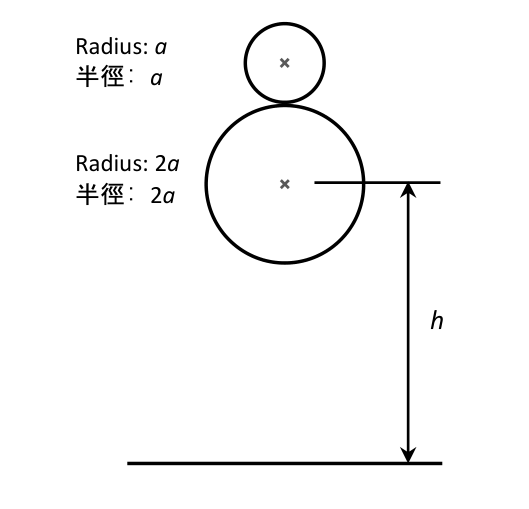
Two rigid spheres (uniform masses, zero initial speed, radii and ) are dropped from a height (measured from ground to center of the lower sphere) under the influence of gravity. What is the maximum height (measured from ground to sphere center) that the upper sphere will reach? Assume all the collisions are instantaneous.
Hints: i) Air resistance is negligible; ii) Collisions are elastic; iii) Centers of the spheres (marked as “x”) always lie on the same vertical line; iv) Lower sphere collides with the ground before it collides with the upper sphere.
- (A)
- (B)
- (C)
- (D)
- (E)
Fonte: Testo (PDF) — p.7 Topic: Conservation of Momentum Metodi: Conservation of Momentum, Conservation of Energy Competenze: Physical Reasoning Objects: Sphere
*(Nota: la domanda 7 è annullata.) *
Due sfere rigide (masse uniformi, velocità iniziale zero, raggi e ) vengono abbassate da un’altezza (misurata dal suolo al centro della sfera inferiore) sotto l’influenza della gravità. Qual è l’altezza massima (misurata dal terreno al centro della sfera) che raggiungerà la sfera superiore? Supponiamo che tutte le collisioni siano istantanee.
*Insigni: * i) La resistenza all’aria è trascurabile; ii) Le collisioni sono elastiche; iii) I centri delle sfere (indicati come “x”) si trovano sempre sulla stessa linea verticale; iv) la sfera inferiore colpisce il terreno prima di colpirsi con la sfera superiore.
- (A)
- (B)
- (C)
- (D)
- (E)
Fonte: Testo (PDF) — p.7 Topic: Conservation of Momentum Metodi: Conservation of Momentum, Conservation of Energy Competenze: Physical Reasoning Objects: Sphere
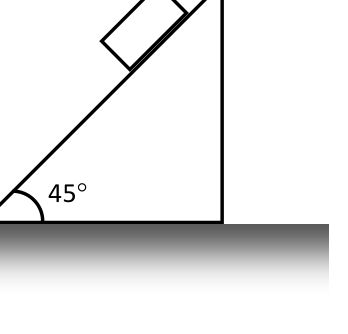
A block (mass ) slides on an inclined plane (mass , angle to the horizontal). Ignoring all the frictions between all the surfaces, find the acceleration of the inclined plane when the block is sliding.
- (A)
- (B)
- (C)
- (D)
- (E)
Fonte: Testo (PDF) — p.8 Topic: Newtonian Mechanics Metodi: Free-Body Diagram, Conservation of Momentum Competenze: Physical Reasoning Objects: Block, Inclined Plane
Un blocco (massa ) scorre su un piano inclinato (massa , angolo orizzontale). Ignorando tutte le frizioni tra tutte le superfici, trovi l’accelerazione del piano inclinato quando il blocco scivola.
- (A)
- (B)
- (C)
- (D)
- (E)
Fonte: Testo (PDF) — p.8 Topic: Newtonian Mechanics Metodi: Free-Body Diagram, Conservation of Momentum Competenze: Physical Reasoning Objects: Block, Inclined Plane
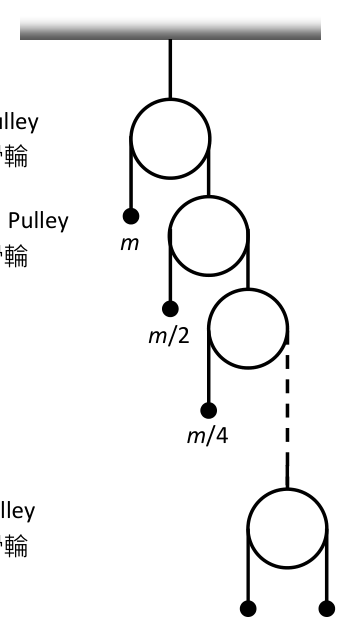
An Atwood machine consists of masses (masses , , , ……, respectively attached on the first, second, third, …… pulley) and pulleys (massless, frictionless, and negligible inertia), where is an integer with . At the last pulley, it is attached 2 equal masses (mass ). What is the acceleration of the mass attached to the first pulley?
- (A) Zero acceleration.
- (B) .
- (C) .
- (D) .
- (E) Greater than or equal to .
Fonte: Testo (PDF) — p.8 Topic: Newtonian Mechanics Metodi: Free-Body Diagram, Approximation & Series Expansion Competenze: Physical Reasoning Objects: Pulley, Block
Una macchina Atwood è composta da masse (masse , , , ……, rispettivamente attaccate alla prima, seconda, terza, …… pollice) e pollice (senza massa, senza attrito e inerzia trascurabile), dove è un intero con . Al suo ultimo pollice sono attaccate due masse uguali (massa ). Qual è l’accelerazione della massa attaccata alla prima polla?
- **(A) ** Accelerazione zero.
- (B) .
- (C) .
- (D) .
- **(E) ** Più grande o uguale a .
Fonte: Testo (PDF) — p.8 Topic: Newtonian Mechanics Metodi: Free-Body Diagram, Approximation & Series Expansion Competenze: Physical Reasoning Objects: Pulley, Block
(Remark: Question 11 is cancelled — see Problema 11.)
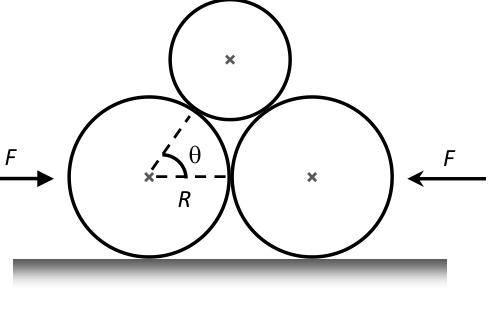
Consider the following 3 planar circles with identical mass density per unit area of . One of the circles is put between and above the other 2 identical circles (radius ). The radii of contact points between the upper circle and the lower circles make an angle with the horizontal. Ignoring all the frictions, what is the horizontal force, , on each side of the lower circle in order to keep them stationary?
- (A)
- (B)
- (C)
- (D) Revised to:
- (E)
Fonte: Testo (PDF) — p.9 Topic: Rigid Body Statics Metodi: Free-Body Diagram, Vector Decomposition Competenze: Physical Reasoning Objects: Disk
*(Nota: la domanda 11 è annullata vedere Problema 11.) *
Considerate i seguenti 3 cerchi pianari con densità di massa identica per unità di superficie . Uno dei cerchi è posto tra e sopra gli altri 2 cerchi identici (radio ). I raggi dei punti di contatto tra il cerchio superiore e il cerchio inferiore costituiscono un angolo con l’orizzontale. Ignorando tutte le frizioni, qual è la forza orizzontale, , su ogni lato del cerchio inferiore per tenerli fermi?
- (A)
- (B)
- (C)
- **(D) ** *Riviso a: *
- (E)
Fonte: Testo (PDF) — p.9 Topic: Rigid Body Statics Metodi: Free-Body Diagram, Vector Decomposition Competenze: Physical Reasoning Objects: Disk
(Remark: Question 11 is cancelled.)
A stone is dropped from rest into a deep well. After three seconds, a sound is heard when the stone hits the well water. Assume that the speed of sound in air is 340 m/s, and air resistance is negligible; what is the approximate depth (from the top of the well to water surface), , of the well?
- (A) 15 m.
- (B) 20 m.
- (C) 25 m.
- (D) 30 m.
- (E) 35 m.
Fonte: Testo (PDF) — p.9 Topic: Newtonian Mechanics Metodi: Kinematic Equations Competenze: Physical Reasoning Objects: —
*(Nota: la domanda 11 è annullata.) *
Una pietra viene gettata dal riposo in un pozzo profondo. Dopo tre secondi, viene sentito un suono quando la pietra colpisce l’acqua del pozzo. Supponiamo che la velocità del suono nell’aria sia di 340 m/s e che la resistenza all’aria sia trascurabile; qual è la profondità approssimativa (da cima del pozzo alla superficie dell’acqua), , del pozzo?
- (A) 15 m.
- (B) 20 m.
- (C) 25 m.
- (D) 30 m.
- (E) 35 m.
Fonte: Testo (PDF) — p.9 Topic: Newtonian Mechanics Metodi: Kinematic Equations Competenze: Physical Reasoning Objects: —
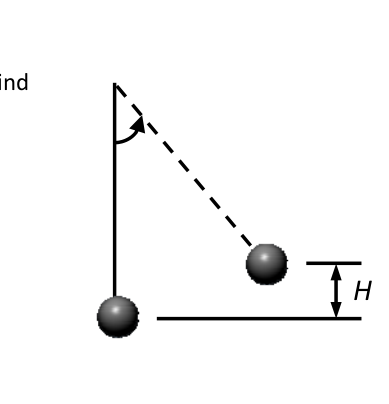
A sphere (mass and radius ) is hanged vertically with a massless rope (length ). A wind is exerting constant horizontal force density (force per unit area), on the sphere. Without energy loss, what is the maximum height that the sphere can rise?
- (A)
- (B)
- (C)
- (D)
- (E)
Fonte: Testo (PDF) — p.10 Topic: Conservation of Energy Metodi: Conservation of Energy, Free-Body Diagram Competenze: Physical Reasoning Objects: Sphere, String
Una sfera (massa e raggio ) è appesa verticalmente con una corda senza massa (lunghezza ). Un vento esercita una densità di forza orizzontale costante (forza per unità di superficie), sulla sfera. Senza perdita di energia, qual è l’altezza massima che la sfera può elevare?
- (A)
- (B)
- (C)
- (D)
- (E)
Fonte: Testo (PDF) — p.10 Topic: Conservation of Energy Metodi: Conservation of Energy, Free-Body Diagram Competenze: Physical Reasoning Objects: Sphere, String
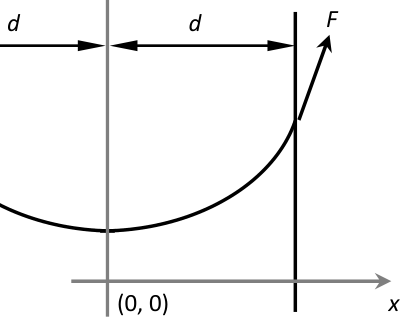
A rope (mass ) is hanged between two supports (separation ) at the same level. The shape of the hanging rope can be approximated to the function in an - coordinate system, where is a constant. The slope of the function is . What is the magnitude of force at each of the support?
- (A)
- (B)
- (C)
- (D)
- (E)
Fonte: Testo (PDF) — p.10 Topic: Rigid Body Statics Metodi: Free-Body Diagram, Vector Decomposition Competenze: Physical Reasoning Objects: String
Una corda (massa ) è appesa tra due supporti (separazione ) allo stesso livello. La forma della corda appesa può essere approssimata alla funzione in un sistema di coordinate -, dove è una costante. La pendenza della funzione è . Qual è la magnitudine della forza a ciascun supporto?
- (A)
- (B)
- (C)
- (D)
- (E)
Fonte: Testo (PDF) — p.10 Topic: Rigid Body Statics Metodi: Free-Body Diagram, Vector Decomposition Competenze: Physical Reasoning Objects: String
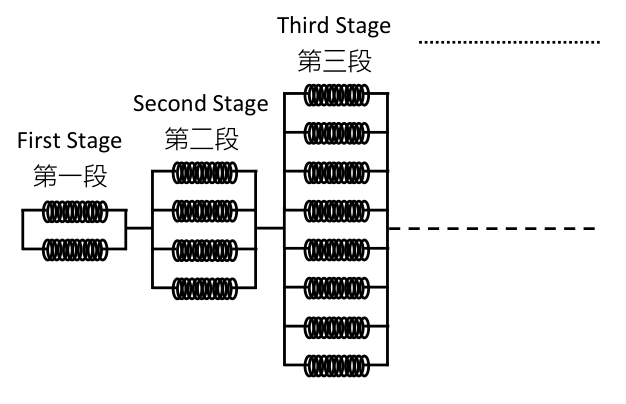
Questions 14 to 15. A spring system consists of stages, where tends to infinity. The first stage contains 2 springs, and the number of springs in the next stages are a geometric sequence, that is, the second stage contains 4 springs, the third stage contains 8 springs, and so on. All the springs are massless and identical having the same spring constant of .
The equivalent spring constant of this spring system is:
- (A) .
- (B) .
- (C) .
- (D) .
- (E) .
Fonte: Testo (PDF) — p.11 Topic: Elasticity & Materials Metodi: Hooke’s Law, Approximation & Series Expansion Competenze: Mathematical Modeling Objects: Spring
*Domande da 14 a 15. * Un sistema di molla consiste in fasi , dove tende all’infinito. La prima fase contiene 2 sorgenti, e il numero di sorgenti nelle fasi successive è una sequenza geometrica, cioè la seconda fase contiene 4 sorgenti, la terza fase contiene 8 sorgenti, e così via. Tutte le molle sono senza massa e identiche, avendo la stessa costante di molle .
La costante di molla equivalente di questo sistema di molla è:
- (A) .
- (B) .
- (C) .
- (D) .
- (E) .
Fonte: Testo (PDF) — p.11 Topic: Elasticity & Materials Metodi: Hooke’s Law, Approximation & Series Expansion Competenze: Mathematical Modeling Objects: Spring
If the total elongation of the spring system (Problema 14) is 10 cm, what is the elongation in the fourth stage, that is, the stage that contains 16 springs?
- (A) 7.5 cm.
- (B) 5.0 cm.
- (C) 2.5 cm.
- (D) 1.25 cm.
- (E) 0.625 cm.
Fonte: Testo (PDF) — p.11 Topic: Elasticity & Materials Metodi: Hooke’s Law, Approximation & Series Expansion Competenze: Physical Reasoning Objects: Spring
Se l’allungamento totale del sistema di molla (problema 14) è di 10 cm, qual è l’allungamento nel quarto stadio, cioè quello che contiene 16 molle?
- (A) 7.5 cm.
- (B) 5.0 cm.
- (C) 2.5 cm.
- (D) 1.25 cm.
- (E) 0.625 cm.
Fonte: Testo (PDF) — p.11 Topic: Elasticity & Materials Metodi: Hooke’s Law, Approximation & Series Expansion Competenze: Physical Reasoning Objects: Spring
Two identical balls are projected up an incline (angle ) with initial speed at angle and at angle with respect to the horizontal, where and . The two balls eventually reach the same distance on the incline. The relationship between , , , and is:
- (A)
- (B)
- (C)
- (D)
- (E)
Fonte: Testo (PDF) — p.12 Topic: Newtonian Mechanics Metodi: Kinematic Equations, Vector Decomposition Competenze: Physical Reasoning Objects: Ball, Inclined Plane
Due palle identiche sono proiettate verso l’inclinazione (angolo ) con velocità iniziale all’angolo e all’angolo rispetto all’orizzontale, dove e . Le due palle raggiungono alla fine la stessa distanza sulla pendenza. Il rapporto tra , , e è:
- (A)
- (B)
- (C)
- (D)
- (E)
Fonte: Testo (PDF) — p.12 Topic: Newtonian Mechanics Metodi: Kinematic Equations, Vector Decomposition Competenze: Physical Reasoning Objects: Ball, Inclined Plane
A helium-filled balloon is held on a horizontal floor of a MTR train by a massless string (length 0.5 m). The train is travelling at constant speed of 105 km/hour and turning a circular path of radius 1000 m. The densities of air and helium gases are and , respectively. The angle of the balloon string making with the vertical is:
- (A) .
- (B) .
- (C) .
- (D) .
- (E) .
Fonte: Testo (PDF) — p.12 Topic: Fluid Mechanics Metodi: Free-Body Diagram, Hydrostatic Equilibrium Competenze: Physical Reasoning Objects: String
Un palloncino pieno di elio è tenuto su un pavimento orizzontale di un treno MTR da una corda senza massa (lunga 0,5 m). Il treno si muove a velocità costante di 105 km/h e gira un percorso circolare di raggio di 1000 m. Le densità di gas aria e elio sono rispettivamente e . L’angolo della corda del palloncino con la verticale è:
- (A) .
- (B) .
- (C) .
- (D) .
- (E) .
Fonte: Testo (PDF) — p.12 Topic: Fluid Mechanics Metodi: Free-Body Diagram, Hydrostatic Equilibrium Competenze: Physical Reasoning Objects: String
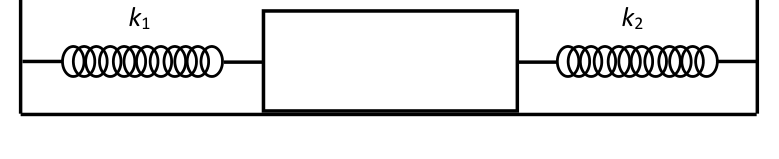
A wooden block (mass 1 kg) is connected to 2 massless springs (Spring 1 with spring constant N/m; and Spring 2 with spring constant N/m), and is oscillating on a frictionless horizontal table with small amplitude. At the equilibrium position (time second), the block is moving at 2 m/s towards the Spring 2. The time that the block will take when the Spring 1 has maximum compression is:
- (A) seconds.
- (B) seconds.
- (C) seconds.
- (D) second.
- (E) second.
Fonte: Testo (PDF) — p.12 Topic: Oscillations & Waves Metodi: Simple Harmonic Motion Analysis, Hooke’s Law Competenze: Physical Reasoning Objects: Block, Spring
Un blocco di legno (massa 1 kg) è collegato a 2 sorgenti senza massa (sorgente 1 con costante sorgente N/m; e sorgente 2 con costante sorgente N/m), e oscilla su una tavola orizzontale senza attrito con piccola amplitudine. Nella posizione di equilibrio (tempo secondo), il blocco si sta muovendo a 2 m/s verso la primavera 2. Il tempo che il blocco impiega quando la primavera 1 ha la massima compressione è:
- **(A) ** secondi.
- **(B) ** secondi.
- **(C) ** secondi.
- **(D) ** secondo.
- **(E) ** secondo.
Fonte: Testo (PDF) — p.12 Topic: Oscillations & Waves Metodi: Simple Harmonic Motion Analysis, Hooke’s Law Competenze: Physical Reasoning Objects: Block, Spring
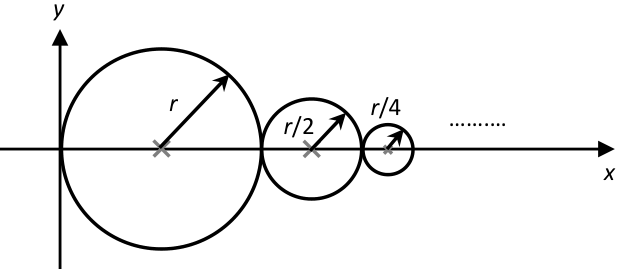
Find the center of gravity of the integrated shape in the - coordinate system. The integrated shape is an infinite series of circular discs with radii of , , , , ……, and their centers are on the -axis. The masses of the circular discs are proportional to their areas.
Hints: ; .
- (A) , .
- (B) , .
- (C) , .
- (D) , .
- (E) , .
Fonte: Testo (PDF) — p.13 Topic: Newtonian Mechanics Metodi: Statistical Averaging, Approximation & Series Expansion Competenze: Mathematical Modeling Objects: Disk
Trova il centro di gravità della forma integrata nel sistema di coordinate -. La forma integrata è una serie infinita di dischi circolari con radii , , , , ……, e i loro centri sono sull’asse . Le masse dei dischi circolari sono proporzionali alle loro superfici.
*Insigni: * ; .
- (A) , .
- (B) , .
- (C) , .
- (D) , .
- (E) , .
Fonte: Testo (PDF) — p.13 Topic: Newtonian Mechanics Metodi: Statistical Averaging, Approximation & Series Expansion Competenze: Mathematical Modeling Objects: Disk
A Newton kinetic ball stress reliever gadget contains 5 identical hard balls supported by identical strings (negligible mass) of equal lengths. From left to right, the hard balls are labelled as ball 1, ball 2, ball 3, ball 4 and ball 5. Balls 4 and 5 are glued together (glue is massless). When Ball 1 is slightly pulled out and released, velocity of Ball 1 just before collision with Ball 2 is (positive velocity represents moving to the right). Assuming all the collisions are elastic, the velocities of Ball 1 (), and Balls 4, 5 () after collision are:
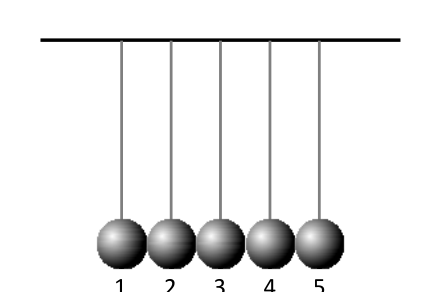
- (A) ; .
- (B) ; .
- (C) ; .
- (D) ; .
- (E) ; .
Fonte: Testo (PDF) — p.13 Topic: Conservation of Momentum Metodi: Conservation of Momentum, Conservation of Energy Competenze: Physical Reasoning Objects: Ball, String
Un dispositivo di sollievo di stress Newton kinetico di palle contiene 5 palle dure identiche supportate da stringhe identiche (massa trascurabile) di uguale lunghezza. Da sinistra a destra, le palle dure sono etichettate come palla 1, palla 2, palla 3, palla 4 e palla 5. Le palle 4 e 5 sono incollate insieme (la colla è senza massa). Quando la palla 1 viene leggermente tirata fuori e rilasciata, la velocità della palla 1 poco prima della collisione con la palla 2 è (la velocità positiva rappresenta il movimento a destra). Supponendo che tutte le collisioni siano elastiche, le velocità della palla 1 () e delle palle 4, 5 () dopo la collisione sono:
- (A) ; .
- (B) ; .
- (C) ; .
- (D) ; .
- (E) ; .
Fonte: Testo (PDF) — p.13 Topic: Conservation of Momentum Metodi: Conservation of Momentum, Conservation of Energy Competenze: Physical Reasoning Objects: Ball, String
Open Problems — Problem 1: Faster track (9 Marks).
A school student designed a frictionless track to allow a ball (negligible radius) to move on a track, which consisted of a downward slope and a horizontal path (Fig. 1, Track 1). At time second, a ball is released from rest to move down the slope (angle , height ). After the slope, it is a horizontal path (length ). The time duration to complete this track (Track 1) is . However, the student did not satisfy the time duration. He/she would like to design a faster track with shorter completion time.
Another faster track (Fig. 1, Track 2) is designed, which includes 2 downward slopes (angles and , height ), 1 upward slope (angle , height ), and 3 horizontal paths. The lengths , , , , , and are the horizontal lengths.
You may assume that the ball speeds on the 2 tracks are low enough such that the balls are always moving on the tracks without projectile motion.
(a) Express in terms of , , , , and .
(b) Find the time durations to complete Track 1 () and Track 2 (). Express your answers in terms of , , (acceleration due to gravity), , , , , and .
(c) Prove that Track 2 is always faster than Track 1, that is, . Find the time difference () between the 2 tracks. Express your answer in terms of , , , and .
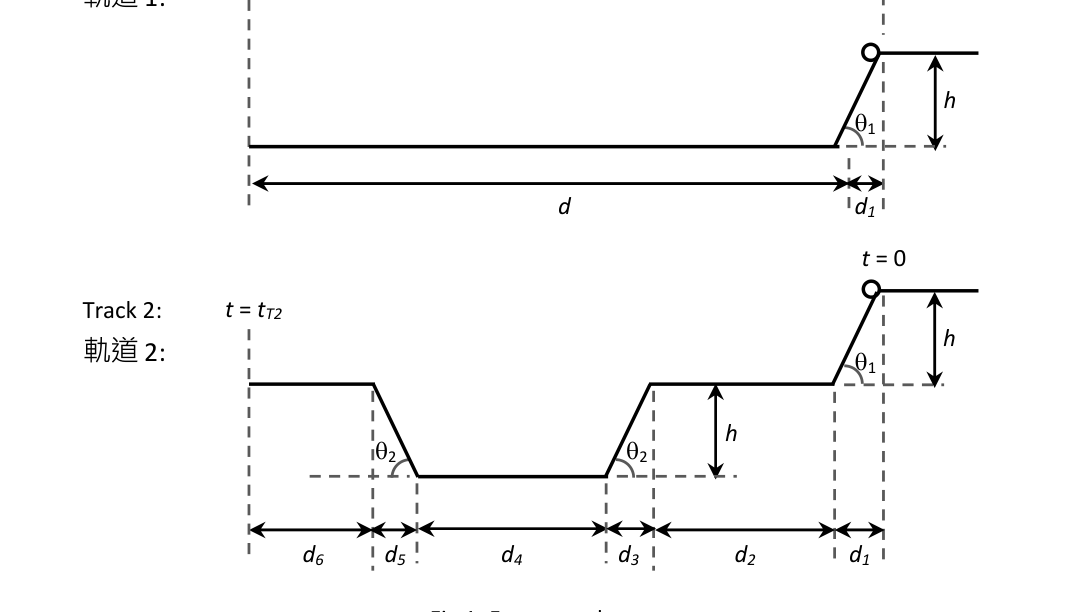
Fig. 1. Faster track.
Fonte: Testo (PDF) — p.14 Topic: Newtonian Mechanics Metodi: Conservation of Energy, Kinematic Equations Competenze: Physical Reasoning Objects: Ball
Problemi aperti Problema 1: pista più veloce (9 punti).
Uno studente scolastico progettò una pista senza attrito per permettere a una palla (radio trascurabile) di muoversi su una pista, che consisteva in una pendenza verso il basso e un percorso orizzontale (Fig. 1, pista 1). Al momento secondo, una palla viene rilasciata dal riposo per muoversi verso il basso (angolo , altezza ). Dopo la pendenza, si tratta di un percorso orizzontale (lunghezza ). La durata di completamento di questa pista (Scorso 1) è . Tuttavia, lo studente non ha soddisfatto la durata del tempo. Vorrebbe progettare una pista più veloce con un tempo di completamento più breve.
Un’altra pista più veloce (Fig. 1, è progettata la pista 2 che comprende 2 piste verso il basso (angoli e , altezza ), 1 piste verso l’alto (angolo , altezza ) e 3 percorsi orizzontali. Le lunghezze , , , , e sono le lunghezze orizzontali.
Si può presumere che le velocità della palla sulle due piste siano abbastanza basse da permettere alle palle di muoversi sempre sulle piste senza movimento del proiettile.
(a) Esprimere in termini di , , , e .
b) Trova le durate di tempo per completare la pista 1 () e la pista 2 (). Esprimere le risposte in termini di , , (accelerazione dovuta alla gravità), , , , e .
c) dimostrare che la pista 2 è sempre più veloce della pista 1, cioè . Trova la differenza di tempo () tra le due tracce. Esprimere la risposta in termini di , , e .
*Fig. 1. Traccia più veloce.
Fonte: Testo (PDF) — p.14 Topic: Newtonian Mechanics Metodi: Conservation of Energy, Kinematic Equations Competenze: Physical Reasoning Objects: Ball
Open Problems — Problem 2: Rod in semispherical bowl (9 Marks).
A uniform rod (mass , length ) is placed partially within and partially outside a fixed hemispherical bowl (radius , where ). The bowl rests on a horizontal table. When the rod is in equilibrium, the rod makes an angle with the horizontal. is the length of the rod partially within the bowl. Ignore all the frictions.
(a) Derive the angle and the length . Express your answers in terms of and .
(b) Give the numerical value for the special case of .
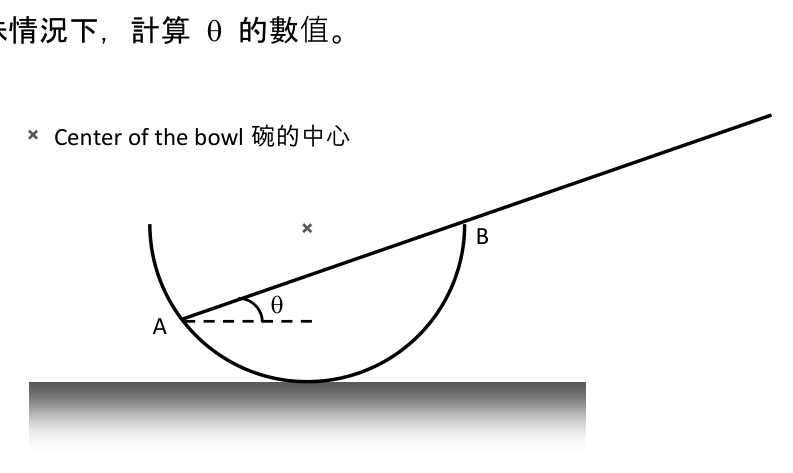
Fig. 2. Rod in semispherical bowl.
Fonte: Testo (PDF) — p.15 Topic: Rigid Body Statics Metodi: Torque & Angular Momentum Analysis, Free-Body Diagram Competenze: Physical Reasoning Objects: Rod
Problemi aperti Problema 2: Rod in vasca semisferica (9 punti).
Una barra uniforme (massa , lunghezza ) è collocata parzialmente all’interno e parzialmente all’esterno di una ciotola emisferica fissa (radio , dove ). La ciotola si posa su un tavolo orizzontale. Quando la canna è in equilibrio, la canna fa un angolo con l’orizzontale. è la lunghezza della canna parzialmente all’interno della ciotola. Ignora tutte le frizioni.
a) Derivare l’angolo e la lunghezza . Esprimere le risposte in termini di e .
b) Indicare il valore numerico per il caso speciale di .
Fig. 2. Rolo in una ciotola semisferica.
Fonte: Testo (PDF) — p.15 Topic: Rigid Body Statics Metodi: Torque & Angular Momentum Analysis, Free-Body Diagram Competenze: Physical Reasoning Objects: Rod
Open Problems — Problem 3: Stacked spheres (24 Marks).
Two spheres are stacked such that an upper sphere (radius , mass ) is put on the top of a stationary lower sphere (radius ; where ). Eventually, under the influence of gravity, the upper sphere rolls without sliding on the surface of the lower stationary sphere. () is the angle between the centers of the upper sphere and the lower sphere, whereas is the angle that the upper sphere rotates. Initially, and .
(a) Find the angular velocities of and . Also obtain the velocity of the upper sphere as a function of . Express your answers in terms of , , (acceleration due to gravity), and .
(b) Find the angle at which the upper sphere will detach from the lower sphere.
(c) Suppose that coefficient of static friction between the two spheres is . Find the minimum value of that the upper sphere starts to slide. Express your answer in terms of .
(d) By considering the coefficient of static friction, find the minimum and maximum values of .
Hints: i) Kinetic energy of the upper sphere at an angular velocity is given by [Revised to: ].
ii) In case of existence of friction, the frictional force, , at an angle is: .
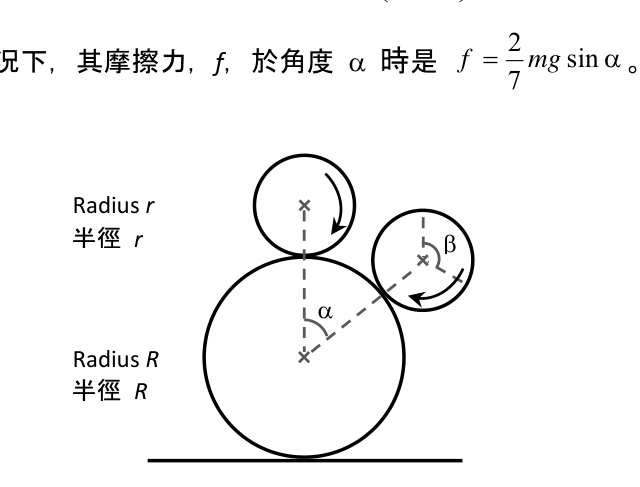
Fig. 3. Stacked sphere.
Fonte: Testo (PDF) — p.16 Topic: Rotational Dynamics Metodi: Conservation of Energy, Torque & Angular Momentum Analysis Competenze: Physical Reasoning Objects: Sphere
Problemi aperti Problema 3: sfere accumulate (24 punti).
Due sfere sono impilate in modo tale che una sfera superiore (radio , massa ) sia posta sulla parte superiore di una sfera inferiore stazionaria (radio ; dove ). Alla fine, sotto l’influenza della gravità, la sfera superiore ruota senza scivolare sulla superficie della sfera stazionaria inferiore. () è l’angolo tra i centri della sfera superiore e la sfera inferiore, mentre è l’angolo che la sfera superiore ruota. Inizialmente e .
(a) Trova le velocità angolari di e . Ottenere anche la velocità della sfera superiore come funzione di . Esprimere le risposte in termini di , , (accelerazione a causa della gravità) e .
b) Trova l’angolo in cui la sfera superiore si stacca dalla sfera inferiore.
c) Supponiamo che il coefficiente di attrito statico tra le due sfere sia . Trova il valore minimo di che la sfera superiore inizia a scivolare. Esprimere la risposta in termini di .
d) Considerando il coefficiente di attrito statico, si trovano i valori minimi e massimi di .
*Insigni: * i) L’energia cinetica della sfera superiore ad una velocità angolare è data da [Revisata a: .
ii) In caso di attrito, la forza di attrito, , ad un angolo è: .
*Fig. 3. Sfera impilata
Fonte: Testo (PDF) — p.16 Topic: Rotational Dynamics Metodi: Conservation of Energy, Torque & Angular Momentum Analysis Competenze: Physical Reasoning Objects: Sphere
Open Problems — Problem 4: A ‘8’ shape oscillator (11 Marks).
Two uniform, thin, and hollow cylinders (radii and , masses and , respectively) are stacked to form an “8” shape such that their diameters are aligned in a straight line. The stacked cylinders is free to oscillate about its axis of oscillation (Fig. 4). The kinetic energy of the stacked cylinders is where is the instantaneous angular velocity about the oscillation axis. A small angle is made to displace the stacked cylinders from the equilibrium position. Figure 4 shows the equilibrium position of the stacked cylinders. At equilibrium position, .
(a) Find the potential energy of the stacked cylinders in terms of , , , , (acceleration due to gravity) and . Take zero potential energy at the level of oscillation axis.
(b) Find the total energy of the oscillator of the stacked cylinders. Express your answer in the form of energy transformation in a simple harmonic mass-spring system, that is, Total Energy , where you may consider as an angular displacement.
(c) Determine the effective mass (), effective spring constant (), and period of the oscillation.
(d) According to the above results, estimate the oscillation period of a single hollow cylinder about the same oscillation axis, that is, without the upper hollow cylinder.
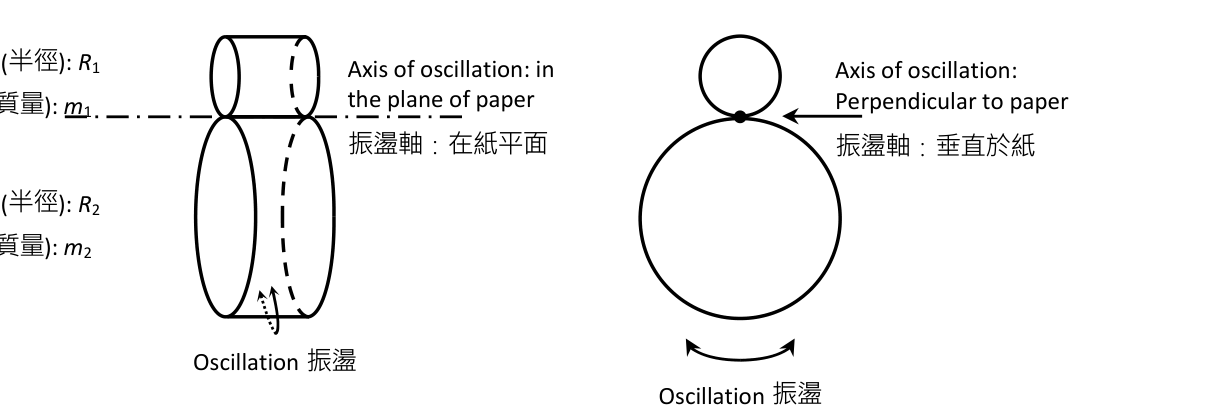
Fig. 4. A ‘8’ shape oscillator.
Fonte: Testo (PDF) — p.17 Topic: Oscillations & Waves Metodi: Simple Harmonic Motion Analysis, Conservation of Energy Competenze: Physical Reasoning Objects: Cylinder
Problemi aperti Problema 4: Oscillatore a forma di 8” (11 punti).
Due cilindri uniformi, sottili e vuoti (radii e , masse e , rispettivamente) sono impilati per formare una forma “8” tale che i loro diametri siano allineati in linea retta. I cilindri impilati sono liberi di oscillare intorno al suo asse di oscillazione (Fig. 4). L’energia cinetica dei cilindri impilati è dove è la velocità angolare istantanea intorno all’asse di oscillazione. Si realizza un angolo piccolo per spostare i cilindri impilati dalla posizione di equilibrio. La figura 4 mostra la posizione di equilibrio dei cilindri impilati. Al punto di equilibrio, .
(a) Trova l’energia potenziale dei cilindri impilati in termini di , , , , (accelerazione a causa della gravità) e . Prendiamo energia potenziale zero al livello dell’asse di oscillazione.
b) Trova l’energia totale dell’oscillatore dei cilindri impilati. Esprimere la risposta sotto forma di trasformazione energetica in un semplice sistema di sorgente di massa armonica, cioè Energia totale , dove si può considerare come uno spostamento angolare.
c) Determinare la massa effettiva (), la costante di molla effettiva () e il periodo di oscillazione.
d) Secondo i risultati precedenti, calcolare il periodo di oscillazione di un singolo cilindro vuoto intorno allo stesso asse di oscillazione, cioè senza il cilindro vuoto superiore.
*Fig. 4. Oscillatore a forma di 8
Fonte: Testo (PDF) — p.17 Topic: Oscillations & Waves Metodi: Simple Harmonic Motion Analysis, Conservation of Energy Competenze: Physical Reasoning Objects: Cylinder
Open Problems — Problem 5: Energy to break up the Sun completely (7 Marks).
By considering the gravitational potential energy to separate all the solar mass to infinity, estimate the energy required to break up the Sun completely. Express your answer in terms of (mass of the Sun), (radius of the Sun), and (Gravitational Constant). You may assume i) the Sun is spherical, and ii) the Sun density is uniform.
Hint: Other than solving integral, the following summation formula may help: where and are integers.
Fonte: Testo (PDF) — p.18 Topic: Gravitation Metodi: Newton’s Law of Gravitation, Calculus-Integration Competenze: Estimation & Approximation Objects: Star
**Problemi aperti Problema 5: Energia per rompere completamente il Sole (7 punti). **
Considerando l’energia potenziale gravitazionale per separare tutta la massa solare fino all’infinito, stimare l’energia necessaria per rompere completamente il Sole. Esprimete la vostra risposta in termini di (massa del Sole), (radio del Sole) e (constante gravitazionale). Si può supporre che i) il Sole sia sferico e ii) la densità del Sole sia uniforme.
*Signore: * Oltre a risolvere l’integrale, la seguente formula di sommazione può aiutare: in cui e sono numeri interi.
Fonte: Testo (PDF) — p.18 Topic: Gravitation Metodi: Newton’s Law of Gravitation, Calculus-Integration Competenze: Estimation & Approximation Objects: Star