The orbital period of the Moon around the Earth is 27.3 days. The orbital period of the Earth around the Sun is 365.3 days. What is the time difference between two full moons?
- (A) 25.3 days
- (B) 25.4 days
- (C) 27.3 days
- (D) 29.3 days
- (E) 29.5 days
Fonte: Testo (PDF) — p.4
Topic: Astrophysics Metodi: Kepler’s Laws, Approximation & Series Expansion Competenze: Physical Reasoning Objects: Satellite, Planet, Star
Il periodo orbitale della Luna intorno alla Terra è di 27,3 giorni. Il periodo orbitale della Terra intorno al Sole è di 365,3 giorni. Qual è la differenza di tempo tra due lune piene?
- **(A) ** 25,3 giorni
- **(B) ** 25,4 giorni
- **(C) ** 27,3 giorni
- **(D) ** 29,3 giorni
- **(E) ** 29,5 giorni
Fonte: Testo (PDF) — p.4
Topic: Astrophysics Metodi: Kepler’s Laws, Approximation & Series Expansion Competenze: Physical Reasoning Objects: Satellite, Planet, Star
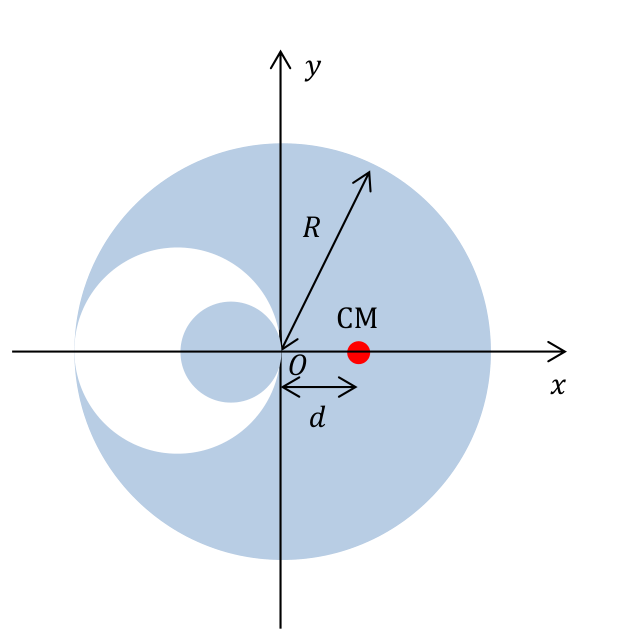
A circular hole with radius is carved from a uniform circular disk of radius . A smaller disk with radius with the same uniform density is then put inside the hole, as shown in the figure below. The center of mass of the whole system is located at a distance from the origin. Find .
- (A)
- (B)
- (C)
- (D)
- (E)
Fonte: Testo (PDF) — p.4
Topic: Newtonian Mechanics Metodi: Physical Modeling, Symmetry Argument Competenze: Physical Reasoning Objects: Disk
Un buco circolare di raggio è scolpito da un disco circolare uniforme di raggio . Un disco più piccolo con raggio con la stessa densità uniforme viene poi inserito all’interno del buco, come mostrato nella figura seguente. Il centro di massa di tutto il sistema si trova a una distanza dall’origine. Trova .
- (A)
- (B)
- (C)
- (D)
- (E)
Fonte: Testo (PDF) — p.4
Topic: Newtonian Mechanics Metodi: Physical Modeling, Symmetry Argument Competenze: Physical Reasoning Objects: Disk
A seconds pendulum clock loses 20 seconds a day at place A but gains 20 seconds a day at another place B. Find the ratio of the accelerations due to gravity at the two places, . Note: a seconds pendulum has a period of 2 seconds.
- (A)
- (B)
- (C)
- (D)
- (E)
Fonte: Testo (PDF) — p.4
Topic: Oscillations & Waves Metodi: Simple Harmonic Motion Analysis, Approximation & Series Expansion Competenze: Physical Reasoning Objects: Pendulum
Un orologio a pendolo di secondi perde 20 secondi al giorno al posto A ma guadagna 20 secondi al giorno in un altro posto B. Trova il rapporto delle accelerazioni dovute alla gravità nei due posti, . Nota: un pendolo di secondi ha un periodo di 2 secondi.
- (A)
- (B)
- (C)
- (D)
- (E)
Fonte: Testo (PDF) — p.4
Topic: Oscillations & Waves Metodi: Simple Harmonic Motion Analysis, Approximation & Series Expansion Competenze: Physical Reasoning Objects: Pendulum
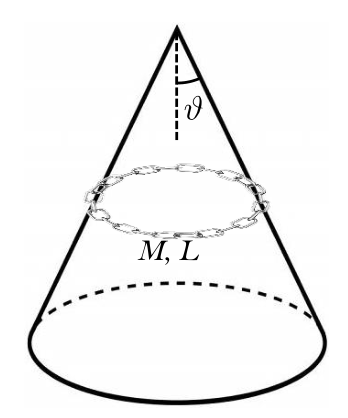
A loop of chain of mass and length (circumference) rests on the slanted surface of a cone. The chain lies in a horizontal plane, and the half-angle of the cone is . Assume that the contact surfaces are smooth. What is the tension in the chain?
- (A)
- (B)
- (C)
- (D)
- (E) None of the above.
Fonte: Testo (PDF) — p.5
Topic: Newtonian Mechanics Metodi: Free-Body Diagram, Vector Decomposition Competenze: Physical Reasoning Objects: String
Un ciclo di catena di massa e lunghezza (circumferenza) si posa sulla superficie inclinata di un cono. La catena si trova in un piano orizzontale e il semicongo del cono è . Supponiamo che le superfici di contatto siano lisce. Qual è la tensione nella catena?
- (A)
- (B)
- (C)
- (D)
- **(E) ** Nessuna delle seguenti.
Fonte: Testo (PDF) — p.5
Topic: Newtonian Mechanics Metodi: Free-Body Diagram, Vector Decomposition Competenze: Physical Reasoning Objects: String
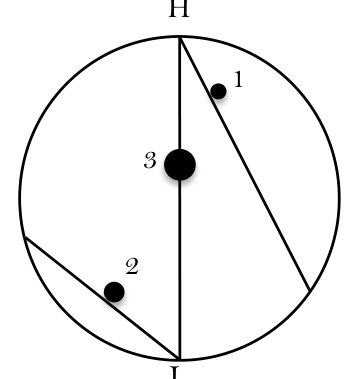
Particle 1 of mass takes time to slide down from rest on a chord starting from the highest point of a vertical circle. Particle 2 of mass takes time to slide down from rest on a chord ending at the lowest point of the circle. Particle 3 of mass takes time to drop from point to point (along the vertical diameter). Assume that the contact surfaces are smooth. Compare , , and .
- (A) .
- (B) .
- (C) .
- (D) .
- (E) Depends on the relative values of the masses.
Fonte: Testo (PDF) — p.5
Topic: Newtonian Mechanics Metodi: Kinematic Equations, Free-Body Diagram Competenze: Physical Reasoning Objects: —
La particella 1 di massa richiede tempo per scivolare dal riposo su un’accordazione partendo dal punto più alto di un cerchio verticale. La particella 2 di massa richiede tempo per scivolare dal riposo su un’accorda che termina al punto più basso del cerchio. La particella 3 di massa deve impiegare per scendere dal punto al punto (lungo il diametro verticale). Supponiamo che le superfici di contatto siano lisce. Compare , e .
- (A) .
- (B) .
- (C) .
- (D) .
- **(E) ** Dipende dai valori relativi delle masse.
Fonte: Testo (PDF) — p.5
Topic: Newtonian Mechanics Metodi: Kinematic Equations, Free-Body Diagram Competenze: Physical Reasoning Objects: —
A satellite is orbiting around the Earth on a circular orbit at velocity . It is hit by an asteroid. After the impact, the radial velocity of the satellite becomes , and the tangential velocity remains at the value . The new orbit of the satellite is
- (A) a circular orbit with a larger orbital radius
- (B) an elliptical orbit
- (C) a parabolic orbit
- (D) a hyperbolic orbit
- (E) an oscillating orbit about a circular trajectory
Fonte: Testo (PDF) — p.6
Topic: Gravitation Metodi: Conservation of Energy, Newton’s Law of Gravitation Competenze: Physical Reasoning Objects: Satellite, Planet
Un satellite sta orbitando intorno alla Terra in orbita circolare a velocità . E’ stato colpito da un asteroide. Dopo l’impatto, la velocità radial del satellite diventa e la velocità tangenziale rimane al valore . La nuova orbita del satellite è
- **(A) ** un’orbita circolare con un raggio orbitale maggiore
- **(B) ** un’orbita ellittica
- **(C) ** un’orbita parabolica
- **(D) ** un’orbita iperbolica
- **(E) ** un’orbita oscillante su una traiettoria circolare
Fonte: Testo (PDF) — p.6
Topic: Gravitation Metodi: Conservation of Energy, Newton’s Law of Gravitation Competenze: Physical Reasoning Objects: Satellite, Planet
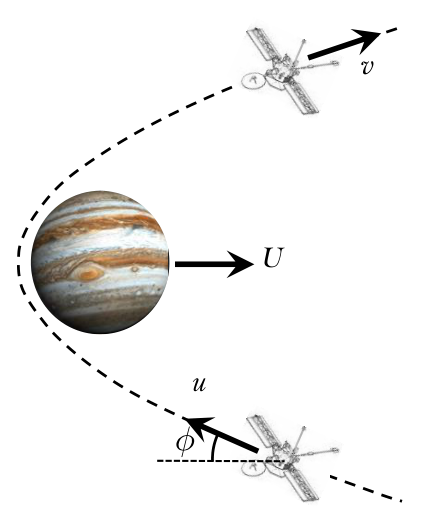
A spacecraft moving with initial velocity approaches Jupiter (which moves with orbital velocity ) at an angle to the planet’s orbital motion. The spacecraft does not enter Jupiter’s atmosphere. The gravitational pull from Jupiter causes the spacecraft to swing around the planet and head off with final velocity in another direction. Note that and are the velocities when the spacecraft is sufficiently far away from Jupiter’s gravitational influence. Find the final velocity of the spacecraft.
- (A)
- (B)
- (C)
- (D)
- (E)
Fonte: Testo (PDF) — p.6
Topic: Gravitation Metodi: Conservation of Energy, Vector Decomposition Competenze: Physical Reasoning Objects: Satellite, Planet
Una nave spaziale in movimento con velocità iniziale si avvicina a Giove (che si muove con velocità orbitale ) ad un angolo al movimento orbitale del pianeta. La sonda spaziale non entra nell’atmosfera di Giove. L’attrazione gravitazionale di Giove fa girare la sonda intorno al pianeta e partire con velocità finale in un’altra direzione. Si noti che e sono le velocità quando la sonda spaziale è abbastanza lontana dall’influenza gravitazionale di Giove. Trova la velocità finale della sonda spaziale.
- (A)
- (B)
- (C)
- (D)
- (E)
Fonte: Testo (PDF) — p.6
Topic: Gravitation Metodi: Conservation of Energy, Vector Decomposition Competenze: Physical Reasoning Objects: Satellite, Planet
A large piece of granite is put on board a boat, which floats in a swimming pool, and the initial water level of the pool is recorded at equilibrium. Now, if the granite is thrown overboard and sinks into the pool, what will happen to the water level of the pool?
- (A) The water level rises.
- (B) The water level drops.
- (C) The water level first rises and then drops to the initial level.
- (D) The water level first drops and then rises to the initial level.
- (E) Cannot be determined without the exact values of the densities of granite and water.
Fonte: Testo (PDF) — p.6
Topic: Fluid Mechanics Metodi: Hydrostatic Equilibrium, Physical Modeling Competenze: Physical Reasoning Objects: —
Un grande pezzo di granito viene messo a bordo di una barca, che galleggia in una piscina, e il livello iniziale dell’acqua della piscina viene registrato in equilibrio. Ora, se il granito viene gettato oltre mare e affonda nella piscina, cosa accadrà al livello dell’acqua della piscina?
- **(A) ** Il livello dell’acqua aumenta.
- **(B) ** Il livello dell’acqua scende.
- **(C) ** Il livello dell’acqua aumenta prima e poi scende al livello iniziale.
- **(D) ** Il livello dell’acqua scende prima e poi sale al livello iniziale.
- **(E) ** Non può essere determinato senza i valori esatti delle densità di granito e acqua.
Fonte: Testo (PDF) — p.6
Topic: Fluid Mechanics Metodi: Hydrostatic Equilibrium, Physical Modeling Competenze: Physical Reasoning Objects: —
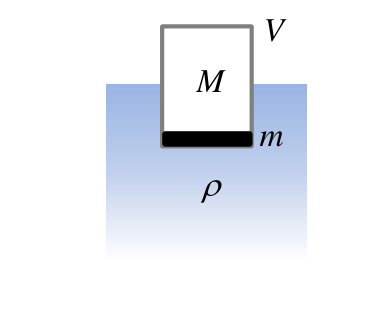
Consider a ship of mass and volume floating in water with density . Assume that its density is uniform and its horizontal and vertical cross sections are rectangular. To prevent the ship from overturning, a thin layer of mass is placed at the bottom floor of the ship. What is the minimum value of ?
- (A)
- (B)
- (C)
- (D)
- (E)
Fonte: Testo (PDF) — p.7
Topic: Fluid Mechanics Metodi: Hydrostatic Equilibrium, Torque & Angular Momentum Analysis Competenze: Physical Reasoning Objects: —
Considerate una nave di massa e volume galleggiante in acqua con densità . Supponiamo che la densità sia uniforme e che le sue sezioni trasversali orizzontali e verticali siano rettangolari. Per evitare che la nave si rovesci, al piano inferiore della nave viene posizionato un sottile strato di massa . Qual è il valore minimo di ?
- (A)
- (B)
- (C)
- (D)
- (E)
Fonte: Testo (PDF) — p.7
Topic: Fluid Mechanics Metodi: Hydrostatic Equilibrium, Torque & Angular Momentum Analysis Competenze: Physical Reasoning Objects: —
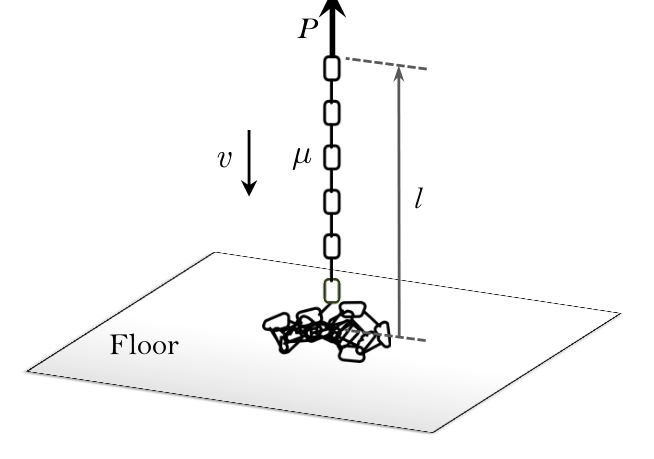
A chain, of mass per unit length , is hung vertically by an upward pull acting at the upper end of the chain. Meanwhile, the chain is lowered onto the floor with velocity . Let be the length of the free-hanging portion of the chain above the floor. Find the acceleration of the top end of the chain.
- (A)
- (B)
- (C)
- (D)
- (E)
Fonte: Testo (PDF) — p.7
Topic: Conservation of Momentum Metodi: Impulse-Momentum Theorem, Free-Body Diagram Competenze: Physical Reasoning Objects: String
Una catena, di massa per lunghezza unitaria , è appesa in verticale da un trazione ascendente che agisce all’estremità superiore della catena. Nel frattempo, la catena viene abbassata sul pavimento con velocità . La deve essere la lunghezza della parte di catena che si appende liberamente sopra il pavimento. Trova l’accelerazione dell’estremità superiore della catena.
- (A)
- (B)
- (C)
- (D)
- (E)
Fonte: Testo (PDF) — p.7
Topic: Conservation of Momentum Metodi: Impulse-Momentum Theorem, Free-Body Diagram Competenze: Physical Reasoning Objects: String
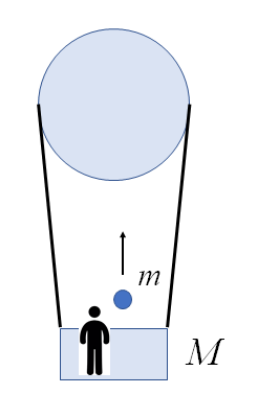
A man with a ball of mass on his hand is sitting on the basket hung by a hot air balloon. The total mass of the balloon, the basket and the man is and the whole system remains at rest in the sky. Suddenly the man throws the ball vertically upward, and the ball falls back to his hand after time . What is the total work done by the man in throwing the ball?
- (A)
- (B)
- (C)
- (D)
- (E)
Fonte: Testo (PDF) — p.8
Topic: Conservation of Momentum Metodi: Conservation of Momentum, Energy Conservation Method Competenze: Physical Reasoning Objects: Ball
Un uomo con una palla di massa sulla mano sta seduto sul cesto appeso da un palloncino ad aria calda. La massa totale del pallone, del cestino e dell’uomo è e l’intero sistema rimane a riposo nel cielo. All’improvviso l’uomo lancia la palla verticalmente verso l’alto, e la palla cade di nuovo nella sua mano dopo il tempo . Qual è il lavoro totale fatto dall’uomo nel lanciare la palla?
- (A)
- (B)
- (C)
- (D)
- (E)
Fonte: Testo (PDF) — p.8
Topic: Conservation of Momentum Metodi: Conservation of Momentum, Energy Conservation Method Competenze: Physical Reasoning Objects: Ball
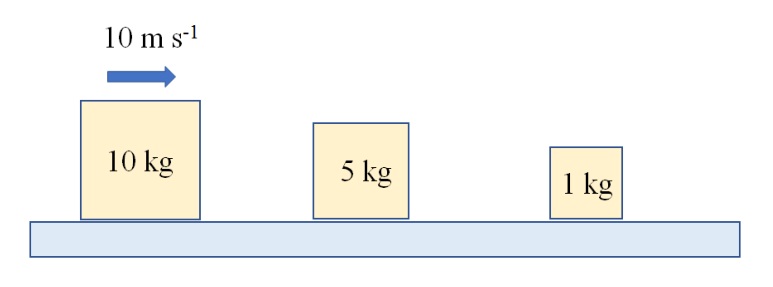
Three blocks with masses 10 kg, 5 kg and 1 kg respectively are sitting on the frictionless tabletop as shown in the figure. Initially, the 10 kg block is moving with to the right. Assume all the collisions are elastic, what is the final velocity of the 1 kg mass after collision?
- (A)
- (B)
- (C)
- (D)
- (E)
Fonte: Testo (PDF) — p.8
Topic: Conservation of Momentum Metodi: Conservation of Momentum, Conservation of Energy Competenze: Physical Reasoning Objects: Block
Tre blocchi di massa rispettivamente di 10 kg, 5 kg e 1 kg sono posti sulla tavola senza attrito, come mostrato nella figura. Inizialmente, il blocco di 10 kg si muove con a destra. Supponiamo che tutte le collisioni siano elastiche, qual è la velocità finale della massa di 1 kg dopo la collisione?
- (A)
- (B)
- (C)
- (D)
- (E)
Fonte: Testo (PDF) — p.8
Topic: Conservation of Momentum Metodi: Conservation of Momentum, Conservation of Energy Competenze: Physical Reasoning Objects: Block
Two blocks with masses 10 kg and 1 kg respectively are sitting on the frictionless tabletop as shown. The coefficients of static and kinetic friction on the interface between two blocks are 0.5 and 0.3 respectively. What is the acceleration of the 1 kg block relative to the 10 kg block if the horizontal force applied on the 10 kg block is 100 N?
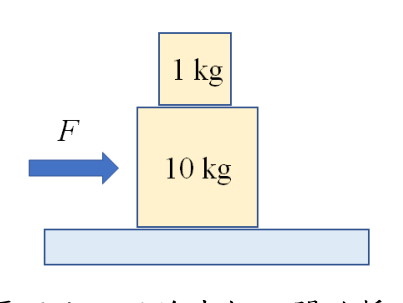
- (A) to the left
- (B) to the right
- (C) to the left
- (D) to the right
- (E)
Fonte: Testo (PDF) — p.8
Topic: Newtonian Mechanics Metodi: Free-Body Diagram, Vector Decomposition Competenze: Physical Reasoning Objects: Block
Due blocchi di massa rispettivamente di 10 kg e 1 kg si trovano sul tavolo senza attrito come mostrato. I coefficienti di attrito statico e cinetico sull’interfaccia tra due blocchi sono rispettivamente 0,5 e 0,3. Qual è l’accelerazione del blocco da 1 kg rispetto al blocco da 10 kg se la forza orizzontale applicata al blocco da 10 kg è di 100 N?
- **(A) ** a sinistra
- **(B) ** a destra
- **(C) ** a sinistra
- **(D) ** a destra
- (E)
Fonte: Testo (PDF) — p.8
Topic: Newtonian Mechanics Metodi: Free-Body Diagram, Vector Decomposition Competenze: Physical Reasoning Objects: Block
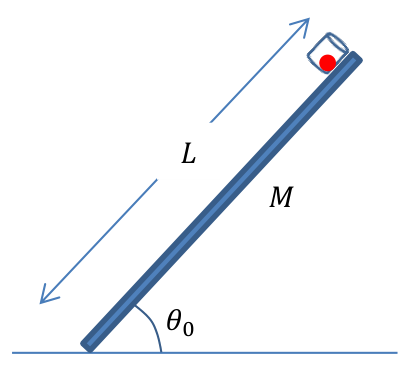
A uniform thin rod with mass and length is initially held at an angle with the ground. A small cup is fixed at the higher end of the rod with the mouth facing outward and a small ball is put inside the cup, as shown in the figure. The masses of the cup and the ball are both negligible. The rod is then released from rest to hit the ground. It is assumed that the friction of the ground is large enough so that the contact point of the rod and the ground remains the same when the rod falls. It is given that the rotational kinetic energy of the rod rotating about its end with angular speed is . At what angle will the ball start to move out of the cup, if the friction between the cup and the ball is negligible?
- (A) At all angles
- (B) At no angle
- (C)
- (D)
- (E)
Fonte: Testo (PDF) — p.9
Topic: Rotational Dynamics Metodi: Energy Conservation Method, Torque & Angular Momentum Analysis Competenze: Physical Reasoning Objects: Rod, Ball
Una canna sottile uniforme di massa e lunghezza è inizialmente tenuta in un angolo con il terreno. Una piccola tazza è fissata all’estremità superiore del bastone con la bocca rivolta verso l’esterno e una piccola palla viene messa all’interno della tazza, come mostrato nella figura. La massa della tazza e della palla sono entrambi trascurabili. La canna viene poi rilasciata dal riposo per colpire il terreno. Si presume che la frizione del terreno sia sufficientemente grande da mantenere lo stesso punto di contatto tra la canna e il terreno quando la canna cade. Si dà conto che l’energia cinetica di rotazione della canna che ruota intorno alla sua estremità con velocità angolare è . A quale angolo la palla inizierà a uscire dalla tazza, se l’attrito tra la tazza e la palla è trascurabile?
- **(A) ** In tutti gli angoli
- **(B) ** In nessun angolo
- (C)
- (D)
- (E)
Fonte: Testo (PDF) — p.9
Topic: Rotational Dynamics Metodi: Energy Conservation Method, Torque & Angular Momentum Analysis Competenze: Physical Reasoning Objects: Rod, Ball
The Grand Coulee Dam is 1270 m long and 170 m high. The electrical power output from generators at its base is approximately W. How many cubic meters of water must flow from the top of the dam per second to produce this amount of power if 92% of the work done on the water by gravity is converted to electrical energy? (Each cubic meter of water has a mass of 1000 kg.)
- (A)
- (B)
- (C)
- (D)
- (E)
Fonte: Testo (PDF) — p.9
Topic: Conservation of Energy Metodi: Energy Conservation Method, Conservation of Energy Competenze: Unit Conversion Objects: —
La diga di Grand Coulee è lunga 1270 m e alta 170 m. La potenza elettrica uscita dei generatori alla sua base è di circa W. Quanti metri cubi d’acqua devono fluire dalla parte superiore della diga al secondo per produrre questa quantità di energia se il 92% del lavoro fatto sull’acqua dalla gravità viene convertito in energia elettrica? (Ogni metro cubo di acqua ha una massa di 1000 kg.)
- (A)
- (B)
- (C)
- (D)
- (E)
Fonte: Testo (PDF) — p.9
Topic: Conservation of Energy Metodi: Energy Conservation Method, Conservation of Energy Competenze: Unit Conversion Objects: —
A mass is hung from the ceiling of a lift by a spring and is initially at rest. The period of oscillation of the mass hung by the spring is . At time the lift starts from rest to move upwards and reaches a constant velocity in a short time. After moving a time interval equal to , the lift stops in a short time. Which one of the following figures represents the time dependence of the height of the mass, measured from the floor of the lift?
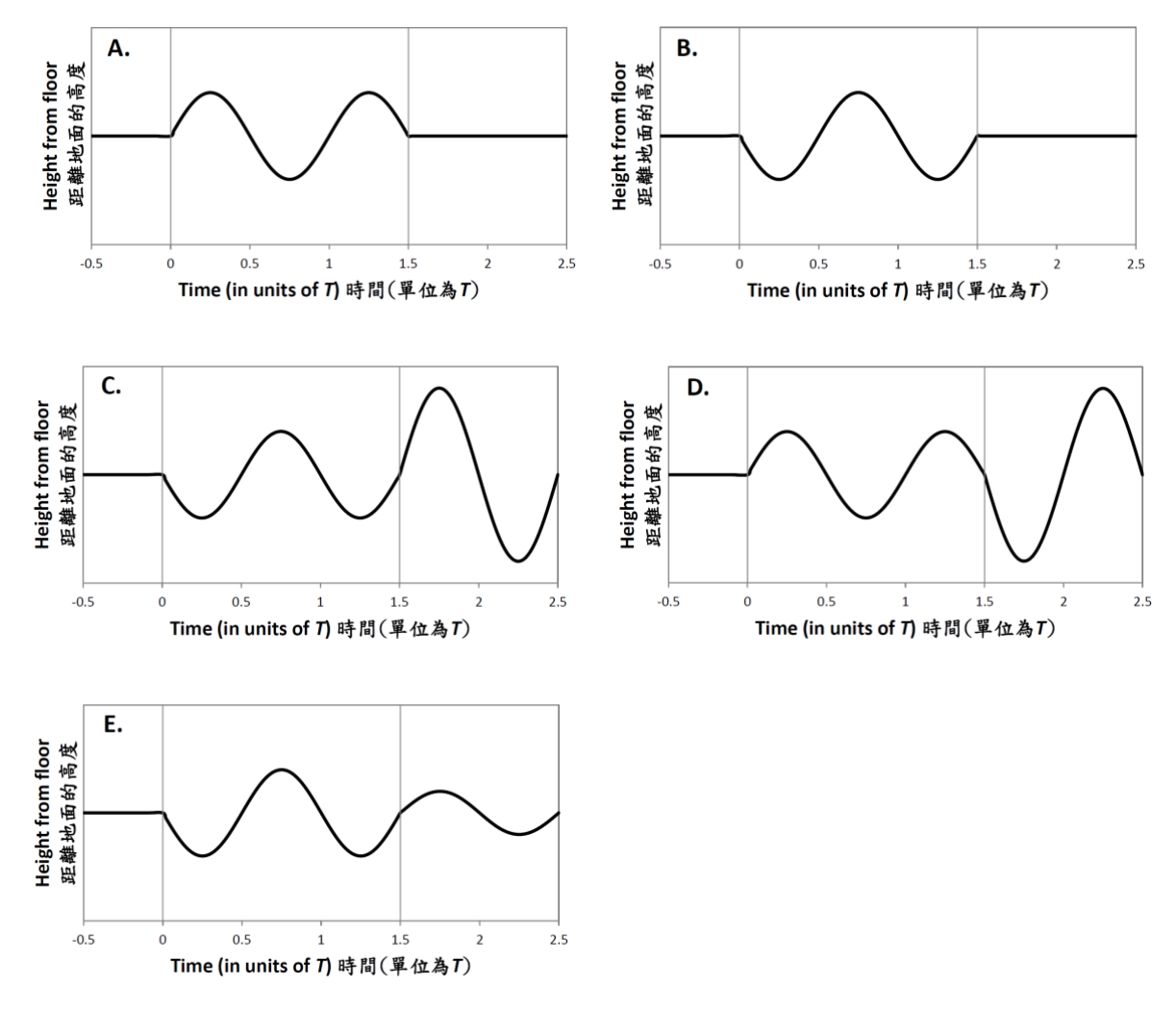
Fonte: Testo (PDF) — p.10
Topic: Oscillations & Waves Metodi: Simple Harmonic Motion Analysis, Physical Modeling Competenze: Diagrammatic Reasoning Objects: Spring
Una massa viene appesa al soffitto di un ascensore da una sorgente e inizialmente è in riposo. Il periodo di oscillazione della massa appesa alla molla è . Al tempo l’ascensore parte dal riposo per muoversi verso l’alto e raggiunge una velocità costante in breve tempo. Dopo aver spostato un intervallo di tempo pari a , l’ascensore si ferma in breve tempo. Quale delle seguenti figure rappresenta la dipendenza temporale dell’altezza della massa, misurata dal pavimento dell’ascensore?
Fonte: Testo (PDF) — p.10
Topic: Oscillations & Waves Metodi: Simple Harmonic Motion Analysis, Physical Modeling Competenze: Diagrammatic Reasoning Objects: Spring
A mass is attached to a spring and allowed to oscillate. The velocity of the mass is shown in the figure. What is the maximum acceleration magnitude of the mass?
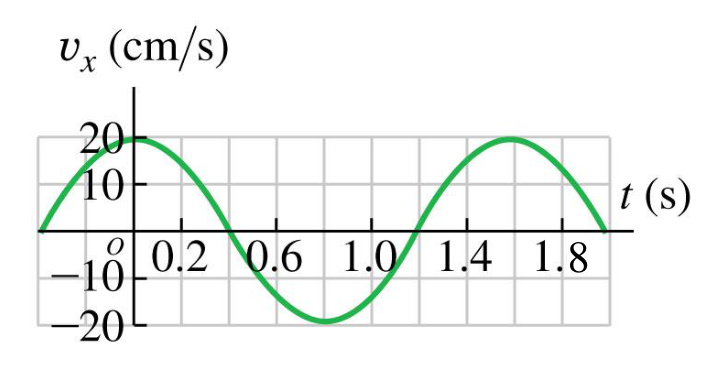
- (A)
- (B)
- (C)
- (D)
- (E)
Fonte: Testo (PDF) — p.10
Topic: Oscillations & Waves Metodi: Simple Harmonic Motion Analysis, Experimental Data Analysis Competenze: Diagrammatic Reasoning Objects: Spring
Una massa è attaccata a una molla e può oscillarsi. La velocità della massa è mostrata nella figura. Qual è la massima grandezza di accelerazione della massa?
- (A)
- (B)
- (C)
- (D)
- (E)
Fonte: Testo (PDF) — p.10
Topic: Oscillations & Waves Metodi: Simple Harmonic Motion Analysis, Experimental Data Analysis Competenze: Diagrammatic Reasoning Objects: Spring
An object is released from rest at time at a height of . Suppose its collision with the ground is inelastic and during every collision the fractional loss in KE is , where . After how much time will the object stop and become at rest on the ground?
- (A)
- (B)
- (C)
- (D)
- (E)
Fonte: Testo (PDF) — p.11
Topic: Conservation of Energy Metodi: Kinematic Equations, Approximation & Series Expansion Competenze: Physical Reasoning Objects: —
Un oggetto viene rilasciato dal riposo al tempo ad un’altezza di . Supponiamo che la collisione con il terreno sia inelastica e che durante ogni collisione la perdita frazionaria in KE sia , dove . Dopo quanto tempo l’oggetto si fermerà e si riposerà a terra?
- (A)
- (B)
- (C)
- (D)
- (E)
Fonte: Testo (PDF) — p.11
Topic: Conservation of Energy Metodi: Kinematic Equations, Approximation & Series Expansion Competenze: Physical Reasoning Objects: —
(Questions 19–20.) Two identical particles A and B with charge and mass are inside a region of uniform and constant downward gravitational field and uniform time-varying electric field , where and are the unit vectors along the and axes respectively. At time , particle A is located at , moving with speed making an angle with the positive -axis. Particle B is initially located at and is launched with speed at an angle measured from the positive -axis, as shown in the figure below. It is given that
It is also given that the electric force acting on a charge under an electric field is . Assume that the electrical and gravitational forces between the particles are negligible.
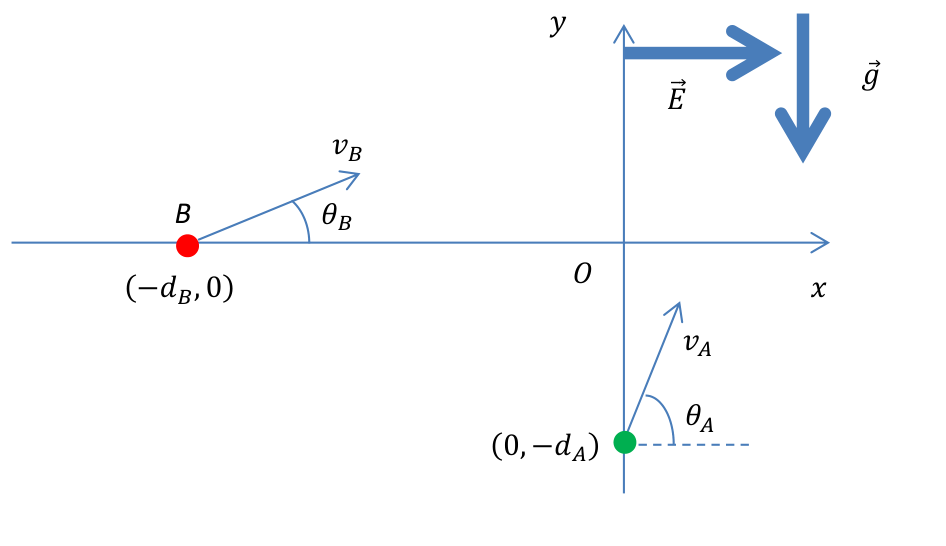
Find the minimum value of so that particle B can hit particle A with certain angle .
- (A)
- (B)
- (C)
- (D)
- (E)
Fonte: Testo (PDF) — p.11
Topic: Electromagnetism Metodi: Kinematic Equations, Vector Decomposition Competenze: Physical Reasoning Objects: Point Charge
*(Questioni 1920.) * Due particelle identiche A e B con carica e massa sono all’interno di una regione di campo gravitazionale uniforme e costante verso il basso e di campo elettrico uniforme variabile nel tempo , dove e sono i vettori unitari lungo gli assi e rispettivamente. Al tempo , la particella A si trova a , muovendosi a velocità , facendo un angolo con l’asse positivo. La particella B è inizialmente situata a e viene lanciata con velocità ad un angolo misurato dall’asse positivo, come mostrato nella figura seguente. Si tratta di un’azione
Si ritiene inoltre che la forza elettrica che agisce su una carica sotto un campo elettrico sia . Supponiamo che le forze elettriche e gravitazionali tra le particelle siano trascurabili.
Trova il valore minimo di in modo che la particella B possa colpire la particella A con un certo angolo .
- (A)
- (B)
- (C)
- (D)
- (E)
Fonte: Testo (PDF) — p.11
Topic: Electromagnetism Metodi: Kinematic Equations, Vector Decomposition Competenze: Physical Reasoning Objects: Point Charge
With the above minimum speed and angle, what is the time at which particle B will hit particle A?
- (A)
- (B)
- (C)
- (D)
- (E)
Fonte: Testo (PDF) — p.12
Topic: Electromagnetism Metodi: Kinematic Equations, Vector Decomposition Competenze: Physical Reasoning Objects: Point Charge
Con la velocità minima e l’angolo sopra indicati, a che ora la particella B colpirà la particella A?
- (A)
- (B)
- (C)
- (D)
- (E)
Fonte: Testo (PDF) — p.12
Topic: Electromagnetism Metodi: Kinematic Equations, Vector Decomposition Competenze: Physical Reasoning Objects: Point Charge
Spider-Man Saving a Train
In the movie Spider-Man 2, Spider-Man uses his spider webs to save a runaway train by bringing it to a stop (see the figures). The train is running at 80 mph on a straight railway. It has six carts and the mass of each cart is 58,000 lb. Spider-Man shoots two identical bundles of spider webs, one bundle from each hand, which sticks firmly onto the buildings on both sides of the train. With the help of the webs, the train is eventually stopped in 50 s. The buildings are so close to the train that the webs can be considered parallel to the railway. Assume that each web bundle acts like a spring of spring constant , and that friction is negligible.
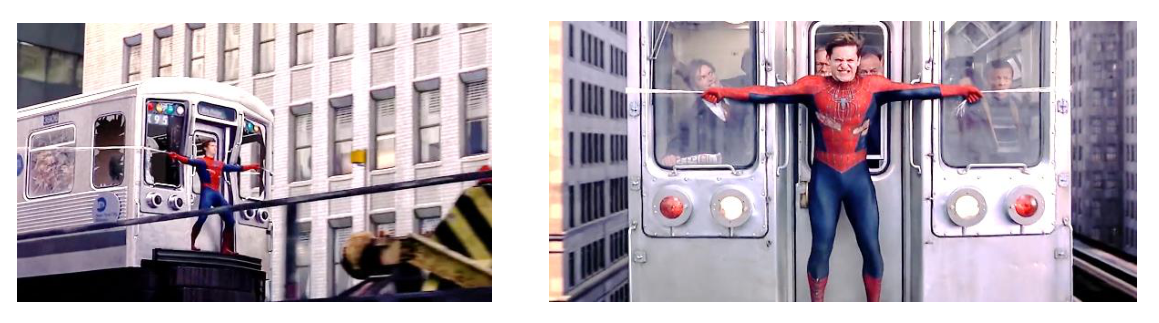
(a) Find the extension of each web bundle. You may take the extension as the distance travelled by the train during its deceleration by the webs.
(b) Find the spring constant of each web bundle.
(c) Find the tension in each web bundle just before the train is stopped.
Give your answers correct to 3 significant figures, in SI units.
[Unit conversions: 1 mph (mile per hour) = 1.61 km/h; 1 kg = 2.2 lb (pounds).]
Fonte: Testo (PDF) — p.13
Topic: Conservation of Energy Metodi: Hooke’s Law, Energy Conservation Method Competenze: Unit Conversion, Significant Figures Objects: Spring
“Spider-Man Salva un Treno”
Nel film Spider-Man 2, Spider-Man usa le sue reti di ragno per salvare un treno in fuga portandolo in fermo (vedi le figure). Il treno corre a 80 mph su una linea di ferro dritta. Ha sei carri e la massa di ogni carro è di 58.000 libbre. Spider-Man spara due identici fasci di ragni, un fascio da ogni mano, che si attacca saldamente agli edifici su entrambi i lati del treno. Con l’aiuto delle reti, il treno finisce per essere fermato in 50 secondi. Gli edifici sono così vicini al treno che le reti possono essere considerate parallele al treno. Supponiamo che ogni fascia di rete agisca come una molla di costante di primavera , e che l’attrito sia trascurabile.
**(a) ** Trova l’estensione di ogni fascia web. L’estensione può essere considerata come la distanza percorsa dal treno durante la sua decelerazione dalle reti.
**(b) ** Trova la costante di primavera di ogni fascia web.
**(c) ** Trova la tensione in ogni fascia web poco prima che il treno si ferma.
Date le risposte corrette a 3 cifre significative, in unità SI.
[Conversioni unitarie: 1 mph (mile/ora) = 1,61 km/h; 1 kg = 2,2 lb (libbre).]
Fonte: Testo (PDF) — p.13
Topic: Conservation of Energy Metodi: Hooke’s Law, Energy Conservation Method Competenze: Unit Conversion, Significant Figures Objects: Spring
A Round Snooker Table
A smooth snooker ball S is struck from point O of a specially-designed circular snooker table. The ball then moves off horizontally in a direction making an angle with the radius CO. The ball makes impacts with the smooth vertical wall of the table before returning to point O. If , . The coefficient of restitution between the ball and the wall is . (The coefficient of restitution is the ratio of the normal speed after the impact to its value before.)
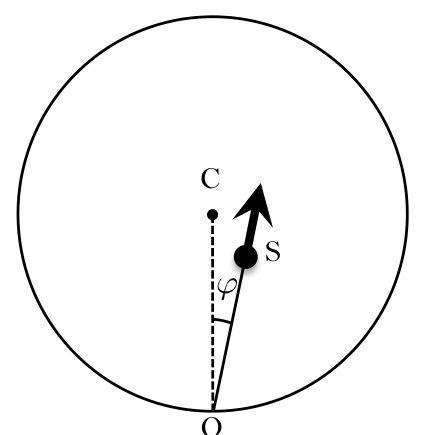
(a) If , find in terms of .
(b) If , find in terms of .
Fonte: Testo (PDF) — p.14
Topic: Newtonian Mechanics Metodi: Conservation of Momentum, Symmetry Argument Competenze: Physical Reasoning Objects: Ball
**Un tavolo rotondo per il snooker **
Una palla da snooker liscia S viene colpita dal punto O di un tavolo da snooker circolare appositamente progettato. La palla si sposta poi orizzontalmente in una direzione che fa un angolo con il raggio CO. La palla fa impatti con la parete verticale liscia del tavolo prima di tornare al punto O. If , . Il coefficiente di restituzione tra la palla e la parete è . (Il coefficiente di restituzione è il rapporto tra la velocità normale dopo l’impatto e il suo valore precedente.)
**(a) ** Se , trovare in termini di .
Se , trovare in termini di .
Fonte: Testo (PDF) — p.14
Topic: Newtonian Mechanics Metodi: Conservation of Momentum, Symmetry Argument Competenze: Physical Reasoning Objects: Ball
Escalator Breakdown
An escalator has a horizontal length m and a height m. It transports passengers upward through its length in 90 s. Each step on the escalator is 0.5 m deep and 0.3 m high. There are 60 steps on the escalator.
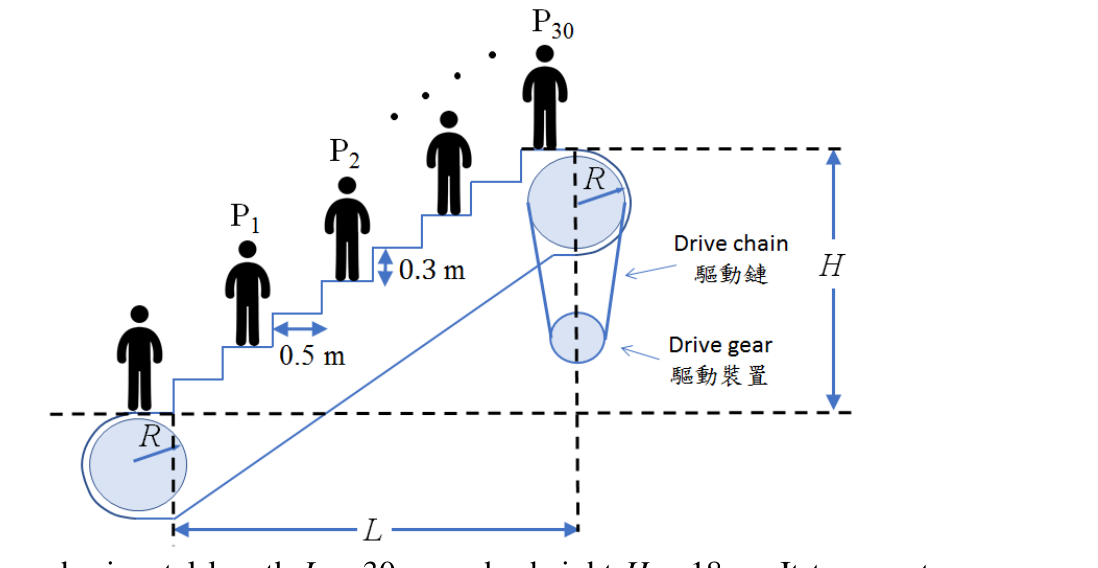
(a) Assume that there is one passenger with mass kg standing on alternating steps of the escalator (i.e. there are 30 passengers on the escalator at any time). What is the minimum power of the electric motor to keep the escalator moving at the steady speed?
(b) Suppose the drive chain is suddenly broken and all the braking devices malfunction. The escalator reverses direction, and sends passengers careening downward with an acceleration. Eventually, all passengers will hit on the ground.
Assume both wheels have mass kg, radius m, and there is one passenger on alternating steps. Initially, the passengers are standing as shown in the figure when the drive chain is broken. What is the velocity of the passengers when the first passenger (P1) hits on the ground?
(Hint: The rotational kinetic energy of a wheel is where is the angular velocity of the wheel.)
(c) What is the velocity of the second passenger (P2) before he/she hits the ground? Assume that the first passenger has left the location.
(d) What is the velocity of the last passenger (P30) before he/she hits the ground? Assume that all passengers hitting the ground earlier have left the location.
(Hint: A useful approximation is: .)
Fonte: Testo (PDF) — p.14
Topic: Conservation of Energy Metodi: Energy Conservation Method, Approximation & Series Expansion Competenze: Physical Reasoning Objects: Wheel
Scompiamento dell’escalatore
Una scala mobile ha una lunghezza orizzontale m e un’altezza m. Trasporta passeggeri verso l’alto per tutta la sua lunghezza in 90 secondi. Ogni gradino della scala mobile è profondo 0,5 m e alto 0,3 m. Ci sono 60 gradini sulla scala mobile.
**(a) ** Supponiamo che ci sia un passeggero di massa kg che sta in piedi su gradini alternati della scala mobile (cioè: ci sono 30 passeggeri in ogni momento sulla scala mobile). Qual è la potenza minima del motore elettrico per mantenere la scala mobile in movimento a velocità costante?
**(b) ** Supponiamo che la catena di trazione sia improvvisamente rotta e tutti i dispositivi di frenata funzionino male. La scala mobile inverte la direzione e manda i passeggeri che si arrampicano verso il basso con un’accelerazione. Alla fine, tutti i passeggeri si schiereranno a terra.
Supponiamo che entrambe le ruote abbiano massa kg, raggio m e che ci sia un passeggero su passaggi alternati. Inizialmente, i passeggeri si trovano in piedi come mostrato nella figura quando la catena di propulsione è rotta. Qual è la velocità dei passeggeri quando il primo passeggero (P1) colpisce il terreno?
(Signore: l’energia cinetica di rotazione di una ruota è , dove è la velocità angolare della ruota.)
Qual è la velocità del secondo passeggero (P2) prima di colpire il suolo? Supponiamo che il primo passeggero abbia lasciato l’ubicazione.
Qual è la velocità dell’ultimo passeggero (P30) prima di colpire il terreno? Supponiamo che tutti i passeggeri che hanno colpito il terreno prima abbiano lasciato l’ubicazione.
(Signore: un approccio utile è: .)
Fonte: Testo (PDF) — p.14
Topic: Conservation of Energy Metodi: Energy Conservation Method, Approximation & Series Expansion Competenze: Physical Reasoning Objects: Wheel
A block of mass and length is sliding on the frictionless table and moves with constant velocity to the right. Suddenly, a small mass is put on the right end of the block. The mass slides relative to the block and falls off the left end of the block. Let the coefficient of friction between the block and mass be .
(a) What is the loss of the total mechanical energy during the process?
(b) What is the final velocity of the mass and the total travelled time of the mass before it falls off the left end?
(c) What is the minimum value of ?
Fonte: Testo (PDF) — p.15
Topic: Newtonian Mechanics Metodi: Free-Body Diagram, Energy Conservation Method, Kinematic Equations Competenze: Physical Reasoning Objects: Block
Un blocco di massa e lunghezza si scivola sulla tavola senza attrito e si muove a velocità costante a destra. All’improvviso, una piccola massa viene posta all’estremità destra del blocco. La massa scorre rispetto al blocco e cade dall’estremità sinistra del blocco. Il coefficiente di attrito tra il blocco e la massa deve essere .
**(a) ** Qual è la perdita totale di energia meccanica durante il processo?
**(b) ** Qual è la velocità finale della massa e il tempo totale di viaggio della massa prima che cadda dall’estremità sinistra?
**(c) ** Qual è il valore minimo di ?
Fonte: Testo (PDF) — p.15
Topic: Newtonian Mechanics Metodi: Free-Body Diagram, Energy Conservation Method, Kinematic Equations Competenze: Physical Reasoning Objects: Block
A space station orbits around the Earth at the height above the Earth’s surface. A small satellite of mass is launched from the space station to arrive at a geostationary orbit, such that the satellite is constantly above a fixed location on Earth’s surface. Find the energy required to launch the satellite. The Earth has mass , radius , and angular velocity . The gravitational constant is .
Fonte: Testo (PDF) — p.15
Topic: Gravitation Metodi: Newton’s Law of Gravitation, Energy Conservation Method, Kepler’s Laws Competenze: Physical Reasoning Objects: Satellite, Planet
Una stazione spaziale orbita intorno alla Terra ad un’altezza sopra la superficie terrestre. Un piccolo satellite di massa viene lanciato dalla stazione spaziale per arrivare ad un’orbita geostazionaria, in modo tale che il satellite sia costantemente sopra una posizione fissa sulla superficie terrestre. Trova l’energia necessaria per lanciare il satellite. La Terra ha massa , raggio e velocità angolare . La costante gravitazionale è .
Fonte: Testo (PDF) — p.15
Topic: Gravitation Metodi: Newton’s Law of Gravitation, Energy Conservation Method, Kepler’s Laws Competenze: Physical Reasoning Objects: Satellite, Planet