It is given that the center of mass of a uniform semi-disc with unit radius is located as shown in the figure below.
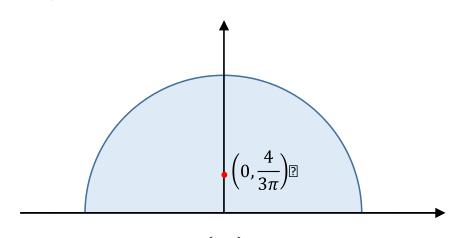 Center of mass of a uniform semi-disc of unit radius, located at above the flat edge at the origin .
Find the center of mass of the following figure.
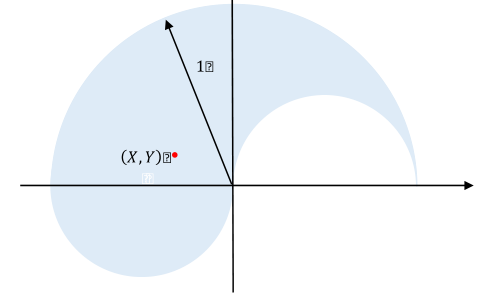 The composite figure: a large semi-disc of radius with a smaller semi-disc removed.
- (A)
- (B)
- (C)
- (D)
- (E)
Fonte: Testo (PDF) — p.4
Topic: Mathematics Metodi: Calculus-Integration, Symmetry Argument Competenze: Mathematical Modeling, Physical Reasoning Objects: Disk
Si dà che il centro di massa di un semidisc uniforme con raggio unitario si trova come mostrato nella figura seguente.
Centro di massa di un semidisc uniforme di raggio unitario, situato a sopra il bordo piatto all’origine .
Trova il centro di massa della figura seguente.
La figura composta: un grande semidisc di raggio con un semidisc più piccolo rimosso.
- (A)
- (B)
- (C)
- (D)
- (E)
Fonte: Testo (PDF) — p.4
Topic: Mathematics Metodi: Calculus-Integration, Symmetry Argument Competenze: Mathematical Modeling, Physical Reasoning Objects: Disk
Two identical blocks with uniform mass and length are stacked at the table edge without falling off the table. What is the maximum overhang distance of two blocks?
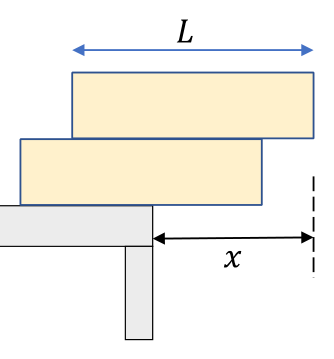 Two identical uniform blocks of length stacked at the edge of a table, with overhang .
- (A)
- (B)
- (C)
- (D)
- (E)
Fonte: Testo (PDF) — p.4
Topic: Rigid Body Statics Metodi: Torque & Angular Momentum Analysis, Free-Body Diagram Competenze: Physical Reasoning, Diagrammatic Reasoning Objects: Block
Due blocchi identici di massa e lunghezza uniformi sono impilati al bordo del tavolo senza cadere dal tavolo. Qual è la distanza massima di sospensione di due blocchi?
Due blocchi uniformi identici di lunghezza impilati al bordo di un tavolo, con sopraffatto .
- (A)
- (B)
- (C)
- (D)
- (E)
Fonte: Testo (PDF) — p.4
Topic: Rigid Body Statics Metodi: Torque & Angular Momentum Analysis, Free-Body Diagram Competenze: Physical Reasoning, Diagrammatic Reasoning Objects: Block
A 50 kg woman stands up in a 75 kg boat of 10 m long. She walks from one end of the boat to the other end. If you ignore resistance to motion of boat in the water and assume that the mass of the boat is uniformly distributed, how far does the boat move during this process?
- (A)
- (B)
- (C)
- (D)
- (E)
Fonte: Testo (PDF) — p.5
Topic: Conservation of Momentum Metodi: Conservation of Momentum, Physical Modeling Competenze: Physical Reasoning Objects: —
Una donna di 50 kg si alza su una barca di 75 kg di lunghezza di 10 metri. Cammina da un’estremità della barca all’altra. Se si ignora la resistenza al movimento della barca nell’acqua e si assume che la massa della barca sia distribuita uniformemente, fino a che punto la barca si muove durante questo processo?
- (A)
- (B)
- (C)
- (D)
- (E)
Fonte: Testo (PDF) — p.5
Topic: Conservation of Momentum Metodi: Conservation of Momentum, Physical Modeling Competenze: Physical Reasoning Objects: —
A uniform rod of length 1 m is supported at two points each by a pivot. The left pivot is fixed and the right one is movable, and the coefficients of friction between the pivots and the rod are the same. The initial positions of the two pivots are and from the left end respectively. Now a leftward external force is horizontally applied to the right pivot. This external force is gradually increased from until sliding motion takes place. Which of the following figures is a possible trajectory of and ?
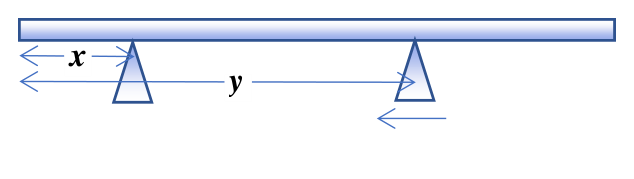 Uniform rod resting on a fixed left pivot (at distance ) and a movable right pivot (at distance ); a leftward horizontal force is applied to the right pivot.
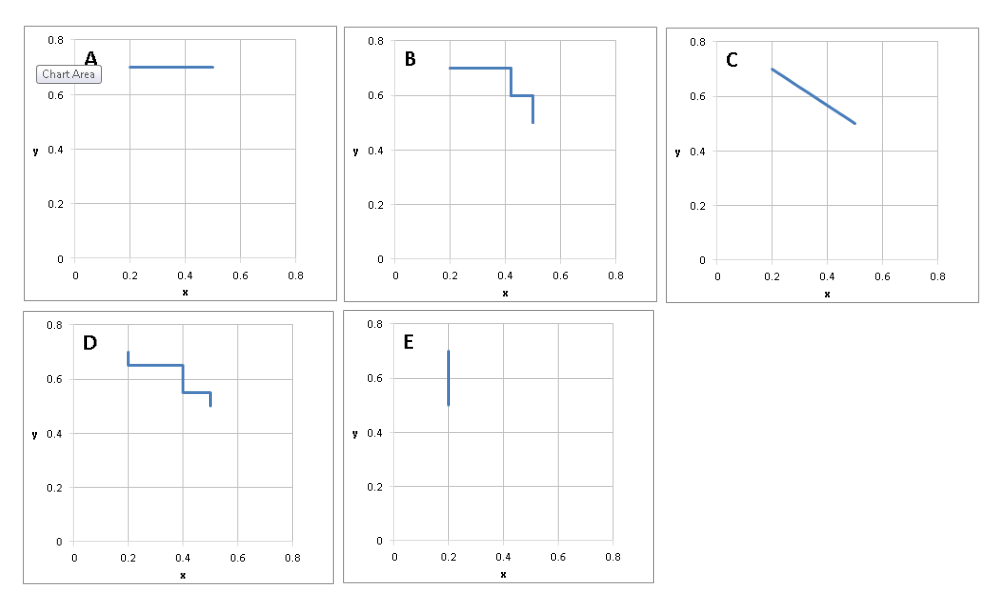 Answer options (A)–(E): candidate trajectories in the – plane.
Fonte: Testo (PDF) — p.5
Topic: Rigid Body Statics Metodi: Torque & Angular Momentum Analysis, Free-Body Diagram Competenze: Physical Reasoning, Diagrammatic Reasoning Objects: Rod
Una barra uniforme di lunghezza di 1 m è sostenuta a due punti ciascuno da un pivot. Il pivot sinistro è fisso e quello destro è mobile, e i coefficienti di attrito tra i pivot e la canna sono gli stessi. Le posizioni iniziali dei due pivot sono rispettivamente e dall’estremità sinistra. Ora una forza esterna verso sinistra viene applicata orizzontalmente al pivot destro. Questa forza esterna è gradualmente aumentata da fino a quando si verifica un movimento di scorrere. Qual è una trajectoria possibile di e tra le seguenti cifre?
Rasta uniforme appoggiata su un pivot fisso sinistro (a distanza ) e su un pivot mobile a destra (a distanza ); viene applicata una forza orizzontale a sinistra sul pivot a destra.
Opzioni di risposta (A)(E): traiettorie candidate nel piano x$$y.
Fonte: Testo (PDF) — p.5
Topic: Rigid Body Statics Metodi: Torque & Angular Momentum Analysis, Free-Body Diagram Competenze: Physical Reasoning, Diagrammatic Reasoning Objects: Rod
A uniform ladder of mass and length is leaning at an angle against a step whose height is . There is static friction between the ladder and the ground but negligible friction between the ladder and the step. What is the minimum value of the coefficient of static friction between the ladder and ground that would be necessary to keep the ladder from moving?
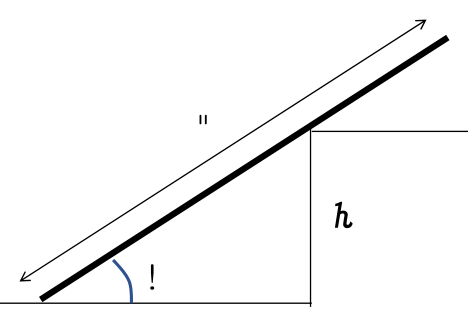 Uniform ladder of length leaning at angle against a step of height .
- (A)
- (B)
- (C)
- (D)
- (E)
Fonte: Testo (PDF) — p.6
Topic: Rigid Body Statics Metodi: Torque & Angular Momentum Analysis, Free-Body Diagram Competenze: Physical Reasoning Objects: Rod
Una scala uniforme di massa e lunghezza si appoggia ad un angolo contro un gradino la cui altezza è . C’è un attrito statico tra la scala e il terreno, ma un attrito trascurabile tra la scala e il gradino. Qual è il valore minimo del coefficiente di attrito statico tra scala e terra necessario per impedire il movimento della scala?
Scala uniforme di lunghezza appoggiata all’angolo contro un gradino di altezza .
- (A)
- (B)
- (C)
- (D)
- (E)
Fonte: Testo (PDF) — p.6
Topic: Rigid Body Statics Metodi: Torque & Angular Momentum Analysis, Free-Body Diagram Competenze: Physical Reasoning Objects: Rod
A homogeneous cylinder of radius and height floats at the interface of two fluids with densities and respectively. If and the density of the homogeneous cylinder is . What is the distance from the center of mass of the cylinder to the interface between two fluids if the cylinder remains stationary?
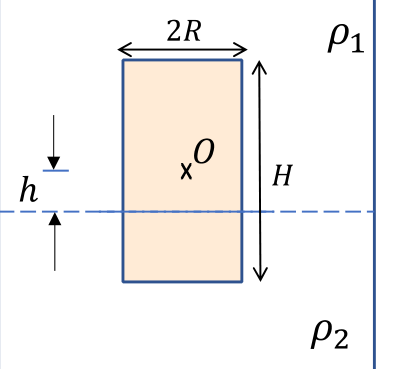 Cylinder of radius and height floating at the interface between fluids of densities (top) and (bottom); is the distance from its center to the interface.
- (A)
- (B)
- (C)
- (D)
- (E)
Fonte: Testo (PDF) — p.6
Topic: Fluid Mechanics Metodi: Hydrostatic Equilibrium, Physical Modeling Competenze: Physical Reasoning Objects: Cylinder
Un cilindro omogeneo di raggio e altezza galleggia all’interfaccia di due fluidi rispettivamente di densità e . Se e la densità del cilindro omogeneo è . Qual è la distanza dal centro di massa del cilindro all’interfaccia tra due fluidi se il cilindro rimane fermo?
Cilindro di raggio e altezza galleggiante all’interfaccia tra fluidi di densità (alto) e (infine); è la distanza dal suo centro all’interfaccia.
- (A)
- (B)
- (C)
- (D)
- (E)
Fonte: Testo (PDF) — p.6
Topic: Fluid Mechanics Metodi: Hydrostatic Equilibrium, Physical Modeling Competenze: Physical Reasoning Objects: Cylinder
Peter is planning to sail a boat across a river. He can sail the boat at a speed of . The water in the river is flowing at the speed of . To arrive at the opposite bank of the river with the smallest distance downstream, what should be the angle between the sailing direction of his boat and the downstream direction of the river?
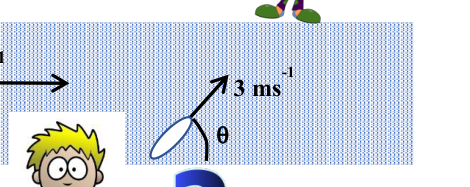 River flowing at ; the boat sails at making angle with the downstream direction.
- (A)
- (B)
- (C)
- (D)
- (E)
Fonte: Testo (PDF) — p.7
Topic: Newtonian Mechanics Metodi: Vector Decomposition, Physical Modeling Competenze: Physical Reasoning, Diagrammatic Reasoning Objects: —
Peter sta pianificando di navigare in barca attraverso un fiume. Può navigare la barca a una velocità . L’acqua nel fiume scorre a velocità . Per arrivare sulla riva opposta del fiume con la più piccola distanza a valle, quale dovrebbe essere l’angolo tra la direzione di vela della sua barca e la direzione a valle del fiume?
Fiume che scorre a ; la barca naviga a facendo angolo con la direzione a valle.
- (A)
- (B)
- (C)
- (D)
- (E)
Fonte: Testo (PDF) — p.7
Topic: Newtonian Mechanics Metodi: Vector Decomposition, Physical Modeling Competenze: Physical Reasoning, Diagrammatic Reasoning Objects: —
Ball A is projected horizontally with velocity at the point . To intercept the ball A, another ball B is projected at the origin with velocity . What is the launching angle of the ball B?
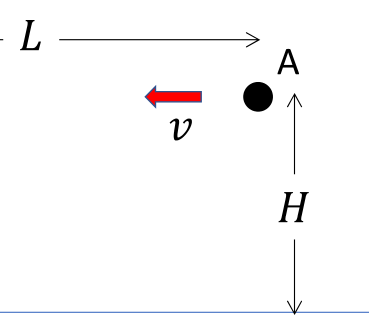 Ball A launched horizontally with speed from ; ball B launched from the origin with speed at angle .
- (A)
- (B)
- (C)
- (D)
- (E)
Fonte: Testo (PDF) — p.7
Topic: Newtonian Mechanics Metodi: Kinematic Equations, Vector Decomposition Competenze: Physical Reasoning Objects: Ball, Projectile
La palla A è proiettata orizzontalmente con velocità al punto . Per intercettare la palla A, viene proiettata un’altra palla B all’origine con velocità . Qual è l’angolo di lancio della palla B?
Bolla A lanciata orizzontalmente con velocità da ; pallina B lanciata dall’origine con velocità all’angolo .
- (A)
- (B)
- (C)
- (D)
- (E)
Fonte: Testo (PDF) — p.7
Topic: Newtonian Mechanics Metodi: Kinematic Equations, Vector Decomposition Competenze: Physical Reasoning Objects: Ball, Projectile
Two friends Sandy and Lilian are playing a game of throwing stones. Lilian is at rest and Sandy is throwing a stone to Lilian once every seconds, while at the same time walking at a constant velocity away from Lilian (a negative means Sandy is walking towards Lilian). The speed of the stone in air is . Lilian receives a stone every seconds. Find .
- (A)
- (B)
- (C)
- (D)
- (E)
Fonte: Testo (PDF) — p.7
Topic: Newtonian Mechanics Metodi: Kinematic Equations, Physical Modeling Competenze: Physical Reasoning Objects: —
Due amiche Sandy e Lilian stanno giocando a lanciare pietre. Lilian è in riposo e Sandy lancia una pietra a Lilian una volta ogni secondi, mentre allo stesso tempo cammina a una velocità costante lontano da Lilian (un negativo significa che Sandy sta camminando verso Lilian). La velocità della pietra nell’aria è . Lilian receives a stone every seconds. Trova .
- (A)
- (B)
- (C)
- (D)
- (E)
Fonte: Testo (PDF) — p.7
Topic: Newtonian Mechanics Metodi: Kinematic Equations, Physical Modeling Competenze: Physical Reasoning Objects: —
Following the previous question. This time Sandy is at rest and Lilian is walking towards Sandy with a constant velocity of , where (a negative means Lilian is walking away from Sandy). Lilian receives a stone every seconds. Find .
- (A)
- (B)
- (C)
- (D)
- (E)
Fonte: Testo (PDF) — p.8
Topic: Newtonian Mechanics Metodi: Kinematic Equations, Physical Modeling Competenze: Physical Reasoning Objects: —
Seguendo la domanda precedente. Questa volta Sandy è in riposo e Lilian sta camminando verso Sandy con una velocità costante di , dove (una negativa significa che Lilian sta allontanandosi da Sandy). Lilian receives a stone every seconds. Trova .
- (A)
- (B)
- (C)
- (D)
- (E)
Fonte: Testo (PDF) — p.8
Topic: Newtonian Mechanics Metodi: Kinematic Equations, Physical Modeling Competenze: Physical Reasoning Objects: —
A massless rope is passed over a frictionless tree branch. A box of mass 12 kg is hung from one end, and a monkey of mass 10 kg is hung from the other end. What should the monkey do to lift up the box? (Choose all valid answers. Marks will only be given if all valid answers are the only chosen ones.)
- (A) Climb up the rope with accelerating speed.
- (B) Climb up the rope with decelerating speed.
- (C) Climb down the rope with accelerating speed.
- (D) Climb down the rope with decelerating speed.
- (E) Climb with a constant speed.
Fonte: Testo (PDF) — p.8
Topic: Newtonian Mechanics Metodi: Free-Body Diagram, Conservation Laws Competenze: Physical Reasoning Objects: String, Block
Una corda senza massa viene passata sopra un ramo di albero senza attrito. Una scatola di massa di 12 kg è appesa da un’altra estremità e una scimmia di massa di 10 kg è appesa dall’altra. Cosa dovrebbe fare la scimmia per sollevare la scatola? (Scegli tutte le risposte valide. I marchi saranno dati solo se tutte le risposte valide sono le uniche scelte.)
- **(A) ** Sali la corda con velocità accelerata.
- **(B) ** Sali sulla corda con velocità decelerante.
- **(C) ** Sali giù la corda con velocità accelerata.
- **(D) ** Sali giù la corda con velocità decelerante.
- **(E) ** Climb con velocità costante.
Fonte: Testo (PDF) — p.8
Topic: Newtonian Mechanics Metodi: Free-Body Diagram, Conservation Laws Competenze: Physical Reasoning Objects: String, Block
As shown in the figure, masses and are connected by a string over a massless, frictionless pulley A. The axle of pulley A is connected by a second string over a second massless, frictionless pulley B to a mass . Pulley B is suspended from the ceiling by an attachment to the axle. The system is released from rest. What is the acceleration of the mass ?
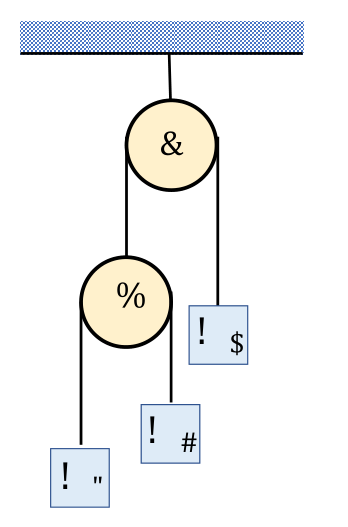 Pulley B hangs from the ceiling and carries mass on one side and pulley A on the other; pulley A carries and . (Figure labels are garbled in the source font: the upper pulley is B, the lower pulley is A.)
- (A) upward
- (B) downward
- (C) upward
- (D) downward
- (E) upward
Fonte: Testo (PDF) — p.9
Topic: Newtonian Mechanics Metodi: Free-Body Diagram, Conservation Laws Competenze: Physical Reasoning, Diagrammatic Reasoning Objects: Pulley, String, Block
Come mostrato nella figura, le masse e sono collegate da una corda su una polla senza massa e senza attrito A. L’asse della pollice A è collegato da una seconda corda su una seconda pollice B senza massa e senza attrito ad una massa . La polla B è sospesa dal soffitto con un attaccamento all’asse. Il sistema è rilasciato dal riposo. Qual è l’accelerazione della massa ?
La pollice B è appesa al soffitto e porta massa da un lato e pollice A dall’altro; la pollice A porta e . (Le etichette figurative sono contorte nel carattere sorgente: la pollice superiore è B, la pollice inferiore è A.)*
- **(A) ** in su
- **(B) ** verso il basso
- **(C) ** in su
- **(D) ** verso il basso
- **(E) ** in su
Fonte: Testo (PDF) — p.9
Topic: Newtonian Mechanics Metodi: Free-Body Diagram, Conservation Laws Competenze: Physical Reasoning, Diagrammatic Reasoning Objects: Pulley, String, Block
A block of mass is attached to a massless rope of length which is initially at rest. A bullet with a mass of and a speed of strikes the block horizontally. The bullet embeds itself there and the whole system swings. Find the maximum angle of the swinging.
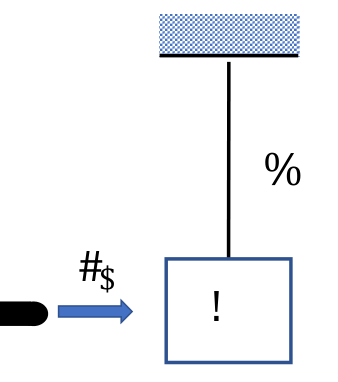 Block of mass on a rope of length , struck horizontally by a bullet of mass and speed ; the system then swings.
- (A)
- (B)
- (C)
- (D)
- (E)
Fonte: Testo (PDF) — p.9
Topic: Conservation of Momentum Metodi: Conservation of Momentum, Conservation of Energy Competenze: Physical Reasoning Objects: Block, String, Pendulum, Projectile
Un blocco di massa è attaccato a una corda senza massa di lunghezza che è inizialmente a riposo. Un proiettile con una massa di e una velocità di colpisce il blocco orizzontalmente. Il proiettile si inserisce lì e tutto il sistema oscilla. Trova l’angolo massimo dell’oscillazione.
Blocco di massa su una corda di lunghezza , colpito orizzontalmente da un proiettile di massa e velocità ; il sistema poi oscilla.
- (A)
- (B)
- (C)
- (D)
- (E)
Fonte: Testo (PDF) — p.9
Topic: Conservation of Momentum Metodi: Conservation of Momentum, Conservation of Energy Competenze: Physical Reasoning Objects: Block, String, Pendulum, Projectile
A 2.00 kg stone is sliding to the right on a frictionless horizontal surface at when it suddenly collides with an object that exerts a large horizontal force to the left on it for a short period of time. The graph shows the magnitude of this force as a function of time. What is the magnitude and direction of the stone’s velocity after collision?
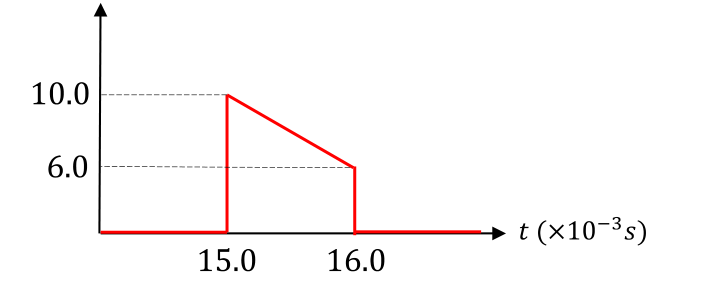 Magnitude of the leftward force (in ) versus time (in ): the force rises to at then decreases linearly to at , where it drops to zero.
- (A) to the left
- (B) to the right
- (C) to the left
- (D) to the right
- (E) to the left
Fonte: Testo (PDF) — p.10
Topic: Newtonian Mechanics Metodi: Impulse-Momentum Theorem, Calculus-Integration Competenze: Diagrammatic Reasoning, Physical Reasoning Objects: —
Una pietra di 2,00 kg scivola a destra su una superficie orizzontale senza attrito a quando si schianta improvvisamente con un oggetto che esercita una grande forza orizzontale a sinistra su di esso per un breve periodo di tempo. Il grafico mostra la grandezza di questa forza come funzione del tempo. Qual è la magnitudo e la direzione della velocità della pietra dopo la collisione?
Magnitude della forza sinistra (in ) contro il tempo (in ): la forza sale a a , poi diminuisce linearmente a a , dove scende a zero.
- **(A) ** a sinistra
- **(B) ** a destra
- **(C) ** a sinistra
- **(D) ** a destra
- **(E) ** a sinistra
Fonte: Testo (PDF) — p.10
Topic: Newtonian Mechanics Metodi: Impulse-Momentum Theorem, Calculus-Integration Competenze: Diagrammatic Reasoning, Physical Reasoning Objects: —
A 1 kg ball is released from rest at a height of 20 m above ground at . After 1 s, a 2 kg ball is thrown downward with an initial speed of . Find the time when the center of mass of the two balls first comes to rest. The collision of the balls and the ground is perfectly inelastic, whereas the collision between the two balls (if they do collide) is elastic.
- (A)
- (B)
- (C)
- (D)
- (E)
Fonte: Testo (PDF) — p.10
Topic: Conservation of Momentum Metodi: Conservation of Momentum, Kinematic Equations Competenze: Physical Reasoning Objects: Ball, Projectile
Una palla di 1 kg viene rilasciata dal riposo ad un’altezza di 20 m sopra il suolo a . Dopo 1 s, una palla da 2 kg viene lanciata verso il basso con una velocità iniziale di . Trova il tempo quando il centro di massa delle due palle si riposa per la prima volta. La collisione tra le palle e il terreno è perfettamente inelastica, mentre la collisione tra le due palle (se si collidono) è elastica.
- (A)
- (B)
- (C)
- (D)
- (E)
Fonte: Testo (PDF) — p.10
Topic: Conservation of Momentum Metodi: Conservation of Momentum, Kinematic Equations Competenze: Physical Reasoning Objects: Ball, Projectile
Three small balls of the same size but different masses are hung side-by-side in parallel on the strings of same length. They touch each other. The first ball of mass is pulled to the height and released from rest. The first ball collides elastically with the second ball of mass and the second ball collides elastically with the third ball of mass afterwards. After these two collisions, three balls will have the same momentum. What is the value of ?
- (A)
- (B)
- (C)
- (D)
- (E)
Fonte: Testo (PDF) — p.10
Topic: Conservation of Momentum Metodi: Conservation of Momentum, Conservation of Energy Competenze: Physical Reasoning Objects: Ball, String, Pendulum
Tre piccole palle della stessa dimensione ma di diverse masse sono appese fianco a fianco in parallelo sulle corde della stessa lunghezza. Si toccano a vicenda. La prima palla di massa viene tirata all’altezza e rilasciata dal riposo. La prima palla colpisce elasticamente la seconda palla di massa e la seconda palla colpisce elasticamente la terza palla di massa successivamente. Dopo queste due collisioni, tre palle avranno lo stesso impulso. Qual è il valore di ?
- (A)
- (B)
- (C)
- (D)
- (E)
Fonte: Testo (PDF) — p.10
Topic: Conservation of Momentum Metodi: Conservation of Momentum, Conservation of Energy Competenze: Physical Reasoning Objects: Ball, String, Pendulum
An astronaut lands on a spherical planet in a distant galaxy. He throws a 2.50 kg stone upward from the ground at and it returns to the ground at . The circumference of the planet is and there is no atmosphere on the planet. If a spaceship goes into a circular orbit above the surface of the planet, how many hours will it take the ship to complete one orbit?
- (A) hours
- (B) hours
- (C) hours
- (D) hours
- (E) hours
Fonte: Testo (PDF) — p.11
Topic: Gravitation Metodi: Newton’s Law of Gravitation, Kepler’s Laws Competenze: Physical Reasoning Objects: Planet, Satellite
Un astronauta atterra’ su un pianeta sferico in una galassia lontana. Il pilota lancia una pietra da 2,50 kg verso l’alto dal suolo a e ritorna al suolo a . La circonferenza del pianeta è e non c’è atmosfera sul pianeta. Se una nave spaziale entra in un’orbita circolare sopra la superficie del pianeta, quante ore ci vorranno per completare una orbita?
- **(A) ** ore
- **(B) ** ore
- **(C) ** ore
- **(D) ** ore
- **(E) ** ore
Fonte: Testo (PDF) — p.11
Topic: Gravitation Metodi: Newton’s Law of Gravitation, Kepler’s Laws Competenze: Physical Reasoning Objects: Planet, Satellite
(Questions 18–19 share the following setup.) A block of mass rests on a frictionless surface and is connected to a horizontal spring of force constant . The other end of the spring is attached to a wall. A second block with mass rests on top of the first block. The coefficient of static friction between the blocks is .
Find the maximum amplitude of oscillation such that the top block will not slip on the bottom block.
- (A)
- (B)
- (C)
- (D)
- (E)
Fonte: Testo (PDF) — p.12
Topic: Oscillations & Waves Metodi: Simple Harmonic Motion Analysis, Free-Body Diagram Competenze: Physical Reasoning Objects: Spring, Block
*(Le domande 1819 hanno la seguente configurazione.) * Un blocco di massa si posa su una superficie senza attrito ed è collegato a una sorgente orizzontale di forza costante . L’altra estremità della sorgente è attaccata a un muro. Un secondo blocco con massa si trova sopra il primo blocco. Il coefficiente di attrito statico tra i blocchi è .
Trova l’ampiezza massima di oscillazione in modo che il blocco superiore non scivoli sul blocco inferiore.
- (A)
- (B)
- (C)
- (D)
- (E)
Fonte: Testo (PDF) — p.12
Topic: Oscillations & Waves Metodi: Simple Harmonic Motion Analysis, Free-Body Diagram Competenze: Physical Reasoning Objects: Spring, Block
(Continuation of the Question 18 setup: , , , .) If the spring is compressed to and the system is released at rest initially. When will the top block slip on the bottom block?
- (A)
- (B)
- (C)
- (D)
- (E)
Fonte: Testo (PDF) — p.12
Topic: Oscillations & Waves Metodi: Simple Harmonic Motion Analysis, Free-Body Diagram Competenze: Physical Reasoning Objects: Spring, Block
*(Continuare la configurazione della domanda 18: , , , .) * Se la molla è compressa a e il sistema viene rilasciato in riposo inizialmente. Quando si scivola il blocco superiore sul blocco inferiore?
- (A)
- (B)
- (C)
- (D)
- (E)
Fonte: Testo (PDF) — p.12
Topic: Oscillations & Waves Metodi: Simple Harmonic Motion Analysis, Free-Body Diagram Competenze: Physical Reasoning Objects: Spring, Block
A small ball of mass rests on a frictionless surface and is connected to a horizontal spring of force constant . The other end of the spring is attached to a wall. At time , the spring is unstretched and the ball is moving to right with initial speed at the origin. There is another wall at distance from the origin where . The collisions between the ball and the wall is elastic. Find the time when the ball will return to the origin for the first time.
- (A)
- (B)
- (C)
- (D)
- (E)
Fonte: Testo (PDF) — p.12
Topic: Oscillations & Waves Metodi: Simple Harmonic Motion Analysis, Energy Conservation Method Competenze: Physical Reasoning Objects: Spring, Ball
Part II — Open Problems (12 marks each).
Una piccola palla di massa si posa su una superficie senza attrito e è collegata a una sorgente orizzontale di forza costante . L’altra estremità della sorgente è attaccata a un muro. Al momento , la molla non è allungata e la palla si muove a destra con la velocità iniziale all’origine. C’è un altro muro a distanza dall’origine dove . Le collisioni tra la palla e la parete sono elastiche. Trova l’ora in cui la palla tornerà all’origine per la prima volta.
- (A)
- (B)
- (C)
- (D)
- (E)
Fonte: Testo (PDF) — p.12
Topic: Oscillations & Waves Metodi: Simple Harmonic Motion Analysis, Energy Conservation Method Competenze: Physical Reasoning Objects: Spring, Ball
Parte II Problemi aperti (12 punti ciascuno).
The trebuchet is a medieval weapon of war – a catapult that is powered by a falling massive counterweight and a swinging arm to throw a projectile. In this problem, we analyze a simplified version of the trebuchet – the see-saw trebuchet (Fig. 1). It has appeared in movies such as The Lord of the Rings: The Return of the King.
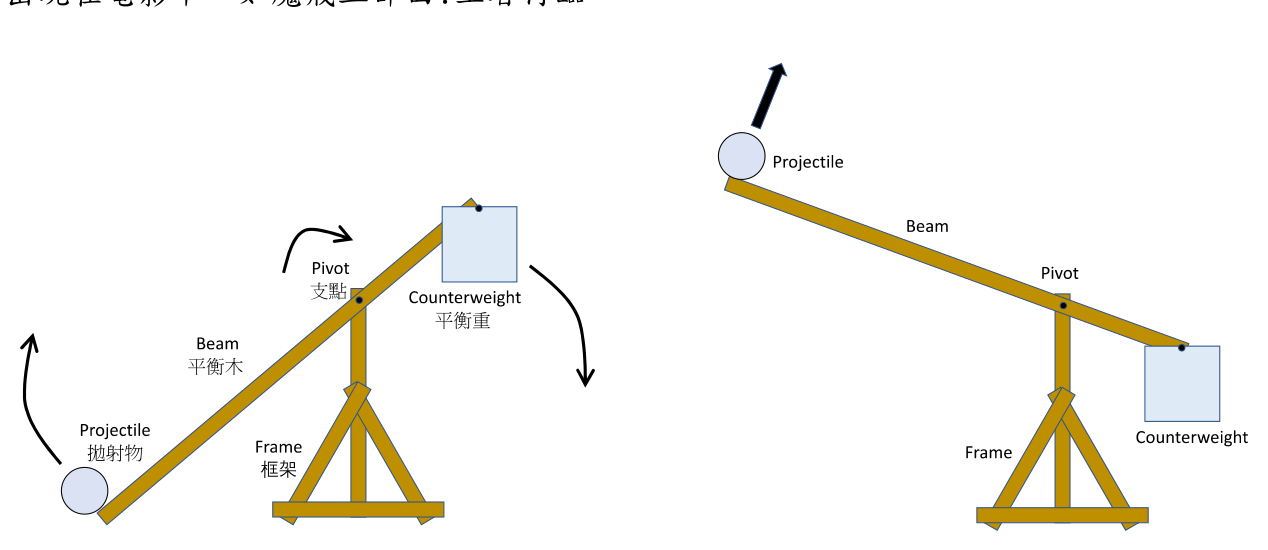 Figure 1: Systematic picture of a see-saw trebuchet, showing the projectile, beam, pivot, counterweight and frame.
In this problem, we fix the pivot at the height above the origin . And here are the parameters you will need:
| Symbol | Value | Description |
|---|---|---|
| mass of projectile | ||
| mass of counterweight | ||
| distance from pivot to counterweight | ||
| distance from pivot to projectile | ||
| — | speed of counterweight | |
| — | speed of projectile | |
| — | beam angle |
To simplify the analysis, assume that the beam is massless. The counterweight and projectile are treated as point masses, and both are released from rest at the initial beam angle .
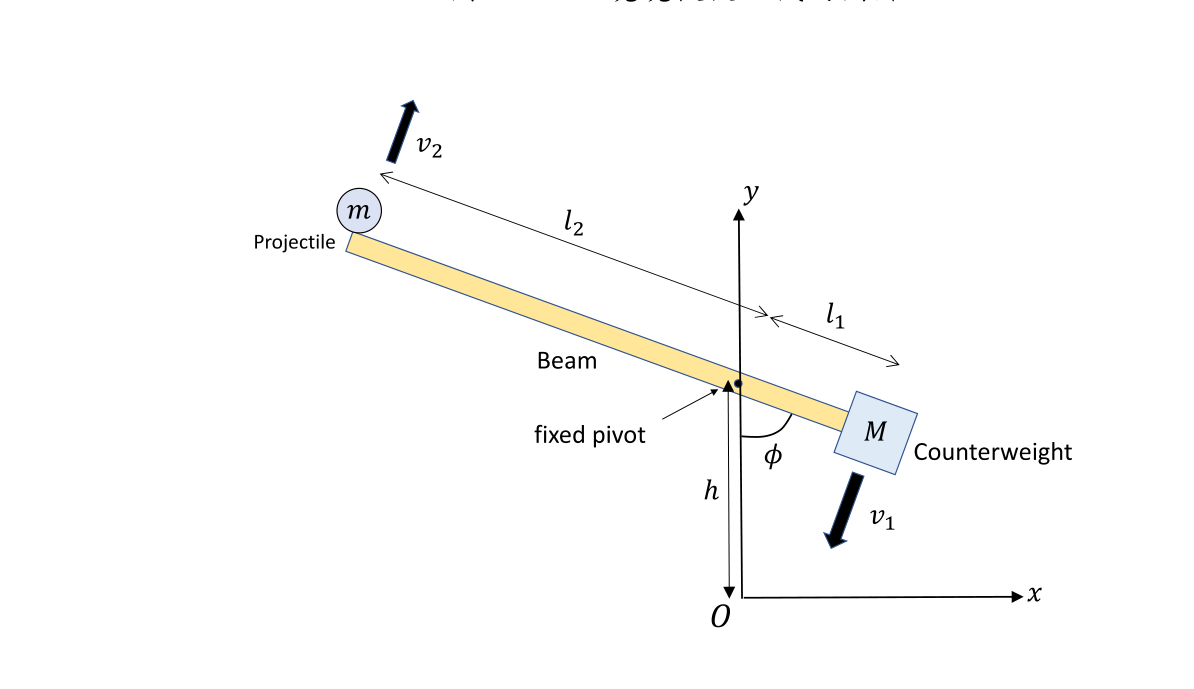 Parametrized see-saw trebuchet: massless beam pivoted at height above the origin , with the projectile (mass , at distance , speed ) and the counterweight (mass , at distance , speed ); the beam makes angle with the horizontal.
(a) Find the relationship between the speed of the counterweight () and the projectile () at angle .
(b) Calculate the total mechanical energy of the system at beam angle in terms of , , , and . Assuming the gravitational potential energy of masses are zero at the initial beam angle .
(c) If the projectile is launched at the beam angle , what is the numerical value of the initial speed () of the projectile?
(d) What is the numerical value of the horizontal range, , of the projectile relative to the origin?
Fonte: Testo (PDF) — p.13
Topic: Conservation of Energy Metodi: Energy Conservation Method, Kinematic Equations Competenze: Physical Reasoning, Mathematical Modeling Objects: Projectile, Beam, Lever
Il trebuchet è un’arma di guerra medievale, una catapulta alimentata da un contropeso massiccio in caduta e da un braccio oscillante per lanciare un proiettile. In questo problema analizziamo una versione semplificata del trebuchet il trebuchet di siera (Fig. 1). È apparso in film come Il Signore degli Anelli: Il ritorno del re.
Figura 1: Immagine sistematica di un traboccetto a scaglie, che mostra proiettile, fascio, pivot, contrapeso e telaio.
In questo problema, fissa il pivot all’altezza sopra l’origine . E ecco i parametri che ti serviranno:
Simbolo Descrizione del valore |---|---|---| | | | mass of projectile | | | | mass of counterweight | ♬ ♬ ♬ Distanza da pivot a contrapeso ♬ | | | distance from pivot to projectile | | | — | speed of counterweight | ♬ ♬ ♬ velocità del proiettile ♬ | | — | beam angle |
Per semplificare l’analisi, supponiamo che il fascio sia senza massa. Il contrappeso e il proiettile sono trattati come masse puntate e entrambi vengono rilasciati dal riposo all’angolo iniziale del fascio .
Tribùceto di seggiatura parametrizzato: fascio senza massa rotato ad un’altezza superiore alla fonte , con il proiettile (massa , a distanza , velocità ) e il contrappeso (massa , a distanza , velocità ); il fascio fa angolo con l’orizzontale.
**(a) ** Trovare la relazione tra la velocità del contrappeso () e il proiettile () all’angolo .
**(b) ** Calcolare l’energia meccanica totale del sistema all’angolo del fascio in termini di , , , e . Supponendo che l’energia potenziale gravitazionale delle masse sia zero all’angolo iniziale del fascio .
(c) If the projectile is launched at the beam angle , what is the numerical value of the initial speed () of the projectile?
**(d) ** Qual è il valore numerico della gamma orizzontale, , del proiettile rispetto all’origine?
Fonte: Testo (PDF) — p.13
Topic: Conservation of Energy Metodi: Energy Conservation Method, Kinematic Equations Competenze: Physical Reasoning, Mathematical Modeling Objects: Projectile, Beam, Lever
An object with mass is initially at rest at a distance above ground on a smooth track, as shown in the figure below.
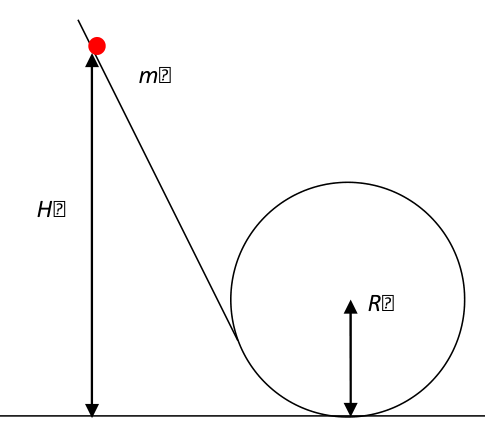 Object of mass released from rest at height on a smooth track whose lower part is a circle of radius .
The lower part of the track is circular and has radius . It is assumed that all frictional forces can be ignored.
(a) Find the critical initial height below which the object cannot complete the whole journey along the circular track.
(b) When , the object will leave the track at some point. Find so that the object will hit the center of the circle after leaving the track.
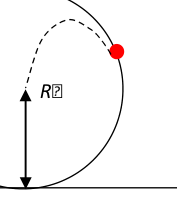 Part (b): for the object leaves the circular track at some point and follows a projectile path toward the center of the circle.
Fonte: Testo (PDF) — p.15
Topic: Conservation of Energy Metodi: Energy Conservation Method, Free-Body Diagram Competenze: Physical Reasoning Objects: —
Un oggetto di massa è inizialmente a riposo a una distanza sopra il suolo su una pista liscia, come mostrato nella figura seguente.
Oggetto di massa rilasciato dal riposo ad altezza su una pista liscia la cui parte inferiore è un cerchio di raggio .
La parte inferiore della pista è circolare e ha un raggio . Si presume che tutte le forze di attrito possano essere ignorate.
**(a) ** Trova l’altezza iniziale critica al di sotto della quale l’oggetto non può completare l’intero viaggio lungo la pista circolare.
**(b) ** Quando , l’oggetto lascerà la traccia in un certo punto. Trova in modo che l’oggetto colpisca il centro del cerchio dopo aver lasciato la pista.
Parte (b): per l’oggetto lascia la traccia circolare in un certo punto e segue un percorso proiettile verso il centro del cerchio.
Fonte: Testo (PDF) — p.15
Topic: Conservation of Energy Metodi: Energy Conservation Method, Free-Body Diagram Competenze: Physical Reasoning Objects: —
An artificial satellite falls back to the Earth due to malfunction. During its last stage just before hitting the ground, its height is much smaller than the Earth’s radius. To avoid its hitting the ground, a projectile is launched to destroy it, as shown in the figure below. Ignore air resistance.
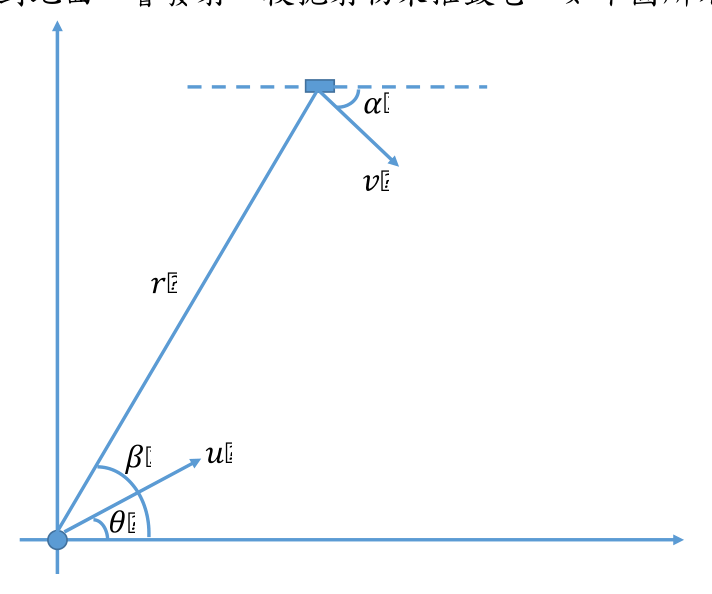 Geometry: the satellite is at distance from the launch point, moving with speed at angle below the horizontal; the projectile is launched from the origin with speed at angle , while is the angle of the line of sight to the satellite.
(a) If , , , , find the time taken for the satellite to hit the ground if it were not hit by the projectile.
(b) Find the minimum value of and the corresponding launching angle so that the projectile can hit the satellite before it hits the ground.
Fonte: Testo (PDF) — p.16
Topic: Newtonian Mechanics Metodi: Kinematic Equations, Vector Decomposition Competenze: Physical Reasoning Objects: Satellite, Projectile
Un satellite artificiale cade sulla Terra a causa di un guasto. Durante l’ultima fase, poco prima di colpire il terreno, la sua altezza è molto inferiore al raggio terrestre. Per evitare che colpisca il terreno, viene lanciato un proiettile per distruggerlo, come mostra la figura seguente. Ignora la resistenza dell’aria.
Geometria: il satellite è a distanza dal punto di lancio, muovendosi con velocità all’angolo al di sotto dell’orizzontale; il proiettile viene lanciato dall’origine con velocità all’angolo , mentre è l’angolo della linea di visione verso il satellite.
**(a) ** Se , , , , si trova il tempo necessario per il satellite per colpire il terreno se non è stato colpito dal proiettile.
**(b) ** Trova il valore minimo di e l’angolo di lancio corrispondente in modo che il proiettile possa colpire il satellite prima di colpire il terreno.
Fonte: Testo (PDF) — p.16
Topic: Newtonian Mechanics Metodi: Kinematic Equations, Vector Decomposition Competenze: Physical Reasoning Objects: Satellite, Projectile
There is a box A of length on the smooth horizontal surface. The center of mass of the box is located at its middle position. Inside the box, there is a block B with negligible size. Box A and block B have the same mass. Initially, box A is at rest and block B is located at the middle of A and moves to the right with an initial speed . The coefficient of friction between A and B is and the collisions between the left and right walls of A and B are elastic.
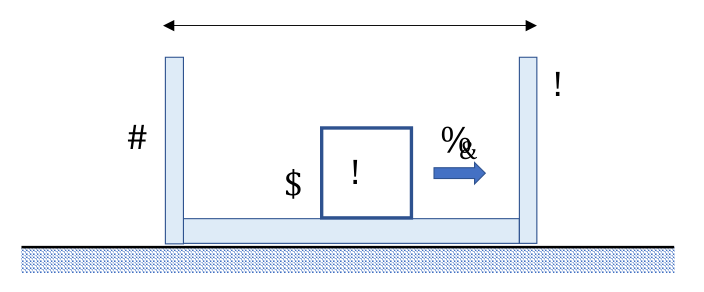 Box A of length on a smooth surface, with block B (negligible size) initially at the middle of A moving right with speed .
(a) How many collisions occur between the walls of box A and block B?
(b) What is the horizontal displacement of box A from the initial moment to the moment when block B has just reached the relatively stationary position inside the box?
Fonte: Testo (PDF) — p.17
Topic: Conservation of Momentum Metodi: Conservation of Momentum, Conservation of Energy Competenze: Physical Reasoning Objects: Block
La superficie orizzontale liscia è caratterizzata da una casella A di lunghezza . Il centro di massa della scatola si trova nella sua posizione centrale. All’interno della scatola c’è un blocco B di dimensioni trascurabili. La casella A e il blocco B hanno la stessa massa. Inizialmente, la casella A è in riposo e il blocco B si trova al centro di A e si muove a destra con una velocità iniziale . Il coefficiente di attrito tra A e B è e le collisioni tra le pareti sinistra e destra di A e B sono elastiche.
Box A di lunghezza su una superficie liscia, con blocco B (dimensione trascurabile) inizialmente al centro di A che si muove a destra con velocità .
**(a) ** Quante collisioni si verificano tra le pareti della casella A e del blocco B?
**(b) ** Qual è il spostamento orizzontale della casella A dal momento iniziale al momento in cui il blocco B ha appena raggiunto la posizione relativamente stazionaria all’interno della casella?
Fonte: Testo (PDF) — p.17
Topic: Conservation of Momentum Metodi: Conservation of Momentum, Conservation of Energy Competenze: Physical Reasoning Objects: Block
Assume that there are two point particles A and B in space with masses and respectively. Initially, the separation between A and B is . A is at rest and B moves with initial velocity along the line AB. An external force is applied to B in the direction of its motion such that the velocity of B is maintained at a constant.
(a) If , what is the magnitude of the external force when the separation between A and B is maximum. (Hint: you should consider the inertia reference frame where B is at rest.)
(b) Calculate the total work done by the external force from the beginning to the time when two particles are maximally separated.
(c) If , calculate the total work done by the external force from the beginning to the time when two particles are maximally separated.
Fonte: Testo (PDF) — p.18
Topic: Gravitation Metodi: Newton’s Law of Gravitation, Energy Conservation Method Competenze: Physical Reasoning Objects: —
Supponiamo che ci siano due particelle puntate A e B nello spazio con masse e rispettivamente. Inizialmente, la separazione tra A e B è . A è in riposo e B si muove con velocità iniziale lungo la linea AB. Una forza esterna viene applicata a B nella direzione del suo movimento in modo tale che la velocità di B sia mantenuta costante.
Se , qual è la magnitudine della forza esterna quando la separazione tra A e B è massima. (Signore: si deve considerare il quadro di riferimento di inerzia dove B è a riposo.)
**(b) ** Calcolare il lavoro totale svolto dalla forza esterna dall’inizio fino al momento in cui due particelle sono separate al massimo.
**(c) ** Se , calcolare il lavoro totale svolto dalla forza esterna dall’inizio fino al momento in cui due particelle sono separate al massimo.
Fonte: Testo (PDF) — p.18
Topic: Gravitation Metodi: Newton’s Law of Gravitation, Energy Conservation Method Competenze: Physical Reasoning Objects: —