The figure shows the position of an object (moving along a straight line) as a function of time. Assume two significant figures in each number. Which of the following statements about this object is true over the interval shown?
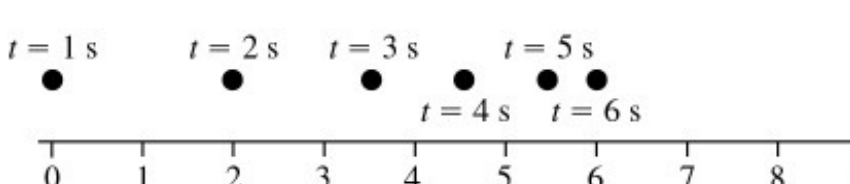
- (A) The object is accelerating to the right.
- (B) The average speed of the object is .
- (C) The acceleration of the object is in the same direction as its velocity.
- (D) The object is accelerating to the left.
- (E) The acceleration of the object is in the same direction as its displacement.
Fonte: Testo (PDF) — p.4
Topic: Newtonian Mechanics Metodi: Kinematic Equations, Graph Linearization Competenze: Diagrammatic Reasoning, Physical Reasoning Objects: —
La figura mostra la posizione di un oggetto (movendo lungo una linea retta) come funzione del tempo. Supponiamo due cifre significative in ogni numero. Quale delle seguenti affermazioni su questo oggetto è vera nell’intervallo mostrato?
- **(A) ** L’oggetto si sta accelerando a destra.
- **(B) ** La velocità media dell’oggetto è .
- **(C) ** L’accelerazione dell’oggetto è nella stessa direzione della sua velocità.
- **(D) ** L’oggetto si sta accelerando verso sinistra.
- **(E) ** L’accelerazione dell’oggetto è nella stessa direzione del suo spostamento.
Fonte: Testo (PDF) — p.4
Topic: Newtonian Mechanics Metodi: Kinematic Equations, Graph Linearization Competenze: Diagrammatic Reasoning, Physical Reasoning Objects: —
Shown below are the velocity and acceleration vectors for a person in several different types of motion. In which case is the person slowing down and turning to his right?
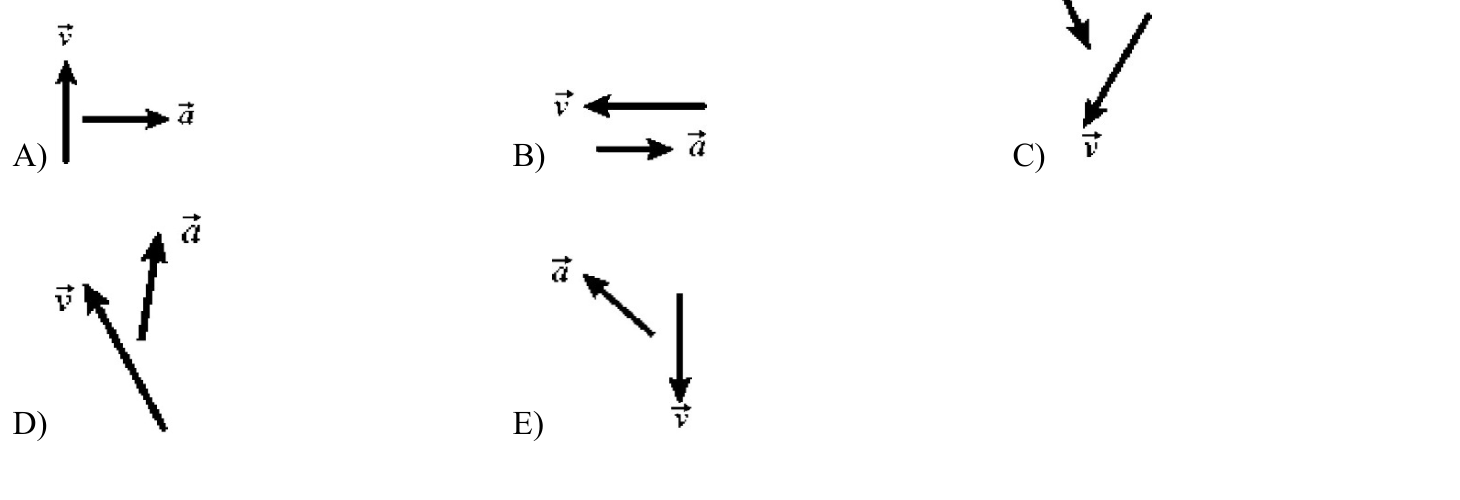
Fonte: Testo (PDF) — p.4
Topic: Newtonian Mechanics Metodi: Vector Decomposition, Kinematic Equations Competenze: Diagrammatic Reasoning, Physical Reasoning Objects: —
Sotto sono mostrati i vettori di velocità e accelerazione per una persona in diversi tipi di movimento. In quale caso la persona si rallenta e si gira a destra?
Fonte: Testo (PDF) — p.4
Topic: Newtonian Mechanics Metodi: Vector Decomposition, Kinematic Equations Competenze: Diagrammatic Reasoning, Physical Reasoning Objects: —
You are standing in a moving bus, facing forward, and you suddenly fall forward when the bus comes to a stop. The force acting on your body to make you fall forward is
- (A) the force due to static friction between you and the floor of the bus
- (B) the force due to kinetic friction between you and the floor of the bus
- (C) the force of gravity
- (D) the normal force due to your contact with the floor of the bus
- (E) No forces acting on you to cause you to fall.
Fonte: Testo (PDF) — p.5
Topic: Newtonian Mechanics Metodi: Free-Body Diagram Competenze: Physical Reasoning Objects: —
Stai in un autobus in movimento, rivolto in avanti, e improvvisamente ti trovi cadendo in avanti quando l’autobus si ferma. La forza che agisce sul tuo corpo per farti cadere in avanti è
- **(A) ** la forza dovuta a attrito statico tra te e il pavimento dell’autobus
- **(B) ** la forza dovuta alla frizione cinetica tra te e il pavimento dell’autobus
- **(C) ** la forza di gravità
- **(D) ** la forza normale dovuta al tuo contatto con il pavimento dell’autobus
- Non ci sono forze che ti influenzano per farti cadere.
Fonte: Testo (PDF) — p.5
Topic: Newtonian Mechanics Metodi: Free-Body Diagram Competenze: Physical Reasoning Objects: —
A worker at the local grocery store has a job consisting of the following five segments:
- picking up boxes of tomatoes from the stockroom floor
- accelerating to a comfortable speed
- carrying the boxes to the tomato display shelf at constant speed
- decelerating to a stop
- lowering the boxes slowly to the floor
During which of the five segments of the job does the stock person do positive work on the boxes?
- (A) (1) only
- (B) (1) and (5)
- (C) (1), (2), (4) and (5)
- (D) (1) and (2)
- (E) (2) and (3)
Fonte: Testo (PDF) — p.5
Topic: Conservation of Energy Metodi: Energy Conservation Method, Free-Body Diagram Competenze: Physical Reasoning Objects: —
Un lavoratore del negozio di alimentari locale ha un lavoro composto dai seguenti cinque segmenti:
- raccogliere scatole di pomodori dal pavimento del magazzino
- Accelerazione a una velocità confortevole
- trasportare le scatole sul ripostiglio di pomodori a velocità costante
- rallentare fino a fermarsi
- abbassare lentamente le scatole al pavimento
In quale dei cinque segmenti del lavoro il gestore di magazzini fa un lavoro positivo sulle scatole?
- solo **(A) ** (1)
- **(B) ** (1) e (5)
- **(C) ** (1), (2), (4) e (5)
- **(D) ** (1) e (2)
- **(E) ** (2) e (3)
Fonte: Testo (PDF) — p.5
Topic: Conservation of Energy Metodi: Energy Conservation Method, Free-Body Diagram Competenze: Physical Reasoning Objects: —
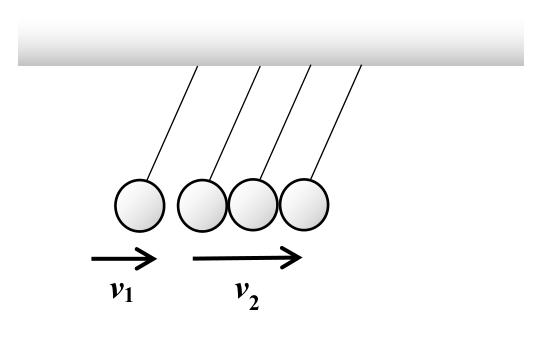
A Newton’s cradle consists of four solid balls of equal mass hung on a bar. When the left ball undergoes an elastic collision with the other balls, it is traveling at the velocity and the other three balls are traveling at the velocity . Here, . What is the velocity of the right ball after the collision?
- (A)
- (B)
- (C)
- (D)
- (E) none of the above
Fonte: Testo (PDF) — p.5
Topic: Conservation of Momentum Metodi: Conservation of Momentum, Conservation of Energy Competenze: Physical Reasoning Objects: Ball, Pendulum
La culla di Newton è costituita da quattro sfere solide di massa uguale appese su una barra. Quando la palla sinistra subisce una collisione elastica con le altre palle, essa si muove alla velocità e le altre tre palle si muovono alla velocità . Qui, . Qual è la velocità della palla destra dopo la collisione?
- (A)
- (B)
- (C)
- (D)
- **(E) ** nessuna delle seguenti:
Fonte: Testo (PDF) — p.5
Topic: Conservation of Momentum Metodi: Conservation of Momentum, Conservation of Energy Competenze: Physical Reasoning Objects: Ball, Pendulum
A bunch of bananas hangs at the end of a rope which passes over a pulley fixed to a tree. The pulley is very light and frictionless. A monkey of mass equal to the mass of the bananas hangs at the other end of the rope. The monkey and the bananas are initially balanced and at rest. Now the monkey starts to climb up the rope, moving away from the ground with speed . What happens to the bananas?
- (A) They move up at speed .
- (B) They move downward at speed .
- (C) They move up at speed .
- (D) They remain stationary.
- (E) They move up at speed .
Fonte: Testo (PDF) — p.6
Topic: Newtonian Mechanics Metodi: Free-Body Diagram, Conservation of Momentum Competenze: Physical Reasoning Objects: String, Pulley
Un mucchio di banane appesa alla fine di una corda che passa sopra una polla fissata ad un albero. La polla è molto leggera e senza attriti. Una scimmia di massa uguale alla massa delle banane è appesa all’altra estremità della corda. La scimmia e le banane sono inizialmente equilibrate e a riposo. Ora la scimmia inizia a salire la corda, allontanandosi dal terreno con velocità . Che succede alle banane?
- **(A) ** Si muovono a velocità .
- **(B) ** Si muovono verso il basso a velocità .
- **(C) ** Si muovono in salita a velocità .
- **(D) ** Restano fermi.
- **(E) ** Si muovono a velocità .
Fonte: Testo (PDF) — p.6
Topic: Newtonian Mechanics Metodi: Free-Body Diagram, Conservation of Momentum Competenze: Physical Reasoning Objects: String, Pulley
Suppose the death star in the Star Wars series can be modelled as a huge space station with the shape of a hollow sphere, a uniform spherical shell in the empty space. Now, you stand against the inner wall and fire a bullet to the other side of the inner wall as illustrated. The dashed line is its firing direction in a straight line. Which of the following will describe the motion of the bullet?
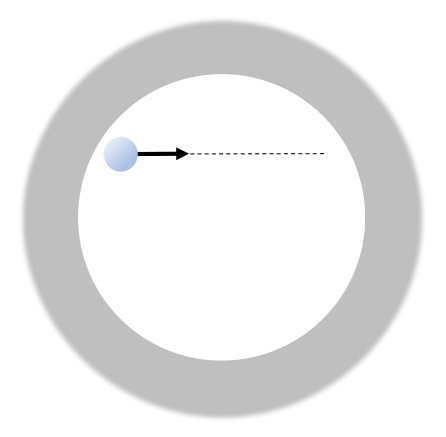
- (A) The bullet bends upwards and accelerates with larger speed.
- (B) The bullet travels with constant velocity along the dashed line.
- (C) The bullet decelerates and accelerates back to the original velocity when it hits the other side of wall.
- (D) The bullet accelerates and decelerates back to the original velocity when it hits the other side of wall.
- (E) None of the above is correct.
Fonte: Testo (PDF) — p.6
Topic: Gravitation Metodi: Newton’s Law of Gravitation, Symmetry Argument Competenze: Physical Reasoning Objects: Sphere, Projectile
Supponiamo che la stella della morte della serie Star Wars possa essere modellata come una enorme stazione spaziale con la forma di una sfera vuota, un guscio sferico uniforme nello spazio vuoto. Ora, si sta contro il muro interno e sparare un proiettile all’altro lato del muro interno come illustrato. La linea tracciata è la sua direzione di fuoco in linea retta. Quale delle seguenti descriverà il movimento del proiettile?
- **(A) ** Il proiettile si piega verso l’alto e accelera con una velocità maggiore.
- **(B) ** Il proiettile si muove con velocità costante lungo la linea tracciata. Il proiettile rallenta e accelera alla velocità originale quando colpisce l’altro lato del muro. Il proiettile accelera e rallenta alla velocità originale quando colpisce l’altro lato del muro.
- **(E) ** Nessuna delle indicazioni sopra esposte è corretta.
Fonte: Testo (PDF) — p.6
Topic: Gravitation Metodi: Newton’s Law of Gravitation, Symmetry Argument Competenze: Physical Reasoning Objects: Sphere, Projectile
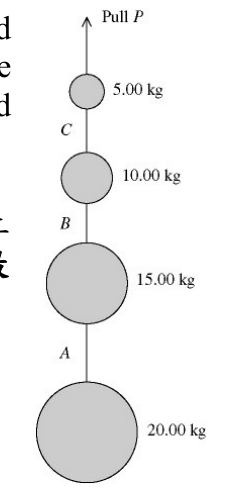
A series of weights connected by very light cords are given a vertically upward acceleration of by a pull , as shown in the figure. , , and are the tensions in the connecting cords. The SMALLEST of the three tensions, , , and , is closest to
- (A)
- (B)
- (C)
- (D)
- (E)
Fonte: Testo (PDF) — p.7
Topic: Newtonian Mechanics Metodi: Free-Body Diagram, Vector Decomposition Competenze: Physical Reasoning Objects: Block, String
Una serie di pesi collegate da cavi molto leggeri riceve un’accelerazione verticale verso l’alto di con un trazione , come mostrato nella figura. , e sono le tensioni dei fili di connessione. Il SMALLEST delle tre tensioni, , e , è il più vicino a
- (A)
- (B)
- (C)
- (D)
- (E)
Fonte: Testo (PDF) — p.7
Topic: Newtonian Mechanics Metodi: Free-Body Diagram, Vector Decomposition Competenze: Physical Reasoning Objects: Block, String
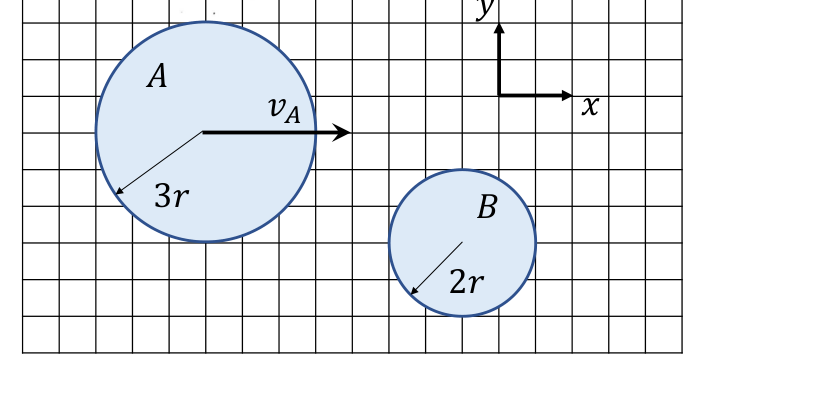
Two discs and of the same density and height with radii and respectively are placed on a smooth horizontal table. Disc moves with the speed in a direction shown in the figure toward disc which is at rest. If the friction between the two discs is negligible, and the collision is perfectly elastic, the speed of disc after collision is:
- (A)
- (B)
- (C)
- (D)
- (E)
Fonte: Testo (PDF) — p.7
Topic: Conservation of Momentum Metodi: Conservation of Momentum, Conservation of Energy, Vector Decomposition Competenze: Physical Reasoning Objects: Disk
Due dischi e della stessa densità e altezza con radii e sono posti rispettivamente su una tavola orizzontale liscia. Il disco si muove con la velocità nella direzione indicata nella figura verso il disco che è in riposo. Se la frizione tra i due dischi è trascurabile e la collisione è perfettamente elastica, la velocità del disco dopo la collisione è:
- (A)
- (B)
- (C)
- (D)
- (E)
Fonte: Testo (PDF) — p.7
Topic: Conservation of Momentum Metodi: Conservation of Momentum, Conservation of Energy, Vector Decomposition Competenze: Physical Reasoning Objects: Disk
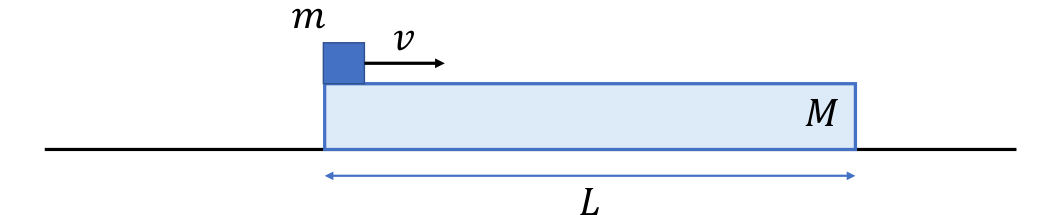
As shown in the figure below, on a smooth horizontal plane there is a rectangular block of mass and length at rest. A small block of mass with negligible length is placed on the left end of the block, and starts to slide to the right along the centre line with an initial horizontal velocity . If the coefficient of kinetic friction between the block and the cube is , and the cube does not fall from the right end of the block, the maximum value of the initial velocity of the cube is:
- (A)
- (B)
- (C)
- (D)
- (E)
Fonte: Testo (PDF) — p.7
Topic: Conservation of Energy Metodi: Conservation of Momentum, Energy Conservation Method Competenze: Physical Reasoning, Mathematical Modeling Objects: Block
Come mostrato nella figura seguente, su un piano orizzontale liscio c’è un blocco rettangolare di massa e lunghezza in riposo. Un piccolo blocco di massa di lunghezza trascurabile viene posizionato all’estremità sinistra del blocco e inizia a scivolare a destra lungo la linea centrale con una velocità orizzontale iniziale . Se il coefficiente di attrito cinetico tra il blocco e il cubo è e il cubo non cade dall’estremità destra del blocco, il valore massimo della velocità iniziale del cubo è:
- (A)
- (B)
- (C)
- (D)
- (E)
Fonte: Testo (PDF) — p.7
Topic: Conservation of Energy Metodi: Conservation of Momentum, Energy Conservation Method Competenze: Physical Reasoning, Mathematical Modeling Objects: Block
Following the previous problem, when the block stops sliding on the rectangular block, what is the displacement of the rectangular block?
- (A)
- (B)
- (C)
- (D)
- (E)
Fonte: Testo (PDF) — p.8
Topic: Conservation of Momentum Metodi: Conservation of Momentum Competenze: Physical Reasoning Objects: Block
Dopo il problema precedente, quando il blocco smette di scivolare sul blocco rettangolare, qual è il spostamento del blocco rettangolare?
- (A)
- (B)
- (C)
- (D)
- (E)
Fonte: Testo (PDF) — p.8
Topic: Conservation of Momentum Metodi: Conservation of Momentum Competenze: Physical Reasoning Objects: Block
Train stations A and B are separated by a distance of . At 12 pm train starts from station A and runs at a speed of per hour along a railway towards station B. The railway between A and B is a straight line. At the same time train starts from B and runs at the same speed along the same railway towards station A. When starts, a bird flies forward from at a speed of per hour. When the bird meets , it turns around and flies towards with the same speed as it flew before. When the bird meets again, the time is
- (A) 12:52 pm
- (B) 12:54 pm
- (C) 12:56 pm
- (D) 12:58 pm
- (E) 1:00 pm
Fonte: Testo (PDF) — p.8
Topic: Newtonian Mechanics Metodi: Kinematic Equations Competenze: Mathematical Modeling Objects: —
Le stazioni ferroviarie A e B sono separate da una distanza di . Alle 12 del pomeriggio il treno parte dalla stazione A e corre a una velocità di all’ora lungo una ferrovia verso la stazione B. La ferrovia tra A e B è una linea retta. Allo stesso tempo il treno parte da B e corre alla stessa velocità lungo la stessa ferrovia verso la stazione A. Quando inizia, un uccello vola avanti da a una velocità di all’ora. Quando l’uccello incontra , si gira e vola verso con la stessa velocità con cui è volato prima. Quando l’uccello incontra di nuovo , il tempo è
- (A) 12:52 pm
- (B) 12:54 pm
- (C) 12:56 pm
- (D) 12:58 pm
- (E) 1:00 pm
Fonte: Testo (PDF) — p.8
Topic: Newtonian Mechanics Metodi: Kinematic Equations Competenze: Mathematical Modeling Objects: —
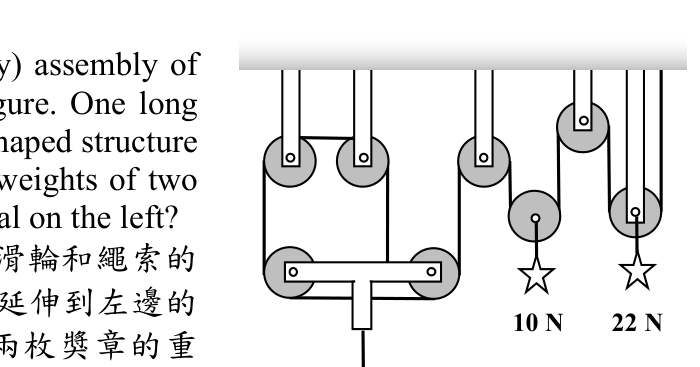
Three star medals hang from the (stationary) assembly of massless pulleys and cords as shown in the figure. One long cord runs from the ceiling at the right to the T-shaped structure at the left, looping around all the pulleys. The weights of two medals are given. What is the weight of the medal on the left?
- (A)
- (B)
- (C)
- (D)
- (E)
Fonte: Testo (PDF) — p.8
Topic: Rigid Body Statics Metodi: Free-Body Diagram Competenze: Diagrammatic Reasoning, Physical Reasoning Objects: Pulley, String
Tre medaglie a stelle appoggiate all’assemblaggio (stazionario) di pole e di corde senza massa come mostrato nella figura. Un lungo cavo va dal soffitto a destra alla struttura a forma di T a sinistra, girando intorno a tutte le pole. I pesi di due medaglie sono dati. Qual è il peso della medaglia sulla sinistra?
- (A)
- (B)
- (C)
- (D)
- (E)
Fonte: Testo (PDF) — p.8
Topic: Rigid Body Statics Metodi: Free-Body Diagram Competenze: Diagrammatic Reasoning, Physical Reasoning Objects: Pulley, String
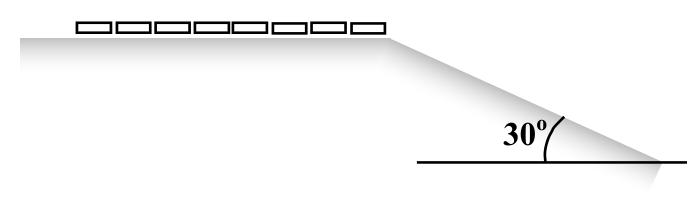
As shown in the figure, a train with a length of rests on a horizontal rail, and the front carriage of the train rests at the edge of a rail on a slope inclined at an angle of . When the front carriage is tipped from rest onto the slope by a very small force, the train rolls freely down. What is the speed of the train when half of the carriages have rolled down the slope?
- (A)
- (B)
- (C)
- (D)
- (E)
Fonte: Testo (PDF) — p.8
Topic: Conservation of Energy Metodi: Energy Conservation Method, Calculus-Integration Competenze: Mathematical Modeling Objects: Inclined Plane
Come illustrato nella figura, un treno di lunghezza si posa su una rotaia orizzontale e il carrozzone anteriore del treno si posa sul bordo di una rotaia su una pendice inclinata ad un angolo . Quando il carrozza anteriore viene inclinato dal riposo verso la pendice da una forza molto piccola, il treno ruota liberamente in basso. Qual è la velocità del treno quando la metà dei carri è rotta lungo la pendiente?
- (A)
- (B)
- (C)
- (D)
- (E)
Fonte: Testo (PDF) — p.8
Topic: Conservation of Energy Metodi: Energy Conservation Method, Calculus-Integration Competenze: Mathematical Modeling Objects: Inclined Plane
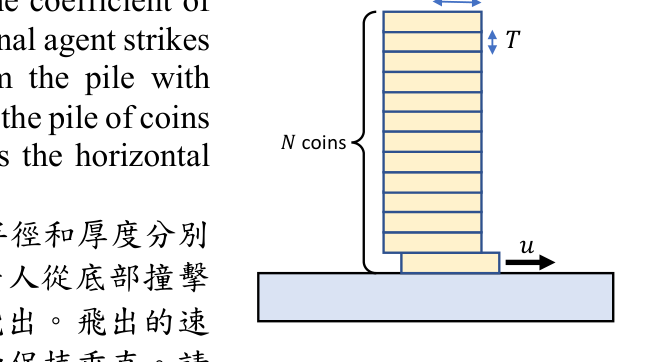
A pile of one-dollar coins rest on a table. The mass, radius and thickness of each coin are , and respectively. The coefficient of kinetic friction between the coin surfaces is . An external agent strikes the coin at the bottom such that it is removed from the pile with horizontal speed . The removal speed is so high that the pile of coins effectively remains vertical after the removal. What is the horizontal displacement of the pile of coins after the strike?
- (A)
- (B)
- (C)
- (D)
- (E)
Fonte: Testo (PDF) — p.9
Topic: Newtonian Mechanics Metodi: Free-Body Diagram, Kinematic Equations Competenze: Mathematical Modeling, Physical Reasoning Objects: Disk
A pile of one-dollar coins rest on a table. La massa, il raggio e lo spessore di ciascuna moneta sono rispettivamente , e . Il coefficiente di attrito cinetico tra le superfici delle monete è . Un agente esterno colpisce la moneta in fondo in modo tale che venga rimossa dalla pila con velocità orizzontale . La velocità di rimozione è così elevata che l’ampolla di monete rimane effettivamente verticale dopo la rimozione. Qual è il spostamento orizzontale della pila di monete dopo lo sciopero?
- (A)
- (B)
- (C)
- (D)
- (E)
Fonte: Testo (PDF) — p.9
Topic: Newtonian Mechanics Metodi: Free-Body Diagram, Kinematic Equations Competenze: Mathematical Modeling, Physical Reasoning Objects: Disk
A pendulum is formed by a particle of mass and a massless string of length hung from a fixed point in the ceiling. The pendulum is swung from rest at an initial angle of with the vertical. Calculate the tension of the string when the angle of the string with the vertical is .
- (A)
- (B)
- (C)
- (D)
- (E)
Fonte: Testo (PDF) — p.9
Topic: Oscillations & Waves Metodi: Energy Conservation Method, Free-Body Diagram Competenze: Physical Reasoning Objects: Pendulum
Un pendolo è formato da una particella di massa e da una stringa senza massa di lunghezza appesa da un punto fisso del soffitto. Il pendolo è oscillato dal riposo ad un angolo iniziale di con la verticale. Calcolare la tensione della corda quando l’angolo della corda con la verticale è .
- (A)
- (B)
- (C)
- (D)
- (E)
Fonte: Testo (PDF) — p.9
Topic: Oscillations & Waves Metodi: Energy Conservation Method, Free-Body Diagram Competenze: Physical Reasoning Objects: Pendulum
A bullet of mass is fired towards a rest block of wood with mass on a smooth table. What is the maximum fraction of the initial kinetic energy of the bullet that can be turned into heat when it hits the rest mass?
- (A)
- (B)
- (C)
- (D)
- (E) Not enough information
Fonte: Testo (PDF) — p.9
Topic: Conservation of Momentum Metodi: Conservation of Momentum, Energy Conservation Method Competenze: Physical Reasoning Objects: Projectile, Block
Un proiettile di massa viene sparato verso un blocco di legno di riposo di massa su un tavolo liscio. Qual è la frazione massima dell’energia cinetica iniziale del proiettile che può essere trasformata in calore quando colpisce la massa del resto?
- (A)
- (B)
- (C)
- (D)
- **(E) ** Non sufficiente informazione
Fonte: Testo (PDF) — p.9
Topic: Conservation of Momentum Metodi: Conservation of Momentum, Energy Conservation Method Competenze: Physical Reasoning Objects: Projectile, Block
The orbiting period of Moon is (27 days), orbiting at a height of above the Earth of radius . A geostationary satellite is a satellite that always stays above the same location on the Equator. It stays at a height of above the Earth with an orbiting period of (1 day). What is the ratio in terms of and ?
- (A)
- (B)
- (C)
- (D)
- (E) None of the above
Fonte: Testo (PDF) — p.9
Topic: Gravitation Metodi: Kepler’s Laws, Newton’s Law of Gravitation Competenze: Mathematical Modeling Objects: Satellite, Planet
Il periodo di orbita della Luna è (27 giorni), orbitando ad un’altezza di sopra la Terra di raggio . Un satellite geostazionario è un satellite che rimane sempre sopra la stessa posizione sull’equatore. Si trova ad un’altezza di sopra la Terra con un periodo di orbita di (1 giorno). Qual è il rapporto in termini di e ?
- (A)
- (B)
- (C)
- (D)
- **(E) ** Nessuna delle seguenti:
Fonte: Testo (PDF) — p.9
Topic: Gravitation Metodi: Kepler’s Laws, Newton’s Law of Gravitation Competenze: Mathematical Modeling Objects: Satellite, Planet
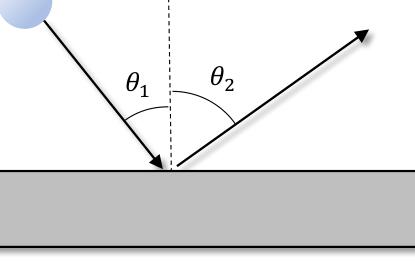
A ball of mass hits a frictionless rectangular block at an incident angle and exits at an angle , measured from the normal direction of the block, as shown in the figure. The rectangular block can also freely move. What is the mass of the block? Elastic collision is assumed.
- (A)
- (B)
- (C)
- (D)
- (E) Infinite mass
Fonte: Testo (PDF) — p.10
Topic: Conservation of Momentum Metodi: Conservation of Momentum, Conservation of Energy, Vector Decomposition Competenze: Mathematical Modeling Objects: Ball, Block
Una palla di massa colpisce un blocco rettangolare senza attrito ad un angolo di incidenza e esce ad un angolo , misurato dalla direzione normale del blocco, come mostrato nella figura. Anche il blocco rettangolare può muoversi liberamente. Qual è la massa del blocco? Si presume una collisione elastica.
- (A)
- (B)
- (C)
- (D)
- **(E) ** Massa infinita
Fonte: Testo (PDF) — p.10
Topic: Conservation of Momentum Metodi: Conservation of Momentum, Conservation of Energy, Vector Decomposition Competenze: Mathematical Modeling Objects: Ball, Block
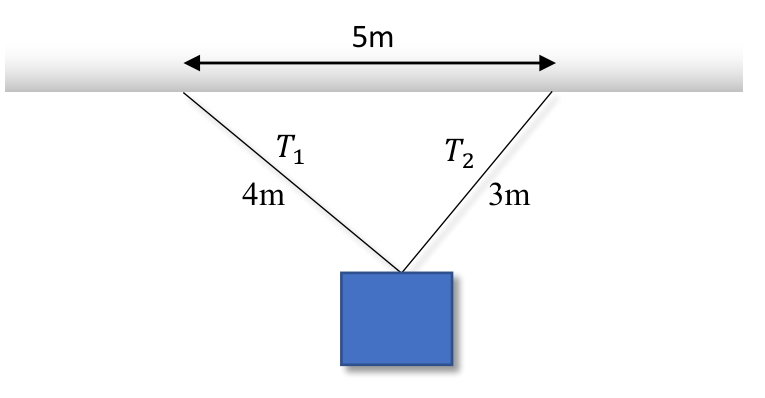
A mass of is hung by two strings attached to the same position of the mass, one with long and tension and another with long and tension , which are connected to the ceiling at two locations with in separation. What are the tensions and of the two strings?
- (A)
- (B)
- (C)
- (D)
- (E)
Fonte: Testo (PDF) — p.10
Topic: Rigid Body Statics Metodi: Free-Body Diagram, Vector Decomposition Competenze: Physical Reasoning Objects: String
Part II — Open Problems (15 marks each).
Una massa di è appesa da due stringhe fissate alla stessa posizione della massa, una con lunghezza e tensione e un’altra con lunghezza e tensione , che sono collegate al soffitto in due posizioni con separati. Quali sono le tensioni e delle due stringhe?
- (A)
- (B)
- (C)
- (D)
- (E)
Fonte: Testo (PDF) — p.10
Topic: Rigid Body Statics Metodi: Free-Body Diagram, Vector Decomposition Competenze: Physical Reasoning Objects: String
Parte II Problemi aperti (15 punti ciascuno).
From a fixed point A at a height above the ground, a ball X is thrown at a speed with launching angle . A very massive plate is placed in front of point A and the ball hits at the point B on the plate which is above the ground at the same level as the point A.
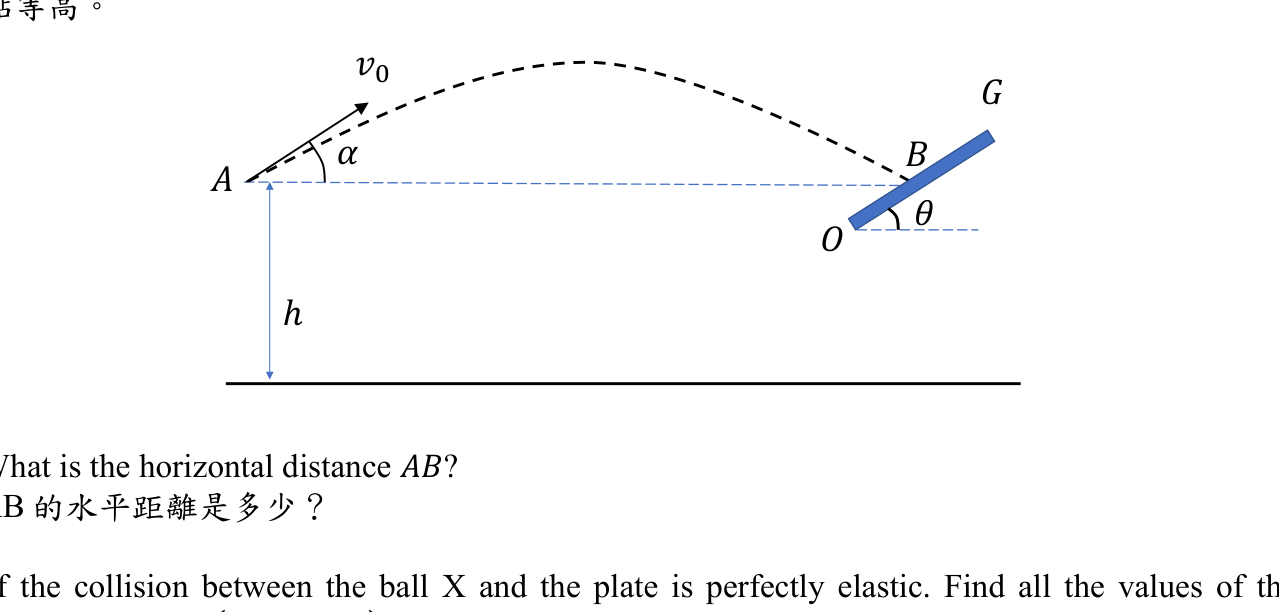
(a) What is the horizontal distance ?
(b) If the collision between the ball X and the plate is perfectly elastic, find all the values of the inclination angle of the plate such that the ball X will return to the initial position A after the collision.
(c) There is another small ball Y. At the instant when the ball X is thrown from point A, it falls from rest freely from point A and makes a perfectly elastic collision with the ground. Find all the values of such that the ball Y will return to the initial position A with ball X at the same instant.
Fonte: Testo (PDF) — p.11
Topic: Newtonian Mechanics Metodi: Kinematic Equations, Vector Decomposition Competenze: Mathematical Modeling, Physical Reasoning Objects: Ball, Projectile
Da un punto fisso A ad un’altezza sopra il terreno, viene lanciata una palla X ad una velocità con angolo di lancio . Una piastra molto massiccia è posta davanti al punto A e la palla colpisce il punto B sulla piastra che si trova al di sopra del terreno allo stesso livello del punto A.
**(a) ** Qual è la distanza orizzontale ?
Se la collisione tra la palla X e la piastra è perfettamente elastica, trovare tutti i valori dell’angolo di inclinazione della piastra in modo tale che la palla X ritorni alla posizione iniziale A dopo la collisione.
C’è un’altra piccola palla Y. Nel momento in cui la palla X viene lanciata dal punto A, cade liberamente dal riposo dal punto A e fa una collisione perfettamente elastica con il terreno. Trova tutti i valori di in modo che la palla Y ritorni alla posizione iniziale A con la palla X nello stesso istante.
Fonte: Testo (PDF) — p.11
Topic: Newtonian Mechanics Metodi: Kinematic Equations, Vector Decomposition Competenze: Mathematical Modeling, Physical Reasoning Objects: Ball, Projectile
Bungee jump is a sport for adventurous people. As shown in Fig. 1(a), a bungee jumper of mass is initially standing on a bridge with a rope of mass , length and of uniform density. One end of the rope is fastened to the bridge and the other end is tied to the jumper’s body, and the rope is hanging freely below the bridge, with its midpoint furthest down.
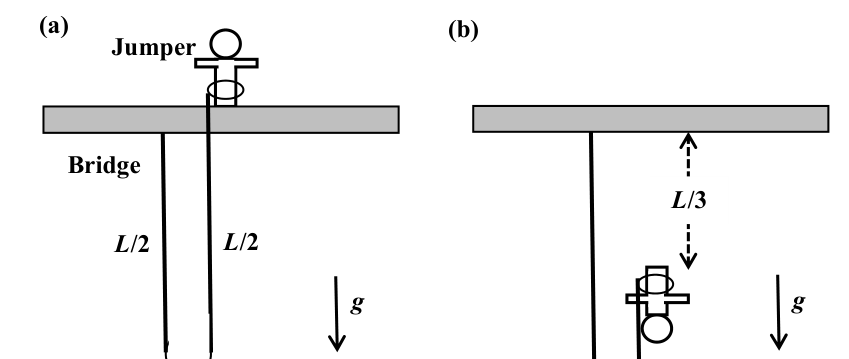
In the following calculations, you may assume that the air resistance is negligible, and the gravitational acceleration is . The jumper jumps off and the rope is being straightened from the folded state (Fig. 1(b)).
(a)-(b) Consider the instant that the jumper has fallen a distance .
(a) What is the change in the potential energy of the rope compared with the initial state?
(b) Calculate the speed of the jumper when the jumper has fallen a distance .
(c) Calculate the speed of the jumper when the entire rope becomes hanging downward.
(d) Jumpers claim that they enjoy the thrill of reaching a speed faster than free fall. Calculate the speed of the jumper if the jumper falls from the bridge through the same distance as in part (c) during a free fall.
(e)-(f) After the entire rope becomes hanging downward, the jumper remains tied to the rope but continues to fall further downward due to the elastic nature of the rope. Let the force constant of the rope be .
(e) Calculate the maximum distance the jumper falls as measured from the bridge.
(f) After the motion of the jumper stops, what is the distance of the jumper below the bridge?
Fonte: Testo (PDF) — p.12
Topic: Conservation of Energy Metodi: Energy Conservation Method, Hooke’s Law, Simple Harmonic Motion Analysis Competenze: Mathematical Modeling, Physical Reasoning Objects: String
Il salto a bungee è uno sport per gli avventurosi. Come mostrato nella figura. 1(a), un bungee jumper di massa è inizialmente in piedi su un ponte con una corda di massa , lunghezza e di densità uniforme. Una estremità della corda è attaccata al ponte e l’altra è legata al corpo del saltatore, e la corda è appesa liberamente sotto il ponte, con il suo punto medio più lontano in basso.
Nei seguenti calcoli, si può presumere che la resistenza all’aria sia trascurabile e l’accelerazione gravitazionale sia . Il salto dal salto e la corda viene raddrizzata dal stato piegato (Fig. 1(b)).
**(a)-(b) ** Considera l’istante in cui il salto è caduto a una distanza .
Qual è la variazione dell’energia potenziale della corda rispetto allo stato iniziale?
**(b) ** Calcolare la velocità del saltatore quando il saltatore è caduto a una distanza .
**(c) ** Calcolare la velocità del saltatore quando l’intera corda diventa appesa verso il basso.
I saltatori affermano di godere dell’emozione di raggiungere una velocità più veloce della caduta libera. Calcolare la velocità del saltatore se il saltatore cade dal ponte attraverso la stessa distanza di quella di cui alla parte c) durante una caduta libera.
**(e)-(f) ** Dopo che l’intera corda è appesa verso il basso, il saltatore rimane legato alla corda ma continua a cadere più in basso a causa della natura elastica della corda. La costante di forza della corda deve essere .
**(e) ** Calcolare la distanza massima che il salto si trova a misura dal ponte.
**(f) ** Dopo che il movimento del saltatore si ferma, quale è la distanza del saltatore sotto il ponte?
Fonte: Testo (PDF) — p.12
Topic: Conservation of Energy Metodi: Energy Conservation Method, Hooke’s Law, Simple Harmonic Motion Analysis Competenze: Mathematical Modeling, Physical Reasoning Objects: String
Three identical steel balls A, B, and C are connected by two light, hard rods AB and BC, each of length . A and C lie on a horizontal surface along the axis, and B is supported by the rods to stand in a vertical direction parallel to the axis. As shown in Figure I, there is a vertical wall at distance from the rod. Due to a small disturbance, the two rods slide to two sides and ball B falls (Figure II). In this problem, all friction is negligible, and the diameter of each ball is much smaller than .
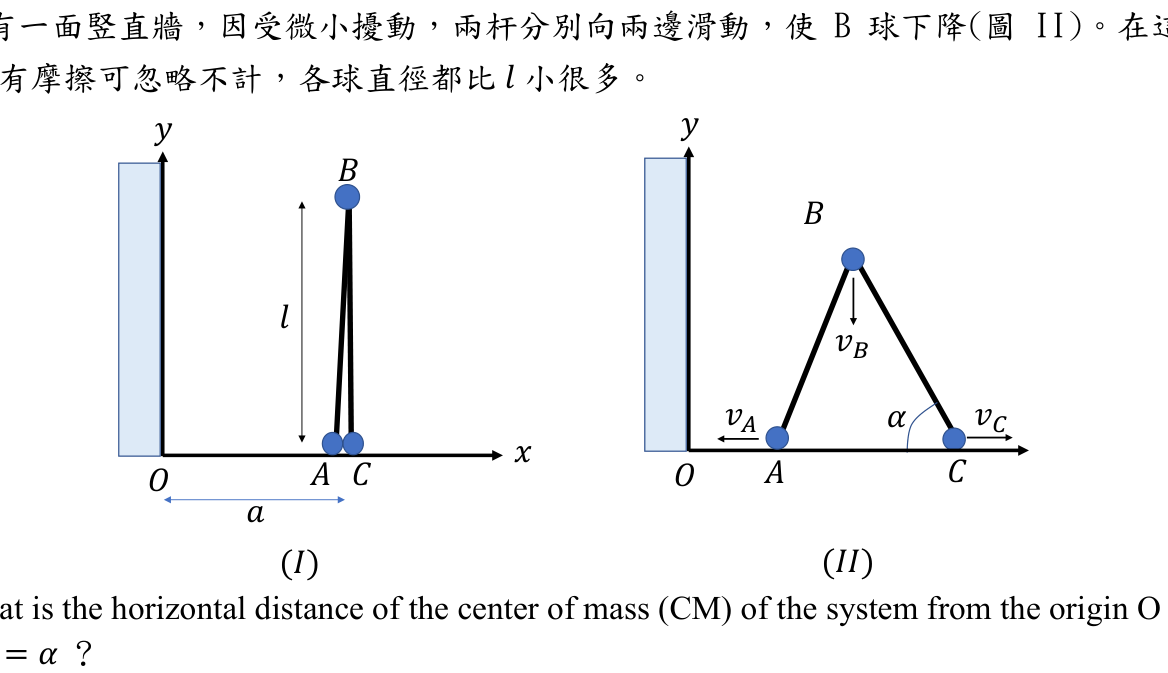
(a) What is the horizontal distance of the center of mass (CM) of the system from the origin O when ?
(b) What is the ratio of the speed of two balls A and C when ?
(c) What is the angle when ball A hits the wall?
(d) What is the ratio immediately before this instant?
(e) What is the velocities of three balls at this moment?
Fonte: Testo (PDF) — p.13
Topic: Conservation of Energy Metodi: Energy Conservation Method, Vector Decomposition, Calculus-Integration Competenze: Mathematical Modeling, Physical Reasoning Objects: Ball, Rod
Tre palle di acciaio identiche A, B e C sono collegate da due bastone leggere e dure AB e BC, di lunghezza . A e C si trovano su una superficie orizzontale lungo l’asse e B è sostenuto dalle barre per stare in direzione verticale parallela all’asse . Come mostrato alla figura I, c’è una parete verticale a distanza dalla canna. A causa di un piccolo disturbo, le due barre scivolano a due lati e la palla B cade (Figura II). In questo problema, tutte le frizioni sono trascurabili e il diametro di ogni palla è molto inferiore a .
**(a) ** Qual è la distanza orizzontale del centro di massa (CM) del sistema dall’origine O quando ?
**(b) ** Qual è il rapporto della velocità di due palle A e C quando ?
Qual è l’angolo quando la palla A colpisce il muro?
**(d) ** Qual è il rapporto subito prima di questo istante?
Qual è la velocità di tre palle in questo momento?
Fonte: Testo (PDF) — p.13
Topic: Conservation of Energy Metodi: Energy Conservation Method, Vector Decomposition, Calculus-Integration Competenze: Mathematical Modeling, Physical Reasoning Objects: Ball, Rod
A bus is going around a banked turn, as shown in the figure. The horizontal radius of the turn is and the inclination angle of the bank is . The figure also shows the cross-section of the bus, having a width of between the inner and outer wheels and a center of mass (CM) at a height of . We also label several forces: and are the normal forces acting on the inner and outer wheels while and are the friction action on the inner and outer wheels. is the weight of the bus.
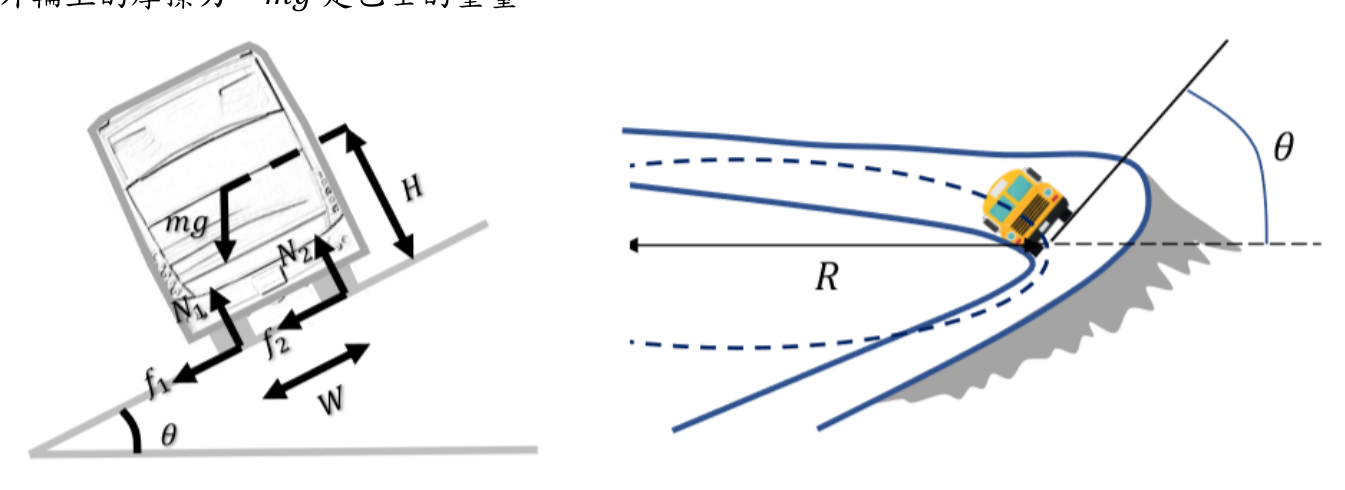
(a) Suppose the static coefficient of friction of the bank is , which is a bit slippery in a rainy day. Determine the valid range of speed for the bus so that its center-of-mass motion remains in circular shape. For simplicity, we can start by considering the total friction as , the total normal force as and neglect the internal distribution between and , i.e. we can assume . Note that the radius of turn is measured from center of the turn to the CM.
(b) By considering the moment of the bus about its CM, determine the valid range of the speed for the bus so that the bus will not topple. Toppling means the bus overturns.
Fonte: Testo (PDF) — p.14
Topic: Newtonian Mechanics, Rigid Body Statics Metodi: Free-Body Diagram, Torque & Angular Momentum Analysis, Vector Decomposition Competenze: Mathematical Modeling, Physical Reasoning Objects: —
Un autobus gira intorno a una curva bancata, come mostra la figura. Il raggio orizzontale della curva è e l’angolo di inclinamento della banchina è . La figura mostra anche la sezione trasversale del bus, con una larghezza di tra le ruote interne ed esterne e un centro di massa (CM) ad un’altezza di . Si etichettano anche diverse forze: e sono le forze normali che agiscono sulle ruote interne ed esterne mentre e sono l’azione di attrito sulle ruote interne ed esterne. è il peso dell’autobus.
**(a) ** Supponiamo che il coefficiente statico di attrito della banca sia , che è un po’ scivoloso in una giornata piovosa. Determinare la gamma di velocità valida per l’autobus in modo che il suo movimento al centro della massa rimanga in forma circolare. Per semplicità, possiamo iniziare considerando la attrito totale come , la forza normale totale come e trascurare la distribuzione interna tra e , cioè possiamo supporre . Si noti che il raggio di rotazione è misurato dal centro della rotazione al CM.
**(b) ** Considerando il momento dell’autobus circa il suo CM, determinare la gamma valida della velocità per l’autobus in modo che l’autobus non si ribolli. Il topping significa che l’autobus si rovescia.
Fonte: Testo (PDF) — p.14
Topic: Newtonian Mechanics, Rigid Body Statics Metodi: Free-Body Diagram, Torque & Angular Momentum Analysis, Vector Decomposition Competenze: Mathematical Modeling, Physical Reasoning Objects: —