A -kg block and a -kg block are pressed together on a horizontal frictionless surface with a compressed light spring between them. They are not attached to the spring. After they are released and detached from the spring,
- (A) both blocks will have the same amount of kinetic energy.
- (B) both blocks will have equal speeds.
- (C) the lighter block will have more kinetic energy than the heavier block.
- (D) the magnitude of the momentum of the heavier block will be greater than the magnitude of the momentum of the lighter block.
- (E) the heavier block will have more kinetic energy than the lighter block.
Fonte: Testo (PDF) — p.3 Topic: Conservation of Momentum Metodi: Conservation of Momentum, Conservation of Energy Competenze: Physical Reasoning Objects: Block, Spring
Un blocco -kg e un blocco -kg sono premuti insieme su una superficie orizzontale senza attrito con una sorgente luminosa compressa tra di loro. Non sono attaccate alla sorgente. Dopo che saranno stati liberati e separati dalla sorgente,
- **(A) ** entrambi i blocchi avranno la stessa quantità di energia cinetica.
- **(B) ** entrambi i blocchi avranno velocità uguali.
- **(C) ** il blocco più leggero avrà più energia cinetica del blocco più pesante.
- **(D) ** la grandezza del momento del blocco più pesante sarà maggiore della grandezza del momento del blocco più leggero.
- **(E) ** il blocco più pesante avrà più energia cinetica del blocco più leggero.
Fonte: Testo (PDF) — p.3 Topic: Conservation of Momentum Metodi: Conservation of Momentum, Conservation of Energy Competenze: Physical Reasoning Objects: Block, Spring
A heavy ball is hung with a string from the ceiling. Another string is attached to the bottom of the ball. A downward pulling force is exerted on the lower string as shown in the figure below. Which of the following statements is true?
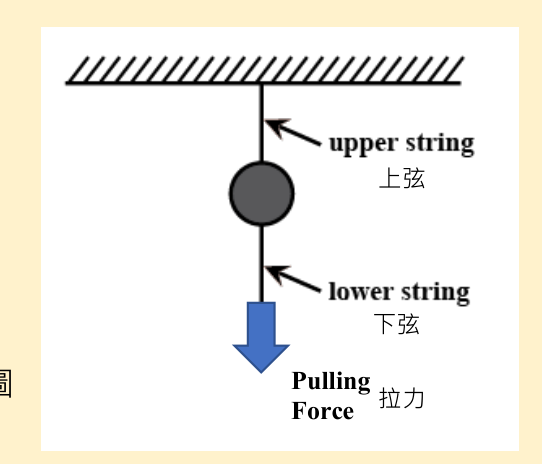
- (A) If the lower string is pulled suddenly by a large force, the upper string will break first.
- (B) If the lower string is pulled suddenly by a large force, the lower string will break first.
- (C) If the lower string is pulled suddenly by a large force, the two strings will break at the same time.
- (D) If the lower string is pulled by a slowly increasing force, the lower string will break first.
- (E) If the lower string is pulled by a slowly increasing force, none of the string will eventually break.
Fonte: Testo (PDF) — p.3 Topic: Newtonian Mechanics Metodi: Free-Body Diagram, Impulse-Momentum Theorem Competenze: Physical Reasoning Objects: Ball, String
Una pesante palla è appesa con una corda dal soffitto. Un’altra corda è attaccata alla parte inferiore della palla. Una forza di trazione verso il basso viene esercitata sulla corda inferiore come mostrato nella figura seguente. Quale delle seguenti affermazioni è vera?
- **(A) ** Se la corda inferiore viene tirata improvvisamente da una grande forza, la corda superiore si rompe prima.
- **(B) ** Se la corda inferiore viene tirata improvvisamente da una forza grande, la corda inferiore si rompe prima.
- **(C) ** Se la corda inferiore viene tirata improvvisamente da una grande forza, le due corde si romperanno contemporaneamente.
- **(D) ** Se la corda inferiore viene tirata da una forza che aumenta lentamente, la corda inferiore si rompe prima.
- **(E) ** Se la corda inferiore viene tirata da una forza che aumenta lentamente, nessuna della corda finirà per rompersi.
Fonte: Testo (PDF) — p.3 Topic: Newtonian Mechanics Metodi: Free-Body Diagram, Impulse-Momentum Theorem Competenze: Physical Reasoning Objects: Ball, String
Which of the following statements is true in describing two satellites orbiting on circular orbits with the same radius around Earth?
- (A) The satellites could have different masses.
- (B) The satellites could have different periods.
- (C) The satellites could have different linear speeds.
- (D) The satellites could have different magnitudes of accelerations.
- (E) The gravitational acceleration measured inside the satellites could be different.
Fonte: Testo (PDF) — p.4 Topic: Gravitation Metodi: Newton’s Law of Gravitation, Kepler’s Laws Competenze: Physical Reasoning Objects: Satellite, Planet
Quale delle seguenti affermazioni è vera nel descrivere due satelliti che orbitano in orbite circolari con lo stesso raggio intorno alla Terra?
- **(A) ** I satelliti potrebbero avere masse diverse.
- **(B) ** I satelliti potrebbero avere periodi diversi.
- **(C) ** I satelliti potrebbero avere velocità lineari diverse. I satelliti potrebbero avere magnitudini di accelerazione diverse.
- **(E) ** L’accelerazione gravitazionale misurata all’interno dei satelliti potrebbe essere diversa.
Fonte: Testo (PDF) — p.4 Topic: Gravitation Metodi: Newton’s Law of Gravitation, Kepler’s Laws Competenze: Physical Reasoning Objects: Satellite, Planet
A roller-coaster cart full of water is moving at a constant speed along a horizontal, frictionless length of track. Suddenly, a plug in the bottom of the cart is removed, and the water starts to flow downwards out of the cart. What happens to the speed of the cart while the water is flowing? Ignore air resistance in your answer.
- (A) The cart speeds up.
- (B) The cart slows down.
- (C) The cart speeds up until half the water is gone, then it slows down.
- (D) The cart slows down until half the water is gone, then it speeds up.
- (E) The cart’s speed does not change.
Fonte: Testo (PDF) — p.4 Topic: Conservation of Momentum Metodi: Conservation of Momentum, Physical Modeling Competenze: Physical Reasoning Objects: Cart
Un carrello di montagna russa pieno di acqua si muove a una velocità costante lungo una lunghezza orizzontale e senza attrito. Improvvisamente, viene rimosso un tappo in fondo al carrello e l’acqua inizia a scorrere verso il basso. Che succede alla velocità del carro mentre l’acqua scorre? Ignora la resistenza dell’aria nella tua risposta.
- **(A) ** Il carrello si accelera.
- **(B) ** Il carrello rallenta.
- **(C) ** Il carrello accelera fino a quando la metà dell’acqua non è più presente, poi rallenta.
- **(D) ** Il carrello rallenta fino a quando la metà dell’acqua non è più presente, poi si accelera.
- **(E) ** La velocità del carrello non cambia.
Fonte: Testo (PDF) — p.4 Topic: Conservation of Momentum Metodi: Conservation of Momentum, Physical Modeling Competenze: Physical Reasoning Objects: Cart
A cylinder half-filled with water is hung from the ceiling by a long cable and swings with a small angle like a pendulum. At the position shown in the figure, the water level is observed to be (see the figure below for the description of the choices)
- (A) curved
- (B) horizontal
- (C) tipped inward
- (D) tipped outward
- (E) tipped outward when the pendulum is swinging outward, and tipped inward when the pendulum is swinging inward
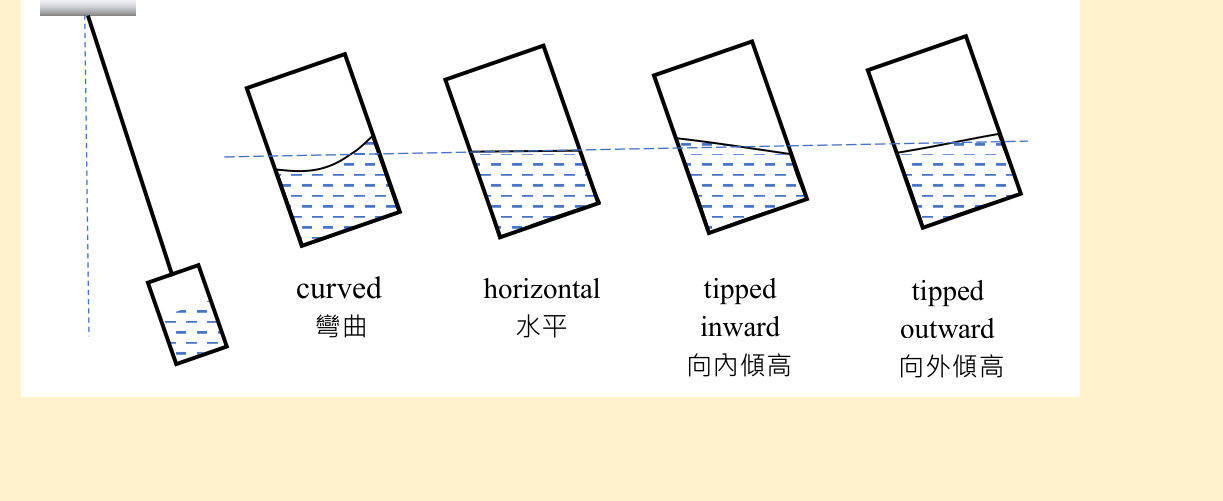
Fonte: Testo (PDF) — p.5 Topic: Newtonian Mechanics Metodi: Free-Body Diagram, Vector Decomposition Competenze: Physical Reasoning Objects: Cylinder, Pendulum
Un cilindro mezzo riempito di acqua è appeso al soffitto da un lungo cavo e oscilla con un angolo piccolo come un pendolo. Al punto indicato nella figura, si osserva che il livello dell’acqua è (vedi figura seguente per la descrizione delle opzioni)
- **(A) ** curvo
- **(B) ** orizzontale
- **(C) ** inclinato verso l’interno
- **(D) ** inclinato verso l’esterno
- **(E) ** inclinato verso l’esterno quando il pendolo si sta svolgendo verso l’esterno e inclinato verso l’interno quando il pendolo si sta svolgendo verso l’interno
Fonte: Testo (PDF) — p.5 Topic: Newtonian Mechanics Metodi: Free-Body Diagram, Vector Decomposition Competenze: Physical Reasoning Objects: Cylinder, Pendulum
Consider the one-dimensional collision of two objects and with masses and . The objects are made of unknown materials. and are initially moving with constant velocities of to the right and to the left, respectively, with on the left side of . Which of the following are possible final velocities of the objects after the collision?
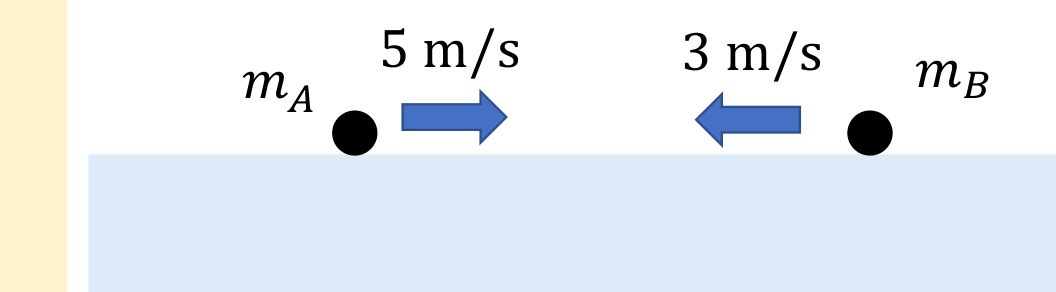
-
I — : to the left, : to the right
-
II — : to the left, : to the right
-
III — : to the left, : to the right
-
IV — : to the right, : to the right
-
(A) II only
-
(B) III only
-
(C) II and III only
-
(D) I, II and III only
-
(E) II, III and IV only
Fonte: Testo (PDF) — p.6 Topic: Conservation of Momentum Metodi: Conservation of Momentum, Conservation of Energy Competenze: Physical Reasoning Objects: Block
Considerate la collisione unidimensional di due oggetti e con masse e . Gli oggetti sono fatti di materiali sconosciuti. e si muovono inizialmente con velocità costanti di a destra e a sinistra, rispettivamente, con sul lato sinistro di . Quali delle seguenti sono le possibili velocità finali degli oggetti dopo la collisione?
-
I : a sinistra, : a destra
-
II : a sinistra, : a destra
-
III : a sinistra, : a destra
-
IV : a destra, : a destra
-
solo **(A) ** II
-
**(B) ** III solo
-
solo **(C) ** II e III
-
**(D) ** I, II e III soltanto
-
solo **(E) ** II, III e IV
Fonte: Testo (PDF) — p.6 Topic: Conservation of Momentum Metodi: Conservation of Momentum, Conservation of Energy Competenze: Physical Reasoning Objects: Block
A right-angled plate with equal length on both sides is placed horizontally on a fixed cylinder. The plate has uniform density and the length of each side is , where is the radius of the cylinder. What is the minimum coefficient of static friction between the cylinder and the plate to prevent the plate from slipping off?
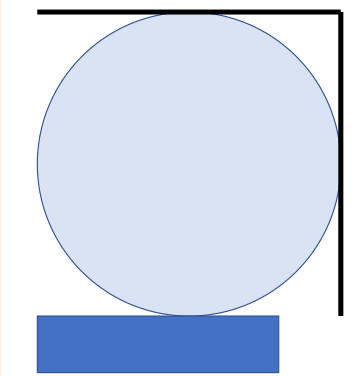
- (A) 0.414
- (B) 0.207
- (C) 0.104
- (D) 0.828
- (E) 0.312
Fonte: Testo (PDF) — p.6 Topic: Rigid Body Statics Metodi: Torque & Angular Momentum Analysis, Free-Body Diagram Competenze: Physical Reasoning Objects: Cylinder
Una piastra rettangolare di uguale lunghezza su entrambi i lati è posizionata orizzontalmente su un cilindro fisso. La piastra ha una densità uniforme e la lunghezza di ciascun lato è , dove è il raggio del cilindro. Qual è il coefficiente minimo di attrito statico tra il cilindro e la piastra per evitare che la piastra scivoli?
- (A) 0.414
- (B) 0.207
- (C) 0.104
- (D) 0.828
- (E) 0.312
Fonte: Testo (PDF) — p.6 Topic: Rigid Body Statics Metodi: Torque & Angular Momentum Analysis, Free-Body Diagram Competenze: Physical Reasoning Objects: Cylinder
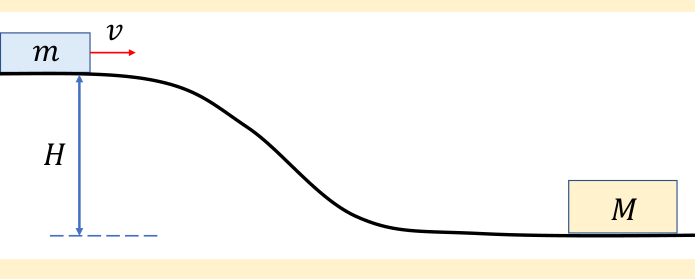
A trolley with mass moves along the horizontal track at speed . The track continues to extend downward and smoothly connects to a new horizontal track at height below. There is a stationary carriage with mass here (). The trolley moves towards the carriage, causing a completely elastic collision. What is the minimum initial speed of the trolley such that it can return to the upper horizontal section? The friction can be neglected.
- (A)
- (B)
- (C)
- (D)
- (E)
Fonte: Testo (PDF) — p.7 Topic: Conservation of Momentum Metodi: Conservation of Momentum, Conservation of Energy Competenze: Mathematical Modeling Objects: Cart
Un carrello di massa si muove lungo la pista orizzontale a velocità . La pista continua a estendersi verso il basso e si collega senza problemi a una nuova pista orizzontale ad altitudine inferiore. Qui è presente un carro stationario di massa (). Il carrello si muove verso il carro, causando una collisione completamente elastica. Qual è la velocità iniziale minima del carrello in modo da poter tornare nella sezione orizzontale superiore? La friczione può essere trascurata.
- (A)
- (B)
- (C)
- (D)
- (E)
Fonte: Testo (PDF) — p.7 Topic: Conservation of Momentum Metodi: Conservation of Momentum, Conservation of Energy Competenze: Mathematical Modeling Objects: Cart
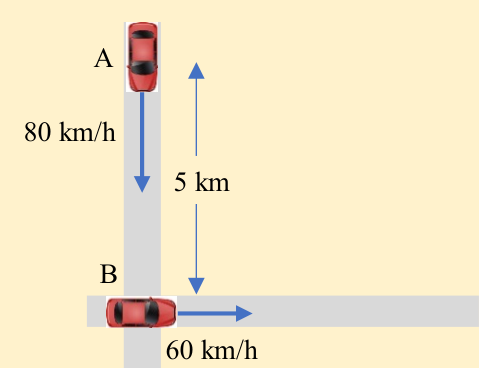
Two highways intersect at right angles as shown in the figure. At the instant shown, car A is located at from the intersection and is traveling at speed . Car B is located at the intersection and is traveling at speed . When the two cars are closest to each other, car B has travelled a distance of
- (A) 1.8 km
- (B) 2.4 km
- (C) 3 km
- (D) 3.2 km
- (E) 4 km
Fonte: Testo (PDF) — p.7 Topic: Newtonian Mechanics Metodi: Kinematic Equations, Vector Decomposition Competenze: Mathematical Modeling Objects: —
Due autostrade si incrociano a angolo retto come mostrato nella figura. All’istante indicato, la vettura A si trova a dall’intersezione e si sta muovendo a velocità . La vettura B si trova all’intersezione e si sta muovendo a velocità . Quando le due auto sono più vicine l’una all’altra, la macchina B ha percorso una distanza di
- (A) 1.8 km
- (B) 2.4 km
- (C) 3 km
- (D) 3.2 km
- (E) 4 km
Fonte: Testo (PDF) — p.7 Topic: Newtonian Mechanics Metodi: Kinematic Equations, Vector Decomposition Competenze: Mathematical Modeling Objects: —
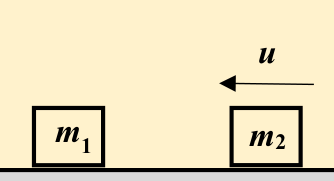
As shown in the figure, a block of mass is at rest on a long frictionless table that is touching a wall. Block 2 of mass is placed between block 1 and the wall and is moving to the left at speed . After block 2 has collided once with block 1 and once with the wall, both blocks move with the same velocity. Assume all collisions are elastic. The value of is
- (A)
- (B)
- (C)
- (D)
- (E)
Fonte: Testo (PDF) — p.8 Topic: Conservation of Momentum Metodi: Conservation of Momentum, Conservation of Energy Competenze: Mathematical Modeling Objects: Block
Come mostrato nella figura, un blocco di massa è in riposo su un lungo tavolo senza attrito che sta toccando un muro. Il blocco 2 di massa è collocato tra il blocco 1 e la parete e si muove a sinistra alla velocità . Dopo che il blocco 2 ha colpito una volta con il blocco 1 e una volta con il muro, entrambi i blocchi si muovono con la stessa velocità. Supponiamo che tutte le collisioni siano elastiche. Il valore di è
- (A)
- (B)
- (C)
- (D)
- (E)
Fonte: Testo (PDF) — p.8 Topic: Conservation of Momentum Metodi: Conservation of Momentum, Conservation of Energy Competenze: Mathematical Modeling Objects: Block
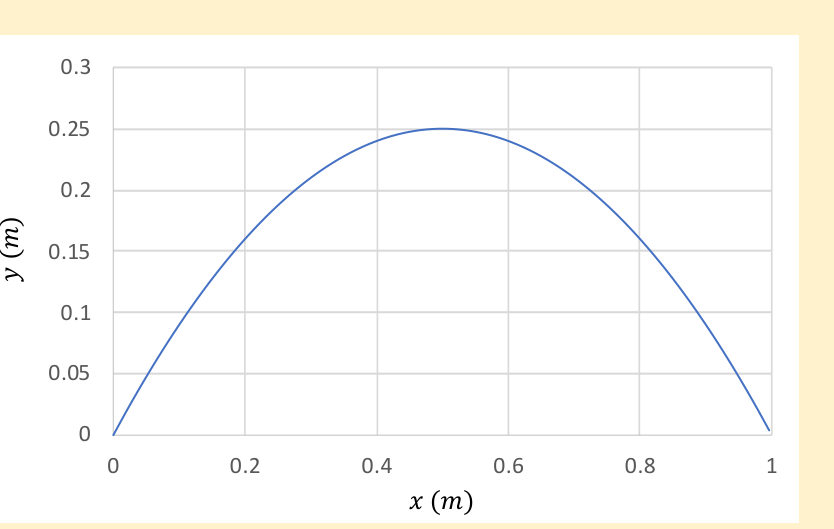
The trajectory of a toy cannon is shown in the figure below. Assuming that the air resistance during the flight can be neglected, what is the launching angle of the projectile?
- (A)
- (B)
- (C)
- (D)
- (E)
Fonte: Testo (PDF) — p.8 Topic: Newtonian Mechanics Metodi: Kinematic Equations, Vector Decomposition Competenze: Diagrammatic Reasoning Objects: Projectile
La traiettoria di un cannone giocattolo è mostrata nella figura seguente. Supponendo che la resistenza all’aria durante il volo possa essere trascurata, quale è l’angolo di lancio del proiettile?
- (A)
- (B)
- (C)
- (D)
- (E)
Fonte: Testo (PDF) — p.8 Topic: Newtonian Mechanics Metodi: Kinematic Equations, Vector Decomposition Competenze: Diagrammatic Reasoning Objects: Projectile
Following the previous question, what is the initial speed of the cannon?
- (A) 9.8 m/s
- (B) 6.26 m/s
- (C) 4.43 m/s
- (D) 3.36 m/s
- (E) 3.13 m/s
Fonte: Testo (PDF) — p.8 Topic: Newtonian Mechanics Metodi: Kinematic Equations, Vector Decomposition Competenze: Mathematical Modeling Objects: Projectile
In seguito alla domanda precedente, qual è la velocità iniziale del cannone?
- (A) 9.8 m/s
- (B) 6.26 m/s
- (C) 4.43 m/s
- (D) 3.36 m/s
- (E) 3.13 m/s
Fonte: Testo (PDF) — p.8 Topic: Newtonian Mechanics Metodi: Kinematic Equations, Vector Decomposition Competenze: Mathematical Modeling Objects: Projectile
point particles are equally spaced on a circle with radius . The particles are identical with mass except two, both with mass . The angle between the radii joining these two particles to the center is . What is the distance (in m) of the center of mass of the system from the center of the circle?
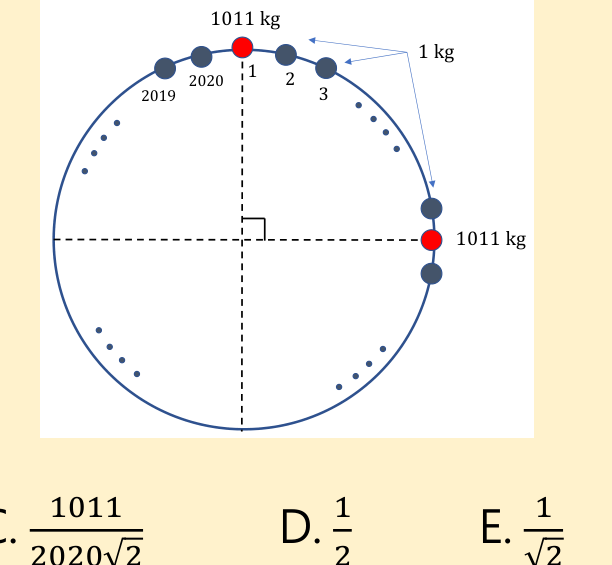
- (A)
- (B)
- (C)
- (D)
- (E)
Fonte: Testo (PDF) — p.9 Topic: Newtonian Mechanics Metodi: Vector Decomposition, Symmetry Argument Competenze: Mathematical Modeling Objects: —
Le particelle puntate sono spaziate in modo uguale su un cerchio con raggio . Le particelle sono identiche con massa tranne due, entrambe con massa . L’angolo tra i raggi che uniscono queste due particelle al centro è . Qual è la distanza (in m) del centro di massa del sistema dal centro del cerchio?
- (A)
- (B)
- (C)
- (D)
- (E)
Fonte: Testo (PDF) — p.9 Topic: Newtonian Mechanics Metodi: Vector Decomposition, Symmetry Argument Competenze: Mathematical Modeling Objects: —
A truck is travelling on a straight road under a constant acceleration of . A simple pendulum hung from the ceiling of the truck performs small angle oscillations. The length of the pendulum is and the mass of the bob is . What is the frequency of the oscillations?
- (A) 0.70 Hz
- (B) 0.73 Hz
- (C) 0.84 Hz
- (D) 4.4 Hz
- (E) 4.6 Hz
Fonte: Testo (PDF) — p.9 Topic: Oscillations & Waves Metodi: Simple Harmonic Motion Analysis, Vector Decomposition Competenze: Mathematical Modeling Objects: Pendulum
Un camion si sta muovendo su una strada retta con una costante accelerazione di . Un semplice pendolo appeso al soffitto del camion fa piccole oscillazioni d’angolo. La lunghezza del pendolo è e la massa del bob è . Qual è la frequenza delle oscillazioni?
- (A) 0.70 Hz
- (B) 0.73 Hz
- (C) 0.84 Hz
- (D) 4.4 Hz
- (E) 4.6 Hz
Fonte: Testo (PDF) — p.9 Topic: Oscillations & Waves Metodi: Simple Harmonic Motion Analysis, Vector Decomposition Competenze: Mathematical Modeling Objects: Pendulum
Following the previous question. When the pendulum is at equilibrium, what is its angle from the vertical direction?
- (A) 0°
- (B) 14°
- (C) 22°
- (D) 35°
- (E) 43°
Fonte: Testo (PDF) — p.9 Topic: Newtonian Mechanics Metodi: Free-Body Diagram, Vector Decomposition Competenze: Physical Reasoning Objects: Pendulum
Seguendo la domanda precedente. Quando il pendolo è in equilibrio, quale è l’angolo da cui è la direzione verticale?
- (A) 0°
- (B) 14°
- (C) 22°
- (D) 35°
- (E) 43°
Fonte: Testo (PDF) — p.9 Topic: Newtonian Mechanics Metodi: Free-Body Diagram, Vector Decomposition Competenze: Physical Reasoning Objects: Pendulum
Consider two concentric uniform thin shells. The inner shell has radius and mass . The outer shell has radius and mass . A point particle with mass is initially at infinity and moves to a final distance of from the center, where (assuming that the particle can penetrate a shell). What is the work done by the gravitational force of the shells in the above motion?
- (A)
- (B)
- (C)
- (D)
- (E)
Fonte: Testo (PDF) — p.10 Topic: Gravitation Metodi: Newton’s Law of Gravitation, Energy Conservation Method Competenze: Physical Reasoning Objects: —
Considerate due conchiglie sottili, concentrici e uniformi. Il rivestimento interno ha un raggio e una massa . Il rivestimento esterno ha raggio e massa . Una particella puntosa con massa è inizialmente infinita e si sposta a una distanza finale di dal centro, dove (presumendo che la particella possa penetrare un guscio). Qual è il lavoro svolto dalla forza gravitazionale dei gusci nel movimento sopra indicato?
- (A)
- (B)
- (C)
- (D)
- (E)
Fonte: Testo (PDF) — p.10 Topic: Gravitation Metodi: Newton’s Law of Gravitation, Energy Conservation Method Competenze: Physical Reasoning Objects: —
The equation
is a quintic equation in which has no analytic solution in general. The numerical (real) solution is approximately when , when , and when .
The mass of a moon is . The mass of the parent planet is so that when considering their orbital motion one can consider the planet to be at rest. Both the planet and the moon can be considered as point objects. One may also assume that the moon’s orbital motion is perfectly circular with a radius of . An artificial satellite can stay on the line between the planet and the moon at fixed distances from them. What approximately is the distance of this satellite from the planet? Choose the best answer.
- (A) 32,400 km
- (B) 45,300 km
- (C) 255,000 km
- (D) 268,000 km
- (E) 276,000 km
Fonte: Testo (PDF) — p.10 Topic: Gravitation Metodi: Newton’s Law of Gravitation, Kepler’s Laws Competenze: Mathematical Modeling Objects: Planet, Satellite
L’equazione
è un’equazione quintica in che non ha soluzione analitica in generale. La soluzione numerica (reale) è approssimativamente quando , quando e quando .
La massa di una luna è . La massa del pianeta madre è , in modo che quando si considera il suo movimento orbitale si possa considerare che il pianeta sia in riposo. Sia il pianeta che la luna possono essere considerati come oggetti puntati. Si può anche supporre che il movimento orbitale della luna sia perfettamente circolare con un raggio di . Un satellite artificiale può rimanere sulla linea tra il pianeta e la luna a distanze fisse da loro. Quanto è la distanza di questo satellite dal pianeta? Scegli la risposta migliore.
- (A) 32,400 km
- (B) 45,300 km
- (C) 255,000 km
- (D) 268,000 km
- (E) 276,000 km
Fonte: Testo (PDF) — p.10 Topic: Gravitation Metodi: Newton’s Law of Gravitation, Kepler’s Laws Competenze: Mathematical Modeling Objects: Planet, Satellite
An object of mass is initially at a height of above a flat plate. The plate is supported by a long spring below with spring constant , and is initially at equilibrium under gravity and the spring force. The object is then released from rest to hit the plate in a perfectly inelastic collision, but the object is not glued to the plate after collision. Find the maximum height below which the object will always remain in contact with the plate in the subsequent oscillations.
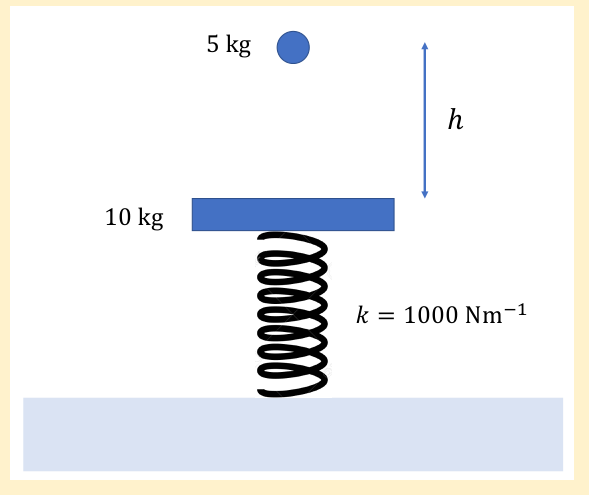
- (A) 20 cm
- (B) 22 cm
- (C) 45 cm
- (D) 59 cm
- (E) 66 cm
Fonte: Testo (PDF) — p.11 Topic: Oscillations & Waves Metodi: Simple Harmonic Motion Analysis, Conservation of Momentum, Hooke’s Law Competenze: Mathematical Modeling Objects: Spring, Block
Un oggetto di massa è inizialmente a un’altezza di sopra una piastra piatta . La piastra è sostenuta da una lunga molla sotto con costante molla , ed è inizialmente in equilibrio sotto la gravità e la forza della molla. L’oggetto viene quindi rilasciato dal riposo per colpire la piastra in una collisione perfettamente inelastica, ma l’oggetto non viene incollato alla piastra dopo la collisione. Trova l’altezza massima al di sotto della quale l’oggetto rimarrà sempre in contatto con la targa nelle successive oscillazioni.
- (A) 20 cm
- (B) 22 cm
- (C) 45 cm
- (D) 59 cm
- (E) 66 cm
Fonte: Testo (PDF) — p.11 Topic: Oscillations & Waves Metodi: Simple Harmonic Motion Analysis, Conservation of Momentum, Hooke’s Law Competenze: Mathematical Modeling Objects: Spring, Block
A -m long ladder leans against a smooth wall, making an angle of with the rough floor. The mass of the ladder is and the linear mass density along its length is constant. The coefficient of static friction between the ladder and the floor is . When the angle is smaller than a certain critical value, the ladder cannot be in equilibrium. What is this critical angle?
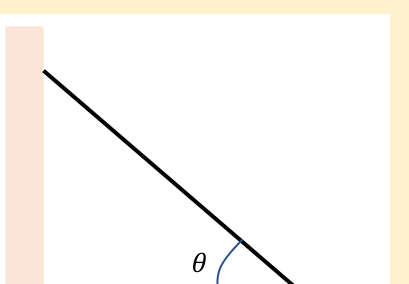
- (A) 11°
- (B) 22°
- (C) 66°
- (D) 68°
- (E) 79°
Fonte: Testo (PDF) — p.11 Topic: Rigid Body Statics Metodi: Torque & Angular Momentum Analysis, Free-Body Diagram Competenze: Mathematical Modeling Objects: Rod
Una scala lunga -m si appoggia a una parete liscia, formando un angolo di con il pavimento accidentato. La massa della scala è e la densità di massa lineare lungo la sua lunghezza è costante. Il coefficiente di attrito statico tra scala e pavimento è . Quando l’angolo è inferiore a un certo valore critico, la scala non può essere in equilibrio. Qual è l’angolo critico?
- (A) 11°
- (B) 22°
- (C) 66°
- (D) 68°
- (E) 79°
Fonte: Testo (PDF) — p.11 Topic: Rigid Body Statics Metodi: Torque & Angular Momentum Analysis, Free-Body Diagram Competenze: Mathematical Modeling Objects: Rod
The tip of an iceberg has a volume of above the sea level. Given the density for the iceberg is and the density for sea water is . What is the volume of the iceberg submerged in water?
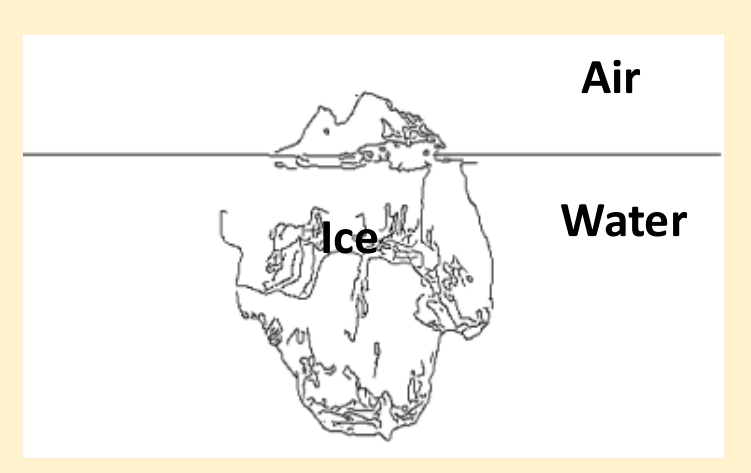
- (A)
- (B)
- (C)
- (D)
- (E)
Fonte: Testo (PDF) — p.12 Topic: Fluid Mechanics Metodi: Hydrostatic Equilibrium, Physical Modeling Competenze: Mathematical Modeling Objects: —
La punta di un iceberg ha un volume di sopra il livello del mare. Dato che la densità dell’iceberg è e la densità dell’acqua di mare è . Qual è il volume dell’iceberg sommerso dall’acqua?
- (A)
- (B)
- (C)
- (D)
- (E)
Fonte: Testo (PDF) — p.12 Topic: Fluid Mechanics Metodi: Hydrostatic Equilibrium, Physical Modeling Competenze: Mathematical Modeling Objects: —
A basketball is dropped vertically at a height of . Initially, it is at rest and if every time it bounces back from the ground, it loses of its energy. How long can the basketball stay in motion until it becomes completely at rest again?
- (A) 1.84 s
- (B) 3.14 s
- (C) 3.39 s
- (D) 6.22 s
- (E) 6.78 s
Fonte: Testo (PDF) — p.12 Topic: Conservation of Energy Metodi: Conservation of Energy, Kinematic Equations, Approximation & Series Expansion Competenze: Mathematical Modeling Objects: Ball
Una palla da basket viene abbassata verticalmente ad un’altezza di . Inizialmente, è in riposo e ogni volta che rimbalza dal terreno perde della sua energia. Quanto tempo può rimanere in movimento il basket finché non si riposerà completamente?
- (A) 1.84 s
- (B) 3.14 s
- (C) 3.39 s
- (D) 6.22 s
- (E) 6.78 s
Fonte: Testo (PDF) — p.12 Topic: Conservation of Energy Metodi: Conservation of Energy, Kinematic Equations, Approximation & Series Expansion Competenze: Mathematical Modeling Objects: Ball
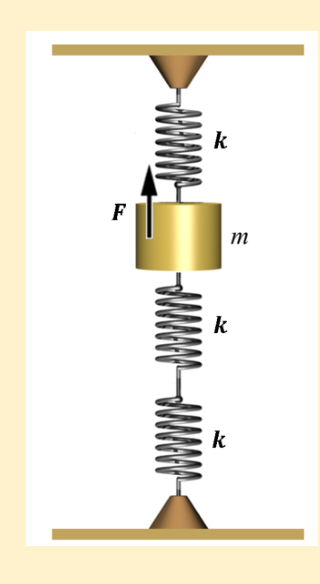
A mass is connected to 3 identical springs with spring constant , as shown in the figure. The whole set is then mounted to a fixed ceiling and floor and is allowed to settle to equilibrium. Now, we apply a force in the upward direction to displace the mass. What will be the displacement from its equilibrium position?
- (A)
- (B)
- (C)
- (D)
- (E)
Fonte: Testo (PDF) — p.13 Topic: Newtonian Mechanics Metodi: Hooke’s Law, Free-Body Diagram Competenze: Physical Reasoning Objects: Spring, Block
Una massa è collegata a 3 sorgenti identiche con costante sorgente , come mostrato nella figura. L’intero set viene quindi montato su un soffitto e un pavimento fissi e si permette di stabilizzarsi in equilibrio. Ora, applichiamo una forza nella direzione ascendente per spostare la massa. Qual sarà il spostamento dalla sua posizione di equilibrio?
- (A)
- (B)
- (C)
- (D)
- (E)
Fonte: Testo (PDF) — p.13 Topic: Newtonian Mechanics Metodi: Hooke’s Law, Free-Body Diagram Competenze: Physical Reasoning Objects: Spring, Block
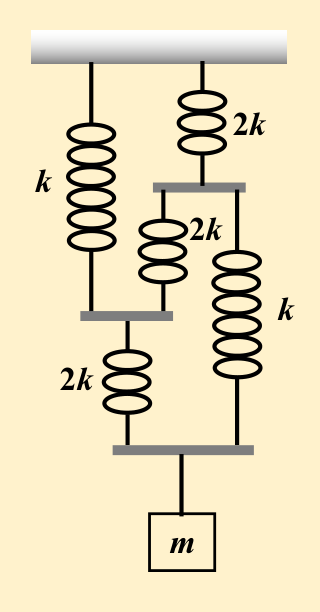
A block of mass is hung from the system of massless springs with force constants shown in the figure. The downward extension of the spring system caused by the block is
- (A)
- (B)
- (C)
- (D)
- (E)
Fonte: Testo (PDF) — p.13 Topic: Newtonian Mechanics Metodi: Hooke’s Law, Free-Body Diagram Competenze: Diagrammatic Reasoning Objects: Spring, Block
Un blocco di massa è appeso al sistema di sorgenti senza massa con costanti di forza mostrate nella figura. L’estensione verso il basso del sistema di molla causata dal blocco è
- (A)
- (B)
- (C)
- (D)
- (E)
Fonte: Testo (PDF) — p.13 Topic: Newtonian Mechanics Metodi: Hooke’s Law, Free-Body Diagram Competenze: Diagrammatic Reasoning Objects: Spring, Block
As shown in Fig. 1, a massive block is driven by a motor to exercise vertical motion. The acceleration due to the periodic motion is much higher than the gravitational acceleration. The displacement of the block versus time for two cycles is shown in Fig. 2. (The units of the vertical axis are arbitrary.)
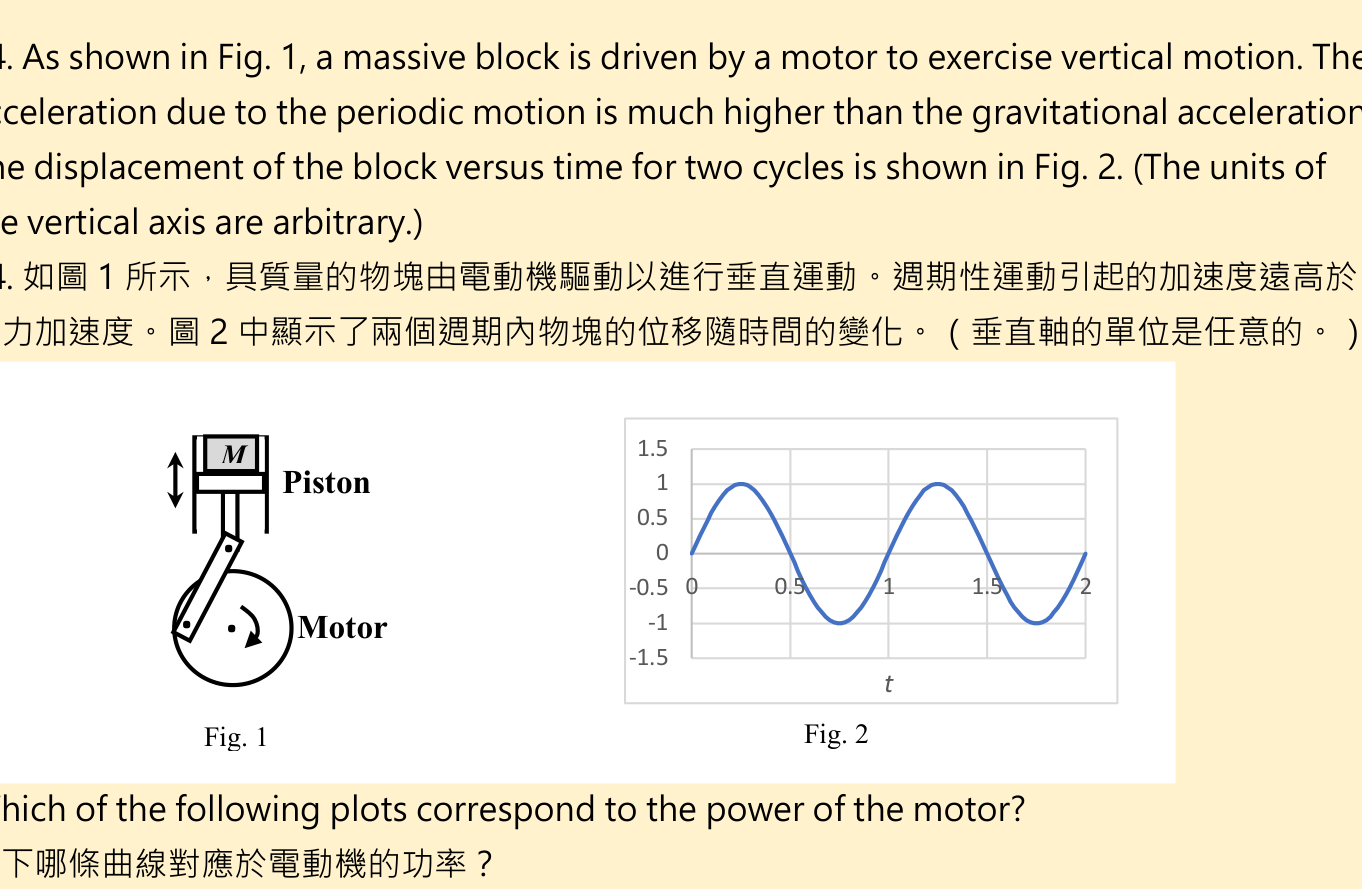
Which of the following plots correspond to the power of the motor?
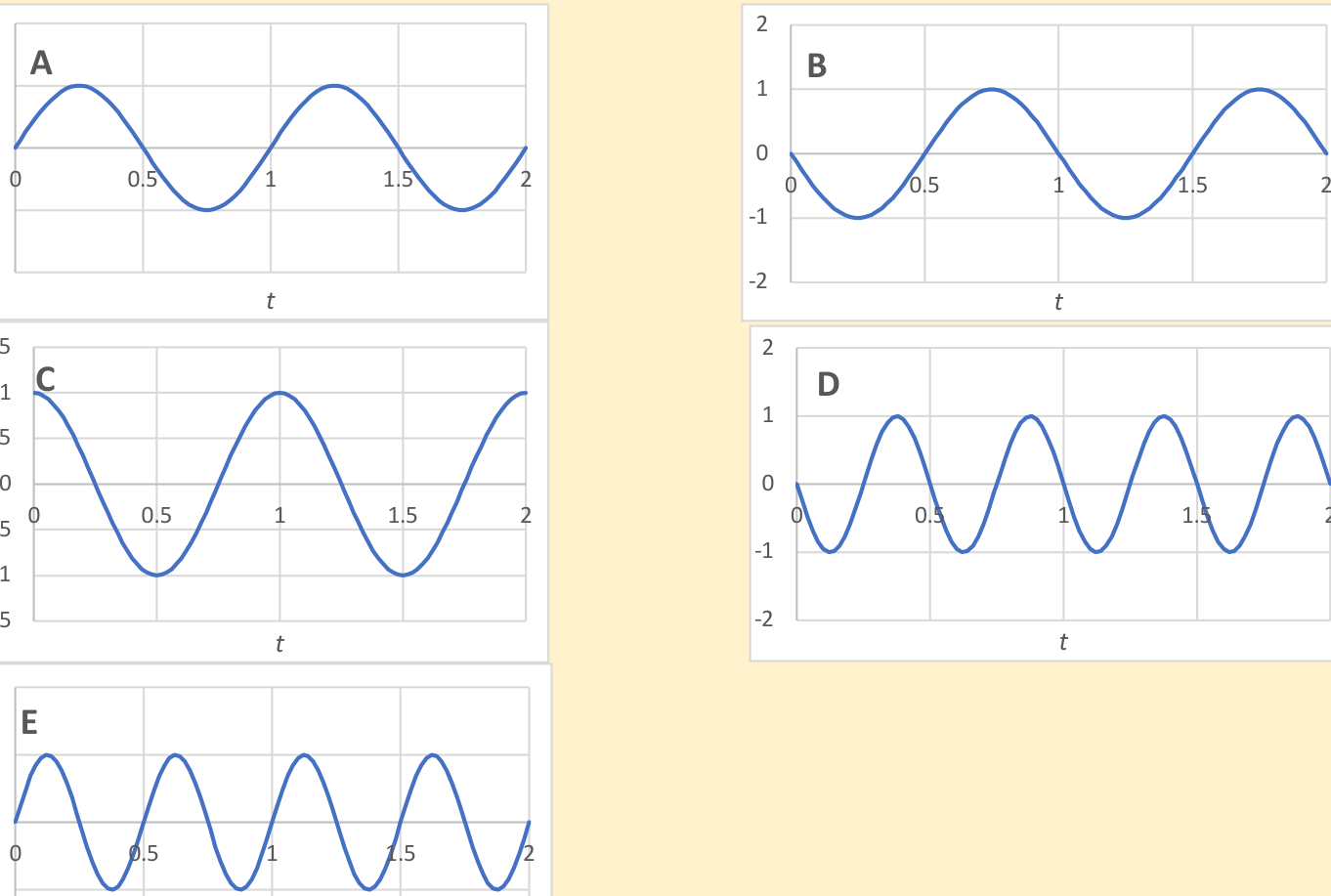
- (A) Plot A
- (B) Plot B
- (C) Plot C
- (D) Plot D
- (E) Plot E
Fonte: Testo (PDF) — p.14 Topic: Newtonian Mechanics Metodi: Free-Body Diagram, Physical Modeling Competenze: Diagrammatic Reasoning Objects: Block
Come mostrato nella figura. 1, un blocco massiccio è guidato da un motore per esercitare un movimento verticale. L’accelerazione dovuta al movimento periodico è molto superiore all’accelerazione gravitazionale. Il spostamento del blocco rispetto al tempo per due cicli è mostrato nella figura. 2. (Le unità dell’asse verticale sono arbitrarie.)
Quale delle seguenti parti corrisponde alla potenza del motore?
- **(A) ** Plot A
- **(B) ** Plot B
- **(C) ** Plot C
- **(D) ** Trama D
- **(E) ** Plot E
Fonte: Testo (PDF) — p.14 Topic: Newtonian Mechanics Metodi: Free-Body Diagram, Physical Modeling Competenze: Diagrammatic Reasoning Objects: Block
A uniform rectangular slab of width , height and negligible thickness is hung from the ceiling by two rods at the upper edges. When the slab is tilted by , the ratio of the tensions is equal to
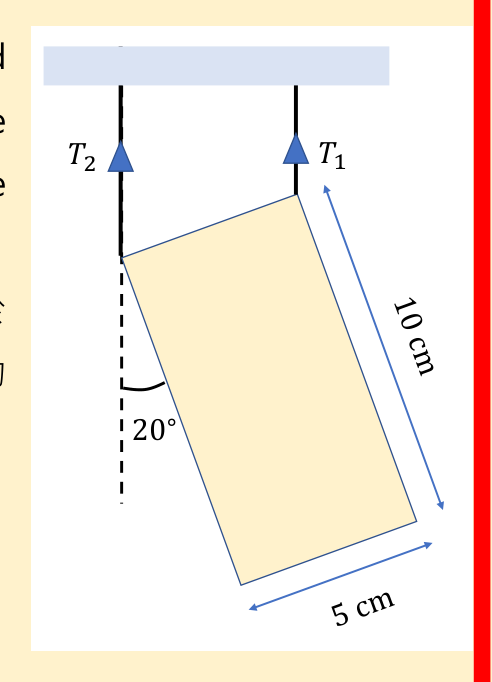
- (A) -2.14
- (B) 2.14
- (C) 0.15
- (D) 6.35
- (E) -6.35
Fonte: Testo (PDF) — p.15 Topic: Rigid Body Statics Metodi: Torque & Angular Momentum Analysis, Free-Body Diagram Competenze: Mathematical Modeling Objects: Rod
Un lastro rettangolare uniforme di larghezza , altezza e spessore trascurabile è appeso al soffitto da due bastone ai bordi superiori. Quando la lastra è inclinata di , il rapporto delle tensioni è pari a
- (A) -2.14
- (B) 2.14
- (C) 0.15
- (D) 6.35
- (E) -6.35
Fonte: Testo (PDF) — p.15 Topic: Rigid Body Statics Metodi: Torque & Angular Momentum Analysis, Free-Body Diagram Competenze: Mathematical Modeling Objects: Rod
Paper 2 — Open Problems.
The information below may be useful for solving the problems.
A. Kinetic friction. A body moving on a surface experiences a frictional force in the opposite direction of its movement. The magnitude of the frictional force is , where is called the coefficient of kinetic friction and is the normal force acting on the body.
B. Elastic potential energy. The potential energy stored in a compressed spring is given by , where is the spring constant and is the compressed length of the spring.
(15 points) As shown in the figure below, a uniform rectangular block of mass is resting on a smooth horizontal surface. A small cube with mass and negligible length and width is on the top of the rectangular block. At time , the cube moves from the left end of the block to the right with an initial velocity . It finally sits at half the length of the rectangular block. It is known that the coefficient of kinetic friction between the small cube and the rectangular block is , and the gravitational acceleration is .
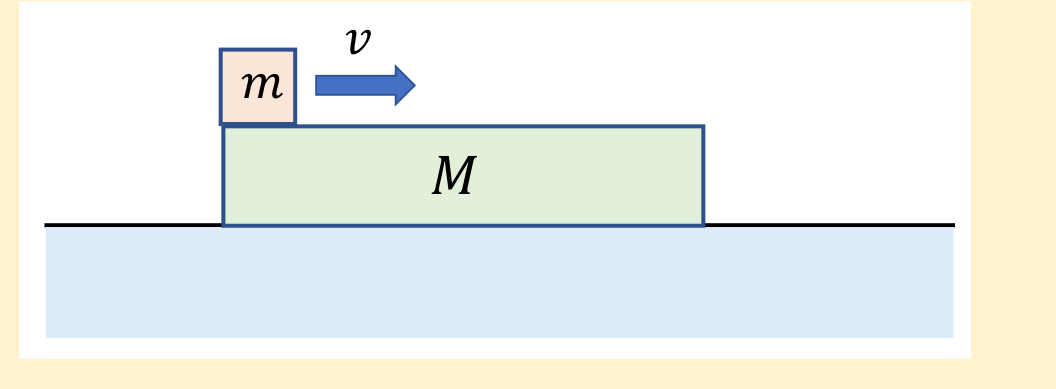
(a) (4 points) What is the time for the small cube to stop on the rectangular block?
(b) (4 points) From time to and relative to the smooth surface, what are the distances travelled by the small cube and the rectangular block respectively?
(c) (4 points) What is the length of the rectangular block? (Express your answer in terms of , , , , .)
(d) (3 points) From time to , what is the total work done by the frictional force on the small cube and the rectangular block?
Fonte: Testo (PDF) — p.19 Topic: Newtonian Mechanics Metodi: Conservation of Momentum, Kinematic Equations, Free-Body Diagram Competenze: Mathematical Modeling Objects: Block
Carta 2 Problemi aperti.
Le informazioni riportate di seguito possono essere utili per risolvere i problemi.
A. Frizione cinetica. Un corpo in movimento su una superficie sperimenta una forza di frizione nella direzione opposta al suo movimento. La grandezza della forza di attrito è , dove è chiamato coefficiente di attrito cinetico e è la forza normale che agisce sul corpo.
B. L’energia potenziale elastica. L’energia potenziale immagazzinata in una sorgente compressa è data da , dove è la costante della sorgente e è la lunghezza compressa della sorgente.
(15 punti) Come mostrato nella figura seguente, un blocco rettangolare uniforme di massa si trova su una superficie orizzontale liscia. Un piccolo cubo di massa e lunghezza e larghezza trascurabili è situato sulla parte superiore del blocco rettangolare. Al tempo , il cubo si muove dall’estremità sinistra del blocco a destra con una velocità iniziale . Finalmente si trova a metà della lunghezza del blocco rettangolare. È noto che il coefficiente di attrito cinetico tra il piccolo cubo e il blocco rettangolare è e l’accelerazione gravitazionale è .
**(a) ** (4 punti) Qual è il tempo per il piccolo cubo di fermarsi sul blocco rettangolare?
**(b) ** (4 punti) Dal tempo al e rispetto alla superficie liscia, quali sono le distanze percorse rispettivamente dal piccolo cubo e dal blocco rettangolare?
**(c) ** (4 punti) Qual è la lunghezza del blocco rettangolare? (Esprimi la tua risposta in termini di , , , , .)
**(d) ** (3 punti) Dal tempo al , qual è il lavoro totale svolto dalla forza di attrito sul piccolo cubo e sul blocco rettangolare?
Fonte: Testo (PDF) — p.19 Topic: Newtonian Mechanics Metodi: Conservation of Momentum, Kinematic Equations, Free-Body Diagram Competenze: Mathematical Modeling Objects: Block
(15 points) A wooden cart is driven by shooting marbles from identical compressed spring launchers mounted on the cart. The cart, including the marbles, has a mass of and each marble has a mass of . For simplicity, we assume that the resistance experienced by the cart can be effectively represented by a kinetic friction coefficient between the ground and the cart and all other resistance such as air drag can be neglected. The initial velocity of the cart is before launching any marbles. When a marble is fired by one of the spring launchers, we assume the impact time is very short and is negligible. We also assume that all the stored elastic energy goes to the kinetic energy of different parts without generating heat. We are interested on how far the cart can go by firing these marbles.
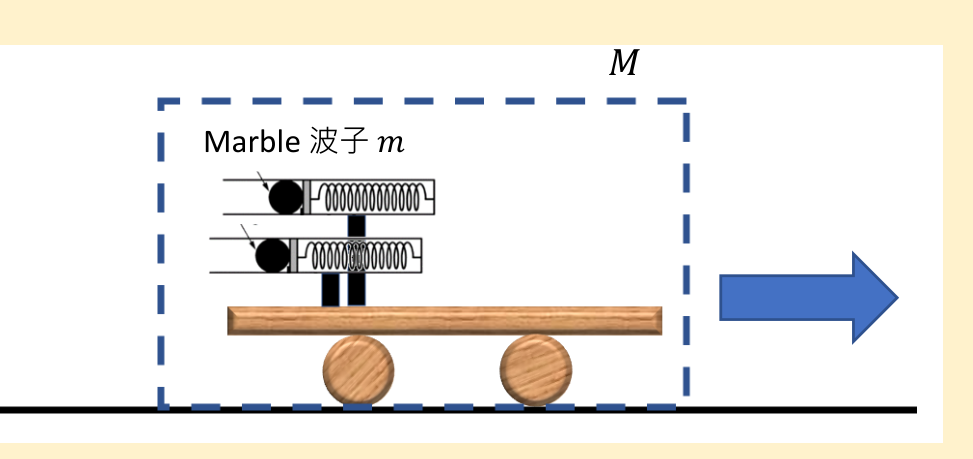
(a) (7 points) Suppose each spring is compressed by an amount of in length with spring constant . Find the velocity for the cart immediately after one marble is launched. What is the distance the cart can elapse before it stops if the initial velocity of the cart is ?
(b) (8 points) You can fire a second marble at any time you choose, what will be the maximum and minimum distance the cart can elapse in firing two marbles? The initial velocity of the cart is still zero before firing the two marbles. Please take the limit for simplification.
Fonte: Testo (PDF) — p.20 Topic: Conservation of Momentum Metodi: Conservation of Momentum, Conservation of Energy, Hooke’s Law Competenze: Mathematical Modeling Objects: Cart, Spring, Ball
(15 punti) Un carrello di legno viene guidato sparando marmi da identici lanciatori di molla compressa montati sul carrello. Il carrello, comprese le marmiere, ha una massa di e ogni marmo ha una massa di . Per semplicità, presumiamo che la resistenza vissuta dal carrello possa essere rappresentata in modo efficace da un coefficiente di attrito cinetico tra il terreno e il carrello e che tutte le altre resistenze come la resistenza all’aria possono essere trascurate. La velocità iniziale del carrello è prima di lanciare qualsiasi marmo. Quando un marmo viene lanciato da uno dei lanciatori di primavera, presumiamo che il tempo di impatto sia molto breve e trascurabile. Supponiamo anche che tutta l’energia elastica immagazzinata vada all’energia cinetica di parti diverse senza generare calore. Ci interessa sapere fino a che punto il carro può arrivare sparando questi marmi.
**(a) ** (7 punti) Supponiamo che ogni molla sia compressa da una quantità di di lunghezza con costante molla . Trova la velocità per il carrello immediatamente dopo il lancio di un marmo. Qual è la distanza che il carrello può percorrere prima di fermarsi se la velocità iniziale del carrello è ?
**(b) ** (8 punti) Puoi sparare un secondo marmo in qualsiasi momento che desideri, qual sarà la distanza massima e minima che il carrello può percorrere nel sparare due marmi? La velocità iniziale del carrello è ancora zero prima di sparare le due marmi. Per semplificazione, si prega di prendere il limite .
Fonte: Testo (PDF) — p.20 Topic: Conservation of Momentum Metodi: Conservation of Momentum, Conservation of Energy, Hooke’s Law Competenze: Mathematical Modeling Objects: Cart, Spring, Ball
(20 points) This problem is a tribute to Kobe Bryant, one of the greatest basketball players of all time but whose life was taken in a helicopter accident earlier this year.
Consider a free-throw shot in a basketball game. He projects the basketball with an initial velocity . Assume that air resistance is negligible in this problem.
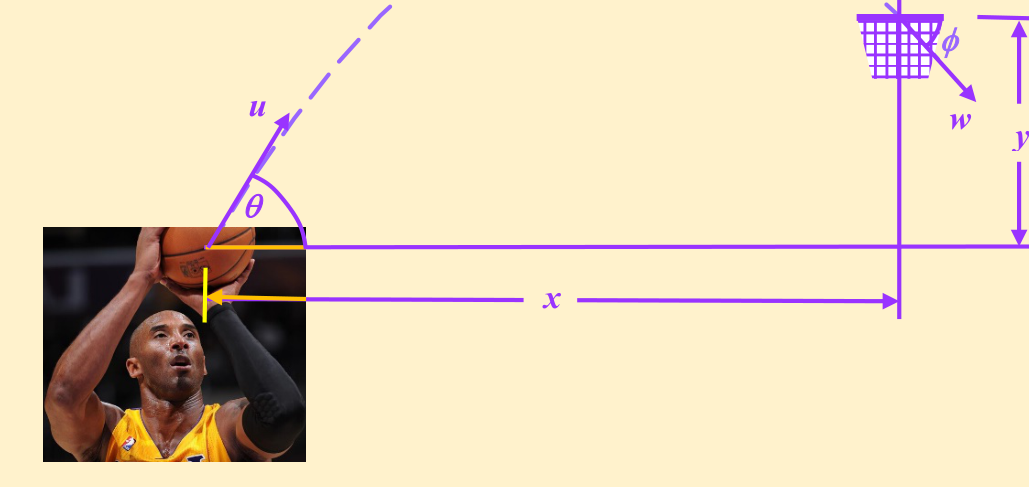
(a) (4 points) Derive an explicit expression of the angle of inclination such that the basketball can hit the center of the basket rim, which is at a horizontal distance and a vertical distance .
(b) (4 points) A physics professor suggested that the best shot can be achieved by shooting the ball at the minimum possible speed, because it has a higher chance of passing through the hoop in case the shot is not accurate and bounces off the rim of the hoop. Derive an expression for the minimum shooting speed and the corresponding shooting angle .
(c) (4 points) For Kobe Bryant, the ball is launched from a height of and the rim of the hoop is above the ground. The horizontal distance is . Calculate the speed and shooting angle in part (b).
(d) (4 points) Calculate the angle of approach when the basketball arrives at the hoop for the shot in part (c).
(e) (4 points) Another physics professor, being a basketball player himself, suggested that Kobe’s shot can be improved by shooting with a higher angle, so that the angle of approach is larger and results in a bigger target of the hoop. Calculate the shooting angle such that the angle of approach of the shot.
Fonte: Testo (PDF) — p.21 Topic: Newtonian Mechanics Metodi: Kinematic Equations, Vector Decomposition, Calculus-Integration Competenze: Mathematical Modeling Objects: Ball, Projectile
(20 punti) Questo problema è un omaggio a Kobe Bryant, uno dei più grandi giocatori di basket di tutti i tempi ma la cui vita è stata uccisa in un incidente di elicottero all’inizio di quest’anno.
Considerate un tiro a tiro libero in una partita di basket. Proietta il basket con una velocità iniziale . Supponiamo che la resistenza all’aria sia trascurabile in questo problema.
**(a) ** (4 punti) Derivare un’espressione esplicita dell’angolo di inclinazione in modo tale che la palla da basket possa colpire il centro del bordo del paniere, che si trova a una distanza orizzontale e a una distanza verticale .
Un professore di fisica ha suggerito che il miglior colpo può essere raggiunto sparando alla palla alla velocità minima possibile, perché ha maggiori possibilità di passare attraverso il cerchio nel caso in cui il colpo non sia preciso e rimbalzi dal bordo del cerchio. Derivare un’espressione per la velocità minima di tiro e l’angolo di tiro corrispondente .
**(c) ** (4 punti) Per Kobe Bryant, la palla viene lanciata da un’altezza di e il bordo del cerchio è sopra il terreno. La distanza orizzontale è . Calcolare la velocità e l’angolo di sparata nella parte b).
**(d) ** (4 punti) Calcolare l’angolo di avvicinamento quando il basket arriva al cerchio per il colpo nella parte (c).
Un altro professore di fisica, essendo lui stesso un giocatore di basket, ha suggerito che il colpo di Kobe può essere migliorato sparando con un angolo più alto, in modo che l’angolo di approccio sia più grande e si traduca in un obiettivo più grande del cerchio. Calcolare l’angolo di tiro in modo tale che l’angolo di avvicinamento del colpo.
Fonte: Testo (PDF) — p.21 Topic: Newtonian Mechanics Metodi: Kinematic Equations, Vector Decomposition, Calculus-Integration Competenze: Mathematical Modeling Objects: Ball, Projectile