A mass hangs from a massless spring connected to the roof of a lift. When the lift is stationary, the mass–spring system oscillates vertically with angular frequency . If the lift is moving downward with a constant velocity, how will the angular frequency change?
- (A) will be unchanged.
- (B) will increase.
- (C) will decrease.
- (D) Oscillations are impossible under these conditions.
- (E) will increase or decrease depending on the values of and the spring constant of the massless spring.
Fonte: Testo (PDF) — p.3
Topic: Oscillations & Waves Metodi: Simple Harmonic Motion Analysis, Physical Modeling Competenze: Physical Reasoning Objects: Spring, Block
Una massa è appesa a una sorgente senza massa collegata al tetto di un ascensore. Quando l’ascensore è stazionario, il sistema di massspring oscilla verticalmente con frequenza angolare . Se l’ascensore si muove verso il basso a una velocità costante, come cambierà la frequenza angolare?
- **(A) ** resterà invariato.
- **(B) ** aumenterà.
- **(C) ** diminuirà.
- **(D) ** Le oscillazioni sono impossibili in queste condizioni.
- **(E) ** aumenterà o diminuirà a seconda dei valori di e della costante di molla della molla senza massa.
Fonte: Testo (PDF) — p.3
Topic: Oscillations & Waves Metodi: Simple Harmonic Motion Analysis, Physical Modeling Competenze: Physical Reasoning Objects: Spring, Block
A ball is released from rest above an inclined plane and bounces elastically down the plane. As the ball progresses down the plane, the time and the distance between each collision will
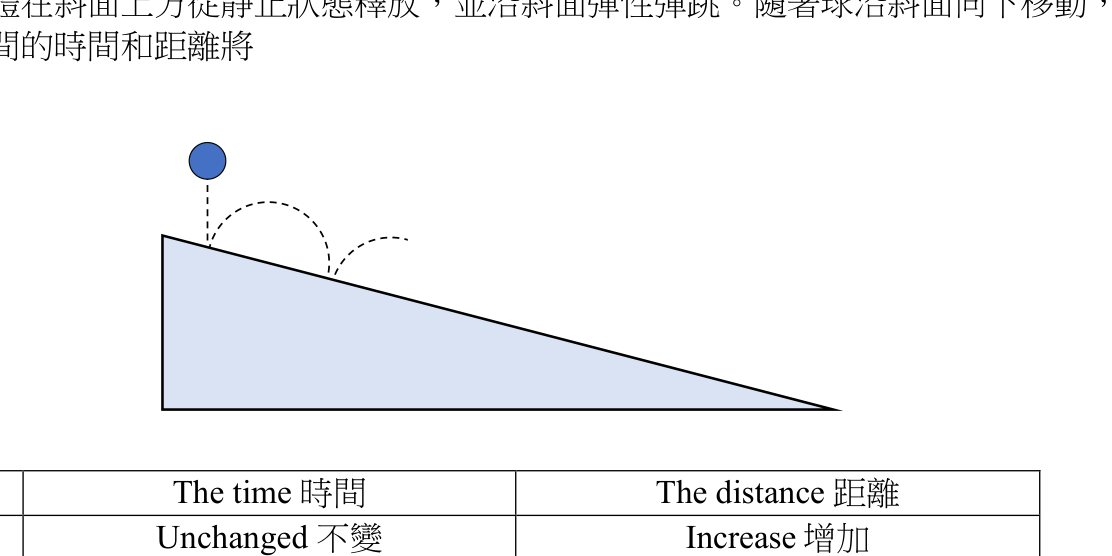
| The time | The distance | |
|---|---|---|
| (A) | Unchanged | Increase |
| (B) | Increase | Unchanged |
| (C) | Decrease | Increase |
| (D) | Decrease | Unchanged |
| (E) | Unchanged | Unchanged |
Fonte: Testo (PDF) — p.3
Topic: Newtonian Mechanics Metodi: Kinematic Equations, Physical Modeling Competenze: Physical Reasoning Objects: Ball, Inclined Plane
Una palla viene rilasciata dal riposo sopra un piano inclinato e rimbalza elasticamente giù per il piano. Mentre la palla si sposta verso il piano, il tempo e la distanza tra ogni collisione
Il tempo, la distanza. |---|---|---|
# # # # # # # # # # # # # # # # # # # # # # # # # # # # # # # # # # # # # # # # # # # # # # # # # # # # # # # # # # # # # # # # # # # # # # # # # # # # # # # # # # # # # # # # # # # # # # # # # # # # # # # # # # # # # # # # # # # # # # # # # # # # # # # # # # # # # # # # # # # # # # # # # # # # # # # # # # # # # # # # # # # # # # # # # # # # # # # # # # # # # # # # # # # # # # # # # # # # # # # # # # # # # # # # # # # # # # # # # # # # # # # # # # # # # # # # # # # # # # # # # # # # # # # # # # # # # # # # # # # # # # # # # # # # # # # # # # # # # # # # # # # # # # # # # # # # # # # # # # # # # # # # # # # # # # # # # # # # # # # # # # # # # # # # # # # # # # # # # # # # # # # # # # # # # # # # # # # # # # # # # # # # # # # # # # # # # # # # # # # # # # # # # # # # # # # # # # # # # # # # # # # # # # # # # # # # # # # # # # # # # # # # # # # # # # # # # # # # # # # # # # # # # # # # # # # # # # # # # # # # # # # # # # # # # # # # # # # # # # # # # # # # # # # # # # # # # # # # # # # # # # # # # # # # #
# # # # # # # # # # # # # # # # # # # # # # # # # # # # # # # # # # # # # # # # # # # # # # # # # # # # # # # # # # # # # # # # # # # # # # # # # # # # # # # # # # # # # # # # # # # # # # # # # # # # # # # # # # # # # # # # # # # # # # # # # # # # # # # # # # # # # # # # # # # # # # # # # # # # # # # # # # # # # # # # # # # # # # # # # # # # # # # # # # # # # # # # # # # # # # # # # # # # # # # # # # # # # # # # # # # # # # # # # # # # # # # # # # # # # # # # # # # # # # # # # # # # # # # # # # # # # # # # # # # # # # # # # # # # # # # # # # # # # # # # # # # # # # # # # # # # # # # # # # # # # # # # # # # # # # # # # # # # # # # # # # # # # # # # # # # # # # # # # # # # # # # # # # # # # # # # # # # # # # # # # # # # # # # # # # # # # # # # # # # # # # # # # # # # # # # # # # # # # # # # # # # # # # # # # # # # # # # # # # # # # # # # # # # # # # # # # # # # # # # # # # # # # # # # # # # # # # # # # # # # # # # # # # # # # # # # # # # # # # # # # # # # # # # # # # # # # # # # # # # # # # # # # # # # #
# # # # # # # # # # # # # # # # # # # # # # # # # # # # # # # # # # # # # # # # # # # # # # # # # # # # # # # # # # # # # # # # # # # # # # # # # # # # # # # # # # # # # # # # # # # # # # # # # # # # # # # # # # # # # # # # # # # # # # # # # # # # # # # # # # # # # # # # # # # # # # # # # # # # # # # # # # # # # # # # # # # # # # # # # # # # # # # # # # # # # # # # # # # # # # # # # # # # # # # # # # # # # # # # # # # # # # # # # # # # # # # # # # # # # # # # # # # # # # # # # # # # # # # # # # # # # # # # # # # # # # # # # # # # # # # # # # # # # # # # # # # # # # # # # # # # # # # # # # # # # # # # # # # # # # # # # # # # # # # # # # # # # # # # # # # # # # # # # # # # # # # # # # # # # # # # # # # # # # # # # # # # # # # # # # # # # # # # # # # # # # # # # # # # # # # # # # # # # # # # # # # # # # # # # # # # # # # # # # # # # # # # # # # # # # # # # # # # # # # # # # # # # # # # # # # # # # # # # # # # # # # # # # # # # # # # # # # # # # # # # # # # # # # # # # # # # # # # # # # # # # # # # # # # #
# # # # # # # # # # # # # # # # # # # # # # # # # # # # # # # # # # # # # # # # # # # # # # # # # # # # # # # # # # # # # # # # # # # # # # # # # # # # # # # # # # # # # # # # # # # # # # # # # # # # # # # # # # # # # # # # # # # # # # # # # # # # # # # # # # # # # # # # # # # # # # # # # # # # # # # # # # # # # # # # # # # # # # # # # # # # # # # # # # # # # # # # # # # # # # # # # # # # # # # # # # # # # # # # # # # # # # # # # # # # # # # # # # # # # # # # # # # # # # # # # # # # # # # # # # # # # # # # # # # # # # # # # # # # # # # # # # # # # # # # # # # # # # # # # # # # # # # # # # # # # # # # # # # # # # # # # # # # # # # # # # # # # # # # # # # # # # # # # # # # # # # # # # # # # # # # # # # # # # # # # # # # # # # # # # # # # # # # # # # # # # # # # # # # # # # # # # # # # # # # # # # # # # # # # # # # # # # # # # # # # # # # # # # # # # # # # # # # # # # # # # # # # # # # # # # # # # # # # # # # # # # # # # # # # # # # # # # # # # # # # # # # # # # # # # # # # # # # # # # # # # # # # # # # #
# # # # # # # # # # # # # # # # # # # # # # # # # # # # # # # # # # # # # # # # # # # # # # # # # # # # # # # # # # # # # # # # # # # # # # # # # # # # # # # # # # # # # # # # # # # # # # # # # # # # # # # # # # # # # # # # # # # # # # # # # # # # # # # # # # # # # # # # # # # # # # # # # # # # # # # # # # # # # # # # # # # # # # # # # # # # # # # # # # # # # # # # # # # # # # # # # # # # # # # # # # # # # # # # # # # # # # # # # # # # # # # # # # # # # # # # # # # # # # # # # # # # # # # # # # # # # # # # # # # # # # # # # # # # # # # # # # # # # # # # # # # # # # # # # # # # # # # # # # # # # # # # # # # # # # # # # # # # # # # # # # # # # # # # # # # # # # # # # # # # # # # # # # # # # # # # # # # # # # # # # # # # # # # # # # # # # # # # # # # # # # # # # # # # # # # # # # # # # # # # # # # # # # # # # # # # # # # # # # # # # # # # # # # # # # # # # # # # # # # # # # # # # # # # # # # # # # # # # # # # # # # # # # # # # # # # # # # # # # # # # # # # # # # # # # # # # # # # # # # # # # # # # # # # #
Fonte: Testo (PDF) — p.3
Topic: Newtonian Mechanics Metodi: Kinematic Equations, Physical Modeling Competenze: Physical Reasoning Objects: Ball, Inclined Plane
How many of the following statements about an action–reaction force pair is/are true?
-
I. The sum of the impulses due to the two forces is always zero.
-
II. The sum of the two forces is always zero.
-
III. The sum of the torques due to the two forces depends on the choice of reference point with respect to which torques are measured.
-
IV. The sum of the works done by the two forces is always zero.
-
(A)
-
(B)
-
(C)
-
(D)
-
(E)
Fonte: Testo (PDF) — p.4
Topic: Newtonian Mechanics Metodi: Conservation Laws, Impulse-Momentum Theorem Competenze: Physical Reasoning Objects: —
Quante delle seguenti affermazioni relative a una coppia di forze di azione reazione sono/sono vere?
-
I. La somma degli impulsi dovuti alle due forze è sempre zero.
-
II. La somma delle due forze è sempre zero.
-
III. La somma delle coppie dovute alle due forze dipende dalla scelta del punto di riferimento rispetto al quale vengono misurate le coppie.
-
IV. La somma delle opere svolte dalle due forze è sempre zero.
-
(A)
-
(B)
-
(C)
-
(D)
-
(E)
Fonte: Testo (PDF) — p.4
Topic: Newtonian Mechanics Metodi: Conservation Laws, Impulse-Momentum Theorem Competenze: Physical Reasoning Objects: —
A geosynchronous satellite is an artificial satellite in circular orbit around the Earth with the same period as the self-rotation period of the Earth. A geostationary satellite is an artificial satellite that appears stationary in the sky when observed by a ground observer. Which of the following statements is/are correct?
-
I. All geosynchronous satellites are geostationary.
-
II. All geostationary satellites are geosynchronous.
-
III. It is possible to have a geostationary satellite at the zenith (directly overhead in the sky) of the local sky of Hong Kong.
-
(A) I only
-
(B) II only
-
(C) III only
-
(D) I and II only
-
(E) I, II, and III
Fonte: Testo (PDF) — p.4
Topic: Gravitation Metodi: Newton’s Law of Gravitation, Physical Modeling Competenze: Physical Reasoning Objects: Satellite, Planet
Un satellite geosincrono è un satellite artificiale in orbita circolare intorno alla Terra con lo stesso periodo di auto-rotatoria della Terra. Un satellite geostazionario è un satellite artificiale che appare stazionario nel cielo quando osservato da un osservatore terrestre. Quali delle seguenti affermazioni sono/sono corrette?
-
I. Tutti i satelliti geosincroni sono geostazionari.
-
II. Tutti i satelliti geostazionari sono geosincroni.
-
III. È possibile avere un satellite geostazionario al zenit (direttamente in alto nel cielo) del cielo locale di Hong Kong.
-
**(A) ** I solo
-
**(B) ** II solo
-
solo **(C) ** III
-
**(D) ** I e II solo
-
**(E) ** I, II e III
Fonte: Testo (PDF) — p.4
Topic: Gravitation Metodi: Newton’s Law of Gravitation, Physical Modeling Competenze: Physical Reasoning Objects: Satellite, Planet
A circular ring and a circular disk have the same mass and radius. Consider the following three motions:
- I. The ring rotating about an axis passing through the center of the ring and perpendicular to the plane on which the ring lies
- II. The ring rotating about its diameter
- III. The disk rotating about its diameter
The three rotational speeds are the same. Rank the kinetic energies due to the rotation, from smallest to largest.
- (A) I, II, III
- (B) I, III, II
- (C) II, III, I
- (D) III, I, II
- (E) III, II, I
Fonte: Testo (PDF) — p.5
Topic: Rotational Dynamics Metodi: Torque & Angular Momentum Analysis, Physical Modeling Competenze: Physical Reasoning Objects: Disk
Un anello circolare e un disco circolare hanno la stessa massa e il medesimo raggio. Considerate le seguenti tre proposte:
- I. L’anello che ruota attorno ad un asse che attraversa il centro dell’anello e che è perpendicolare al piano su cui si trova l’anello
- II. L’anello che ruota intorno al suo diametro
- III. Il disco che ruota intorno al suo diametro
Le tre velocità di rotazione sono le stesse. Rendi le energie cinetiche a causa della rotazione, dalla più piccola alla più grande.
- **(A) ** I, II, III
- **(B) ** I, III, II
- **(C) ** II, III, I
- **(D) ** III, I, II
- **(E) ** III, II, I
Fonte: Testo (PDF) — p.5
Topic: Rotational Dynamics Metodi: Torque & Angular Momentum Analysis, Physical Modeling Competenze: Physical Reasoning Objects: Disk
An object is launched vertically upwards somewhere on the Earth’s surface not at the north and south pole. Regarding the minimum initial vertical velocity the object needs to have so that it can escape the Earth’s gravity, and taking the Earth’s self-rotation into account, how does it compare to the escape velocity at the surface of the Earth?
- (A) It is slightly smaller than the escape velocity.
- (B) It is equal to the escape velocity.
- (C) It is slightly larger than the escape velocity.
- (D) Which of A, B, C being correct depends on the longitude of the location.
- (E) Which of A, B, C being correct depends on the latitude of the location.
Fonte: Testo (PDF) — p.5
Topic: Gravitation Metodi: Newton’s Law of Gravitation, Energy Conservation Method Competenze: Physical Reasoning Objects: Planet
Un oggetto viene lanciato verticalmente verso l’alto da qualche parte sulla superficie terrestre non al polo nord e sud. Per quanto riguarda la velocità verticale iniziale minima che l’oggetto deve avere per poter sfuggire alla gravità terrestre, e tenendo conto dell’auto-rottamento terrestre, come si confronta con la velocità di fuga alla superficie terrestre?
- **(A) ** È leggermente inferiore alla velocità di fuga.
- **(B) ** È uguale alla velocità di fuga.
- **(C) ** È leggermente superiore alla velocità di fuga.
- **(D) ** Quale di A, B e C è corretto dipende dalla longitudine della posizione.
- **(E) ** Quale di A, B e C sia corretto dipende dalla latitudine della posizione.
Fonte: Testo (PDF) — p.5
Topic: Gravitation Metodi: Newton’s Law of Gravitation, Energy Conservation Method Competenze: Physical Reasoning Objects: Planet
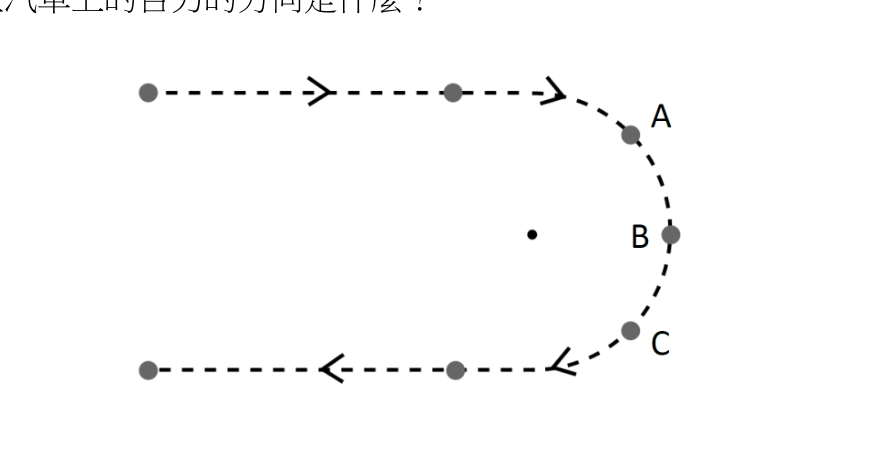
A car makes a U-turn along a semi-circular curve as shown below. Moving from A to C, the car is slowing down with a constant rate. What is the direction of the net force acting on the car when the car is at point B?
- (A)
- (B)
- (C)
- (D)
- (E)
Fonte: Testo (PDF) — p.6
Topic: Newtonian Mechanics Metodi: Vector Decomposition, Free-Body Diagram Competenze: Diagrammatic Reasoning Objects: Cart
Una macchina fa una curva U lungo una curva semicircolare come mostrato di seguito. Passando da A a C, l’auto rallenta a una velocità costante. Qual è la direzione della forza di rete che agisce sull’auto quando l’auto è al punto B?
- (A)
- (B)
- (C)
- (D)
- (E)
Fonte: Testo (PDF) — p.6
Topic: Newtonian Mechanics Metodi: Vector Decomposition, Free-Body Diagram Competenze: Diagrammatic Reasoning Objects: Cart
An ice is floating on water in a cup. At the beginning, part of the ice submerges under the water surface. Finally the ice is completely melted. Ignoring evaporation and thermal expansion. Which statement below is true?
- (A) The water level rises after the ice is melted.
- (B) The water level drops after the ice is melted.
- (C) The water level remains unchanged after the ice is melted.
- (D) The ice could not melt completely as no heat is supplied.
- (E) Further information is needed to determine what could happen.
Fonte: Testo (PDF) — p.6
Topic: Fluid Mechanics Metodi: Hydrostatic Equilibrium, Physical Modeling Competenze: Physical Reasoning Objects: Container
Un ghiaccio galleggia sull’acqua in una tazza. All’inizio, una parte del ghiaccio submerge sotto la superficie dell’acqua. Finalmente il ghiaccio si scioglie completamente. Ignorando l’evaporazione e l’espansione termica. Quale di queste affermazioni è vera?
- **(A) ** Il livello dell’acqua aumenta dopo che il ghiaccio è sciolto.
- **(B) ** Il livello dell’ acqua scende dopo che il ghiaccio è sciolto.
- **(C) ** Il livello dell’acqua rimane invariato dopo che il ghiaccio è stato sciolto.
- **(D) ** Il ghiaccio non è stato completamente sciolto in quanto non è stato fornito calore.
- **(E) ** Per determinare cosa potrebbe accadere sono necessarie ulteriori informazioni.
Fonte: Testo (PDF) — p.6
Topic: Fluid Mechanics Metodi: Hydrostatic Equilibrium, Physical Modeling Competenze: Physical Reasoning Objects: Container
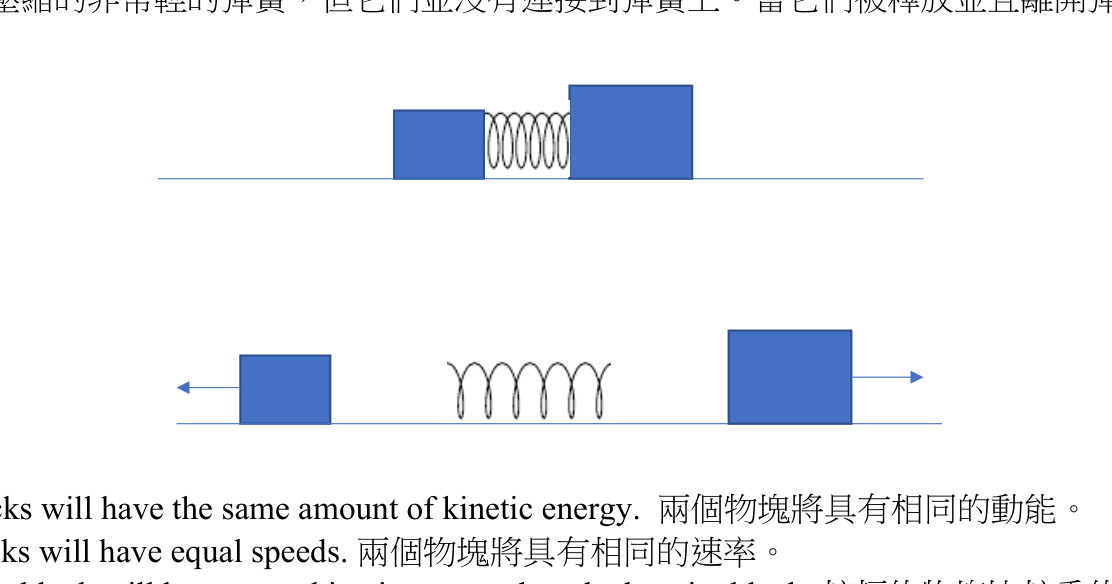
A 1.0-kg block and a 2.0-kg block are pressed together on a horizontal frictionless surface with a compressed very light spring between them. They are not attached to the spring. After they are released and have both moved away from the spring
- (A) both blocks will have the same amount of kinetic energy.
- (B) both blocks will have equal speeds.
- (C) the lighter block will have more kinetic energy than the heavier block.
- (D) the magnitude of the momentum of the heavier block will be greater than the magnitude of the momentum of the lighter block.
- (E) the heavier block will have more kinetic energy than the lighter block.
Fonte: Testo (PDF) — p.7
Topic: Conservation of Momentum Metodi: Conservation of Momentum, Conservation of Energy Competenze: Physical Reasoning Objects: Block, Spring
Un blocco di 1,0 kg e un blocco di 2,0 kg sono premuti insieme su una superficie orizzontale senza attrito con una sorgente compressa molto leggera tra di loro. Non sono attaccate alla sorgente. Dopo che saranno stati rilasciati e si sono entrambi allontanati dalla sorgente
- **(A) ** entrambi i blocchi avranno la stessa quantità di energia cinetica.
- **(B) ** entrambi i blocchi avranno velocità uguali.
- **(C) ** il blocco più leggero avrà più energia cinetica del blocco più pesante.
- **(D) ** la grandezza del momento del blocco più pesante sarà maggiore della grandezza del momento del blocco più leggero.
- **(E) ** il blocco più pesante avrà più energia cinetica del blocco più leggero.
Fonte: Testo (PDF) — p.7
Topic: Conservation of Momentum Metodi: Conservation of Momentum, Conservation of Energy Competenze: Physical Reasoning Objects: Block, Spring
Three uniform objects are placed on a frictional plane so they will not slide. The plane is being tilted from horizontal. As the angle gradually increases from , determine which object(s) will start to tip over at the smallest angle and which object(s) will start to tip over at a largest angle.
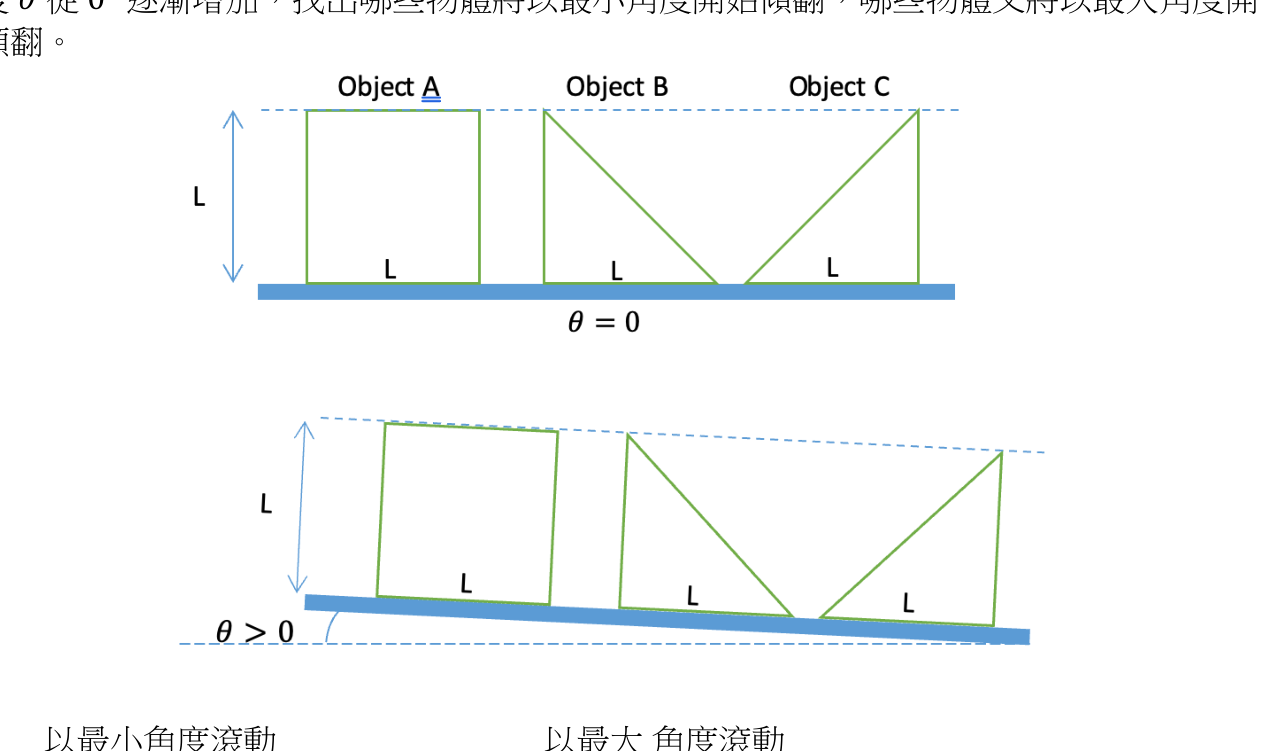
| Tip over at smallest angle | Tip over at largest angle | |
|---|---|---|
| (A) | Object C | Object B |
| (B) | Object C | Object A |
| (C) | Object B and C | Object A |
| (D) | Object A and C | Object B |
| (E) | Object A | Object C |
Fonte: Testo (PDF) — p.8
Topic: Rigid Body Statics Metodi: Torque & Angular Momentum Analysis, Free-Body Diagram Competenze: Physical Reasoning Objects: Inclined Plane
Tre oggetti uniformi sono posizionati su un piano di attrito in modo da non scivolare. L’aereo si inclina da orizzontale. Quando l’angolo aumenta gradualmente da , determinare quale oggetto(s) inizierà a inclinarsi all’angolo più piccolo e quale oggetto(s) inizierà a inclinarsi all’angolo più grande.
♬ Girati all’angolo più piccolo ♬ Girati all’angolo più grande ♬ |---|---|---|
# # # # # # # # # # # # # # # # # # # # # # # # # # # # # # # # # # # # # # # # # # # # # # # # # # # # # # # # # # # # # # # # # # # # # # # # # # # # # # # # # # # # # # # # # # # # # # # # # # # # # # # # # # # # # # # # # # # # # # # # # # # # # # # # # # # # # # # # # # # # # # # # # # # # # # # # # # # # # # # # # # # # # # # # # # # # # # # # # # # # # # # # # # # # # # # # # # # # # # # # # # # # # # # # # # # # # # # # # # # # # # # # # # # # # # # # # # # # # # # # # # # # # # # # # # # # # # # # # # # # # # # # # # # # # # # # # # # # # # # # # # # # # # # # # # # # # # # # # # # # # # # # # # # # # # # # # # # # # # # # # # # # # # # # # # # # # # # # # # # # # # # # # # # # # # # # # # # # # # # # # # # # # # # # # # # # # # # # # # # # # # # # # # # # # # # # # # # # # # # # # # # # # # # # # # # # # # # # # # # # # # # # # # # # # # # # # # # # # # # # # # # # # # # # # # # # # # # # # # # # # # # # # # # # # # # # # # # # # # # # # # # # # # # # # # # # # # # # # # # # # # # # # # # # #
# # # # # # # # # # # # # # # # # # # # # # # # # # # # # # # # # # # # # # # # # # # # # # # # # # # # # # # # # # # # # # # # # # # # # # # # # # # # # # # # # # # # # # # # # # # # # # # # # # # # # # # # # # # # # # # # # # # # # # # # # # # # # # # # # # # # # # # # # # # # # # # # # # # # # # # # # # # # # # # # # # # # # # # # # # # # # # # # # # # # # # # # # # # # # # # # # # # # # # # # # # # # # # # # # # # # # # # # # # # # # # # # # # # # # # # # # # # # # # # # # # # # # # # # # # # # # # # # # # # # # # # # # # # # # # # # # # # # # # # # # # # # # # # # # # # # # # # # # # # # # # # # # # # # # # # # # # # # # # # # # # # # # # # # # # # # # # # # # # # # # # # # # # # # # # # # # # # # # # # # # # # # # # # # # # # # # # # # # # # # # # # # # # # # # # # # # # # # # # # # # # # # # # # # # # # # # # # # # # # # # # # # # # # # # # # # # # # # # # # # # # # # # # # # # # # # # # # # # # # # # # # # # # # # # # # # # # # # # # # # # # # # # # # # # # # # # # # # # # # # # # # # # # # # #
# # # # # # # # # # # # # # # # # # # # # # # # # # # # # # # # # # # # # # # # # # # # # # # # # # # # # # # # # # # # # # # # # # # # # # # # # # # # # # # # # # # # # # # # # # # # # # # # # # # # # # # # # # # # # # # # # # # # # # # # # # # # # # # # # # # # # # # # # # # # # # # # # # # # # # # # # # # # # # # # # # # # # # # # # # # # # # # # # # # # # # # # # # # # # # # # # # # # # # # # # # # # # # # # # # # # # # # # # # # # # # # # # # # # # # # # # # # # # # # # # # # # # # # # # # # # # # # # # # # # # # # # # # # # # # # # # # # # # # # # # # # # # # # # # # # # # # # # # # # # # # # # # # # # # # # # # # # # # # # # # # # # # # # # # # # # # # # # # # # # # # # # # # # # # # # # # # # # # # # # # # # # # # # # # # # # # # # # # # # # # # # # # # # # # # # # # # # # # # # # # # # # # # # # # # # # # # # # # # # # # # # # # # # # # # # # # # # # # # # # # # # # # # # # # # # # # # # # # # # # # # # # # # # # # # # # # # # # # # # # # # # # # # # # # # # # # # # # # # # # # # # # # # # # #
# # # # # # # # # # # # # # # # # # # # # # # # # # # # # # # # # # # # # # # # # # # # # # # # # # # # # # # # # # # # # # # # # # # # # # # # # # # # # # # # # # # # # # # # # # # # # # # # # # # # # # # # # # # # # # # # # # # # # # # # # # # # # # # # # # # # # # # # # # # # # # # # # # # # # # # # # # # # # # # # # # # # # # # # # # # # # # # # # # # # # # # # # # # # # # # # # # # # # # # # # # # # # # # # # # # # # # # # # # # # # # # # # # # # # # # # # # # # # # # # # # # # # # # # # # # # # # # # # # # # # # # # # # # # # # # # # # # # # # # # # # # # # # # # # # # # # # # # # # # # # # # # # # # # # # # # # # # # # # # # # # # # # # # # # # # # # # # # # # # # # # # # # # # # # # # # # # # # # # # # # # # # # # # # # # # # # # # # # # # # # # # # # # # # # # # # # # # # # # # # # # # # # # # # # # # # # # # # # # # # # # # # # # # # # # # # # # # # # # # # # # # # # # # # # # # # # # # # # # # # # # # # # # # # # # # # # # # # # # # # # # # # # # # # # # # # # # # # # # # # # # # # # # # # #
# # # # # # # # # # # # # # # # # # # # # # # # # # # # # # # # # # # # # # # # # # # # # # # # # # # # # # # # # # # # # # # # # # # # # # # # # # # # # # # # # # # # # # # # # # # # # # # # # # # # # # # # # # # # # # # # # # # # # # # # # # # # # # # # # # # # # # # # # # # # # # # # # # # # # # # # # # # # # # # # # # # # # # # # # # # # # # # # # # # # # # # # # # # # # # # # # # # # # # # # # # # # # # # # # # # # # # # # # # # # # # # # # # # # # # # # # # # # # # # # # # # # # # # # # # # # # # # # # # # # # # # # # # # # # # # # # # # # # # # # # # # # # # # # # # # # # # # # # # # # # # # # # # # # # # # # # # # # # # # # # # # # # # # # # # # # # # # # # # # # # # # # # # # # # # # # # # # # # # # # # # # # # # # # # # # # # # # # # # # # # # # # # # # # # # # # # # # # # # # # # # # # # # # # # # # # # # # # # # # # # # # # # # # # # # # # # # # # # # # # # # # # # # # # # # # # # # # # # # # # # # # # # # # # # # # # # # # # # # # # # # # # # # # # # # # # # # # # # # # # # # # # # # # # #
Fonte: Testo (PDF) — p.8
Topic: Rigid Body Statics Metodi: Torque & Angular Momentum Analysis, Free-Body Diagram Competenze: Physical Reasoning Objects: Inclined Plane
A particle sliding on a curved track (similar to surface of a bowl) is under the net force consisting of gravity, normal force and friction. The total mechanical energy is defined as the sum of the kinetic energy and the gravitational potential energy. Which of the following statement is true?
- (A) The change in mechanical energy equals work done by friction and gravity.
- (B) The change in mechanical energy equals work done by friction only.
- (C) The change in kinetic energy equals work done by friction and gravity.
- (D) Normal force does not do any work.
- (E) Work done by friction must be negative.
Fonte: Testo (PDF) — p.8
Topic: Conservation of Energy Metodi: Energy Conservation Method, Free-Body Diagram Competenze: Physical Reasoning Objects: —
Una particella che scivola su una pista curva (simile alla superficie di una ciotola) è sotto la forza netta costituita da gravità, forza normale e attrito. L’energia meccanica totale è definita come la somma dell’energia cinetica e dell’energia potenziale gravitazionale. Quale delle seguenti affermazioni è vera?
- **(A) ** Il cambiamento di energia meccanica equivale al lavoro effettuato da attrito e gravità.
- **(B) ** Il cambiamento di energia meccanica equivale al lavoro effettuato solo con attrito.
- **(C) ** Il cambiamento di energia cinetica equivale al lavoro effettuato da attrito e gravità.
- **(D) ** La forza normale non fa alcun lavoro.
- **(E) ** Il lavoro effettuato con attrito deve essere negativo.
Fonte: Testo (PDF) — p.8
Topic: Conservation of Energy Metodi: Energy Conservation Method, Free-Body Diagram Competenze: Physical Reasoning Objects: —
Consider a pulse with an upward displacement of a half-cosine shape is travelling to the right on a string with a fixed end on the right (fixed on a wall with no displacement allowed). Which of the following in describing the pulse after it hits the fixed end is correct?

- (A) The pulse are reflected with the pulse width halved.
- (B) The pulse are reflected with upward displacement of the same shape.
- (C) The pulse are reflected with downward displacement of the same shape.
- (D) The pulse is absorbed by the fixed end.
- (E) None of the above.
Fonte: Testo (PDF) — p.9
Topic: Oscillations & Waves Metodi: Wave Equation, Physical Modeling Competenze: Physical Reasoning Objects: String
Considera che un impulso con uno spostamento verso l’alto di forma di mezzo cosino si sposta a destra su una corda con un’estremità fissa a destra (fisso su un muro senza spostamento consentito). Quale delle seguenti descrizioni del polso dopo che ha raggiunto l’estremità fissa è corretta?
- **(A) ** Il polso si riflette con la larghezza del polso dimezzata.
- **(B) ** Il polso si riflette con spostamento verso l’alto della stessa forma.
- **(C) ** Il polso si riflette con spostamento verso il basso della stessa forma.
- **(D) ** Il polso è assorbito dall’ estremità fissa.
- **(E) ** Nessuna delle seguenti.
Fonte: Testo (PDF) — p.9
Topic: Oscillations & Waves Metodi: Wave Equation, Physical Modeling Competenze: Physical Reasoning Objects: String
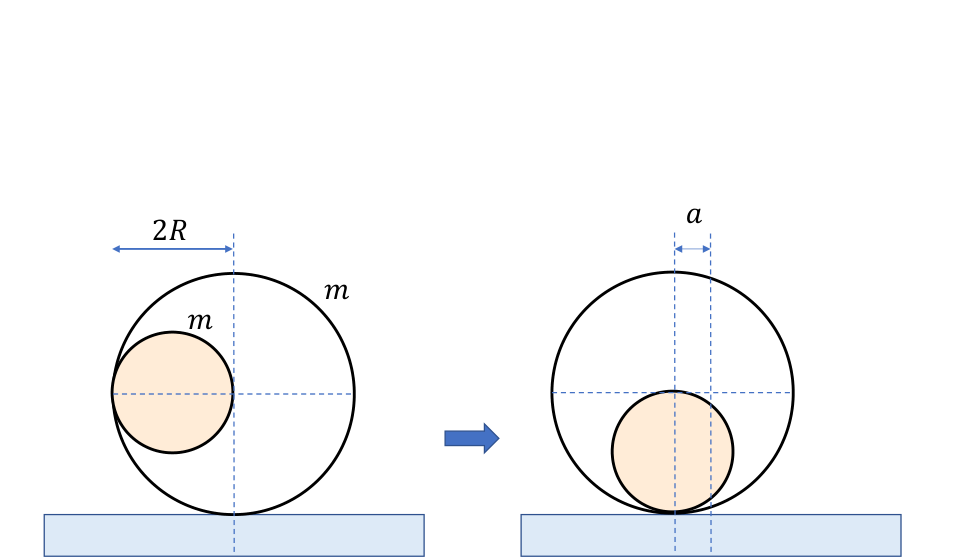
A ball of radius and mass is put inside a cylindrical shell of the same mass and radius . The system is at rest on a horizontal frictionless surface initially. When the ball is released inside the shell, it moves along the shell and eventually stops at the bottom of the shell. What is the final displacement does the shell move from its initial contact point with the surface?
- (A)
- (B)
- (C)
- (D)
- (E)
Fonte: Testo (PDF) — p.9
Topic: Conservation of Momentum Metodi: Conservation of Momentum, Physical Modeling Competenze: Physical Reasoning Objects: Ball, Cylinder
Una sfera di raggio e massa viene inserita all’interno di una conchiglia cilindrica della stessa massa e raggio . Il sistema è a riposo su una superficie orizzontale senza attrito inizialmente. Quando la palla viene rilasciata all’interno del guscio, si muove lungo il guscio e alla fine si ferma in fondo al guscio. Qual è il spostamento finale se la conchiglia si muove dal suo punto di contatto iniziale con la superficie?
- (A)
- (B)
- (C)
- (D)
- (E)
Fonte: Testo (PDF) — p.9
Topic: Conservation of Momentum Metodi: Conservation of Momentum, Physical Modeling Competenze: Physical Reasoning Objects: Ball, Cylinder
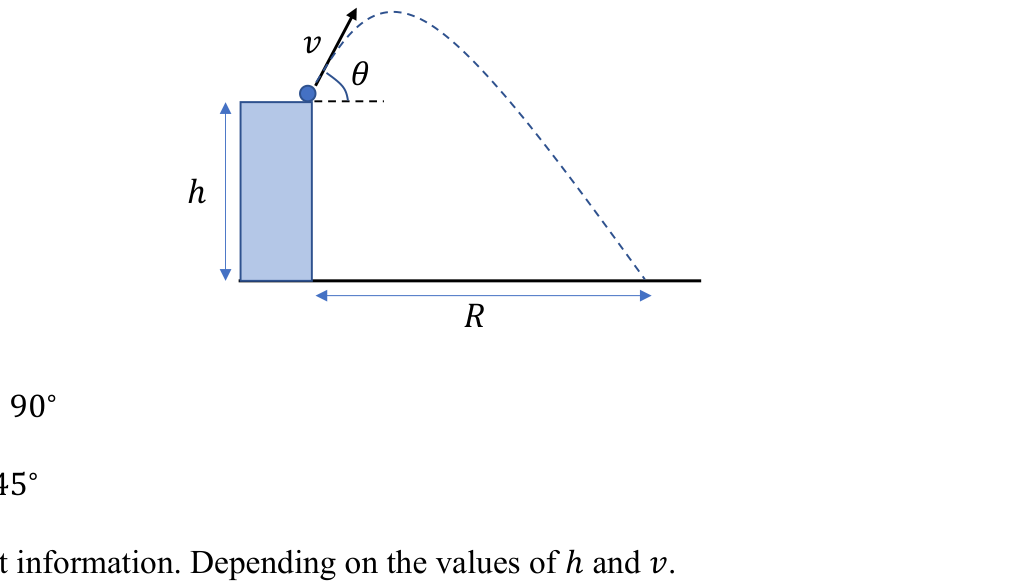
A projectile is launched with speed off the edge of a cliff of height , at an angle from the horizontal. Air friction is negligible. To maximize the horizontal range of the projectile, should satisfy
- (A)
- (B)
- (C)
- (D)
- (E) Insufficient information. Depending on the values of and .
Fonte: Testo (PDF) — p.10
Topic: Newtonian Mechanics Metodi: Kinematic Equations, Vector Decomposition Competenze: Mathematical Modeling Objects: Projectile
Un proiettile viene lanciato a velocità dal bordo di una scogliera di altezza , ad un angolo dall’orizzontale. L’attrito dell’aria è trascurabile. Per massimizzare l’intervallo orizzontale del proiettile, deve soddisfare le condizioni di
- (A)
- (B)
- (C)
- (D)
- **(E) ** Informazioni insufficienti. A seconda dei valori di e .
Fonte: Testo (PDF) — p.10
Topic: Newtonian Mechanics Metodi: Kinematic Equations, Vector Decomposition Competenze: Mathematical Modeling Objects: Projectile
A massless rope passes over a frictionless pulley. Particles of mass and are suspended from the two different ends of the rope and they move under the gravity. If , the tension in the rope is . If the value of increases to infinity, the value of the tension
- (A) Stays constant
- (B) Decreases to a nonzero constant
- (C) Decreases to zero
- (D) Increases to a finite constant
- (E) Increases to infinity
Fonte: Testo (PDF) — p.11
Topic: Newtonian Mechanics Metodi: Free-Body Diagram, Approximation & Series Expansion Competenze: Physical Reasoning Objects: String, Pulley
Una corda senza massa passa sopra una polla senza attrito. Le particelle di massa e sono sospese dalle due estremità diverse della corda e si muovono sotto la gravità. Se , la tensione nella corda è . Se il valore di aumenta fino all’infinito, il valore della tensione
- **(A) ** Rimane costante
- **(B) ** Si riduce a una costante non zero
- **(C) ** Riduce a zero
- **(D) ** Aumenta a una costante finita
- **(E) ** Aumenta fino all’infinito
Fonte: Testo (PDF) — p.11
Topic: Newtonian Mechanics Metodi: Free-Body Diagram, Approximation & Series Expansion Competenze: Physical Reasoning Objects: String, Pulley
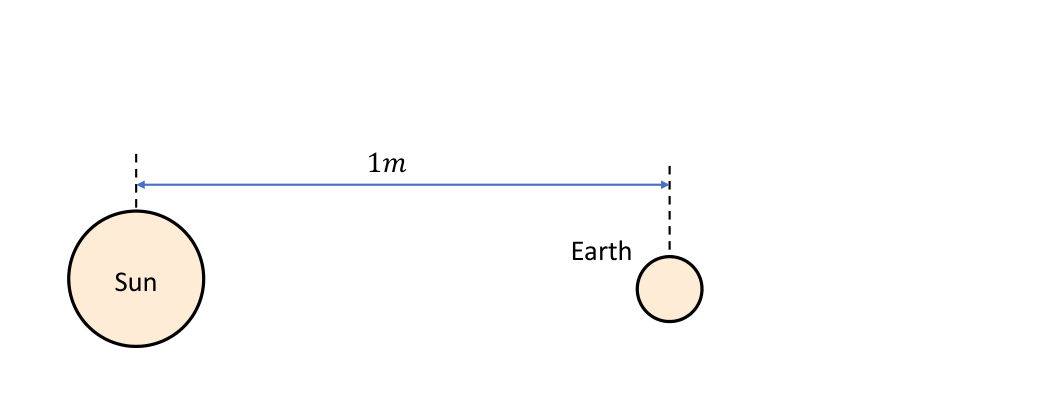
If the solar system scales down such that the average distance between the earth and the sun is , what is the period of the earth around the sun? Assuming that the density of the object does not change.
- (A) year
- (B) year
- (C) year
- (D) years
- (E) years
Fonte: Testo (PDF) — p.11
Topic: Gravitation Metodi: Kepler’s Laws, Dimensional Analysis Competenze: Mathematical Modeling Objects: Planet, Star
Se il sistema solare si riduce in modo tale che la distanza media tra la terra e il sole sia , quale è il periodo della terra intorno al sole? Supponendo che la densità dell’oggetto non cambie.
- **(A) ** anno
- **(B) ** anno
- **(C) ** anno
- **(D) ** anni
- **(E) ** anni
Fonte: Testo (PDF) — p.11
Topic: Gravitation Metodi: Kepler’s Laws, Dimensional Analysis Competenze: Mathematical Modeling Objects: Planet, Star
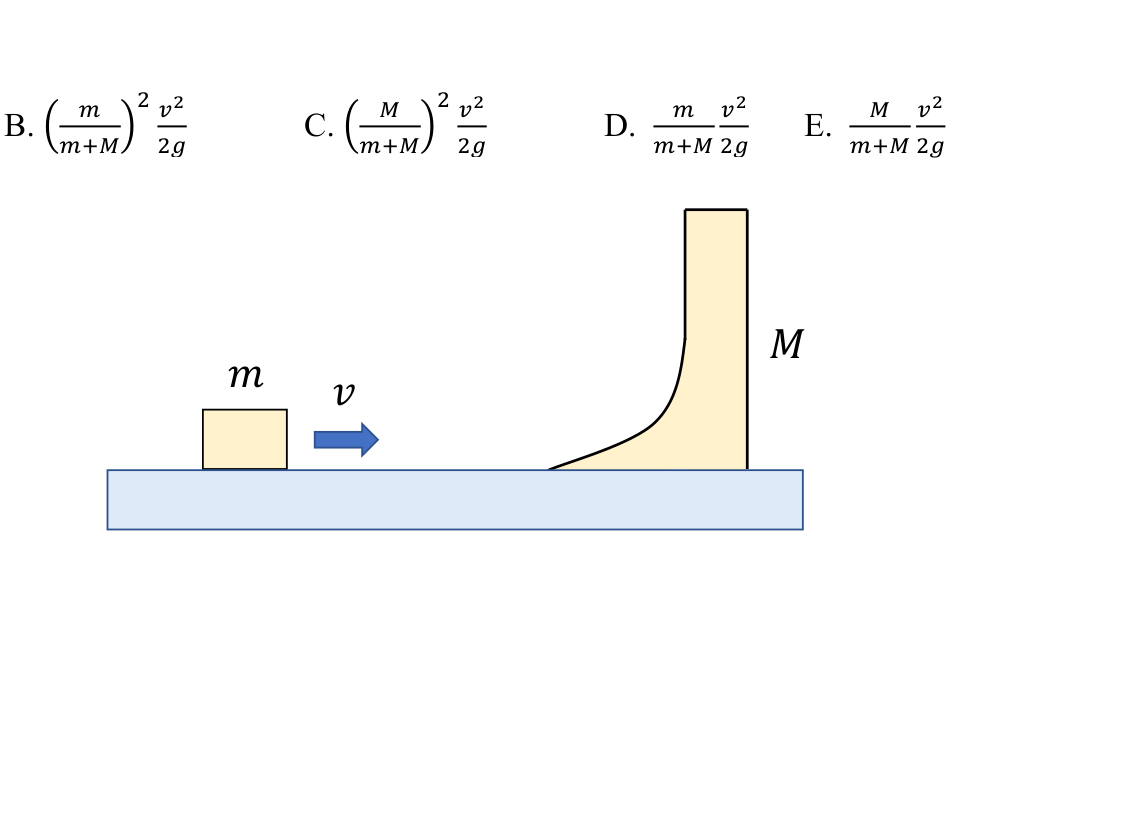
A block of mass is launched horizontally onto a curved wedge of mass at a velocity . What is the maximum height reached by the block after it shoots off the vertical segment of the wedge? Assume all surfaces are frictionless; both the block and the curved wedge are free to move.
- (A)
- (B)
- (C)
- (D)
- (E)
Fonte: Testo (PDF) — p.12
Topic: Conservation of Momentum Metodi: Conservation of Momentum, Energy Conservation Method Competenze: Mathematical Modeling Objects: Block, Wedge
Un blocco di massa viene lanciato orizzontalmente su una cuccia curva di massa a velocità . Qual è l’altezza massima raggiunta dal blocco dopo che è stato spinto dal segmento verticale della cuccia? Supponiamo che tutte le superfici siano senza attrito; sia il blocco che la cuccia curva sono liberi di muoversi.
- (A)
- (B)
- (C)
- (D)
- (E)
Fonte: Testo (PDF) — p.12
Topic: Conservation of Momentum Metodi: Conservation of Momentum, Energy Conservation Method Competenze: Mathematical Modeling Objects: Block, Wedge
Two small balls, and , are attached to the two ends of a rigid rod with length . At a certain moment, it is observed that ball is located at and moving with velocity while ball is located at and moving with velocity . Which of the following is/are impossible?
-
I.
-
II.
-
III.
-
(A) I only
-
(B) II only
-
(C) III only
-
(D) I and III
-
(E) II and III
Fonte: Testo (PDF) — p.12
Topic: Rotational Dynamics Metodi: Vector Decomposition, Physical Modeling Competenze: Mathematical Modeling Objects: Ball, Rod
Due piccole palle, e , sono attaccate alle due estremità di una canna rigida di lunghezza . In un certo momento si osserva che la palla si trova a e si muove con velocità mentre la palla si trova a e si muove con velocità . Qual è/sono impossibile?
-
I.
-
II.
-
III.
-
**(A) ** I solo
-
**(B) ** II solo
-
solo **(C) ** III
-
**(D) ** I e III
-
**(E) ** II e III
Fonte: Testo (PDF) — p.12
Topic: Rotational Dynamics Metodi: Vector Decomposition, Physical Modeling Competenze: Mathematical Modeling Objects: Ball, Rod
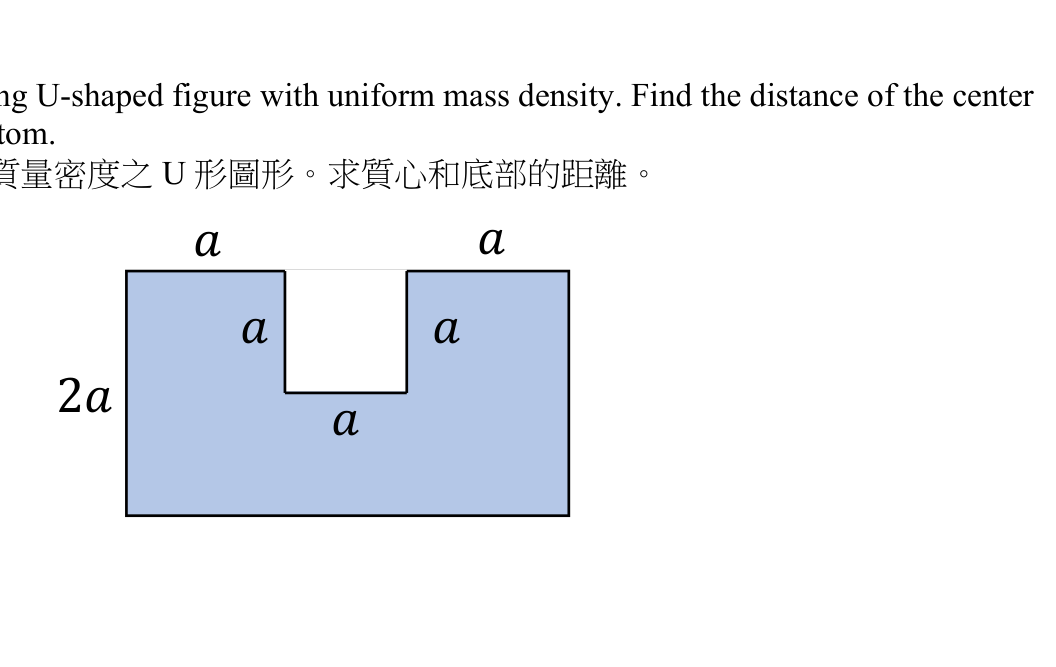
Consider the following U-shaped figure with uniform mass density. Find the distance of the center of mass from the bottom.
- (A)
- (B)
- (C)
- (D)
- (E)
Fonte: Testo (PDF) — p.13
Topic: Newtonian Mechanics Metodi: Calculus-Integration, Symmetry Argument Competenze: Mathematical Modeling Objects: —
Considera la figura a forma di U con densità di massa uniforme. Trova la distanza del centro di massa dal fondo.
- (A)
- (B)
- (C)
- (D)
- (E)
Fonte: Testo (PDF) — p.13
Topic: Newtonian Mechanics Metodi: Calculus-Integration, Symmetry Argument Competenze: Mathematical Modeling Objects: —
If gravitational force between two masses is given by instead of , Kepler’s third law will become: (where is the radius and is the period of a circular orbit)
- (A)
- (B)
- (C)
- (D)
- (E)
Fonte: Testo (PDF) — p.13
Topic: Gravitation Metodi: Newton’s Law of Gravitation, Kepler’s Laws Competenze: Mathematical Modeling Objects: —
Se la forza gravitazionale tra due masse viene data da invece di , la terza legge di Kepler diventerà: (dove è il raggio e è il periodo di un’orbita circolare)
- (A)
- (B)
- (C)
- (D)
- (E)
Fonte: Testo (PDF) — p.13
Topic: Gravitation Metodi: Newton’s Law of Gravitation, Kepler’s Laws Competenze: Mathematical Modeling Objects: —
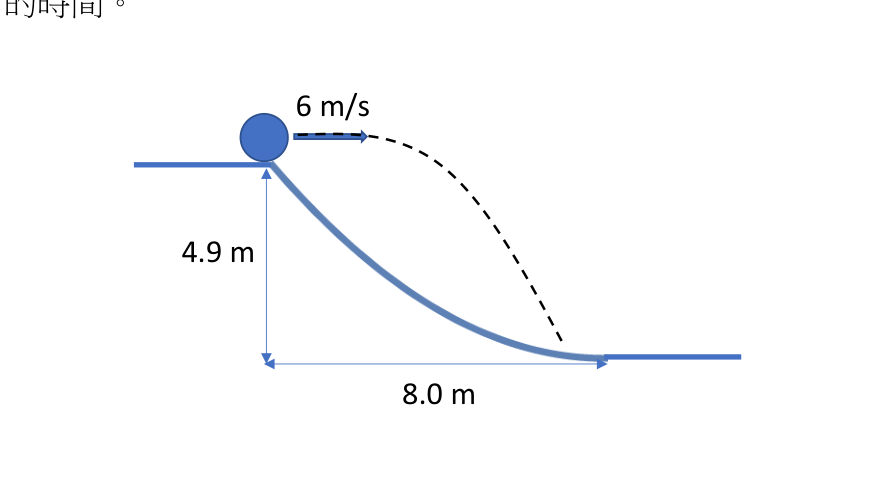
A slope of parabolic in shape has a height of and a width of so that the slope goes back to zero just before connecting to a flat ground. Initially at the height of , the ball is pushed to have a horizontal velocity of with a zero vertical velocity. The ball is acted upon gravity. Find the time elapsed when the ball hits again the parabolic slope.

- (A)
- (B)
- (C)
- (D)
- (E)
Fonte: Testo (PDF) — p.13
Topic: Newtonian Mechanics Metodi: Kinematic Equations, Vector Decomposition Competenze: Mathematical Modeling Objects: Ball
Una pendenza di forma parabolica ha un’altezza di e una larghezza di in modo che la pendenza torni a zero poco prima di collegarsi a un terreno piatto. Inizialmente, all’altezza di , la palla viene spinta per avere una velocità orizzontale di con velocità verticale zero. La palla agisce sulla gravità. Trova il tempo trascorso quando la palla colpisce di nuovo la pendenza parabolica.
- (A)
- (B)
- (C)
- (D)
- (E)
Fonte: Testo (PDF) — p.13
Topic: Newtonian Mechanics Metodi: Kinematic Equations, Vector Decomposition Competenze: Mathematical Modeling Objects: Ball
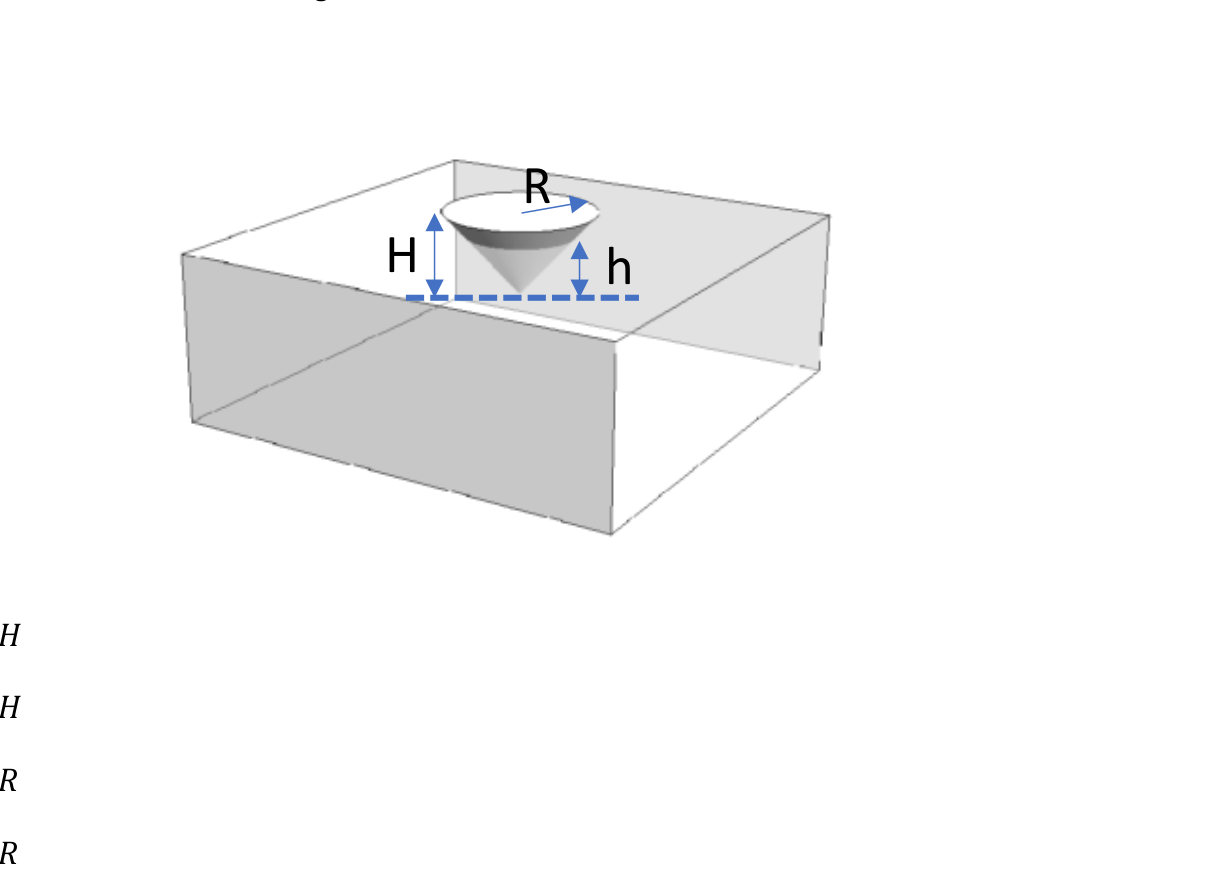
Supposed a solid inverted cone, with base radius , height and density , can be stably submerged in water with a larger density for a depth of inside water, being less than , as the following figure shows. Express in terms of the other defined variables, assuming no external force, except those by the gravity (standard gravity ) and the fluid, is applied on the solid.
- (A)
- (B)
- (C)
- (D)
- (E)
Fonte: Testo (PDF) — p.14
Topic: Fluid Mechanics Metodi: Hydrostatic Equilibrium, Free-Body Diagram Competenze: Mathematical Modeling Objects: —
Se si suppone un cono invertito solido, con raggio di base , altezza e densità , può essere stabilmente immerso in acqua con densità maggiore per una profondità di all’interno dell’acqua, inferiore a , come mostra la figura seguente. Esprimere in termini di altre variabili definite, presumendo che non si applichi alcuna forza esterna, tranne quella della gravità (gravità standard ) e del fluido, sul solido.
- (A)
- (B)
- (C)
- (D)
- (E)
Fonte: Testo (PDF) — p.14
Topic: Fluid Mechanics Metodi: Hydrostatic Equilibrium, Free-Body Diagram Competenze: Mathematical Modeling Objects: —
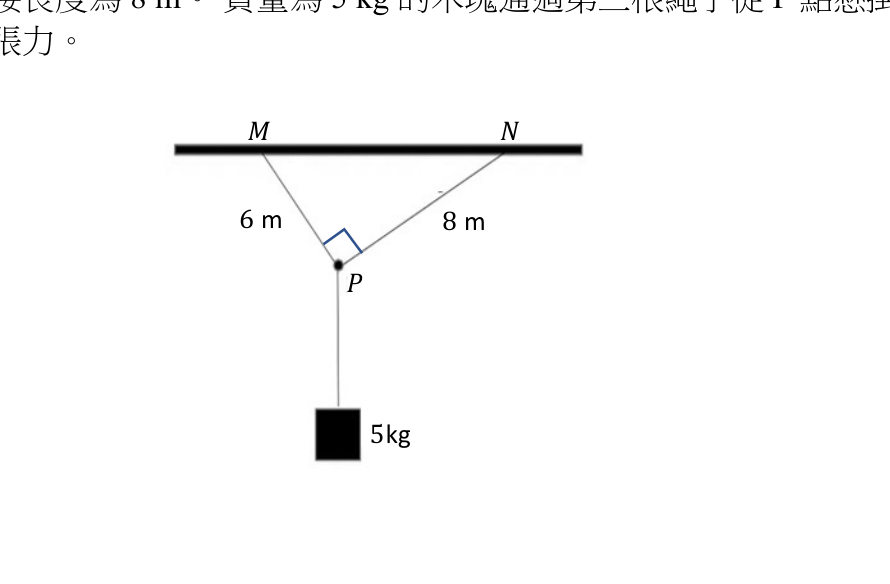
Two ropes suspended from the roof at points M and N are joint at point P with a right angle. The length of the rope joining MP is and the length of rope joining NP is . A wooden block of mass hangs from point P through a third rope. Find the tension on the rope joining NP.
- (A)
- (B)
- (C)
- (D)
- (E)
Fonte: Testo (PDF) — p.15
Topic: Rigid Body Statics Metodi: Free-Body Diagram, Vector Decomposition Competenze: Mathematical Modeling Objects: String, Block
Due corde sospese dal tetto ai punti M e N sono unite al punto P con un angolo retto. La lunghezza della corda che collega MP è e la lunghezza della corda che collega NP è . Un blocco di legno di massa è appeso dal punto P attraverso una terza corda. Trova la tensione sulla corda che si unisce a NP.
- (A)
- (B)
- (C)
- (D)
- (E)
Fonte: Testo (PDF) — p.15
Topic: Rigid Body Statics Metodi: Free-Body Diagram, Vector Decomposition Competenze: Mathematical Modeling Objects: String, Block
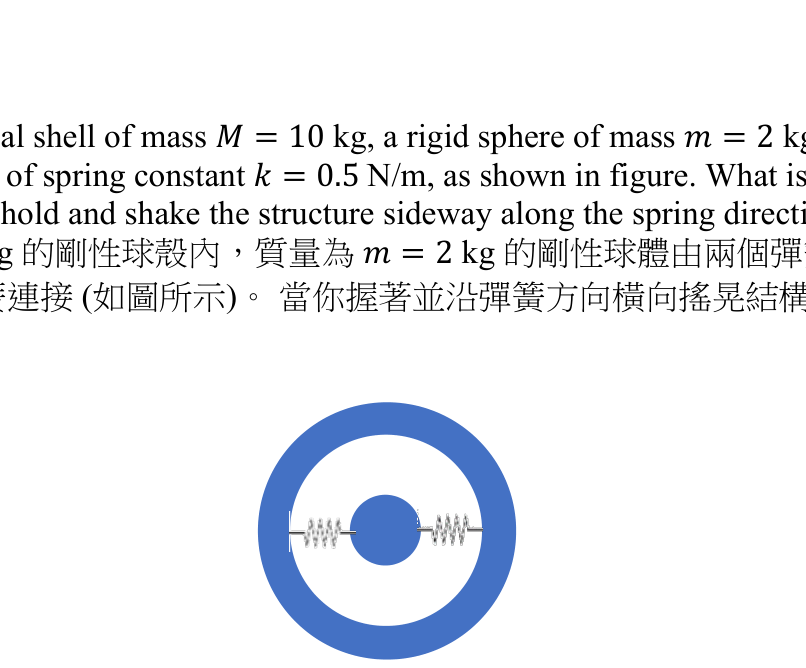
Inside a rigid spherical shell of mass , a rigid sphere of mass is connected by two identical springs of spring constant , as shown in figure. What is the resonating frequency when you hold and shake the structure sideway along the spring direction?
- (A)
- (B)
- (C)
- (D)
- (E)
Fonte: Testo (PDF) — p.15
Topic: Oscillations & Waves Metodi: Simple Harmonic Motion Analysis, Hooke’s Law Competenze: Mathematical Modeling Objects: Sphere, Spring
All’interno di una rigida conchiglia sferica di massa , una rigida sfera di massa è collegata da due sorgenti identiche della costante di primavera , come mostrato nella figura. Qual è la frequenza di risonanza quando si tiene e scuote la struttura lateralmente lungo la direzione della primavera?
- (A)
- (B)
- (C)
- (D)
- (E)
Fonte: Testo (PDF) — p.15
Topic: Oscillations & Waves Metodi: Simple Harmonic Motion Analysis, Hooke’s Law Competenze: Mathematical Modeling Objects: Sphere, Spring
Hubble’s law states that the galaxies are moving away from each other at distance at a velocity given by the Hubble’s law: where is called the Hubble’s constant. By treating the universe as a giant sphere of homogeneous density and galaxies escaping away from the edge of the universe, find out the critical density of the universe, , above which the velocity of the galaxies moving away from us is exactly the escape velocity on such a giant sphere. According to the Hubble’s law, it is exactly the escape velocity on such a giant sphere.
- (A)
- (B)
- (C)
- (D)
- (E) None of the above.
Fonte: Testo (PDF) — p.16
Topic: Astrophysics Metodi: Newton’s Law of Gravitation, Energy Conservation Method Competenze: Mathematical Modeling Objects: —
Paper 2 — Open Problems (Please answer all problems.)
La legge di Hubble afferma che le galassie si allontanano l’una dall’altra a distanza a una velocità data dalla legge di Hubble: dove viene chiamata costante di Hubble. Trattando l’universo come una sfera gigante di densità omogenea e galassie che fuggono dal bordo dell’universo, scopri la densità critica dell’universo, , sopra la quale la velocità delle galassie che si allontanano da noi è esattamente la velocità di fuga su una sfera gigante. Secondo la legge di Hubble, è esattamente la velocità di fuga su una sfera così gigante.
- (A)
- (B)
- (C)
- (D)
- **(E) ** Nessuna delle seguenti.
Fonte: Testo (PDF) — p.16
Topic: Astrophysics Metodi: Newton’s Law of Gravitation, Energy Conservation Method Competenze: Mathematical Modeling Objects: —
Paper 2 Problemi aperti (Si prega di rispondere a tutti i problemi.)
(15 points) A bullet with mass was fired against a stationary and fixed wooden block with mass . It has an initial velocity of and penetrated the block into depth . Assume the wood resists the movement of the bullet steadily.
(a) (4 points) What is the resistance force in the wooden block against the bullet?
Now the wooden block is movable freely on a table with negligible friction between the block and the table and the bullet is now fired horizontally to the wooden block and is finally stopped inside the block.
(b) (3 points) What is the final speed of the wooden block with bullet?
(c) (4 points) What is the depth into which the bullet have penetrated when the block is movable?
(d) (4 points) How long does the bullet take to be stopped after it has entered the block?
Fonte: Testo (PDF) — p.19
Topic: Conservation of Momentum Metodi: Conservation of Momentum, Impulse-Momentum Theorem, Kinematic Equations Competenze: Mathematical Modeling Objects: Projectile, Block
**(15 punti) ** Un proiettile di massa è stato sparato contro un blocco di legno fisso e fermo di massa . Ha una velocità iniziale di e ha penetrato il blocco in profondità . Supponiamo che il legno resista al movimento della pallottola costantemente.
**(a) ** (4 punti) Qual è la forza di resistenza del blocco di legno contro il proiettile?
Ora il blocco di legno si muove liberamente su un tavolo con un trascurso trascurabile tra il blocco e il tavolo e il proiettile viene ora sparato orizzontalmente al blocco di legno e viene infine fermato all’interno del blocco.
**(b) ** (3 punti) Qual è la velocità finale del blocco di legno con proiettile?
**(c) ** (4 punti) Qual è la profondità in cui il proiettile è penetrato quando il blocco è mobile?
**(d) ** (4 punti) Quanto tempo ci vuole per fermare il proiettile dopo aver entrato nel blocco?
Fonte: Testo (PDF) — p.19
Topic: Conservation of Momentum Metodi: Conservation of Momentum, Impulse-Momentum Theorem, Kinematic Equations Competenze: Mathematical Modeling Objects: Projectile, Block
(15 points) A person is sitting on a frictionless board holding a ball. A block is placed separately and at rest in front of the person. The person wants to set himself moving by throwing the ball towards the block. However, in order to catch the ball again after the first throw, the ball must return back to the person after bouncing off the block.
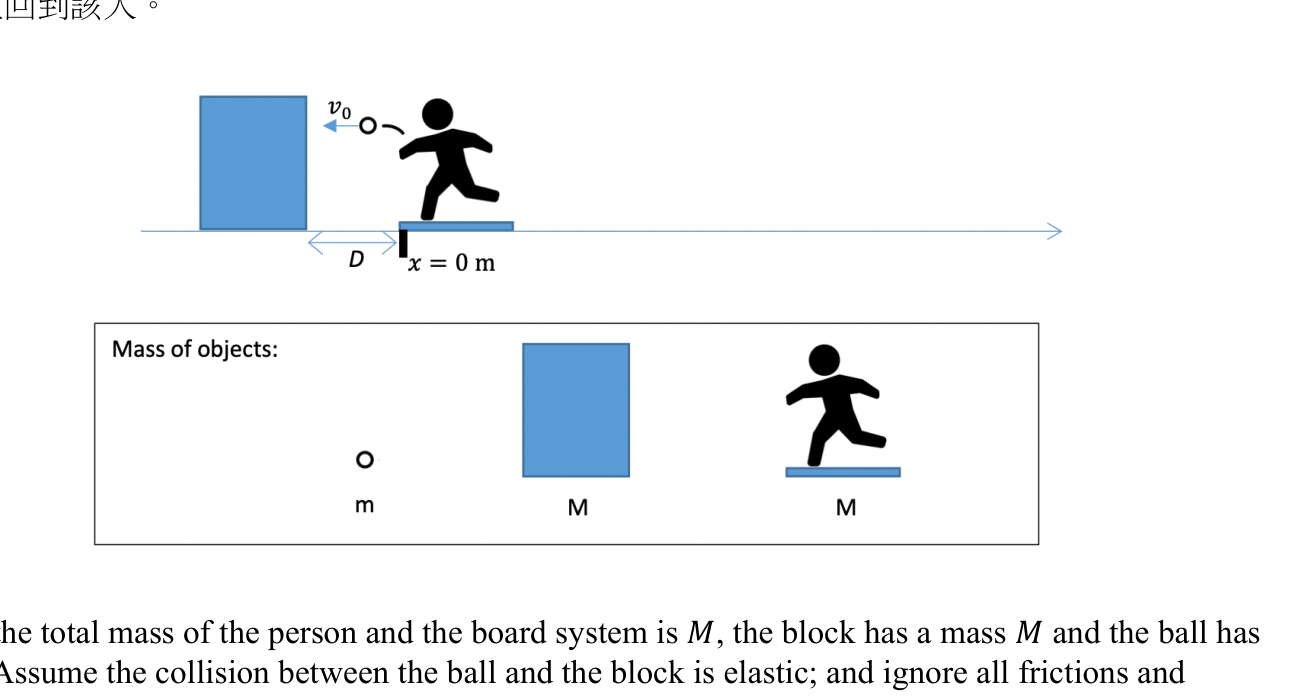
Suppose the total mass of the person and the board system is , the block has a mass and the ball has mass . Assume the collision between the ball and the block is elastic; and ignore all frictions and gravity.
(a) (3 points) The person is initially at rest. If the ball is thrown at speed with respect to ground. What is the speed of the person and the board after his throwing?
(b) (3 points) Find the kinetic energy transferred to the block by the ball after the collision.
(c) (4 points) Find the conditions, if any, for the ratio of the masses and for the initial throwing speed such that the person can catch the ball back after it bounces off from the block.
(d) (3 points) If and , find the distance the person travelled between throwing the ball and catching it again.
(e) (3 points) After catching the ball, the person wants to stop by throwing the ball away (this time he does not need to catch it back). Describe at which direction and at what speed he should throw the ball again. Answer with the speed of the ball with respect to the ground.
Fonte: Testo (PDF) — p.20
Topic: Conservation of Momentum Metodi: Conservation of Momentum, Energy Conservation Method Competenze: Mathematical Modeling Objects: Ball, Block
**(15 punti) ** Una persona è seduta su una tavola senza attrito tenendo una palla. Un blocco viene posto separatamente e a riposo davanti alla persona. La persona vuole mettersi in movimento lanciando la palla verso il blocco. Tuttavia, per catturare di nuovo la palla dopo il primo lancio, la palla deve tornare alla persona dopo aver saltato fuori dal blocco.
Supponiamo che la massa totale della persona e del sistema di tavola sia , il blocco abbia una massa e la palla abbia una massa . Supponiamo che la collisione tra la palla e il blocco sia elastica; e ignori tutte le frizioni e la gravità.
**(a) ** (3 punti) La persona è inizialmente in riposo. Se la palla viene lanciata a velocità rispetto al suolo. Qual è la velocità della persona e della lavagna dopo il lancio?
**(b) ** (3 punti) Trova l’energia cinetica trasferita al blocco dalla palla dopo la collisione.
**(c) ** (4 punti) Trovare le condizioni, se esistenti, per il rapporto delle masse e per la velocità di lancio iniziale in modo tale che la persona possa catturare la palla dopo che rimbalza dal blocco.
Se e , calcolare la distanza tra il lancio della palla e la sua cattura.
**(e) ** (3 punti) Dopo aver catturato la palla, la persona vuole fermarsi gettando via la palla (questa volta non ha bisogno di riprenderla). Descrivi in quale direzione e a che velocità dovrebbe lanciare di nuovo la palla. Rispondi con la velocità della palla rispetto al terreno.
Fonte: Testo (PDF) — p.20
Topic: Conservation of Momentum Metodi: Conservation of Momentum, Energy Conservation Method Competenze: Mathematical Modeling Objects: Ball, Block
(20 points) In this question, it is assumed that all frictional forces can be ignored.
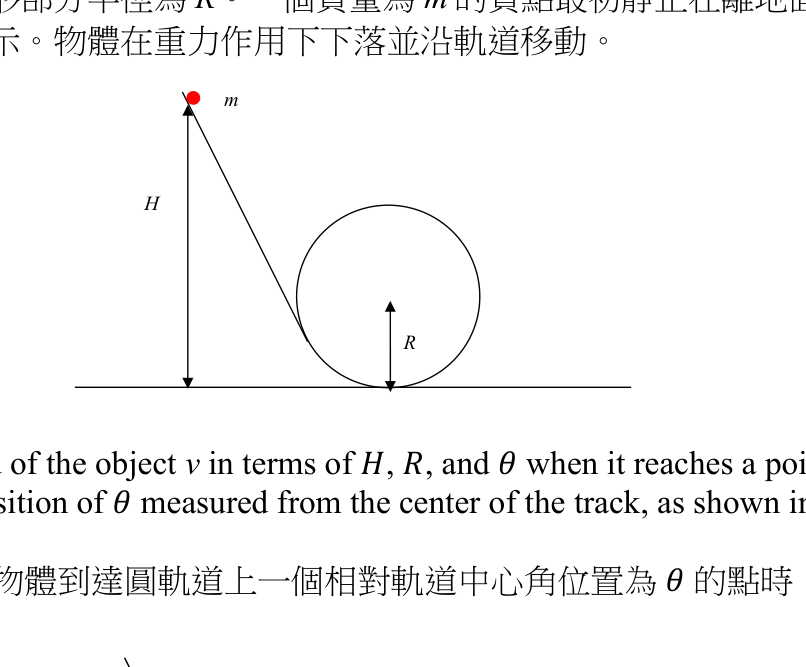
A smooth track consists of two parts. The left part is straight and is connected to the right circular part at a point at which the tangent of the circle has the same slope as the straight track. The radius of the circular part is . A point object with mass is initially at rest on the left straight track at a height of above ground, as shown in the figure below. The object falls under gravity to move along the track.
(a) (5 points) Find the speed of the object in terms of , , and when it reaches a point on the circular track with an angular position of measured from the center of the track, as shown in the figure below.
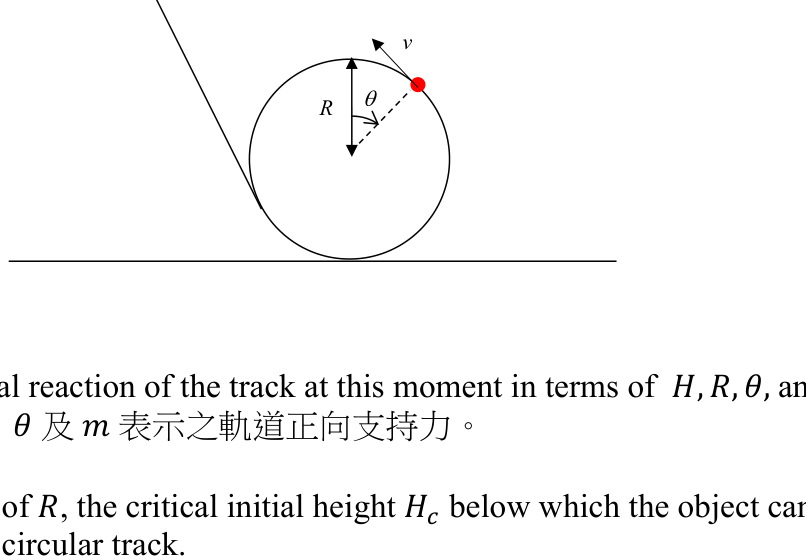
(b) (5 points) Find the normal reaction of the track at this moment in terms of , , , and .
(c) (5 points) Find, in terms of , the critical initial height below which the object cannot complete the whole journey along the circular track.
(d) (5 points) A point target is located at the center of the circular track. The object released at a certain initial height will hit the target. Find in terms of .
Fonte: Testo (PDF) — p.21
Topic: Conservation of Energy Metodi: Energy Conservation Method, Free-Body Diagram, Kinematic Equations Competenze: Mathematical Modeling Objects: Block
In questa domanda si assume che tutte le forze di attrito possano essere ignorate.
Una pista liscia è composta da due parti. La parte sinistra è retta e è collegata alla parte circolare destra in un punto in cui la tangente del cerchio ha la stessa pendenza della pista retta. Il raggio di radius della parte circolare è . Un oggetto puntino con massa è inizialmente a riposo sulla pista dritta sinistra ad un’altezza di sopra il suolo, come mostrato nella figura seguente. L’oggetto cade sotto la gravità per muoversi lungo la pista.
**(a) ** (5 punti) Trovare la velocità dell’oggetto in termini di , e quando raggiunge un punto sulla pista circolare con una posizione angolare di misurata dal centro della pista, come mostrato nella figura seguente.
**(b) ** (5 punti) Trovare la reazione normale della pista in questo momento in termini di , , e .
**(c) ** (5 punti) Trova, in termini di , l’altezza iniziale critica al di sotto della quale l’oggetto non può completare l’intero viaggio lungo la pista circolare.
**(d) ** (5 punti) Un obiettivo di punto si trova al centro della pista circolare. L’oggetto rilasciato ad una certa altezza iniziale colpirà l’obiettivo. Trova in termini di .
Fonte: Testo (PDF) — p.21
Topic: Conservation of Energy Metodi: Energy Conservation Method, Free-Body Diagram, Kinematic Equations Competenze: Mathematical Modeling Objects: Block