As shown below, Bob is using the rope through a fixed pulley to move a box with constant speed . The coefficient of kinetic friction between the box and the ground is . Assume that the fixed pulley is massless and there is no friction between the rope and the fixed pulley. While the box is moving, which of the following statements is correct?
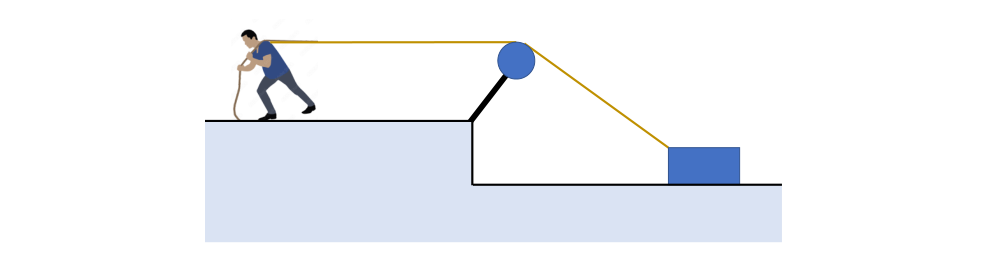
- (A) The magnitude of the force on the rope is constant.
- (B) The magnitude of friction between the ground and the box is decreasing.
- (C) The magnitude of the normal force of the ground on the box is increasing.
- (D) The pressure of the box on the ground is increasing.
- (E) The pressure of the box on the ground is constant.
Fonte: Testo (PDF) — p.3 Topic: Newtonian Mechanics Metodi: Free-Body Diagram, Vector Decomposition Competenze: Physical Reasoning, Diagrammatic Reasoning Objects: String, Pulley, Block
Come mostrato di seguito, Bob usa la corda attraverso una polla fissa per spostare una scatola con velocità costante . Il coefficiente di attrito cinetico tra la scatola e il terreno è . Supponiamo che la pollice fissa sia senza massa e che non ci sia attrito tra la corda e la pollice fissa. Mentre la scatola si muove, quale delle seguenti affermazioni è corretta?
- **(A) ** La forza sulla corda è costante.
- **(B) ** L’entità della frizione tra il terreno e la scatola sta diminuendo.
- **(C) ** L’entità della forza normale del terreno sulla scatola è in aumento.
- **(D) ** La pressione della scatola sul terreno aumenta.
- **(E) ** La pressione della scatola sul terreno è costante.
Fonte: Testo (PDF) — p.3 Topic: Newtonian Mechanics Metodi: Free-Body Diagram, Vector Decomposition Competenze: Physical Reasoning, Diagrammatic Reasoning Objects: String, Pulley, Block
An inelastic ball is dropped from a height and sticks on the ground. Which graph best represents the acceleration of the center of mass of the ball as a function of time?
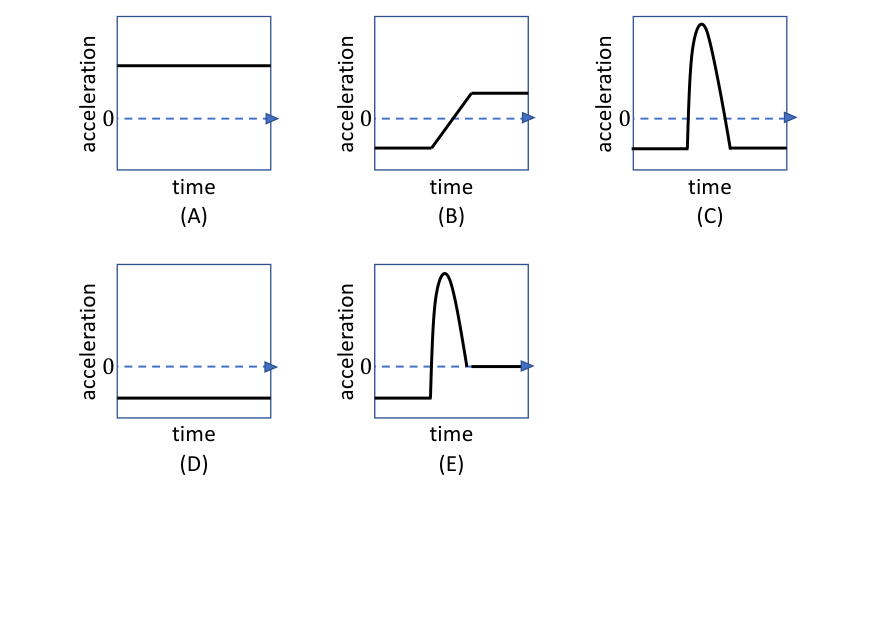
Fonte: Testo (PDF) — p.3 Topic: Newtonian Mechanics Metodi: Free-Body Diagram, Impulse-Momentum Theorem Competenze: Physical Reasoning, Diagrammatic Reasoning Objects: Ball
Una palla inelastica viene abbassata da un’altezza e si attacca al terreno. Quale grafico rappresenta meglio l’accelerazione del centro di massa della palla in funzione del tempo?
Fonte: Testo (PDF) — p.3 Topic: Newtonian Mechanics Metodi: Free-Body Diagram, Impulse-Momentum Theorem Competenze: Physical Reasoning, Diagrammatic Reasoning Objects: Ball
A basketball is dropped from the height and bounces on the ground. Considering only the ball just before and just after the bounce, which of the following statements must be true?
- (A) The momentum and the total mechanical energy of the ball are conserved.
- (B) The momentum of the ball is conserved, but not the kinetic energy.
- (C) The total mechanical energy of the ball is conserved, but not the momentum.
- (D) The kinetic energy of the ball is conserved, but not the momentum.
- (E) The momentum of the ball is not conserved.
Fonte: Testo (PDF) — p.4 Topic: Conservation of Momentum Metodi: Conservation of Momentum, Conservation of Energy Competenze: Physical Reasoning Objects: Ball
Una pallacanestro viene abbassata dall’altezza e rimbalza sul terreno. Considerando solo la palla appena prima e subito dopo il rimbalzo, quale delle seguenti affermazioni deve essere vera?
- **(A) ** Il momento e l’energia meccanica totale della palla sono conservati.
- **(B) ** L’impulso della palla è conservato, ma non l’energia cinetica.
- **(C) ** L’energia meccanica totale della palla è conservata, ma non l’impulso.
- **(D) ** L’energia cinetica della palla è conservata, ma non l’impulso.
- **(E) ** L’impulso della palla non è conservato.
Fonte: Testo (PDF) — p.4 Topic: Conservation of Momentum Metodi: Conservation of Momentum, Conservation of Energy Competenze: Physical Reasoning Objects: Ball
A ball enters a bend tube lying on the ground (as shown in the figure). Both the ball and the bend tube can slide freely on the ground. What is the direction of the velocity of the ball (relative to the ground) when it exits the tube?
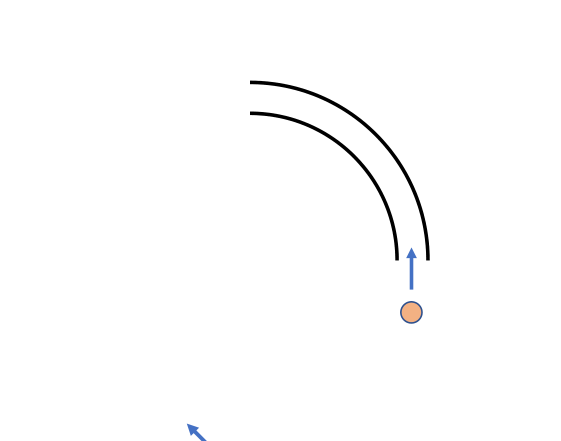
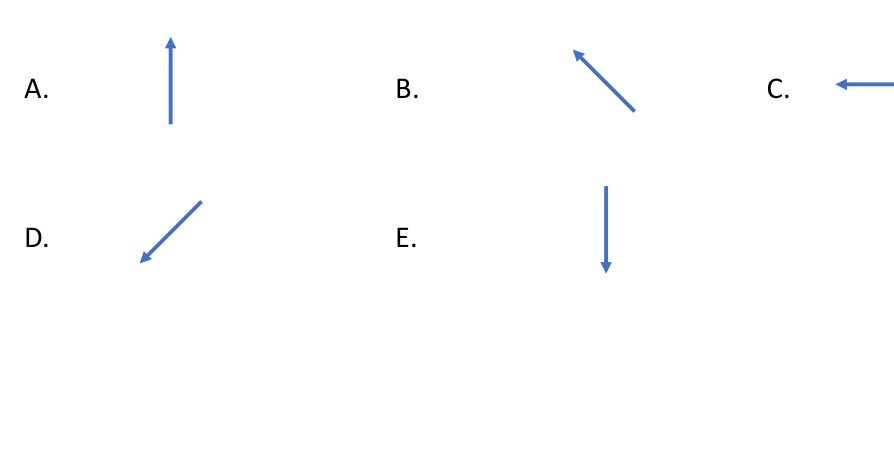
Fonte: Testo (PDF) — p.4 Topic: Conservation of Momentum Metodi: Conservation of Momentum, Vector Decomposition Competenze: Physical Reasoning, Diagrammatic Reasoning Objects: Ball, Tube
Una palla entra in un tubo di piega che si trova a terra (come mostrato nella figura). Sia la palla che il tubo di curvatura possono scivolare liberamente sul terreno. Qual è la direzione della velocità della palla (relativamente al suolo) quando esce dal tubo?
Fonte: Testo (PDF) — p.4 Topic: Conservation of Momentum Metodi: Conservation of Momentum, Vector Decomposition Competenze: Physical Reasoning, Diagrammatic Reasoning Objects: Ball, Tube
A projectile is launched at an angle of from the horizontal. Is there any point on the trajectory where the velocity and the acceleration are parallel to each other? If so, where?
- (A) An instant before impact on the ground.
- (B) At the highest point.
- (C) They are never parallel.
- (D) An instant after launch.
- (E) Somewhere in the middle when the projectile is going down.
Fonte: Testo (PDF) — p.5 Topic: Newtonian Mechanics Metodi: Kinematic Equations, Vector Decomposition Competenze: Physical Reasoning Objects: Projectile
Un proiettile viene lanciato ad un angolo di dall’orizzontale. C’è un punto sulla traiettoria dove la velocità e l’accelerazione sono parallele tra loro? Se sì, dove?
- **(A) ** Un istante prima dell’impatto sul terreno.
- **(B) ** Al punto più alto.
- **(C) ** Non sono mai parallele.
- **(D) ** Un istante dopo il lancio.
- **(E) ** Da qualche parte nel mezzo quando il proiettile sta scendendo.
Fonte: Testo (PDF) — p.5 Topic: Newtonian Mechanics Metodi: Kinematic Equations, Vector Decomposition Competenze: Physical Reasoning Objects: Projectile
A cannon car can fire a cannonball in any direction at a fixed speed with respect to itself. Now the cannon car, initially at rest, can move towards North by firing two cannon balls to propel itself. Ignore all frictions. Which of the following situations will give the cannon car the highest speed after firing the two cannonballs?
- (A) Fire both cannonballs horizontally towards South at the same time.
- (B) Fire one cannonball horizontally towards South, then wait for 5 seconds and fire another one towards South again.
- (C) Fire one cannonball at to the ground towards South, then wait for 5 seconds and fire another one towards South again.
- (D) Fire one cannonball horizontally towards South-West and another towards South-East at the same time.
- (E) Both A and B will give the car the same speed.
Fonte: Testo (PDF) — p.5 Topic: Conservation of Momentum Metodi: Conservation of Momentum, Vector Decomposition Competenze: Physical Reasoning Objects: Cart, Ball
Un’auto con cannoni può sparare una palla di cannone in qualsiasi direzione a una velocità fissa rispetto a se stessa. Ora la carrozza, inizialmente in riposo, può muoversi verso nord sparando due palline di cannone per spingere se stessa. Ignora tutte le frizioni. Quale delle seguenti situazioni darà alla macchina del cannone la massima velocità dopo aver sparato le due palline?
- Scaricate entrambi i cannoni orizzontalmente verso sud allo stesso tempo.
- **(B) ** Sparare una palla di cannone orizzontalmente verso sud, quindi aspettare per 5 secondi e sparare un altro verso sud di nuovo.
- **(C) ** Sparare una palla di cannone a al suolo verso sud, quindi aspettare per 5 secondi e sparare un altro verso sud di nuovo.
- **(D) ** Sparate una palla di cannone orizzontalmente verso sud-ovest e un’altra verso sud-est allo stesso tempo.
- **(E) ** Entrambi A e B danno alla macchina la stessa velocità.
Fonte: Testo (PDF) — p.5 Topic: Conservation of Momentum Metodi: Conservation of Momentum, Vector Decomposition Competenze: Physical Reasoning Objects: Cart, Ball
Consider the following two cases:
Case A: A boy is pulling himself up on a movable platform hung on a frictionless pulley at a constant speed.
Case B: The boy on the platform is pulled by another boy standing on the ground.
Suppose the total weight of the boy on the platform and the platform is . The rope is massless. The boy and the platform eventually moved 2 m vertically upwards. Which of the following statements is/are true?
I. The pulling force applied by the boy in case A is half of the force applied by the boy on the ground in case B.
II. To move up 2 m, the work done by the boy in case A is less than the work done by the boy on the ground in case B.
III. The tension on the rope in both cases are the same.
- (A) I only
- (B) I and II only
- (C) II and III only
- (D) I, II and III
- (E) None of them
Fonte: Testo (PDF) — p.6 Topic: Conservation of Energy Metodi: Energy Conservation Method, Free-Body Diagram Competenze: Physical Reasoning Objects: Pulley, String
Considerate i seguenti due casi:
Caso A: un ragazzo si sta tirando su una piattaforma mobile appesa a una pollice senza attrito a una velocità costante.
Caso B: il ragazzo sulla piattaforma viene tirato da un altro ragazzo in piedi sul pavimento.
Supponiamo che il peso totale del ragazzo sulla piattaforma e sulla piattaforma sia . La corda non ha massa. Il ragazzo e la piattaforma si spostarono alla fine 2 metri verticalmente verso l’alto. Quali delle seguenti affermazioni sono/sono vere?
I. La forza di trazione applicata dal ragazzo nel caso A è la metà della forza applicata dal ragazzo sul terreno nel caso B.
II. Per salire 2 metri, il lavoro svolto dal ragazzo nel caso A è inferiore al lavoro svolto dal ragazzo sul terreno nel caso B.
III. Il La tensione sulla corda in entrambi i casi è la stessa.
- **(A) ** I solo
- **(B) ** I e II solo
- solo **(C) ** II e III
- **(D) ** I, II e III
- **(E) ** Nessuno di essi
Fonte: Testo (PDF) — p.6 Topic: Conservation of Energy Metodi: Energy Conservation Method, Free-Body Diagram Competenze: Physical Reasoning Objects: Pulley, String
Four identical springs, with spring constant , are mounted on 3 rigid and vertical thin plates as following in their equilibrium situation. Now, we compress the whole assembly as a whole in the direction perpendicular to the plates. What is the effective spring constant as a whole? Assume the masses of both the springs and the plates can be neglected and the displacement is small.
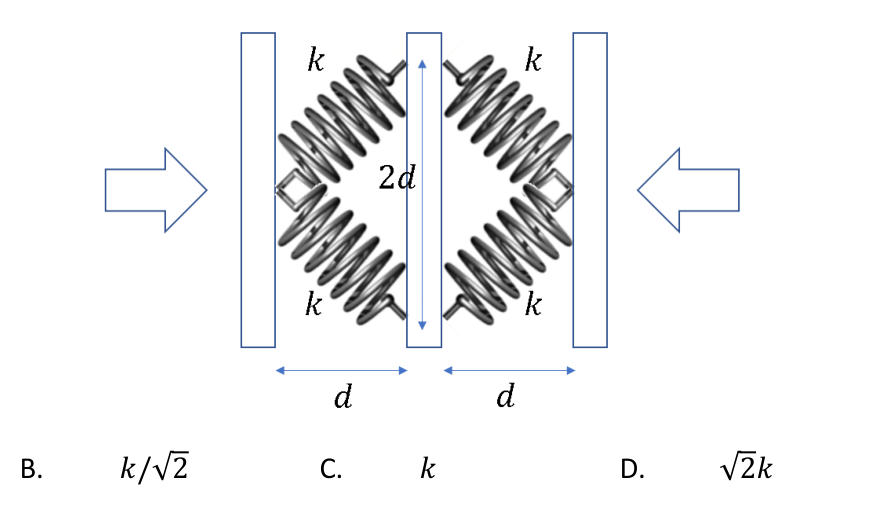
- (A)
- (B)
- (C)
- (D)
- (E)
Fonte: Testo (PDF) — p.7 Topic: Elasticity & Materials Metodi: Hooke’s Law Competenze: Physical Reasoning Objects: Spring
Quattro molla identiche, con costante molla , sono montate su 3 lastre sottili rigide e verticali, come segue nella loro situazione di equilibrio. Ora, comprimiamo l’intero assemblaggio nel suo complesso nella direzione perpendicolare alle placche. Qual è l’effettiva costante di primavera nel suo insieme? Supponiamo che sia la massa delle sorgenti che delle piastre possa essere trascurata e il spostamento sia piccolo.
- (A)
- (B)
- (C)
- (D)
- (E)
Fonte: Testo (PDF) — p.7 Topic: Elasticity & Materials Metodi: Hooke’s Law Competenze: Physical Reasoning Objects: Spring
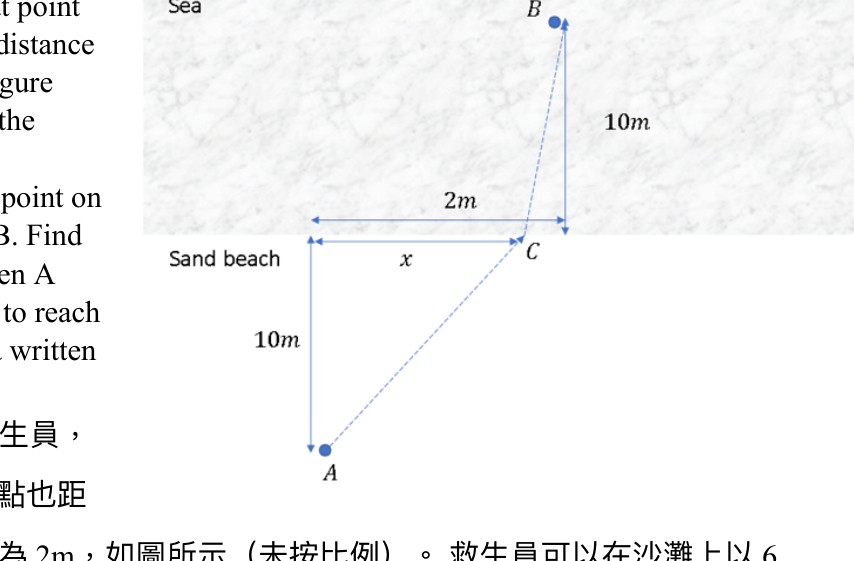
A lifeguard at point A on the beach, 10 m from the coastline, is going to save a swimmer in the sea at point B, also 10 m from the coastline. The alongshore distance is 2 m between points A and B, as shown in the figure (not in scale). The lifeguard can run at 6 m/s on the beach and swim at 2 m/s in the sea. Suppose the lifeguard will go in a straight line from A to C, a point on the coastline, and another straight line from C to B. Find the distance , i.e. the alongshore distance between A and C, if he would like to minimize the total time to reach point B. You may use the approximation formula written on P.2.
- (A) 0 m
- (B) 0.5 m
- (C) 1.0 m
- (D) 1.5 m
- (E) 2.0 m
Fonte: Testo (PDF) — p.7 Topic: Geometric Optics Metodi: Snell’s Law, Approximation & Series Expansion Competenze: Mathematical Modeling, Estimation & Approximation Objects: —
Un salvatore al punto A sulla spiaggia, a 10 metri dalla costa, salverà un nuotatore in mare al punto B, anche a 10 metri dalla costa. La distanza lungo la costa è di 2 m tra i punti A e B, come mostrato nella figura (non in scala). Il salvatore può correre a 6 m/s sulla spiaggia e nuotare a 2 m/s nel mare. Supponiamo che il salvatore vada in linea retta da A a C, un punto sulla costa e un’altra linea retta da C a B. Trova la distanza , ovvero la distanza di riva tra A e C, se desidera ridurre al minimo il tempo totale per raggiungere il punto B. È possibile utilizzare la formula di approssimazione scritta in P.2.
- (A) 0 m
- (B) 0.5 m
- (C) 1.0 m
- (D) 1.5 m
- (E) 2.0 m
Fonte: Testo (PDF) — p.7 Topic: Geometric Optics Metodi: Snell’s Law, Approximation & Series Expansion Competenze: Mathematical Modeling, Estimation & Approximation Objects: —
The escape velocity is the minimum speed needed for an object to escape from the gravitational influence of a planet without burning fuel. The acceleration due to gravity on the surface of an unknown planet X is given as and the escape velocity on the surface is given as . Estimate the radius of the Planet X.
- (A)
- (B)
- (C)
- (D)
- (E)
Fonte: Testo (PDF) — p.8 Topic: Gravitation Metodi: Newton’s Law of Gravitation, Energy Conservation Method Competenze: Mathematical Modeling Objects: Planet
La velocità di fuga è la velocità minima necessaria per un oggetto di sfuggire all’influenza gravitazionale di un pianeta senza bruciare combustibile. L’accelerazione dovuta alla gravità sulla superficie di un pianeta X sconosciuto è data come e la velocità di fuga sulla superficie è data come . Calcola il raggio del pianeta X.
- (A)
- (B)
- (C)
- (D)
- (E)
Fonte: Testo (PDF) — p.8 Topic: Gravitation Metodi: Newton’s Law of Gravitation, Energy Conservation Method Competenze: Mathematical Modeling Objects: Planet
A 15 kg uniform ladder, with a length 2.5 m, is at rest at the corner between a vertical wall and the ground at an angle of . Suppose the vertical wall is smooth. Find the frictional force on the ground to keep the ladder at rest without sliding.
- (A) 36.8 N
- (B) 42.4 N
- (C) 84.9 N
- (D) 127.3 N
- (E) None of the above
Fonte: Testo (PDF) — p.8 Topic: Rigid Body Statics Metodi: Torque & Angular Momentum Analysis, Free-Body Diagram Competenze: Physical Reasoning Objects: Rod
Una scala uniforme di 15 kg, di 2,5 m di lunghezza, è posta in riposo all’angolo tra una parete verticale e il terreno ad un angolo di . Supponiamo che la parete verticale sia liscia. Trova la forza di attrito sul terreno per mantenere la scala a riposo senza scivolare.
- (A) 36.8 N
- (B) 42.4 N
- (C) 84.9 N
- (D) 127.3 N
- **(E) ** Nessuna delle seguenti:
Fonte: Testo (PDF) — p.8 Topic: Rigid Body Statics Metodi: Torque & Angular Momentum Analysis, Free-Body Diagram Competenze: Physical Reasoning Objects: Rod
Although a photon does not have a mass, it carries a momentum along its propagation direction, which is related to its energy by where is the light speed. A solar sail is a proposed method of spacecraft propulsion by shining sunlight on it to exert pressure to push the sail. Suppose the area of the sail is and there are photons per unit area per second for the sunlight. What is the maximum resultant force on the spacecraft by the sunlight? Hint: assume the sail is a perfect mirror to reflect the light off completely, i.e. 100% reflection of light.
- (A)
- (B)
- (C)
- (D)
- (E) None of the above
Fonte: Testo (PDF) — p.8 Topic: Modern-Quantum Physics Metodi: Photon Energy Relation, Impulse-Momentum Theorem Competenze: Physical Reasoning Objects: Photon, Mirror
Anche se un fotone non ha massa, porta un momento lungo la sua direzione di propagazione, che è correlato alla sua energia da dove è la velocità della luce. Una vela solare è un metodo proposto per la propulsione della nave spaziale, che colpisce la luce solare per esercitare pressione per spingere la vela. Supponiamo che la superficie della vela sia e che ci siano fotoni per unità di superficie al secondo per la luce solare. Qual è la forza massima risultante sulla sonda dalla luce solare? Suggerimento: supponiamo che la vela sia uno specchio perfetto per riflettere completamente la luce, cioè 100% riflessione della luce.
- (A)
- (B)
- (C)
- (D)
- **(E) ** Nessuna delle seguenti:
Fonte: Testo (PDF) — p.8 Topic: Modern-Quantum Physics Metodi: Photon Energy Relation, Impulse-Momentum Theorem Competenze: Physical Reasoning Objects: Photon, Mirror
A tuning fork undergoes simple harmonic motion at one of its ends and fires a middle C musical note at a fixed frequency of 261 Hz. The simple harmonic motion has a maximum amplitude of 0.4 mm. Find the acceleration when the end has a displacement of mm.
- (A)
- (B)
- (C)
- (D)
- (E)
Fonte: Testo (PDF) — p.9 Topic: Oscillations & Waves Metodi: Simple Harmonic Motion Analysis Competenze: Mathematical Modeling Objects: Tuning Fork
Una forchetta di sintonia subisce un semplice movimento armonico ad una delle sue estremità e suona una nota musicale C centrale a una frequenza fissa di 261 Hz. Il semplice movimento armonico ha un’ampiezza massima di 0,4 mm. Trova l’accelerazione quando la punta ha un spostamento di mm.
- (A)
- (B)
- (C)
- (D)
- (E)
Fonte: Testo (PDF) — p.9 Topic: Oscillations & Waves Metodi: Simple Harmonic Motion Analysis Competenze: Mathematical Modeling Objects: Tuning Fork
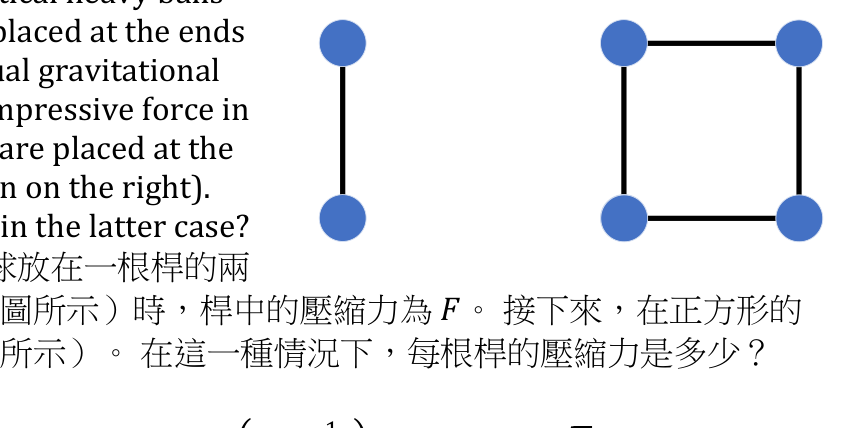
You are given a large collection of identical heavy balls and lightweight rods. When two balls are placed at the ends of one rod and interact through their mutual gravitational attraction (as is shown on the left), the compressive force in the rod is . Next, four balls and four rods are placed at the vertexes and edges of a square (as is shown on the right). What is the compressive force in each rod in the latter case?
- (A)
- (B)
- (C)
- (D)
- (E)
Fonte: Testo (PDF) — p.9 Topic: Gravitation Metodi: Newton’s Law of Gravitation, Vector Decomposition Competenze: Physical Reasoning Objects: Ball, Rod
Vi viene data una grande collezione di palle pesanti e bastone leggere identiche. Quando due palle sono posizionate alle estremità di una canna e interagiscono attraverso la loro attrazione gravitazionale reciproca (come mostrato a sinistra), la forza compressiva della canna è . Successivamente, quattro palle e quattro bastone vengono posizionate ai vertici e ai bordi di un quadrato (come mostrato a destra). Qual è la forza di compressione di ciascuna canna in quest’ultimo caso?
- (A)
- (B)
- (C)
- (D)
- (E)
Fonte: Testo (PDF) — p.9 Topic: Gravitation Metodi: Newton’s Law of Gravitation, Vector Decomposition Competenze: Physical Reasoning Objects: Ball, Rod
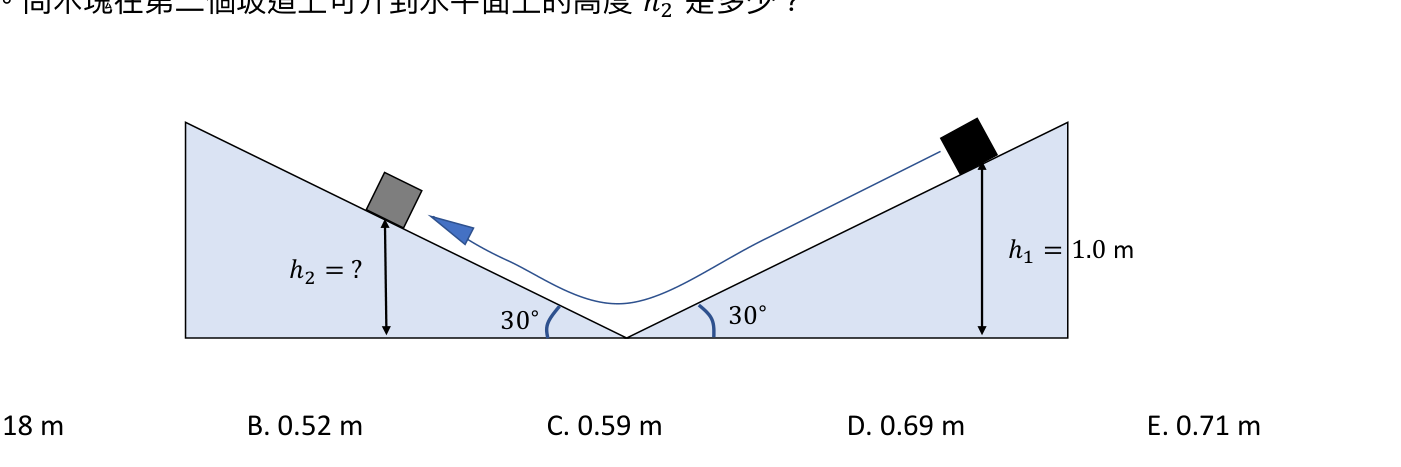
A block of mass kg slides down one ramp and then up a second ramp smoothly without flipping. The coefficient of kinetic friction between the block and each ramp is . The block begins at a height m above the horizontal. Both ramps are at a incline above the horizontal. To what height above the horizontal does the block rise on the second ramp?
- (A) 0.18 m
- (B) 0.52 m
- (C) 0.59 m
- (D) 0.69 m
- (E) 0.71 m
Fonte: Testo (PDF) — p.9 Topic: Conservation of Energy Metodi: Energy Conservation Method, Free-Body Diagram Competenze: Physical Reasoning Objects: Block, Inclined Plane
Un blocco di massa kg scende in un rampa e poi su un secondo rampa senza ruotare. Il coefficiente di attrito cinetico tra il blocco e ogni rampa è . Il blocco inizia ad un’altezza m sopra l’orizzontale. Entrambe le rampe sono inclinate sopra l’orizzontale. A che altezza sopra l’orizzontale si alza il blocco sulla seconda rampa?
- (A) 0.18 m
- (B) 0.52 m
- (C) 0.59 m
- (D) 0.69 m
- (E) 0.71 m
Fonte: Testo (PDF) — p.9 Topic: Conservation of Energy Metodi: Energy Conservation Method, Free-Body Diagram Competenze: Physical Reasoning Objects: Block, Inclined Plane
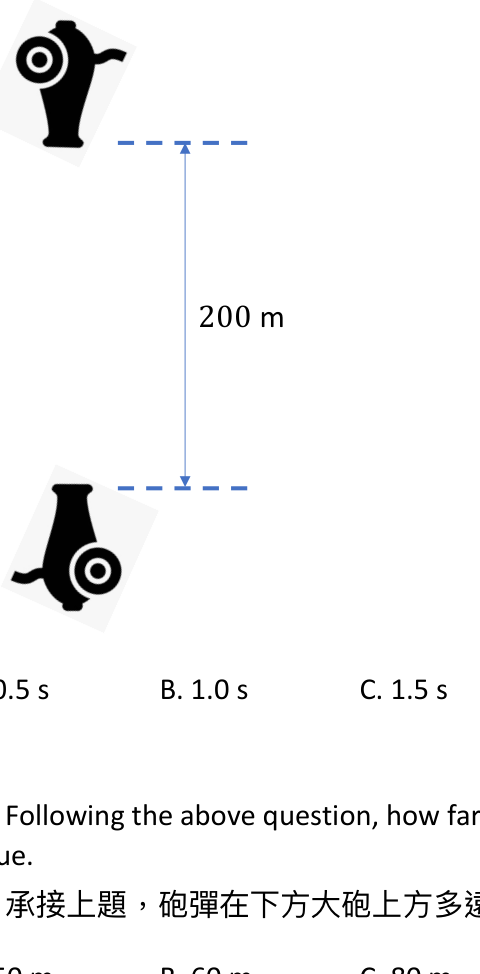
Two cannons are arranged vertically under the Earth’s gravity, with the lower cannon pointing upward (towards the upper cannon) and the upper cannon pointing downward (towards the lower cannon), 200 m above the lower cannon. They fire a projectile at the same time. The initial speed of the projectiles are both equal to 50 m/s. How long after the cannons fire do the projectiles collide?
- (A) 0.5 s
- (B) 1.0 s
- (C) 1.5 s
- (D) 2.0 s
- (E) 4.0 s
Fonte: Testo (PDF) — p.10 Topic: Newtonian Mechanics Metodi: Kinematic Equations Competenze: Mathematical Modeling Objects: Projectile
Due cannoni sono disposti verticalmente sotto la gravità terrestre, con il cannone inferiore puntato verso l’alto (verso il cannone superiore) e il cannone superiore puntato verso il basso (verso il cannone inferiore), a 200 m sopra il cannone inferiore. Sparano un proiettile allo stesso tempo. La velocità iniziale dei proiettili è pari a 50 m/s. Quanto tempo dopo il fuoco dei cannoni i proiettili si schiantano?
- (A) 0.5 s
- (B) 1.0 s
- (C) 1.5 s
- (D) 2.0 s
- (E) 4.0 s
Fonte: Testo (PDF) — p.10 Topic: Newtonian Mechanics Metodi: Kinematic Equations Competenze: Mathematical Modeling Objects: Projectile
Following the above question, how far above the lower cannon do the projectiles collide? Choose the closest value.
- (A) 50 m
- (B) 60 m
- (C) 80 m
- (D) 100 m
- (E) 120 m
Fonte: Testo (PDF) — p.10 Topic: Newtonian Mechanics Metodi: Kinematic Equations Competenze: Mathematical Modeling Objects: Projectile
In base alla domanda di cui sopra, a che punto sopra il cannone inferiore i proiettili si schiantano? Scegli il valore più vicino.
- (A) 50 m
- (B) 60 m
- (C) 80 m
- (D) 100 m
- (E) 120 m
Fonte: Testo (PDF) — p.10 Topic: Newtonian Mechanics Metodi: Kinematic Equations Competenze: Mathematical Modeling Objects: Projectile
A 0.100 kg object is released from rest at the height of 3.30 m above the ground and slides along a frictionless track with a loop of diameter 3.00 m. While the object is moving along the loop, it can be considered to be rotating about the center of the loop. When it is at point P (the far-right-most position of the loop), what is the net force exerting on the object (to 3 sig. fig.)?
- (A) 2.35 N
- (B) 0.98 N
- (C) 2.55 N
- (D) 2.04 N
- (E) 1.56 N
Fonte: Testo (PDF) — p.11 Topic: Rotational Dynamics Metodi: Energy Conservation Method, Free-Body Diagram Competenze: Physical Reasoning Objects: Block
Un oggetto di 0,100 kg viene rilasciato dal riposo ad un’altezza di 3,30 m sopra il suolo e scivola lungo una pista senza attrito con un ciclo di diametro di 3,00 m. Mentre l’oggetto si muove lungo il ciclo, può essere considerato come ruotare intorno al centro del ciclo. Quando si trova al punto P (la posizione più a destra dell’anello), qual è la forza netta che esercita sull’oggetto (a 3 sig. - Figo?
- (A) 2.35 N
- (B) 0.98 N
- (C) 2.55 N
- (D) 2.04 N
- (E) 1.56 N
Fonte: Testo (PDF) — p.11 Topic: Rotational Dynamics Metodi: Energy Conservation Method, Free-Body Diagram Competenze: Physical Reasoning Objects: Block
A car heading north collides at an intersection with a truck heading east. The mass of the truck is twice the mass of the car. If they lock together and travel at 28 m/s at north of east just after the collision, how fast was the car initially travelling? Assume that any forces exerted by objects other than the car or the truck are negligible.
- (A) 60 m/s
- (B) 20 m/s
- (C) 30 m/s
- (D) 40 m/s
- (E) 58 m/s
Fonte: Testo (PDF) — p.11 Topic: Conservation of Momentum Metodi: Conservation of Momentum, Vector Decomposition Competenze: Mathematical Modeling Objects: —
Una macchina che si dirige verso nord si schianta ad un’intersezione con un camion che si dirige verso est. La massa del camion è il doppio della massa dell’auto. Se si bloccano insieme e viaggiano a 28 m/s a a nord-est subito dopo la collisione, a che velocità stava viaggiando l’auto inizialmente? Supponiamo che le forze esercitate da oggetti diversi da auto o camion siano trascurabili.
- (A) 60 m/s
- (B) 20 m/s
- (C) 30 m/s
- (D) 40 m/s
- (E) 58 m/s
Fonte: Testo (PDF) — p.11 Topic: Conservation of Momentum Metodi: Conservation of Momentum, Vector Decomposition Competenze: Mathematical Modeling Objects: —
A 5.00-kg box is sliding down along an incline. The incline makes an angle of to the horizontal and the friction between the box and the inclined surface is non-zero. The box is sliding at a constant speed of 0.60 m/s. Find the magnitude of the power by the friction on the box.
- (A) 14.7 W
- (B) 29.4 W
- (C) 25.5 W
- (D) 0 W
- (E) 21.3 W
Fonte: Testo (PDF) — p.12 Topic: Newtonian Mechanics Metodi: Free-Body Diagram, Vector Decomposition Competenze: Physical Reasoning Objects: Block, Inclined Plane
Una scatola da 5,00 kg scende lungo una pendenza. L’inclinazione fa un angolo di verso l’orizzontale e l’attrito tra la scatola e la superficie inclinata non è zero. La scatola si sposta a velocità costante di 0,60 m/s. Trova la potenza della forza dalla friczione sulla scatola.
- (A) 14.7 W
- (B) 29.4 W
- (C) 25.5 W
- (D) 0 W
- (E) 21.3 W
Fonte: Testo (PDF) — p.12 Topic: Newtonian Mechanics Metodi: Free-Body Diagram, Vector Decomposition Competenze: Physical Reasoning Objects: Block, Inclined Plane
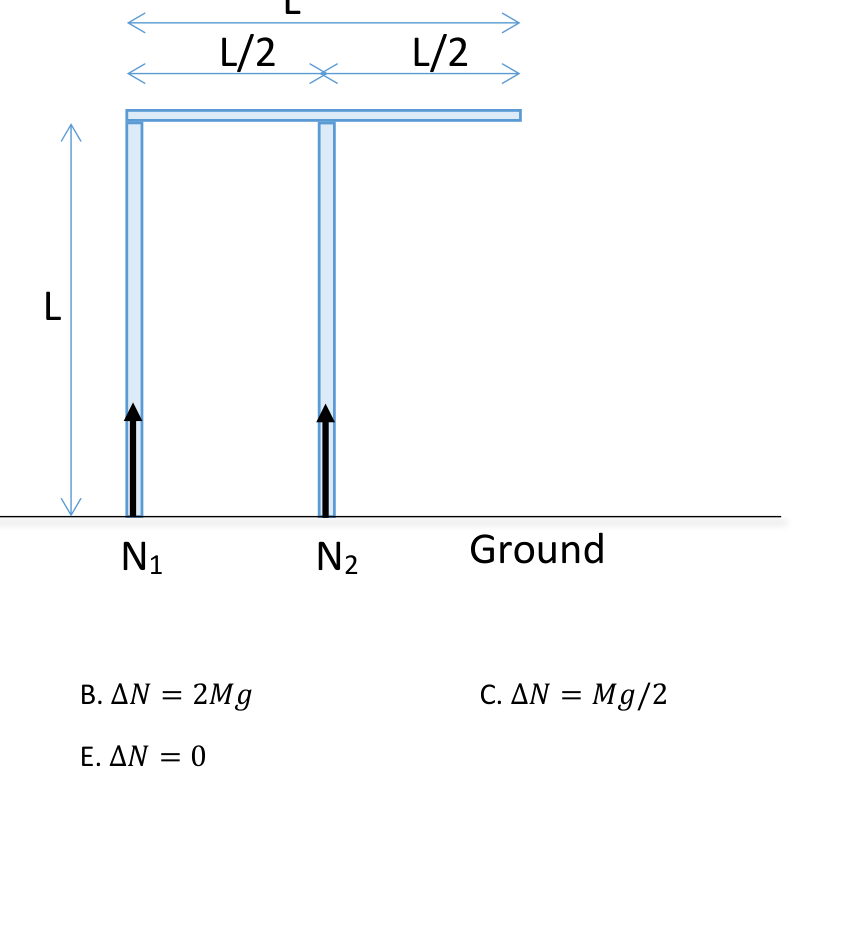
An art sculpture made of material with uniform density is placed on the horizontal ground as shown below. The sculpture is formed by three identical bars with length , each with a mass . The bars are firmly attached together. Neglect the thickness of the bar. Find the difference in the normal force, , exerting on the sculpture.
- (A)
- (B)
- (C)
- (D)
- (E)
Fonte: Testo (PDF) — p.12 Topic: Rigid Body Statics Metodi: Torque & Angular Momentum Analysis, Symmetry Argument Competenze: Physical Reasoning Objects: Rod
Una scultura d’arte fatta di materiale con densità uniforme è posizionata sul terreno orizzontale come mostrato di seguito. La scultura è costituita da tre barre identiche di lunghezza , ciascuna con una massa . Le barre sono saldamente attaccate. - Non ti preoccupare del grosso della barra. Trova la differenza nella forza normale, , che si esercita sulla scultura.
- (A)
- (B)
- (C)
- (D)
- (E)
Fonte: Testo (PDF) — p.12 Topic: Rigid Body Statics Metodi: Torque & Angular Momentum Analysis, Symmetry Argument Competenze: Physical Reasoning Objects: Rod
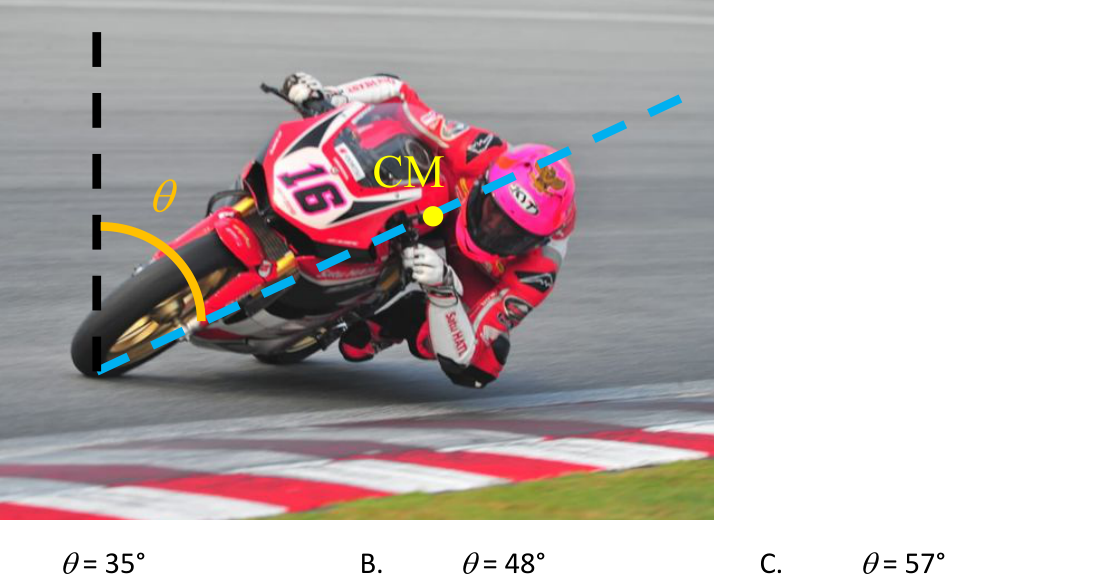
A motorcycle moves with constant speed along a circular track with radius . The rider leans his body and the motorcycle inwards so that the line joining the track-motorcycle contact point and the center of mass of the whole system (rider + motorcycle) makes an angle with the vertically upward direction, as shown in the figure below.
Find if m/s, m, and kg, where is the total mass of the motorcycle and the rider.
- (A)
- (B)
- (C)
- (D)
- (E)
Fonte: Testo (PDF) — p.13 Topic: Newtonian Mechanics Metodi: Free-Body Diagram, Vector Decomposition Competenze: Physical Reasoning Objects: —
Una motociclista si muove a velocità costante lungo una pista circolare con raggio . Il pilota inclina il corpo e la moto verso l’interno in modo che la linea che collega il punto di contatto tra pista e moto e il centro di massa dell’intero sistema (riditore + moto) faccia un angolo con la direzione verticale verso l’alto, come mostrato nella figura seguente.
Trova se m/s, m e kg, dove è la massa totale della moto e del pilota.
- (A)
- (B)
- (C)
- (D)
- (E)
Fonte: Testo (PDF) — p.13 Topic: Newtonian Mechanics Metodi: Free-Body Diagram, Vector Decomposition Competenze: Physical Reasoning Objects: —
Two point particles A and B move on the x-y plane. There may be interacting forces between the two particles, but the system as a whole is isolated. At a certain moment, particle A is at and particle B is at , where and are the unit vectors along the and direction respectively. Denote the respective accelerations of A and B at this moment by and . Which of the following is/are possible?
I.
II.
III.
IV.
- (A) III only
- (B) IV only
- (C) III and IV only
- (D) II, III, and IV only
- (E) I, II, III, and IV
Fonte: Testo (PDF) — p.13 Topic: Conservation of Momentum Metodi: Conservation of Momentum, Vector Decomposition Competenze: Physical Reasoning Objects: —
Due particelle a punti A e B si muovono sul piano x-y. Ci possono essere forze interattive tra le due particelle, ma il sistema nel suo complesso è isolato. In un certo momento, la particella A è a e la particella B è a , dove e sono i vettori unitari lungo la direzione e rispettivamente. Denotare le rispettive accelerazioni di A e B in questo momento con e . Qual è/sono possibile?
I.
II.
III. Il
IV.
- solo **(A) ** III
- solo **(B) ** IV
- solo **(C) ** III e IV
- **(D) ** solo II, III e IV
- **(E) ** I, II, III e IV
Fonte: Testo (PDF) — p.13 Topic: Conservation of Momentum Metodi: Conservation of Momentum, Vector Decomposition Competenze: Physical Reasoning Objects: —
A point object is under simple harmonic oscillation on the x-axis centered at the origin. The amplitude is . At time , its position is . At time , its position is . What is its position at ?
I.
II.
III.
IV.
- (A) I only
- (B) II only
- (C) IV only
- (D) I or IV
- (E) II or III
Fonte: Testo (PDF) — p.14 Topic: Oscillations & Waves Metodi: Simple Harmonic Motion Analysis Competenze: Physical Reasoning Objects: —
Un oggetto puntino è sotto semplice oscillazione armonica sull’asse x centrato all’origine. L’ampiezza è . Al momento , la sua posizione è . Al momento , la sua posizione è . Qual è la sua posizione a ?
I.
II.
III. Il
IV.
- **(A) ** I solo
- **(B) ** II solo
- solo **(C) ** IV
- (D) I or IV
- **(E) ** II o III
Fonte: Testo (PDF) — p.14 Topic: Oscillations & Waves Metodi: Simple Harmonic Motion Analysis Competenze: Physical Reasoning Objects: —
Two tennis balls A and B with the same mass, move with respective velocities and on the x-axis. B is located in the direction with respect to A and , so that A will hit B. After the collision, the final velocities of A and B are and , respectively. What are the possible values of ? Ignore all external forces acting on A and B.
- (A)
- (B)
- (C)
- (D)
- (E)
Fonte: Testo (PDF) — p.14 Topic: Conservation of Momentum Metodi: Conservation of Momentum, Conservation of Energy Competenze: Physical Reasoning Objects: Ball
Due palline da tennis A e B della stessa massa, che si muovono rispettivamente a velocità e sull’asse x. B è situato nella direzione rispetto a A e , in modo che A colpisca B. Dopo la collisione, le velocità finali di A e B sono rispettivamente e . Quali sono i valori possibili di ? Ignorare tutte le forze esterne che agiscono su A e B.
- (A)
- (B)
- (C)
- (D)
- (E)
Fonte: Testo (PDF) — p.14 Topic: Conservation of Momentum Metodi: Conservation of Momentum, Conservation of Energy Competenze: Physical Reasoning Objects: Ball
[15 pts] A bead of a mass is hanged by a string from the tip of a cone, as shown in the figure below. The cone surface and the bead have a coefficient of static friction, and a coefficient of kinetic friction, .
The cone starts to rotate from rest and uniformly increases its angular speed to in seconds. The cone surface drags the bead to move at the same angular speed such that the bead has no relative motion to the cone surface (i.e. no sliding on the surface). After second, the cone is rotating at constant speed and the bead is moving in a uniform circular motion with a radius at the same angular speed as shown in the figure below. Assume a massless string and neglect air friction. Answer the following questions in terms of , , , , and .
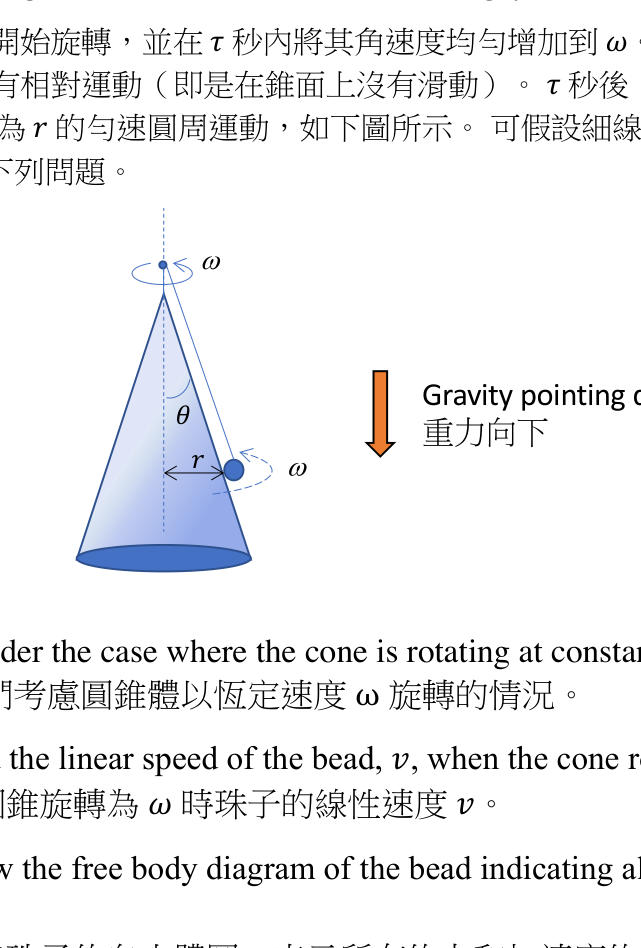
In (a)–(c), we consider the case where the cone is rotating at constant speed .
(a) [1 pts] Find the linear speed of the bead, , when the cone rotation is at .
(b) [2 pts] Draw the free body diagram of the bead indicating all the force vectors and the acceleration vector.
(c) [5 pts] Find the tension of the string, , and the normal force, , acting on the ball by the cone.
(d) [2 pts] Find the linear acceleration of the bead along the direction of motion during the acceleration from s to s.
(e) [5 pts] Find the maximum value of such that the bead will not slide on the cone surface throughout/at the end of the acceleration from s to s. Given gram, , m, and .
Fonte: Testo (PDF) — p.17 Topic: Newtonian Mechanics Metodi: Free-Body Diagram, Vector Decomposition Competenze: Physical Reasoning, Diagrammatic Reasoning Objects: String
[15 pts] Una manciata di massa viene appesa con una corda dalla punta di un cono, come mostrato nella figura seguente. La superficie del cono e la perla hanno un coefficiente di attrito statico, , e un coefficiente di attrito cinetico, .
Il cono inizia a ruotare dal riposo e aumenta uniformemente la sua velocità angolare a in secondi. La superficie del cono trascina la perla per muoversi alla stessa velocità angolare in modo tale che la perla non abbia alcun movimento relativo alla superficie del cono (cioè: non scorre sulla superficie). Dopo secondo, il cono ruota a velocità costante e la mancia si muove in un movimento circolare uniforme con un raggio alla stessa velocità angolare come mostrato nella figura seguente. Supponiamo una corda senza massa e trascuriamo l’attrito dell’aria. Rispondere alle seguenti domande in termini di , , , , e .
In (a) (c), si considera il caso in cui il cono ruota a velocità costante .
(a) [1 pts] Trova la velocità lineare della mancia, , quando la rotazione del cono è a .
(b) [2 pts] Disegnare il diagramma del corpo libero della mancia indicando tutti i vettori di forza e il vettore di accelerazione.
**(c) [5 pts] ** Trova la tensione della corda, , e la forza normale, , che agisce sulla palla con il cono.
(d) [2 pts] Trova l’accelerazione lineare della perla lungo la direzione di movimento durante l’accelerazione da s a s.
(e) [5 pts] Trovare il valore massimo di in modo tale che la perla non scivoli sulla superficie del cono durante/al termine dell’accelerazione da s a s. Se si dà grammi, , m, e .
Fonte: Testo (PDF) — p.17 Topic: Newtonian Mechanics Metodi: Free-Body Diagram, Vector Decomposition Competenze: Physical Reasoning, Diagrammatic Reasoning Objects: String
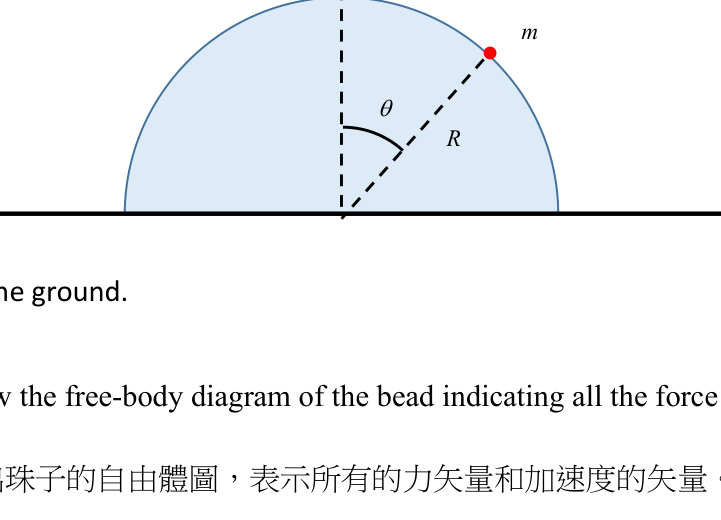
[15 pts] The figure below shows a small bead with mass located on the surface of a semi-circular block with mass and radius . The surface of the block is smooth and there are no frictional forces between the two objects. The bead is initially put at the top of the block () and is given a very small initial push to the right so that it starts to slide down the block with negligible initial speed.
(a) If the block is fixed on the ground.
(ai) [2 pts] Draw the free-body diagram of the bead indicating all the force vectors and the acceleration vector.
(aii) [4 pts] Find the angle at which the bead will leave the surface of the block.
(aiii) [4 pts] Find the distance of the bead from the center of the block when it hits the ground.
(b) [5 pts] If the block is free to slide on the ground under no friction and given that the bead does not leave the surface of the block, find the speed of the bead at angle .
Fonte: Testo (PDF) — p.18 Topic: Conservation of Energy Metodi: Energy Conservation Method, Conservation of Momentum, Free-Body Diagram Competenze: Physical Reasoning, Diagrammatic Reasoning Objects: Block
[15 pts] La figura seguente mostra una piccola perla di massa situata sulla superficie di un blocco semicircolare di massa e di raggio . La superficie del blocco è liscia e non ci sono forze di attrito tra i due oggetti. La perla viene inizialmente posta in cima al blocco () e viene data una piccola spinta iniziale a destra in modo che comincia a scivolare verso il blocco con una velocità iniziale trascurabile.
**(a) ** Se il blocco è fissato a terra.
(ai) [2 pts] Disegnare il diagramma del corpo libero della perla indicando tutti i vettori di forza e il vettore di accelerazione.
**(aii) [4 pts] ** Trova l’angolo in cui la perla lascerà la superficie del blocco.
(aiii) [4 pts] Trova la distanza della manciata dal centro del blocco quando colpisce il terreno.
Se il blocco è libero di scivolare sul terreno senza attrito e dato che la mancia non lascia la superficie del blocco, trovare la velocità della mancia all’angolo .
Fonte: Testo (PDF) — p.18 Topic: Conservation of Energy Metodi: Energy Conservation Method, Conservation of Momentum, Free-Body Diagram Competenze: Physical Reasoning, Diagrammatic Reasoning Objects: Block
[20 pts] Newton’s law of gravitation holds only for two point objects. Nevertheless, for finite-sized objects with spherically symmetric mass distributions, the gravitational forces are still simple due to the following “Shell theorem”:
The gravitational force by a thin (negligible thickness) spherical shell with uniform mass density exerting on a small test mass
(i) is the same as if all of its mass were concentrated at a point at its center, if the test mass is outside the shell, and
(ii) is zero (no net gravitational force), if the test mass is inside the shell.
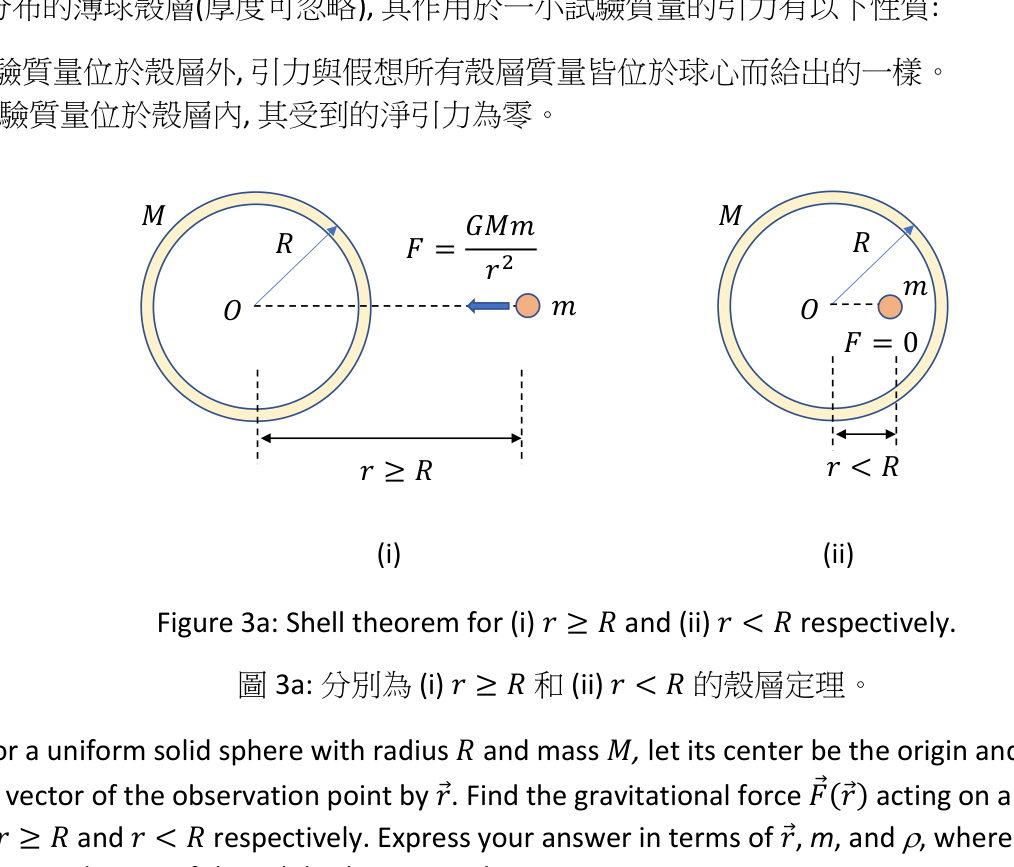
(a) [3 pts] For a uniform solid sphere with radius and mass , let its center be the origin and denote the position vector of the observation point by . Find the gravitational force acting on a point mass at for and respectively. Express your answer in terms of , , and , where is the uniform mass density of the solid sphere given by
An alien civilization with very advanced technology in astronomical engineering created an artificial planet with a hole in it, as shown in the figure below, so that they can reside inside the hole because it is too cold outside. The planet is made of material with uniform density . The planet’s surface and the hole are both spherical, with radius and , respectively, so that the hole touches the center of the planet.
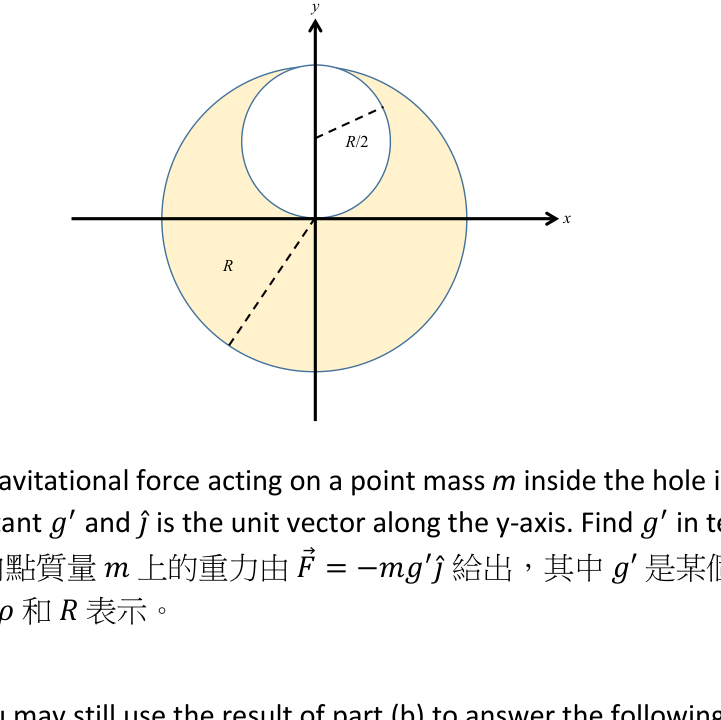
(b) [5 pts] Show that the gravitational force acting on a point mass inside the hole is given by for some positive constant and is the unit vector along the y-axis. Find in terms of and .
If you cannot solve part (b), you may still use the result of part (b) to answer the following parts and express your answers in terms of .
(c) [4 pts] A small object with mass is launched from the center of the hole in the positive x direction with initial speed . Find the y coordinate of the point at which the object hits the surface of the hole.
(d) [4 pts] If the object can be launched from the center of the hole at any angle, then it will be able to hit any point of the surface of the hole when for some critical speed . If , then the object cannot hit the surface of the hole at which for some . Find and .
(e) [4 pts] If the object is launched from the center of the hole in the positive y direction and assumes that there is a very small opening at the top of the hole, find the minimum launching speed so that the object can escape to infinity.
Fonte: Testo (PDF) — p.19 Topic: Gravitation Metodi: Newton’s Law of Gravitation, Superposition Principle, Energy Conservation Method Competenze: Mathematical Modeling, Physical Reasoning Objects: Planet, Sphere
La legge di gravitazione di Newton si applica solo agli oggetti a due punti. Tuttavia, per gli oggetti di dimensioni finite con distribuzioni di massa sferiche simmetriche, le forze gravitazionali sono ancora semplici a causa del seguente “teorema di Shell”:
La forza gravitazionale di una conchiglia sferica sottile (di spessore trascurabile) con una densità di massa uniforme che esercita su una piccola massa di prova
-
è uguale a se tutta la sua massa fosse concentrata in un punto al centro, se la massa di prova è al di fuori della conchiglia;
-
è zero (senza forza gravitazionale netta), se la massa di prova è all’interno della conchiglia.
(a) [3 pts] Per una sfera solida uniforme con raggio e massa , il suo centro deve essere l’origine e denotare il vettore di posizione del punto di osservazione con . Trova la forza gravitazionale che agisce su una massa puntaria a per e rispettivamente. Esprimere la risposta in termini di , e , dove è la densità di massa uniforme della sfera solida data da
Una civiltà aliena con una tecnologia molto avanzata nell’ingegneria astronomica ha creato un pianeta artificiale con un buco, come mostrato nella figura qui sotto, in modo che possano risiedere all’interno del buco perché fuori fa troppo freddo. Il pianeta è fatto di materiale con densità uniforme . La superficie del pianeta e il buco sono entrambi sferici, con raggio e , rispettivamente, in modo che il buco tocchi il centro del pianeta.
(b) [5 pts] Mostra che la forza gravitazionale che agisce su una massa di punto all’interno del buco è data da per una costante positiva e è il vettore unitario lungo l’asse y. Trova in termini di e .
Se non riesci a risolvere la parte b), puoi comunque usare il risultato della parte b) per rispondere alle seguenti parti e esprimere le tue risposte in termini di .
**(c) [4 pts] ** Un piccolo oggetto di massa viene lanciato dal centro del buco nella direzione x positiva con velocità iniziale . Trova la coordinata y del punto in cui l’oggetto colpisce la superficie del buco.
(d) [4 pts] Se l’oggetto può essere lanciato dal centro del buco ad ogni angolo, allora sarà in grado di colpire qualsiasi punto della superficie del buco quando per una velocità critica . Se , l’oggetto non può colpire la superficie del buco al quale per alcuni . Trova e .
Se l’oggetto viene lanciato dal centro del buco nella direzione positiva y e si suppone che ci sia un’apertura molto piccola nella parte superiore del buco, trovare la velocità minima di lancio in modo che l’oggetto possa sfuggire all’infinito.
Fonte: Testo (PDF) — p.19 Topic: Gravitation Metodi: Newton’s Law of Gravitation, Superposition Principle, Energy Conservation Method Competenze: Mathematical Modeling, Physical Reasoning Objects: Planet, Sphere