Suppose that all collisions are instantaneous and completely elastic. After a long time, which of the following is true?
- (A) The center block is moving to the left.
- (B) The center block is moving to the right.
- (C) The center block is at rest somewhere to the left of its initial position.
- (D) The center block is at rest at its initial position.
- (E) The center block is at rest somewhere to the right of its initial position.
Fonte: Testo (PDF) — p.3
Topic: Conservation of Momentum Metodi: Conservation of Momentum, Conservation of Energy Competenze: Physical Reasoning Objects: Block
Supponiamo che tutte le collisioni siano istantanee e ** completamente elastica **. Dopo tanto tempo, quale di queste parole è vero?
- **(A) ** Il blocco centrale si sta spostando a sinistra.
- **(B) ** Il blocco centrale si sta spostando a destra.
- **(C) ** Il blocco centrale è in riposo da qualche parte a sinistra della sua posizione iniziale.
- **(D) ** Il blocco centrale è in riposo nella sua posizione iniziale.
- **(E) ** Il blocco centrale è in riposo da qualche parte a destra della sua posizione iniziale.
Fonte: Testo (PDF) — p.3
Topic: Conservation of Momentum Metodi: Conservation of Momentum, Conservation of Energy Competenze: Physical Reasoning Objects: Block
Suppose, instead, that all collisions are instantaneous and perfectly inelastic. After a long time, which of the following is true?
- (A) The center block is moving to the left.
- (B) The center block is moving to the right.
- (C) The center block is at rest somewhere to the left of its initial position.
- (D) The center block is at rest at its initial position.
- (E) The center block is at rest somewhere to the right of its initial position.
Fonte: Testo (PDF) — p.3
Topic: Conservation of Momentum Metodi: Conservation of Momentum, Conservation Laws Competenze: Physical Reasoning Objects: Block
Supponiamo invece che tutte le collisioni siano istantanee e perfettamente inelasche. Dopo tanto tempo, quale di queste parole è vero?
- **(A) ** Il blocco centrale si sta spostando a sinistra.
- **(B) ** Il blocco centrale si sta spostando a destra.
- **(C) ** Il blocco centrale è in riposo da qualche parte a sinistra della sua posizione iniziale.
- **(D) ** Il blocco centrale è in riposo nella sua posizione iniziale.
- **(E) ** Il blocco centrale è in riposo da qualche parte a destra della sua posizione iniziale.
Fonte: Testo (PDF) — p.3
Topic: Conservation of Momentum Metodi: Conservation of Momentum, Conservation Laws Competenze: Physical Reasoning Objects: Block
An object is thrown with a fixed initial speed at angle relative to the horizon. At some height above the launch point the speed of the object is measured as a function of the initial angle . Which of the following best describes the dependence of on ? (Assume that there is no air resistance.)
- (A) will increase monotonically with .
- (B) will increase to some critical value and then decrease.
- (C) will remain constant, independent of .
- (D) will decrease to some critical value and then increase.
- (E) None of the above.
Fonte: Testo (PDF) — p.3
Topic: Conservation of Energy Metodi: Conservation of Energy, Kinematic Equations Competenze: Physical Reasoning Objects: Projectile
Un oggetto viene lanciato con una velocità iniziale fissa all’angolo rispetto all’orizzonte. A una certa altezza sopra il punto di lancio, la velocità dell’oggetto viene misurata in funzione dell’angolo iniziale . Qual è la descrizione migliore della dipendenza di da ? (Supponiamo che non ci sia alcuna resistenza all’aria.)
- **(A) ** aumenterà monotonamente con .
- **(B) ** aumenterà a un certo valore critico e diminuirà.
- **(C) ** rimarrà costante, indipendente da .
- **(D) ** diminuirà a un certo valore critico e poi aumenterà.
- **(E) ** Nessuna delle seguenti.
Fonte: Testo (PDF) — p.3
Topic: Conservation of Energy Metodi: Conservation of Energy, Kinematic Equations Competenze: Physical Reasoning Objects: Projectile
In a lightweight seesaw, Albert (mass ), Isaac (mass ), and Marie (mass ) are seated in order with equal spacing of between them. Isaac is positioned between Albert and Marie in a way that balances the seesaw. Neglecting the mass of the seesaw, determine which person exerts the greatest magnitude of torque (relative to the center of the seesaw) on the seesaw.
- (A) Albert
- (B) Isaac
- (C) Marie
- (D) They all exert the same torque.
- (E) There is not enough information to answer the question.
Fonte: Testo (PDF) — p.3
Topic: Rigid Body Statics Metodi: Torque & Angular Momentum Analysis Competenze: Physical Reasoning Objects: Lever
In un seggiolino leggero, Albert (massa ), Isaac (massa ) e Marie (massa ) sono seduti in ordine con spaziamento uguale di tra loro. Isaac si trova tra Albert e Marie in modo da bilanciare il segno. Trascurando la massa della scatola, si determina quale persona esercita la maggiore magnitudine di coppia (relativamente al centro della scatola) sulla scatola.
- **(A) ** Albert
- **(B) ** Isaac
- **(C) ** Marie
- **(D) ** Esercitano tutti la stessa coppia.
- **(E) ** Non ci sono informazioni sufficienti per rispondere alla domanda.
Fonte: Testo (PDF) — p.3
Topic: Rigid Body Statics Metodi: Torque & Angular Momentum Analysis Competenze: Physical Reasoning Objects: Lever
A mass is suspended from the ceiling of a box by an ideal spring. The mass is given an initial velocity and oscillates vertically while the box is held fixed. When the mass reaches the lowest point of its motion, the box is released and falls. To an observer inside the box, which of the following quantities does not change when the box is released? Ignore air resistance.
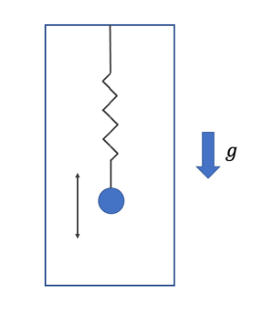 A mass suspended from the ceiling of a box by an ideal spring; the box may fall under gravity .
- (A) The amplitude of the oscillation
- (B) The period of the oscillation
- (C) The maximum speed reached by the mass
- (D) The height at which the mass reaches its maximum speed
- (E) The maximum height reached by the mass
Fonte: Testo (PDF) — p.4
Topic: Oscillations & Waves Metodi: Simple Harmonic Motion Analysis, Conservation of Energy Competenze: Physical Reasoning Objects: Spring
Una massa è sospesa dal soffitto di una scatola da una sorgente ideale. La massa riceve una velocità iniziale e oscilla verticalmente mentre la scatola è tenuta fissa. Quando la massa raggiunge il punto più basso del suo movimento, la scatola viene rilasciata e cade. Per un osservatore all’interno della scatola, quale delle seguenti quantità non cambia quando la scatola viene rilasciata? Ignora la resistenza dell’aria.
Una massa sospesa dal soffitto di una scatola da una molla ideale; la scatola può cadere sotto gravità .
- **(A) ** L’ampiezza dell’oscillazione
- **(B) ** Il periodo di oscillazione
- **(C) ** La velocità massima raggiunta dalla massa
- **(D) ** L’altezza alla quale la massa raggiunge la sua velocità massima
- **(E) ** L’altezza massima raggiunta dalla massa
Fonte: Testo (PDF) — p.4
Topic: Oscillations & Waves Metodi: Simple Harmonic Motion Analysis, Conservation of Energy Competenze: Physical Reasoning Objects: Spring
Two objects A and B are launched at the same time and place from ground on the Moon (no air). Object A is launched with speed at an angle of above horizon. Object B is launched with speed at an angle of measured in the same way. What is the distance between A and B after two seconds? It is given that at this moment neither A nor B has hit the ground yet.
- (A)
- (B)
- (C)
- (D)
- (E)
Fonte: Testo (PDF) — p.4
Topic: Newtonian Mechanics Metodi: Kinematic Equations, Vector Decomposition Competenze: Physical Reasoning Objects: Projectile
Due oggetti A e B vengono lanciati allo stesso tempo e posizionati dal suolo sulla Luna (senza aria). L’oggetto A viene lanciato con velocità in un angolo sopra l’orizzonte. L’oggetto B viene lanciato con velocità ad un angolo di misurato nello stesso modo. Qual è la distanza tra A e B dopo due secondi? Si deve tenere conto che, in questo momento, né A né B sono ancora atterrati.
- (A)
- (B)
- (C)
- (D)
- (E)
Fonte: Testo (PDF) — p.4
Topic: Newtonian Mechanics Metodi: Kinematic Equations, Vector Decomposition Competenze: Physical Reasoning Objects: Projectile
All numbers in this question are in units of m/s and and are two perpendicular unit vectors.
An object consisting of two parts of unknown masses separated by a massless compressed spring moves with constant initial velocity . At a certain moment the spring is released to push the two parts apart. Ignoring friction and gravity, which of the following velocities is/are possible at a certain time after the spring is released?
- (A) I only
- (B) II only
- (C) None
- (D) II and III only
- (E) II and IV only
Fonte: Testo (PDF) — p.4
Topic: Conservation of Momentum Metodi: Conservation of Momentum, Vector Decomposition Competenze: Physical Reasoning Objects: Spring
Tutti i numeri di questa domanda sono in unità di m/s e e sono due vettori perpendicolari di unità.
Un oggetto costituito da due parti di masse sconosciute separate da una sorgente compressa senza massa si muove con una velocità iniziale costante . In un certo momento la primavera viene rilasciata per spingere le due parti a distanza. Ignorando l’attrito e la gravità, quale delle seguenti velocità è/è possibile in un certo momento dopo la liberazione della primavera?
- **(A) ** I solo
- **(B) ** II solo
- **(C) ** Nessuna
- **(D) ** solo II e III
- solo **(E) ** II e IV
Fonte: Testo (PDF) — p.4
Topic: Conservation of Momentum Metodi: Conservation of Momentum, Vector Decomposition Competenze: Physical Reasoning Objects: Spring
All numbers in this question are in units of m/s.
A projectile loaded with explosive is launched from ground at the origin and hits the ground again at a displacement , where and is in a horizontal direction. It is then launched again for a second time in exactly the same way but this time the explosive explodes when it has velocity , where is in the vertically upward direction. Due to the explosion it splits into two parts A and B. Denote the velocities of A and B just after the explosion by and , respectively. Assume that each part stops immediately after hitting the ground. Denote the final position of the center of mass after both parts hit the ground by . In which of the following case(s) will be greater than ?
- (A) I only
- (B) II only
- (C) III only
- (D) None
- (E) II and III only
Fonte: Testo (PDF) — p.4
Topic: Conservation of Momentum Metodi: Conservation of Momentum, Kinematic Equations, Vector Decomposition Competenze: Physical Reasoning Objects: Projectile
Tutti i numeri in questa domanda sono in unità di m/s.
Un proiettile carico di esplosivo viene lanciato dal suolo all’origine e colpisce nuovamente il suolo a un spostamento , dove e sono in direzione orizzontale. È poi lanciato di nuovo per la seconda volta esattamente nello stesso modo, ma questa volta l’esplosivo esplode quando ha velocità , dove è nella direzione verticale verso l’alto. A causa dell’esplosione si divide in due parti A e B. Nota le velocità di A e B subito dopo l’esplosione rispettivamente e . Supponiamo che ogni parte si fermi subito dopo aver colpito il terreno. Indicare la posizione finale del centro di massa dopo che entrambe le parti hanno colpito il terreno con . In quale dei seguenti casi è maggiore il di ?
- **(A) ** I solo
- **(B) ** II solo
- solo **(C) ** III
- **(D) ** Nessuna
- solo **(E) ** II e III
Fonte: Testo (PDF) — p.4
Topic: Conservation of Momentum Metodi: Conservation of Momentum, Kinematic Equations, Vector Decomposition Competenze: Physical Reasoning Objects: Projectile
A mass is attached to a horizontal spring with a spring constant of to move on a rough horizontal surface. Let the line of motion be the -axis and the mass is at the origin when the spring is unstretched. The coefficient of static friction and kinetic friction are and , respectively. The mass is initially at the origin, and is given an initial speed of in the positive direction. What is the position at which the mass will come to a complete stop?
- (A)
- (B)
- (C)
- (D)
- (E)
Fonte: Testo (PDF) — p.5
Topic: Conservation of Energy Metodi: Energy Conservation Method, Hooke’s Law, Free-Body Diagram Competenze: Physical Reasoning Objects: Spring, Block
Una massa è fissata ad una molla orizzontale con una costante di molla per muoversi su una superficie orizzontale ruvida. La linea di movimento deve essere l’asse e la massa è all’origine quando la molla non è allungata. I coefficienti di attrito statico e di attrito cinetico sono e , rispettivamente. La massa è inizialmente all’origine e viene data una velocità iniziale di nella direzione positiva . A che punto la massa si fermerà completamente?
- (A)
- (B)
- (C)
- (D)
- (E)
Fonte: Testo (PDF) — p.5
Topic: Conservation of Energy Metodi: Energy Conservation Method, Hooke’s Law, Free-Body Diagram Competenze: Physical Reasoning Objects: Spring, Block
Following question 9, what is the answer if the initial velocity is increased to in the positive direction?
- (A)
- (B)
- (C)
- (D)
- (E)
Fonte: Testo (PDF) — p.5
Topic: Conservation of Energy Metodi: Energy Conservation Method, Hooke’s Law, Free-Body Diagram Competenze: Physical Reasoning Objects: Spring, Block
Dopo la domanda 9, qual è la risposta se la velocità iniziale viene aumentata a nella direzione positiva ?
- (A)
- (B)
- (C)
- (D)
- (E)
Fonte: Testo (PDF) — p.5
Topic: Conservation of Energy Metodi: Energy Conservation Method, Hooke’s Law, Free-Body Diagram Competenze: Physical Reasoning Objects: Spring, Block
Two identical triangles with mass are placed on a frictional horizontal surface. A sphere with mass is held by the triangles without falling, as shown in the diagram below. Consider that the surface between the sphere and triangles is frictionless, find the minimum value of the coefficient of static friction between the triangle and the surface such that the triangles will not slide away.
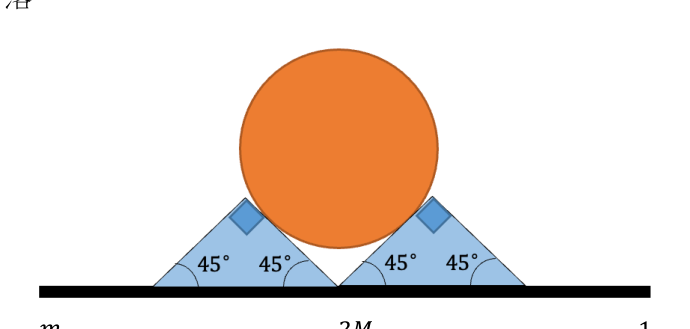 A sphere of mass rests on two identical triangular wedges of mass each, which sit on a horizontal surface.
- (A)
- (B)
- (C)
- (D)
- (E)
Fonte: Testo (PDF) — p.5
Topic: Rigid Body Statics Metodi: Free-Body Diagram, Vector Decomposition Competenze: Physical Reasoning Objects: Sphere, Wedge
Due triangoli identici di massa sono posizionati su una superficie orizzontale a friczione. Una sfera con massa è trattenuta dai triangoli senza cadere, come mostrato nel diagramma di seguito. Considerate che la superficie tra sfera e triangoli è senza attrito, troverete il valore minimo del coefficiente di attrito statico tra triangole e superficie in modo che i triangoli non si scivolassero.
Una sfera di massa si fonda su due cucine triangolari identiche di massa ciascuna, che si trovano su una superficie orizzontale.
- (A)
- (B)
- (C)
- (D)
- (E)
Fonte: Testo (PDF) — p.5
Topic: Rigid Body Statics Metodi: Free-Body Diagram, Vector Decomposition Competenze: Physical Reasoning Objects: Sphere, Wedge
Q12 and Q13 concern the same situation below. A mass is hanging on a massless ring which slides through a straight cable that makes a angle with the horizontal as shown in the figure. There may be friction between the ring and the cable. The mass accelerates along a straight line parallel to the cable above.
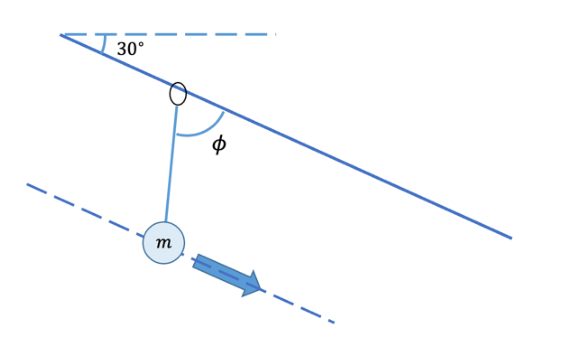 A mass hangs from a massless ring sliding along a cable inclined at to the horizontal; is the angle between the cable and the hanging string. (Used for Problems 12 and 13.)
If the angle, , between the cable and the string hanging the mass is , what is the magnitude of the friction between the ring and the cable?
- (A)
- (B)
- (C)
- (D)
- (E)
Fonte: Testo (PDF) — p.5
Topic: Newtonian Mechanics Metodi: Free-Body Diagram, Vector Decomposition Competenze: Physical Reasoning Objects: String
Q12 e Q13 riguardano la stessa situazione di seguito. Una massa è appesa ad un anello senza massa che scivola attraverso un cavo retto che crea un angolo con l’orizzontale come mostrato nella figura. Potrebbe esserci attrito tra l’anello e il cavo. La massa accelera lungo una linea retta parallela al cavo sopra.
Una massa è appesa ad un anello senza massa che scivola lungo un cavo inclinato a verso l’orizzontale; è l’angolo tra il cavo e la corda appesa. (Utilizzato per i problemi 12 e 13.)
Se l’angolo tra il cavo e la corda che sostiene la massa è , quale è la magnitudine dell’attrito tra l’anello e il cavo?
- (A)
- (B)
- (C)
- (D)
- (E)
Fonte: Testo (PDF) — p.5
Topic: Newtonian Mechanics Metodi: Free-Body Diagram, Vector Decomposition Competenze: Physical Reasoning Objects: String
If the mass is accelerating down along the dotted line, what is the minimum value of ?
- (A)
- (B)
- (C)
- (D)
- (E)
Fonte: Testo (PDF) — p.5
Topic: Newtonian Mechanics Metodi: Free-Body Diagram, Vector Decomposition Competenze: Physical Reasoning Objects: String
Se la massa si accelera lungo la linea puntata, qual è il valore minimo di ?
- (A)
- (B)
- (C)
- (D)
- (E)
Fonte: Testo (PDF) — p.5
Topic: Newtonian Mechanics Metodi: Free-Body Diagram, Vector Decomposition Competenze: Physical Reasoning Objects: String
Consider a mass which is hanging vertically by a spring with spring constant under constant gravity. The spring-mass system undergoes a simple harmonic oscillation with amplitude . The largest magnitude of net force that acts on the mass during the oscillation is
- (A)
- (B)
- (C)
- (D)
- (E)
Fonte: Testo (PDF) — p.6
Topic: Oscillations & Waves Metodi: Simple Harmonic Motion Analysis, Hooke’s Law Competenze: Physical Reasoning Objects: Spring
Si consideri una massa che è appesa verticalmente da una molla con costante molla sotto gravità costante. Il sistema di massa di molla subisce una semplice oscillazione armonica con amplitudine . La maggiore grandezza della forza netta che agisce sulla massa durante l’oscillazione è
- (A)
- (B)
- (C)
- (D)
- (E)
Fonte: Testo (PDF) — p.6
Topic: Oscillations & Waves Metodi: Simple Harmonic Motion Analysis, Hooke’s Law Competenze: Physical Reasoning Objects: Spring
A constant force applied horizontally to a block with mass pushes the block up a surface that is inclined by (see figure). The coefficient of kinetic friction between the block and the surface is . Under the application of the force, the velocity of the block increases from its initial value to a final value over a distance of along the surface. What is the work done by friction?
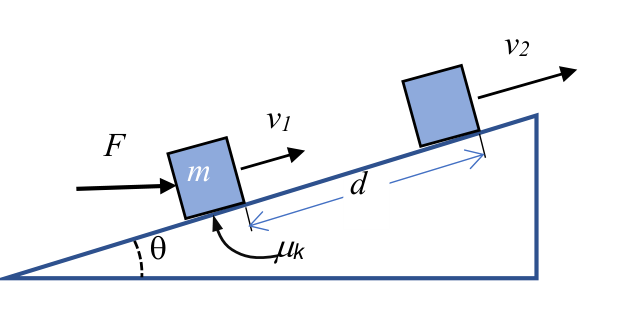 A block of mass pushed up an incline of angle by a horizontal force , accelerating from to over distance ; the surface has kinetic friction coefficient .
- (A)
- (B)
- (C)
- (D)
- (E)
Fonte: Testo (PDF) — p.6
Topic: Conservation of Energy Metodi: Energy Conservation Method, Free-Body Diagram, Vector Decomposition Competenze: Physical Reasoning Objects: Block, Inclined Plane
Una forza costante applicata orizzontalmente a un blocco di massa spinge il blocco verso l’alto su una superficie inclinata da (vedi figura). Il coefficiente di attrito cinetico tra il blocco e la superficie è . In base all’applicazione della forza, la velocità del blocco aumenta dal suo valore iniziale a un valore finale su una distanza di lungo la superficie. Che lavoro si fa con l’attrito?
A block of mass pushed up an incline of angle by a horizontal force , accelerating from to over distance ; the surface has kinetic friction coefficient .
- (A)
- (B)
- (C)
- (D)
- (E)
Fonte: Testo (PDF) — p.6
Topic: Conservation of Energy Metodi: Energy Conservation Method, Free-Body Diagram, Vector Decomposition Competenze: Physical Reasoning Objects: Block, Inclined Plane
A cubic wooden block of width is floating on a tank of water. When we push the block from the top side and displace it by a little, the block undergoes an up and down motion. Assume that the up and down motion of the block can be modelled as simple harmonic motion. What is the period of the simple harmonic motion of the block? The density of wood is . The density of water is .
- (A)
- (B)
- (C)
- (D)
- (E)
Fonte: Testo (PDF) — p.6
Topic: Oscillations & Waves, Fluid Mechanics Metodi: Simple Harmonic Motion Analysis, Hydrostatic Equilibrium Competenze: Physical Reasoning Objects: Block, Container
Un blocco di legno cubo di larghezza galleggia su un serbatoio d’acqua. Quando spingiamo il blocco dal lato superiore e lo spostamo un po’, il blocco subisce un movimento su e giù. Supponiamo che il movimento su e giù del blocco possa essere modellato come un semplice movimento armonico. Qual è il periodo del semplice movimento armonico del blocco? La densità del legno è . La densità dell’acqua è .
- (A)
- (B)
- (C)
- (D)
- (E)
Fonte: Testo (PDF) — p.6
Topic: Oscillations & Waves, Fluid Mechanics Metodi: Simple Harmonic Motion Analysis, Hydrostatic Equilibrium Competenze: Physical Reasoning Objects: Block, Container
A rectangular block with dimensions is placed on a slope that makes an angle of with the horizontal. The square side of the rectangular block is initially put on the slope. The coefficient of static friction between the block and the slope is . Will the block slide down the slope, topple over, or neither?
- (A) The block will slide down the slope, but will not topple over.
- (B) The block will topple over, but will not slide down the slope.
- (C) The block will both slide down the slope and topple over.
- (D) The block will neither slide down the slope nor topple over.
- (E) Not enough information to decide.
Fonte: Testo (PDF) — p.6
Topic: Rigid Body Statics Metodi: Torque & Angular Momentum Analysis, Free-Body Diagram Competenze: Physical Reasoning Objects: Block, Inclined Plane
Un blocco rettangolare con dimensioni è posizionato su una pendice che fa un angolo di con l’orizzontale. Il lato quadrato del blocco rettangolare è inizialmente posto sulla pendenza. Il coefficiente di attrito statico tra il blocco e la pendenza è . Il blocco scivola per la pendenza, si rovescia o non si rovescia?
- **(A) ** Il blocco scivolerà lungo la pendenza, ma non si ribalterà.
- **(B) ** Il blocco si rovescerà, ma non scivolerà verso il basso pendio.
- **(C) ** Il blocco scivola in discesa e si rovescia.
- **(D) ** Il blocco non scivolerà sulla pendice né si ribalterà.
- **(E) ** Non ci sono informazioni sufficienti per decidere.
Fonte: Testo (PDF) — p.6
Topic: Rigid Body Statics Metodi: Torque & Angular Momentum Analysis, Free-Body Diagram Competenze: Physical Reasoning Objects: Block, Inclined Plane
A block of mass is being pulled along an inclined surface at a constant velocity using two massless pulleys as shown in the diagram. The coefficient of kinetic friction between the block and the surface is . What is the magnitude of the pulling force required to maintain the constant velocity? Assume the strings are massless and inextensible, and the mass of the block is . The angle of inclination is .
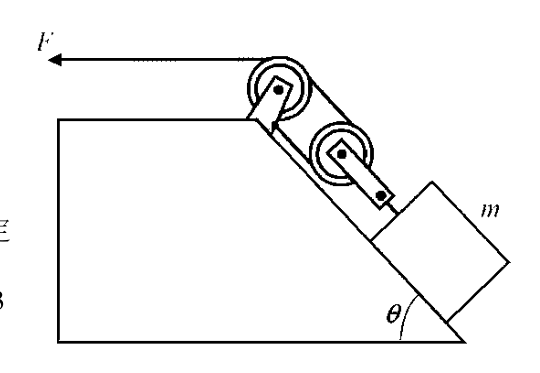 A block of mass on an incline of angle , pulled at constant velocity by force through a system of two massless pulleys.
- (A)
- (B)
- (C)
- (D)
- (E)
Fonte: Testo (PDF) — p.7
Topic: Newtonian Mechanics Metodi: Free-Body Diagram, Vector Decomposition Competenze: Physical Reasoning Objects: Block, Inclined Plane, Pulley, String
Un blocco di massa viene trascinato lungo una superficie inclinata a velocità costante utilizzando due polli senza massa come mostrato nel diagramma. Il coefficiente di attrito cinetico tra il blocco e la superficie è . Qual è la grandezza della forza di trazione necessaria per mantenere la velocità costante? Supponiamo che le stringhe siano senza massa e inestensibili, e che la massa del blocco sia . L’angolo di inclinazione è .
Un blocco di massa su un’inclinazione di angolo , tirato a velocità costante con la forza attraverso un sistema di due polliere senza massa.
- (A)
- (B)
- (C)
- (D)
- (E)
Fonte: Testo (PDF) — p.7
Topic: Newtonian Mechanics Metodi: Free-Body Diagram, Vector Decomposition Competenze: Physical Reasoning Objects: Block, Inclined Plane, Pulley, String
A man standing on a movable cart throws a ball towards a fixed wall outside the cart. The ball has an initial velocity of and bounces back from the wall, which the man then catches. The ball has a mass of , the cart (with the man) has a mass of and is initially at rest before the ball is thrown. Find the final speed of the cart. We assume the collision between the ball and the wall is elastic and the mass of the wall is much larger than that of the ball.
- (A)
- (B)
- (C)
- (D)
- (E)
Fonte: Testo (PDF) — p.7
Topic: Conservation of Momentum Metodi: Conservation of Momentum, Impulse-Momentum Theorem Competenze: Physical Reasoning Objects: Cart, Ball
Un uomo che sta su un carrello mobile lancia una palla verso un muro fisso fuori dal carrello. La palla ha una velocità iniziale di e rimbalza dal muro, che l’uomo cattura. La palla ha una massa di , il carrello (con l’uomo) ha una massa di e inizia a riposare prima del lancio della palla. Trova la velocità finale del carrello. Supponiamo che la collisione tra la palla e il muro sia elastica e la massa del muro sia molto più grande di quella della palla.
- (A)
- (B)
- (C)
- (D)
- (E)
Fonte: Testo (PDF) — p.7
Topic: Conservation of Momentum Metodi: Conservation of Momentum, Impulse-Momentum Theorem Competenze: Physical Reasoning Objects: Cart, Ball
The rotor of a centrifuge rotates at (revolutions per minute). A particle at the top of a test tube (mounted on the centrifuge) is from the rotation axis. Calculate the effective gravity the particle feels. Assume the effect of the original gravity is negligible in this case.
- (A)
- (B)
- (C)
- (D)
- (E) None of the above
Fonte: Testo (PDF) — p.7
Topic: Newtonian Mechanics Metodi: Kinematic Equations, Dimensional Analysis Competenze: Unit Conversion Objects: Container
Il rotore di una centrifugatrice ruota a (torsioni al minuto). Una particella in cima a un tubo di prova (montata sulla centrifugatrice) è dall’asse di rotazione. Calcola la gravità effettiva che la particella prova. Supponiamo che l’effetto della gravità originale sia trascurabile in questo caso.
- (A)
- (B)
- (C)
- (D)
- **(E) ** Nessuna delle seguenti:
Fonte: Testo (PDF) — p.7
Topic: Newtonian Mechanics Metodi: Kinematic Equations, Dimensional Analysis Competenze: Unit Conversion Objects: Container
Open Problems (15 Points Each) — Problem 1. [15 points]
A small block X with mass initially at height starts to slide down a ramp from rest. It collides with a stationary small block Y on a horizontal surface, which has a mass of for some number , as shown in the figure. Assume all collisions are perfectly elastic and friction can be neglected in this problem.
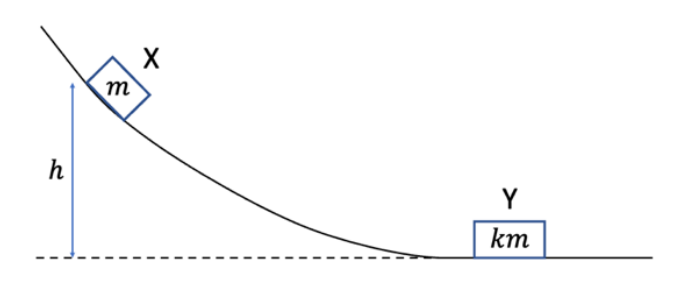 Block X (mass ) slides down from height on a frictionless ramp and collides with block Y (mass ) at rest on the horizontal surface.
(a) [3] What is the velocity of X right before the collision with block Y?
(b) [3] What are the velocities of blocks X and Y after the first collision?
(c) [3] If two blocks can only collide exactly once, what condition must be satisfied for the value of ?
(d) [3] Suppose the value of does not satisfy the condition you found in part (c) and two blocks encounter the second collision. What are the velocities of blocks X and Y after the second collision?
(e) [3] If two blocks can only collide exactly twice, what condition must be satisfied for the value of ?
Fonte: Testo (PDF) — p.7
Topic: Conservation of Momentum, Conservation of Energy Metodi: Conservation of Momentum, Conservation of Energy Competenze: Physical Reasoning, Mathematical Modeling Objects: Block, Inclined Plane
Problemi aperti (15 punti ciascuno) Problema 1. [15 punti]
Un piccolo blocco X con massa inizialmente a altezza inizia a scivolare in basso una rampa dal riposo. Colpisce con un piccolo blocco Y stazionario su una superficie orizzontale, che ha una massa di per un certo numero , come mostrato nella figura. Supponiamo che tutte le collisioni siano perfettamente elastiche e che la frizione possa essere trascurata in questo problema.
Il blocco X (massa ) scivola giù dall’altezza su una rampa senza attrito e si schianta con il blocco Y (massa ) in riposo sulla superficie orizzontale.
**(a) ** [3] Qual è la velocità di X subito prima della collisione con il blocco Y?
**(b) ** [3] Quali sono le velocità dei blocchi X e Y dopo la prima collisione?
**(c) ** [3] Se due blocchi possono collidere esattamente una sola volta, quale condizione deve essere soddisfatta per il valore di ?
**(d) ** [3] Supponiamo che il valore di non soddisfi la condizione riportata nella parte (c) e due blocchi incontrino la seconda collisione. Quali sono le velocità dei blocchi X e Y dopo la seconda collisione?
**(e) ** [3] Se due blocchi possono collidere esattamente solo due volte, quale condizione deve essere soddisfatta per il valore di ?
Fonte: Testo (PDF) — p.7
Topic: Conservation of Momentum, Conservation of Energy Metodi: Conservation of Momentum, Conservation of Energy Competenze: Physical Reasoning, Mathematical Modeling Objects: Block, Inclined Plane
Open Problem 2.
Part I
A ball with mass moving towards North at speed hits a moving wall that makes a angle with the East and is travelling towards West at speed . The ball then bounces away from the wall at speed at South of West as shown in Fig. 2a. The wall is very heavy, so its velocity does not change due to the collision.
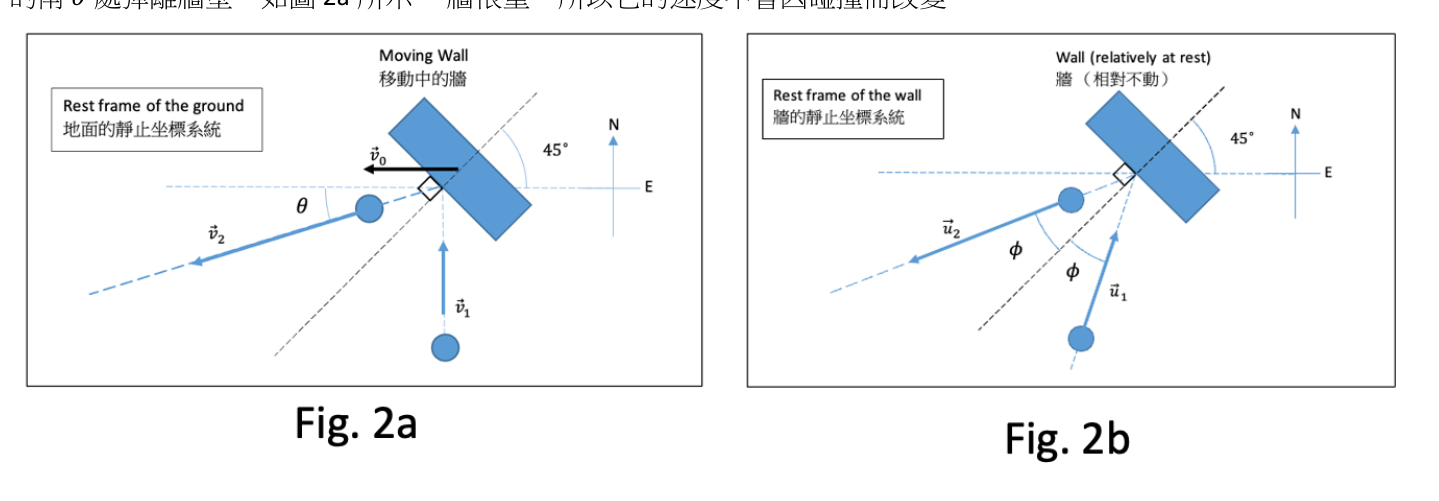 Fig. 2a (rest frame of the ground): incoming ball velocity towards North, wall (at to East) moving West at , outgoing ball velocity at angle . Fig. 2b (rest frame of the wall): incoming and outgoing make equal angles with the wall normal.
(a) [5] Assume that the collision is elastic in the rest frame of the wall. Find the speeds and , and the angle in the rest frame of the wall shown in Fig. 2b, in terms of , and .
(b) [4] Find angle and speed in the rest frame of the ground (Fig. 2a) in terms of , and .
Part II
Gravity Assist is a technique to achieve acceleration (or deceleration) of a spacecraft using the gravity of the planet that the spacecraft is flying by. The drawing below shows an example of how a spacecraft launched from Earth executes a gravity assist when flying by Jupiter to change direction and accelerate to fly far away from the Sun’s gravity.
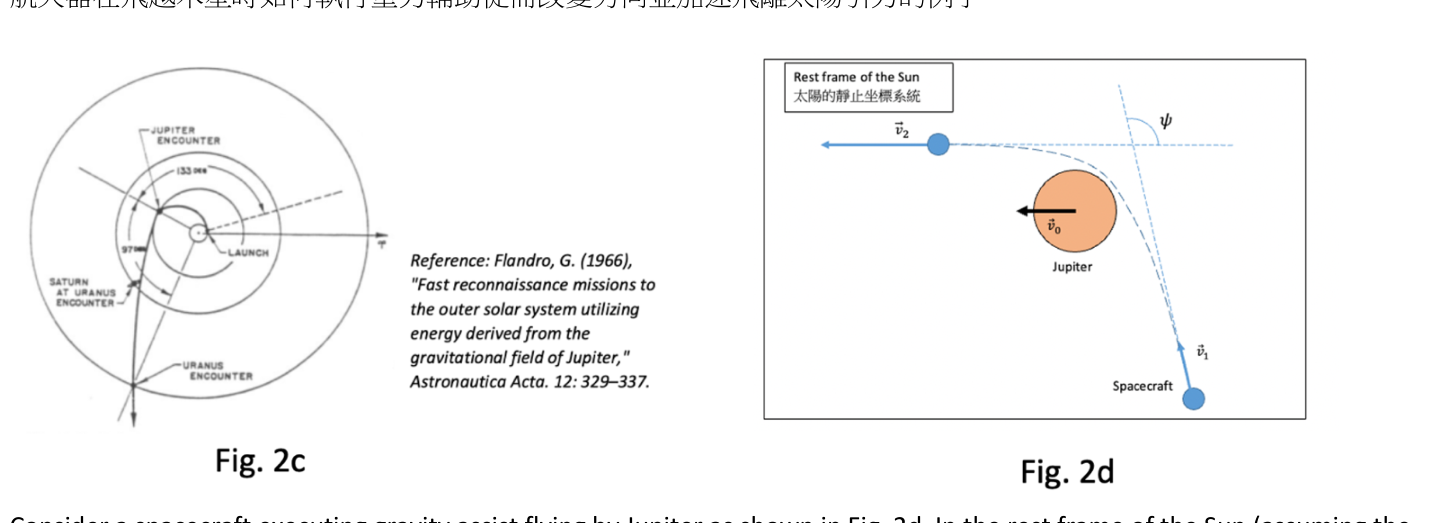 Fig. 2c (trajectory of a spacecraft performing gravity assist; reference: Flandro, G. (1966), “Fast reconnaissance missions to the outer solar system utilizing energy derived from the gravitational field of Jupiter”, Astronautica Acta. 12: 329–337). Fig. 2d (rest frame of the Sun): Jupiter moves left at , the spacecraft enters at and exits at .
Consider a spacecraft executing gravity assist flying by Jupiter as shown in Fig. 2d. In the rest frame of the Sun (assuming the Sun is absolutely at rest), Jupiter is moving to the left at speed . The spacecraft comes in at incident speed and exits at speed ( will not change any further) with a deflection of its trajectory with angle and is parallel to .
The mass of Jupiter is much larger than the spacecraft. One can assume that, in the rest frame of Jupiter, the spacecraft’s mechanical energy (sum of its kinetic energy and gravitational potential energy due to Jupiter) is conserved when it flies by.
(c) [4] Find the speed of the spacecraft when it flies away from Jupiter in the rest frame of the Sun in terms of , and .
(d) [2] Given , find the speed of spacecraft in terms of such that the spacecraft exits at three times its incident speed .
Fonte: Testo (PDF) — p.8
Topic: Conservation of Momentum, Conservation of Energy Metodi: Conservation of Momentum, Conservation of Energy, Vector Decomposition Competenze: Physical Reasoning, Mathematical Modeling Objects: Ball, Planet, Star, Satellite
Problema aperto 2.
Parte I
Una palla con massa che si muove verso nord a velocità colpisce un muro in movimento che fa un angolo con l’est e si muove verso ovest a velocità . La palla rimbalza quindi dal muro a velocità a sud di West come mostrato nella figura. 2a. Il muro è molto pesante, quindi la sua velocità non cambia a causa della collisione.
Fig. 2a (quadro di riposo del terreno): velocità di entrata della palla verso nord, parete (a verso est) in movimento verso ovest a , velocità di uscita della palla all’angolo . Fig. - Cosa? 2b (quadro di riposo della parete): e uscenti rendono gli angoli uguali alla parete normale.
**(a) ** [5] Supponiamo che la collisione sia elastica nel quadro del resto della parete. Trova le velocità e e l’angolo nel quadro restante della parete mostrato nella figura. 2b, in termini di , e .
**(b) ** [4] Trova l’angolo e la velocità nel cornice di riposo del terreno (Fig. 2 bis) in termini di , e .
parte II
Gravity Assist è una tecnica per ottenere l’accelerazione (o la decelerazione) di una nave spaziale utilizzando la gravità del pianeta da cui la nave spaziale vola. Il disegno di seguito mostra un esempio di come una nave spaziale lanciata dalla Terra esegue un’assistenza gravitazionale quando vola vicino a Giove per cambiare direzione e accelerare per volare lontano dalla gravità del Sole.
Fig. 2c (tragittoria di una nave spaziale che svolge un’assistenza gravitazionale; riferimento: Flandro, G. (1966), “Missioni di ricognizione rapida al sistema solare esterno utilizzando l’energia derivata dal campo gravitazionale di Giove”, Astronautica Acta. 12: 329–337). Fig. - Cosa? 2d (quadro di riposo del Sole): Giove si muove a sinistra a , la sonda entra a e esce a .
Considerate un veicolo spaziale che esegue un’assistenza gravitazionale che vola vicino a Giove come mostrato nella figura. 2d. Nel quadro di riposo del Sole (supponendo che il Sole sia assolutamente in riposo), Giove si sta muovendo a sinistra a velocità . La sonda entra a velocità di incidente e esce a velocità ( non cambierà più) con una deviazione della sua traiettoria con angolo e è parallela a .
La massa di Giove è molto più grande della sonda spaziale. Si può supporre che, nel quadro di riposo di Giove, l’energia meccanica della sonda (suma della sua energia cinetica e dell’energia potenziale gravitazionale dovuta a Giove) sia conservata quando passa.
**(c) ** [4] Trova la velocità della sonda spaziale quando si allontana da Giove nel cornice di riposo del Sole in termini di , e .
**(d) ** [2] Se si dà , si trova la velocità della sonda in termini di in modo tale che la sonda esci a tre volte la sua velocità di incidente .
Fonte: Testo (PDF) — p.8
Topic: Conservation of Momentum, Conservation of Energy Metodi: Conservation of Momentum, Conservation of Energy, Vector Decomposition Competenze: Physical Reasoning, Mathematical Modeling Objects: Ball, Planet, Star, Satellite
Open Problem 3. [15 points]
We consider an asteroid coming across the Earth, tracing out a hyperbolic trajectory on the x-y plane as
where is the radial distance of the current asteroid position measured from the Earth at origin and is the angle measured from the positive x-axis, as shown in the figure below. The parameters of the trajectory, and , are positive constants, which can be determined from the initial condition. For an asteroid coming at a perpendicular distance and speed at infinity, the asteroid has a speed , pointing in the negative y-direction, at the closest point P of radial distance on the x-axis. The asteroid will then leave to infinity with its original direction being deflected by an angle if the asteroid has not hit the Earth.
In this problem, we have assumed the Earth is in an inertial reference frame as simplification. For the hyperbolic trajectory, we have and satisfies . Unlike circular motion, the velocity vector is not always perpendicular to the position vector . To ease the discussion, it is given that , as a geometric fact of the hyperbola. We are also given constants: Mass of Earth . Radius of Earth .
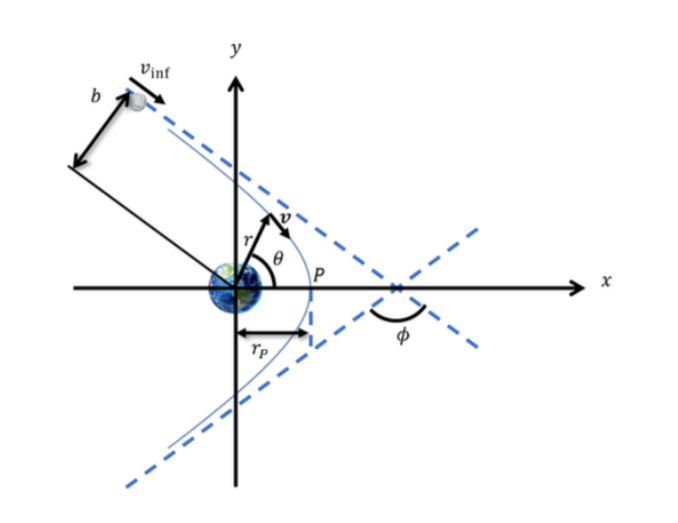 Hyperbolic trajectory of an asteroid about the Earth: impact parameter and speed at infinity, closest approach P at radial distance on the x-axis with velocity , and overall deflection angle .
(a) [3] Suppose the asteroid is able to hit the Earth. Find the minimum speed at the moment of impact. Please ignore the effect of atmosphere in decelerating the asteroid.
(b) [2] Now, we are given the initial conditions that and while other parameters such as , and are assumed to be derived quantities. According to Kepler’s second law which is valid even if the trajectory is hyperbolic, the trajectory sweeps out equal areas in equal intervals of time. Calculate the numerical value of the sweeping area per unit time which should be a constant along the whole trajectory.
(c) [5] With the given initial condition, calculate the numerical value of the closest radial distance . You may need to use the results of last part.
(d) [5] With the same initial condition, calculate the angle of deflection . (Hint: You can consider a point of the trajectory on the y-axis.)
Fonte: Testo (PDF) — p.9
Topic: Gravitation Metodi: Newton’s Law of Gravitation, Kepler’s Laws, Conservation Laws Competenze: Mathematical Modeling, Physical Reasoning Objects: Planet
Problema aperto 3. [15 punti]
Consideramo un asteroide che attraversa la Terra, tracciando una traiettoria iperbolica sul piano x-y come
dove è la distanza radial della posizione attuale dell’asteroide misurata dalla Terra in origine e è l’angolo misurato dall’asse x positivo, come mostrato nella figura seguente. I parametri della traiettoria, e , sono costanti positive, che possono essere determinate dalla condizione iniziale. Per un asteroide che arriva a una distanza perpendicolare e velocità all’infinito, l’asteroide ha una velocità , puntando nella direzione y negativa, al punto P più vicino della distanza radiale sull’asse x. L’asteroide partirà quindi all’infinito con la sua direzione originale deviata da un angolo se l’asteroide non ha colpito la Terra.
In questo problema, abbiamo supposto che la Terra sia in un quadro di riferimento inerziale come semplificazione. Per la traiettoria iperbolica, abbiamo e soddisfa . A differenza del movimento circolare, il vettore di velocità non è sempre perpendicolare al vettore di posizione . Per facilitare la discussione, viene data la , come fatto geometrico dell’iperbola. Ci sono state date anche costanti: massa della Terra . Radius della Terra .
Trajectoria iperbolica di un asteroide intorno alla Terra: parametro di impatto e velocità all’infinito, più vicino approccio P a distanza radial sull’asse x con velocità , e angolo di deflessione complessivo .
**(a) ** [3] Supponiamo che l’asteroide sia in grado di colpire la Terra. Trova la velocità minima al momento dell’impatto. Per favore, ignori l’effetto dell’atmosfera nel rallentare l’asteroide.
**(b) ** [2] Ora, ci sono date le condizioni iniziali che e mentre altri parametri come , e sono presunti come quantità derivate. Secondo la seconda legge di Kepler, valida anche se la traiettoria è iperbolica, la traiettoria spazza fuori aree uguali in intervalli di tempo uguali. Calcolare il valore numerico dell’area di spazzatura per unità di tempo che dovrebbe essere costante lungo l’intera traiettoria.
**(c) ** [5] Con la condizione iniziale data calcolare il valore numerico della distanza radial più vicina . Potrebbe essere necessario utilizzare i risultati dell’ultima parte.
**(d) ** [5] Con la stessa condizione iniziale calcolare l’angolo di deviazione . (Signore: Si può considerare un punto della traiettoria sull’asse y.)
Fonte: Testo (PDF) — p.9
Topic: Gravitation Metodi: Newton’s Law of Gravitation, Kepler’s Laws, Conservation Laws Competenze: Mathematical Modeling, Physical Reasoning Objects: Planet
Open Problem 4. [15 points]
In an air show two helicopters are at rest at the same height above ground at a distance to each other. At , one of them launches a projectile, called A, with speed at an angle of measured upward from the direction of the other helicopter. At the same time, the other helicopter also launches a projectile, called B, with speed at an angle of measured upward from the same direction, as shown in the figure below. It is given that the changes in heights during the motions of the projectiles are much smaller than the radius of the Earth and the helicopters are very high above ground so that there is no need to consider the projectiles hitting the ground. Ignore air resistance.
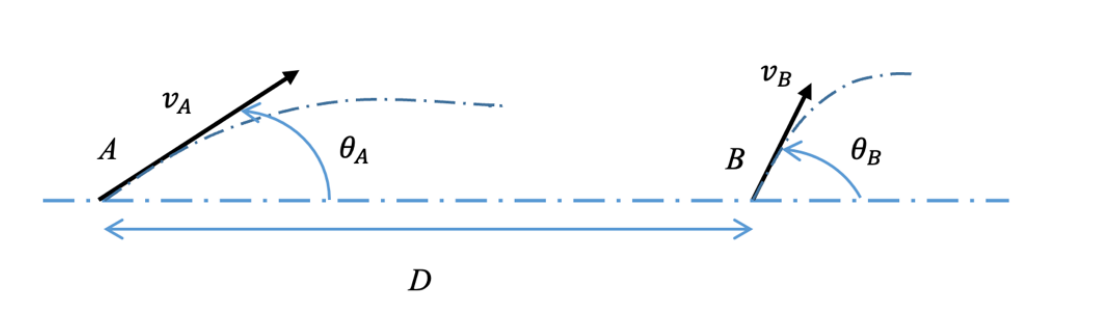 Two helicopters a distance apart launch projectiles A (speed , angle ) and B (speed , angle ), each angle measured upward from the direction of the other helicopter.
(a) [5] Find the minimum distance and the time when A and B are at this distance. Express your answers in terms of , , , and . Find all possible answers in different cases.
(b) [5] Hence, or otherwise, find the condition in terms of , , and , such that B will hit A, and the time taken for B to hit A after being launched, in terms of , , , and .
(c) [5] Hence, or otherwise, find in terms of such that B will hit A if and . At what time, in terms of , , and , will B hit A?
Fonte: Testo (PDF) — p.10
Topic: Newtonian Mechanics Metodi: Kinematic Equations, Vector Decomposition Competenze: Mathematical Modeling, Physical Reasoning Objects: Projectile
Problema aperto 4. [15 punti]
In una mostra aerea due elicotteri sono a riposo alla stessa altezza al di sopra del suolo, a una distanza l’uno dall’altro. A , uno di loro lancia un proiettile, chiamato A, con velocità ad un angolo di misurato verso l’alto dalla direzione dell’altro elicottero. Allo stesso tempo, l’altro elicottero lancia anche un proiettile, chiamato B, con velocità ad un angolo di misurato verso l’alto dalla stessa direzione, come mostrato nella figura seguente. Si dà in considerazione che i cambiamenti di altezza durante i movimenti dei proiettili sono molto più piccoli del raggio della Terra e che gli elicotteri sono molto alti sopra il terreno, in modo che non è necessario considerare i proiettili che colpiscono il terreno. Ignora la resistenza dell’aria.
Due elicotteri a distanza da un proiettolo di lancio A (velocità , angolo ) e B (velocità , angolo ), ogni angolo misurato verso l’alto dalla direzione dell’altro elicottero.
**(a) ** [5] Trova la distanza minima e l’ora in cui A e B sono a questa distanza. Esprimere le risposte in termini di , , , e . Trova tutte le possibili risposte in casi diversi.
**(b) ** [5] Quindi, o altrimenti, trovare la condizione in termini di , , e , in modo tale che B raggiunga A, e il tempo necessario per B di raggiungere A dopo il lancio, in termini di , , , e .
**(c) ** [5] Quindi, o altrimenti, trovare in termini di in modo tale che B raggiunga A se e . A che ora, in termini di , e , B raggiungerà A?
Fonte: Testo (PDF) — p.10
Topic: Newtonian Mechanics Metodi: Kinematic Equations, Vector Decomposition Competenze: Mathematical Modeling, Physical Reasoning Objects: Projectile