(10 marks) On the evening of an autumnal equinox day Siddhant noticed that Mars was exactly along the north-south meridian in his sky at the exact moment when the sun was setting. In other words, the Sun and Mars subtended an angle of exactly as measured from the Earth. If the orbital radius of Mars is 1.52 au, what will be the approximate rise time of the Mars on the next autumnal equinox day?
Topic: Astrophysics, Gravitation Metodi: Kepler’s Laws, Physical Modeling Competenze: Mathematical Modeling Objects: Planet, Star Fonte: Testo (PDF) — p.2 Soluzione: Soluzioni (PDF)
(10 punti) La sera di un equinoccio autunnale Siddhant notò che Marte era esattamente lungo il meridiano nord-sud nel suo cielo, nel momento esatto in cui il sole stava tramontando. In altre parole, il Sole e Marte hanno sottostillato un angolo di esattamente misurato dalla Terra. Se il raggio orbitale di Marte è di 1,52 AU, qual sarà l’orario di ascensione approssimativo di Marte il giorno dell’equinozio autunnale successivo?
Topic: Astrophysics, Gravitation Metodi: Kepler’s Laws, Physical Modeling Competenze: Mathematical Modeling Objects: Planet, Star Fonte: Testo (PDF) — p.2 Soluzione: Soluzioni (PDF)
Manoj was determined to claim some world record. He got an idea from the fairy tale of Rapunzel that he will never cut his hair and he can claim world record for growing longest hair.
(a) (3 marks) Estimate maximum length of the hair that he can grow in his whole life, if he hasn’t cut his hair from his birth.
(b) (7 marks) What will be mass of these hair? (density of typical hair strand is ) If you make any simplifying assumptions, discuss qualitatively how answer would have been affected if those assumptions were not made.
Topic: Order-of-Magnitude Estimation Metodi: Order-of-Magnitude Estimation Competenze: Estimation & Approximation Objects: — Fonte: Testo (PDF) — p.2 Soluzione: Soluzioni (PDF)
Manoj era determinato a rivendicare un record mondiale. Ha avuto un’idea dal racconto di fiaba di Rapunzel che non si taglierà mai i capelli e che può rivendicare il record mondiale per la crescita dei capelli più lunghi.
a) (3 punti) Calcolare la lunghezza massima dei capelli che può crescere in tutta la vita, se non si è tagliato i capelli dalla nascita.
(b) (7 punti) Quanto sarà la massa di questi capelli? (densità del filo di capelli tipico è ) Se si fanno ipotesi semplificanti, discutere qualitativamente come la risposta sarebbe stata influenzata se tali ipotesi non fossero state fatte.
Topic: Order-of-Magnitude Estimation Metodi: Order-of-Magnitude Estimation Competenze: Estimation & Approximation Objects: — Fonte: Testo (PDF) — p.2 Soluzione: Soluzioni (PDF)
(10 marks) A curious middle school student wants to actually measure perimeter of a circle of radius 2 cm. He has a scale and plenty of time at his disposal, but does not have a thread to measure lengths along arcs. Hence, he comes up with the following strategy:
Quesito 3
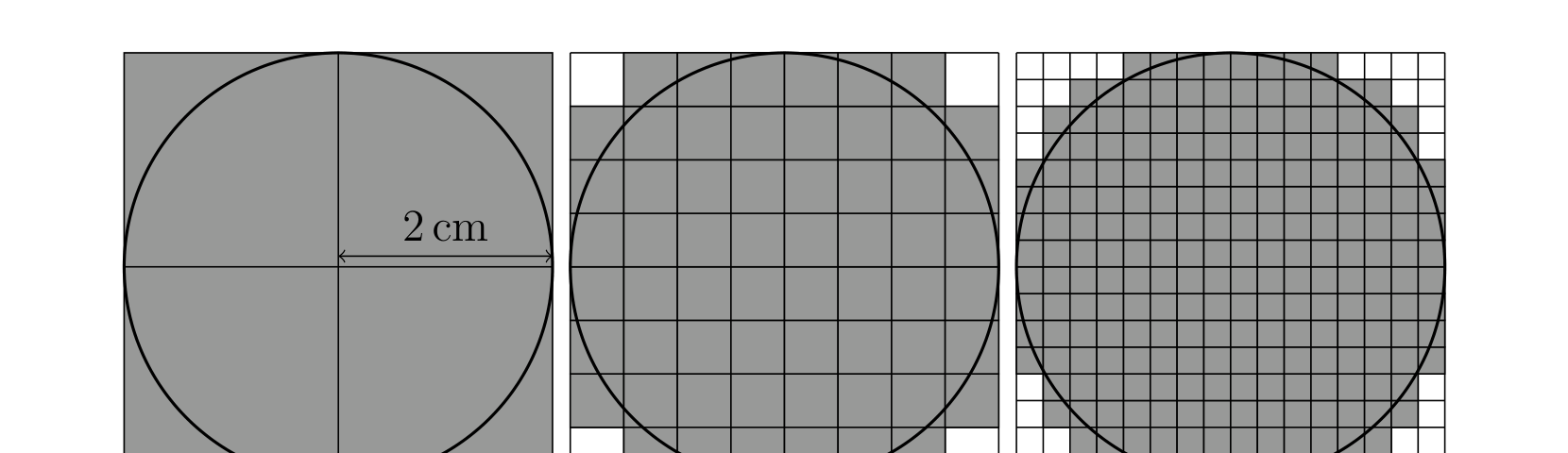
- He makes a circumscribing square of the circle.
- He divides the square into 4 equal smaller squares (left panel).
- He measures the outer boundary (perimeter) of a shape formed by all the squares that overlap (fully or partially) with the circle (shape is highlighted in gray in the figure). He calls this estimate as .
- He then makes a finer grid by dividing each smaller square into grid. He again repeats step 3 to estimate the perimeter and calls it (middle panel).
- He keeps refining the grid again and again times and finds final estimate . Estimate .
Hint: Eliminate white squares one by one, starting from corners, to arrive at the perimeter of gray shape.
Topic: Mathematics Metodi: Approximation & Series Expansion Competenze: Mathematical Modeling Objects: — Fonte: Testo (PDF) — p.2 Soluzione: Soluzioni (PDF)
(10 punti) Un curioso studente di scuola media vuole effettivamente misurare il perimetro di un cerchio di raggio di 2 cm. Ha una scala e un sacco di tempo a sua disposizione, ma non ha un filo per misurare lunghezze lungo archi. Per questo ha formulato la seguente strategia:
Quesito 3
- Fa un quadrato circonscrizione del cerchio.
- Divide il quadrato in 4 quadrati uguali più piccoli (panecchio sinistro).
- Misura il limite esterno (perimetro) di una forma formata da tutti i quadrati che si sovrappongono (interamente o parzialmente) con il cerchio (la forma è evidenziata in grigio nella figura). He calls this estimate as .
- Quindi fa una griglia più fine dividendo ogni quadrato più piccolo in griglia . Ripete il passo 3 per stimare il perimetro e lo chiama (parco medio).
- Continua a rifinire la griglia più e più volte e trova la stima finale . Stimazione .
Suggerimento: Elimina i quadrati bianchi uno ad uno, partendo da angoli, per arrivare al perimetro di forma grigia.
Topic: Mathematics Metodi: Approximation & Series Expansion Competenze: Mathematical Modeling Objects: — Fonte: Testo (PDF) — p.2 Soluzione: Soluzioni (PDF)
Let us consider three stars A, B and C. It was observed that
- As seen from star B, star A is barely visible to the naked eye,
- As seen from star C, star B is barely visible to the naked eye,
- As seen from star A, star C is barely visible to the naked eye,
Let us denote the distance between star A and star B as , and distance between star B and C as and star C and A as .
Absolute magnitude of star A, i.e. mag and that of star B is mag. (For explanation of magnitude system, see the box below.)
(a) (4 marks) Find the distances and .
(b) (5 marks) Find the interval (in magnitudes) in which the absolute magnitude has to belong so that the above described configuration is allowed.
(c) (3 marks) If mag, find the largest angle in this stellar triangle.
(d) (6 marks) Show that if we change the values of the three absolute magnitudes so that their differences remain the same, the angles in the triangle will not change.
A note about magnitude system:
The brightness of a star as seen by some observer, is dependent on the observer’s distance from the star as well the intrinsic brightness of the star (ignoring any absorption in the intervening space).
In astronomy, brightness of a star, as seen by some observer, is measured in terms of its ‘apparent magnitude’ (). For two stars (1 and 2) with fluxes and respectively, their apparent magnitudes and are related by
Absolute magnitude () of any star is its apparent magnitude, if the star was exactly 10 pc away from the observer. Thus, only depends on the intrinsic brightness of the star.
The relation between and is given as,
where is measured in parsec (pc). By convention, the faintest stars visible to naked eye, in ideal viewing conditions, have been assigned an apparent magnitude of mag.
Topic: Astrophysics Metodi: Physical Modeling Competenze: Mathematical Modeling Objects: Star Fonte: Testo (PDF) — p.3 Soluzione: Soluzioni (PDF)
Consideriamo tre stelle A, B e C. È stato osservato che
- Come visto dalla stella B, la stella A è appena visibile ad occhio nudo.
- Come visto dalla stella C, la stella B è appena visibile ad occhio nudo.
- Come visto dalla stella A, la stella C è a malapena visibile ad occhio nudo.
Indichiamo la distanza tra stella A e stella B come , e la distanza tra stella B e C come e stella C e A come .
Magnitude assoluta della stella A, cioè mag e quella della stella B è mag. (Per una spiegazione del sistema di magnitudine, vedi il riquadro seguente.)
a) (4 punti) Trova le distanze e .
b) (5 punti) Trova l’intervallo (in magnitudini) in cui deve appartenere la magnitudine assoluta in modo da consentire la configurazione sopra descritta.
(c) (3 punti) Se mag, trovare l’angolo più grande in questo triangolo stellare.
(d) (6 punti) Mostra che se cambiamo i valori delle tre magnitudini assolute in modo che le loro differenze rimangano le stesse, gli angoli del triangolo non cambieranno.
Una nota sul sistema di magnitudine:
La luminosità di una stella come vista da alcuni osservatori dipende dalla distanza dell’osservatore dalla stella e dalla luminosità intrinseca della stella (ignorando qualsiasi assorbimento nello spazio intermedio).
In astronomia, la luminosità di una stella, come osservata da alcuni osservatori, è misurata in termini di “magnitù apparente” (). Per due stelle (1 e 2) con flussi e rispettivamente, le loro magnitudini apparenti e sono correlate da:
La magnitudine assoluta () di una qualsiasi stella è la sua magnitudine apparente, se la stella era esattamente a 10 pc dall’osservatore. Pertanto, dipende solo dalla luminosità intrinseca della stella.
Il rapporto tra e è dato come segue:
in cui è misurato in parsec (pc). Per convenzione, alle stelle più deboli visibili a occhio nudo, in condizioni di visione ideali, è stata assegnata una magnitudine apparente di mag.
Topic: Astrophysics Metodi: Physical Modeling Competenze: Mathematical Modeling Objects: Star Fonte: Testo (PDF) — p.3 Soluzione: Soluzioni (PDF)
An extremely powerful cannon is placed horizontally at the north pole (at ground level) and its barrel is aligned with the Prime Meridian (Greenwich Meridian). The cannon is fired at , and the cannonball has sufficient velocity to travel in a circular orbit around the Earth. Assume the Earth to be a perfect sphere and that no objects obstruct the path of the cannonball.
(a) (3 marks) What is the period of the orbit of this cannonball?
(b) (10 marks) Plot the trajectory of the cannonball (latitude () vs. longitude ()) on a regular graph paper given in your answersheet. The plot should correspond to one full orbit.
(c) (7 marks) The second graph given in the answersheet is a part of a large polar projection plot having concentric arcs around the centre as latitudes and radial lines as longitudes. Define appropriate scale and show the path of cannonball on this graph from the moment it is fired till the moment it crosses the equator.
Topic: Gravitation, Astrophysics Metodi: Newton’s Law of Gravitation, Kepler’s Laws Competenze: Diagrammatic Reasoning Objects: Satellite, Planet Fonte: Testo (PDF) — p.3 Soluzione: Soluzioni (PDF)
Un cannone estremamente potente è posizionato orizzontalmente al polo nord (a livello del suolo) e il suo barile è allineato con il Meridiano Principale (Meridiano di Greenwich). Il cannone viene sparato a , e la palla di cannone ha una velocità sufficiente per viaggiare in un’orbita circolare intorno alla Terra. Supponiamo che la Terra sia una sfera perfetta e che nessun oggetto ostacoli il percorso della palla di cannone.
(a) (3 punti) Qual è il periodo di orbita di questa palla di cannone?
(b) (10 marks) Plot the trajectory of the cannonball (latitude () vs. L’indicazione di un’area di longitudine () su un grafico regolare indicato nella scheda delle risposte. La trama dovrebbe corrispondere a una orbita completa.
(c) (7 punti) Il secondo grafico della scheda di risposta è una parte di un grande grafico di proiezione polare che ha archi concentrici intorno al centro come latitudini e linee radiali come lungitudini. Defini la scala appropriata e mostra il percorso della pallina di cannone su questo grafico dal momento in cui viene sparata fino al momento in cui attraversa l’equatore.
Topic: Gravitation, Astrophysics Metodi: Newton’s Law of Gravitation, Kepler’s Laws Competenze: Diagrammatic Reasoning Objects: Satellite, Planet Fonte: Testo (PDF) — p.3 Soluzione: Soluzioni (PDF)
Pulsars are a type of fast rotating, high density stars, which are known for their regular pulses of radiation. They are also sometimes called as the ‘light houses of the universe’. In this problem, we assume the pulsars to be spheres of uniform density, which are gravitationally bound.
(a) (4 marks) Rotation period of a pulsar was measured to be ms. What limit does this put on its density?
(b) (2 marks) If mass of this pulsar is , what limit can we place on its radius?
A pulsar is formed from a massive progenitor star which typically has a magnetic field of T and average density of . Such a star loses about 90% of its mass towards the end of its life. The remnant mass forms a pulsar of the kind described above.
(c) (2 marks) Along the lines of part (a), what limit does this put on the rotation period of the progenitor star?
(d) (4 marks) Assuming that the magnetic flux is conserved during the formation of a pulsar, find the typical magnetic field at the surface of the pulsar?
Topic: Astrophysics, Gravitation Metodi: Newton’s Law of Gravitation, Conservation Laws Competenze: Mathematical Modeling Objects: Star Fonte: Testo (PDF) — p.4 Soluzione: Soluzioni (PDF)
I pulsari sono un tipo di stelle di alta densità che ruotano velocemente e sono note per i loro pulsi regolari di radiazioni. Sono anche a volte chiamate ‘le case luminose dell’universo’. In questo problema, supponiamo che i pulsari siano sfere di densità uniforme, che sono gravitationalmente legate.
(a) (4 marchi) Il periodo di rotazione di un pulsar è stato misurato a ms. Che limite mette questo alla sua densità?
(b) (2 punti) Se la massa di questo pulsare è , quale limite possiamo mettere sul suo raggio?
Un pulsar si forma da una stella progenitora massiccia che ha in genere un campo magnetico di T e una densità media di . Una stella del genere perde circa il 90% della sua massa verso la fine della sua vita. La massa residuo forma un pulsare del tipo descritto sopra.
(c) (2 punti) Secondo le linee della parte (a), quale limite pone questo sul periodo di rotazione della stella progenitora?
(d) (4 punti) Supponendo che il flusso magnetico sia conservato durante la formazione di un pulsar, trovare il campo magnetico tipico alla superficie del pulsar?
Topic: Astrophysics, Gravitation Metodi: Newton’s Law of Gravitation, Conservation Laws Competenze: Mathematical Modeling Objects: Star Fonte: Testo (PDF) — p.4 Soluzione: Soluzioni (PDF)
The picture below was taken on 24th December 2019, from some place in India, showing the crescent of the Moon near the horizon (the horizontal dashed line marks the horizon of the place). Field of View (FOV) of the image is .
Quesito 7
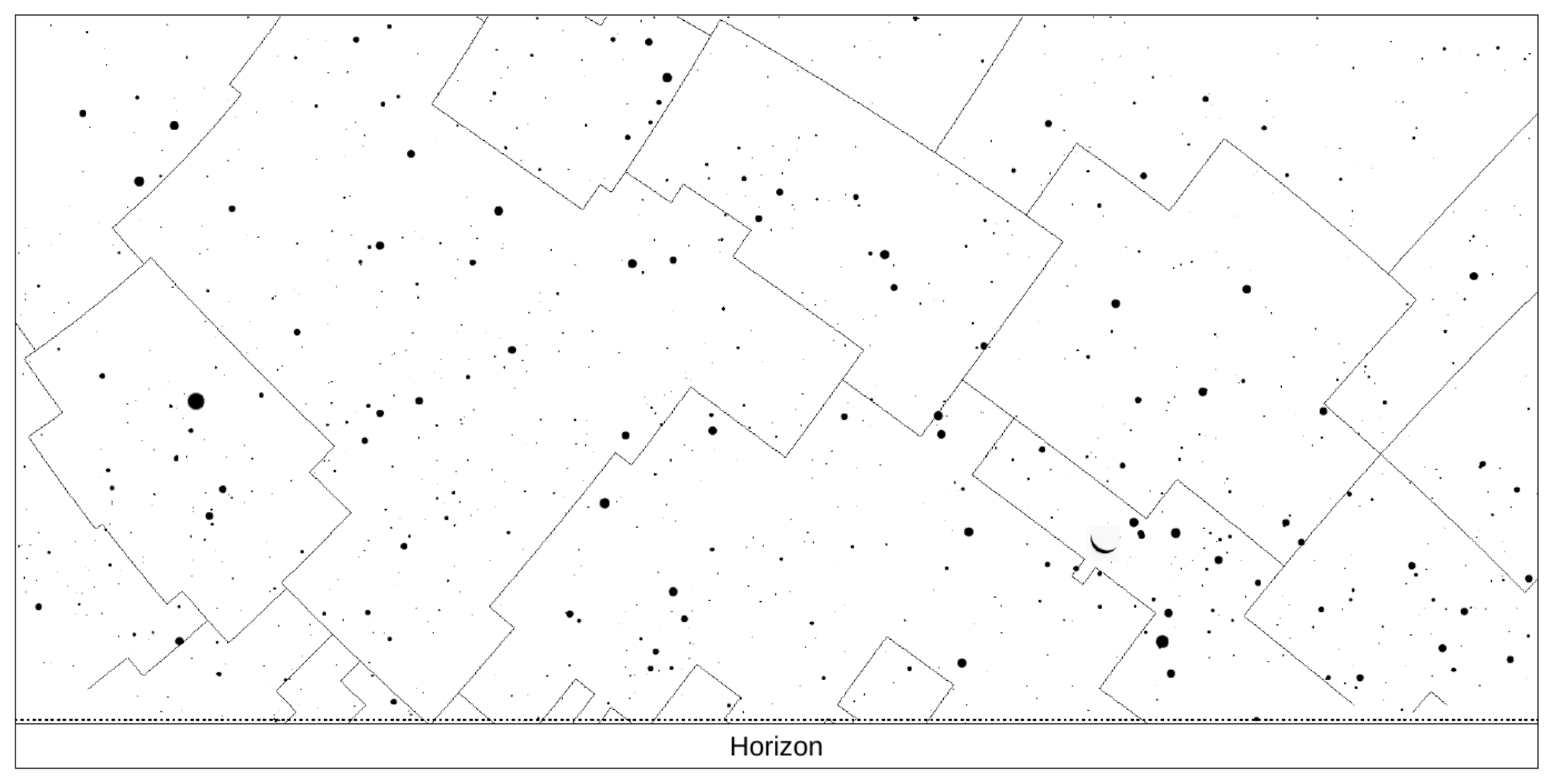
Figure 1: Negative image of certain patch of the sky on 24th December 2019
Note: The images printed are colour-inverted, i.e. the bright parts of the image appear black and dark parts appear white. Thus, the black dots are stars and planet and the dark crescent is actually bright crescent of the moon.
(a) (5 marks) At which of the following times this picture may have been taken? Give justification for your answer.
18:00 hrs, 22:00 hrs, 01:00 hrs, 05:00 hrs
(b) (5 marks) Write the names of the constellations present in the image of the sky.
(c) (1 mark) The map also includes a planet. Mark the planet on the map with a circle and label as ‘P’.
(d) (5 marks) A zoomed-in image of the lunar crescent is given in the answersheet. On this image mark the approximate directions to the cardinal points. [East-West-North-South]
Note: You may assume the box in the answersheet has a linear angular scale along the horizon.
(e) (4 marks) Find approximate latitude of the place.
Topic: Astrophysics Metodi: Physical Modeling Competenze: Diagrammatic Reasoning Objects: Planet, Star Fonte: Testo (PDF) — p.4 Soluzione: Soluzioni (PDF)
La foto di seguito è stata scattata il 24 dicembre 2019 da un luogo in India, mostrando la mezzaluna vicino all’orizzonte (la linea orizzontale tracciata segna l’orizzonte del luogo). Il campo di vista (FOV) dell’immagine è .
Quesito 7
Figura 1: Immagine negativa di un certo pezzo del cielo il 24 dicembre 2019
Nota: le immagini stampate sono invertite a colori, ovvero Le parti luminose dell’immagine sembrano nere e le parti scure sembrano bianche. Quindi, i punti neri sono stelle e pianeti e la mezzaluna oscura è in realtà la mezzaluna luminosa della luna.
(a) (5 punti) In quale delle seguenti occasioni si può essere scattata questa foto? Di’ una giustificazione per la tua risposta.
Le ore 18:00, 22:00, 01:00, 05:00
b) (5 punti) Scrivi i nomi delle costellazioni presenti nell’immagine del cielo.
(c) (1 segno) La mappa include anche un pianeta. Segna il pianeta sulla mappa con un cerchio e etichettalo come “P”.
(d) (5 punti) Nella scheda di risposta è riportata un’immagine zoomata del semiluno. Su questa immagine segna le indicazioni approssimative dei punti cardinali. [Est-Ovest-Nord-Sud]
Nota: Si può supporre che la casella della scheda di risposte abbia una scala angolare lineare lungo l’orizzonte.
e) (4 punti) Trova la latitudine approssimativa del luogo.
Topic: Astrophysics Metodi: Physical Modeling Competenze: Diagrammatic Reasoning Objects: Planet, Star Fonte: Testo (PDF) — p.4 Soluzione: Soluzioni (PDF)