For the spacecrafts travelling from one planet to another, the travel path can be designed in multiple ways. The most energy efficient of these methods is called ‘Hohmann Transfer Orbit’. In this method, the spacecraft travels in an elliptical orbit with the Sun at the principal focus. Thus, its motion is governed by Kepler’s Laws and hardly any fuel is spent for this journey.
Step-wise process of Hohmann orbit is as follows:
- Step 1: The spacecraft is in the close proximity of Earth.
- Step 2: The spacecraft engine is fired to allow it to escape the sphere of influence of the Earth and enter the region where the Sun’s gravity is the dominating force. The point in Earth’s orbit at which engine is fired will also be a point in the new orbit of the spacecraft around the Sun.
- Step 3: The spacecraft travels along an elliptical orbit around the Sun and reaches the orbit of Mars.
- Step 4: The timing of this journey is such that Mars is exactly at the common point of Martian orbit and the elliptical orbit of the spacecraft at the instance when the spacecraft reaches this point.
- Step 5: The spacecraft engine is fired again so that the spacecraft is captured by the Mars’ gravity and it remains in close proximity of Mars.
Points to note:
A. The point where the engine is first fired (Step 2) will be spacecraft’s shortest distance from the Sun. B. The point where the spacecraft is captured by Mars (Step 5) will be the spacecraft’s farthest distance from the Sun. C. If Step 5 is not executed, the spacecraft will complete its orbit around the Sun and reach back the point in space where Step 2 was executed. D. Let us assume that both Earth and Mars are in circular, co-planer orbits around the Sun and the Hohmann transfer orbit is also in the same plane. E. Assume that all the three bodies (Earth, Mars and the spacecraft) are point masses and moving in anti-clockwise direction (as viewed from the top) in their respective orbits. F. The time durations for which engine is fired (Step 2 as well as Step 5) is very small. Hence, the thrust is almost instantaneous.
Based on this, answer the following questions:
(a) [1.5] Find the orbital period of Mars in years.
(b) [1.5] Find the length of semi-major axis of this Hohmann transfer orbit (in au).
(c) [1.5] Find time spent by the spacecraft between Step 2 and Step 5.
(d) [5] Draw a diagram showing the Hohmann transfer orbit between Earth and Mars. Show positions of Earth and Mars at the instance of Step 2 (as and ) and at the instance of Step 5 ( and ). Keep position directly below the Sun. Calculate angles subtended with respect to Sun - line for the other three points (, and ).
(e) [2.5] Calculate orbital velocity of Earth and Mars around Sun.
(f) [8] Determine if the following statements are True or False. Explain your reason in one line each. i. The semi-minor axis of the Hohmann orbit is 1 au. ii. The semi-major axis of the Hohmann orbit is 1.52 au. iii. The thrust was applied in Step 2 to increase the speed of the spacecraft. iv. The thrust was applied in Step 5 to increase the speed of the spacecraft. v. If Step 5 is missed, we can re-capture the spacecraft in an orbit around the Earth when it again reaches its departure point in space. (see point C above). vi. The Hohmann transfer orbit only touches (and does not intersect) the Earth’s orbit. vii. The kinetic energy of the spacecraft in Hohmann orbit is lowest just before Step 5. viii. The spacecraft would be approaching Mars from behind in its orbit.
Topic: Gravitation, Astrophysics Metodi: Kepler’s Laws, Newton’s Law of Gravitation Competenze: Physical Reasoning Objects: Satellite, Planet, Star Fonte: Testo (PDF) — p.2 Soluzione: Soluzioni (PDF)
Per le navi spaziali che viaggiano da un pianeta all’altro, il percorso di viaggio può essere progettato in diversi modi. Il metodo più energeticamente efficiente di questi è chiamato “Hohmann Transfer Orbit”. In questo metodo, la sonda spaziale viaggia in un’orbita ellittica con il Sole al centro. Il suo movimento è quindi governato dalle leggi di Kepler e quasi nessun carburante viene speso per questo viaggio.
Il processo di Hohmann in orbita è il seguente:
- Passo 1: la sonda e’ nelle vicinanze della Terra.
- Passo 2: Il motore della sonda spaziale viene attivato per permettergli di sfuggire alla sfera di influenza della Terra e entrare nella regione dove la gravità del Sole è la forza dominante. Il punto dell’orbita terrestre al quale viene lanciato il motore sarà anche un punto della nuova orbita della sonda intorno al Sole.
- Passo 3: La sonda viaggia lungo un’orbita ellittica attorno al Sole e raggiunge l’orbita di Marte.
- Passo 4: Il tempo di questo viaggio è tale che Marte si trova esattamente al punto comune dell’orbita marziana e all’orbita ellittica della sonda nello stesso momento in cui la sonda raggiunge questo punto.
- Passo 5: Il motore della sonda viene ricaricato in modo che la sonda sia catturata dalla gravità di Marte e rimanga in prossimità di Marte.
I punti da notare:
A. Il punto in cui il motore viene spinto per la prima volta (fase 2) sarà la distanza più breve della sonda spaziale dal Sole. B. Il punto in cui la sonda sarà catturata da Marte (Step 5) sarà la distanza più lontana della sonda dal Sole. C. Se non viene eseguita la fase 5, la sonda completerà la sua orbita attorno al Sole e raggiungerà il punto nello spazio in cui è stato eseguito la fase 2. D. Supponiamo che sia la Terra che Marte siano in orbite circolari, co-planer attorno al Sole e che l’orbita di trasferimento di Hohmann sia nello stesso piano. E. Supponiamo che tutti e tre i corpi (Terra, Marte e la sonda spaziale) siano masse puntate e si muovano in direzione antiorologiale (come visto dall’alto) nelle rispettive orbite. F. La durata del funzionamento del motore (fase 2 e 5), è molto breve. Quindi, la spinta è quasi istantanea.
In base a questo, rispondi alle seguenti domande:
(a) [1.5] Trova il periodo orbitale di Marte in anni.
b) [1.5] Trova la lunghezza dell’asse semimejor di questa orbita di trasferimento Hohmann (in au).
(c) [1.5] Trova il tempo trascorso dalla sonda spaziale tra il passaggio 2 e il passaggio 5.
(d) [5] Disegnare un diagramma che mostra l’orbita di trasferimento Hohmann tra la Terra e Marte. Mostra le posizioni della Terra e di Marte nell’istanza del passaggio 2 (come e ) e nell’istanza del passaggio 5 ( e ). Mantenere la posizione direttamente sotto il Sole. Calcolare gli angoli sottostanti rispetto alla linea Sun - per gli altri tre punti (, e ).
(e) [2.5] Calcolare la velocità orbitale della Terra e di Marte attorno al Sole.
(f) [8] Determinare se le seguenti affermazioni sono vere o false. Spiegate la vostra ragione in una riga. i. L’asse semiminor della orbita di Hohmann è di 1 au. ii. L’asse semimejor dell’orbita di Hohmann è di 1,52 AU. iii. La spinta è stata applicata in fase 2 per aumentare la velocità della sonda. iv. La spinta è stata applicata nel passaggio 5 per aumentare la velocità della sonda. v. Se manca il passo 5, possiamo riprendere la sonda in orbita attorno alla Terra quando raggiunge di nuovo il suo punto di partenza nello spazio. (cfr. punto C). vi. L’orbita di trasferimento di Hohmann tocca (e non interseca) solo l’orbita terrestre.
- il numero di persone L’energia cinetica della sonda in orbita di Hohmann è la più bassa appena prima del passaggio 5.
- Il terzo. La sonda si avvicinerebbe a Marte da dietro nella sua orbita.
Topic: Gravitation, Astrophysics Metodi: Kepler’s Laws, Newton’s Law of Gravitation Competenze: Physical Reasoning Objects: Satellite, Planet, Star Fonte: Testo (PDF) — p.2 Soluzione: Soluzioni (PDF)
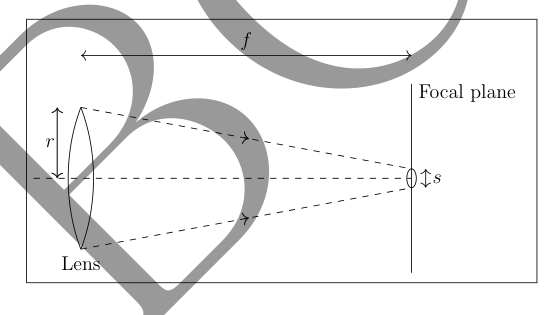
[10] A telescope with objective lens of focal length is used to image a binary star system using a CCD kept at its focal plane and the image forming symmetrically at the centre (on the optic axis). In the figure, is the image size of a point object. The image has a finite size due to diffraction. Two nearby objects are considered to be resolved when their image disks are just touching each other externally.
The radius of the objective lens is . The limiting resolution of the lens is given to be and the two stars are separated by an angle of . Determine the range allowed for the CCD to be displaced from the focal plane towards the lens such that individual stars can still be separately resolved.
(Note: This is related to the notion of “depth of field” of a camera lens.)
Quesito 2
Topic: Geometric Optics, Astrophysics Metodi: Small-Angle Approximation, Thin Lens & Mirror Equation Competenze: Mathematical Modeling Objects: Lens, Screen, Star Fonte: Testo (PDF) — p.3 Soluzione: Soluzioni (PDF)
[10] Un telescopio con obiettivo di distanza focale è utilizzato per immaginare un sistema stellare binario utilizzando un CCD tenuto al suo piano focale e l’immagine formata simmetricamente al centro (sulla spina ottica). Nella figura, è la dimensione dell’immagine di un oggetto puntino. L’immagine ha una dimensione finita a causa della diffrazione. Due oggetti vicini sono considerati risolti quando i loro dischi di immagine si toccano a vicenda esternamente.
Il raggio di raggi dell’obiettivo è . La risoluzione di limitazione della lente è data a e le due stelle sono separate da un angolo di . Determinare il raggio consentito per il spostamento del CCD dal piano focale verso la lente in modo che le singole stelle possano ancora essere risolte separatamente.
(Nota: questo è correlato alla nozione di “profondità di campo” di un obiettivo della fotocamera.)
Quesito 2
Topic: Geometric Optics, Astrophysics Metodi: Small-Angle Approximation, Thin Lens & Mirror Equation Competenze: Mathematical Modeling Objects: Lens, Screen, Star Fonte: Testo (PDF) — p.3 Soluzione: Soluzioni (PDF)
A cubical box, with edges of length , is in a circular orbit of radius around a star. The time period of revolution of the box is . The star can be approximated as a perfect blackbody with radius () and temperature .
In all parts of this question, at time , normal vector to one face of the box is exactly pointing towards the star and this face has an albedo of (where ). The top face of the box is parallel to the orbital plane of the box.
The box is in thermal equilibrium at each instance , i.e. its emissivity is exactly equal to its absorptivity. The temperature in all parts of the box is the same at each instance.
Note: Albedo is the fraction of incident light reflected off the surface of an object.
(a) [7] If the same face of the box is locked in towards the star at all times, find its equilibrium temperature .
(b) [6] Let all 6 faces of the box have albedo . If the box is revolving around the star, but not rotating about itself, derive the expression for the equilibrium temperature as a function of time .
(c) [3] Now consider the case, where the face of the cube which is towards the star at and the face opposite to it have albedo and all other faces of the cube have albedo of . Observe the expressions obtained in part b and write the final expression for temperature in this case.
Topic: Astrophysics, Thermodynamics Metodi: Physical Modeling, Differential Equations Competenze: Mathematical Modeling Objects: Satellite, Star Fonte: Testo (PDF) — p.3 Soluzione: Soluzioni (PDF)
Una scatola cubica, con bordi di lunghezza , è in orbita circolare di raggio attorno a una stella. Il periodo di rivoluzione della scatola è . La stella può essere approssimata come un corpo nero perfetto con raggio () e temperatura .
In tutte le parti di questa domanda, al tempo , il vettore normale di una faccia della scatola punta esattamente verso la stella e questa faccia ha un albedo di (dove ). La parte superiore della scatola è parallela al piano orbitale della scatola.
La scatola è in equilibrio termico in ogni istanza , ovvero la sua emissività è esattamente uguale alla sua assorbenza. La temperatura in tutte le parti della scatola è la stessa in ogni istanza.
Nota: Albedo è la frazione di luce incidente riflessa dalla superficie di un oggetto.
(a) [7] Se la stessa faccia della scatola è bloccata in direzione della stella in ogni momento, trovare la sua temperatura di equilibrio .
b) [6] Le 6 facce della scatola devono avere albedo . Se la scatola ruota attorno alla stella, ma non ruota intorno a se stessa, derivare l’espressione per la temperatura di equilibrio come funzione del tempo .
(c) [3] Ora consideriamo il caso, in cui la faccia del cubo che è rivolta verso la stella a e la faccia opposta a essa hanno albedo e tutte le altre facce del cubo hanno albedo di . Osservare le espressioni ottenute nella parte b e scrivere l’espressione finale per la temperatura in questo caso.
Topic: Astrophysics, Thermodynamics Metodi: Physical Modeling, Differential Equations Competenze: Mathematical Modeling Objects: Satellite, Star Fonte: Testo (PDF) — p.3 Soluzione: Soluzioni (PDF)
Indian Space Research Organisation (ISRO) decided to send a spaceship to the planet Jupiter. The spaceship needs to pass through the asteroid belt between Mars and Jupiter which lies between 2.0 au and 3.0 au. The asteroid belt has a thickness (total height perpendicular to the plane of the solar system) of about 0.10 au and there are about asteroids of radius (assumed to be spherical) in it. The spaceship is spherical and is in radius.
(a) [2] Calculate the cross-section area within which the centre of an asteroid needs to come from the centre of the spacecraft to collide with it.
(b) [8] Assume that the asteroid belt is completely static and the spaceship is launched on a random day of the year to travel radially away from Sun, but within the plane of solar system. Calculate the probability () that the spaceship will escape the asteroid belt unharmed.
(c) Qualitatively compare the probability in the each of the following cases with : i. [2] The probability () when the spacecraft’s speed through the asteroid belt is doubled. ii. [1] The probability () when the spacecraft is not moving radially but is in an elliptical orbit with aphelion point at Jupiter (5 au). Here we consider probability only for a single crossing. iii. [2] The probability () when the spacecraft is not moving radially but is in an elliptical orbit with aphelion point at the centre of the asteroid belt (2.5 au).
Topic: Order-of-Magnitude Estimation, Astrophysics Metodi: Order-of-Magnitude Estimation, Statistical Averaging Competenze: Estimation & Approximation Objects: Satellite, Sphere, Star Fonte: Testo (PDF) — p.4 Soluzione: Soluzioni (PDF)
L’Organizzazione indiana di ricerca spaziale (ISRO) ha deciso di inviare una nave spaziale al pianeta Giove. La nave spaziale deve passare attraverso la cintura di asteroidi tra Marte e Giove che si trova tra 2,0 au e 3,0 au. La cintura di asteroidi ha uno spessore (altezza totale perpendicolare al piano del sistema solare) di circa 0,10 au e vi sono circa asteroidi di raggio (presumendo di essere sferici) in esso. La nave spaziale è sferica e ha di raggio.
a) [2] Calcolare l’area di sezione trasversale entro la quale il centro di un asteroide deve provenire dal centro della sonda spaziale per colpirlo.
(b) [8] Supponiamo che la cintura di asteroidi sia completamente statica e la nave spaziale sia lanciata in un giorno casuale dell’anno per viaggiare radialmente lontano dal Sole, ma all’interno del piano del sistema solare. Calcola la probabilità () che la nave spaziale sfugge al cinturino degli asteroidi incolum.
c) Confronta qualitativamente la probabilità in ciascuno dei seguenti casi con : i. [2] La probabilità () quando la velocità della sonda attraverso la cintura degli asteroidi è raddoppiata. ii. [1] La probabilità () quando la sonda spaziale non si muove radialmente ma si trova in un’orbita ellittica con punto di afelione a Giove (5 au). Qui consideriamo la probabilità solo per un singolo incrocio. iii. [2] La probabilità () quando la sonda non si muove radialmente ma si trova in un’orbita ellittica con punto di afelione al centro della cintura di asteroidi (2.5 au).
Topic: Order-of-Magnitude Estimation, Astrophysics Metodi: Order-of-Magnitude Estimation, Statistical Averaging Competenze: Estimation & Approximation Objects: Satellite, Sphere, Star Fonte: Testo (PDF) — p.4 Soluzione: Soluzioni (PDF)
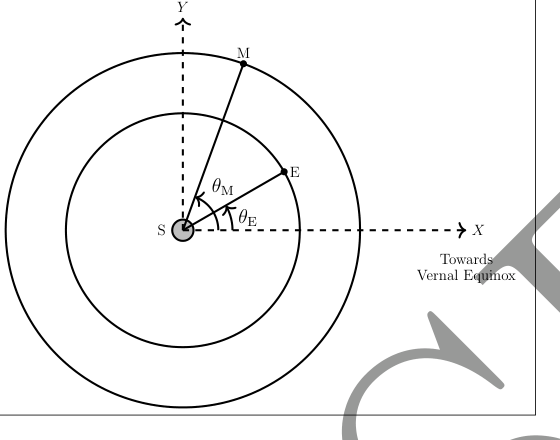
[22] Assume that the Earth and Mars revolve around the Sun in coplanar circular orbits of radius and respectively. In the figure below, and are the angles made by the radius vectors of Earth and Mars, measured at the Sun with respect to the X-axis (which points in the direction of Vernal Equinox - a reference point in space).
On 21 September, was and was .
In the answersheet you are given a table to note down your observations. Calculate the values of and for the dates mentioned in the table and write them in the respective columns.
The answersheet also has a particular section of the orbits of Mars and Earth. The dotted lines are markings for angles in the orbits at an interval of . The central black line is when or will be . You can also see the distant stellar background near one edge of the page.
For the dates given in the table mark the projected positions of Mars on the stellar background. Also write the corresponding observation numbers near the marked projected positions. Now describe the motion of Mars as seen by an Earth based observer.
Quesito 5
Topic: Gravitation, Astrophysics Metodi: Kepler’s Laws, Vector Decomposition Competenze: Diagrammatic Reasoning Objects: Planet, Star Fonte: Testo (PDF) — p.4 Soluzione: Soluzioni (PDF)
[22] Supponiamo che la Terra e Marte ruotino intorno al Sole in orbite circolari coplanari di raggio e rispettivamente. Nella figura seguente, e sono gli angoli realizzati dai vettori del raggio della Terra e di Marte, misurati al Sole rispetto all’asse X (che punta nella direzione dell’equinozio vernale - punto di riferimento nello spazio).
Il 21 settembre, è stato e è stato .
Nella scheda delle risposte vi viene data una tabella per annotare le vostre osservazioni. Calcolare i valori di e per le date menzionate nella tabella e scriverli nelle rispettive colonne.
La scheda di risposta contiene anche una sezione particolare delle orbite di Marte e Terra. Le linee puntate sono segni per gli angoli delle orbite ad un intervallo di . La linea nera centrale è quando o sarà . Si può anche vedere lo sfondo stellare lontano vicino ad un bordo della pagina.
Per le date indicate nella tabella, le posizioni progettate di Marte sullo sfondo stellare. Scrivere anche i numeri di osservazione corrispondenti vicino alle posizioni proiettate segnate. Descrivi il movimento di Marte visto da un osservatore terrestre.
Quesito 5
Topic: Gravitation, Astrophysics Metodi: Kepler’s Laws, Vector Decomposition Competenze: Diagrammatic Reasoning Objects: Planet, Star Fonte: Testo (PDF) — p.4 Soluzione: Soluzioni (PDF)
Saee is an observer at North Pole during the month of December. On the grid given in your answersheet:
(a) [1] Mark the directions.
(b) [1] Mark the pole star (Polaris).
(c) [6] Approximately, for how many days will the Moon be visible in one lunar month assuming clear skies? If you were doing an exact calculation, which secondary effects you will have to consider? List any three effects that may affect your answer by an hour or more.
(d) [6] In this month the full Moon was seen on winter solstice day in the Gemini constellation. Saee noted the Moon’s position every day at 7 pm during an entire lunar month. Mark the approximate positions of the Moon as seen by her. For each observation label the day number starting with day of first observation.
(e) [3] Aadarsh, who is also camping at the North pole with Saee, noted the Moon’s position for 24 hours period of the 6th day after full moon. Describe what he will observe.
Topic: Astrophysics Metodi: Physical Modeling Competenze: Diagrammatic Reasoning Objects: Star Fonte: Testo (PDF) — p.5 Soluzione: Soluzioni (PDF)
Saee è un osservatore al Polo Nord durante il mese di dicembre. Nella griglia di risposta:
(a) [1] Segna le indicazioni.
b) [1] Segna la stella polare (Polaris).
(c) [6] Per circa quanti giorni la Luna sarà visibile in un mese lunare assumendo cieli limpidi? Se dovessi fare un calcolo preciso, quali effetti secondari dovresti considerare? Elencate tre effetti che potrebbero influenzare la vostra risposta di un’ora o più.
(d) [6] In questo mese la Luna piena è stata vista nel giorno del solstizio d’inverno nella costellazione dei Gemelli. Saee ha notato la posizione della Luna ogni giorno alle 19 durante un intero mese lunare. Segna le posizioni approssimative della Luna come vista da lei. Per ogni etichetta di osservazione il numero di giorni a partire dal giorno della prima osservazione.
(e) [3] Aadarsh, che sta anche accampando al polo nord con Saee, ha notato la posizione della Luna per un periodo di 24 ore del 6 ° giorno dopo la luna piena. Descrivi cosa osserverà.
Topic: Astrophysics Metodi: Physical Modeling Competenze: Diagrammatic Reasoning Objects: Star Fonte: Testo (PDF) — p.5 Soluzione: Soluzioni (PDF)