Answer each of the following sub-questions with a brief justification —
(a) [2] Fatima observed a celestial object, with her unaided eyes, very near to the western horizon immediately after sunset on 17 July 2023. She continued to observe the same object at the same time everyday till 4 September 2023. She made the following observations —
- Object’s separation from the Sun increases starting from 17 July.
- Object’s separation from the Sun decreases after 11 August.
- She also made an observation that the object was never seen overhead at sunset within that year.
Name one object, which is not a comet, that fits these observations made by Fatima.
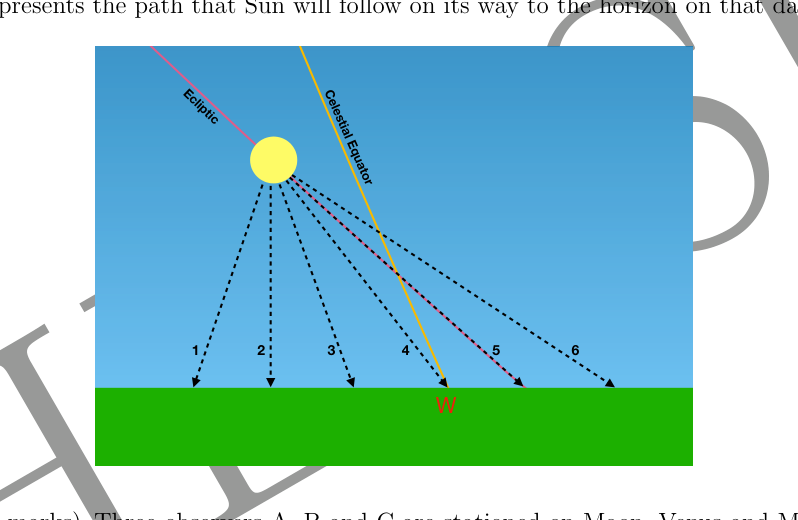
(b) [2] In the image below, you see the Sun just above the western horizon on some day as seen from the city of Ujjain. The ecliptic, celestial equator and due west point (W) are marked in the image. Which of the paths marked (1 to 6) on the image closely represents the path that Sun will follow on its way to the horizon on that day.
Quesito 1
(c) [2] Three observers A, B and C are stationed on Moon, Venus and Mars respectively. Which of these observer(s) can see almost all the phases of Earth [new (no earth), crescent, half, gibbous, etc.].
(d) [4] A certain star was observed to remain always above horizon over the course of one full day. During this period its maximum altitude was and minimum altitude was . What is/are the latitude/s for the place of observation?
Note: Altitude is the angular distance of a star from the horizon measured along a circular arc perpendicular to the horizon.
(e) [2] In which month/s of the year, will there be a New Moon in the constellation of Leo?
- (A) August
- (B) November
- (C) February
- (D) May
(f) [4] Which of the following statement(s) CANNOT be inferred from Kepler’s laws of motion?
- (A) A planet moves in an elliptical orbit around the Sun.
- (B) The eccentricity of the orbits of all solar system planets is small.
- (C) A solar system planet has its highest tangential velocity when it is closest to the Sun.
- (D) All the planets move in elliptical orbits in roughly the same plane around the Sun.
(g) [5] The presence of different elements in a distant astronomical object is inferred from the peaks in the emission spectrum of its soil, at certain wavelengths, characteristic to each element. One such spectrum for a moon (named ) around a distant exoplanet observed by the hypothetical mission , that landed on the surface of in the future is shown below. The spectrometer is noisy i.e., small random fluctuations get superimposed on top of the actual signal. The units of both the axes in the figure below are arbitrary.
Quesito 1
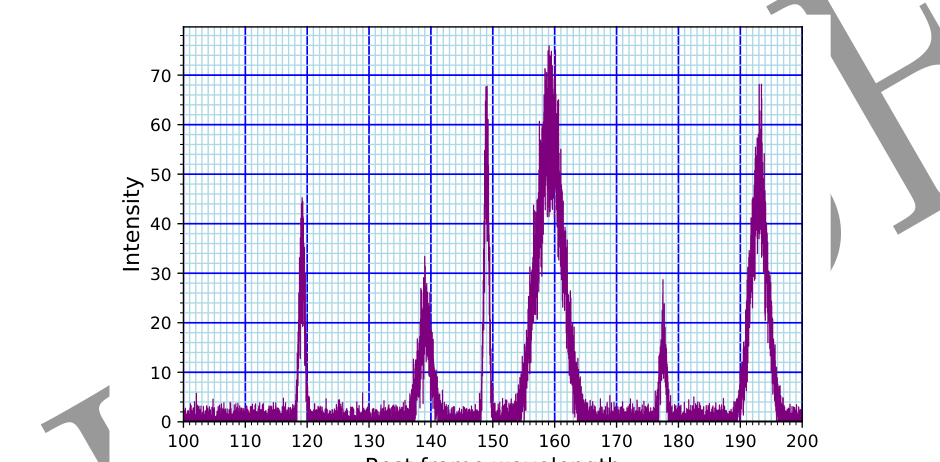
A complete table of emission peaks (in same arbitrary length unit as in the above figure) of various hypothetical elements is given below. It is assumed that the strength of all the peaks indicated in the table is sufficiently high to be observed in the spectrum shown above if the corresponding element is present in the source. Identify the elements present on the surface of .
| Element | Wavelength 1 | Wavelength 2 | Wavelength 3 |
|---|---|---|---|
| Fh | 193.44 | – | – |
| Dz | 149.18 | 159.73 | – |
| Ab | 111.71 | 122.87 | 177.94 |
| Hm | 132.67 | 139.56 | – |
| Cw | 119.55 | 139.32 | – |
| Xy | 148.90 | 159.69 | – |
Table 1: Emission lines
Topic: Astrophysics, Gravitation Metodi: Physical Modeling Competenze: Diagrammatic Reasoning Objects: Planet, Star, Satellite Fonte: Testo (PDF) — p.2 Soluzione: Soluzioni (PDF)
Rispondi a ciascuna delle seguenti sotto-questioni con una breve giustificazione
(a) [2] Fatima ha osservato un oggetto celeste, con gli occhi non aiutati, molto vicino all’orizzonte occidentale subito dopo il tramonto del 17 luglio 2023. Ha continuato ad osservare lo stesso oggetto allo stesso tempo ogni giorno fino al 4 settembre 2023. Ha fatto le seguenti osservazioni:
- La separazione dell’oggetto dal Sole aumenta a partire dal 17 luglio.
- La separazione dell’oggetto dal Sole diminuisce dopo l’11 agosto.
- Ha anche fatto un’osservazione che l’oggetto non è mai stato visto sopra di noi al tramonto di quell’anno.
Chiamate un oggetto, che non è una cometa, che si adatta a queste osservazioni fatte da Fatima.
(b) [2] Nell’immagine di seguito, si vede il Sole appena sopra l’orizzonte occidentale in un giorno visto dalla città di Ujjain. L’eclittica, l’equatore celeste e il punto ovest (W) sono segnati nell’immagine. Quale dei percorsi segnati (1 a 6) sull’immagine rappresenta in modo più stretto il percorso che il Sole seguirà per raggiungere l’orizzonte quel giorno.
Quesito 1
(c) [2] Tre osservatori A, B e C sono stati posizionati sulla Luna, Venere e Marte rispettivamente. Quale di questi osservatori può vedere quasi tutte le fasi della Terra [nuova (nessuna terra), mezzaluna, metà, gibbo, ecc].
(d) [4] Una certa stella è stata osservata per rimanere sempre al di sopra dell’orizzonte nel corso di un giorno intero. Durante questo periodo la sua altitudine massima era e l’altitudine minima era . Qual è/sono la latitudine/s del luogo di osservazione?
Nota: L’altitudine è la distanza angolare di una stella dall’orizzonte misurata lungo un arco circolare perpendicolare all’orizzonte.
(e) [2] In quale mese/s dell’anno, ci sarà una Luna Nuova nella costellazione di Leone?
- A) agosto
- B) novembre
- febbraio
- (D) maggio
(f) [4] Quale delle seguenti affermazioni non può essere dedotto dalle leggi del movimento di Kepler?
- (A) Un pianeta si muove in orbita ellittica attorno al Sole.
- (B) L’escentricità delle orbite di tutti i pianeti del sistema solare è piccola.
- (C) Un pianeta del sistema solare ha la sua velocità tangenziale più alta quando è più vicino al Sole.
- (D) Tutti i pianeti si muovono in orbite ellittiche nello stesso piano intorno al Sole.
g) [5] La presenza di elementi diversi in un oggetto astronomico distante è dedotta dai picchi dello spettro di emissioni del suo suolo, a determinate lunghezze d’onda, caratteristiche di ciascun elemento. Uno di questi spettri per una luna (chiamata ) attorno a un esoplaneta lontano osservato dalla missione ipotetica , che è atterrata sulla superficie di in futuro è mostrato qui sotto. Lo spettrometro è rumoroso, cioè piccole fluttuazioni casuali vengono sovrapposte al segnale effettivo. Le unità di entrambi gli assi nella figura seguente sono arbitrarie.
Quesito 1
La tabella completa dei picchi di emissione (in unità di lunghezza arbitraria come nella figura precedente) di vari elementi ipotetici è riportata di seguito. Si presume che la forza di tutti i picchi indicati nella tabella sia sufficientemente elevata da osservare nello spettro indicato sopra, se l’elemento corrispondente è presente nella fonte. Identificare gli elementi presenti sulla superficie di .
♬ Element Wavelength 1 ♬ Wavelength 2 ♬ Wavelength 3 ♬ | --- | --- | --- | --- | | Fh | 193.44 | – | – | | Dz | 149.18 | 159.73 | – | | Ab | 111.71 | 122.87 | 177.94 | | Hm | 132.67 | 139.56 | – | | Cw | 119.55 | 139.32 | – | | Xy | 148.90 | 159.69 | – |
Tabella 1: linee di emissioni
Topic: Astrophysics, Gravitation Metodi: Physical Modeling Competenze: Diagrammatic Reasoning Objects: Planet, Star, Satellite Fonte: Testo (PDF) — p.2 Soluzione: Soluzioni (PDF)
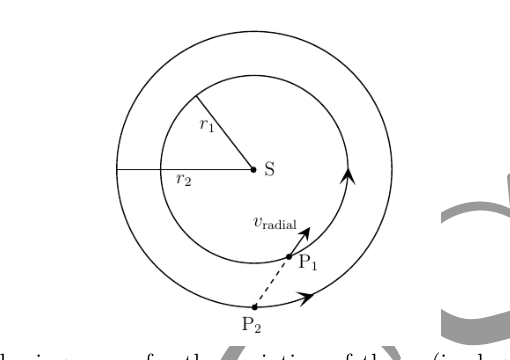
Consider a system of two planets P1 and P2, as shown below, both revolving in the same direction in circular coplanar orbits of radii and , respectively, around a star S of mass much larger than the masses of the planets. Anilesh is stranded on the outer planet P2. Both the star S and the planet P1 are seen to move against the stellar background by Anilesh due to the orbital motions of P1 and P2. Taking the direction of motion of S as positive, he measures the angular velocity of P1 against the stellar background. He also measures the velocity of P1 along the line of sight (called the “radial velocity”, in astronomy) as shown in the figure below.
Quesito 2
He obtained the following curve for the variation of the (in degrees/day, 1 day being 24 hours) versus (in km/s).
Quesito 2
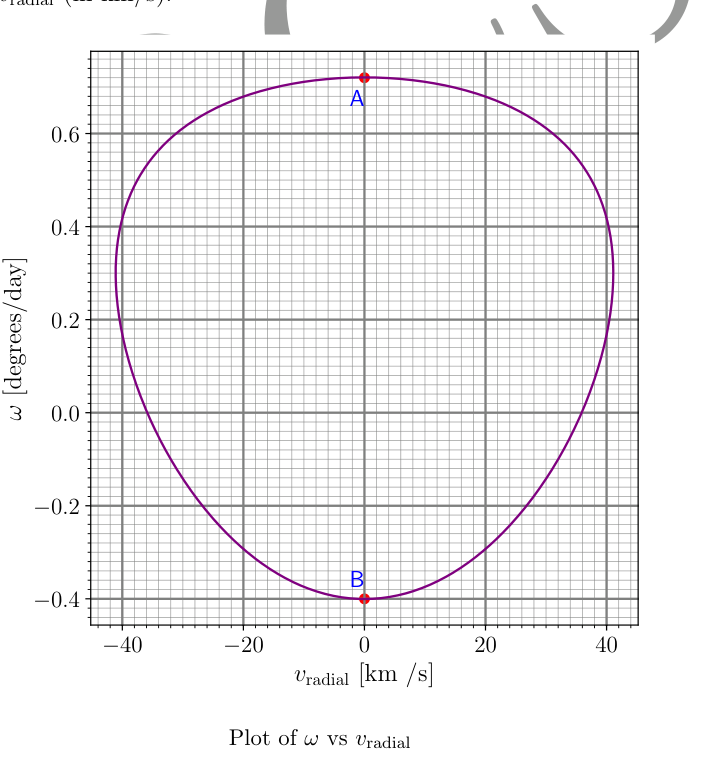
(a) [3] For the given position of P2 as marked in the following figure; show the positions of P1 corresponding to the points A and B on the graph above by marking appropriately on the orbit of P1 (dashed circle in the figure in your answersheet).
Quesito 2
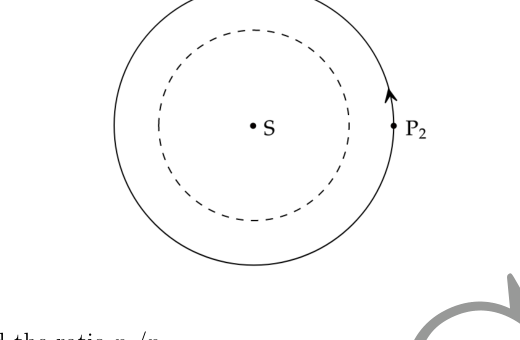
(b) [7] Find the ratio .
(c) [8] Write the expression for as a function of (see figure below). Calculate the value of for which is maximum.
Hint: You may find it useful to use the sine rule here.
Quesito 2
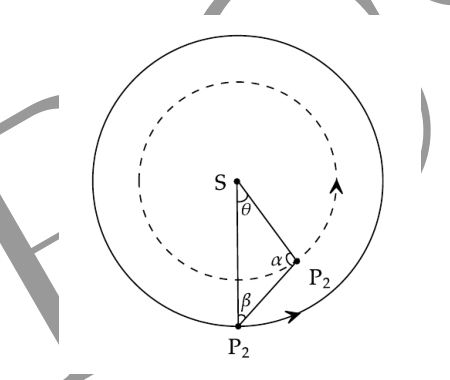
(d) [8] Determine , and .
Topic: Gravitation, Astrophysics Metodi: Kepler’s Laws, Newton’s Law of Gravitation Competenze: Mathematical Modeling Objects: Star, Planet Fonte: Testo (PDF) — p.4 Soluzione: Soluzioni (PDF)
Considera un sistema di due pianeti P1 e P2, come mostrato di seguito, entrambi ruotanti nella stessa direzione in orbite coplanari circolari di raggi e , rispettivamente, intorno a una stella S di massa molto più grande delle masse dei pianeti. Anilesh è bloccato sul pianeta esterno P2. Sia la stella S che il pianeta P1 sono visti muoversi contro lo sfondo stellare da Anilesh a causa dei movimenti orbiti di P1 e P2. Prendendo la direzione di movimento di S come positiva, misura la velocità angolare di P1 contro lo sfondo stellare. Misura anche la velocità di P1 lungo la linea di vista (chiamata “velocità radiale”, in astronomia) come mostrato nella figura di seguito.
Quesito 2
Ha ottenuto la seguente curva per la variazione del (in gradi/giorno, 1 giorno è 24 ore) contro (in km/s).
Quesito 2
(a) [3] Per la posizione data di P2 segnata nella figura seguente; indicare le posizioni di P1 corrispondenti ai punti A e B del grafico di cui sopra segnando in modo appropriato l’orbita di P1 (circolo a marcia nella figura della scheda delle risposte).
Quesito 2
b) [7] Trova il rapporto .
c) [8] Scrivere l’espressione per come funzione di (vedere figura seguente). Calcolare il valore di per il quale è massimo.
Suggerimento: Potresti trovare utile usare la regola del seno qui.
Quesito 2
(d) [8] Determina , e .
Topic: Gravitation, Astrophysics Metodi: Kepler’s Laws, Newton’s Law of Gravitation Competenze: Mathematical Modeling Objects: Star, Planet Fonte: Testo (PDF) — p.4 Soluzione: Soluzioni (PDF)
Consider two containers A and B both with the same amount of liquid of volume . Initially, A only has milk and B only has water. We transfer liquids back and forth between the two containers. One transfer is defined as completion of both the following steps:
- Step 1: Take some fixed volume from container A, put it in B and mix it well.
- Step 2: Take the same volume of the mixed fluid from container B and put it back in A and mix it well.
At the end of each transfer, both containers have liquids with exactly the same volume . Let denote the concentration of milk in container A at the end of the -th transfer. Here we define concentration as
Similarly, you may define , and .
(a) [4] Write down the expression for the concentration of milk in container A at the end of the first transfer. Express the concentration , after the first transfer, in terms of volumes and .
(b) [8] Let us define as, . Write down the recursion relation for , in terms of the concentration at the end of the th transfer i.e., and .
(c) [3] If one does fairly large number of transfers, then the concentration of milk in either of the container will reach almost equilibrium value which is a function of . What will be the value of this equilibrium concentration?
(d) [5] Define a new variable such that,
and simplify the recursion relation between and to express as a function of and .
Topic: Mathematics Metodi: Differential Equations, Physical Modeling Competenze: Mathematical Modeling Objects: Container Fonte: Testo (PDF) — p.5 Soluzione: Soluzioni (PDF)
Considerate due contenitori A e B entrambi con la stessa quantità di liquido di volume . Inizialmente, A ha solo latte e B ha solo acqua. Trasferiamo i liquidi avanti e indietro tra i due contenitori. Un trasferimento è definito come il completamento di entrambe le fasi seguenti:
- **Step 1: ** Prendi un volume fisso dal contenitore A, mettila in B e mescola bene.
- **Step 2: ** Prendi lo stesso volume del liquido misto dal contenitore B e riportilo nel contenitore A e mescolalo bene.
Al termine di ogni trasferimento, entrambi i contenitori hanno liquidi con esattamente lo stesso volume . indica la concentrazione di latte nel contenitore A al termine del trasferimento -th. Qui definiamo la concentrazione come
Allo stesso modo, è possibile definire , e .
a) [4] Scrivi l’espressione per la concentrazione del latte nel contenitore A alla fine del primo trasferimento. Esprimere la concentrazione , dopo il primo trasferimento, in termini di volumi e .
b) [8] Definiremo come, . Scrittore della relazione di ricorrenza per , in termini di concentrazione alla fine del trasferimento th, cioè e .
c) [3] Se si effettuano numerosi trasferimenti, la concentrazione di latte in uno dei contenitori raggiungerà quasi il valore di equilibrio, che è una funzione di . Qual è il valore di questa concentrazione di equilibrio?
(d) [5] Definire una nuova variabile in modo tale che:
e semplificare la relazione di ricorrenza tra e per esprimere come funzione di e .
Topic: Mathematics Metodi: Differential Equations, Physical Modeling Competenze: Mathematical Modeling Objects: Container Fonte: Testo (PDF) — p.5 Soluzione: Soluzioni (PDF)
The difference in magnitudes and of two celestial objects with flux (energy received from the object per unit area per unit time) and , respectively, is given by Pogson’s relation as
(a) [3] Calculate the total energy per unit time received at the primary mirror of diameter 6 inches (1 inch = 2.54 cm) of a telescope from the star Sirius (magnitude ). The flux of the star Vega, which has a magnitude , is equal to .
Consider a Newtonian reflecting telescope ((a) side, (b) top and (c) bottom views shown in the figure below) with a concave primary mirror of diameter 6 inches. A secondary mirror, mounted on a flat disc of diameter cm, is held in place on the axis of the telescope tube by three thin rods of thickness cm, as shown in the figure (b) below.
Quesito 4
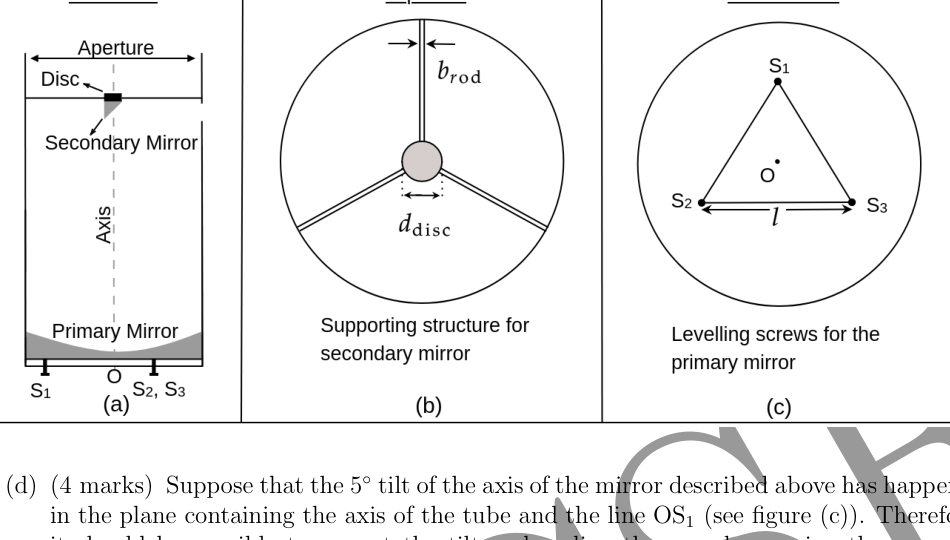
(b) [3] Calculate the percentage reduction in flux at the primary mirror due to the supporting structure of the secondary mirror.
The optic axis of the primary mirror and the axis of the telescope tube are expected to be coincident. But sometimes, they may get misaligned due to mishandling or some other issues.
(c) [3] Suppose that due to a misalignment, the angle between the two axes is . Calculate the percentage change in the flux received at the primary due to this fault. For this part ignore the effects of the secondary mirror and its supporting structure. Assume that the diameter of the primary mirror is very close to that of the telescope tube.
The alignment of the axis of the primary mirror is done by three levelling screws, , and at the bottom of the telescope. As seen in the bottom view (figure (c)), these screws form an equilateral triangle of side inches. The optic axis of the primary mirror is perpendicular to the plane of the paper in figure (c) and passes through the centroid O of this triangle.
(d) [4] Suppose that the tilt of the axis of the mirror described above has happened in the plane containing the axis of the tube and the line (see figure (c)). Therefore, it should be possible to correct the tilt and realign the axes by moving the screw alone, without disturbing or . If the pitch of the screw is 1.15 mm, how many turns of this screw are needed to bring the mirror back in alignment?
The maximum brightness of a source that can be observed with a telescope of a given aperture is limited by the tolerance of the human eye to bright light. The brightest object that can be observed safely with our telescope (primary mirror diameter of 6 inches) is of magnitude . To observe any source brighter than this limit the amount of light that reaches the primary mirror must be restricted by reducing the effective aperture of the telescope. This is accomplished by covering the top of the telescope with a lid that has a smaller hole (aperture) of appropriate size.
(e) [4] Calculate the size of this smaller circular aperture on the lid so that a supernova of magnitude can be safely observed. Once again, ignore the secondary mirror and its supporting structure.
Topic: Astrophysics, Geometric Optics Metodi: Photon Energy Relation, Physical Modeling Competenze: Physical Reasoning Objects: Mirror, Rod, Star Fonte: Testo (PDF) — p.6 Soluzione: Soluzioni (PDF)
La differenza nelle magnitudini e di due oggetti celesti con flusso (energia ricevuta dall’oggetto per unità di area per unità di tempo) e , rispettivamente, è data dalla relazione di Pogson come
(a) [3] Calcolare l’energia totale per unità di tempo ricevuta allo specchio primario di diametro 6 pollici (1 pollice = 2,54 cm) di un telescopio dalla stella Sirio (magnitude ). Il flusso della stella Vega, che ha una magnitudine , è uguale a .
Considera un telescopio riflettente newtoniano ((a) lato, (b) vista superiore e (c) visione inferiore mostrata nella figura di seguito) con uno specchio primario concavo di diametro di 6 pollici. Uno specchio secondario, montato su un disco piatto di diametro cm, è tenuto sullo spessore del tubo del telescopio da tre sottili bastone di spessore cm, come mostrato nella figura b) di seguito.
Quesito 4
b) [3] Calcolare la riduzione percentuale del flusso allo specchio primario a causa della struttura di supporto dello specchio secondario.
Si prevede che l’asse ottico dello specchio primario e l’asse del tubo del telescopio siano coincidenze. Ma a volte, possono essere disallineati a causa di un maltrattamento o di altri problemi.
c) [3] Supponiamo che a causa di un disallineamento, l’angolo tra i due assi sia . Calcolare la variazione percentuale del flusso ricevuto nella prima a causa di questo guasto. Per questo motivo, si ignorano gli effetti dello specchio secondario e della sua struttura di supporto. Supponiamo che il diametro dello specchio primario sia molto vicino a quello del tubo del telescopio.
L’allineamento dell’asse dello specchio primario è effettuato con tre viti di livellamento, , e , nella parte inferiore del telescopio. Come si vede nella vista inferiore (figura (c)), queste viti formano un triangolo equilaterale di pollici laterali . L’asse ottico dello specchio primario è perpendicolare al piano della carta nella figura (c) e passa attraverso il centroide O di questo triangolo.
d) [4] Supponiamo che l’inclinazione dell’asse dello specchio descritto sopra si sia verificata nel piano contenente l’asse del tubo e la linea (vedere figura c)). Pertanto, dovrebbe essere possibile correggere l’inclinazione e riallineare gli assi spostando la vite da sola, senza disturbare o . Se la viscosità è di 1,15 mm, quante volte di questa vite sono necessarie per riportare lo specchio in armonia?
La massima luminosità di una sorgente che può essere osservata con un telescopio di una data apertura è limitata dalla tolleranza dell’occhio umano alla luce brillante. L’oggetto più luminoso che si può osservare in modo sicuro con il nostro telescopio (il diametro dello specchio primario è di 6 pollici) è di magnitudo . Per osservare una fonte più luminosa di questo limite, la quantità di luce che raggiunge lo specchio primario deve essere limitata riducendo l’apertura effettiva del telescopio. Questo viene realizzato coprendo la parte superiore del telescopio con un coperchio che ha un buco (apertura) più piccolo della dimensione appropriata.
e) [4] Calcolare la dimensione di questa piccola apertura circolare sul coperchio in modo da poter osservare in modo sicuro una supernova di magnitudo . Ancora una volta, ignori lo specchio secondario e la sua struttura di supporto.
Topic: Astrophysics, Geometric Optics Metodi: Photon Energy Relation, Physical Modeling Competenze: Physical Reasoning Objects: Mirror, Rod, Star Fonte: Testo (PDF) — p.6 Soluzione: Soluzioni (PDF)
The image below shows a portion of the sky near the western horizon as observed from some place in the northern hemisphere. The horizon is shown as a green strip at the bottom of the image, and the letter ‘W’ marks the West cardinal point. The near-rectangular tilted grid on the sky is that of the RA and Dec coordinates. Each small rectangle corresponds to of RA and of declination. A star, designated by the letter ‘R’, with its celestial coordinates (RA: & Dec: ) is shown in the image. Same image is provided in your answersheet to mark/write your answers. Answer the following questions with the information given above.
Quesito 5
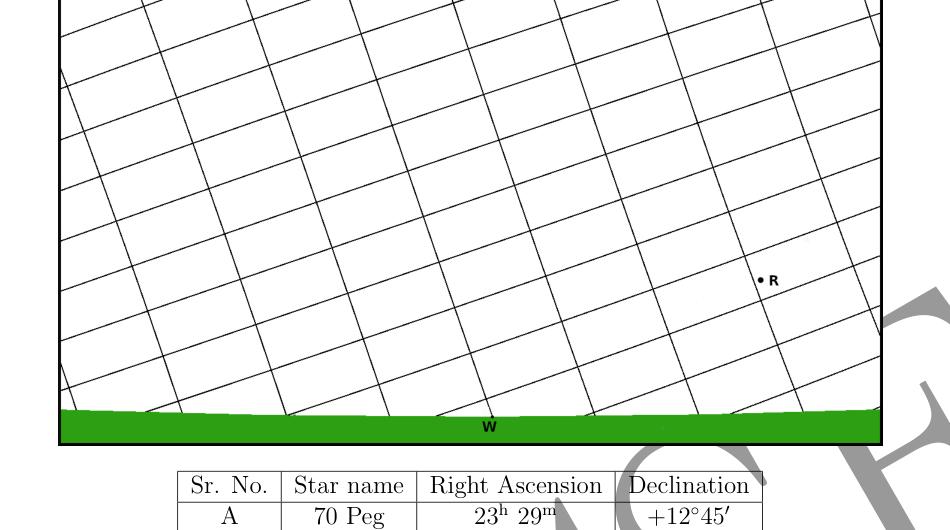
(a) [2] Identify and mark the Celestial Equator on the image provided in the answersheet.
(b) [3] Determine the approximate geographic latitude of the location.
(c) [4] The table below contains RA and Dec of four stars. Mark these stars on the image in your answersheet.
| Sr. No. | Star name | Right Ascension | Declination |
|---|---|---|---|
| A | 70 Peg | ||
| B | Psc | ||
| C | Cet | ||
| D | 71 Aqr |
(d) [2] Identify the star(s) from the table that will NOT be observable to an observer located at the South Pole. Give reason in support of your answers.
(e) [3] At the specified date and time, the coordinates of the (centre of the) Sun are RA: and Dec: . On the image in your answersheet, accurately draw a disc of appropriate size representing the Sun at these coordinates.
(f) [2] At the given location, if the star B in the table above sets at 18:01 hrs local time, determine the approximate local time at which another star, identified by coordinates RA: and Dec: , will set.
Topic: Astrophysics Metodi: Physical Modeling Competenze: Diagrammatic Reasoning Objects: Star Fonte: Testo (PDF) — p.7 Soluzione: Soluzioni (PDF)
L’immagine di seguito mostra una parte del cielo vicino all’orizzonte occidentale osservata da qualche parte nell’emisfero settentrionale. L’orizzonte è mostrato come una striscia verde in fondo all’immagine, e la lettera ‘W’ segna il punto cardinale occidentale. La griglia inclinata quasi rettangolare sul cielo è quella delle coordinate RA e Dec. Ogni piccolo rettangolo corrisponde a di RA e di declinazione. L’immagine mostra una stella, designata con la lettera “R”, con le sue coordinate celesti (RA: & Dec: ). La stessa immagine è fornita nella scheda delle risposte per contrassegnare/scrivere le risposte. Rispondere alle seguenti domande con le informazioni fornite sopra.
Quesito 5
(a) [2] Identificare e contrassegnare l’Equatore Celeste sull’immagine fornita nella scheda delle risposte.
b) [3] Determinare la latitudine geografica approssimativa della località.
(c) [4] La tabella seguente contiene RA e Dec di quattro stelle. Segna queste stelle sull’immagine nella scheda delle risposte.
| Sr. No. ♬ Nome della stella ♬ Ascensione giusta ♬ Declinazione ♬ | --- | --- | --- | --- | | A | 70 Peg | | | | B | Psc | | | | C | Cet | | | | D | 71 Aqr | | |
(d) [2] Identificare le stelle della tabella che NON saranno osservabili da un osservatore situato al Polo Sud. Fornite ragioni a sostegno delle vostre risposte.
e) [3] Alla data e all’ora specificate, le coordinate del (centro del) Sole sono RA: e Dec: . Sulla figura della scheda di risposta disegnate con precisione un disco di dimensioni appropriate che rappresenti il Sole a queste coordinate.
(f) [2] Al luogo specificato, se la stella B della tabella di cui sopra si posa alle 18:01 or. orario locale, determinare l’ora locale approssimativa alla quale si posa un’altra stella, identificata dalle coordinate RA: e Dec: .
Topic: Astrophysics Metodi: Physical Modeling Competenze: Diagrammatic Reasoning Objects: Star Fonte: Testo (PDF) — p.7 Soluzione: Soluzioni (PDF)