Consider a telescope with a primary (convex lens) with a diameter of 5 cm and a focal length of 60 cm, and a secondary (convex lens) with a focal length of 3 cm. This telescope is used to project a perfectly focused image of the Sun at a distance of 60 cm from the secondary. You are given that the diameter of the Sun subtends an angle of in the sky.
(a) What is the distance between the primary and secondary? [2]
(b) Draw a ray diagram marking all the optical elements, images and distances. [3]
(c) What is the size of the image? [3]
(d) What is the physical size of the smallest sunspot that can be resolved by this arrangement? [2]
Topic: Geometric Optics, Astrophysics Metodi: Thin Lens & Mirror Equation, Small-Angle Approximation Competenze: Diagrammatic Reasoning Objects: Lens, Star Fonte: Testo (PDF) — p.2 Soluzione: Soluzioni (PDF)
Considerate un telescopio con una lente primaria (convexa) di 5 cm di diametro e 60 cm di lunghezza focale e un secondario (lente convexa) di 3 cm di lunghezza focale. Questo telescopio viene utilizzato per proiettare un’immagine perfettamente focalizzata del Sole a una distanza di 60 cm dal secondario. Vi viene dato che il diametro del Sole sottende un angolo di nel cielo.
(a) Qual è la distanza tra il primario e il secondario? [2]
b) Disegnare un diagramma di raggi che segni tutti gli elementi ottici, le immagini e le distanze. [3]
c) Qual è la dimensione dell’immagine? [3]
(d) Qual è la dimensione fisica della più piccola macchia solare che può essere risolta con questa disposizione? [2]
Topic: Geometric Optics, Astrophysics Metodi: Thin Lens & Mirror Equation, Small-Angle Approximation Competenze: Diagrammatic Reasoning Objects: Lens, Star Fonte: Testo (PDF) — p.2 Soluzione: Soluzioni (PDF)
An isolated star outside the solar system normally moves with a certain constant velocity with respect to the Sun. However, if there is a planet in orbit around it, there will be an appropriate periodic change in its motion. This variation in motion can now be detected using sensitive measurements of the Doppler shift of spectral lines. However, only the line-of-sight component of the total velocity of the star can be detected using this method. This motion, combined with the time period of the orbital motion, can be used to estimate the mass of a planet orbiting a distant star.
Suppose that a star of mass has a planet of mass in a circular orbit. The separation between the objects is , and circular speed of the planet is .
(a) Assuming that , find an expression for in terms of observables (orbital time period , : the periodic variation in the radial velocity of the star, and mass of the star that can be estimated from other considerations). [3]
(b) We can determine the time period from the periodicity of variation of Doppler shift in the spectral lines and estimate from the spectral type of the star. A special case is where the planet is transiting in front of (i.e. partially eclipsing) the star as it orbits. In this case the inclination is known to be . This leads to the light curve of the type shown in Figure 1. Compute the orbital radius of the orbit of the planet around the star. State your approach and reasoning clearly. You are provided that days, and m/s. Compute the mass and the radius of the planet in the system for which the light curve has been given in Figure 1. [5]
Quesito 2
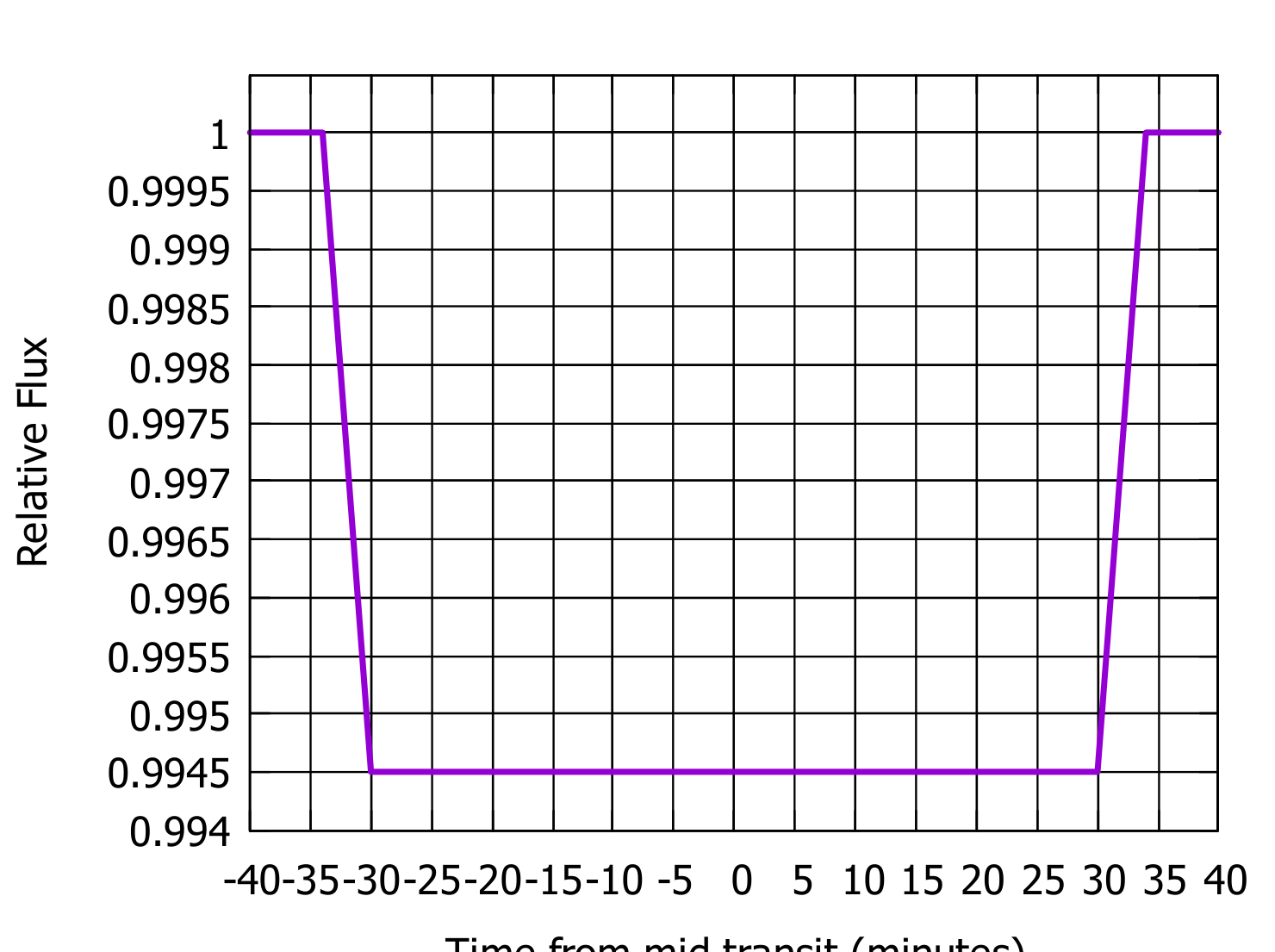
Figure 1: Light curve of the Planet.
(c) Albedo is defined as the reflectivity of a planet. Earth has an Albedo of 0.31, for instance. Assume the planet under consideration has a similar Albedo to that of the Earth. Determine the average surface temperature of the planet, and thus whether water can be found on it in the liquid state, an important condition for a planet to be habitable. The radius and the temperature of the star are and K respectively. [5]
(d) Planets with average density above can be classified as rocky while those below this density can be dubbed as gaseous planet. Find out if the planet is rocky or gaseous. [2]
Topic: Gravitation, Astrophysics Metodi: Kepler’s Laws, Conservation of Momentum Competenze: Mathematical Modeling Objects: Star, Planet Fonte: Testo (PDF) — p.2 Soluzione: Soluzioni (PDF)
Una stella isolata al di fuori del sistema solare si muove normalmente con una certa velocità costante rispetto al Sole. Tuttavia, se c’è un pianeta in orbita intorno a esso, ci sarà un adeguato cambiamento periodico nel suo movimento. Questa variazione del movimento può ora essere rilevata utilizzando misurazioni sensibili del spostamento doppler delle linee spettrali. Tuttavia, solo la componente lineare della velocità totale della stella può essere rilevata utilizzando questo metodo. Questo movimento, combinato con il periodo di tempo del movimento orbitale, può essere utilizzato per stimare la massa di un pianeta in orbita intorno a una stella lontana.
Supponiamo che una stella di massa abbia un pianeta di massa in orbita circolare. La separazione tra gli oggetti è , e la velocità circolare del pianeta è .
(a) Supponendo che , trovare un’espressione per in termini di osservabili (periodo orbitale , : la variazione periodica della velocità radial della stella e della massa della stella che può essere stimata da altre considerazioni). [3]
b) Possiamo determinare il periodo di tempo dalla periodicità di variazione del spostamento di Doppler nelle linee dello spettro e stimare dal tipo dello spettro della stella. Un caso speciale è quando il pianeta è in transito di fronte a (cioè (per la sua eclissione) In questo caso è nota l’inclinazione . Ciò porta alla curva di luce del tipo mostrato nella figura 1. Calcola il raggio orbitale dell’orbita del pianeta attorno alla stella. Esprimi chiaramente il tuo approccio e il tuo ragionamento. Vi è fornito che giorni, e m/s. Calcolare la massa e il raggio del pianeta nel sistema per il quale è stata data la curva di luce nella figura 1. [5]
Quesito 2
Figura 1: Curva della luce del pianeta.
c) Albedo è definito come la riflettività di un pianeta. La Terra ha un Albedo di 0,31, per esempio. Supponiamo che il pianeta in esame abbia un Albedo simile a quello della Terra. Determinare la temperatura media della superficie del pianeta e quindi se si può trovare acqua su di esso in stato liquido, una condizione importante per un pianeta abitabile. Il raggio e la temperatura della stella sono e K rispettivamente. [5]
(d) I pianeti con una densità media superiore a possono essere classificati come rocciosi mentre quelli al di sotto di questa densità possono essere soprannominati pianeti gassosi. Scopri se il pianeta è roccioso o gassoso. [2]
Topic: Gravitation, Astrophysics Metodi: Kepler’s Laws, Conservation of Momentum Competenze: Mathematical Modeling Objects: Star, Planet Fonte: Testo (PDF) — p.2 Soluzione: Soluzioni (PDF)
The flux of light reaching the earth from Venus varies due to (i) the distance of Venus from Sun, (ii) the distance of Venus from the observer on the Earth, (iii) the amount of illuminated surface visible to the observer and (iv) the reflective power of the Venus surface and its rotational speed (see Figure below).
(a) Set up the equation for flux of light reaching the Earth after reflection from Venus. Assume the Sun-Venus and the Sun-Earth orbit to be circular in the same plane with the radii and respectively; the radius of Venus to be , the Earth-Venus distance to be and the Earth-Venus-Sun angle to be . [5]
(b) Find the value of (in terms of and ) so that Venus has maximum flux at that distance. [5]
(c) Estimate the portion of the Venus disk that is illuminated at its maximum flux. Is it in Crescent or Gibbous phase? [2]
(d) The flux received from Venus varies by a factor of 3 between extremes during its entire synodic cycle. How do you explain this almost constant apparent flux in spite of large variation in distance and illumination? [3]
Quesito 3
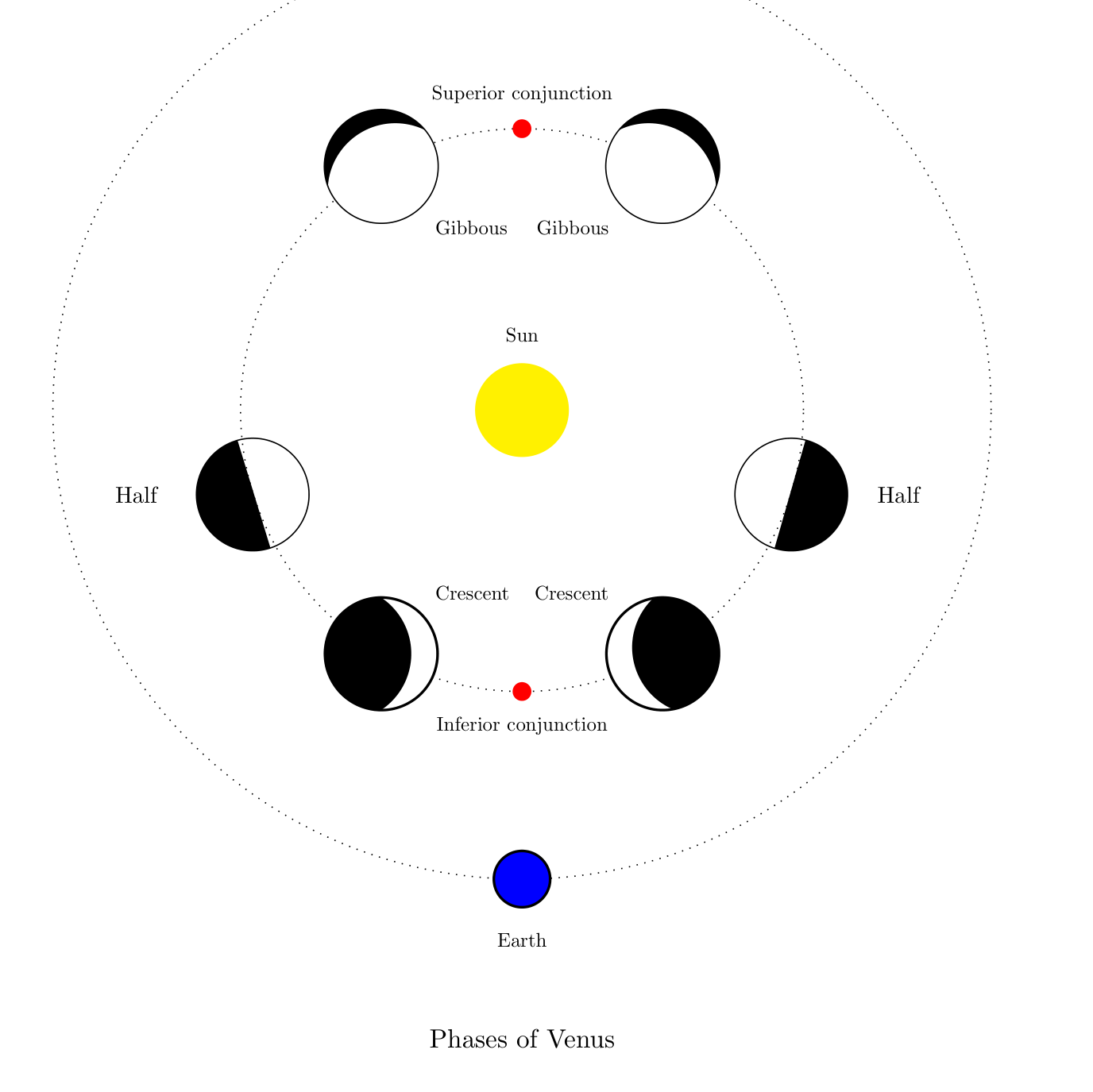
Phases of Venus (Figures not to scale)
Topic: Astrophysics Metodi: Physical Modeling, Calculus-Integration Competenze: Mathematical Modeling Objects: Planet, Star Fonte: Testo (PDF) — p.3 Soluzione: Soluzioni (PDF)
Il flusso di luce che raggiunge la Terra da Venere varia a causa (i) della distanza di Venere dal Sole, (ii) della distanza di Venere dall’osservatore sulla Terra, (iii) della quantità di superficie illuminata visibile all’osservatore e (iv) della potenza riflettiva della superficie di Venere e della sua velocità di rotazione (vedere figura seguente).
a) Estabbilire l’equazione per il flusso di luce che raggiunge la Terra dopo il riflesso da Venere. Supponiamo che l’orbita Sole-Venus e Sole-Terra siano circolari nello stesso piano con i raggi e rispettivamente; il raggio di Venere è , la distanza Terra-Venus è e l’angolo Terra-Vene-Sole . [5]
b) Trova il valore di (in termini di e ) in modo che Venere abbia il massimo flusso a tale distanza. [5]
(c) Estimare la parte del disco di Venere che è illuminata al suo flusso massimo. E’ in fase Crescente o Gibbous? [2]
(d) Il flusso ricevuto da Venere varia di un fattore di 3 tra gli estremi durante tutto il suo ciclo sinodale. Come si spiega questo flusso apparente quasi costante nonostante le grandi variazioni di distanza e illuminazione? [3]
Quesito 3
Fase di Venere (Figure non su scala)
Topic: Astrophysics Metodi: Physical Modeling, Calculus-Integration Competenze: Mathematical Modeling Objects: Planet, Star Fonte: Testo (PDF) — p.3 Soluzione: Soluzioni (PDF)
In a planetary system similar to ours (see Figure 2),
- A planet P has a moon M, and the P-M system orbits their star S.
- The orbit of M around P and that of the P-M system around S are circular, coplanar and in the same sense of rotation.
- The radius of P has been measured to be 6000 km.
- Laser ranging has determined the distance between P and M to be 400,000 km and that between S and the P-M system to be km respectively.
- The angular size of S viewed from the centre of mass of the P-M system and that of M viewed from P are and respectively.
- M completes one orbit around P in 30 Earth days and orbital period of P around S is 360 Earth days.
- Planet P spins around its axis once in 25 Earth hours. The spin of M is synchronised with its orbit around P. The sense of rotation of P and M and of their revolution in their respective orbits are the same.
Quesito 4
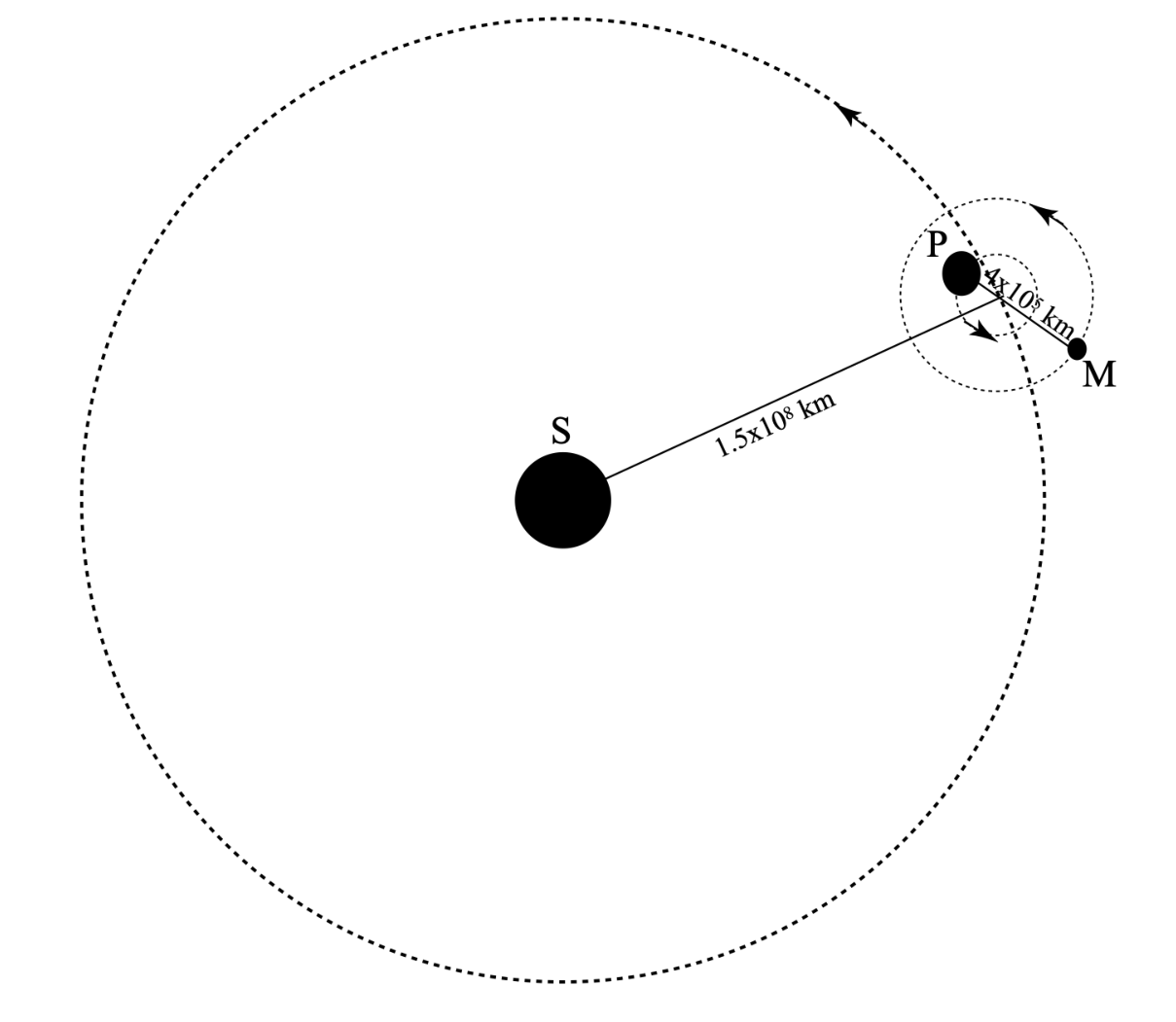
Figure 2: A schematic sketch of the Star S - Planet P - Moon M system
Given the above:
(a) Find the mass of S. [2]
(b) Assuming P and M are made of the same material, and their density is uniform, find the masses of P and M. [3]
(c) Are all the eclipses of S viewed from the equator of P Total? If so, what is the duration of totality? [3]
(d) Fossil records suggest that Earth years ago the spin rate of P was 22 Earth hours. Tidal interaction has caused angular momentum to be transferred from the spin of P to the P-M system. What was the orbital period of M around P, years ago? [3]
(e) If tidal angular momentum transfer continues at the same rate, when will the eclipses of S by M as viewed from the equator of P cease to be total? What will be the orbital period of M and spin period of P then? [4]
Topic: Gravitation, Astrophysics Metodi: Kepler’s Laws, Small-Angle Approximation Competenze: Mathematical Modeling Objects: Star, Planet, Satellite Fonte: Testo (PDF) — p.4 Soluzione: Soluzioni (PDF)
In un sistema planetario simile al nostro (vedere figura 2),
- Un pianeta P ha una luna M, e il sistema P-M orbita intorno alla sua stella S.
- L’orbita di M attorno a P e quella del sistema P-M attorno a S sono circolari, coplanari e nello stesso senso di rotazione.
- Il raggio di P è stato misurato a 6000 km.
- L’intervallo laser ha determinato che la distanza tra P e M è di 400.000 km e che tra S e il sistema P-M è di km rispettivamente.
- Le dimensioni angolari di S viste dal centro di massa del sistema P-M e di M viste da P sono rispettivamente e .
- M completa una orbita intorno a P in 30 giorni terrestri e il periodo orbitale di P intorno a S è di 360 giorni terrestri.
- Il pianeta P ruota attorno al suo asse una volta ogni 25 ore terrestri. Il spin di M è sincronizzato con la sua orbita attorno a P. Il senso di rotazione di P e M e della loro rivoluzione nelle rispettive orbite sono gli stessi.
Quesito 4
Figura 2: Sketch schematico del sistema Stella S - Pianeta P - Luna M
Dato quanto sopra:
(a) Trova la massa di S. [2]
b) Supponendo che P e M siano costituiti dallo stesso materiale e che la loro densità sia uniforme, si trovano le masse di P e M. [3]
(c) Tutte le eclissi di S sono viste dall’equatore di P Total? Se sì, quanto dura la totalità? [3]
(d) I registri fossili suggeriscono che anni fa la velocità di rotazione di P era di 22 ore terrestri. L’interazione delle maree ha causato il trasferimento del momento angolare dal spin di P al sistema P-M. Qual era il periodo orbitale di M intorno a P, anni fa? [3]
(e) Se il trasferimento di impulso angolare delle maree continua allo stesso ritmo, quando le eclissi di S per M, viste dall’equatore di P, cesseranno di essere totali? Qual sarà il periodo orbitale di M e il periodo di spin di P? [4]
Topic: Gravitation, Astrophysics Metodi: Kepler’s Laws, Small-Angle Approximation Competenze: Mathematical Modeling Objects: Star, Planet, Satellite Fonte: Testo (PDF) — p.4 Soluzione: Soluzioni (PDF)
The axes of the Hertzsprung–Russell (HR) diagram in Figure 3 represent two fundamental observable properties of stars: luminosity (the amount of energy radiated per unit time or how bright a star is) on the y-axis and surface temperature (how hot it is on the outside, which is the only part we can directly see) on the x-axis. Typically, the luminosity is expressed in units of the Solar luminosity ( W). The surface temperature of the Sun is approximately 5770 K. The most common form of the H–R diagram uses an unusual convention by representing the direction of increasing temperature values backwards compared to most graphs: temperature increases to the left and decreases to the right. Each square and pentagonal symbol in Figure 3 represents a star. The majority of stars lie on the main sequence (the cloud of points spread diagonally in the centre). You can assume that stars are in equilibrium for most of their lifetime. Note that the temperatures have been plotted on a logarithmic scale (base 10) while the logarithm (base 10) of the luminosity (in units of solar luminosities) have been used.
Quesito 5
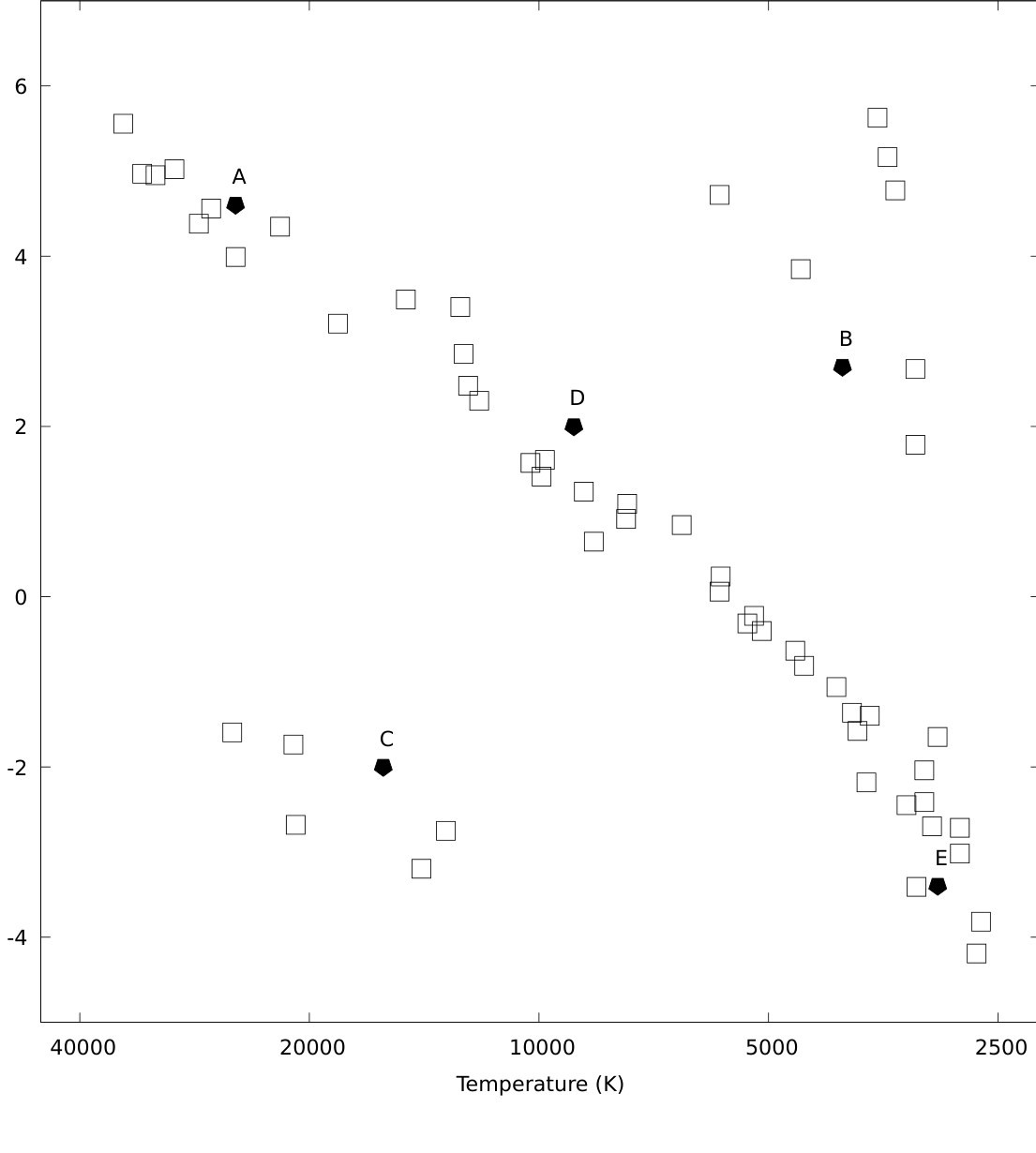
Figure 3: The HR diagram
Another property responsible for determining other characteristics of main-sequence stars is its mass . Stars with more mass have stronger gravity, and therefore achieve higher core temperatures. Since fusion occurs only in the core, higher core temperatures produce higher fusion reaction rates, and this leads to higher luminosity. The lifetime of a star is usually defined as the amount of time that star spends fusing hydrogen into helium in its core, which is the time the star spends on the main sequence. That time is determined by the amount of hydrogen fuel initially in the star’s core (which is proportional to its mass) and the rate at which the star uses that fuel. For main sequence stars .
(a) Order the radii (increasing order) of stars labeled A, B, C, D, E (in Figure 3 and Table 1) [5]
(b) For main sequence stars, A and E, find their lifetime relative to the lifetime of the Sun. [2]
Table 1: Properties of Stars
| Star Label | Temperature (K) | Luminosity () |
|---|---|---|
| A | 25000 | 40000 |
| B | 4000 | 500 |
| C | 16000 | 0.01 |
| D | 9000 | 100 |
| E | 3000 | 0.0004 |
Topic: Astrophysics Metodi: Physical Modeling Competenze: Graph Linearization Objects: Star Fonte: Testo (PDF) — p.5 Soluzione: Soluzioni (PDF)
Gli assi del diagramma di HertzsprungRussell (HR) nella Figura 3 rappresentano due proprietà osservabili fondamentali delle stelle: luminosità (la quantità di energia irradiata per unità di tempo o quanto è luminosa una stella) sull’asse y e temperatura superficiale (quante calore ha all’esterno, che è l’unica parte che possiamo vedere direttamente) sull’asse x. In genere, la luminosità è espressa in unità della luminosità solare ( W). La temperatura superficiale del Sole è di circa 5770 K. La forma più comune del diagramma HR utilizza una convenzione insolita rappresentando la direzione dell’aumento dei valori di temperatura verso l’indietro rispetto alla maggior parte dei grafici: la temperatura aumenta a sinistra e diminuisce a destra. Ogni simbolo quadrato e pentagonale nella Figura 3 rappresenta una stella. La maggior parte delle stelle si trova sulla sequenza principale (la nube di punti si estende diagonalmente al centro). Si può supporre che le stelle siano in equilibrio per la maggior parte della loro vita. Si noti che le temperature sono state tracciate su una scala logaritmica (base 10) mentre è stato utilizzato il logaritmo (base 10) della luminosità (in unità di luminosità solare).
Quesito 5
Figura 3: Il diagramma delle risorse umane
Un’altra proprietà responsabile della determinazione di altre caratteristiche delle stelle di sezione principale è la loro massa . Le stelle con più massa hanno una gravità più forte e conseguono quindi temperature del nucleo più elevate. Poiché la fusione avviene solo nel nucleo, le temperature più elevate del nucleo producono tassi di reazione a fusione più elevati, e questo porta a una maggiore luminosità. La durata di una stella è generalmente definita come la quantità di tempo che la stella trascorre fondendo idrogeno in elio nel suo nucleo, che è il tempo che la stella trascorre sulla sequenza principale. Tale tempo è determinato dalla quantità di combustibile idrogeno inizialmente nel nucleo della stella (che è proporzionale alla sua massa) e dalla velocità con cui la stella utilizza quel combustibile. Per le stelle della sequenza principale .
a) Ordinazione dei raggi (ordine crescente) delle stelle etichettate A, B, C, D, E (in figura 3 e tabella 1) [5]
b) Per le stelle di sezione principale, A e E, trovate la loro durata relativa alla durata del Sole. [2]
Tabella 1: Proprietà delle stelle
| Star Label | Temperature (K) | Luminosity () |
|---|---|---|
| A | 25000 | 40000 |
| B | 4000 | 500 |
| C | 16000 | 0.01 |
| D | 9000 | 100 |
| E | 3000 | 0.0004 |
Topic: Astrophysics Metodi: Physical Modeling Competenze: Graph Linearization Objects: Star Fonte: Testo (PDF) — p.5 Soluzione: Soluzioni (PDF)
Refer to the attached Figure 4. Three identical gas clouds are marked as A, B, and C. Each gas cloud emits EM radiation of luminosity at a spectral line having the rest-frame frequency . The gas clouds A, B, and C are in circular motion, in the counterclockwise direction, with identical speed , in three different co-centric circles with radius , , and respectively. A Telescope is situated at the point T in the circle having radius , also in circular motion with speed in the counterclockwise direction. The center of the circles is marked as O. At an instance, and the segment CTOB forms a straight line.
Quesito 6
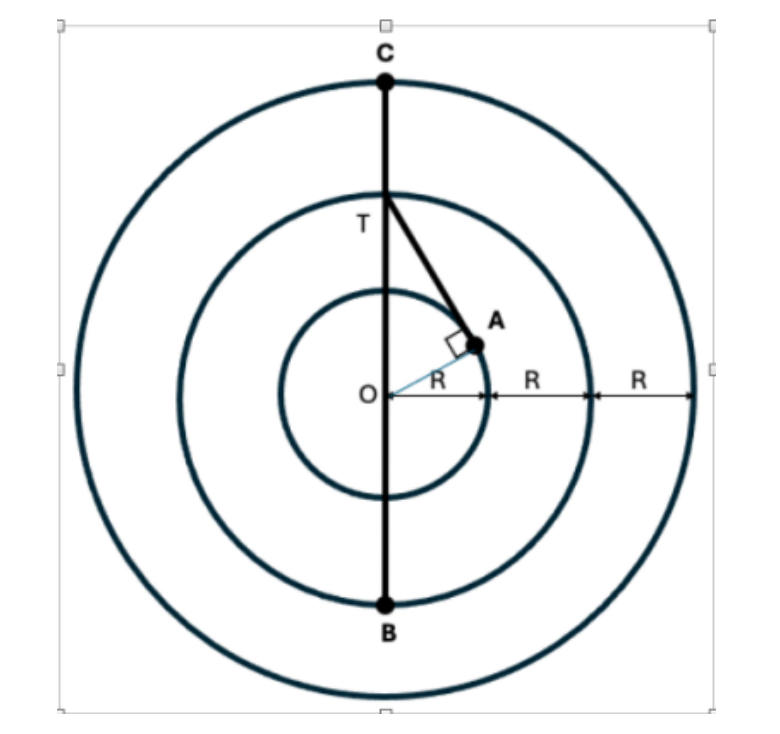
Figure 4: Locations of gas clouds
Answer the following:
-
Estimate the magnitude of line-of-sight velocity of the gas cloud A, as seen by the telescope T. [4]
-
Estimate the ratio of flux received at T from gas clouds A, B, and C. [2]
-
Which cloud(s) will show maximum Doppler frequency shift in the spectral line signal received at T. Explain your answer. [2]
Topic: Astrophysics Metodi: Vector Decomposition, Physical Modeling Competenze: Physical Reasoning Objects: Gas Fonte: Testo (PDF) — p.7 Soluzione: Soluzioni (PDF)
Si riferisce alla figura 4. Tre nuvole di gas identiche sono contrassegnate come A, B e C. Ogni nube di gas emette radiazioni EM di luminosità in una linea spettrale con la frequenza del fotogramma di riposo . Le nuvole di gas A, B e C sono in movimento circolare, in direzione contraria al senso orario, con velocità identica , in tre diversi cerchi cocentrici con raggio , e rispettivamente. Un telescopio è situato al punto T del cerchio con raggio , anche in movimento circolare con velocità nella direzione contraria al senso orario. Il centro dei cerchi è segnato come O. In un caso, e il segmento CTOB formano una linea retta.
Quesito 6
Figura 4: Localizzazione delle nuvole di gas
Rispondi alle seguenti domande:
-
Estima la grandezza della velocità di linea di visione della nube di gas A, vista dal telescopio T. [4]
-
Estimare il rapporto di flusso ricevuto a T dalle nuvole di gas A, B e C. [2]
-
Quali nuvole mostreranno il massimo spostamento di frequenza Doppler nel segnale della linea spettrale ricevuto a T. Spiega la tua risposta. [2]
Topic: Astrophysics Metodi: Vector Decomposition, Physical Modeling Competenze: Physical Reasoning Objects: Gas Fonte: Testo (PDF) — p.7 Soluzione: Soluzioni (PDF)
A spacecraft is in a circular orbit around the Sun with an orbital radius of 1 A.U. The spacecraft deploys a panel of area with the normal of the panel pointing towards the Sun. The panel is made of a perfectly reflecting material. What can be the maximum mass of the spacecraft (including that of the panel) such that the spacecraft escapes the solar system? [5]
Topic: Astrophysics, Gravitation Metodi: Conservation of Energy, Order-of-Magnitude Estimation Competenze: Mathematical Modeling Objects: Satellite, Star Fonte: Testo (PDF) — p.8 Soluzione: Soluzioni (PDF)
Una sonda spaziale è in orbita circolare attorno al Sole con un raggio orbitale di 1 AU. La sonda spaziale dispone di un pannello di superficie con la normalità del pannello che punta verso il Sole. Il pannello è fatto di materiale perfettamente riflettente. Qual è la massa massima della sonda spaziale (compresa quella del pannello) tale da far sfuggire la sonda al sistema solare? [5]
Topic: Astrophysics, Gravitation Metodi: Conservation of Energy, Order-of-Magnitude Estimation Competenze: Mathematical Modeling Objects: Satellite, Star Fonte: Testo (PDF) — p.8 Soluzione: Soluzioni (PDF)
Let us consider a distant point-like object, say a star, which is emitting radiation isotropically. The star is surrounded by numerous hydrogen clouds, uniformly distributed over a large radius . The radiation from the star after getting scattered from the gas clouds arrive as parallel rays to a distant observer who collects these with a lens, as depicted in Figure 5. Derive the expression for the locus of clouds that will result in a fixed time delay of (known as an isodelay surface) to echo the brightness change of the star? For simplicity, consider a cloud distribution in 2-dimensions with the star at . [5]
Quesito 8
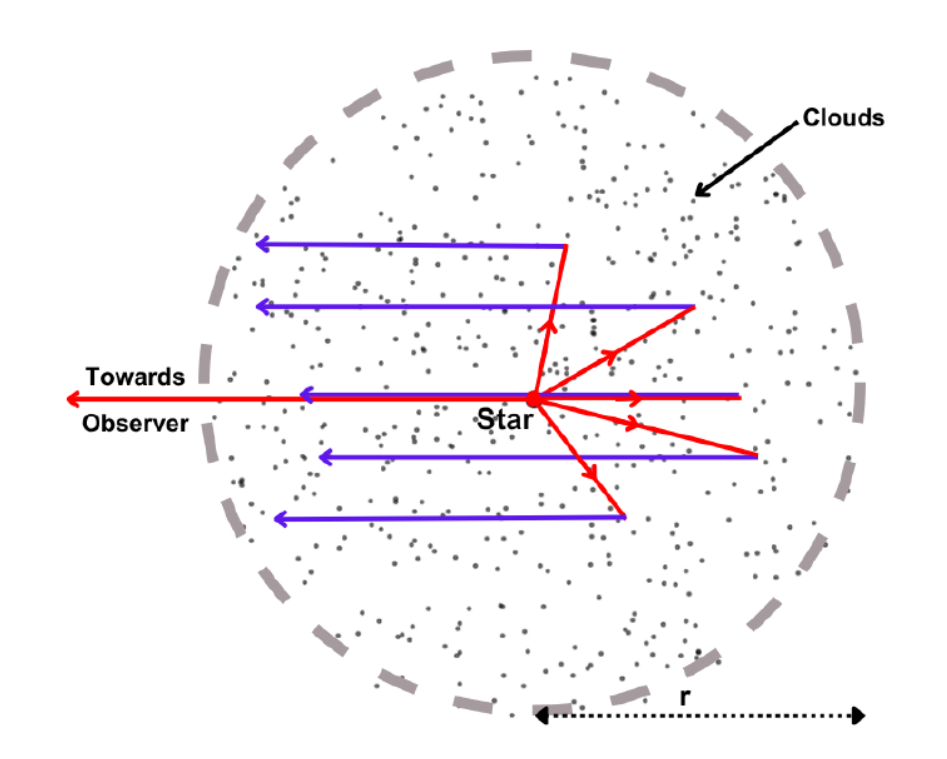
Figure 5: Star is in the centre and all the dots are the clouds absorbing radiation incident on them from the star and then emitted as line radiation towards a distant observer.
Topic: Astrophysics Metodi: Physical Modeling Competenze: Mathematical Modeling Objects: Star, Gas, Lens Fonte: Testo (PDF) — p.8 Soluzione: Soluzioni (PDF)
Consideriamo un oggetto lontano, come un punto, ad esempio una stella, che emette radiazioni isotropiche. La stella è circondata da numerose nuvole di idrogeno, uniformemente distribuite su un ampio raggio . La radiazione proveniente dalla stella dopo essere stata dispersa dalle nuvole di gas arriva come raggi paralleli ad un osservatore lontano che li raccoglie con una lente, come illustrato nella figura 5. Derivare l’espressione per il locus delle nuvole che si traduce in un ritardo di tempo fisso di (noto come superficie isodela) per far eco al cambiamento di luminosità della stella? Per semplicità, considera una distribuzione di nuvole in 2 dimensioni con la stella a . [5]
Quesito 8
Figura 5: La stella è al centro e tutti i punti sono le nuvole che assorbono il risorgimento delle radiazioni provenienti dalla stella e che vengono quindi emesse come radiazioni lineari verso un osservatore lontano.
Topic: Astrophysics Metodi: Physical Modeling Competenze: Mathematical Modeling Objects: Star, Gas, Lens Fonte: Testo (PDF) — p.8 Soluzione: Soluzioni (PDF)
On August 16, 2023, it was new Moon and on August 23, 2023, 6 PM IST (the Chandrayan-3 landing event) it was sixth day of the waxing moon. Nearly 30% of Moon was illuminated as illustrated below:
Quesito 9
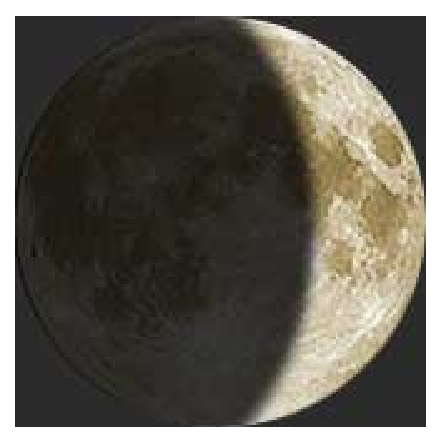
The orbital plane of Moon is tilted by about , with respect to the ecliptic plane, and it orbits in an elliptical orbit. However, assume that the path of Moon around the Earth is coplanar with ecliptic and the orbit is circular.
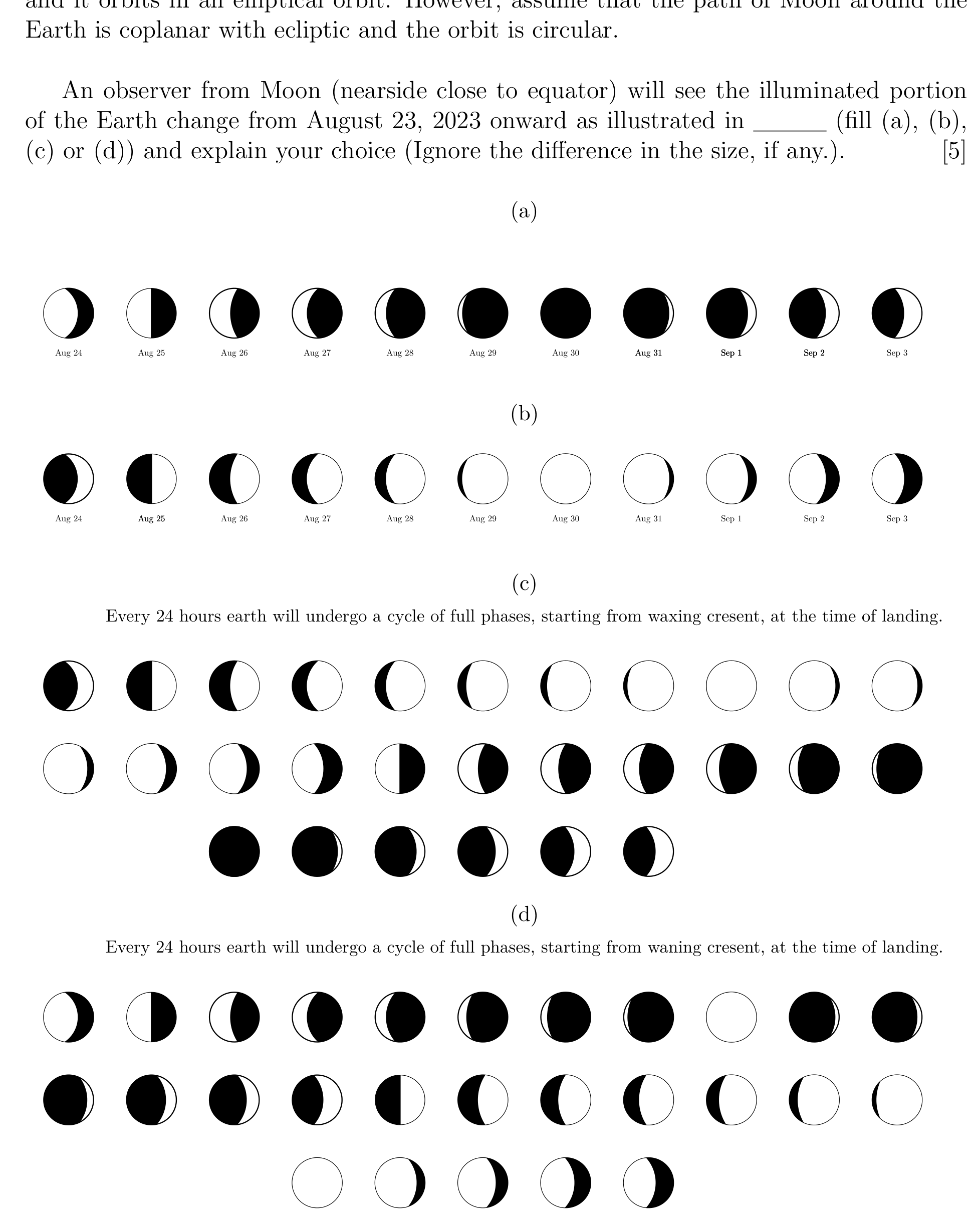
An observer from Moon (nearside close to equator) will see the illuminated portion of the Earth change from August 23, 2023 onward as illustrated in ______ (fill (a), (b), (c) or (d)) and explain your choice (Ignore the difference in the size, if any.). [5]
- (a) Aug 24 – Sep 3, daily phases as shown in the strip.
- (b) Aug 24 – Sep 3, daily phases as shown in the strip.
- (c) Every 24 hours earth will undergo a cycle of full phases, starting from waxing crescent, at the time of landing.
- (d) Every 24 hours earth will undergo a cycle of full phases, starting from waning crescent, at the time of landing.
Quesito 9
Topic: Astrophysics Metodi: Physical Modeling Competenze: Diagrammatic Reasoning Objects: Satellite, Planet Fonte: Testo (PDF) — p.8 Soluzione: Soluzioni (PDF)
Il 16 agosto 2023, era la Luna nuova e il 23 agosto 2023, alle 6 di sera IST (l’evento di atterraggio di Chandrayan-3), era il sesto giorno della luna crescente. Quasi il 30% della Luna era illuminata come illustrato di seguito:
Quesito 9
Il piano orbitale della Luna è inclinato di circa , rispetto al piano eclittico, e orbita in un’orbita ellittica. Tuttavia, supponiamo che il percorso della Luna intorno alla Terra sia coplanare con l’eclittica e l’orbita sia circolare.
Un osservatore dalla Luna (vicino all’equatore) vedrà la parte illuminata della Terra cambiare dal 23 agosto 2023 in poi come illustrato in ______ (compilare (a), (b), (c) o (d)) e spiegare la tua scelta (ignorare la differenza di dimensione, se del caso). [5]
- a) 24 agosto 3 settembre, fasi giornaliere come illustrato nella striscia.
- b) 24 agosto 3 settembre, fasi giornaliere come illustrato nella striscia.
- (c) Ogni 24 ore la Terra subirà un ciclo di fasi complete, a partire dalla crescente mezzaluna, al momento dell’atterraggio.
- (d) Ogni 24 ore la Terra subirà un ciclo di fasi complete, a partire dal crescente declinante, al momento dell’atterraggio.
Quesito 9
Topic: Astrophysics Metodi: Physical Modeling Competenze: Diagrammatic Reasoning Objects: Satellite, Planet Fonte: Testo (PDF) — p.8 Soluzione: Soluzioni (PDF)
Consider Earth as a sphere of radius 6400 km. At the time of equinox (i.e. center of the Sun’s disk is at declination 0.0 deg), an observer is standing exactly at North pole with a drone (a flying device) camera. The observer wishes to see the full disk of the Sun, which subtends an angle of 0.009 radian to the observer. At what minimum height, flying above the North pole, the drone camera can see the full disk of the Sun. Assume that the local horizon is clear without any geographical obstructions (land, trees, building etc.) to the horizon and sun-rays are parallel. Also ignore all light-ray bending effects such as atmospheric refraction etc. [5]
Topic: Astrophysics Metodi: Small-Angle Approximation, Physical Modeling Competenze: Mathematical Modeling Objects: Planet, Star Fonte: Testo (PDF) — p.9 Soluzione: Soluzioni (PDF)
Considera la Terra come una sfera di raggio di 6400 km. Al momento dell’equinozio (cioè il centro del disco solare è a declinazione di 0,0 gradi), un osservatore sta esattamente al polo nord con una telecamera aereo (un dispositivo volante). L’osservatore desidera vedere il disco completo del Sole, che sottende all’osservatore un angolo di 0,009 radiani. A quale altezza minima, volare sopra il polo nord, la telecamera del drone può vedere l’intero disco del Sole. Supponiamo che l’orizzonte locale sia chiaro senza alcun ostacolo geografico (terra, alberi, edifici, ecc.) e che i raggi solari siano paralleli. Inoltre, si ignorano tutti gli effetti di piegatura dei raggi luminosi come la rifrazione atmosferica, ecc. [5]
Topic: Astrophysics Metodi: Small-Angle Approximation, Physical Modeling Competenze: Mathematical Modeling Objects: Planet, Star Fonte: Testo (PDF) — p.9 Soluzione: Soluzioni (PDF)
A powerful luminous source is orbiting almost touching to the surface (at equator) of a spherical white dwarf in a circular orbit. The rotation orbit is perpendicular to the line joining star and us. Variation of light received from this source has a periodicity of 8 seconds. What is the density of white dwarf? [5]
Topic: Gravitation, Astrophysics Metodi: Newton’s Law of Gravitation, Kepler’s Laws Competenze: Mathematical Modeling Objects: Star, Satellite Fonte: Testo (PDF) — p.10 Soluzione: Soluzioni (PDF)
Una potente fonte luminosa sta orbitando quasi toccando la superficie (all’equatore) di una nana bianca sferica in orbita circolare. L’orbita di rotazione è perpendicolare alla linea che unisce stella e noi. La variazione della luce ricevuta da questa fonte ha una periodicità di 8 secondi. Qual è la densità della nana bianca? [5]
Topic: Gravitation, Astrophysics Metodi: Newton’s Law of Gravitation, Kepler’s Laws Competenze: Mathematical Modeling Objects: Star, Satellite Fonte: Testo (PDF) — p.10 Soluzione: Soluzioni (PDF)
A photon leaving the surface of non-spinning compact stars like white dwarf or Neutron star will face intense gravity, leading to a change in the wave energy associated with the photon (this phenomenon is generally called gravitational redshift). For gravity effect on photons, an effective mass can be assumed through the relation . Estimate the fractional change in the frequency of a photon leaving the surface of a white dwarf, Sirius B of mass and radius , when observed by a distant observer (assuming Newton’s gravity). [5]
Topic: Astrophysics, Gravitation Metodi: Conservation of Energy, Mass-Energy Equivalence Competenze: Mathematical Modeling Objects: Photon, Star Fonte: Testo (PDF) — p.10 Soluzione: Soluzioni (PDF)
Un fotone che lascia la superficie di stelle compatte non in rotazione come la nana bianca o la stella di neutroni affronterà una gravità intensa, portando a un cambiamento nell’energia d’onda associata al fotone (questo fenomeno è generalmente chiamato spostamento rossa gravitazionale). Per l’effetto gravitazionale sui fotoni, si può assumere una massa effettiva attraverso la relazione . Estimare il cambiamento frazionato nella frequenza di un fotone che lascia la superficie di una nana bianca, Sirius B di massa e raggio , quando osservato da un osservatore lontano (presumendo la gravità di Newton). [5]
Topic: Astrophysics, Gravitation Metodi: Conservation of Energy, Mass-Energy Equivalence Competenze: Mathematical Modeling Objects: Photon, Star Fonte: Testo (PDF) — p.10 Soluzione: Soluzioni (PDF)