Part A (10 Q × 3 marks each)
If and , then [3]
- (a)
- (b)
- (c)
- (d)
Topic: Mathematics Metodi: Approximation & Series Expansion Competenze: Mathematical Modeling Objects: — Fonte: Testo (PDF) — p.3
**Parte A (10 Q × 3 marchi ciascuno) **
Se e , allora [3]
- (a)
- (b)
- (c)
- (d)
Topic: Mathematics Metodi: Approximation & Series Expansion Competenze: Mathematical Modeling Objects: — Fonte: Testo (PDF) — p.3
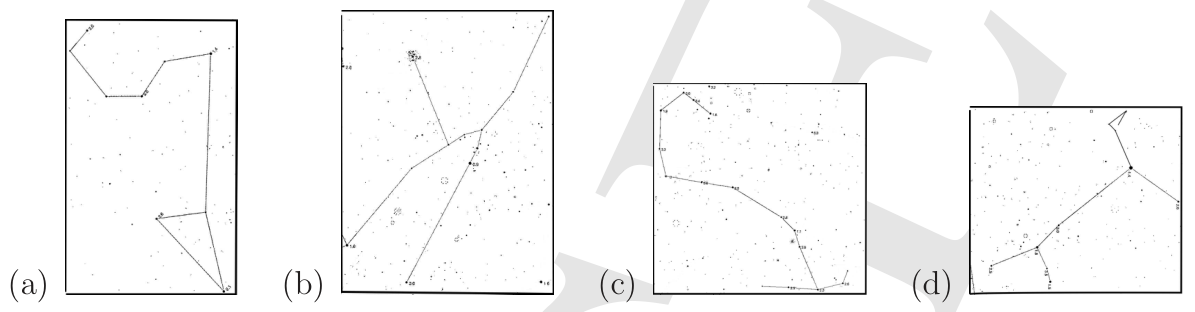
Each of the figures below depict a constellation. Find the odd one out. [3]
Quesito 2
- (a)
- (b)
- (c)
- (d)
Topic: Astrophysics Metodi: Physical Modeling Competenze: Diagrammatic Reasoning Objects: — Fonte: Testo (PDF) — p.3
Ciascuna delle figure di seguito raffigura una costellazione. Trova la strana. [3]
Quesito 2
- (a)
- (b)
- (c)
- (d)
Topic: Astrophysics Metodi: Physical Modeling Competenze: Diagrammatic Reasoning Objects: — Fonte: Testo (PDF) — p.3
Gravitational force between two identical uniform solid gold spheres of radius each in contact is proportional to [3]
- (a)
- (b)
- (c)
- (d)
Topic: Gravitation Metodi: Newton’s Law of Gravitation Competenze: Physical Reasoning Objects: Sphere Fonte: Testo (PDF) — p.3
La forza gravitazionale tra due sfere di oro solido uniformi identiche di raggio che entrano in contatto è proporzionale a [3]
- (a)
- (b)
- (c)
- (d)
Topic: Gravitation Metodi: Newton’s Law of Gravitation Competenze: Physical Reasoning Objects: Sphere Fonte: Testo (PDF) — p.3
A copper cube and a wooden cube of volume each are initially at room temperature. They are then moved to an enclosure of ambient temperature . What can we conclude about the temperatures attained by both cubes after 5 hours? [3]
- (a) as thermal conductivity of copper is greater than that of wood.
- (b) as specific heat capacity of wood is greater than that of copper.
- (c) The temperatures will depend on the interplay between specific heat capacity and thermal conductivity of the materials.
- (d) Both temperatures will be practically the same, as they are in the enclosure for 5 hours.
Topic: Thermodynamics Metodi: Physical Modeling Competenze: Physical Reasoning Objects: — Fonte: Testo (PDF) — p.3
Un cubo di rame e un cubo di legno di volume sono inizialmente a temperatura ambiente. Sono quindi spostati in un recinto a temperatura ambiente . Cosa possiamo concludere sulle temperature raggiunte da entrambi i cubetti dopo 5 ore? [3]
- a) in quanto la conducibilità termica del rame è superiore a quella del legno.
- b) in quanto la capacità calda specifica del legno è superiore a quella del rame.
- c) Le temperature dipenderanno dall’interazione tra la capacità termica specifica e la conducibilità termica dei materiali.
- (d) Entrambe le temperature saranno praticamente le stesse, poiché saranno nel recinto per 5 ore.
Topic: Thermodynamics Metodi: Physical Modeling Competenze: Physical Reasoning Objects: — Fonte: Testo (PDF) — p.3
If the product of all the numbers from 1 to 100 is divisible by , then what is the maximum possible value for ? [3]
- (a) 128
- (b) 97
- (c) 64
- (d) 87
Topic: Mathematics Metodi: Physical Modeling Competenze: Mathematical Modeling Objects: — Fonte: Testo (PDF) — p.3
Se il prodotto di tutti i numeri da 1 a 100 è divisibile da , qual è il valore massimo possibile per ? [3]
- (a) 128
- (b) 97
- (c) 64
- (d) 87
Topic: Mathematics Metodi: Physical Modeling Competenze: Mathematical Modeling Objects: — Fonte: Testo (PDF) — p.3
Two vectors and are acting at a point such that their resultant is perpendicular to . If is the angle between and then is given by, [3]
- (a)
- (b)
- (c)
- (d)
Topic: Newtonian Mechanics Metodi: Vector Decomposition Competenze: Physical Reasoning Objects: — Fonte: Testo (PDF) — p.3
Due vettori e agiscono in un punto tale che il loro risultante sia perpendicolare a . Se è l’angolo tra e , allora è dato da: [3]
- (a)
- (b)
- (c)
- (d)
Topic: Newtonian Mechanics Metodi: Vector Decomposition Competenze: Physical Reasoning Objects: — Fonte: Testo (PDF) — p.3
What will be the approximate period of Chandrayaan moving in an orbit 100 km above the moon’s surface? [3]
- (a) 57 min
- (b) 30 min
- (c) 118 min
- (d) 79 min
Topic: Gravitation Metodi: Kepler’s Laws, Newton’s Law of Gravitation Competenze: Physical Reasoning Objects: Satellite, Planet Fonte: Testo (PDF) — p.3
Qual sarà il periodo approssimativo di Chandrayaan in orbita a 100 km sopra la superficie lunare? [3]
- a) 57 minuti
- b) 30 minuti
- c) 118 minuti
- d) 79 minuti
Topic: Gravitation Metodi: Kepler’s Laws, Newton’s Law of Gravitation Competenze: Physical Reasoning Objects: Satellite, Planet Fonte: Testo (PDF) — p.3
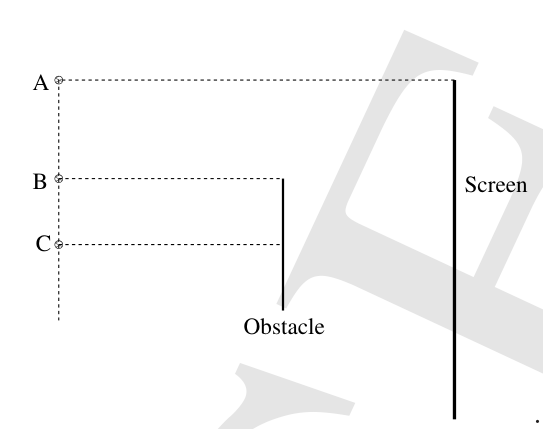
In the following figure, A, B, C are three light source positions with respect to the obstacle and the screen. Which of these light source positions will result in the longest shadow of the obstacle on the screen? [3]
Quesito 8
- (a) A
- (b) C
- (c) A and C form shadows of same length, while B forms a smaller shadow.
- (d) All the three light sources will form shadows of same length.
Topic: Geometric Optics Metodi: Ray Tracing Competenze: Diagrammatic Reasoning Objects: Screen Fonte: Testo (PDF) — p.4
Nella figura seguente, A, B e C sono tre posizioni della fonte luminosa rispetto all’ostacolo e allo schermo. Quale di queste posizioni della fonte luminosa causerà l’ombra più lunga dell’ostacolo sullo schermo? [3]
Quesito 8
- (a) A
- (b) C
- (c) A e C formano ombre di stessa lunghezza, mentre B formano un’ombra più piccola.
- (d) Tutte le tre fonti di luce formeranno ombre di uguale lunghezza.
Topic: Geometric Optics Metodi: Ray Tracing Competenze: Diagrammatic Reasoning Objects: Screen Fonte: Testo (PDF) — p.4
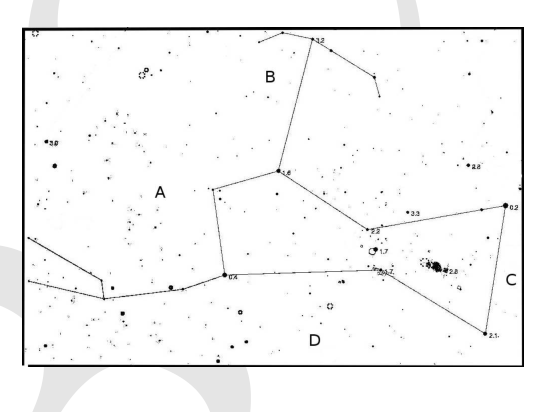
The following figure shows skeleton chart of the Orion constellation. Approximate “North” is indicated by the letter … [3]
Quesito 9
- (a) A
- (b) B
- (c) C
- (d) D
Topic: Astrophysics Metodi: Physical Modeling Competenze: Diagrammatic Reasoning Objects: Star Fonte: Testo (PDF) — p.4
La figura seguente mostra la grafica scheletrica della costellazione di Orione. La “Nord” approssimativa è indicata dalla lettera … [3]
Quesito 9
- (a) A
- (b) B
- (c) C
- (d) D
Topic: Astrophysics Metodi: Physical Modeling Competenze: Diagrammatic Reasoning Objects: Star Fonte: Testo (PDF) — p.4
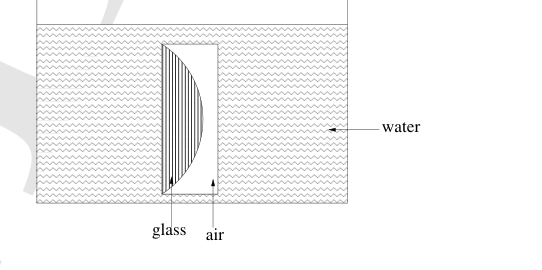
Find the resultant focal length for following system where the radius of curvature is 15 cm. [3]
Quesito 10
- (a) 40 cm
- (b) 60 cm
- (c) 120 cm
- (d)
Topic: Geometric Optics Metodi: Thin Lens & Mirror Equation Competenze: Physical Reasoning Objects: Lens Fonte: Testo (PDF) — p.4
Trova la distanza focale risultante per il sistema di seguimento in cui il raggio di curvatura è di 15 cm. [3]
Quesito 10
- (a) 40 cm
- (b) 60 cm
- (c) 120 cm
- (d)
Topic: Geometric Optics Metodi: Thin Lens & Mirror Equation Competenze: Physical Reasoning Objects: Lens Fonte: Testo (PDF) — p.4
Section B (4 Q × 5 marks each; any number of alternatives may be correct)
Which of the following observations support the statement that “Every system tends to adjust by itself to have minimum Potential Energy”. [5]
- (a) Andromeda galaxy and Milky Way are approaching each other.
- (b) Two unlike, free charges move towards each other.
- (c) External work is required to compress a spring.
- (d) A powerful magnet can deflect a compass needle from equilibrium position.
Topic: Conservation of Energy Metodi: Conservation of Energy Competenze: Physical Reasoning Objects: Spring, Magnet, Point Charge Fonte: Testo (PDF) — p.5
**Sezione B (4 Q × 5 marchi ciascuno; qualsiasi numero di alternative può essere corretto) **
Quali delle seguenti osservazioni corrispondono alla affermazione che “Ogni sistema tende ad adattarsi da solo per avere un minimo di energia potenziale”. [5]
- (a) La galassia di Andromeda e la Via Lattea si stanno avvicinando.
- b) Due cariche gratuite, diverse, si spostano l’una verso l’altra.
- c) Per comprimere una molla è necessario un lavoro esterno.
- (d) Un potente magnete può deviare un ago da un equilibrio.
Topic: Conservation of Energy Metodi: Conservation of Energy Competenze: Physical Reasoning Objects: Spring, Magnet, Point Charge Fonte: Testo (PDF) — p.5
Consider a sealed cylinder with frictionless, free-moving piston of fixed mass attached on the top, kept in an environment of constant atmospheric pressure. The ideal gas in the cylinder is slowly heated and it expands. Which of the following is / are true? [5]
- (a) The density of the gas will increase.
- (b) The pressure of the gas will decrease.
- (c) The internal energy of the system will remain the same.
- (d) In this process work is done by the gas.
Topic: Thermodynamics Metodi: First Law of Thermodynamics, Ideal Gas Law Competenze: Physical Reasoning Objects: Gas, Cylinder, Piston Fonte: Testo (PDF) — p.5
Considera un cilindro sigillato con pistone di massa fissa, senza attrito, in movimento libero, attaccato in cima, mantenuto in un ambiente di pressione atmosferica costante. Il gas ideale nel cilindro viene scaldato lentamente e si espandono. Quale delle seguenti è / sono vere? [5]
- (a) La densità del gas aumenterà.
- (b) La pressione del gas diminuirà.
- (c) L’energia interna del sistema rimarrà la stessa.
- (d) In questo processo il lavoro è svolto dal gas.
Topic: Thermodynamics Metodi: First Law of Thermodynamics, Ideal Gas Law Competenze: Physical Reasoning Objects: Gas, Cylinder, Piston Fonte: Testo (PDF) — p.5
In one of the truly revolutionary finds of the 20th century, Howard Carter discovered the tomb of the Egyptian Pharaoh (emperor) Tutankhamen in 1922. Following items were removed from the tomb, along with the mummy of the Pharaoh. Which of these items could have been carbon dated to fix the period of the Pharaoh? [5]
- (a) Fragments of glass
- (b) Golden Bracelets
- (c) Dried Fruits
- (d) Leather Shoe
Topic: Nuclear & Particle Physics Metodi: Radioactive Decay Law Competenze: Physical Reasoning Objects: — Fonte: Testo (PDF) — p.5
In uno dei ritrovamenti veramente rivoluzionari del XX secolo, Howard Carter scoprì la tomba del faraone egiziano (imperatore) Tutankhamen nel 1922. I seguenti oggetti furono rimossi dalla tomba, insieme alla mummia del faraone. Quale di questi elementi potrebbe essere stato datato al carbonio per fissare il periodo del faraone? [5]
- a) Fragmenti di vetro
- b) Braccialetti d’oro
- (c) Frutta secca
- (d) Scarpe di pelle
Topic: Nuclear & Particle Physics Metodi: Radioactive Decay Law Competenze: Physical Reasoning Objects: — Fonte: Testo (PDF) — p.5
Which of the following phenomena is / are useful, in estimating distances in the Universe? [5]
- (a) Some time Venus can be seen transiting over the solar disc.
- (b) Stars with no proper motion appear to change their position in the sky when viewed six months apart.
- (c) Stars exhibit Doppler shift.
- (d) All supernovae of Type Ia have same absolute brightness.
Topic: Astrophysics Metodi: Physical Modeling Competenze: Physical Reasoning Objects: Star, Planet Fonte: Testo (PDF) — p.5
Quale dei seguenti fenomeni è / sono utili, per stimare le distanze nell’Universo? [5]
- (a) A volte si può vedere Venere transitare sul disco solare.
- (b) Le stelle senza movimento corretto sembrano cambiare posizione nel cielo quando sono viste a sei mesi di distanza.
- (c) Le stelle mostrano il turno di Doppler.
- (d) Tutte le supernovai di tipo Ia hanno la stessa luminosità assoluta.
Topic: Astrophysics Metodi: Physical Modeling Competenze: Physical Reasoning Objects: Star, Planet Fonte: Testo (PDF) — p.5
Section C: Analytical Questions
(α) What will be area of the largest cyclic quadrilateral that can be inscribed in a given circle? Justify your answer qualitatively (formal proof not necessary). [8]
Topic: Mathematics Metodi: Physical Modeling Competenze: Mathematical Modeling Objects: — Fonte: Testo (PDF) — p.5
Sezione C: Domande analitiche
**α) ** Qual sarà l’area del più grande quadrilatero ciclico che può essere inserito in un dato cerchio? giustificare qualitativamente la risposta (non necessaria prova formale). [8]
Topic: Mathematics Metodi: Physical Modeling Competenze: Mathematical Modeling Objects: — Fonte: Testo (PDF) — p.5
(β) Jayshree claimed that she saw a solar eclipse when the size of the solar disk was and that of the lunar disk was . She also claimed that at the time of the maximum eclipse, distance between the centres of the two disks was . Qualitatively show that she could not have observed a total eclipse. Find the percentage of the solar disk covered at the time of the maximum eclipse. (Given: rad). [12]
Topic: Astrophysics, Geometric Optics Metodi: Small-Angle Approximation Competenze: Estimation & Approximation Objects: Star Fonte: Testo (PDF) — p.5
Jayshree ha affermato di aver visto un’eclissi solare quando la dimensione del disco solare era e quella del disco lunare era . Ha anche affermato che al momento dell’eclissi massimo, la distanza tra i centri dei due dischi era . In termini qualitativi, dimostrano che non avrebbe potuto osservare un’eclissi totale. Trova la percentuale del disco solare coperto al momento dell’eclissi massimo. (Dato: rad). [12]
Topic: Astrophysics, Geometric Optics Metodi: Small-Angle Approximation Competenze: Estimation & Approximation Objects: Star Fonte: Testo (PDF) — p.5
(γ) The famous Indian astronomer, Aryabhata, expressed the value of in what we now know as continuing fractions, i.e.
where , , , are positive integers. Find , , , . [8]
Topic: Mathematics Metodi: Approximation & Series Expansion Competenze: Mathematical Modeling Objects: — Fonte: Testo (PDF) — p.6
Il famoso astronomo indiano, Aryabhata, espresse il valore di in quello che oggi conosciamo come frazioni continue, cioè
dove , , , sono integri positivi. Trova , , , . [8]
Topic: Mathematics Metodi: Approximation & Series Expansion Competenze: Mathematical Modeling Objects: — Fonte: Testo (PDF) — p.6
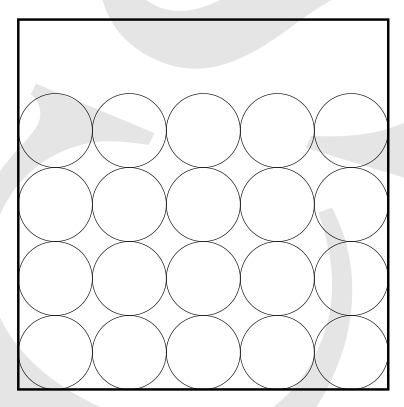
(δ) Kedar sent a container of marbles by road from Mumbai to Parag in Pune. The container was in size, with height being the larger dimension. Marbles of 2 cm diameter were arranged to fill the entire base and then additional layers of marbles were arranged with each upper marble exactly on top of corresponding marble in the previous layer (see figure). The marbles were thus placed upto 2 m height to complete the cubical structure. However, on reaching Pune, when Parag opened the container, he found the height of structure was not 2 m as promised by Kedar, but something else. Kedar defended saying that marbles may have readjusted due to jiggling. Can you find new height of this marble pile? [10]
Quesito 18
Topic: Mathematics Metodi: Physical Modeling Competenze: Mathematical Modeling Objects: Container, Sphere Fonte: Testo (PDF) — p.6
Kedar ha inviato un contenitore di marmi da Mumbai a Parag a Pune. Il contenitore era di dimensioni , con l’altezza come dimensione più grande. I marmi di diametro di 2 cm sono stati disposti per riempire l’intera base e poi ulteriori strati di marmi sono stati disposti con ogni marmo superiore esattamente sopra il marmo corrispondente nel livello precedente (vedi figura). I marmi sono stati quindi posizionati fino a 2 m di altezza per completare la struttura cubica. Tuttavia, arrivando a Pune, quando Parag aprì il contenitore, scoprì che l’altezza della struttura non era di 2 metri come promesso da Kedar, ma qualcosa di diverso. Kedar ha difeso dicendo che i marmi potrebbero essere riadattati a causa del jiggling. Riesci a trovare un’altezza nuova di questa pila di marmo? [10]
Quesito 18
Topic: Mathematics Metodi: Physical Modeling Competenze: Mathematical Modeling Objects: Container, Sphere Fonte: Testo (PDF) — p.6
(ε) Chiraag performed an experiment using a simple pendulum to find value of . He measured time taken for 30 oscillations of the pendulum for various values of length (repeated thrice for each value of length), following readings were obtained.
| L | (Sec) | (Sec) | (Sec) |
|---|---|---|---|
| cm | |||
| 20.0 | 26.9 | 26.9 | 27.0 |
| 25.0 | 30.1 | 30.1 | 30.1 |
| 30.0 | 32.9 | 32.8 | 32.7 |
| 35.0 | 35.6 | 35.8 | 35.7 |
| 40.0 | 38.0 | 38.1 | 38.1 |
| 45.0 | 40.4 | 40.4 | 40.5 |
Mass of the bob of the pendulum was known to be 50 gm.
(a) Plot appropriate graph to represent the data. [9]
(b) Find the value of . [2]
(c) Using the graph, find out required length of the pendulum to get a time period of 1.24 sec. [1]
Topic: Oscillations & Waves Metodi: Simple Harmonic Motion Analysis, Graph Linearization Competenze: Graph Linearization Objects: Pendulum Fonte: Testo (PDF) — p.6
** (ε) ** Chiraag ha eseguito un esperimento con un semplice pendolo per trovare il valore di . Egli misurò il tempo impiegato per 30 oscillazioni del pendolo per vari valori di lunghezza (ripetuti tre volte per ogni valore di lunghezza), dopo che furono ottenute le letture.
| L | (Sec) | (Sec) | (Sec) |
|---|---|---|---|
| cm | |||
| 20.0 | 26.9 | 26.9 | 27.0 |
| 25.0 | 30.1 | 30.1 | 30.1 |
| 30.0 | 32.9 | 32.8 | 32.7 |
| 35.0 | 35.6 | 35.8 | 35.7 |
| 40.0 | 38.0 | 38.1 | 38.1 |
| 45.0 | 40.4 | 40.4 | 40.5 |
La massa del bob del pendolo era nota per essere di 50 g.
- Disegnare un grafico appropriato per rappresentare i dati. [9]
b) Trova il valore di . [2]
(c) Con il grafico, si può trovare la lunghezza del pendolo necessaria per ottenere un periodo di tempo di 1,24 secondi. [1]
Topic: Oscillations & Waves Metodi: Simple Harmonic Motion Analysis, Graph Linearization Competenze: Graph Linearization Objects: Pendulum Fonte: Testo (PDF) — p.6