Section A (MCQ). Section A: Questions 1 to 60 are multiple choice with every correct answer carrying 1 mark and every wrong answer carrying −0.25 mark.
Which one of the following expressions has the same units as power?
- (a) Force × distance
- (b) Work × time
- (c) Force × acceleration
- (d) Force × velocity
Topic: Newtonian Mechanics Metodi: Dimensional Analysis Competenze: Unit Conversion Objects: — Fonte: Testo (PDF) — p.1
**Sezione A (MCQ). ** Sezione A: Le domande da 1 a 60 sono di scelta multipla, con ogni risposta corretta con un punteggio e ogni risposta sbagliata con un punteggio -0,25.
Quale delle seguenti espressioni ha le stesse unità di potenza?
- a) Distanza forza ×
- b) Tempo di lavoro ×
- (c) Forza × accelerazione
- (d) Forza × velocità
Topic: Newtonian Mechanics Metodi: Dimensional Analysis Competenze: Unit Conversion Objects: — Fonte: Testo (PDF) — p.1
Suppose you are given three resistances of values , , ohm. Which one of the following values is not possible to get by arranging resistances in various combinations?
- (a) Less than
- (b) Equal to
- (c) Equal to
- (d) Equal to
Topic: Circuits Metodi: Equivalent Circuit Reduction Competenze: Physical Reasoning Objects: Resistor Fonte: Testo (PDF) — p.1
Supponiamo che ti siano date tre resistenze dei valori , , ohm. Quale dei seguenti valori non è possibile ottenere organizzando le resistenze in varie combinazioni?
- a) Minore di
- b) Equa a
- (c) Equa a
- d) Equa a
Topic: Circuits Metodi: Equivalent Circuit Reduction Competenze: Physical Reasoning Objects: Resistor Fonte: Testo (PDF) — p.1
A green leaf is placed in a dark room illuminated by red light. The leaf will appear to be
- (a) Green
- (b) Red
- (c) Yellow
- (d) Black
Topic: Geometric Optics Metodi: Physical Modeling Competenze: Physical Reasoning Objects: — Fonte: Testo (PDF) — p.1
Una foglia verde viene posta in una stanza buia illuminata da luce rossa. La foglia sembrerà
- a) Verde
- b) Rossa
- c) Giallo
- (d) Nero
Topic: Geometric Optics Metodi: Physical Modeling Competenze: Physical Reasoning Objects: — Fonte: Testo (PDF) — p.1
The coil of the heater is cut into two equal halves and only one of them is used in the heater. The ratio of the heat produced by the original coil to the halved coil is
- (a)
- (b)
- (c)
- (d)
Topic: Circuits Metodi: Equivalent Circuit Reduction Competenze: Physical Reasoning Objects: Coil Fonte: Testo (PDF) — p.1
La bobina del riscaldatore è tagliata in due metà uguali e solo una di esse viene utilizzata nel riscaldatore. Il rapporto tra il calore prodotto dalla bobina originale e la bobina dimezzata è
- (a)
- (b)
- (c)
- (d)
Topic: Circuits Metodi: Equivalent Circuit Reduction Competenze: Physical Reasoning Objects: Coil Fonte: Testo (PDF) — p.1
In a very heavy lorry moving on the road with slightly flattened tyres
- (a) only rolling friction is involved.
- (b) both rolling and kinetic friction are involved.
- (c) only kinetic friction is involved.
- (d) the type of friction depends on the speed of the lorry.
Topic: Newtonian Mechanics Metodi: Free-Body Diagram Competenze: Physical Reasoning Objects: Wheel Fonte: Testo (PDF) — p.1
In un camion molto pesante che si muove sulla strada con pneumatici leggermente appiattiti
- a) si tratta solo di attrito a rotazione.
- b) sia la rotazione che l’attrito cinetico.
- c) si tratta solo di attrito cinetico.
- d) il tipo di attrito dipende dalla velocità del camion.
Topic: Newtonian Mechanics Metodi: Free-Body Diagram Competenze: Physical Reasoning Objects: Wheel Fonte: Testo (PDF) — p.1
Which of the given velocity–time graphs (see box) matches the given acceleration–time graph which you see at the right? (Time is plotted along the horizontal axis in all cases.)
Quesito 6
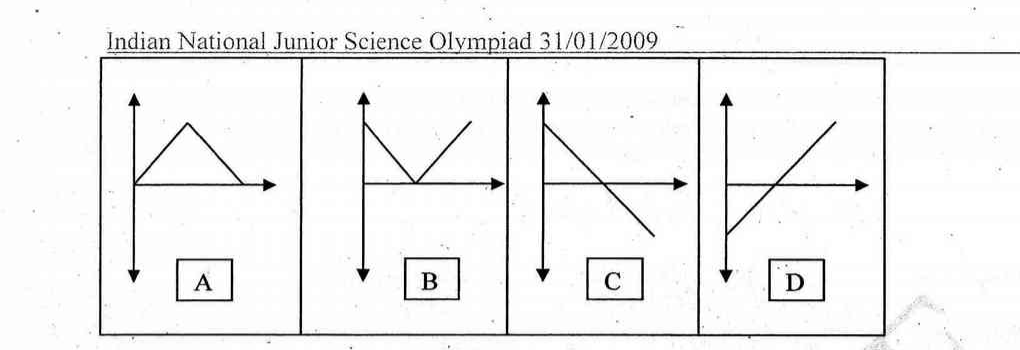
- (a) A
- (b) B
- (c) C
- (d) D
Topic: Newtonian Mechanics Metodi: Kinematic Equations Competenze: Diagrammatic Reasoning Objects: — Fonte: Testo (PDF) — p.1
Quale dei grafici dati di velocitàtempo (vedi casella) corrisponde al grafico di accelerazionetempo dato che vedi a destra? (Il tempo è tracciato lungo l’asse orizzontale in tutti i casi.)
Quesito 6
- (a) A
- (b) B
- (c) C
- (d) D
Topic: Newtonian Mechanics Metodi: Kinematic Equations Competenze: Diagrammatic Reasoning Objects: — Fonte: Testo (PDF) — p.1
A ball is thrown vertically upwards. Ignore air resistance. Take the upward motion as positive. Which one of the following graphs represents the velocity of the ball as a function of time? (Time is plotted along the horizontal axis in all cases.)
Quesito 7
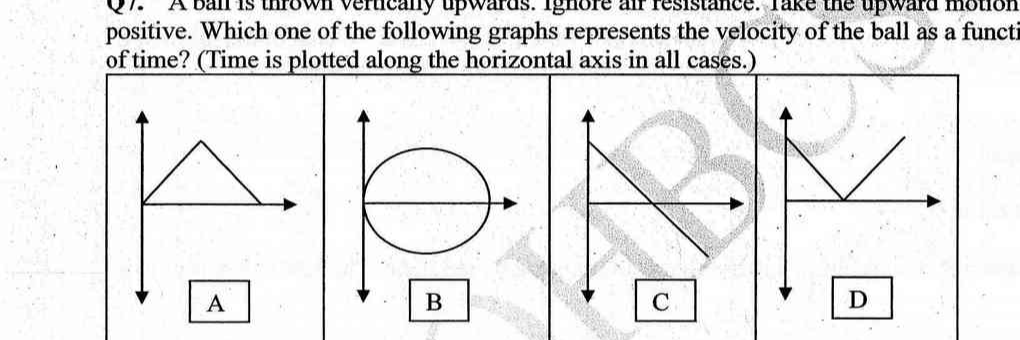
- (a) A
- (b) B
- (c) C
- (d) D
Topic: Newtonian Mechanics Metodi: Kinematic Equations Competenze: Diagrammatic Reasoning Objects: Ball Fonte: Testo (PDF) — p.2
Una palla viene lanciata verticalmente verso l’alto. Ignora la resistenza dell’aria. Prendi il movimento verso l’alto come positivo. Quale dei grafici seguenti rappresenta la velocità della palla come funzione del tempo? (Il tempo è tracciato lungo l’asse orizzontale in tutti i casi.)
Quesito 7
- (a) A
- (b) B
- (c) C
- (d) D
Topic: Newtonian Mechanics Metodi: Kinematic Equations Competenze: Diagrammatic Reasoning Objects: Ball Fonte: Testo (PDF) — p.2
The distance '' of the real image formed by a convex lens is measured for various object distances ''. A graph is plotted between and . Which of the following graphs is the correct graph?
Quesito 8
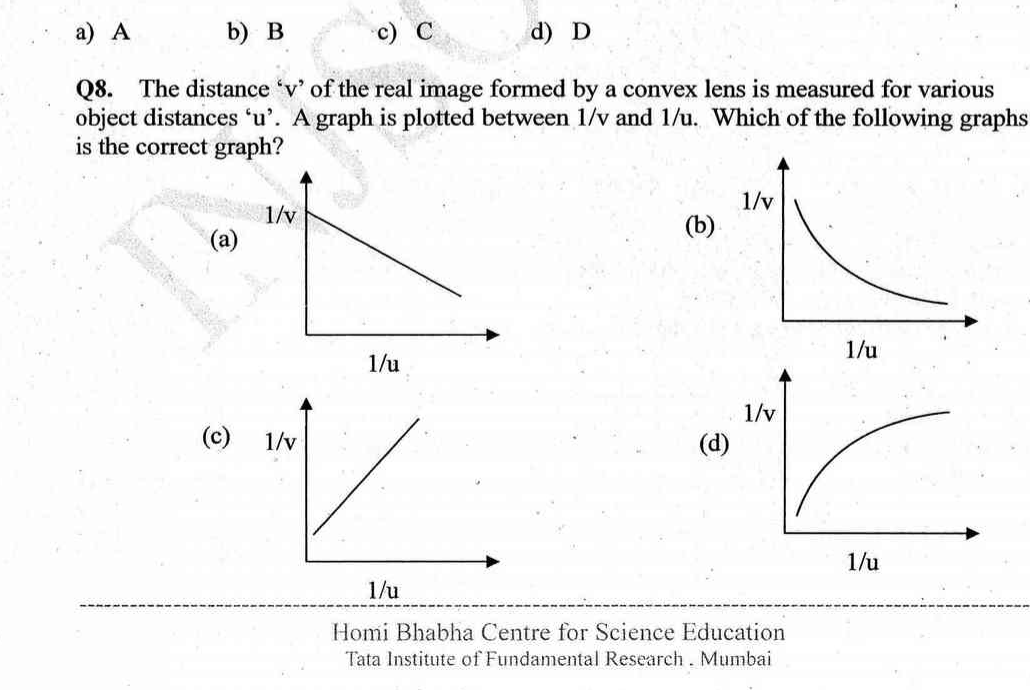
- (a)
- (b)
- (c)
- (d)
Topic: Geometric Optics Metodi: Thin Lens & Mirror Equation, Graph Linearization Competenze: Graph Linearization Objects: Lens Fonte: Testo (PDF) — p.2
La distanza "" dell’immagine reale formata da una lente convexa è misurata per varie distanze di oggetto "". Un grafico è tracciato tra e . Quale dei seguenti grafici è il grafico corretto?
Quesito 8
- (a)
- (b)
- (c)
- (d)
Topic: Geometric Optics Metodi: Thin Lens & Mirror Equation, Graph Linearization Competenze: Graph Linearization Objects: Lens Fonte: Testo (PDF) — p.2
A graph given, shows the variation of velocity and time of two bodies A and B. Choose an alternative for their average velocities.
Quesito 9
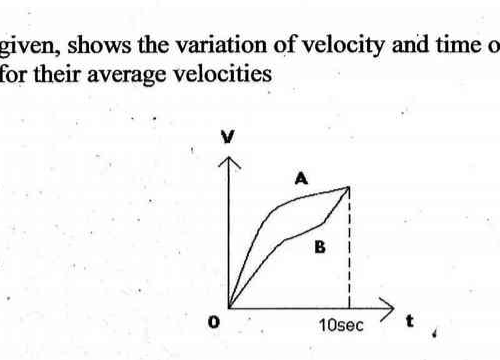
- (a) Average velocities of both are same since they have same initial and final velocities
- (b) Average velocities of both are same since both cover equal distance in equal interval of time
- (c) Average velocity of A is greater than that of B since it covers more distance than B in 10 sec.
- (d) Nothing can be said since their accelerations are not given
Topic: Newtonian Mechanics Metodi: Kinematic Equations Competenze: Diagrammatic Reasoning Objects: — Fonte: Testo (PDF) — p.3
Un grafico dato, mostra la variazione della velocità e del tempo di due corpi A e B. Scegli un’alternativa per le loro velocità medie.
Quesito 9
- (a) Le velocità medie di entrambe sono uguali in quanto hanno le stesse velocità iniziali e finali
- (b) Le velocità medie di entrambe sono uguali in quanto coprono distanze uguali in intervalli di tempo uguali
- (c) La velocità media di A è superiore a quella di B poiché copre più distanza di B in 10 secondi.
- (d) Non si può dire nulla, poiché non sono indicate le loro accelerazioni
Topic: Newtonian Mechanics Metodi: Kinematic Equations Competenze: Diagrammatic Reasoning Objects: — Fonte: Testo (PDF) — p.3
Two identical balls are released simultaneously from equal heights . Ball A is thrown horizontally with velocity and the ball B is just released. Choose the alternative that best represents the motion of A and B with respect to an observer who moves with velocity with respect to the ground as shown in the figure.
Quesito 10
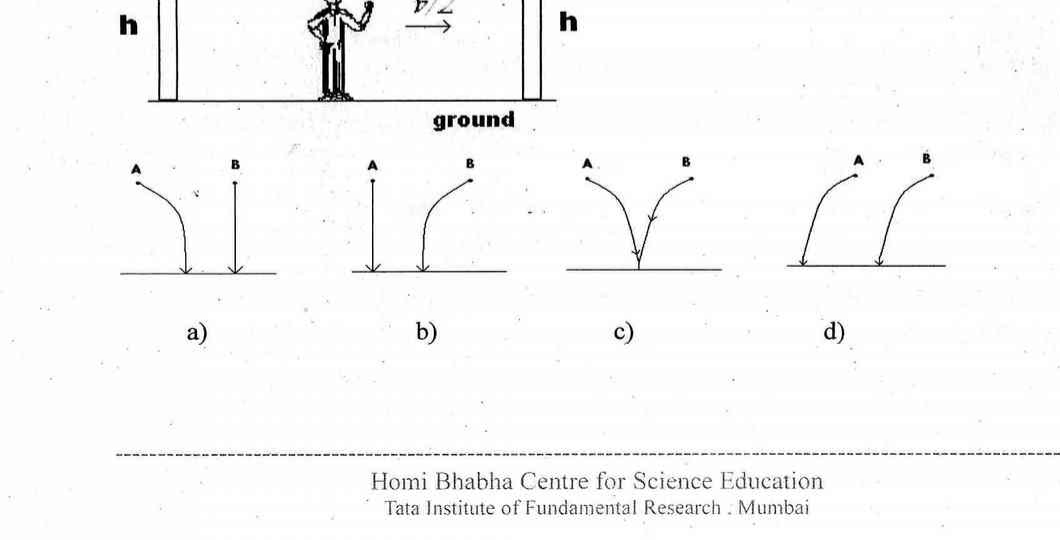
Topic: Newtonian Mechanics Metodi: Kinematic Equations, Vector Decomposition Competenze: Physical Reasoning Objects: Ball Fonte: Testo (PDF) — p.3
Due palle identiche vengono rilasciate contemporaneamente da altezza uguale . La palla A viene lanciata orizzontalmente con velocità e la palla B viene rilasciata. Scegli l’alternativa che meglio rappresenti il movimento di A e B rispetto ad un osservatore che si muove con velocità rispetto al suolo come mostrato nella figura.
Quesito 10
Topic: Newtonian Mechanics Metodi: Kinematic Equations, Vector Decomposition Competenze: Physical Reasoning Objects: Ball Fonte: Testo (PDF) — p.3
If is the mass of Earth and is the radius of Earth, acceleration due to gravity, () is given by the equation . Now, if is the radius of a star of mass , and the following four gives the correct equation for the escape velocity from the star such that it is equal to the speed of light ?
- (a)
- (b)
- (c)
- (d)
Topic: Gravitation Metodi: Newton’s Law of Gravitation, Energy Conservation Method Competenze: Mathematical Modeling Objects: Star, Planet Fonte: Testo (PDF) — p.4
Se è la massa della Terra e è il raggio della Terra, l’accelerazione dovuta alla gravità, () viene data dall’equazione . Ora, se è il raggio di una stella di massa , e i quattro seguenti dati forniscono la corretta equazione per la velocità di fuga dalla stella in modo tale che sia uguale alla velocità di luce ?
- (a)
- (b)
- (c)
- (d)
Topic: Gravitation Metodi: Newton’s Law of Gravitation, Energy Conservation Method Competenze: Mathematical Modeling Objects: Star, Planet Fonte: Testo (PDF) — p.4
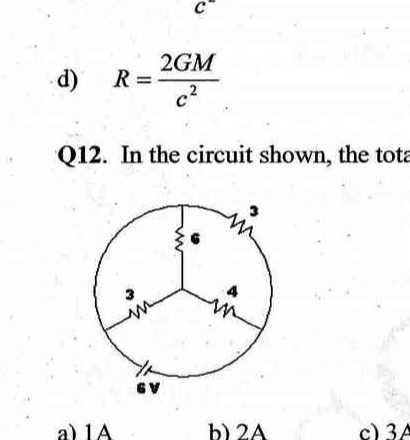
In the circuit shown, the total current supplied by the battery is
Quesito 12
- (a)
- (b)
- (c)
- (d)
Topic: Circuits Metodi: Equivalent Circuit Reduction, Kirchhoff’s Laws Competenze: Physical Reasoning Objects: Battery, Resistor Fonte: Testo (PDF) — p.4
Nel circuito mostrato, la corrente totale fornita dalla batteria è
Quesito 12
- (a)
- (b)
- (c)
- (d)
Topic: Circuits Metodi: Equivalent Circuit Reduction, Kirchhoff’s Laws Competenze: Physical Reasoning Objects: Battery, Resistor Fonte: Testo (PDF) — p.4
A satellite orbits the Earth in a circle of radius km. At that distance from the Earth, . The velocity of the satellite is
- (a) km/s
- (b) km/s
- (c) km/s
- (d) impossible without knowing the satellite’s mass
Topic: Gravitation Metodi: Newton’s Law of Gravitation Competenze: Physical Reasoning Objects: Satellite, Planet Fonte: Testo (PDF) — p.4
Un satellite orbita intorno alla Terra in un cerchio di raggio km. A tale distanza dalla Terra, . La velocità del satellite è
- (a) km/s
- (b) km/s
- (c) km/s
- d) impossibile senza conoscere la massa del satellite
Topic: Gravitation Metodi: Newton’s Law of Gravitation Competenze: Physical Reasoning Objects: Satellite, Planet Fonte: Testo (PDF) — p.4
A , electric oven is mistakenly connected to a power line that also has a -A fuse. The oven will
- (a) give off less than of heat
- (b) give off heat at of heat
- (c) give off more than of heat
- (d) blow the fuse
Topic: Circuits Metodi: Physical Modeling Competenze: Physical Reasoning Objects: — Fonte: Testo (PDF) — p.4
Un forno elettrico , è collegato erroneamente a una linea di alimentazione che ha anche un fusibile -A. Il forno
- a) emettono calore inferiore a
- b) emettono calore a di calore
- c) emettono più di di calore
- (d) far saltare il fusibile
Topic: Circuits Metodi: Physical Modeling Competenze: Physical Reasoning Objects: — Fonte: Testo (PDF) — p.4
When kJ of heat is removed from kg of ice originally at , its new temperature is
- (a)
- (b)
- (c)
- (d)
Topic: Thermodynamics Metodi: Physical Modeling Competenze: Physical Reasoning Objects: — Fonte: Testo (PDF) — p.4
Quando kJ di calore viene rimosso da kg di ghiaccio originariamente a , la sua nuova temperatura è
- (a)
- (b)
- (c)
- (d)
Topic: Thermodynamics Metodi: Physical Modeling Competenze: Physical Reasoning Objects: — Fonte: Testo (PDF) — p.4
A gallon of water and a gallon of antifreeze solution weigh, respectively, and lb. The antifreeze solution has a relative density of
- (a)
- (b)
- (c)
- (d)
Topic: Fluid Mechanics Metodi: Physical Modeling Competenze: Physical Reasoning Objects: — Fonte: Testo (PDF) — p.5
Un gallone di acqua e un gallone di soluzione antifrizzante pesano rispettivamente e lb. La soluzione antifrizzante ha una densità relativa di
- (a)
- (b)
- (c)
- (d)
Topic: Fluid Mechanics Metodi: Physical Modeling Competenze: Physical Reasoning Objects: — Fonte: Testo (PDF) — p.5
A ball whose density is falls into water from a height of cm. To what depth does the ball sink? (Hint: Only consider buoyancy and ignore retardation due to viscosity)
- (a) cm
- (b) cm
- (c) cm
- (d) cm
Topic: Fluid Mechanics Metodi: Hydrostatic Equilibrium, Energy Conservation Method Competenze: Physical Reasoning Objects: Ball Fonte: Testo (PDF) — p.5
Una palla di densità cade in acqua da un’altezza di cm. A che profondità si affaccia la palla? (Suggestone: considerare solo la flottabilità e ignorare il ritardo dovuto alla viscosità)
- (a) cm
- (b) cm
- (c) cm
- (d) cm
Topic: Fluid Mechanics Metodi: Hydrostatic Equilibrium, Energy Conservation Method Competenze: Physical Reasoning Objects: Ball Fonte: Testo (PDF) — p.5
A sealed container at a certain temperature is half full of water. The temperature of the container is increased and maintained till equilibrium is re-established. Which statement is correct when the equilibrium is re-established at the higher temperature?
- (a) The rate of vaporization is greater than the rate of condensation.
- (b) The amount of water vapour is greater than the amount of liquid water.
- (c) The amount of water vapour is greater than what it was at the lower temperature.
- (d) The rate of condensation is greater than the rate of vaporization.
Topic: Thermodynamics Metodi: Physical Modeling Competenze: Physical Reasoning Objects: Container Fonte: Testo (PDF) — p.5
Un contenitore sigillato a una certa temperatura è mezzo pieno di acqua. La temperatura del contenitore viene aumentata e mantenuta fino a quando non si ripristina l’equilibrio. Quale affermazione è corretta quando l’equilibrio viene ripristinato alla temperatura più alta?
- (a) La velocità di vaporizzazione è superiore alla velocità di condensazione.
- b) La quantità di vapore idrico è superiore alla quantità di acqua liquida.
- (c) La quantità di vapore idrico è superiore a quella che era a temperatura inferiore.
- (d) La velocità di condensazione è superiore alla velocità di vaporizzazione.
Topic: Thermodynamics Metodi: Physical Modeling Competenze: Physical Reasoning Objects: Container Fonte: Testo (PDF) — p.5
The temperature of a substance of mass (in g) and of specific heat capacity (in ) increases by . What is the change in heat in J?
- (a)
- (b)
- (c)
- (d)
Topic: Thermodynamics Metodi: Physical Modeling Competenze: Unit Conversion Objects: — Fonte: Testo (PDF) — p.5
La temperatura di una sostanza di massa (in g) e di capacità termico specifica (in ) aumenta di . Qual è il cambiamento di calore di J?
- (a)
- (b)
- (c)
- (d)
Topic: Thermodynamics Metodi: Physical Modeling Competenze: Unit Conversion Objects: — Fonte: Testo (PDF) — p.5
A fixed mass of an ideal gas has a volume of under certain conditions. The pressure (in kPa) and temperature (in K) are both doubled. What is the volume of the gas after these changes when other conditions remaining the same?
- (a)
- (b)
- (c)
- (d)
Topic: Kinetic Theory Metodi: Ideal Gas Law Competenze: Physical Reasoning Objects: Gas Fonte: Testo (PDF) — p.5
Una massa fissa di un gas ideale ha un volume di in determinate condizioni. La pressione (in kPa) e la temperatura (in K) sono entrambi raddoppiati. Qual è il volume del gas dopo questi cambiamenti quando le altre condizioni rimangono le stesse?
- (a)
- (b)
- (c)
- (d)
Topic: Kinetic Theory Metodi: Ideal Gas Law Competenze: Physical Reasoning Objects: Gas Fonte: Testo (PDF) — p.5
What amount of oxygen, , (in moles) contains molecules?
- (a)
- (b)
- (c)
- (d)
Topic: Chemistry Metodi: Physical Modeling Competenze: Unit Conversion Objects: — Fonte: Testo (PDF) — p.5
Quale quantità di ossigeno, , (in mole) contiene molecole?
- (a)
- (b)
- (c)
- (d)
Topic: Chemistry Metodi: Physical Modeling Competenze: Unit Conversion Objects: — Fonte: Testo (PDF) — p.5
Which pair of elements reacts most readily?
- (a)
- (b)
- (c)
- (d)
Topic: Chemistry Metodi: Physical Modeling Competenze: Physical Reasoning Objects: — Fonte: Testo (PDF) — p.5
Quale coppia di elementi reagisce più prontamente?
- (a)
- (b)
- (c)
- (d)
Topic: Chemistry Metodi: Physical Modeling Competenze: Physical Reasoning Objects: — Fonte: Testo (PDF) — p.5
What is the formula for the compound formed by calcium and nitrogen?
- (a)
- (b)
- (c)
- (d)
Topic: Chemistry Metodi: Physical Modeling Competenze: Physical Reasoning Objects: — Fonte: Testo (PDF) — p.5
Qual è la formula del composto formato da calcio e azoto?
- (a)
- (b)
- (c)
- (d)
Topic: Chemistry Metodi: Physical Modeling Competenze: Physical Reasoning Objects: — Fonte: Testo (PDF) — p.5
Using the equations below:
what is (in kJ) for the following reaction ?
- (a)
- (b)
- (c)
- (d)
Topic: Chemistry Metodi: Conservation of Energy Competenze: Physical Reasoning Objects: — Fonte: Testo (PDF) — p.6
Usando le equazioni di seguito:
Qual è (in kJ) per la seguente reazione ?
- (a)
- (b)
- (c)
- (d)
Topic: Chemistry Metodi: Conservation of Energy Competenze: Physical Reasoning Objects: — Fonte: Testo (PDF) — p.6
The compounds , and respectively are
- (a) acidic, amphoteric and basic.
- (b) amphoteric, basic and acidic.
- (c) basic, acidic and amphoteric.
- (d) basic, amphoteric and acidic.
Topic: Chemistry Metodi: Physical Modeling Competenze: Physical Reasoning Objects: — Fonte: Testo (PDF) — p.6
I composti , e sono rispettivamente:
- a) acido, anfoterico e di base.
- b) anfetari, basici e acidi.
- c) basi, acidi e anfotieri.
- d) basiche, anfoterico e acido.
Topic: Chemistry Metodi: Physical Modeling Competenze: Physical Reasoning Objects: — Fonte: Testo (PDF) — p.6
When the oxidation–reduction equation above is balanced, what is the coefficient for ?
- (a)
- (b)
- (c)
- (d)
Topic: Chemistry Metodi: Physical Modeling Competenze: Physical Reasoning Objects: — Fonte: Testo (PDF) — p.6
Quando l’equazione di riduzione dell’ossidazione di cui sopra è equilibrata, qual è il coefficiente per ?
- (a)
- (b)
- (c)
- (d)
Topic: Chemistry Metodi: Physical Modeling Competenze: Physical Reasoning Objects: — Fonte: Testo (PDF) — p.6
Which solution, of concentration , has the highest pH value?
- (a)
- (b)
- (c)
- (d)
Topic: Chemistry Metodi: Physical Modeling Competenze: Physical Reasoning Objects: — Fonte: Testo (PDF) — p.6
Quale soluzione, di concentrazione , ha il più alto valore di pH?
- (a)
- (b)
- (c)
- (d)
Topic: Chemistry Metodi: Physical Modeling Competenze: Physical Reasoning Objects: — Fonte: Testo (PDF) — p.6
Which compound dissolves in water to form an aqueous solution that can conduct an electric current?
- (a)
- (b)
- (c)
- (d)
Topic: Chemistry Metodi: Physical Modeling Competenze: Physical Reasoning Objects: — Fonte: Testo (PDF) — p.6
Quale composto si dissolve in acqua per formare una soluzione acquosa che può condurre una corrente elettrica?
- (a)
- (b)
- (c)
- (d)
Topic: Chemistry Metodi: Physical Modeling Competenze: Physical Reasoning Objects: — Fonte: Testo (PDF) — p.6
At the same temperature and pressure which sample contains the same number of moles of particles as litre of (g)?
- (a) (g)
- (b) (g)
- (c) (g)
- (d) (g)
Topic: Chemistry Metodi: Ideal Gas Law Competenze: Physical Reasoning Objects: — Fonte: Testo (PDF) — p.6
Al medesimo livello di temperatura e pressione quale campione contiene lo stesso numero di mole di particelle di litro di (g)?
- (a) (g)
- (b) (g)
- (c) (g)
- (d) (g)
Topic: Chemistry Metodi: Ideal Gas Law Competenze: Physical Reasoning Objects: — Fonte: Testo (PDF) — p.6
The pH of solution is and that of is . Which statement is correct about the ion concentrations in the two solutions?
- (a) in is half that in .
- (b) in is twice that in .
- (c) in is one tenth that in .
- (d) in is ten times that in .
Topic: Chemistry Metodi: Physical Modeling Competenze: Physical Reasoning Objects: — Fonte: Testo (PDF) — p.6
Il pH della soluzione è e quello di è . Quale affermazione è corretta riguardo alle concentrazioni di ioni nelle due soluzioni?
- a) in è la metà di quella di .
- b) in è il doppio di .
- (c) in è uno decimo di quello di .
- (d) in è dieci volte superiore a quello di .
Topic: Chemistry Metodi: Physical Modeling Competenze: Physical Reasoning Objects: — Fonte: Testo (PDF) — p.6
Which compound has the empirical formula with the greatest mass?
- (a)
- (b)
- (c)
- (d)
Topic: Organic Chemistry Metodi: Physical Modeling Competenze: Physical Reasoning Objects: — Fonte: Testo (PDF) — p.6
Quale composto ha la formula empirica con la massa più grande?
- (a)
- (b)
- (c)
- (d)
Topic: Organic Chemistry Metodi: Physical Modeling Competenze: Physical Reasoning Objects: — Fonte: Testo (PDF) — p.6
Which statements are correct for a reaction at equilibrium?
-
I. The forward and reverse reactions both continue.
-
II. The rates of the forward and reverse reactions are equal.
-
III. The concentrations of reactants and products are equal.
-
(a) I and II only
-
(b) I and III only
-
(c) II and III only
-
(d) I, II and III
Topic: Chemistry Metodi: Physical Modeling Competenze: Physical Reasoning Objects: — Fonte: Testo (PDF) — p.7
Quali affermazioni sono corrette per una reazione in equilibrio?
-
I. Le reazioni in avanti e in rovescia continuano.
-
II. Le percentuali di reazioni a termine e inverse sono uguali.
-
III. Le concentrazioni dei reagenti e dei prodotti sono uguali.
-
a) Solo I e II
-
b) Solo I e III
-
c) Solo II e III
-
d) I, II e III
Topic: Chemistry Metodi: Physical Modeling Competenze: Physical Reasoning Objects: — Fonte: Testo (PDF) — p.7
Which of the following combinations of elements of given atomic numbers can lead to a compound with a chemical formula of ?
- (a) and
- (b) and
- (c) and
- (d) and
Topic: Chemistry Metodi: Physical Modeling Competenze: Physical Reasoning Objects: — Fonte: Testo (PDF) — p.7
Quale delle seguenti combinazioni di elementi di dati numeri atomici può portare ad un composto con una formula chimica di ?
- a) e
- b) e
- c) e
- (d) e
Topic: Chemistry Metodi: Physical Modeling Competenze: Physical Reasoning Objects: — Fonte: Testo (PDF) — p.7
Which list of formulas represents compounds only?
- (a) , ,
- (b) , ,
- (c) , ,
- (d) , ,
Topic: Chemistry Metodi: Physical Modeling Competenze: Physical Reasoning Objects: — Fonte: Testo (PDF) — p.7
Quale lista di formule rappresenta solo composti?
- (a) , ,
- (b) , ,
- (c) , ,
- (d) , ,
Topic: Chemistry Metodi: Physical Modeling Competenze: Physical Reasoning Objects: — Fonte: Testo (PDF) — p.7
As the elements of Group are considered in order of increasing atomic number, there is an increase in
- (a) atomic radius
- (b) electronegativity
- (c) first ionization energy
- (d) number of electrons in the first shell
Topic: Chemistry Metodi: Physical Modeling Competenze: Physical Reasoning Objects: — Fonte: Testo (PDF) — p.7
Poiché gli elementi del gruppo sono considerati in ordine di numero atomico crescente, si verifica un aumento del numero di elementi di gruppo in ordine di numero atomico crescente.
- a) raggio atomico
- b) elettronegatività
- c) prima energia di ionizzazione
- (d) numero di elettroni nel primo guscio
Topic: Chemistry Metodi: Physical Modeling Competenze: Physical Reasoning Objects: — Fonte: Testo (PDF) — p.7
Which equation represents an oxidation–reduction reaction?
- (a)
- (b)
- (c)
- (d)
Topic: Chemistry Metodi: Physical Modeling Competenze: Physical Reasoning Objects: — Fonte: Testo (PDF) — p.7
Quale equazione rappresenta una reazione di ossidazione riduzione?
- (a)
- (b)
- (c)
- (d)
Topic: Chemistry Metodi: Physical Modeling Competenze: Physical Reasoning Objects: — Fonte: Testo (PDF) — p.7
Which conclusion was a direct result of the gold foil experiment?
- (a) An atom is mostly empty space with a dense, positively charged nucleus.
- (b) An atom is composed of at least three types of subatomic particles.
- (c) An electron has a positive charge and is located inside the nucleus.
- (d) An electron has properties of both waves and particles.
Topic: Modern-Quantum Physics Metodi: Physical Modeling Competenze: Physical Reasoning Objects: — Fonte: Testo (PDF) — p.7
Quale conclusione è stata il risultato diretto dell’esperimento sulla carta d’oro?
- (a) Un atomo è per lo più uno spazio vuoto con un nucleo denso e carico positivo.
- b) Un atomo è composto da almeno tre tipi di particelle subatomiche.
- (c) Un elettrone ha una carica positiva e si trova all’interno del nucleo.
- (d) Un elettrone ha proprietà sia di onde che di particelle.
Topic: Modern-Quantum Physics Metodi: Physical Modeling Competenze: Physical Reasoning Objects: — Fonte: Testo (PDF) — p.7
Which sample of (g) has the same number of molecules as liters of (g) at STP?
- (a) grams of (g)
- (b) liters of (g)
- (c) moles of (g)
- (d) molecules of (g)
Topic: Chemistry Metodi: Ideal Gas Law Competenze: Physical Reasoning Objects: — Fonte: Testo (PDF) — p.7
Quale campione di (g) ha lo stesso numero di molecole di litri di (g) a STP?
- a) grammi di
- b) litri di
- (c) molli di
- d) molecole di (g)
Topic: Chemistry Metodi: Ideal Gas Law Competenze: Physical Reasoning Objects: — Fonte: Testo (PDF) — p.7
In the ground state, each atom of an element has two valence electrons. This element has first ionization energy than calcium. This element located on the Periodic Table?
- (a) Group 1, Period 4
- (b) Group 2, Period 5
- (c) Group 2, Period 3
- (d) Group 3, Period 4
Topic: Chemistry Metodi: Physical Modeling Competenze: Physical Reasoning Objects: — Fonte: Testo (PDF) — p.8
Nell’ stato di base, ogni atomo di un elemento ha due elettroni di valenza. Questo elemento ha prima energia di ionizzazione che il calcio. Questo elemento situato sulla tabella periodica?
- a) Gruppo 1, Periodo 4
- b) Gruppo 2, Periodo 5
- c) Gruppo 2, Periodo 3
- d) Gruppo 3, Periodo 4
Topic: Chemistry Metodi: Physical Modeling Competenze: Physical Reasoning Objects: — Fonte: Testo (PDF) — p.8
Which substance can not be broken down by a chemical reaction?
- (a) Ammonia
- (b) Argon
- (c) Methane
- (d) Water
Topic: Chemistry Metodi: Physical Modeling Competenze: Physical Reasoning Objects: — Fonte: Testo (PDF) — p.8
Quale sostanza non può essere decomposta da una reazione chimica?
- a) Ammonio
- b) Argono
- c) Metano
- d) Acqua
Topic: Chemistry Metodi: Physical Modeling Competenze: Physical Reasoning Objects: — Fonte: Testo (PDF) — p.8
The cells in the following figure were all taken from the same individual (a mammal). Identify the cell division events happening in each cell.
Quesito 41
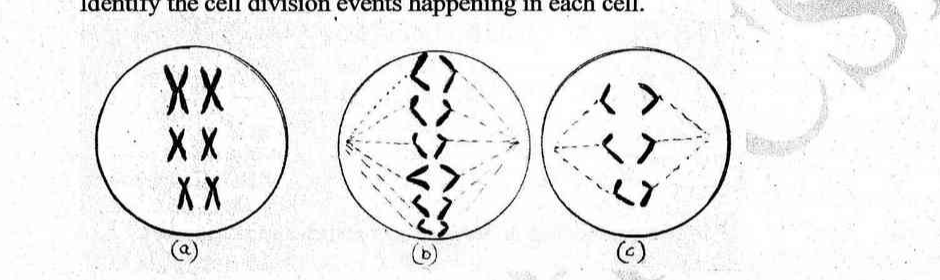
- (a) (a) Meiotic Metaphase I, (b) Mitotic Anaphase, (c) Meiotic Anaphase II
- (b) (a) Mitotic Metaphase, (b) Mitotic Anaphase, (c) Meiotic Anaphase II
- (c) (a) Mitotic Metaphase, (b) Mitotic Anaphase, (c) Meiotic Anaphase I
- (d) (a) Meiotic Metaphase II, (b) Meiotic Anaphase I, (c) Meiotic Anaphase II
Topic: Biology Metodi: Physical Modeling Competenze: Diagrammatic Reasoning Objects: — Fonte: Testo (PDF) — p.8
Le cellule della figura seguente sono state tutte prese dallo stesso individuo (un mammifero). Identificare gli eventi di divisione cellulare che si verificano in ogni cellula.
Quesito 41
- a) metafase meiotica I, b) anafase meiotica, c) anafase meiotica II
- (b) (a) metafase mitotica, (b) anafase mitotica, (c) anafase meiotica II
- (c) (a) metafase mitotica, (b) anafase mitotica, (c) anafase meiotica I
- d) a) metafase miotica II, b) anafase miotica I, c) anafase miotica II
Topic: Biology Metodi: Physical Modeling Competenze: Diagrammatic Reasoning Objects: — Fonte: Testo (PDF) — p.8
One form of color blindness in humans is caused by a sex linked recessive mutant gene. A woman with normal color vision and whose father was color blind marries a man of normal vision whose father was also color blind. Which of the following correctly represents phenotype of ♀ and ♂ offsprings?
- (a) All daughters have normal color vision, all the sons were color blind
- (b) Half the daughters and half the sons were color blind
- (c) All daughters have normal color vision and half the sons were color blind
- (d) Half the daughters were color blind and all the sons had normal color vision
Topic: Biology Metodi: Physical Modeling Competenze: Physical Reasoning Objects: — Fonte: Testo (PDF) — p.8
Una forma di cecità dei colori negli esseri umani è causata da un gene mutante recessivo legato al sesso. Una donna con una normale visione dei colori e il cui padre era cieco dai colori sposa un uomo con una normale visione il cui padre era anche cieco dai colori. Quale delle seguenti indica correttamente il fenotipo di ♀ e ♂?
- (a) Tutte le figlie hanno una normale visione dei colori, tutti i figli erano ciechi dei colori
- (b) Metà delle figlie e metà dei figli erano ciechi di colore
- (c) Tutte le figlie hanno una normale visione dei colori e la metà dei figli erano ciechi dei colori
- (d) Metà delle figlie erano cieche e tutti i figli avevano una normale visione dei colori
Topic: Biology Metodi: Physical Modeling Competenze: Physical Reasoning Objects: — Fonte: Testo (PDF) — p.8
The sense of taste is normally caused by the stimulation of chemoreceptors in the taste buds of the tongue. There are four main ‘tastes’: sweet, salty, bitter and sour. The tongue also has receptors for temperature. It is known that the taste of food can vary according to whether it is cold, warm or hot. Scientists discovered that just warming or cooling parts of the tongue, even when no food was present, also caused a sensation of taste. Scientists experimented with a group of people. They gradually cooled the tips of their tongues and measured the intensity of the taste felt by each member of the group. The experiment was repeated, this time warming the tip of the tongue. The graphs show the average values for the group.
Quesito 43
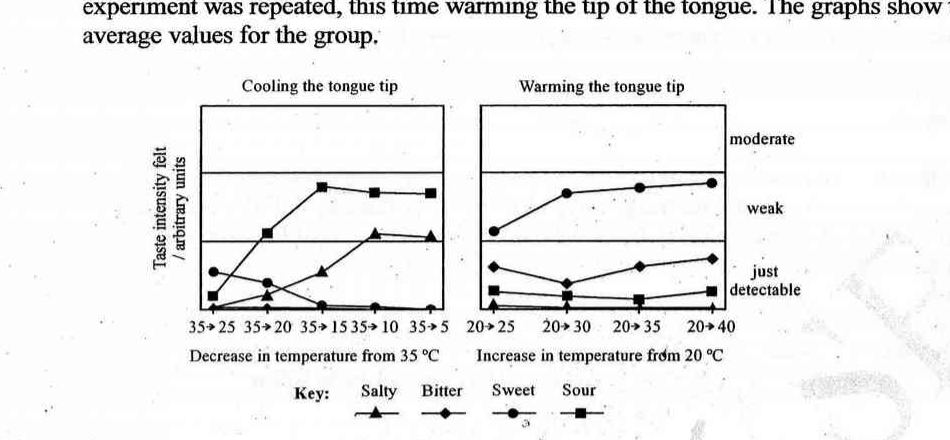
Identify which taste was felt most strongly when the tip of the tongue was cooled:
- (a) Bitter
- (b) Sour
- (c) Sweet
- (d) Cannot decide from the data given
Topic: Biology Metodi: Experimental Data Analysis Competenze: Experimental Data Analysis Objects: — Fonte: Testo (PDF) — p.9
Il senso del gusto è normalmente causato dalla stimolazione di chemioressitori nelle papille gustative della lingua. Ci sono quattro principali ‘gusti’: dolce, salato, amaro e acido. La lingua ha anche recettori per la temperatura. È noto che il sapore dei cibi può variare a seconda che siano freddi, caldi o caldi. Gli scienziati hanno scoperto che anche quando non c’era cibo, il riscaldamento o il raffreddamento delle parti della lingua provocavano un senso del gusto. Gli scienziati hanno sperimentato con un gruppo di persone. I due hanno gradualmente raffreddato le estremità della lingua e misurato l’intensità del sapore sentito da ciascun membro del gruppo. L’esperimento fu ripetuto, questa volta scaldando la punta della lingua. I grafici mostrano i valori medi per il gruppo.
Quesito 43
Indicare quale sapore si è sentito più forte quando la punta della lingua è stata raffreddata:
- a) Amaro
- b) Acido
- (c) Dolce
- d) Non può decidere sulla base dei dati forniti
Topic: Biology Metodi: Experimental Data Analysis Competenze: Experimental Data Analysis Objects: — Fonte: Testo (PDF) — p.9
A person wants to eat a particular piece of food that he likes the most. That particular piece of food is most sweet to taste at some sourness in it. Then which of the following statements are true, looking at the graph given in question no 43.
-
I. The food item should not be cooled below degrees to enjoy the sweetness
-
II. The item can be warmed for most if taken around degrees to enjoy the sweetness
-
III. The food item can be cooled to degrees for enjoying its salty taste
-
(a) Only i
-
(b) i,ii
-
(c) i,ii,iii
-
(d) ii,iii
Topic: Biology Metodi: Experimental Data Analysis Competenze: Experimental Data Analysis Objects: — Fonte: Testo (PDF) — p.9
Una persona vuole mangiare un particolare pezzo di cibo che gli piace di più. Quel pezzo di cibo in particolare è più dolce da assaggiare con un po’ di acridità. In tal caso, quale delle seguenti affermazioni è vera, osservando il grafico 43 in questione.
-
I. Il prodotto alimentare non deve essere raffreddato al di sotto di gradi per godere della dolcezza
-
II. L’oggetto può essere riscaldato per la maggior parte se assunto intorno a gradi per godere della dolcezza
-
III. Il prodotto alimentare può essere raffreddato a gradi per godere del suo sapore salato
-
(a) Solo i
-
(b) i,ii
-
(c) i,ii,iii
-
d) ii, iii
Topic: Biology Metodi: Experimental Data Analysis Competenze: Experimental Data Analysis Objects: — Fonte: Testo (PDF) — p.9
What is/are the advantage(s) of using an electron microscope?
-
I. Very high resolution.
-
II. Very high magnification.
-
III. The possibility of examining living material.
-
(a) I only
-
(b) I and II only
-
(c) II and III only
-
(d) I, II and III
Topic: Biology Metodi: Physical Modeling Competenze: Physical Reasoning Objects: — Fonte: Testo (PDF) — p.9
Quali sono i vantaggi dell’uso di un microscopio elettronico?
-
I. - Molto alta risoluzione.
-
II. Grandizza molto elevata.
-
III. La possibilità di esaminare il materiale vivente.
-
a) solo
-
b) Solo I e II
-
c) Solo II e III
-
d) I, II e III
Topic: Biology Metodi: Physical Modeling Competenze: Physical Reasoning Objects: — Fonte: Testo (PDF) — p.9
Which of the following products, which is produced by both anaerobic respiration and aerobic respiration in humans?
-
I. Pyruvate
-
II. ATP
-
III. Lactate
-
(a) I only
-
(b) I and II only
-
(c) I, II and III
-
(d) II and III only
Topic: Biology Metodi: Physical Modeling Competenze: Physical Reasoning Objects: — Fonte: Testo (PDF) — p.9
Quale dei seguenti prodotti, che è prodotto sia dalla respirazione anaerbica che dalla respirazione aerobica negli esseri umani?
-
I. Pirolato
-
II. ATP
-
III. Lattato
-
a) solo
-
b) Solo I e II
-
c) I, II e III
-
d) Solo II e III
Topic: Biology Metodi: Physical Modeling Competenze: Physical Reasoning Objects: — Fonte: Testo (PDF) — p.9
Which organ secretes enzymes that are active at a low pH?
- (a) Mouth
- (b) Pancreas
- (c) Stomach
- (d) Liver
Topic: Biology Metodi: Physical Modeling Competenze: Physical Reasoning Objects: — Fonte: Testo (PDF) — p.10
Quale organo secre enzimi attivi a basso pH?
- a) Bocca
- b) Pancreas
- c) Stomaco
- (d) Fígado
Topic: Biology Metodi: Physical Modeling Competenze: Physical Reasoning Objects: — Fonte: Testo (PDF) — p.10
The allele for red flower colour (R) in a certain plant is co-dominant with the allele for white flowers (R’). Thus a plant with the genotype RR’ has pink flowers. Tall (D) is dominant to dwarf (d). What would be the expected phenotypic ratio from a cross of RR’dd plants with R’R’Dd plants?
- (a)
- (b) pink white, and all tall
- (c) , in which are tall, dwarf, pink and white
- (d)
Topic: Biology Metodi: Physical Modeling Competenze: Physical Reasoning Objects: — Fonte: Testo (PDF) — p.10
L’alele per il colore dei fiori rossi (R) in una determinata pianta è co-dominante con l’alele per i fiori bianchi (R’). Pertanto una pianta con il genotipo RR’ ha fiori rosa. Tall (D) è dominante per nano (d). Qual è il rapporto fenotipo previsto da un incrocio di piante RR’dd con piante R’R’Dd?
- (a)
- (b) pink white, and all tall
- (c) , in cui sono alti, nani, rosa e bianchi
- (d)
Topic: Biology Metodi: Physical Modeling Competenze: Physical Reasoning Objects: — Fonte: Testo (PDF) — p.10
Which is not true of active immunity?
- (a) It can be produced by exposure to a disease causing organism.
- (b) It can be produced artificially.
- (c) It can be produced by a virus.
- (d) It can be transferred via the colostrum.
Topic: Biology Metodi: Physical Modeling Competenze: Physical Reasoning Objects: — Fonte: Testo (PDF) — p.10
Che non vale per l’immunità attiva?
- (a) Può essere prodotto mediante esposizione ad un organismo patogeno.
- b) Può essere prodotto artificialmente.
- (c) Può essere prodotto da un virus.
- d) Può essere trasferito tramite il colostro.
Topic: Biology Metodi: Physical Modeling Competenze: Physical Reasoning Objects: — Fonte: Testo (PDF) — p.10
Which of the following represents the correct sequence of events when the body is responding to a bacterial infection?
-
I. Antigen presentation by macrophages
-
II. Activation of B-cells
-
III. Activation of helper T-cells
-
(a) I, II, III
-
(b) I, III, II
-
(c) III, II, I
-
(d) II, III, I
Topic: Biology Metodi: Physical Modeling Competenze: Physical Reasoning Objects: — Fonte: Testo (PDF) — p.10
Quale di queste indica la corretta sequenza di eventi che si verificano quando il corpo risponde ad un’infezione batterica?
-
I. Presentazione di antigeni da macrofagi
-
II. Attivazione delle cellule B
-
III. Attivazione delle cellule T auxiliari
-
a) I, II, III
-
b) I, III, II
-
c) III, II, I
-
d) II, III, I
Topic: Biology Metodi: Physical Modeling Competenze: Physical Reasoning Objects: — Fonte: Testo (PDF) — p.10
Why do antibiotics kill bacteria but not viruses?
- (a) Antibiotics stimulate the immune system against bacteria but not viruses
- (b) Viruses have a way of blocking antibiotics
- (c) Viruses are too small to be affected by antibiotics
- (d) Viruses do not have a metabolism
Topic: Biology Metodi: Physical Modeling Competenze: Physical Reasoning Objects: — Fonte: Testo (PDF) — p.10
Perché gli antibiotici uccidono i batteri ma non i virus?
- (a) Gli antibiotici stimolano il sistema immunitario contro i batteri ma non contro i virus
- (b) I virus hanno un modo di bloccare gli antibiotici
- (c) I virus sono troppo piccoli per essere colpiti dagli antibiotici
- (d) I virus non hanno un metabolismo
Topic: Biology Metodi: Physical Modeling Competenze: Physical Reasoning Objects: — Fonte: Testo (PDF) — p.10
What is required to form a blood clot?
-
I. Platelets
-
II. Clotting factors
-
III. Antibodies
-
IV. Fibrinogen
-
(a) I and II only
-
(b) I, II and III only
-
(c) I, II and IV only
-
(d) II and III only
Topic: Biology Metodi: Physical Modeling Competenze: Physical Reasoning Objects: — Fonte: Testo (PDF) — p.10
Cosa è necessario per formare un coagulo di sangue?
-
I. Tricotteri
-
II. Fattori di coagulazione
-
III. Anticorpi
-
IV. Fibrinogeni
-
a) Solo I e II
-
b) Solo I, II e III
-
c) Solo I, II e IV
-
d) Solo II e III
Topic: Biology Metodi: Physical Modeling Competenze: Physical Reasoning Objects: — Fonte: Testo (PDF) — p.10
Where in the kidney does ultra filtration take place?
- (a) Glomerulus
- (b) Loop of Henlé
- (c) Proximal tubule
- (d) Collecting ducts
Topic: Biology Metodi: Physical Modeling Competenze: Physical Reasoning Objects: — Fonte: Testo (PDF) — p.11
Dove nel rene si svolge l’ultrafiltrazione?
- a) Glomerulus
- b) Loop di Henlé
- (c) Tubule proximale
- d) Canoni di raccolta
Topic: Biology Metodi: Physical Modeling Competenze: Physical Reasoning Objects: — Fonte: Testo (PDF) — p.11
If a red blood cell has a diameter of and a student draws it with a diameter of mm in a drawing, what is the magnification of the drawing?
- (a)
- (b)
- (c)
- (d)
Topic: Biology, Mathematics Metodi: Physical Modeling Competenze: Unit Conversion Objects: — Fonte: Testo (PDF) — p.11
Se un globulo rosso ha un diametro di e uno studente lo disegna con un diametro di mm in un disegno, quale è l’ingrandimento del disegno?
- (a)
- (b)
- (c)
- (d)
Topic: Biology, Mathematics Metodi: Physical Modeling Competenze: Unit Conversion Objects: — Fonte: Testo (PDF) — p.11
What is needed in photosynthesis to convert carbon dioxide into organic molecules?
- (a) Light and hydrogen from the splitting of water
- (b) Light and oxygen from the splitting of water
- (c) ATP and hydrogen from the splitting of water
- (d) ATP and oxygen from the splitting of water
Topic: Biology Metodi: Physical Modeling Competenze: Physical Reasoning Objects: — Fonte: Testo (PDF) — p.11
Cosa è necessario per la fotosintesi per convertire l’anidride carbonica in molecole organiche?
- a) Luce e idrogeno derivanti dalla divisione dell’acqua
- b) Luce e ossigeno derivanti dalla divisione dell’acqua
- (c) ATP e idrogeno derivanti dalla divisione dell’acqua
- d) ATP e ossigeno derivanti dalla divisione dell’acqua
Topic: Biology Metodi: Physical Modeling Competenze: Physical Reasoning Objects: — Fonte: Testo (PDF) — p.11
Which is the correct sequence of blood flow in normal human circulation?
- (a) pulmonary vein → right atrium → aorta → vena cava
- (b) vena cava → pulmonary vein → aorta → right atrium
- (c) vena cava → right atrium → pulmonary vein → aorta
- (d) pulmonary vein → vena cava → aorta → right atrium
Topic: Biology Metodi: Physical Modeling Competenze: Physical Reasoning Objects: — Fonte: Testo (PDF) — p.11
Qual è la corretta sequenza del flusso sanguigno nella normale circolazione umana?
- a) vena polmonare → atrio destro → aorta → vena cava
- (b) vena cava → vena polmonare → aorta → atrio destro
- (c) vena cava → atrio destro → vena polmonare → aorta
- d) vena pulmonare → vena cava → aorta → atrio destro
Topic: Biology Metodi: Physical Modeling Competenze: Physical Reasoning Objects: — Fonte: Testo (PDF) — p.11
Which of the following adaptations can help a plant to overcome water stress?
- (a) Increase in the surface area.
- (b) Opening of the stomata.
- (c) Increased rate of growth
- (d) Decrease in the leaf surface area.
Topic: Biology Metodi: Physical Modeling Competenze: Physical Reasoning Objects: — Fonte: Testo (PDF) — p.11
Quali delle seguenti modifiche possono aiutare una pianta a superare lo stress idrico?
- a) Aumento della superficie.
- (b) Apertura dello stomaco.
- (c) Aumento del tasso di crescita
- (d) Riduzione della superficie delle foglie.
Topic: Biology Metodi: Physical Modeling Competenze: Physical Reasoning Objects: — Fonte: Testo (PDF) — p.11
A pond comprises of fishes, algae, water beetles and copepods. On the bank of this pond is a tree that is home to many birds. Mark the appropriate food chain in the pond.
- (a) Tree → beetles → copepods → fishes → birds
- (b) Tree → copepods → beetles → fishes → birds
- (c) Algae → birds → copepods → beetles → fishes
- (d) Algae → copepods → beetles → fishes → birds
Topic: Biology, Earth & Environmental Science Metodi: Physical Modeling Competenze: Physical Reasoning Objects: — Fonte: Testo (PDF) — p.11
Un stagno comprende pesci, alghe, scarafaggi acquatici e copepodi. Sulla riva di questo stagno c’è un albero che ospita molti uccelli. Segna la catena alimentare appropriata nell’acque.
- a) Albero → scarafaggi → copepodi → pesci → uccelli
- b) Albero → copepodi → scarafaggi → pesci → uccelli
- c) Alge → uccelli → copepodi → scarafaggi → pesci
- d) Alge → copepodi → scarafaggi → pesci → uccelli
Topic: Biology, Earth & Environmental Science Metodi: Physical Modeling Competenze: Physical Reasoning Objects: — Fonte: Testo (PDF) — p.11
When the number of two species of aquatic organisms was monitored over time, the following graph was obtained. Which of the following statements is most likely to be true?
Quesito 59
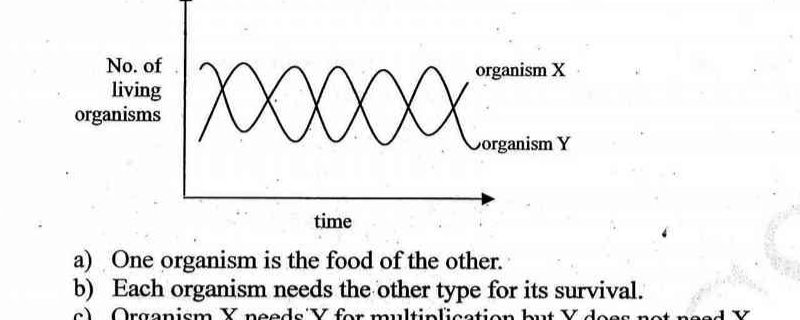
- (a) One organism is the food of the other.
- (b) Each organism needs the other type for its survival.
- (c) Organism X needs Y for multiplication but Y does not need X.
- (d) One organism is a parasite on the other species.
Topic: Biology Metodi: Experimental Data Analysis Competenze: Experimental Data Analysis Objects: — Fonte: Testo (PDF) — p.12
Quando il numero di due specie di organismi acquatici è stato monitorato nel tempo, è stato ottenuto il seguente grafico. Quale delle seguenti affermazioni è più probabile che sia vero?
Quesito 59
- a) Un organismo è il cibo dell’altro.
- (b) Ogni organismo ha bisogno dell’altro tipo per la sua sopravvivenza.
- (c) L’organismo X ha bisogno di Y per la moltiplicazione ma Y non ha bisogno di X.
- (d) Un organismo è parassita dell’altra specie.
Topic: Biology Metodi: Experimental Data Analysis Competenze: Experimental Data Analysis Objects: — Fonte: Testo (PDF) — p.12
A plant cell suspended in a test solution shows the following change in morphology. The test solution possibly could be:
Quesito 60
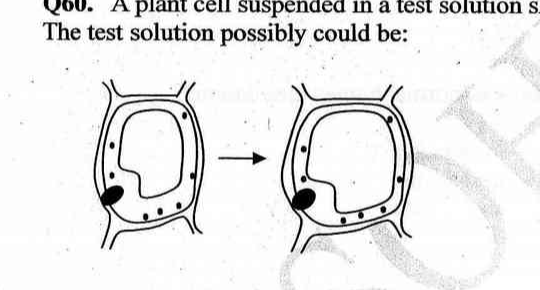
- (a) Hypertonic containing sodium chloride.
- (b) Hypotonic containing sucrose.
- (c) Isotonic containing glucose.
- (d) Saturated solution of potassium chloride.
Topic: Biology Metodi: Physical Modeling Competenze: Physical Reasoning Objects: — Fonte: Testo (PDF) — p.12
Una cellula vegetale sospesa in una soluzione di prova mostra il seguente cambiamento di morfologia. La soluzione di prova potrebbe essere:
Quesito 60
- a) ipertonico contenente cloruro di sodio.
- (b) ipotoni contenenti saccarosio.
- (c) Isotonici contenenti glucosio.
- d) Soluzione saturazione di cloruro di potassio.
Topic: Biology Metodi: Physical Modeling Competenze: Physical Reasoning Objects: — Fonte: Testo (PDF) — p.12
Section B (long questions). Section B: Questions 61 to 68 are 5 marks each. Marks will also be indicated in the questions if there are more than one sub to it.
(a) A tortoise is crawling Eastward with velocity km/hr and a lazy rabbit is travelling southward with velocity km/hr. With the help of a diagram, find the magnitude and direction of the velocity of the tortoise as observed by the rabbit. Show your working clearly. ( marks)
(b) A force varies with time according to , where is in Newton and is in seconds. The force acts on a block of mass kg, which is initially at rest on a frictionless horizontal surface. makes an angle of with the horizontal. What will be the velocity of the body at the end of the second i.e. the value of the velocity of the body at that instant? ( marks)
Topic: Newtonian Mechanics Metodi: Impulse-Momentum Theorem, Vector Decomposition Competenze: Mathematical Modeling Objects: Block Fonte: Testo (PDF) — p.13
**Sezione B (pieghe domande). ** Sezione B: le domande da 61 a 68 sono di 5 punti ciascuno. Le domande indicano anche i segni se sono presenti più di un sottoscritto.
a) Una tartaruga si arrasta verso est con velocità km/h e un coniglio pigro si sta spostando verso sud con velocità km/h. Con l’aiuto di un diagramma, trova la magnitudine e la direzione della velocità della tartaruga come osservato dal coniglio. Mostrate chiaramente il vostro lavoro. (Marchi )
b) Una forza varia con il tempo in base a , dove è in Newton e è in secondi. La forza agisce su un blocco di massa kg, che è inizialmente a riposo su una superficie orizzontale senza attrito. fa un angolo di con l’orizzontale. Qual è la velocità del corpo alla fine del secondo , cioè il valore della velocità del corpo in quel momento? (Marchi )
Topic: Newtonian Mechanics Metodi: Impulse-Momentum Theorem, Vector Decomposition Competenze: Mathematical Modeling Objects: Block Fonte: Testo (PDF) — p.13
A ball of mass kg moves on frictionless horizontal floor and hits a vertical wall with speed m/sec. The ball rebounds with speed m/sec. If the ball was in contact with the wall for sec, find the average force that acted on the ball. If the force is assumed to vary with time as shown in the figure, deduce the maximum force that acted on the ball.
A second harder ball of identical mass to the first also bounces of the wall with same initial and final speed, but stays in contact with the wall for only sec. What is the maximum force exerted by the wall on this ball? (marks)
Quesito 62
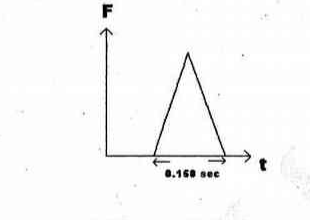
Topic: Newtonian Mechanics Metodi: Impulse-Momentum Theorem Competenze: Physical Reasoning Objects: Ball Fonte: Testo (PDF) — p.13
Una palla di massa kg si muove su un pavimento orizzontale senza attrito e colpisce una parete verticale con velocità m/sec. La palla rimbalza con velocità m/sec. Se la palla è stata in contatto con il muro per sec, trovare la forza media che ha agito sulla palla. Se si presume che la forza varia con il tempo come mostrato nella figura, dedurre la forza massima che ha agito sulla palla.
Una seconda palla più dura di massa identica alla prima rimbalza anche sulla parete con la stessa velocità iniziale e finale, ma rimane in contatto con la parete per solo secondi. Qual è la forza massima esercitata dalla parete su questa palla? ( segni)
Quesito 62
Topic: Newtonian Mechanics Metodi: Impulse-Momentum Theorem Competenze: Physical Reasoning Objects: Ball Fonte: Testo (PDF) — p.13
A g sample of (s) has an initial temperature of . A chemist measures the temperature of the sample as it is heated. Heat is added at a constant rate. The heating curve for the sample is shown below.
Quesito 63
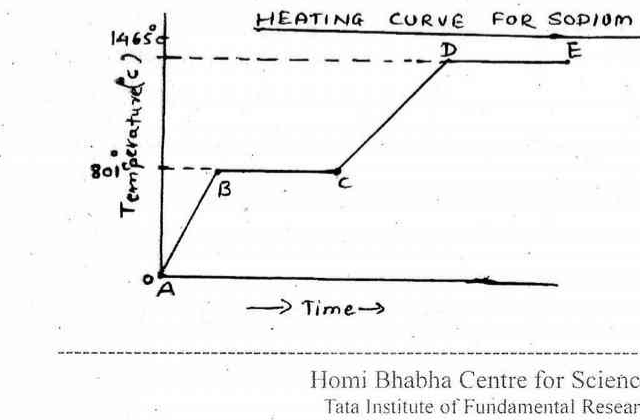
Part I. Determine the temperature range over which the entire sample is a liquid. ( mark)
- (a) to
- (b) to
- (c) to
- (d) to
Part II. Identify one line segment on the curve where the average K.E of the particles of the NaCl sample is changing. ( marks)
- (a) AB and CD
- (b) BC and DE
- (c) AB and BC
- (d) CD and DE
Part III. Identify one line segment on the curve where the NaCl sample is in a single phase and capable of conducting electricity. ( marks)
- (a) AB
- (b) BC
- (c) CD
- (d) DE
Topic: Thermodynamics, Chemistry Metodi: Experimental Data Analysis Competenze: Experimental Data Analysis Objects: — Fonte: Testo (PDF) — p.13
Un campione g di s) ha una temperatura iniziale di . Un chimico misura la temperatura del campione mentre viene riscaldato. Il calore viene aggiunto a un ritmo costante. La curva di riscaldamento del campione è riportata di seguito.
Quesito 63
Parte I. Determina la gamma di temperature sopra la quale l’intero campione è un liquido. (Marchio )
- (a) to
- (b) to
- (c) to
- (d) to
Parte II. Identificare un segmento di linea della curva in cui la media K.E delle particelle del campione di NaCl sta cambiando. (Marchi )
- a) AB e CD
- b) BC e DE
- c) AB e BC
- d) CD e DE
Parte III. Identificare un segmento di linea sulla curva in cui il campione di NaCl è in una singola fase e è in grado di condurre elettricità. (Marchi )
- (a) AB
- (b) BC
- (c) CD
- (d) DE
Topic: Thermodynamics, Chemistry Metodi: Experimental Data Analysis Competenze: Experimental Data Analysis Objects: — Fonte: Testo (PDF) — p.13
Combustion reaction of glucose () produces carbon dioxide gas. The occurring reaction is:
Data on enthalpy formation:
- of glucose (s)
Universal gas constant, . Volume of mole gas at , atm liters. (Important: Show all your calculation steps clearly)
- Calculate the energy produced when mole of glucose is oxidized. [ products reactants] ( mark)
- Calculate the volume of air (, atm) needed to oxidize g of glucose (oxygen content in air is volume). ( marks)
- Calculate the volume of dry carbon dioxide gas produced in the combustion of g of glucose at temperature and pressure at atm. () ( marks)
Topic: Chemistry Metodi: Conservation of Energy, Ideal Gas Law Competenze: Significant Figures Objects: Gas Fonte: Testo (PDF) — p.14
La reazione di combustione del glucosio () produce gas di anidride carbonica. La reazione che si verifica è:
Dati sulla formazione di entalpie:
- di glucosio (s)
Costante universale del gas, . Volume di gas a , atm litri. **(Importante: mostrare chiaramente tutti i passaggi di calcolo) **
- Calcolare l’energia prodotta quando mole di glucosio è ossidato. [ prodotti reagenti] (marchio )
- Calcolare il volume di aria (, atm) necessario per ossidare g di glucosio (il contenuto di ossigeno nell’aria è volume). (Marchi )
- Calcolare il volume di gas secco di anidride carbonica prodotto dalla combustione di g di glucosio a temperatura e pressione a atm. () ( segni)
Topic: Chemistry Metodi: Conservation of Energy, Ideal Gas Law Competenze: Significant Figures Objects: Gas Fonte: Testo (PDF) — p.14
Figure 1 shows a graph of uptake during and immediately after a period of vigorous exercise. To satisfy the energy demands of the exercise aerobically of oxygen per minute must be supplied.
After exercise the body continues to breathe in and use extra oxygen. The amount of this oxygen reserve in our blood, tissue fluids, lungs, haemoglobin and myoglobin. In the initial few minutes of exercise muscle fibre use two other sources for ATP production (other than aerobic respiration). They are:
a) Creatine phosphate system. Muscle cells have – times as much creatine phosphate as ATP. This is the main source of energy during short bursts of activity.
b) Anaerobic respiration which operates faster than aerobic respiration and provides energy for about – s.
Quesito 65
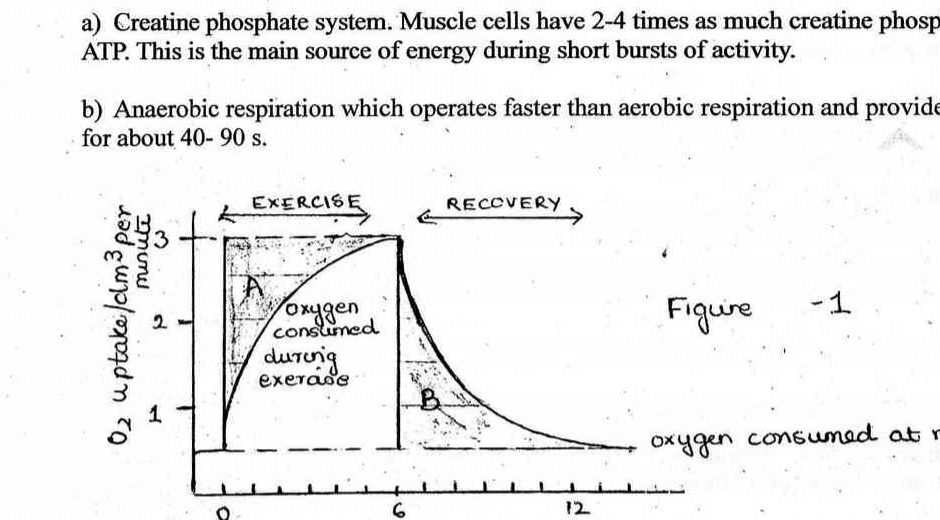
Table 1
- (a) Glucose → Lactate ATP (lactic acid)
- (b) Glucose → ethanol ATP
- (c) ATP
- (d) Creatine phosphate ADP → ATP Creatine
- (e) Creatine ATP → Creatine phosphate ADP
Table 2
- (a) min
- (b) min
- (c) min
Table 3
- (a) oxygen debt
- (b) oxygen deficit
- (c) oxygen uptake
Answer the questions below, giving the letter of the appropriate statements from the respective tables given above.
a) What does region A represent? (Table 3) ( marks)
b) What does region B represent? (Table 3) ( marks)
c) If you make a dash of m to catch a bus, which reaction from Table 1 would predominantly supply energy to your leg muscles? ( mark)
d) You missed the bus, so now you run another m to the next bus stop which exhausts your body completely. Quickly enough to next ten minutes, by mode of respiration is the energy demands of the exercise met during this run? (Figure 1 and Table 2) ( mark)
e) Energy from region A (Figure 1 and Table 2) ( mark)
f) Which reaction from Table 1 describes supply of energy by aerobic respiration? ( mark)
Topic: Biology Metodi: Experimental Data Analysis Competenze: Experimental Data Analysis Objects: — Fonte: Testo (PDF) — p.14
La figura 1 mostra un grafico dell’ assorbimento durante e immediatamente dopo un periodo di esercizio fisico vigoroso. Per soddisfare le esigenze energetiche dell’esercizio, è necessario fornire di ossigeno al minuto.
Dopo l’esercizio il corpo continua a respirare e a usare ossigeno in più. La quantità di questa riserva di ossigeno nel sangue, nei fluidi dei tessuti, nei polmoni, nell’emoglobina e nella mioglobina. Nei primi minuti di esercizio, le fibre muscolari utilizzano altre due fonti di produzione di ATP (diversi dalla respirazione aerobica). Sono:
a) Sistema di fosfato di creatina. Le cellule muscolari hanno 2$$4 volte più fosfato di creatina di ATP. Questa è la principale fonte di energia durante brevi periodi di attività.
b) respirazione anaerobica che opera più velocemente della respirazione aerobica e fornisce energia per circa 40$$90 s.
Quesito 65
Tabella 1
- a) Glucosio → Latato ATP (acido lattico)
- b) Glucosio → etanolo ATP
- (c) ATP
- (d) fosfato di creatina ADP → ATP
- e) Creatina ATP → Fosfato di creatina ADP
Tabella 2
- a) min
- b) min
- c) min
Tabella 3
- a) debito di ossigeno
- b) Deficito di ossigeno
- (c) assorbimento di ossigeno
Rispondi alle domande di seguito, indicando la lettera delle dichiarazioni appropriate delle tabelle sopra indicate.
a) Cosa rappresenta la regione A? (tabella 3) (marchi )
b) Cosa rappresenta la regione B? (tabella 3) (marchi )
c) Se si fa un passo di m per prendere un autobus, quale reazione della tabella 1 fornirebbe principalmente energia ai muscoli delle gambe? (Marchio )
d) Hai perso l’autobus, quindi ora corri un altro m alla prossima fermata dell’autobus che esaurisce completamente il tuo corpo. In modo abbastanza rapido per i prossimi dieci minuti, per modalità di respirazione le esigenze energetiche dell’esercizio sono soddisfatte durante questa corsa? (Figura 1 e tabella 2) (marchio )
e) Energia proveniente dalla regione A (Figura 1 e tabella 2) (marchio )
f) Quale reazione della tabella 1 descrive l’approvvigionamento di energia mediante la respirazione aerobica? (Marchio )
Topic: Biology Metodi: Experimental Data Analysis Competenze: Experimental Data Analysis Objects: — Fonte: Testo (PDF) — p.14
(A) Diagram 1, Diagram 2, Diagram 3 … Diagram .
Quesito 66
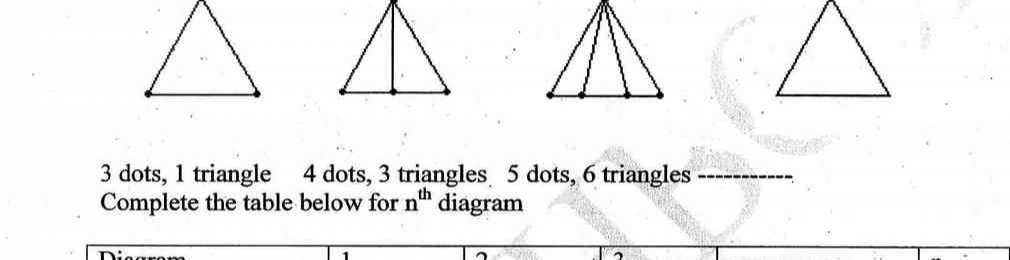
dots, triangle; dots, triangles; dots, triangles. Complete the table below for diagram. ( marks)
| Diagram | 1 | 2 | 3 | … | n |
|---|---|---|---|---|---|
| Number of dots | 3 | 4 | 5 | … | |
| Number of triangles | 1 | 3 | 6 | … |
(B) If '' is the surface area and cuboid of dimensions , , and is the volume, then is equal to ( marks)
- (a)
- (b)
- (c)
- (d)
Topic: Mathematics Metodi: Physical Modeling Competenze: Mathematical Modeling Objects: — Fonte: Testo (PDF) — p.16
**(A) ** Diagramma 1, Diagramma 2, Diagramma 3 … Diagramma .
Quesito 66
I punti , il triangolo ; i punti , i triangoli ; i punti , i triangoli . Completa la tabella seguente per il diagramma . (Marchi )
Il diagramma # 1 # 2 # 3 … | n |
|---|---|---|---|---|---|
Il numero dei punti # 3 # 4 # 5 … | |
♬ Numero di triangoli ♬ 1 ♬ 3 ♬ 6 ♬ | |
Se "" è la superficie e il cuboide delle dimensioni , , e è il volume, allora è uguale a (marchi )
- (a)
- (b)
- (c)
- (d)
Topic: Mathematics Metodi: Physical Modeling Competenze: Mathematical Modeling Objects: — Fonte: Testo (PDF) — p.16
ABO blood group is controlled by gene I which has three alleles , , and are completely dominant over , but when and are present together they both express themselves because of co-dominance. produces A antigen, produces B antigen, results in the absence of both antigens.
i) From the option given below find the possible genotypes of a woman with blood type A and a man with blood type B? ( mark)
- A.
- B.
- C.
- D.
- E.
- F.
ii) If the blood group of both the parents is B then what are the possible blood groups of the children? (Choose from the options below). ( mark)
- A. A blood group
- B. B blood group
- C. AB blood group
- D. O blood group
iii) If the man and woman from Question (i) above get married and have children of blood types A, B, AB and O, then what is the only possible genotype of each parent? (Use the options of Question i?) ( mark)
Mother: Father:
iv) A woman used a famous actor for the support of her child, claiming that he was its father. (Child: Blood type B, Mother: Blood type A, Accused actor: Blood type O) What is the genotype of the mother? Use the options of Question (i) above. ( mark)
v) In Question (iv) above what is the probability (chance) that the accused actor is the father of the child? ( mark)
- A.
- B.
- C.
- D.
Topic: Biology Metodi: Physical Modeling Competenze: Physical Reasoning Objects: — Fonte: Testo (PDF) — p.17
Il gruppo sanguigno ABO è controllato dal gene I che ha tre alleli , , e che sono completamente dominanti su , ma quando e sono presenti insieme entrambi si esprimono a causa della co-dominanza. produce l’ antigene A, produce l’ antigene B, si verifica in assenza di entrambi gli antigeni.
i) Sulla base dell’opzione di seguito, si possono trovare i genotipi possibili di una donna con gruppo sanguigno A e di un uomo con gruppo sanguigno B? (Marchio )
- A.
- B.
- C.
- D.
- E.
- F.
ii) Se il gruppo sanguigno di entrambi i genitori è B, quali sono i possibili gruppi sanguigni dei bambini? (Scegli tra le opzioni di seguito). (Marchio )
- A. Un gruppo sanguigno
- B. Gruppo sanguigno B
- C. Gruppo sanguigno AB
- D. O gruppo sanguigno
iii) Se l’uomo e la donna della domanda (i) di cui sopra si sposano e hanno figli dei gruppi sanguigni A, B, AB e O, qual è l’unico genotipo possibile di ciascun genitore? (Utilizzare le opzioni della domanda i?) (marchio )
Mamma:
- Padre:
iv) Una donna ha usato un famoso attore per sostenere il figlio, sostenendo che lui era il padre. (Bambino: gruppo sanguigno B, Madre: gruppo sanguigno A, attore accusato: gruppo sanguigno O) Qual è il genotipo della madre? Utilizzare le opzioni di cui alla domanda (i) sopra. (Marchio )
v) Nella domanda (iv) di cui sopra, qual è la probabilità (la probabilità) che l’attore accusato sia il padre del bambino? (Marchio )
- A.
- B.
- C.
- D.
Topic: Biology Metodi: Physical Modeling Competenze: Physical Reasoning Objects: — Fonte: Testo (PDF) — p.17
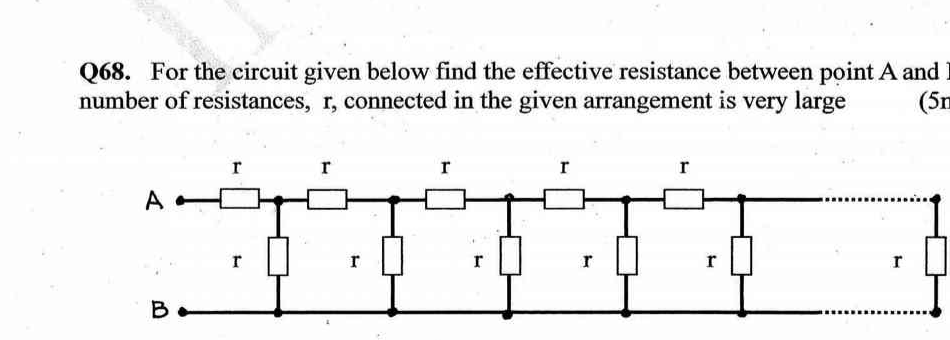
For the circuit given below find the effective resistance between point A and B. The number of resistances, , connected in the given arrangement is very large. (marks)
Quesito 68
Topic: Circuits Metodi: Equivalent Circuit Reduction, Symmetry Argument Competenze: Mathematical Modeling Objects: Resistor Fonte: Testo (PDF) — p.17
Per il circuito indicato di seguito, si deve trovare la resistenza effettiva tra i punti A e B. Il numero di resistenze, , collegate nella disposizione data è molto grande. ( segni)
Quesito 68
Topic: Circuits Metodi: Equivalent Circuit Reduction, Symmetry Argument Competenze: Mathematical Modeling Objects: Resistor Fonte: Testo (PDF) — p.17