Section A (multiple choice). Questions 1 to 30 are multiple choices, with every correct answer carrying 1 mark and every wrong answer carrying mark.
The following graphs represent activities of different enzymes (A to D) at different temperature and pH:
Quesito 1
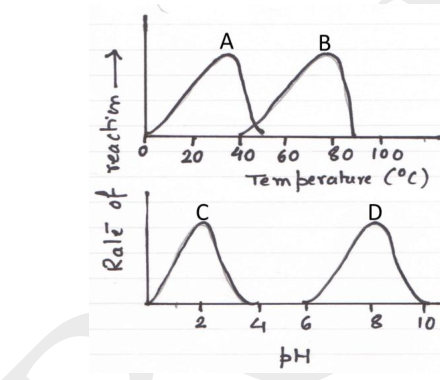
Observe the graphs carefully and infer which of the following options given below (most likely) represents correctly the combinations A, B, C and D.
- (a) A — enzyme of thermophilic bacteria; B — typical human enzyme; C — pepsin (stomach enzyme); D — Trypsin (intestinal enzyme)
- (b) A — enzyme of thermophilic bacteria; B — typical human enzyme; C — Trypsin (intestinal enzyme); D — pepsin (stomach enzyme)
- (c) A — a typical human enzyme; B — enzyme of thermophilic bacteria; C — Trypsin (intestinal enzyme); D — pepsin (stomach enzyme)
- (d) A — a typical human enzyme; B — enzyme of thermophilic bacteria; C — pepsin (stomach enzyme); D — Trypsin (intestinal enzyme)
Topic: Biology Metodi: Physical Modeling Competenze: Diagrammatic Reasoning Objects: — Fonte: Testo (PDF) — p.1
Sezione A (scelta multipla). Le domande da 1 a 30 sono di scelta multipla, con ogni risposta corretta con un segno e ogni risposta sbagliata con un segno .
I seguenti grafici rappresentano le attività di diversi enzimi (A a D) a temperature e pH differenti:
Quesito 1
Osservare attentamente i grafici e dedurre quale delle seguenti opzioni di seguito (il più probabile) rappresenta correttamente le combinazioni A, B, C e D.
- (a) A enzima di batteri termophili; B enzima tipica umana; C pepsina (enzima dello stomaco); D trypsina (enzima intestinale)
- (b) A enzima di batteri termophili; B enzima tipica umana; C Trypsin (enzima intestinale); D pepsin (enzima dello stomaco)
- (c) A un enzima umano tipico; B enzima di batteri termophili; C Trypsin (enzima intestinale); D pepsin (enzima dello stomaco)
- (d) A un enzima umano tipico; B enzima di batteri termophili; C pepsina (enzima dello stomaco); D tripsina (enzima intestinale)
Topic: Biology Metodi: Physical Modeling Competenze: Diagrammatic Reasoning Objects: — Fonte: Testo (PDF) — p.1
Units of length, velocity and force in a certain system of units are double of those in SI (i.e. unit length in this system is 2 m, and so on for force and velocity). Read the following statements.
i) Unit of mass is unchanged. ii) Unit of time is unchanged. iii) Unit of linear momentum is doubled. iv) Unit of energy is doubled.
Among the above statements
- (a) All four are correct.
- (b) Only i, ii and iii are correct.
- (c) Only i and ii are correct.
- (d) Only ii and iii are correct.
Topic: Order-of-Magnitude Estimation Metodi: Dimensional Analysis Competenze: Unit Conversion Objects: — Fonte: Testo (PDF) — p.2
Le unità di lunghezza, velocità e forza in un determinato sistema di unità sono doppie di quelle di SI (cioè La lunghezza di unità in questo sistema è di 2 m, ecc. per forza e velocità). Leggi le seguenti affermazioni.
i) L’unità di massa è invariata. ii) L’unità di tempo è invariata. iii) Unità di impulso lineare raddoppiata. iv) L’unità di energia è raddoppiata.
Tra le dichiarazioni precedenti
- (a) Tutte le quattro sono corrette.
- b) Solo i, ii e iii sono corretti.
- (c) Solo i e ii sono corretti.
- d) Solo ii e iii sono corretti.
Topic: Order-of-Magnitude Estimation Metodi: Dimensional Analysis Competenze: Unit Conversion Objects: — Fonte: Testo (PDF) — p.2
Steel is an alloy of carbon and iron which is used in many utensils. Iron extracted will be of two types pig iron and wrought iron. Iron is extracted from its ore haematite by reduction with carbon monoxide. What (approximate) volume of carbon monoxide at NTP will be required to reduce 31.94 kg of haematite?
- (a) 12275 L
- (b) 4480 L
- (c) 9953 L
- (d) 13440 L
Topic: Chemistry Metodi: Physical Modeling Competenze: Unit Conversion Objects: — Fonte: Testo (PDF) — p.2
L’acciaio è una lega di carbonio e ferro che viene utilizzata in molti utensili. Il ferro estratto sarà di due tipi: ferro porco e ferro forzatore. Il ferro viene estratto dal suo minerale ematite mediante riduzione con monossido di carbonio. Qual è il volume (approssimativo) di monossido di carbonio a NTP necessario per ridurre 31,94 kg di ematite?
- (a) 12275 L
- (b) 4480 L
- (c) 9953 L
- (d) 13440 L
Topic: Chemistry Metodi: Physical Modeling Competenze: Unit Conversion Objects: — Fonte: Testo (PDF) — p.2
A plant (parental) bearing red flowers is self-pollinated and two kinds of progeny are obtained: plants with red flowers and plants with white flowers in a ratio of 3:1. Based on this observation which one of the following statements regarding genes controlling the flower colour is correct?
- (a) The parental plant had one kind of allele for the flower colour.
- (b) Two genes control the flower colour.
- (c) The parental plant had two different alleles for the flower colour.
- (d) All progeny plants with red flower colour have the same genotype as that of the parent.
Topic: Biology Metodi: Physical Modeling Competenze: Physical Reasoning Objects: — Fonte: Testo (PDF) — p.2
Una pianta (materna) che porta fiori rossi si autoimpollina e si ottengono due tipi di discendenza: piante con fiori rossi e piante con fiori bianchi in rapporto di 3:1. In base a questa osservazione, quale delle seguenti affermazioni riguardanti i geni che controllano il colore dei fiori è corretta?
- (a) La pianta madre aveva un tipo di alele per il colore dei fiori.
- (b) Due geni controllano il colore dei fiori.
- (c) La pianta madre aveva due alleli diversi per il colore dei fiori.
- d) Tutte le piante progenie con colore rosso hanno lo stesso genotipo del genitore.
Topic: Biology Metodi: Physical Modeling Competenze: Physical Reasoning Objects: — Fonte: Testo (PDF) — p.2
A gas is obtained by fractional distillation of liquid air. The same gas can also be obtained by Haber’s process at high temperature and low pressure. Find out the number of atoms present in one liter of the gas.
- (a)
- (b)
- (c)
- (d)
Topic: Chemistry Metodi: Physical Modeling Competenze: Physical Reasoning Objects: — Fonte: Testo (PDF) — p.2
Un gas viene ottenuto mediante distillazione frazionaria di aria liquida. Lo stesso gas può essere ottenuto anche con il processo di Haber ad alta temperatura e bassa pressione. Scopri il numero di atomi presenti in un litro di gas.
- (a)
- (b)
- (c)
- (d)
Topic: Chemistry Metodi: Physical Modeling Competenze: Physical Reasoning Objects: — Fonte: Testo (PDF) — p.2
A beam of yellow light travelling in vacuum enters an ordinary transparent glass . Read the following statements.
i) Its wavelength becomes equal to that of red colour in vacuum. ii) Its wavelength becomes equal to that of green colour in vacuum. iii) Energy of the photons corresponding to refracted light is the same as that corresponding to the incident light. iv) Energy of the photons decreases.
- (a) Only iii is correct.
- (b) Only ii & iii are correct.
- (c) Only i & iii are correct.
- (d) Only i & iv are correct.
Topic: Wave Optics, Modern-Quantum Physics Metodi: Photon Energy Relation Competenze: Physical Reasoning Objects: Photon Fonte: Testo (PDF) — p.3
Un fascio di luce gialla che viaggia nel vuoto entra in un vetro trasparente ordinario . Leggi le seguenti affermazioni.
i) La sua lunghezza d’onda diventa uguale a quella del colore rosso nel vuoto. ii) La sua lunghezza d’onda diventa uguale a quella del colore verde nel vuoto. iii) L’energia dei fotoni corrispondente alla luce refratta è la stessa di quella corrispondente alla luce incidentale. iv) L’energia dei fotoni diminuisce.
- (a) Solo iii è corretto.
- b) Solo ii e iii sono corretti.
- (c) Solo i e iii sono corretti.
- (d) Solo i e iv sono corretti.
Topic: Wave Optics, Modern-Quantum Physics Metodi: Photon Energy Relation Competenze: Physical Reasoning Objects: Photon Fonte: Testo (PDF) — p.3
Rajesh was performing the thermometric titration with caustic potash and oil of vitriol, under the same set of conditions. He dissolved 19.6 g of oil of vitriol in of water and 5.6 g of caustic potash in of water. Find the volume of oil of vitriol taken initially for thermometric titration. The observation table of his experiment is as follows.
| Obs No. | Volume of KOH added / | Temperature |
|---|---|---|
| 1 | 20 | 27 |
| 2 | 30 | 27.4 |
| 3 | 40 | 27.5 |
| 4 | 50 | 27.8 |
| 5 | 60 | 27.6 |
| 6 | 70 | 27.2 |
| 7 | 80 | 26.9 |
- (a)
- (b)
- (c)
- (d)
Topic: Chemistry Metodi: Experimental Data Analysis Competenze: Experimental Data Analysis Objects: — Fonte: Testo (PDF) — p.3
Rajesh stava eseguendo la titrazione termometrica con potassio caustico e olio di vitriolo, sotto lo stesso set di condizioni. Ha dissolto 19,6 g di olio di vitriolo in di acqua e 5,6 g di potassico caustico in di acqua. Trova il volume di olio di vitriolo assunto inizialmente per la titolazione termometrica. La tabella di osservazione del suo esperimento è la seguente.
-
No, no. | Volume of KOH added / | Temperature | |---|---|---| | 1 | 20 | 27 | | 2 | 30 | 27.4 | | 3 | 40 | 27.5 | | 4 | 50 | 27.8 | | 5 | 60 | 27.6 | | 6 | 70 | 27.2 | | 7 | 80 | 26.9 |
-
(a)
-
(b)
-
(c)
-
(d)
Topic: Chemistry Metodi: Experimental Data Analysis Competenze: Experimental Data Analysis Objects: — Fonte: Testo (PDF) — p.3
Cabbage, Broccoli, Brussels sprouts are all derived from one species of wild mustard by the selection of desired traits. This has been developed by a process of:
- (a) Inheritance of acquired character
- (b) Natural selection
- (c) Adaptive selection
- (d) Artificial selection
Topic: Biology Metodi: Physical Modeling Competenze: Physical Reasoning Objects: — Fonte: Testo (PDF) — p.3
Il cavolo, il broccoli, i germogli di Bruxelles sono tutti derivati da una specie di senape selvatica mediante la selezione dei tratti desiderati. Questo è stato sviluppato mediante un processo di:
- a) Ereditarietà di carattere acquisito
- b) Selezione naturale
- c) Selezione adattabile
- d) Selezione artificiale
Topic: Biology Metodi: Physical Modeling Competenze: Physical Reasoning Objects: — Fonte: Testo (PDF) — p.3
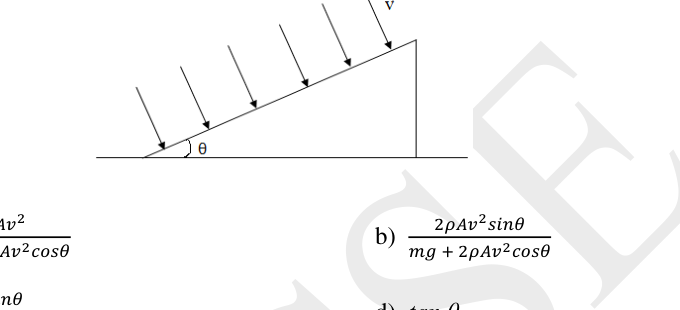
Air of density , moving with velocity strikes normally on an inclined surface (having area A) of a wedge of mass m kept on a horizontal surface. Collisions are perfectly elastic (No loss of kinetic energy). Minimum coefficient of static friction between wedge and the horizontal surface, for the wedge to be stationary, is
Quesito 9
- (a)
- (b)
- (c)
- (d)
Topic: Conservation of Momentum, Newtonian Mechanics Metodi: Impulse-Momentum Theorem, Free-Body Diagram Competenze: Physical Reasoning Objects: Wedge Fonte: Testo (PDF) — p.4
L’aria di densità , che si muove con velocità colpisce normalmente una superficie inclinata (avendo area A) di un cucio di massa m tenuto su una superficie orizzontale. Le collisioni sono perfettamente elastiche (senza perdita di energia cinetica). Il coefficiente minimo di attrito statico tra la ciglia e la superficie orizzontale, per mantenere la ciglia in posizione fermata, è
Quesito 9
- (a)
- (b)
- (c)
- (d)
Topic: Conservation of Momentum, Newtonian Mechanics Metodi: Impulse-Momentum Theorem, Free-Body Diagram Competenze: Physical Reasoning Objects: Wedge Fonte: Testo (PDF) — p.4
Virulent forms (Methicillin-resistant) of the bacterium Staphylococcus aureus (MRSA) is a human pathogen. Some of these strains cause “flesh-eating disease” and are resistant to multiple antibiotics. The story of origin of these strains began in 1943 with the use of penicillin as an antibiotic. By 1945, 20% of the S. aureus strains in hospitals were resistant to penicillin. In 1959, doctors began using the powerful antibiotic methicillin. But within two years methicillin-resistant strains appeared followed by multidrug resistant strains. Which one of the following statements regarding development of multi-drug resistance in MRSA is correct?
- (a) Antibiotics helped in the selection of bacteria with mutations in the DNA conferring drug resistance which was already present in the population.
- (b) Antibiotics triggered DNA modification in the host cells that induced resistance among bacterial cells.
- (c) Antibiotics first led to specific mutation in the DNA of the bacteria conferring drug resistance that was later selected for.
- (d) MRSA would have developed in the same rate even if antibiotics were not used.
Topic: Biology Metodi: Physical Modeling Competenze: Physical Reasoning Objects: — Fonte: Testo (PDF) — p.4
Le forme virulenti (resistenti alla meticilina) del batterio Staphylococcus aureus (MRSA) sono un patogeno umano. Alcuni di questi ceppi causano “malattie da carne” e sono resistenti a più antibiotici. La storia dell’origine di questi ceppi è iniziata nel 1943 con l’uso della penicillina come antibiotico. Nel 1945 il 20% delle MSK0/>S. I ceppi aureus* negli ospedali erano resistenti alla penicillina. Nel 1959 i medici iniziarono a usare la potente antibiotica meticillina. Ma entro due anni sono apparsi ceppi resistenti alla meticillina, seguiti da ceppi resistenti a farmaci. Quale delle seguenti affermazioni riguardanti lo sviluppo di resistenza a molti farmaci nell’ MRSA è corretta?
- (a) Gli antibiotici hanno contribuito alla selezione di batteri con mutazioni nel DNA che conferiscono resistenza ai farmaci già presente nella popolazione.
- (b) Gli antibiotici hanno innescato nella cellula ospitante una modificazione del DNA che ha indotto resistenza tra le cellule batteriche.
- (c) Gli antibiotici hanno portato prima a mutazioni specifiche nel DNA dei batteri che conferiscono resistenza ai farmaci, per cui sono stati successivamente selezionati.
- (d) L’ MRSA si sarebbe sviluppata nello stesso ritmo anche se non si avessero utilizzati antibiotici.
Topic: Biology Metodi: Physical Modeling Competenze: Physical Reasoning Objects: — Fonte: Testo (PDF) — p.4
In today’s world demand for energy is increasing every day. Hence it is necessary to identify inefficient machines and rectify them. Following two reactions are carried out in an oven:
-
Difference in heat content of reactant and product for reaction 1 kJ/mol
-
Difference in heat content of reactant and product for reaction 2 kJ/mol
100 kg impure sample of coal containing 80 % carbon is burnt by supplying insufficient oxygen so that 60 % carbon is converted to and 40 % of carbon is converted to CO. Then the total heat generated will be
- (a) kJ
- (b) kJ
- (c) kJ
- (d) kJ
Topic: Thermodynamics, Chemistry Metodi: First Law of Thermodynamics Competenze: Physical Reasoning Objects: — Fonte: Testo (PDF) — p.5
Nella domanda mondiale di energia di oggi aumenta ogni giorno. È pertanto necessario individuare macchine inefficienti e correggerle. In forno vengono effettuate due reazioni seguenti:
-
Differenze di contenuto di calore del reagente e del prodotto per la reazione 1 kJ/mol
-
Differenze di contenuto di calore del reagente e del prodotto per la reazione 2 kJ/mol
100 kg di campione impuro di carbone contenente l’80% di carbonio vengono bruciati fornendo insufficiente ossigeno, in modo che il 60% di carbonio sia convertito in e il 40% di carbonio sia convertito in CO. Il calore totale generato sarà
- (a) kJ
- (b) kJ
- (c) kJ
- (d) kJ
Topic: Thermodynamics, Chemistry Metodi: First Law of Thermodynamics Competenze: Physical Reasoning Objects: — Fonte: Testo (PDF) — p.5
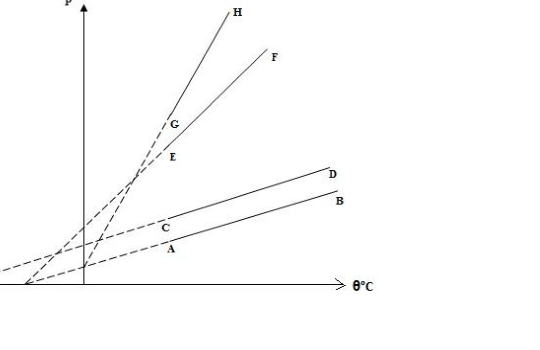
A scientist measures the pressure (P) of a particular mass of an ideal gas in a fixed volume as a function of temperature . The plot of his readings is shown in the figure below as the line AB.
He now repeats the experiment with the same gas in the same volume, but with different mass. Likely plot of pressure against temperature will be
Quesito 12
- (a) AB itself.
- (b) CD
- (c) EF
- (d) GH
Topic: Kinetic Theory Metodi: Ideal Gas Law Competenze: Diagrammatic Reasoning Objects: Gas Fonte: Testo (PDF) — p.5
Uno scienziato misura la pressione (P) di una particolare massa di un gas ideale in un volume fisso in funzione della temperatura . La grafica delle sue letture è mostrata nella figura seguente come la linea AB.
Ora ripete l’esperimento con lo stesso gas, nello stesso volume, ma con una massa diversa. Probabilmente il grafico di pressione contro la temperatura sarà
Quesito 12
- a) AB stessa.
- (b) CD
- (c) EF
- (d) GH
Topic: Kinetic Theory Metodi: Ideal Gas Law Competenze: Diagrammatic Reasoning Objects: Gas Fonte: Testo (PDF) — p.5
Seed of an angiosperm is composed of cells
- (a) Having diploid (2n) number of chromosomes only.
- (b) Having triploid (3n) number of chromosomes only.
- (c) Having diploid (2n) and triploid (3n) number of chromosomes.
- (d) Having diploid (2n), triploid (3n) and haploid (n) number of chromosomes.
Topic: Biology Metodi: Physical Modeling Competenze: Physical Reasoning Objects: — Fonte: Testo (PDF) — p.6
Il seme di un angiospermo è composto da cellule
- a) Avere solo numero di cromosomi diploidi (2n).
- b) Avendo solo un numero triploide (3n) di cromosomi.
- c) Numero di cromosomi diploidi (2n) e triploidi (3n).
- d) Numero di cromosomi diploide (2n), triploide (3n) e haploide (n).
Topic: Biology Metodi: Physical Modeling Competenze: Physical Reasoning Objects: — Fonte: Testo (PDF) — p.6
If the atomic number of a noble gas element is Z, then the element that has the greatest electronegativity in the same period according to the Pauling scale will have atomic number:
- (a)
- (b)
- (c)
- (d)
Topic: Chemistry Metodi: Physical Modeling Competenze: Physical Reasoning Objects: — Fonte: Testo (PDF) — p.6
Se il numero atomico di un elemento di gas nobile è Z, allora l’elemento che ha la maggiore elettronegatività nello stesso periodo secondo la scala di Pauling avrà un numero atomico:
- (a)
- (b)
- (c)
- (d)
Topic: Chemistry Metodi: Physical Modeling Competenze: Physical Reasoning Objects: — Fonte: Testo (PDF) — p.6
A mass hanging with a spring suspended from a ceiling is pulled down and released. The mass then oscillates with simple harmonic motion of period T. The graph shows how its distance from the ceiling varies with time. What can be deduced from the graph?
Quesito 15
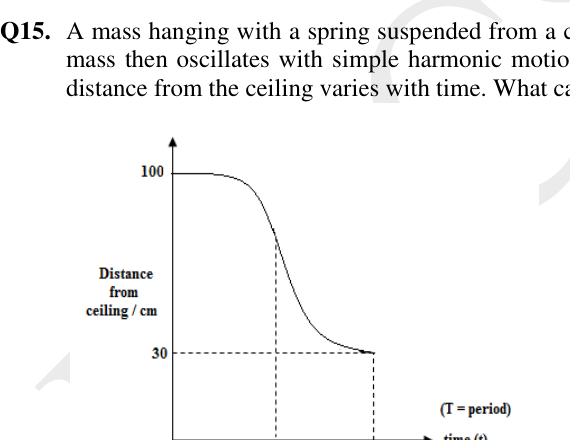
- (a) The amplitude of oscillations is 70 cm.
- (b) The kinetic energy is maximum at .
- (c) The speed is maximum at .
- (d) The restoring force on the mass increases between and .
Topic: Oscillations & Waves Metodi: Simple Harmonic Motion Analysis Competenze: Diagrammatic Reasoning Objects: Spring Fonte: Testo (PDF) — p.6
Una massa appesa con una molla sospesa dal soffitto viene abbassata e rilasciata. La massa oscilla quindi con un semplice movimento armonico del periodo T. Il grafico mostra come la sua distanza dal soffitto varia con il tempo. Cosa si può dedurre dal grafico?
Quesito 15
- a) L’ampiezza delle oscillazioni è di 70 cm.
- b) L’energia cinetica è massima a .
- (c) La velocità massima è .
- (d) L’energia di ripristino della massa aumenta tra e .
Topic: Oscillations & Waves Metodi: Simple Harmonic Motion Analysis Competenze: Diagrammatic Reasoning Objects: Spring Fonte: Testo (PDF) — p.6
The following question refers to energy transfer between trophic levels in an ecosystem. Primary production is the amount of light energy converted to chemical energy (organic compounds) by the autotrophs in an ecosystem during a given time period. Net Secondary production is the amount of chemical energy in consumers’ food that is converted to their own new biomass during a given period of time. The following figure represents the partitioning of energy by a caterpillar eating a leaf and consuming 200J of energy.
Quesito 16
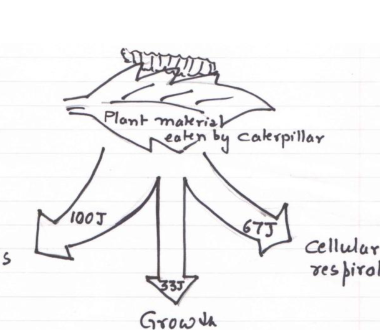
What percentage of the energy in the caterpillar’s food is actually used for secondary production?
- (a) 16.5
- (b) 33.0
- (c) 33.5
- (d) 49.5
Topic: Biology Metodi: Physical Modeling Competenze: Physical Reasoning Objects: — Fonte: Testo (PDF) — p.7
La domanda seguente si riferisce al trasferimento di energia tra livelli trofici in un ecosistema. La produzione primaria è la quantità di energia luminosa convertita in energia chimica (composti organici) dagli autotrofi in un ecosistema durante un determinato periodo di tempo. La produzione secondaria netta è la quantità di energia chimica negli alimenti dei consumatori che viene convertita nella loro nuova biomassa durante un determinato periodo di tempo. La figura seguente rappresenta la divisione dell’energia da parte di una ragna che mangia una foglia e consuma 200 J di energia.
Quesito 16
Quanti percentuali dell’energia contenuta nel cibo della pipistrella vengono effettivamente utilizzate per la produzione secondaria?
- (a) 16.5
- (b) 33.0
- (c) 33.5
- (d) 49.5
Topic: Biology Metodi: Physical Modeling Competenze: Physical Reasoning Objects: — Fonte: Testo (PDF) — p.7
Figure given below shows a small boat, containing some iron balls, floating on a still lake. These iron blocks are now dropped into the lake. Select the WRONG statement.
Quesito 17
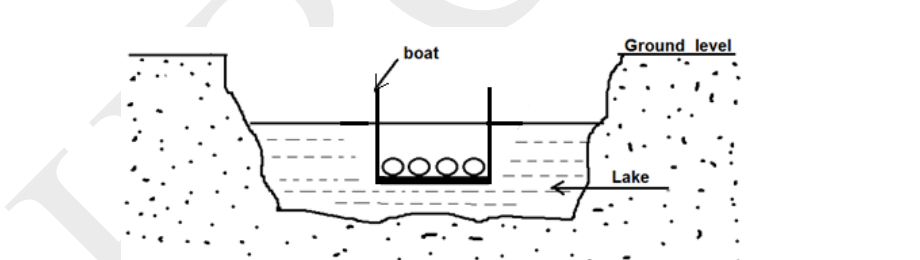
- (a) Level of the lake will fall, with ground reference.
- (b) The boat will rise, with water reference.
- (c) Level of the boat will rise, with ground reference.
- (d) Water level will not change, from the ground reference.
Topic: Fluid Mechanics Metodi: Hydrostatic Equilibrium Competenze: Physical Reasoning Objects: Ball Fonte: Testo (PDF) — p.7
La figura che segue mostra una piccola barca, contenente alcune palle di ferro, galleggiando su un lago fermo. Questi blocchi di ferro sono ora caduti nel lago. Selezionare la dichiarazione RALONG.
Quesito 17
- a) Il livello del lago diminuirà, con riferimento al suolo.
- b) La barca si alzerà, con riferimento all’acqua.
- c) Il livello della barca aumenterà, con riferimento al suolo.
- d) Il livello delle acque non cambierà, a partire dal punto di riferimento del suolo.
Topic: Fluid Mechanics Metodi: Hydrostatic Equilibrium Competenze: Physical Reasoning Objects: Ball Fonte: Testo (PDF) — p.7
Sudha was studying the reaction between aluminium and iodine using 1.2 g aluminium and 2.4 g iodine. Calculate the weight of aluminium iodide formed.
- (a) 2.57 g
- (b) 2.49 g
- (c) 1.35 g
- (d) 1.25 g
Topic: Chemistry Metodi: Physical Modeling Competenze: Physical Reasoning Objects: — Fonte: Testo (PDF) — p.8
Sudha stava studiando la reazione tra alluminio e iodio utilizzando 1,2 g di alluminio e 2,4 g di iodio. Calcolare il peso dell’iotido di alluminio formato.
- (a) 2.57 g
- (b) 2.49 g
- (c) 1.35 g
- (d) 1.25 g
Topic: Chemistry Metodi: Physical Modeling Competenze: Physical Reasoning Objects: — Fonte: Testo (PDF) — p.8
Students were studying cellular processes such as osmosis and plasmolysis. To make them understand the concept better, the teacher asked them to study the effect of a given solution on a specific plant cell. They placed the plant material in a given solution and studied the pattern of movement of water for about two hours duration. It was observed that there was no net movement of water during this period from the cell into the solution or vice a versa. Which of the following condition must be true in the given situation?
- (a) Turgor pressure is more than the wall pressure
- (b) Turgor pressure is equal to the wall pressure.
- (c) Turgor pressure is less than the wall pressure.
- (d) Turgor pressure is zero and wall pressure has a negative value.
Topic: Biology Metodi: Physical Modeling Competenze: Physical Reasoning Objects: — Fonte: Testo (PDF) — p.8
Gli studenti stavano studiando processi cellulari come l’osmosi e la plasmolisi. Per farli capire meglio il concetto, l’insegnante li chiese di studiare l’effetto di una determinata soluzione su una specifica cellula vegetale. Hanno messo il materiale vegetale in una soluzione data e hanno studiato il modello di movimento dell’acqua per circa due ore. Si è osservato che non vi era alcun movimento netto di acqua durante questo periodo dalla cellula nella soluzione o viceversa. Quale delle seguenti condizioni deve essere vera nella situazione data?
- a) La pressione di turgor è superiore alla pressione della parete
- (b) La pressione di turgor è pari alla pressione della parete.
- (c) La pressione di turgor è inferiore alla pressione della parete.
- (d) La pressione di turgor è zero e la pressione della parete ha un valore negativo.
Topic: Biology Metodi: Physical Modeling Competenze: Physical Reasoning Objects: — Fonte: Testo (PDF) — p.8
Soaps (sodium salt of fatty acid) are the molecules in which the two ends have differing properties, one is hydrophilic whereas other is hydrophobic. Hydrophobic part refers to tail of the soap which is always out of water.
Which of the following statement is true about soap?
| Hydrophilic | Hydrophobic | |
|---|---|---|
| (a) | Sodium | Fatty acid |
| (b) | Fatty acid | Sodium |
| (c) | Glycerine | Sodium |
| (d) | Sodium | Ester |
Topic: Organic Chemistry Metodi: Physical Modeling Competenze: Physical Reasoning Objects: — Fonte: Testo (PDF) — p.8
I saponi (sale di sodio di acido grasso) sono le molecole nelle quali le due estremità hanno proprietà diverse, una idrofila mentre l’altra è idrofbica. La parte idrofobia si riferisce alla coda del sapone che è sempre fuori acqua.
Quale delle seguenti affermazioni è vera riguardo al sapone?
♬ Idrofilo ♬ Idrofobo ♬ |---|---|---| (a) Sodio Acido grasso
B. # Acido grasso # Sodio
∙ c ∙ glicerina ∙ sodio ∙
Il sodio e’ l’ester
Topic: Organic Chemistry Metodi: Physical Modeling Competenze: Physical Reasoning Objects: — Fonte: Testo (PDF) — p.8
In Maize plant grafting cannot be done successfully because in this plant:
- (a) Cambium present is inactive.
- (b) Cambium is absent.
- (c) Cambium is short lived.
- (d) Cambia of stock and scion are incompatible.
Topic: Biology Metodi: Physical Modeling Competenze: Physical Reasoning Objects: — Fonte: Testo (PDF) — p.8
In Maiz non si può effettuare con successo il trapianto delle piante perché in questa pianta:
- (a) Cambium presente è inattivo.
- (b) Cambium è assente.
- (c) Cambium è di breve durata.
- d) Le variazioni di origine e di discendenza sono incompatibili.
Topic: Biology Metodi: Physical Modeling Competenze: Physical Reasoning Objects: — Fonte: Testo (PDF) — p.8
There exists a uniform magnetic field perpendicular and inwards to the plane of the figure, through rectangular area ABCD only. PQRS is a rectangular loop of an electrically conducting wire, partly inserted in the region ABCD, in the plane of the figure. Read the following statements.
Quesito 22
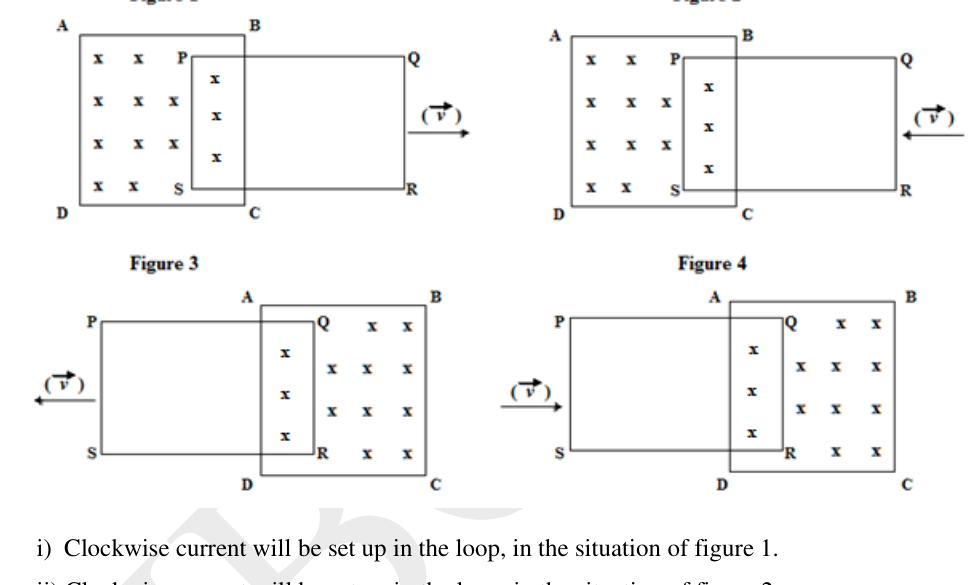
i) Clockwise current will be set up in the loop, in the situation of figure 1. ii) Clockwise current will be set up in the loop, in the situation of figure 2. iii) Clockwise current will be set up in the loop, in the situation of figure 3. iv) Clockwise current will be set up in the loop, in the situation of figure 4.
- (a) Only i and ii are correct.
- (b) Only i and iii are correct.
- (c) Only ii and iv are correct.
- (d) Only iii and iv are correct.
Topic: Electromagnetic Induction Metodi: Lenz’s Law, Faraday’s Law of Induction Competenze: Diagrammatic Reasoning Objects: Wire Fonte: Testo (PDF) — p.9
Esiste un campo magnetico uniforme perpendicolare e verso l’interno del piano della figura, attraverso l’area rettangolare ABCD solo. Il PQRS è un ciclo rettangolare di un filo elettricamente conduttore, inserito in parte nella regione ABCD, nel piano della figura. Leggi le seguenti affermazioni.
Quesito 22
i) La corrente in senso orario sarà impostata nel ciclo, nella situazione della figura 1. ii) La corrente in senso orario sarà impostata nel ciclo, nella situazione della figura 2. iii) La corrente in senso orario sarà impostata nel ciclo, nella situazione della figura 3. iv) La corrente in senso orario sarà impostata nel ciclo, nella situazione della figura 4.
- (a) Solo i e ii sono corretti.
- b) Solo i e iii sono corretti.
- (c) Solo ii e iv sono corretti.
- d) Solo iii e iv sono corrette.
Topic: Electromagnetic Induction Metodi: Lenz’s Law, Faraday’s Law of Induction Competenze: Diagrammatic Reasoning Objects: Wire Fonte: Testo (PDF) — p.9
Minute arm and hour arm of a clock come together after every 65 minutes as measured by an ideal clock. How much does the clock gain per day?
- (a) Little less than 600 sec.
- (b) Little more than 600 sec.
- (c) Exactly 600 sec.
- (d) Clock will not gain but, will lose time.
Topic: Mathematics Metodi: Physical Modeling Competenze: Physical Reasoning Objects: — Fonte: Testo (PDF) — p.9
Il braccio minuto e l’ora di un orologio si uniscono dopo ogni 65 minuti, come misurato da un orologio ideale. Quanto guadagna l’orologio al giorno?
- (a) Poco meno di 600 secondi.
- (b) Poco più di 600 secondi.
- (c) Esattamente 600 secondi.
- (d) L’orologio non guadagna ma perde tempo.
Topic: Mathematics Metodi: Physical Modeling Competenze: Physical Reasoning Objects: — Fonte: Testo (PDF) — p.9
Alkaline potassium permanganate or acidified potassium dichromate is used to convert alcohol to acid. Choose the correct option from the following if methanol () is treated with acidified potassium dichromate solution.
| Formula of acid formed | Potassium dichromate is undergoing | Methanol is undergoing | |
|---|---|---|---|
| (a) | CHCOOH | Reduction | oxidation |
| (b) | HCOOH | Oxidation | Reduction |
| (c) | CHCOOH | Oxidation | Reduction |
| (d) | HCOOH | Reduction | oxidation |
Topic: Organic Chemistry Metodi: Physical Modeling Competenze: Physical Reasoning Objects: — Fonte: Testo (PDF) — p.10
Per convertire l’alcol in acido si utilizza il permanganato di potassio alcalino o il dichromato di potassio acido. Scegliere la scelta corretta tra le seguenti se il metanolo () viene trattato con soluzione di dichromato di potassio acido.
La formula di acido formato # # il dichromato di potassio viene sottoposto # # il metanolo viene sottoposto
|---|---|---|---|
# # # # # # # # # # # # # # # # # # # # # # # # # # # # # # # # # # # # # # # # # # # # # # # # # # # # # # # # # # # # # # # # # # # # # # # # # # # # # # # # # # # # # # # # # # # # # # # # # # # # # # # # # # # # # # # # # # # # # # # # # # # # # # # # # # # # # # # # # # # # # # # # # # # # # # # # # # # # # # # # # # # # # # # # # # # # # # # # # # # # # # # # # # # # # # # # # # # # # # # # # # # # # # # # # # # # # # # # # # # # # # # # # # # # # # # # # # # # # # # # # # # # # # # # # # # # # # # # # # # # # # # # # # # # # # # # # # # # # # # # # # # # # # # # # # # # # # # # # # # # # # # # # # # # # # # # # # # # # # # # # # # # # # # # # # # # # # # # # # # # # # # # # # # # # # # # # # # # # # # # # # # # # # # # # # # # # # # # # # # # # # # # # # # # # # # # # # # # # # # # # # # # # # # # # # # # # # # # # # # # # # # # # # # # # # # # # # # # # # # # # # # # # # # # # # # # # # # # # # # # # # # # # # # # # # # # # # # # # # # # # # # # # # # # # # # # # # # # # # # # # # # # # # # # #
B # HCOOH # Oxidazione # Riduzione
(c) # CHCOOH # # Oxidazione # # riduzione
# Riduzione # # ossidazione
Topic: Organic Chemistry Metodi: Physical Modeling Competenze: Physical Reasoning Objects: — Fonte: Testo (PDF) — p.10
Study the following ray diagram in which: ‘A’ represents atmosphere, ‘B’ represents green plants, ‘C’ represents decomposers and ‘D’ represents animals.
Quesito 25
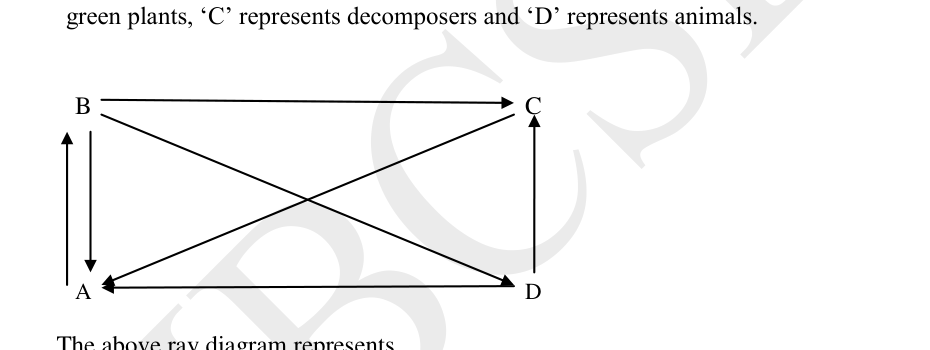
The above ray diagram represents
- (a) Energy flow through the given ecosystem.
- (b) Interconnections among different food chains in the given ecosystem.
- (c) Movement of carbon among A, B, C and D.
- (d) Movement of nitrogen among A, B, C and D.
Topic: Biology, Earth & Environmental Science Metodi: Physical Modeling Competenze: Diagrammatic Reasoning Objects: — Fonte: Testo (PDF) — p.10
Studiare il seguente diagramma di raggi in cui: “A” rappresenta l’atmosfera, “B” rappresenta le piante verdi, “C” rappresenta i decomponenti e “D” rappresenta gli animali.
Quesito 25
Il diagramma di raggi di cui sopra rappresenta
- a) flusso di energia attraverso l’ecosistema.
- b) Interconnessioni tra le diverse catene alimentari del determinato ecosistema.
- (c) Movimento del carbonio tra A, B, C e D.
- (d) Movimento di azoto tra A, B, C e D.
Topic: Biology, Earth & Environmental Science Metodi: Physical Modeling Competenze: Diagrammatic Reasoning Objects: — Fonte: Testo (PDF) — p.10
A bottle of 200 ml of hydrogen peroxide was accidentally left open for long time. Which of the following facts hold good for the chemical reaction that takes place? ( is an equilibrium constant in terms of partial pressures of reactants and products and is equilibrium constant in terms of molar concentrations of reactants and products).
- (a)
- (b)
- (c)
- (d) and cannot be correlated
Topic: Chemistry Metodi: Physical Modeling Competenze: Physical Reasoning Objects: — Fonte: Testo (PDF) — p.10
Una bottiglia di 200 ml di perossido di idrogeno è stata accidentalmente lasciata aperta per molto tempo. Quali dei seguenti fatti sono validi per la reazione chimica che si verifica? ( è una costante di equilibrio in termini di pressioni parziali dei reagenti e dei prodotti e è una costante di equilibrio in termini di concentrazioni molari di reagenti e prodotti).
- (a)
- (b)
- (c)
- (d) e non possono essere correlati
Topic: Chemistry Metodi: Physical Modeling Competenze: Physical Reasoning Objects: — Fonte: Testo (PDF) — p.10
Three filament bulbs made from a metal of low thermal coefficient of resistivity are arranged as shown in the figure. The wattage rating of each bulb is the power output if it is connected independently across 240V. The bulb that glows brightest and least bright are respectively:
Quesito 27
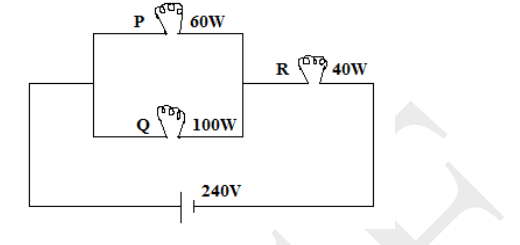
- (a) P,Q
- (b) Q,R
- (c) Q,P
- (d) R,Q
Topic: Circuits Metodi: Kirchhoff’s Laws Competenze: Physical Reasoning Objects: Wire Fonte: Testo (PDF) — p.11
Tre lampadine a filamento realizzate in metallo con un basso coefficiente di resistenza termica sono disposte come mostrato nella figura. La potenza di ogni lampadina è la potenza di uscita se è collegata indipendentemente su 240 V. Le lampadine che brillano di più e meno brillanti sono rispettivamente:
Quesito 27
- (a) P,Q
- (b) Q,R
- (c) Q,P
- (d) R,Q
Topic: Circuits Metodi: Kirchhoff’s Laws Competenze: Physical Reasoning Objects: Wire Fonte: Testo (PDF) — p.11
Alka was walking through a forest. A leech caught one of her legs. It sucked blood and got detached from Alka’s leg when it was full with blood. Find which of the following observations of the table in column ‘A’ will be true in this case. Further, from the options given below (a, b, c, d) find the correct option which matches the suitable explanation (in column ‘B’) to your selected answer in column ‘A’.
| Column A | Column B |
|---|---|
| i. Bleeding from Alka’s leg will stop immediately. | 1. Leech produces only anticoagulant when it attaches human body. |
| ii. Bleeding from Alka’s leg will stop immediately but she will feel acute pain immediately after the leech detaches from her leg. | 2. Leech produces anticoagulant as well as anti-inflammatory substance (histamine like) when it attaches to human body. |
| iii. Alka will continue to bleed for some time with acute pain in her leg after the leech detaches from her leg. | 3. Leech plugs the blood vessel when it detaches from human body. |
| iv. Alka will continue to bleed for sometime without any pain after the leech detaches from her leg. | 4. Leech plugs the blood vessel and removes anti-inflammatory substance when it detaches from the human body. |
- (a) i-3
- (b) ii-4
- (c) iii-1
- (d) iv-2
Topic: Biology Metodi: Physical Modeling Competenze: Physical Reasoning Objects: — Fonte: Testo (PDF) — p.11
Alka camminava attraverso una foresta. Una sanguisughe ha preso una delle sue gambe. Succhiava sangue e si staccava dalla gamba di Alka quando era piena di sangue. Scopri quale delle seguenti osservazioni della tabella nella colonna “A” sarà vera in questo caso. Inoltre, dalle opzioni di seguito indicate (a, b, c, d) trovate l’opzione corretta che corrisponda alla spiegazione appropriata (in colonna “B”) alla risposta selezionata nella colonna “A”.
Colonna A # Colonna B
|---|---| | i. Il sanguinamento dalla gamba di Alka si fermerà immediatamente. | 1. Le leech producono solo anticoagulanti quando si attaccano al corpo umano. | | ii. Il sanguinamento dalla gamba di Alka si fermerà immediatamente ma sentirà un dolore acuto subito dopo che la sanguisughe si stacca dalla gamba. | 2. Il liucido produce un anticoagulante e una sostanza anti-infiammatoria (come l’istamina) quando si attacca al corpo umano. |
Il terzo. Alka continuerà a sanguinare per un po’ con dolore acuto alla gamba dopo che la sanguisughe si stacca dalla gamba. | 3. Leech blocca il vaso sanguigno quando si stacca dal corpo umano. |
| iv. Alka continuerà a sanguinare per un po’ senza dolore dopo che la sanguisughe si stacca dalla gamba. | 4. Le leucite collegano il vaso sanguigno e rimuovono la sostanza anti-infiammatoria quando si stacca dal corpo umano. |
- (a) i-3
- (b) ii-4
- c) iii-1
- (d) iv-2
Topic: Biology Metodi: Physical Modeling Competenze: Physical Reasoning Objects: — Fonte: Testo (PDF) — p.11
An equiconvex lens of focal length f is cut into two equal halves which are pasted as shown in the figure, the focal length of the new system will be:
Quesito 29
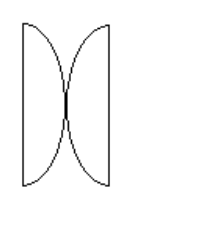
- (a)
- (b)
- (c)
- (d) Infinity.
Topic: Geometric Optics Metodi: Thin Lens & Mirror Equation Competenze: Physical Reasoning Objects: Lens Fonte: Testo (PDF) — p.12
Un obiettivo equiconvex di distanza focale f viene tagliato in due metà uguali che vengono incollate come mostrato nella figura, la distanza focale del nuovo sistema sarà:
Quesito 29
- (a)
- (b)
- (c)
- (d) Infinito.
Topic: Geometric Optics Metodi: Thin Lens & Mirror Equation Competenze: Physical Reasoning Objects: Lens Fonte: Testo (PDF) — p.12
Sunanda was experimenting with an electrolytic cell. She took an aqueous solution of sodium chloride and added some zinc sulphate into it. When she dipped platinum electrodes in the electrolyte and passed electric current through the solution the species discharged at cathode and anode respectively were
- (a) Zinc and Chlorine
- (b) Sodium and Oxygen
- (c) Hydrogen and Chlorine
- (d) Zinc and Oxygen
Topic: Chemistry Metodi: Physical Modeling Competenze: Physical Reasoning Objects: — Fonte: Testo (PDF) — p.12
Sunanda stava sperimentando una cella elettrolitica. Prendendo una soluzione acquosa di cloruro di sodio, le aggiunse del solfato di zinco. Quando ha immerso elettrodi di platino nell’ elettrolita e ha passato corrente elettrica attraverso la soluzione le specie scaricate al catodo e all’ anodo rispettivamente sono state
- a) Zinc e cloro
- b) Sodio e ossigeno
- (c) Idrogeno e cloro
- d) Zinc e ossigeno
Topic: Chemistry Metodi: Physical Modeling Competenze: Physical Reasoning Objects: — Fonte: Testo (PDF) — p.12
Section B (analytical, long questions). Questions 31 to 42 are of 5 marks each. Marks will also be indicated in the questions if there is more than one part to it.
Theory question based on the need for different sizes of cells. Metabolic requirements of a cell impose upper limits on its size that is practical for a single cell. The plasma membrane functions as a selective barrier that allows passage of oxygen, nutrients and wastes to service the cell. For each square micrometer of membrane, only a limited amount of material can cross per second, so the ratio of surface area to volume is critical. The following exercise asks you to calculate the volume and surface areas of two actual cells — a mature yeast cell and a cell budding from it.
The unicellular yeast Saccharomyces cerevisiae divides by budding off a small new cell that then grows to full size. During its growth, the new cell synthesises new cytoplasm, which increases its volume and new plasma membrane which increases its surface area. In an experiment yeast cells were grown under conditions that promoted division by budding. The cells were then viewed with a differential interference contrast light microscope and photographed. The drawing below shows a budding yeast about to be released from the mature parent cell.
Quesito 31
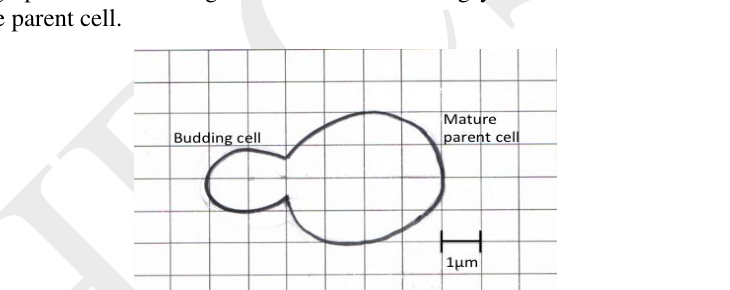
(i) Based on the above figure calculate the volume of the mature parent cell and the budding yeast cell. For calculations the shape of each cell can be considered to be a sphere. (). Answers to be rounded off to whole numbers. [1 mark]
(ii) Based on the above figure calculate the surface area of the mature parent cell and the budding yeast cell. () [0.5 marks]
(iii) Calculate the surface area to volume ratio for a mature yeast cell? [0.5 marks]
(iv) Fill in the blanks from the given choice: [2 marks] a) As the budding cell increases in size, it’s surface area grows proportionally ____________ (less / more) than its volume. b) A smaller cell has a ____________ (lesser / greater) ratio of surface area to volume than a larger cell. c) Cells that exchange a lot of material with their surroundings are expected to have ____________ (a high ratio of surface area to volume / a high ratio of volume to surface area) d) Between intestinal and mesophyll cells, the ____________ (intestinal / mesophyll) cells have higher ratio of surface area to volume.
(v) Nine small cells have the same volume (take up the same amount of space) as a certain large cell. Which has more cell membrane for nutrients and wastes to pass? (the one large cell / the nine smaller cells) [1 mark]
Topic: Biology Metodi: Physical Modeling Competenze: Estimation & Approximation Objects: — Fonte: Testo (PDF) — p.13
**Sezione B (interrogazioni analisiche e lunghe). ** Le domande da 31 a 42 hanno 5 punti ciascuno. Le domande contengono anche segni se sono costituite da più di una parte.
Questione teorica basata sulla necessità di diverse dimensioni delle cellule. I requisiti metabolici di una cellula impongono limiti superiori alla sua dimensione che sono pratici per una singola cellula. La membrana plasmatica **** funziona come barriera selettiva che consente il passaggio di ossigeno, nutrienti e rifiuti per servire la cellula. Per ogni micrometro quadrato di membrana, solo una quantità limitata di materiale può attraversare al secondo, quindi il rapporto tra superficie e volume è critico. L’esercizio seguente ti chiede di calcolare il volume e le superfici di due cellule reali una cellula di lievito matura e una cellula che ne germoglia.
Il lievito unicellulare Saccharomyces cerevisiae si divide spuntando una piccola nuova cellula che poi cresce fino a raggiungere la sua dimensione. Durante la sua crescita, la nuova cellula sintetizza un nuovo citoplasma, che aumenta il suo volume e una nuova membrana plasmatica, che aumenta la sua superficie. In un esperimento le cellule dei lieviti sono state coltivate in condizioni che promuovevano la divisione con la germogliatura. Le cellule sono state poi viste con un microscopio di luce a contrasto di interferenza differenziale e fotografate. Il disegno che segue mostra un lievito che sta per essere rilasciato dalla cellula madre matura.
Quesito 31
-
basandosi sulla figura di cui sopra, calcolare il volume della cellula madre matura e della cellula di lievito in fiore. Per i calcoli la forma di ciascuna cella può essere considerata una sfera. (). Risposte da arrotondare a numeri interi. [1 segno]
-
sulla base della figura sopra indicata calcolare l’area superficiale della cellula madre matura e della cellula fermentatrice in fiore. () [0,5 punti]
(iii) Calcolare il rapporto superficie/volume di una cellula di lievito matura? [0,5 punti]
(iv) Compilare i vuoti della scelta data: [2 punti] a) Man mano che la cellula in erba aumenta di dimensioni, la sua superficie aumenta proporzionalmente ____________ (meno / più) rispetto al suo volume. b) Una cella più piccola ha un rapporto di superficie/volume di ____________ (minore/> maggiore) rispetto a una cella più grande. c) Le cellule che scambiano molto materiale con il loro ambiente si prevede che abbiano ____________ (un rapporto alto di superficie/volume / un rapporto alto di volume/volume) d) Tra le cellule intestinali e mesofilli, le cellule ____________ (intestinale / mesofilli) hanno un rapporto più elevato di superficie al volume.
(v) Nove piccole celle hanno lo stesso volume (occupano lo stesso spazio) di una certa grande cellula. Che ha più membrana cellulare per i nutrienti e i rifiuti? (la singola grande cellula / le nove cellule più piccole) [1 segno]
Topic: Biology Metodi: Physical Modeling Competenze: Estimation & Approximation Objects: — Fonte: Testo (PDF) — p.13
(a) Twelve identical wires are connected in the plane as shown in the figure. The six meter wires make a regular hexagon and the remaining six join the vertices of this hexagon with common centre at C. Each wire has a resistance of 20 . Calculate effective resistance between A and B. (If you connect a battery across A and B, the currents in AC and CB are the same and those in DC and CE are the same). [3 marks]
Quesito 32
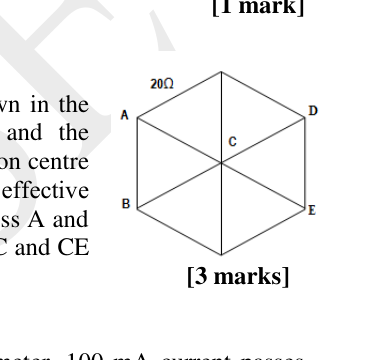
(b) When 5 V are applied across the terminals of a galvanometer, 100 mA current passes through its coil and the galvanometer shows full scale deflection. With suitable modification, it can be used to measure p.d. or currents with certain sensitivities.
A shunt resistance is now connected parallel to the galvanometer so that 80 % of the current approaching the coil goes through the shunt. This ammeter is used to measure current supplied by an ideal cell of emf 6 V, connected across a bulb of resistance 40 . Calculate the error (percentage) in the measurement of current passing through the bulb? [2 marks]
Topic: Circuits Metodi: Equivalent Circuit Reduction, Kirchhoff’s Laws Competenze: Measurement & Instrumentation Objects: Wire, Galvanometer, Battery Fonte: Testo (PDF) — p.14
A) 12 fili identici sono collegati nel piano, come mostrato nella figura. I fili di sei metri formano un esagono regolare e gli altri sei si uniscono ai vertici di questo esagono con centro comune a C. Ogni filo ha una resistenza di 20 . Calcolare la resistenza effettiva tra A e B. (Se si collega una batteria attraverso A e B, le correnti in AC e CB sono le stesse e quelle in DC e CE sono le stesse). **[3 punti] **
Quesito 32
b) Quando si applicano 5 V attraverso i terminali di un galvanometro, una corrente di 100 mA passa attraverso la sua bobina e il galvanometro mostra una deviazione a scala completa. Con una modifica appropriata, può essere utilizzata per misurare la p.d. o correnti con certe sensibilità.
Una resistenza di scatto è ora collegata parallela al galvanometro in modo che l’80% della corrente che si avvicina alla bobina passa attraverso lo scatto. Questo ammeter è utilizzato per misurare la corrente fornita da una cella ideale di emf 6 V, collegata attraverso un’ampolla di resistenza 40 . Calcolare l’errore (percentuale) nella misurazione della corrente che passa attraverso la lampadina? ** [2 punti] **
Topic: Circuits Metodi: Equivalent Circuit Reduction, Kirchhoff’s Laws Competenze: Measurement & Instrumentation Objects: Wire, Galvanometer, Battery Fonte: Testo (PDF) — p.14
(a) Jiya had a piece of plumber’s solder weighing 3.0g. She dissolved it in dilute nitric acid and the resultant solution she treated with . She got precipitate of lead sulphate which after washing and drying weighed 2.93g. From the filtrate she obtained stannic acid. She heated stannic acid to obtain stannic oxide. The yield of stannic oxide was 1.27 g. Help Jiya to find out percentage of lead and stannous in the piece of plumber’s solder. [3 Marks]
(b) Methyl orange and phenolphthalein are two commonly used indicators in neutralization titrations. Acid base indicators are weak acids that can be represented as HIn. These indicators dissociate in alkaline medium to give the anionic form (In⁻).
i. Write the equation for dissociation of indicator. [0.5 Mark] ii. Study the expression for dissociation constant (Kln) for the indicator. [0.5 Mark] iii. From the expression obtained in (ii) derive an expression for pH of the indicator in terms of . [0.5 Mark] iv. If the value of dissociation constant for an indicator is then calculate pH of the solution at the point at which the concentration of anionic form and undissociated form of the indicator become equal. [0.5 Mark]
Topic: Chemistry Metodi: Physical Modeling Competenze: Physical Reasoning Objects: — Fonte: Testo (PDF) — p.14
(a) Jiya aveva un pezzo di soldata di idraulico di peso di 3,0 g. La sciolse in acido nitrico diluito e la soluzione risultante trattata con . Ha ottenuto precipitati di solfato di piombo che dopo averlo lavato e asciugato pesava 2,93 grammi. Dal filtro ha ottenuto l’acido stannico. Ha riscaldato l’acido stannico per ottenere l’ossido stannico. Il rendimento dell’ossido di stannico era di 1,27 g. Aiuta Jiya a scoprire la percentuale di piombo e stanno nel pezzo della soldata del idraulico. ** [3 Marchi] **
b) L’arancia metilica e la fenolftalaina sono due indicatori comunemente utilizzati per le titrazioni di neutralizzazione. Gli indicatori di base acida sono acidi deboli che possono essere rappresentati come HIn. Questi indicatori si dissociano in mezzo alcalino per dare la forma anionica (In−).
i. Scrivi l’equazione per la dissociazione dell’indicatore. [0,5 Marchio] ii. Studiare l’espressione per la costante di dissociazione (Kln) per l’indicatore. [0,5 Marchio] iii. Dall’espressione ottenuta al punto ii) deriva un’espressione per il pH dell’indicatore in termini di . [0,5 Marchio] iv. Se il valore della costante di dissociazione di un indicatore è , calcolare il pH della soluzione al punto in cui la concentrazione della forma anionica e la forma non dissociata dell’indicatore diventano uguali. [0,5 Marchio]
Topic: Chemistry Metodi: Physical Modeling Competenze: Physical Reasoning Objects: — Fonte: Testo (PDF) — p.14
Answer the following questions.
(i) Study the following food web and answer the questions. [3 Marks]
Quesito 34
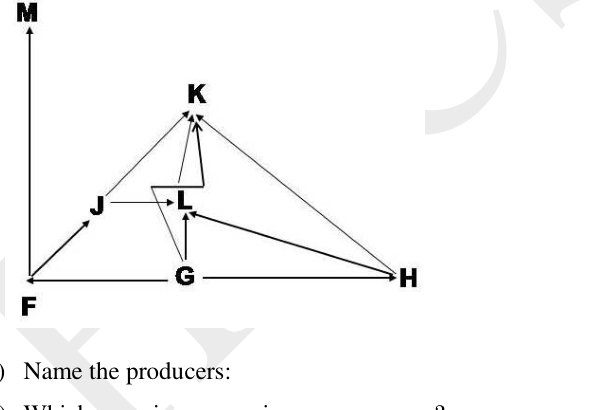
a) Name the producers: b) Which organisms are primary consumers? c) Which organisms will receive maximum energy in the ecosystem? d) Which organisms represent top level carnivores? e) Which organisms occupy more than one trophic levels in the given food web?
(ii) Tropical rain forest biome is constituted by four very distinct layers of trees. These layers have been identified as the emergent layer, canopy, understory, and forest floor.
The emergent layer contains a small number of very large trees called emergents, which grow above the general canopy, reaching heights of 45–55 meters, or even larger. They withstand the hot temperatures and strong winds that occur above the canopy in some areas.
The canopy layer contains trees, typically 30 metres to 45 tall. The plants here are adapted to carry out photosynthesis efficiently in bright sunlight. Light is easily available at the top of this layer, but it greatly reduces the amount of light below it.
The understory layer lies between the canopy and the forest floor. The plants here are adapted to grow under conditions that promoted growth in shade tolerant species. They photosynthesise adequately using the little amount of light that reaches their leaves. They often are able to use wavelengths that canopy tree has fallen and created an opening. The forest floor, usually receives only 2% of the sunlight that is actually incident on earth surface. Only plants adapted to low light can grow in this region. A lot of litter falls on the ground where it is decomposed by decomposers.
Answer the questions given below.
a) A study was conducted to find out the physiologic differences between the trees of the canopy and understory plants. Photosynthesis rate at various irradiance level ( i.e. photons of light that strike the leaf-measured in ) was measured and a graph was plotted to obtain a photosynthesis response curve for a leaf of a plant from the canopy and that from an understory as shown below (Rate of photosynthesis is measured as net evolution).
Quesito 34
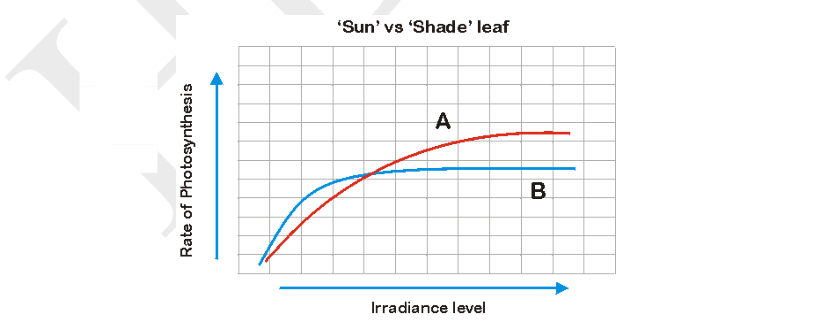
Which curve shows the photosynthesis rate of a leaf of a plant that is growing in the understory? ____________ [1Mark]
b) State whether the following statements are true or false. [1 Mark] bi) Both the curves level off (reach saturation point) after certain irradiance level because the light dependent reaction gets limited by the products produced during light independent reaction. bii) On average, the rate of photosynthesis is higher for curve A when compared to curve B at lower level of irradiance.
Topic: Biology, Earth & Environmental Science Metodi: Physical Modeling Competenze: Diagrammatic Reasoning Objects: — Fonte: Testo (PDF) — p.15
Raccontare alle seguenti domande.
(i) Studiare la seguente rete alimentare e rispondere alle domande. ** [3 Marchi] **
Quesito 34
a) Indicare i produttori: b) Quali organismi sono i principali consumatori? c) Quali organismi riceveranno la massima energia nell’ecosistema? d) Quali organismi rappresentano carnivori di livello superiore? e) Quali organismi occupano più di un livello trofico nella rete alimentare data?
- il bioma della foresta pluviale tropicale è costituito da quattro strati molto distinti di alberi. Questi strati sono stati identificati come strato emergente, copertura, sottosuolo e pavimento forestale.
Lo strato emergente **** contiene un piccolo numero di alberi molto grandi chiamati emergenti, che crescono sopra il dosso generale, raggiungendo altezze di 4555 metri o anche maggiori. Sopportano le temperature calde e i forti venti che si verificano sopra il dosaggio in alcune zone.
Lo strato canopy contiene alberi, di solito da 30 a 45 metri di altezza. Le piante qui sono adattate per svolgere la fotosintesi in modo efficiente alla luce del sole. La luce è facilmente disponibile in alto di questo strato, ma riduce notevolmente la quantità di luce sotto di esso.
Lo strato ** sottosetto** si trova tra il copricapo e il pavimento forestale. Le piante qui sono adattate a crescere in condizioni che promuovono la crescita di specie tolleranti all’ombra. Si fotosintesificano adeguatamente utilizzando la piccola quantità di luce che raggiunge le loro foglie. Spesso sono in grado di usare lunghezze d’onda che il canopy tree ha caduto e creato un’apertura. Il pavimento forestale ****, di solito riceve solo il 2% della luce solare che effettivamente incide sulla superficie terrestre. Solo le piante adatte a scarse luci possono crescere in questa regione. Molte letti cadono sul terreno e vengono decomposti da decomponenti.
Raccontate alle domande di seguito.
a) È stato condotto uno studio per scoprire le differenze fisiologiche tra gli alberi della canopra e le piante sotterranee. Rate di fotosintesi a vari livelli di irradiazione (ad esempio: fotoni di luce che colpiscono la foglia misurata in ) sono stati misurati e un grafico è stato tracciato per ottenere una curva di risposta alla fotosintesi per una foglia di una pianta dal copricapo e quella da un sotterraneo come mostrato di seguito (il tasso di fotosintesi è misurato come evoluzione netta ).
Quesito 34
Quale curva mostra il tasso di fotosintesi di una foglia di pianta che cresce nel sottosortimento? ____________ [1Mark]
b) Indicare se le seguenti affermazioni sono vere o false. [1 Marchio] bi) Entrambe le curve si allontanano (arrivano al punto di saturazione) dopo un certo livello di irradiazione, poiché la reazione a luce dipendente è limitata dai prodotti prodotti durante la reazione a luce indipendente. Bi) In media, il tasso di fotosintesi è più elevato per la curva A rispetto alla curva B a un livello inferiore di irradiazione.
Topic: Biology, Earth & Environmental Science Metodi: Physical Modeling Competenze: Diagrammatic Reasoning Objects: — Fonte: Testo (PDF) — p.15
(a) A cylindrical vessel of diameter 12 cm contains of water. A cylindrical solid glass piece of diameter 8 cm and height 8 cm is placed in the vessel. If a point object at the bottom of the vessel under the glass piece is seen by paraxial rays, looking at the image of this object and find the total apparent shift of the bottom. Refractive index of water and refractive index of glass . [3 marks]
(b) The sharpest image of the sun cast by a converging lens with focal length 25 cm has a diameter of 0.5 cm. A diverging lens of focal length 10 cm is placed at 15 cm from the converging lens on the other side of the sun. Determine the size of the final image and its position with respect to the diverging lens? [2 marks]
Topic: Geometric Optics Metodi: Thin Lens & Mirror Equation, Snell’s Law Competenze: Physical Reasoning Objects: Lens, Cylinder, Container Fonte: Testo (PDF) — p.17
a) Un recipiente cilindrico di 12 cm di diametro contiene di acqua. Nel recipiente si colloca un vetro massiccio cilindrico di 8 cm di diametro e 8 cm di altezza. Se un oggetto puntato al fondo del recipiente sotto il pezzo di vetro viene visto da raggi paraxiali, osservando l’immagine di questo oggetto e trovando il spostamento totale apparente del fondo. Indice di rifrazione dell’acqua e indice di rifrazione del vetro . **[3 punti] **
b) L’immagine più nitida del sole realizzata da una lente convergente con una lunghezza focale di 25 cm ha un diametro di 0,5 cm. Un obiettivo divergente di 10 cm di lunghezza focale è posizionato a 15 cm dall’obiettivo convergente dall’altro lato del sole. Determinare la dimensione dell’immagine finale e la sua posizione rispetto alla lente divergente? ** [2 punti] **
Topic: Geometric Optics Metodi: Thin Lens & Mirror Equation, Snell’s Law Competenze: Physical Reasoning Objects: Lens, Cylinder, Container Fonte: Testo (PDF) — p.17
Decay of organic matter such as vegetation or chemical reaction with sulphur containing mineral in rock and soil produces gas which has rotten egg smell. Calculate the percentage dissociation of the gas produced by the sulphur reducing bacteria if dissociation constant (Kc) of the gas is . There are 0.1 moles of the gas in an vessel.
i. Write the equation for dissociation of the gas produced in the reaction. [1 Mark] ii. If x mols of the gas are dissociated, write the expression for equilibrium constant in terms of x. (Detail working expected) [2 Marks] iii. Calculate the value of x and hence percentage dissociation. [2 Marks]
Topic: Chemistry Metodi: Physical Modeling Competenze: Physical Reasoning Objects: — Fonte: Testo (PDF) — p.17
Il decadimento di sostanze organiche come la vegetazione o la reazione chimica con minerali contenenti zolfo nella roccia e nel suolo produce gas che ha odore di uova marcite. Calcolare la dissociazione percentuale del gas prodotta dai batteri riduttori del zolfo se la costante di dissociazione (Kc) del gas è . Ci sono 0,1 mol di gas in un recipiente .
i. Scrivi l’equazione per la dissociazione del gas prodotto nella reazione. [1 Marchio] ii. Se x mol del gas sono dissociati, scrivete l’espressione per la costante di equilibrio in termini di x. (Trasporto previsto) [2 Marks] iii. Calcolare il valore di x e quindi la dissociazione percentuale. ** [2 Marchi] **
Topic: Chemistry Metodi: Physical Modeling Competenze: Physical Reasoning Objects: — Fonte: Testo (PDF) — p.17
Answer the following questions.
(i) Name the region of alimentary canal where maximum digestion of carbohydrate takes place. [0.5 mark]
(ii) Name the region of alimentary canal where lipid digestion starts. [0.5 mark]
(iii) Which of the following event most likely would not happen in stomach? a) Inactivation of salivary amylase b) Denaturation of proteins that helps in its subsequent digestion c) Activation of salivary amylase d) Activation of pepsin [0.5 mark]
(iv) A biochemist isolated active amylase enzyme from human saliva. She was interested in assaying the enzyme activity of amylase. Which of the following buffer will she be most likely choosing?
| Name of the buffer | Sodium acetate buffer | Sodium Phosphate Buffer | Tris-Hcl buffer | CAPS buffer |
|---|---|---|---|---|
| pH at room temperature | 2.00 | 6.8 | 8.10 | 9.7 |
Answer ____________ [0.5 mark]
(v) A sprint runner was fasting a night before the running event due to spiritual reasons. On the day of the event also he did not take his breakfast and chose to run empty stomach. After he completed the running, he was given 300 ml of 10% glucose solution to drink. If the absorption efficiency of glucose through his intestine is 10%, then calculate the total number and mole of ATP that will be generated out of the glucose he had taken. Consider that complete oxidation of one glucose molecule generates 36 ATP. [3 marks]
[Instructions: M.W. glucose: 180; M.W. ATP: 507, Consider 1 mole molecules]
Important: Show steps of your calculations as they carry marks
Topic: Biology Metodi: Physical Modeling Competenze: Physical Reasoning Objects: — Fonte: Testo (PDF) — p.18
Raccontare alle seguenti domande.
- Indicare la regione del canale alimentare in cui si svolge la massima digestione dei carboidrati. [0,5 punto]
(ii) Indicare la regione del canale alimentare in cui inizia la digestione dei lipidi. [0,5 punto]
(iii) Quale dei seguenti eventi non sarebbe probabilmente avvenuto nello stomaco? a) Inaattivazione dell’ amilasa salivaria b) Denaturazione delle proteine che aiuta nella loro successiva digestione c) Attivazione dell’ amilasa saliva d) Attivazione di pepsina **[0,5 punto] **
(iv) Un biochimico ha isolato l’enzima attiva di amilasa dalla saliva umana. Era interessata a analizzare l’attività enzimatica dell’amilasa. Quale dei seguenti buffer sceglierà probabilmente?
Il nome del buffer # # Buffer di aceto di sodio # # Buffer di fosfato di sodio # Buffer di Tris-Hcl # Buffer di CAPS
|---|---|---|---|---| ♬ pH a temperatura ambiente 2.00 ♬ 6.8 ♬ 8.10 ♬ 9.7 ♬
Risposta ____________ [0,5 punto]
(v) Un corridore di sprint digiunava una notte prima dell’evento di corsa per ragioni spirituali. Anche il giorno dell’evento non ha fatto colazione e ha scelto di correre a stomaco vuoto. Dopo aver completato la corsa, gli furono dati 300 ml di soluzione di glucosio al 10% da bere. Se l’efficienza di assorbimento del glucosio attraverso l’intestino è del 10%, calcola il numero totale e la mole di ATP che verrà generata dal glucosio che ha preso. Considera che l’ossidazione completa di una molecola di glucosio genera 36 ATP. **[3 punti] **
[Instruzioni: M.W. glucosio: 180; M.W. ATP: 507, Considera 1 mole molecole]
Importante: mostrare i passaggi dei calcoli in quanto contengono segni
Topic: Biology Metodi: Physical Modeling Competenze: Physical Reasoning Objects: — Fonte: Testo (PDF) — p.18
(a) A bar magnet of mass 0.2 kg hangs from a string. A metal sphere of mass 0.5 kg is held underneath in contact with the magnet by magnetic force 20 N. An upward force is now applied to the string that develops tension T in the string. Calculate the maximum possible value of T for which the sphere is in contact with the magnet. [3 marks]
(b) A food packet of mass 20 kg is dropped from a helicopter at rest, in air. The packet falls under gravity. It gains a kinetic energy of 5000 J when it acquires terminal velocity (constant velocity) due to air resistance. The force of air resistance F is given by . Calculate the value of k. [2 marks]
Topic: Magnetism, Newtonian Mechanics Metodi: Free-Body Diagram Competenze: Physical Reasoning Objects: Magnet, String, Sphere Fonte: Testo (PDF) — p.19
a) Un magnete a barre di massa di 0,2 kg è appeso a una corda. Sotto il corpo viene mantenuta una sfera metallica di massa 0,5 kg in contatto con il magnete mediante una forza magnetica di 20 N. Ora viene applicata una forza ascendente alla corda che sviluppa tensione T nella corda. Calcolare il valore massimo possibile di T per il quale la sfera è in contatto con il magnete. **[3 punti] **
b) Un pacchetto di cibo di massa di 20 kg viene scaricato da un elicottero in riposo, in aria. Il pacchetto cade sotto la gravità. Otterrà un’energia cinetica di 5000 J quando acquisirà una velocità terminale (velocità costante) a causa della resistenza all’aria. La forza di resistenza all’aria F è data da . Calcolare il valore di k. ** [2 punti] **
Topic: Magnetism, Newtonian Mechanics Metodi: Free-Body Diagram Competenze: Physical Reasoning Objects: Magnet, String, Sphere Fonte: Testo (PDF) — p.19
A mixture of (oxalic acid) and weighing 2.02 g was dissolved in water and this solution was made upto one liter. Two different solutions were carried out and the result obtained: 10 ml of the solution required 3 ml of 0.1NaOH for complete neutralization. Calculate the amount of and in the mixture? [5 Marks]
Topic: Chemistry Metodi: Physical Modeling Competenze: Physical Reasoning Objects: — Fonte: Testo (PDF) — p.19
Una miscela di (acido ossalico) e di peso 2,02 g è stata dissoluta in acqua e questa soluzione è stata preparata fino a un litro. Sono state effettuate due soluzioni diverse e il risultato è stato ottenuto: per una completa neutralizzazione sono stati necessari 10 ml di soluzione e 3 ml di 0,1 NaOH. Calcolare la quantità di e nella miscela? ** [5 Marchi] **
Topic: Chemistry Metodi: Physical Modeling Competenze: Physical Reasoning Objects: — Fonte: Testo (PDF) — p.19
Origin of life in earth is traced back to about 3 billion years ago. Oparin (1924), and John Haldane (1929), independently suggested that if, the primitive atmosphere was reducing (as opposed to oxygen-rich), and if there was an appropriate supply of energy, such as lightning or ultraviolet light, then a wide range of organic compounds might be synthesized. Their hypothesis was proven by the famous Miller and Urey experiment. Using high voltage electric sparks they could experimentally generate bio-molecules from elemental gases. These experiments helped us to understand the sequence of events that might have helped in origin of life in earth.
(i) Considering the above information into account; predict which of the following combination makes the appropriate sequence of formation of bio-molecules and sub- cellular organelles. [1 mark] a) amino acid—protein —chlorophyll b) chlorophyll —starch —glycogen c) nucleic acid—amino acid—chlorophyll d) chlorophyll —nucleic acid—amino acid
(ii) Which of the following components might be logically most abundant in primitive earth? [1 mark] a) Ammonia and helium b) Juvenile water vapor c) Oxygen d) Hydrogen and Methane
(iii) Which of the following energy source might have helped maximally for the formation of first life form in earth? [1 mark] a) Sunlight b) UV rays and lightening energy c) Hydrostatic pressure of sea water d) All of these
(iv) DNA or RNA is the genetic material for organisms. While RNA is the genetic material is mainly restricted to some viruses, DNA forms the genetic material from bacteria to higher organisms. The striking difference between DNA and RNA is in the pentose sugar (deoxy-ribose for DNA and ribose for RNA). This basic difference also brings about difference in their stability in water. The 2’ OH of RNA (which do not form a part of the RNA chain) acts as a nucleophile and makes the RNA unstable in water. On the contrary, the absence of the 2’ OH (instead presence of a 2’H in DNA) makes DNA more stable in water. The Hypothesis for origin of life takes into account DNA and/or RNA as the genetic material. There are two schools of thought regarding the origin of life. One school of thought hypothesizes that life originated in water. In this process, different primary biomolecules after their formation were immersed in water to form a hot primordial soup. The second school proposes that life originated in some nitrogen rich medium.
From the following statements given below, predict the statements supporting school 1 and the statements supporting school 2. Write either school 1 or 2 in the space provided for your answers. [2 marks] a) DNA was the first genetic material____________ b) RNA was the first genetic material____________ c) DNA is chemically stable and makes the obvious choice for becoming the genetic material____________ d) RNA is unstable inside the cell sap____________
Topic: Biology Metodi: Physical Modeling Competenze: Physical Reasoning Objects: — Fonte: Testo (PDF) — p.19
L’origine della vita sulla terra risale a circa 3 miliardi di anni fa. Oparin (1924), e John Haldane (1929), hanno suggerito indipendentemente che se l’atmosfera primitiva si riduceva (a differenza di quella ricca di ossigeno), e se ci fosse un adeguato approvvigionamento di energia, come il fulmine o la luce ultravioletta, allora una vasta gamma di composti organici potrebbe essere sintetizzata. La loro ipotesi fu provata dal famoso esperimento Miller e Urey. Utilizzando scintille elettriche ad alta tensione, potevano generare in modo sperimentale biomolecole a partire da gas elementari. Questi esperimenti ci hanno aiutato a capire il sequenza di eventi che potrebbero aver contribuito all’origine della vita sulla terra.
- tenendo conto delle informazioni sopra indicate; prevedere quale delle seguenti combinazioni costituisce la sequenza appropriata di formazione di biomolecole e di organelli subcellulari. [1 segno] a) aminoacidoproteine clorofilla b) clorofila amidone glicogeno c) acido nucleicoacido aminoclorofilo d) clorofila acido nucleico acido amino
(ii) Quale delle seguenti componenti potrebbe essere logicamente più abbondante nella terra primitiva? [1 segno] a) Ammonio e elio b) Vapore idrico giovanile c) Ossigeno d) Idrogeno e metano
(iii) Quale delle seguenti fonti di energia potrebbe aver contribuito al massimo alla formazione della prima forma di vita sulla terra? [1 segno] a) Luce solare b) raggi UV e energia luminosa c) Pressione idrostatica dell’acqua di mare d) Tutti questi
(iv) Il DNA o l’RNA è il materiale genetico per gli organismi. Mentre l’RNA è il materiale genetico è principalmente limitato a alcuni virus, il DNA forma il materiale genetico dai batteri agli organismi superiori. La differenza tra DNA e RNA è notevole nel zucchero pentoso (desoxy-ribose per DNA e ribose per RNA). Questa differenza fondamentale porta anche a differenze nella loro stabilità nell’acqua. Il 2’ OH dell’RNA (che non fa parte della catena RNA) agisce come nucleofilo e rende l’RNA instabile in acqua. Al contrario, l’assenza del 2’ OH (invece della presenza di un 2’ H nel DNA) rende il DNA più stabile nell’acqua. L’ipotesi per l’origine della vita tiene conto del DNA e/o dell’RNA come materiale genetico. Ci sono due scuole di pensiero riguardo all’origine della vita. Una scuola di pensiero ipotizza che la vita abbia avuto origine nell’acqua. In questo processo, diverse biomolecole primarie dopo la loro formazione sono state immerse in acqua per formare una zuppa primordiale calda. La seconda scuola propone che la vita abbia avuto origine da un mezzo ricco di azoto.
Dalle seguenti dichiarazioni riportate di seguito, prevedi le dichiarazioni a sostegno della scuola 1 e le dichiarazioni a sostegno della scuola 2. Scrivi una scuola 1 o 2 nello spazio previsto per le tue risposte. ** [2 punti] ** a) Il DNA fu il primo materiale genetico b) L’RNA è stato il primo materiale genetico c) Il DNA è chimicamente stabile e fa la scelta ovvia per diventare il materiale genetico d) L’RNA è instabile all’interno della succhia cellulare
Topic: Biology Metodi: Physical Modeling Competenze: Physical Reasoning Objects: — Fonte: Testo (PDF) — p.19
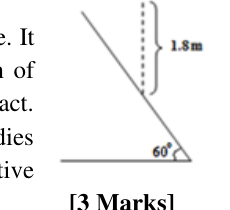
(a) A tiny ball is dropped on a smooth inclined plane as shown in the figure. It falls through 1.8 m before striking the plane. Coefficient of restitution of impact is 0.5. Calculate time taken by the ball before second impact. Neglect air resistance. (Coefficient of restitution for collision of two bodies is defined as the numerical ratio of relative speed of recede to relative speed of approach). [3 Marks]
Quesito 41
(b) Masses of 300 g and 500 g are hung at the opposite ends of a light inextensible string. The string passes over a smooth frictionless peg. The system is released from rest. Calculate the loss in gravitational potential energy of the system when the 300 g mass has ascended by 1 m. At this instant, the other mass is suddenly reduced by 400 g. How much further will the 300 g mass ascend? Neglect air resistance. [2 marks]
Topic: Newtonian Mechanics, Conservation of Energy Metodi: Kinematic Equations, Conservation of Energy Competenze: Physical Reasoning Objects: Ball, Inclined Plane, Pulley, String Fonte: Testo (PDF) — p.21
(a) Una piccola palla viene abbassata su un piano liscio, come mostra la figura. Cade a 1,8 metri prima di colpire l’aereo. Il coefficiente di restituzione dell’impatto è di 0,5. Calcola il tempo impiegato dalla palla prima del secondo impatto. - Non si tratta di resistenza all’aria. (Il coefficiente di restituzione per collisione di due corpi è definito come il rapporto numerico tra velocità relativa di ritiro e velocità relativa di avvicinamento). ** [3 Marchi] **
Quesito 41
b) Masse di 300 g e 500 g sono appese alle estremità opposte di una corda poco estensibile. La corda passa su una collana liscia senza attrito. Il sistema è rilasciato dal riposo. Calcolare la perdita di energia potenziale gravitazionale del sistema quando la massa di 300 g è aumentata di 1 m. In questo istante, l’altra massa viene improvvisamente ridotta di 400 g. Quanto più avanti la massa di 300 g aumenterà? - Non si tratta di resistenza all’aria. ** [2 punti] **
Topic: Newtonian Mechanics, Conservation of Energy Metodi: Kinematic Equations, Conservation of Energy Competenze: Physical Reasoning Objects: Ball, Inclined Plane, Pulley, String Fonte: Testo (PDF) — p.21
Aruna was studying the interaction between various chemicals. She found that when she mixed potassium bromate () with potassium bromide (KBr) and acidified the solution with , vapours of were evolved. On addition of KI to the reaction mixture, a deep brown colour was obtained due to formation of iodine, and this could be titrated with sodium thiosulphate () using starch indicator.
i. Write down the balanced reaction occurring at each stage. [3 Marks] ii. In what molar proportion should and KBr be mixed? [1 Mark] iii. Starting with 10 ml of 0.01M and using excess of KBr, & KI, what volume of 0.05 M will be required? [1 Mark]
Topic: Chemistry Metodi: Physical Modeling Competenze: Physical Reasoning Objects: — Fonte: Testo (PDF) — p.21
Aruna stava studiando l’interazione tra varie sostanze chimiche. Ha scoperto che quando ha mescolato il bromato di potassio () con il bromuro di potassio (KBr) e acidificato la soluzione con , si sono sviluppati vapori di . Dopo l’ aggiunta di KI alla miscela di reazione, è stato ottenuto un colore marrone profondo a causa della formazione di iodio, che potrebbe essere titolato con tiosulfato di sodio () utilizzando l’ indicatore di amido.
i. Scrivi la reazione equilibrata che si verifica in ogni fase. ** [3 Marchi] ** ii. In che proporzione molare e KBr devono essere mescolati? [1 Marchio] iii. A partire da 10 ml di 0,01 M e utilizzando un eccesso di KBr, e KI, quale volume di 0,05 M sarà richiesto? [1 Marchio]
Topic: Chemistry Metodi: Physical Modeling Competenze: Physical Reasoning Objects: — Fonte: Testo (PDF) — p.21