Section A (multiple choice). Questions 1 to 30 are Multiple Choice questions with every correct answer carrying 1 mark and every wrong answer carrying −0.25 mark.
Ingestion, digestion, absorption, assimilation and egestion are the steps in food processing in our body. Majority of absorption takes place in small intestine (villi) and which is transported to different organs through the circulatory system. Starting with villi, which of the following is the correct sequence of organs that the absorbed food passes through?
- (a) Liver → Other organs → Heart
- (b) Heart → Liver → Other organs
- (c) Heart → Other organs → Liver
- (d) Liver → Heart → Other organs
[1 mark]
Topic: Biology Metodi: Physical Modeling Competenze: Physical Reasoning Objects: — Fonte: Testo (PDF) — p.3
Sezione A (scelta multipla). Le domande da 1 a 30 sono domande di scelta multipla con ogni risposta corretta con 1 segno e ogni risposta sbagliata con −0,25 segno.
L’ingestione, la digestione, l’assorbimento, l’assimilazione e l’escesso sono i passaggi della trasformazione alimentare nel nostro corpo. La maggior parte dell’assorbimento avviene nell’intestino tenue (villi) e che viene trasportato verso diversi organi attraverso il sistema circolatorio. A cominciare da villi, quale dei seguenti è la corretta sequenza di organi attraverso cui passa il cibo assorbito?
- a) Fwied → Altri organi → Cuore
- (b) cuore → fegato → Altri organi
- (c) cuore → Altri organi → fegato
- (d) Fwied → Cuore → Altri organi
[1 punto]
Topic: Biology Metodi: Physical Modeling Competenze: Physical Reasoning Objects: — Fonte: Testo (PDF) — p.3
There is a regular bus service between Pune and Mumbai (180 km apart) at every hour from both the cities. First bus leaves (Both Mumbai as well as Pune) at 4 am while the last leaves at 11 pm. These buses run at an average speed of 45 km/hr. Taxies also run on the same route at 60 km/hr with regular interval of 30 min. First taxi leaves (Both Mumbai as well as Pune) at 4 am while the last leaves at 10 pm. Following statements are based upon the number of taxies or buses crossed (not overtaken) only during travelling i.e. excluding instances of arrival and departure. Consider following statements.
(1) Taxi left at 8 pm crosses 10 taxis. (2) Last taxi crosses 5 buses. (3) Last bus crosses 4 taxies.
- (a) Statements 1 & 2 are only correct.
- (b) Statements 2 & 3 are only correct.
- (c) Statements 1 & 3 are only correct.
- (d) All the statements are correct
[1 mark]
Topic: Mathematics Metodi: Kinematic Equations Competenze: Mathematical Modeling Objects: — Fonte: Testo (PDF) — p.3
C’è un servizio di autobus regolare tra Pune e Mumbai (180 km di distanza) ogni ora da entrambe le città. La prima bus parte (sia a Mumbai che a Pune) alle 4 del mattino mentre l’ultima parte alle 11 del pomeriggio. Questi autobus circolano a una velocità media di 45 km/h. I taxi percorrono anche la stessa rotta a 60 km/h con intervalli regolari di 30 minuti. Il primo taxi parte (sia a Mumbai che a Pune) alle 4 del mattino mentre l’ultimo parte alle 10 del pomeriggio. Le seguenti dichiarazioni si basano sul numero di taxi o autobus attraversati (non superati) solo durante il viaggio, cioè esclusi i casi di arrivo e di partenza. Considerate le seguenti affermazioni.
(1) Il taxi che parte alle 20:00 attraversa 10 taxi. (2) L’ultimo taxi attraversa 5 autobus. (3) L’ultimo autobus attraversa 4 taxi.
- (a) Le dichiarazioni 1 e 2 sono solo corrette.
- b) Le dichiarazioni 2 e 3 sono solo corrette.
- c) Le affermazioni 1 e 3 sono solo corrette.
- d) Tutte le dichiarazioni sono corrette
[1 punto]
Topic: Mathematics Metodi: Kinematic Equations Competenze: Mathematical Modeling Objects: — Fonte: Testo (PDF) — p.3
Arun is electrolyzing a mildly acidic aqueous solution containing a mixture of CuCl₂ and ZnSO₄ using Pt electrodes. The products obtained at the cathode and anode respectively are
- (a) H₂ and Cl₂
- (b) Cu and Cl₂
- (c) Zn and O₂
- (d) H₂ and O₂
[1 mark]
Topic: Chemistry Metodi: Physical Modeling Competenze: Physical Reasoning Objects: — Fonte: Testo (PDF) — p.3
Arun sta elettrolizzando una soluzione acquosa leggermente acida contenente una miscela di CuCl2 e ZnSO4 utilizzando elettrodi Pt. I prodotti ottenuti rispettivamente al catodo e all’anodo sono:
- a) H2 e Cl2
- b) Cu e Cl2
- c) Zn e O2
- (d) H2 e O2
[1 punto]
Topic: Chemistry Metodi: Physical Modeling Competenze: Physical Reasoning Objects: — Fonte: Testo (PDF) — p.3
Vector is the resultant of vectors and . Select correct statement about their magnitudes.
- (a) C may be equal to A
- (b) C > A and C > B
- (c) C = A + B
- (d) C cannot be less than the smallest among A and B.
[1 mark]
Topic: Newtonian Mechanics Metodi: Vector Decomposition Competenze: Physical Reasoning Objects: — Fonte: Testo (PDF) — p.3
Il vettore è il risultato dei vettori e . Selezionare la dichiarazione corretta sulle loro magnitudini.
- a) C può essere uguale a A
- b) C > A e C > B
- (c) C = A + B
- (d) C non può essere inferiore alla più piccola fra A e B.
[1 punto]
Topic: Newtonian Mechanics Metodi: Vector Decomposition Competenze: Physical Reasoning Objects: — Fonte: Testo (PDF) — p.3
A colourless solution of compound ‘A’ gives white precipitate, ‘B’, when treated with sodium hydroxide solution. The white precipitate dissolves in excess of sodium hydroxide solution. The clear solution thus obtained when treated with hydrogen sulphide gas gives white precipitate (C). Identify A, B, and C.
- (a) MgSO₄, Mg(OH)₂, MgS
- (b) Al₂(SO₄)₃, Al(OH)₃, Al₂S₃
- (c) ZnSO₄, Zn(OH)₂, ZnS
- (d) (NH₄)₂SO₄, NH₄OH, (NH₄)₂S
[1 mark]
Topic: Chemistry Metodi: Physical Modeling Competenze: Physical Reasoning Objects: — Fonte: Testo (PDF) — p.4
Una soluzione incolore del composto “A” dà precipitazione bianca, “B”, quando trattata con soluzione di idrossido di sodio. Il precipitato bianco si dissolve in eccesso di soluzione di idrossido di sodio. La soluzione trasparente ottenuta con gas solfuro di idrogeno dà precipitazione bianca (C). Identifica A, B e C.
- a) MgSO4, Mg(OH)2, MgS
- b) Al2(SO4)3, Al(OH)3, Al2S3
- (c) ZnSO4, Zn(OH)2, ZnS
- (d) (NH4) 2SO4, NH4OH, (NH4) 2S
[1 punto]
Topic: Chemistry Metodi: Physical Modeling Competenze: Physical Reasoning Objects: — Fonte: Testo (PDF) — p.4
To overcome the problem of water shortage, most urban cities in India promote the concept of ‘rainwater harvesting’. Although the harvested water can be used variously, the main purpose of water harvesting is to:
- (a) directly collect water for household purposes.
- (b) use surface water for irrigation.
- (c) recharge ground water.
- (d) refill lakes and other water bodies.
[1 mark]
Topic: Earth & Environmental Science Metodi: Physical Modeling Competenze: Physical Reasoning Objects: — Fonte: Testo (PDF) — p.4
Per superare la scarsità di acqua, la maggior parte delle città urbane in India promuove il concetto di “raccoltazione dell’acqua piovana”. Sebbene l’acqua raccolta possa essere utilizzata in vari modi, lo scopo principale dell’acqua raccolta è:
- a) raccogliere direttamente l’acqua per uso domestico.
- b) utilizzare le acque superficiali per l’irrigazione.
- c) ricarica delle acque sotterranee.
- riempimento dei laghi e di altri corpi d’acqua.
[1 punto]
Topic: Earth & Environmental Science Metodi: Physical Modeling Competenze: Physical Reasoning Objects: — Fonte: Testo (PDF) — p.4
INSAT series of satellites are launched by India for telecommunication. Such satellites appear stationary at a particular point in the sky when observed from the earth. Consider the following statements:
I. The path of these satellites is always bending towards the earth II. These satellites do not need any fuel for its motion. III. These satellites do not experience net force. IV. Such satellites have to be positioned vertically above the equator.
- (a) Only II, III & IV are correct.
- (b) Only I, II & IV are correct.
- (c) Only I & III are correct.
- (d) Only I & II are correct.
[1 mark]
Topic: Gravitation Metodi: Newton’s Law of Gravitation Competenze: Physical Reasoning Objects: Satellite, Planet Fonte: Testo (PDF) — p.4
L’India lancia una serie di satelliti INSAT per le telecomunicazioni. Tali satelliti sembrano fermi in un determinato punto del cielo quando osservati dalla terra. Considerate le seguenti affermazioni:
I. Il percorso di questi satelliti si piega sempre verso la Terra. II. Questi satelliti non hanno bisogno di combustibile per il suo movimento. III. Il Questi satelliti non hanno forza netta. IV. Tali satelliti devono essere posizionati verticalmente sopra l’equatore.
- a) Solo II, III e IV sono corretti.
- b) Solo I, II e IV sono corretti.
- (c) Solo I & III sono corretti.
- (d) Solo I & II sono corretti.
[1 punto]
Topic: Gravitation Metodi: Newton’s Law of Gravitation Competenze: Physical Reasoning Objects: Satellite, Planet Fonte: Testo (PDF) — p.4
In case of mammals the volume of air inhaled and exhaled with each breath during normal breathing is called as tidal volume. The inhaled air at a time is not completely exhaled because the inlet and outlet for air is the same. The air that remains in the lungs after a forced exhalation is called a residual volume. As each inhalation mixes fresh air with oxygen depleted residual air the partial pressure of oxygen (P_O₂) is different from that of the atmosphere. The following statements were made with reference to the above information.
A. P_O₂ in alveoli is higher than that of the atmosphere. B. P_O₂ in alveoli is lower than that of the atmosphere. C. An animal, e.g. bird, in which there is unidirectional flow of air into lungs (i.e. inhaled and exhaled air did not use the same pipe) the maximum P_O₂ in their lungs will be higher than that of mammals. D. An animal, e.g. bird in which there is unidirectional flow of air into lungs (i.e. inhaled and exhaled air did not use the same pipe) the maximum P_O₂ in their lungs will be lower than that of mammals.
Which one is the most correct combination of the above statements?
- (a) A, C, E
- (b) B, C, E
- (c) A, D, F
- (d) B, C, F
[1 mark]
Topic: Biology Metodi: Physical Modeling Competenze: Physical Reasoning Objects: — Fonte: Testo (PDF) — p.4
Nel caso dei mammiferi il volume di aria inalato e sfrattato con ogni respiro durante la respirazione normale è denominato ** volume di marea**. L’aria inalata non viene completamente esolata perché l’ingresso e la uscita dell’aria sono uguali. L’aria che rimane nei polmoni dopo un’espirazione forzata è chiamata volume residuo ****. Poiché ogni inalazione mescola aria fresca con aria residua di ossigeno esaurita, la pressione parziale dell’ossigeno (P_O2) è diversa da quella dell’atmosfera. Le seguenti dichiarazioni sono state fatte in riferimento alle informazioni di cui sopra.
A. Il P_O2 negli alveoli è **più alto ** di quello dell’atmosfera. B. Il P_O2 negli alveoli è **** inferiore a quello dell’atmosfera. C. Un animale, ad esempio. uccello, in cui vi è un flusso unidirezionale di aria nei polmoni (cioè L’aria inalata e quella esolata non hanno usato lo stesso tubo) il P_O2 massimo nei polmoni sarà superiore a quello dei mammiferi. D. Un animale, ad esempio. uccello in cui l’aria entra nei polmoni unidirezionale (cioè L’aria inalata e l’aria esolata non hanno usato lo stesso tubo) il P_O2 massimo nei polmoni sarà inferiore a quello dei mammiferi.
Quale di queste dichiarazioni è la combinazione più corretta?
- (a) A, C, E
- (b) B, C, E
- (c) A, D, F
- (d) B, C, F
[1 punto]
Topic: Biology Metodi: Physical Modeling Competenze: Physical Reasoning Objects: — Fonte: Testo (PDF) — p.4
Imagine a conductor in a cylindrical shape of radius R. Two thin circular discs of radius R made up of non-conducting material, carrying charge + Q and − Q respectively, are attached to the two ends of this cylinder. Consider following statements.
I. Free or conduction electrons in the conducting cylinder will drift towards +Q. II. A constant current will be set up through cylinder. III. Constant current will flow for very short duration of time.
- (a) Only I is true.
- (b) Only II is true.
- (c) Only III is true.
- (d) Only I and III are true.
[1 mark]
Topic: Electrostatics Metodi: Physical Modeling Competenze: Physical Reasoning Objects: Cylinder, Disk Fonte: Testo (PDF) — p.5
Immaginate un conduttore in forma cilindrica di raggio R. Ai due estremità del cilindro sono fissati due sottili dischi circolari di raggio R costituiti da materiale non conduttore, con carica di carico rispettivamente + Q e − Q. Considerate le seguenti affermazioni.
I. Gli elettroni liberi o di conduttività nel cilindro conduttore si allontaneranno verso +Q. II. Una corrente costante sarà impostata attraverso il cilindro. III. Il La corrente costante fluirà per un periodo molto breve.
- Solo io sono vero.
- b) Solo II è vero.
- (c) Solo III è vero.
- (d) Solo I e III sono veri.
[1 punto]
Topic: Electrostatics Metodi: Physical Modeling Competenze: Physical Reasoning Objects: Cylinder, Disk Fonte: Testo (PDF) — p.5
For a concave lens of focal length is f. In terms of f, the separation between an object and its doubly magnified real image by this mirror is –
- (a) 9f/2
- (b) 5f/2
- (c) 4f
- (d) 3f/2
[1 mark]
Topic: Geometric Optics Metodi: Thin Lens & Mirror Equation Competenze: Mathematical Modeling Objects: Lens Fonte: Testo (PDF) — p.5
Per una lente concava di lunghezza focale è f. In termini di f, la separazione tra un oggetto e la sua immagine reale doppiamente ingrandita da questo specchio è
- (a) 9f/2
- (b) 5f/2
- (c) 4f
- (d) 3f/2
[1 punto]
Topic: Geometric Optics Metodi: Thin Lens & Mirror Equation Competenze: Mathematical Modeling Objects: Lens Fonte: Testo (PDF) — p.5
Following is a hypothetical example. In the forests of a mainland, jungle fowls showed variation in the color of their feathers. Fowls with brown feathers were better camouflaged from their predators than those with bright red feathers. Thus in the mainland more number of brown-feathered fowls were observed as compared to the bright red ones. A person transported a few red-feathered fowls to a nearby island that did not have any jungle fowls. Also, there were no predators for the jungle fowl. After several years the island had more red-feathered fowls than brown-feathered fowl. The observed variation in the frequency of red and brown feathered in island as compared to the mainland is due to:
- (a) Adaptation
- (b) Natural selection
- (c) Genetic Drift
- (d) Competition
[1 mark]
Topic: Biology Metodi: Physical Modeling Competenze: Physical Reasoning Objects: — Fonte: Testo (PDF) — p.5
Il seguente è un esempio ipotetico. Nei boschi di un continente, i galli della giungla mostravano variazioni nel colore delle loro piume. Le galline con piume marroni erano meglio camuffate dai loro predatori rispetto a quelle con piume rosse brillanti. Così, nel continente, si osservarono più uccelli a piume marrone rispetto a quelli rossi brillanti. Una persona trasportò alcuni uccelli di piume rosse in un’isola vicina che non aveva uccelli della giungla. Inoltre, non c’erano predatori per l’uccello della giungla. Dopo diversi anni l’isola ebbe più uccelli a piume rosse che a piume marrone. La variazione osservata nella frequenza delle piume rosse e marroni sull’isola rispetto alla terraferma è dovuta a:
- a) Adaptazione
- b) Selezione naturale
- (c) Drift genetica
- d) Concorrenza
[1 punto]
Topic: Biology Metodi: Physical Modeling Competenze: Physical Reasoning Objects: — Fonte: Testo (PDF) — p.5
The density of air at STP is
- (a) 2.24 mg/cm³
- (b) 0.65 mg/cm³
- (c) 0.59 mg/cm³
- (d) 1.3 mg/cm³
(Air is found to be 78% nitrogen, 21% oxygen, and 1% argon.)
[1 mark]
Topic: Kinetic Theory Metodi: Ideal Gas Law Competenze: Mathematical Modeling Objects: Gas Fonte: Testo (PDF) — p.5
La densità dell’aria a STP è
- a) 2,24 mg/cm3
- b) 0,65 mg/cm3
- c) 0,59 mg/cm3
- d) 1,3 mg/cm3
(Si scopre che l’aria è costituita al 78% di azoto, al 21% di ossigeno e all’1% di argone.)
[1 punto]
Topic: Kinetic Theory Metodi: Ideal Gas Law Competenze: Mathematical Modeling Objects: Gas Fonte: Testo (PDF) — p.5
Sahita took out 100cm³ of X molar aqueous solution of hydrogen peroxide from the refrigerator. On warming to 19.5°C, she observed 3dm³ of oxygen gas was produced (at 1 atm pressure). Assuming complete decomposition of hydrogen peroxide, the value of X is approximately
- (a) 1.25
- (b) 2.5
- (c) 0.8
- (d) 0.5
[1 mark]
Topic: Chemistry Metodi: Ideal Gas Law Competenze: Mathematical Modeling Objects: Gas Fonte: Testo (PDF) — p.6
Sahita ha estratto 100 cm3 di soluzione acquosa di perossido di idrogeno da frigorifero. Al riscaldamento a 19.5°C, ha osservato che 3dm3 di gas ossigeno è stato prodotto (a 1 pressione atm). Supponendo la completa decomposizione del perossido di idrogeno, il valore di X è approssimativamente
- (a) 1.25
- (b) 2.5
- (c) 0.8
- (d) 0.5
[1 punto]
Topic: Chemistry Metodi: Ideal Gas Law Competenze: Mathematical Modeling Objects: Gas Fonte: Testo (PDF) — p.6
Weights of a metal ball recorded in air, in water and in a liquid are 56 N, 49 N and 42.5 N respectively. Specific gravity (or relative density) of the solid and that of the liquid is respectively –
- (a) 8 & 6
- (b) 8 & 2
- (c) 8 & 1.4
- (d) 7 & 0.6
[1 mark]
Topic: Fluid Mechanics Metodi: Hydrostatic Equilibrium Competenze: Mathematical Modeling Objects: Ball Fonte: Testo (PDF) — p.6
I pesi di una palla di metallo registrati nell’aria, nell’acqua e in un liquido sono rispettivamente di 56 N, 49 N e 42,5 N. La gravità specifica (o la densità relativa) del solido e del liquido è rispettivamente
- (a) 8 & 6
- (b) 8 & 2
- (c) 8 & 1.4
- (d) 7 & 0.6
[1 punto]
Topic: Fluid Mechanics Metodi: Hydrostatic Equilibrium Competenze: Mathematical Modeling Objects: Ball Fonte: Testo (PDF) — p.6
Which are the entities that are oxidized and reduced respectively in the following reaction?
- (a) Pb and O
- (b) N and O
- (c) Pb and N
- (d) O and N
[1 mark]
Topic: Chemistry Metodi: Physical Modeling Competenze: Physical Reasoning Objects: — Fonte: Testo (PDF) — p.6
Quali sono le entità che vengono ossidate e ridotte rispettivamente nella reazione seguente?
- a) Pb e O
- b) N e O
- (c) Pb e N
- (d) O e N
[1 punto]
Topic: Chemistry Metodi: Physical Modeling Competenze: Physical Reasoning Objects: — Fonte: Testo (PDF) — p.6
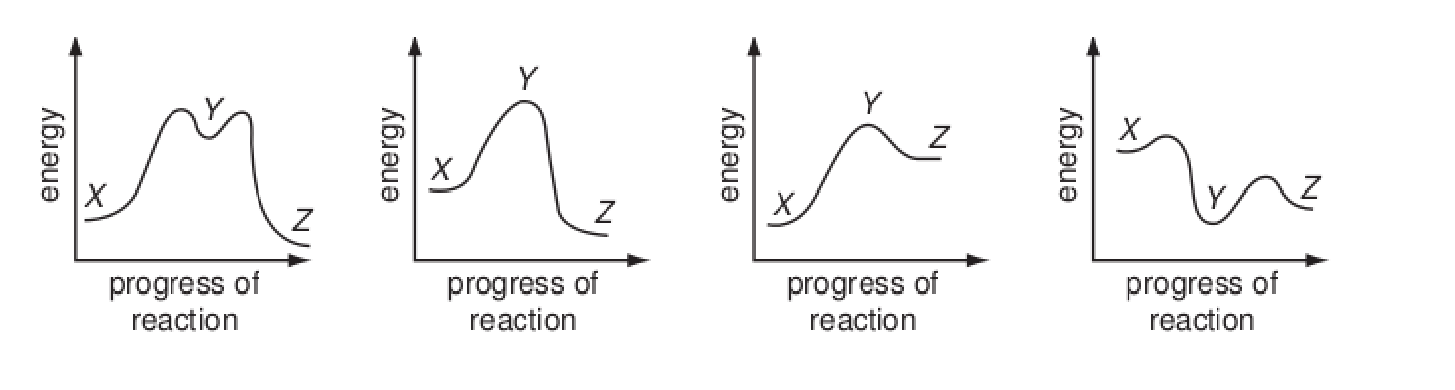
In the conversion of compound X into compound Z, it was found that the reaction proceeded by way of Y, which could be isolated. The following steps were involved:
X→●→Y; endothermic process Y→●→Z; exothermic process
Which is the reaction profile of this conversion from X to Z?
Quesito 16
[1 mark]
Topic: Chemistry Metodi: Physical Modeling Competenze: Diagrammatic Reasoning Objects: — Fonte: Testo (PDF) — p.6
Nella conversione del composto X in composto Z, si è scoperto che la reazione procedeva attraverso Y, che poteva essere isolato. Sono state prese le seguenti misure:
X→●→Y; processo endotermico Y→●→Z; processo esotermo
Qual è il profilo di reazione di questa conversione da X a Z?
Quesito 16
[1 punto]
Topic: Chemistry Metodi: Physical Modeling Competenze: Diagrammatic Reasoning Objects: — Fonte: Testo (PDF) — p.6
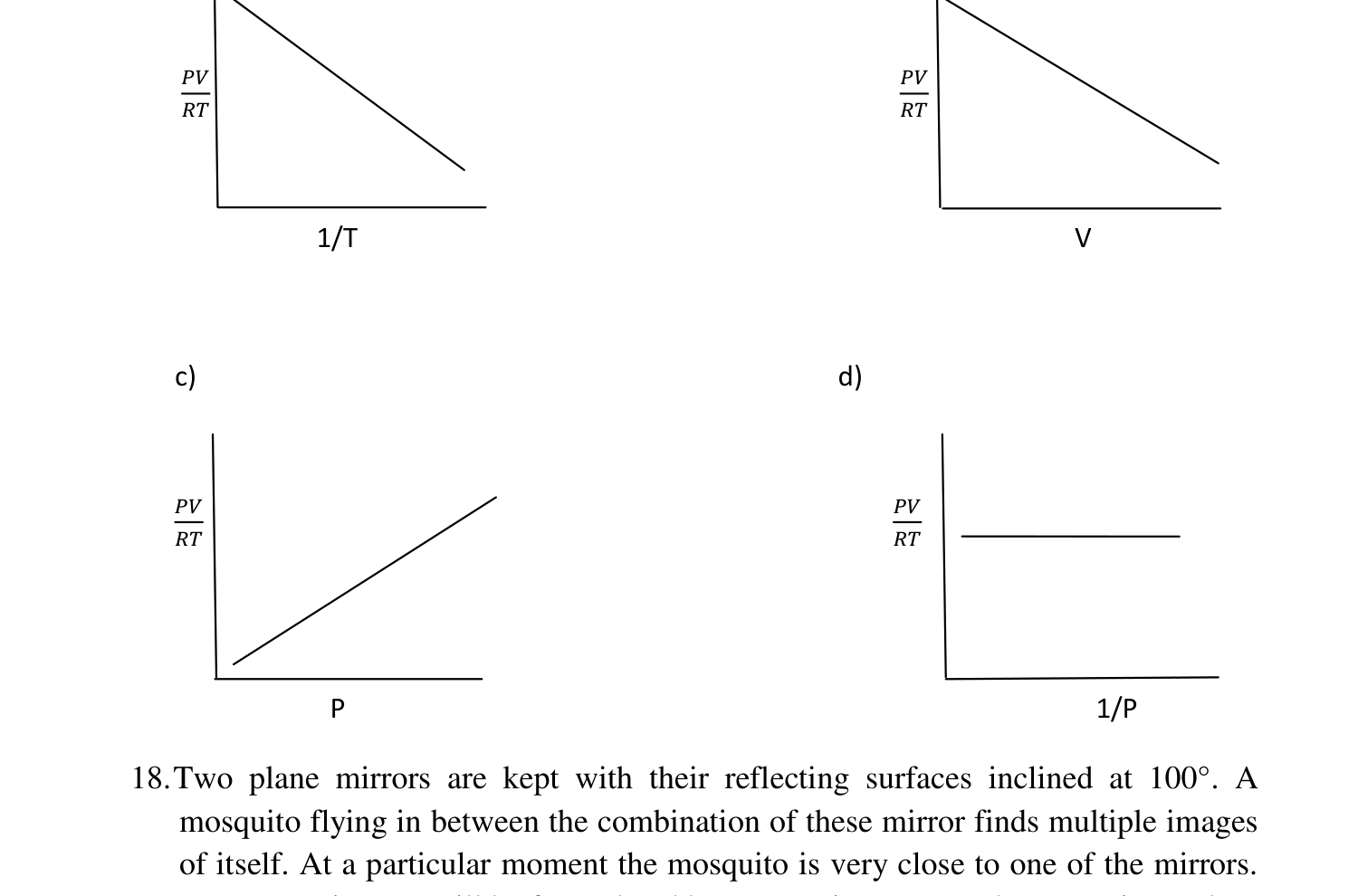
For one mole of an ideal gas, which of the following graphical representations holds true
Quesito 17
[1 mark]
Topic: Kinetic Theory Metodi: Ideal Gas Law Competenze: Diagrammatic Reasoning Objects: Gas Fonte: Testo (PDF) — p.7
Per un mole di gas ideale, quale delle seguenti rappresentazioni grafiche è vera
Quesito 17
[1 punto]
Topic: Kinetic Theory Metodi: Ideal Gas Law Competenze: Diagrammatic Reasoning Objects: Gas Fonte: Testo (PDF) — p.7
Two plane mirrors are kept with their reflecting surfaces inclined at 100°. A mosquito flying in between the combination of these mirror finds multiple images of itself. At a particular moment the mosquito is very close to one of the mirrors. How many images will be formed and how many images can the mosquito see?
- (a) 2, 1
- (b) 3, 1
- (c) 4, 2
- (d) 3, 2
[1 mark]
Topic: Geometric Optics Metodi: Ray Tracing Competenze: Physical Reasoning Objects: Mirror Fonte: Testo (PDF) — p.7
Due specchi piani sono tenuti con le loro superfici riflettenti inclinate a 100°. Una zanzara che vola tra la combinazione di questi specchi trova molteplici immagini di se stessa. In un momento particolare la zanzara è molto vicina a uno degli specchi. Quante immagini si formeranno e quante immagini può vedere la zanzara?
- (a) 2, 1
- (b) 3, 1
- (c) 4, 2
- (d) 3, 2
[1 punto]
Topic: Geometric Optics Metodi: Ray Tracing Competenze: Physical Reasoning Objects: Mirror Fonte: Testo (PDF) — p.7
On thermal decomposition, which of the following substances will give oxygen gas.
I. NH₄NO₃ II. NH₄ClO₃ III. (NH₄)₂Cr₂O₇ IV. (NH₄)₂SO₄
- (a) I and II
- (b) II and III
- (c) III and IV
- (d) I and IV
[1 mark]
Topic: Chemistry Metodi: Physical Modeling Competenze: Physical Reasoning Objects: — Fonte: Testo (PDF) — p.7
In caso di decomposizione termica, quale delle seguenti sostanze produrrà gas ossigeno.
I. NH4NO3 II. NH4ClO3 III. (NH4) 2Cr2O7 IV. (NH4) 2SO4
- a) I e II
- b) II e III
- c) III e IV
- d) I e IV
[1 punto]
Topic: Chemistry Metodi: Physical Modeling Competenze: Physical Reasoning Objects: — Fonte: Testo (PDF) — p.7
A star is seen rising from Kolkata (23.5° N, 92° E) at 7:00 pm IST, at about what time IST will it be seen to rise from Mumbai (19° N, 72° E)?
- (a) 7:00 pm
- (b) 7:20 pm
- (c) 7:40 pm
- (d) 8:20 pm
[1 mark]
Topic: Astrophysics Metodi: Physical Modeling Competenze: Estimation & Approximation Objects: Star Fonte: Testo (PDF) — p.7
Una stella è vista sorgere da Kolkata (23.5° N, 92° E) alle 19:00 IST, a che ora circa IST sarà vista sorgere da Mumbai (19° N, 72° E)?
- (a) 7:00 pm
- (b) 7:20 pm
- (c) 7:40 pm
- (d) 8:20 pm
[1 punto]
Topic: Astrophysics Metodi: Physical Modeling Competenze: Estimation & Approximation Objects: Star Fonte: Testo (PDF) — p.7
Anand wanted to prepare a salt solution of pH 1.0. For that he used solutions of a strong monovalent base and acid. He tried different combinations to obtain the required solution. Can you help him to decide which one is the most correct combination of statements given below?
I. 100ml of (M/10) acid and 100ml of (M/10) alkali. II. 55ml of (M/10) acid and 45ml of (M/10) alkali. III. 10ml of (M/10) acid and 90ml of (M/10) alkali. IV. 75ml of (M/5) acid and 25ml of (M/5) alkali.
- (a) I and III
- (b) II and IV
- (c) Only II
- (d) Only IV
[1 mark]
Topic: Chemistry Metodi: Physical Modeling Competenze: Mathematical Modeling Objects: — Fonte: Testo (PDF) — p.8
Anand voleva preparare una soluzione di sale di pH 1.0. Per questo ha usato soluzioni di una forte base monovalente e acido. Provò diverse combinazioni per ottenere la soluzione richiesta. Potete aiutarlo a decidere quale sia la combinazione più corretta delle affermazioni riportate qui sotto?
I. 100 ml di acido (M/10) e 100 ml di alcalino (M/10). II. 55 ml di acido (M/10) e 45 ml di alcali (M/10). III. Il 10 ml di acido (M/10) e 90 ml di alcali (M/10). IV. 75 ml di acido (M/5) e 25 ml di alcalino (M/5).
- a) I e III
- b) II e IV
- c) Solo II
- d) Solo IV
[1 punto]
Topic: Chemistry Metodi: Physical Modeling Competenze: Mathematical Modeling Objects: — Fonte: Testo (PDF) — p.8
The “chief cells” of stomach secrete hydrochloric acid. Consider a hypothetical situation in which the “chief cells” are destroyed resulting in complete inhibition of acid secretion in stomach. In comparison to a normal person, which one of the following is most likely to happen in the stomach during the above condition?
- (a) Digestion of proteins will increase
- (b) Digestion of fats will start
- (c) Digestion of carbohydrates will continue
- (d) Digestion of fat will decrease
[1 mark]
Topic: Biology Metodi: Physical Modeling Competenze: Physical Reasoning Objects: — Fonte: Testo (PDF) — p.8
Le “cellule principali” dello stomaco secernono l’acido cloridrico. Considerate una ipotetica situazione in cui le “cellule principali” vengono distrutte, con conseguente completa inibzione della secrezione acida nello stomaco. Rispetto a una persona normale, quale di queste condizioni è più probabile che accada nello stomaco durante la condizione sopra menzionata?
- (a) Aumenterà la digestione delle proteine
- (b) Inizierà la digestione dei grassi
- (c) La digestione dei carboidrati continuerà
- (d) diminuirà la digestione dei grassi
[1 punto]
Topic: Biology Metodi: Physical Modeling Competenze: Physical Reasoning Objects: — Fonte: Testo (PDF) — p.8
Female fruit flies with normal wings were mated with males having vestigial wings. All progeny had normal wings. Based on this observation the following conclusion(s) were proposed:
I. Vestigial wing is a recessive character as compared to normal wing. II. Alleles for normal and vestigial wings segregate from each other. III. While flies with normal wings are heterozygous for the alleles controlling the character, flies with vestigial wings are homozygous.
Which of the above statement(s) is/are correct from the above observations?
- (a) Only I
- (b) Only III
- (c) I and II both
- (d) II and III both
[1 mark]
Topic: Biology Metodi: Physical Modeling Competenze: Physical Reasoning Objects: — Fonte: Testo (PDF) — p.8
Le femmine di mosche di frutto con ali normali sono state accoppiate con i maschi con ali vestigiali. Tutte le progenie avevano le ali normali. In base a questa osservazione sono state proposte le seguenti conclusioni:
I. L’ala vestigiale è un carattere recessivo rispetto all’ala normale. II. Gli alleli delle ali normali e vestigiali si separano l’uno dall’altro. III. Il Mentre le mosche con ali normali sono eterogeni per gli alleli che controllano il personaggio, le mosche con ali vestigiali sono omogeni.
Quali delle affermazioni sopra citate sono/sono corrette?
- a) Solo io
- b) Solo III
- c) I e II entrambe
- II e III entrambe
[1 punto]
Topic: Biology Metodi: Physical Modeling Competenze: Physical Reasoning Objects: — Fonte: Testo (PDF) — p.8
A piece of ice, with a stone (denser than water) embedded inside, is kept in a vessel containing water. Size and mass of the stone is such that the stone – ice combination is floating on water. When the ice melts, what will happen to the level of water in the beaker?
- (a) Water level will rise.
- (b) Water level will fall.
- (c) Water level will remain unchanged.
- (d) Final level of water will depend upon actual density of the stone.
[1 mark]
Topic: Fluid Mechanics Metodi: Hydrostatic Equilibrium Competenze: Physical Reasoning Objects: Container Fonte: Testo (PDF) — p.8
Un pezzo di ghiaccio, con una pietra (più densa di acqua) inserita all’interno, viene conservato in un recipiente contenente acqua. La dimensione e la massa della pietra sono tali che la combinazione di ghiaccio di pietra è galleggiante sull’acqua. Quando il ghiaccio scioglierà, cosa accadrà al livello dell’acqua nella coppa?
- (a) Il livello dell’acqua aumenterà.
- (b) Il livello dell’acqua diminuirà.
- (c) Il livello dell’acqua rimarrà invariato.
- (d) Il livello finale di acqua dipenderà dalla densità effettiva della pietra.
[1 punto]
Topic: Fluid Mechanics Metodi: Hydrostatic Equilibrium Competenze: Physical Reasoning Objects: Container Fonte: Testo (PDF) — p.8
In an experiment, plant and animal cells were placed in different solutions (A, B, C and D) as shown below. The outcome of placing them in these solutions is also indicated in the figure.
Quesito 25
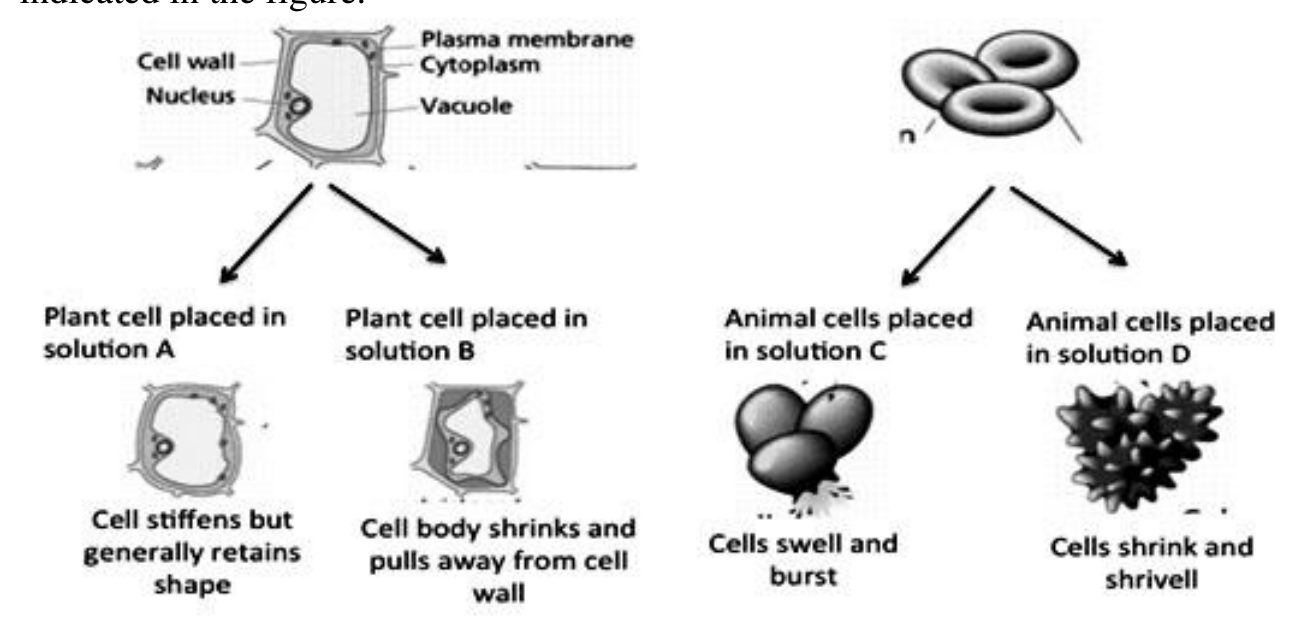
Identify the nature of the solutions A, B, C and D.
- (a) A and C are hypertonic, B and D are hypertonic
- (b) A and C are hypertonic, B and D are hypotonic
- (c) A and D are hypotonic, B and C are hypotonic
- (d) A and D are hypertonic, B and C are hypotonic
[1 mark]
Topic: Biology Metodi: Physical Modeling Competenze: Diagrammatic Reasoning Objects: — Fonte: Testo (PDF) — p.9
In un esperimento, cellule vegetali e animali sono state collocate in soluzioni diverse (A, B, C e D) come mostrato di seguito. Il risultato della loro inserzione in tali soluzioni è anche indicato nella figura.
Quesito 25
Identificare la natura delle soluzioni A, B, C e D.
- a) A e C sono ipertonico, B e D sono ipertonico
- (b) A e C sono ipertonico, B e D sono ipotonico
- (c) A e D sono ipotonico, B e C sono ipotonico
- (d) A e D sono ipertonico, B e C sono ipotonici
[1 punto]
Topic: Biology Metodi: Physical Modeling Competenze: Diagrammatic Reasoning Objects: — Fonte: Testo (PDF) — p.9
Miska combined one litre oxygen gas and one litre hydrogen gas by applying an electric spark in a vessel at STP. She observed that water is formed. Find the weight of water and the weight of unreacted component respectively.
- (a) 0.4017 g and 0.7143 g
- (b) 0.8036 g and 1.4286 g
- (c) 0.4017 g and 1.4286 g
- (d) 0.8036 g and 0.7143 g
[1 mark]
Topic: Chemistry Metodi: Physical Modeling Competenze: Mathematical Modeling Objects: Gas, Container Fonte: Testo (PDF) — p.9
Miska ha combinato un litro di gas ossigeno e un litro di gas idrogeno applicando una scintilla elettrica in una nave a STP. Ha osservato che si forma acqua. Trova il peso dell’acqua e il peso del componente non reagito rispettivamente.
- a) 0,4017 g e 0,7143 g
- b) 0,8036 g e 1,4286 g
- c) 0,4017 g e 1,4286 g
- 0,8036 g e 0,7143 g
[1 punto]
Topic: Chemistry Metodi: Physical Modeling Competenze: Mathematical Modeling Objects: Gas, Container Fonte: Testo (PDF) — p.9
Seema was observing cross section of an unknown plant material which as per her observation was a ‘Submerged Hydrophyte’. Which of the following features must have been observed by her to reach this conclusion?
I. Water storage tissues II. Large air spaces III. Absence of vascular tissues IV. Salt glands V. Sunken stomata VI. Thick cuticle
- (a) I, IV and V
- (b) III and V
- (c) II and III
- (d) only V
[1 mark]
Topic: Biology Metodi: Physical Modeling Competenze: Physical Reasoning Objects: — Fonte: Testo (PDF) — p.9
Seema stava osservando una sezione trasversale di un materiale vegetale sconosciuto che, secondo la sua osservazione, era un “idrofito sommerso”. Quali delle seguenti caratteristiche deve aver osservato per arrivare a questa conclusione?
I. Tessili di stoccaggio dell’acqua II. Grandi spazi aerei III. Il assenza di tessuti vascolari IV. Glande saliche V. Stomaco affondato VI. Cuticule spessa
- a) I, IV e V
- b) III e V
- c) II e III
- (d) solo V
[1 punto]
Topic: Biology Metodi: Physical Modeling Competenze: Physical Reasoning Objects: — Fonte: Testo (PDF) — p.9
The ABO blood group in humans was first identified by Karl Landsteiner. The four blood groups were identified based on whether blood corpuscles (RBCs) clump (agglutinate) or do not clump in the presence of serum of another individual. Blood groups are defined based on the molecules (antigens) present on RBCs, i.e. A blood group has A antigen, B blood group has B antigen, AB blood group has both A and B antigen, while O blood group have neither A or B antigen. The serum contains antibodies. However, a normal person will not have antibodies for the antigen present on his own RBC. Agglutination occurs during transfusion if serum contains the antibody against the antigen present on the RBC. In the experiment by Landsteiner (Landst.), he mixed the blood corpuscles from five of his colleagues and himself with serum collected from them as shown in the table below. A ’+’ sign indicated agglutination and ’−‘indicates lack of agglutination.
| Serum | \multicolumn{6}{c}{Blood corpuscles of} | | | Dr. St. | Dr. Plecn. | Dr. Strul. | Dr. Erdh. | Zar. | Landst. | | Dr. St. | − | + | + | + | + | − | | Dr. Plecn. | − | − | + | + | − | − | | Dr. Strul. | − | + | − | − | + | − | | Dr. Erdh. | − | + | − | − | + | − | | Zar. | − | − | + | + | − | − | | Landst. | − | + | + | + | + | − |
Deduce the blood group of Landsteiner (Landst.).
- (a) A
- (b) B
- (c) O
- (d) AB
[1 mark]
Topic: Biology Metodi: Physical Modeling Competenze: Diagrammatic Reasoning Objects: — Fonte: Testo (PDF) — p.10
Il gruppo sanguigno ABO negli esseri umani è stato identificato per la prima volta da Karl Landsteiner. I quattro gruppi sanguigni sono stati identificati in base al fatto che i corpuscoli sanguigni (RBC) si aggluttino o non si agglomerano in presenza di siero di un altro individuo. I gruppi sanguigni sono definiti in base alle molecole (antigeni) presenti nelle CCR, cioè Un gruppo sanguigno ha l’antigene A, il gruppo sanguigno B ha l’antigene B, il gruppo sanguigno AB ha l’antigene A e B, mentre il gruppo sanguigno O non ha né l’antigene A né il B. Il siero contiene anticorpi. Tuttavia, una persona normale non avrà anticorpi per l’antigene presente nel suo RBC. L’aglutinazione si verifica durante la trasfusione se il siero contiene l’ anticorpo contro l’ antigene presente sul RBC. Nell’esperimento di Landsteiner (Landst.), ha mescolato i corpuscoli sanguigni di cinque dei suoi colleghi e di se stesso con il siero raccolto da loro come mostrato nella tabella di seguito. Un segno ’+’ indica agglutinazione e ’−’ indica mancanza di agglutinazione.
Serum # # multicolonna # # corpuscoli di sangue
| | Dr. St. | Dr. - Non lo so. | Dr. Strul. | Dr. - E’ stato un po’ difficile. ♬ Zar. ♬ Landst. | | Dr. St. | − | + | + | + | + | − | | Dr. - Non lo so. | − | − | + | + | − | − | | Dr. Strul. | − | + | − | − | + | − | | Dr. - E’ stato un po’ difficile. | − | + | − | − | + | − | ♬ Zar. | − | − | + | + | − | − | ♬ Landst. | − | + | + | + | + | − |
Riduzione del gruppo sanguigno di Landsteiner (Landst.).
- (a) A
- (b) B
- (c) O
- (d) AB
[1 punto]
Topic: Biology Metodi: Physical Modeling Competenze: Diagrammatic Reasoning Objects: — Fonte: Testo (PDF) — p.10
Evaporation of (sweat) water is an essential mechanism in human beings for maintaining normal body temperature. For human beings, heat of vaporization of water at a body temperature of 37°C is nearly J/kg and specific heat capacity is 3500 J/kg⁻¹K⁻¹. On consuming a certain prescribed diet, the body temperature of an athlete of mass 82 kg is expected to increase by 2°C. In order to prevent this, he drinks N bottles of mineral water (250 ml water in each) at 37°C. Assume that the entire amount of this water is given out as sweat, which vaporizes. N is nearly –
- (a) 4
- (b) 3
- (c) 2
- (d) 1
[1 mark]
Topic: Thermodynamics Metodi: First Law of Thermodynamics Competenze: Mathematical Modeling Objects: — Fonte: Testo (PDF) — p.10
L’evaporazione dell’acqua (sweet) è un meccanismo essenziale per mantenere la temperatura corporea normale. Per gli esseri umani, il calore di vaporizzazione dell’acqua a temperatura corporea di 37°C è quasi J/kg e la capacità di calore specifica è di 3500 J/kg−1K−1. Al momento del consumo di una certa dieta prescritta, si prevede che la temperatura corporea di un atleta di massa di 82 kg aumenterà di 2°C. Per evitare questo, beve N bottiglie di acqua minerale (250 ml di acqua in ciascuna) a 37°C. Supponiamo che l’intera quantità di questa acqua venga rilasciata come sudore, che si vapora. N è quasi
- (a) 4
- (b) 3
- (c) 2
- (d) 1
[1 punto]
Topic: Thermodynamics Metodi: First Law of Thermodynamics Competenze: Mathematical Modeling Objects: — Fonte: Testo (PDF) — p.10
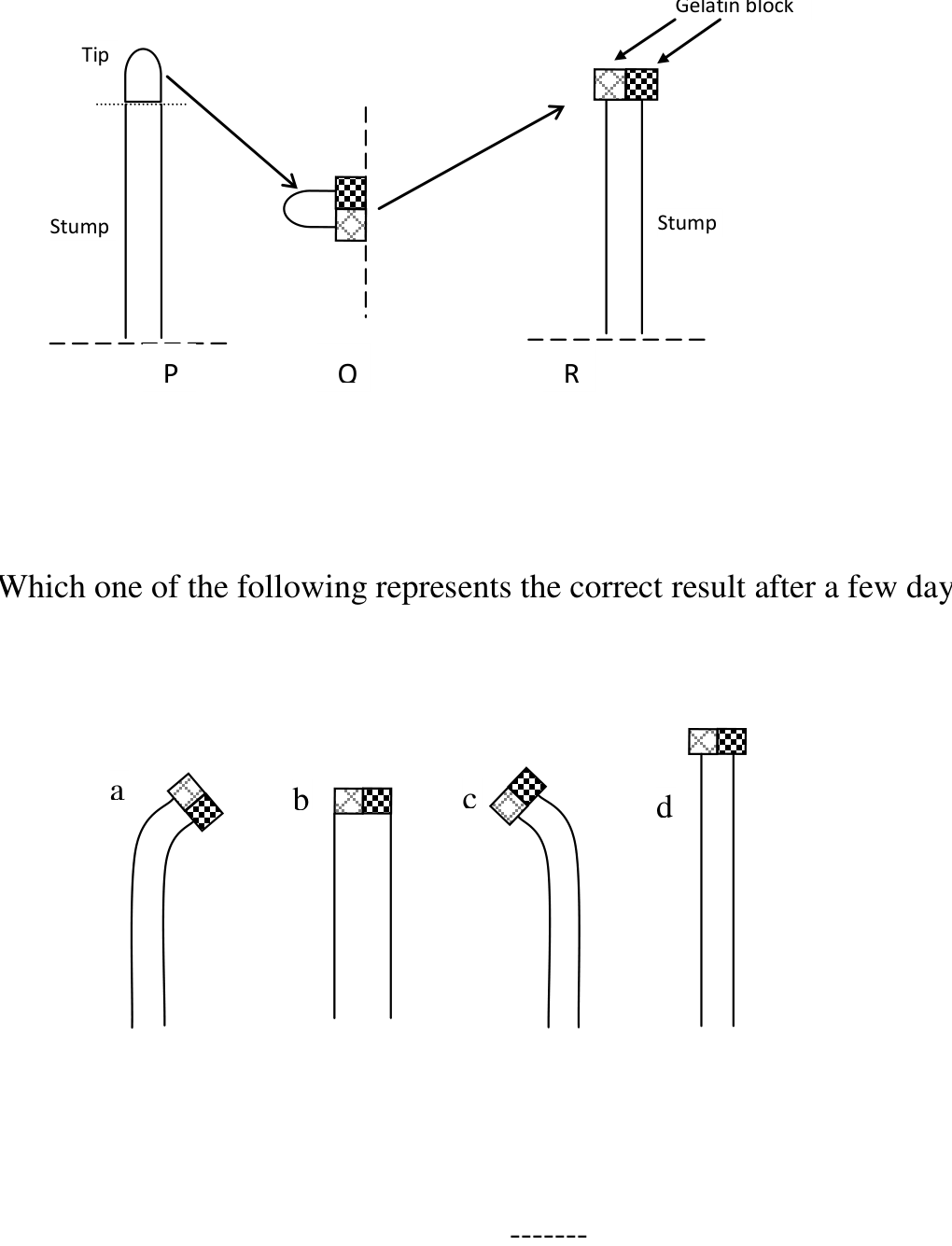
Plants show phototropism, wherein shoots respond by bending towards light. The plant hormone auxin is responsible for this phototropic effect. An experiment was carried out where the tip of growing seedling was cut and placed horizontally with its cut end in equal contact with two gelatin blocks as shown in the figure (P) below. Auxin diffuses into the gelatin blocks. After some time the gelatin blocks were placed on seedling stump as shown in the figure (R). The complete experiment was carried out in dark condition.
Which one of the following represents the correct result after a few days?
Quesito 30
[1 mark]
Topic: Biology Metodi: Physical Modeling Competenze: Diagrammatic Reasoning Objects: — Fonte: Testo (PDF) — p.11
Le piante mostrano fototropismo, in cui i germogli rispondono piegandosi verso la luce. L’ ormone vegetale auxina è responsabile di questo effetto fototropo. È stato condotto un esperimento in cui la punta della pianta in crescita è stata tagliata e collocata orizzontalmente con la sua estremità tagliata in contatto uguale con due blocchi di gelatina come mostrato nella figura (P) di seguito. L’auxina si diffonde nei blocchi di gelatina. Dopo un certo tempo i blocchi di gelatina sono stati collocati sul tronco delle piantine come mostrato nella figura (R). L’esperimento completo è stato condotto in buio.
Quale di queste indicazioni rappresenta il risultato corretto dopo pochi giorni?
Quesito 30
[1 punto]
Topic: Biology Metodi: Physical Modeling Competenze: Diagrammatic Reasoning Objects: — Fonte: Testo (PDF) — p.11
Section B (analytical). Questions 31 to 42 are long questions. Marks are indicated in the brackets. Answer the questions only in the answer sheet provided.
A. Zinc and iron are two metals which have many uses and they are part of the process of galvanizing. Zinc is 24ᵗʰ most abundant element in earth’s crust. It has five stable isotopes. The most common ore of zinc is zinc sulfide. Zinc is extracted from its ores by the process of roasting and calcination. In roasting zinc sulfide ore is converted into zinc oxide when heated in excess of oxygen. Zinc is also extracted from its carbonate ore by the process of calcination where it is heated at very high temperature and converted into zinc oxide. Both reactions are carried out in different reaction vessels. Zinc oxide is heated with carbon to extract the metal. [2.0]
I) Write balanced chemical equation for the process of roasting. II) Write the balanced chemical equation for the process of calcination. III) Write balanced chemical equation when zinc oxide is heated with carbon.
B. The iron pillar near Qutub Minar in Delhi was built more than 1600 years ago by metallurgists in India. They had developed the process which prevents iron from rusting. It has been examined by scientists from all over the world. Iron can be extracted from its ore Hematite by Thermite reaction. [2.0]
I. Which of the following statement is correct about Thermite reaction? i. It is an endothermic reaction between Alumina and iron where iron acts as reducing agent and Alumina acts as oxidizing agent. ii. It is an exothermic reaction between Alumina and iron where iron acts as oxidizing agent and alumina acts as reducing agent. iii. It is an exothermic reaction between iron oxide and aluminium where aluminium acts as oxidizing agent and iron acts as reducing agent. iv. It is an exothermic reaction between iron oxide and aluminium where aluminium acts as reducing agent and iron acts as oxidizing agent.
II. Write balanced equation for Thermite reaction?
C. An iron cylinder contains helium at a pressure of 250 kPa at 300 K. The cylinder can withstand a pressure of Pa. If the room in which the cylinder is placed catches fire, predict whether the cylinder would blow up before it melts (melting point of cylinder is 1800 K). [1.0]
[Total = 5 marks]
Topic: Chemistry Metodi: Physical Modeling Competenze: Physical Reasoning Objects: Gas, Cylinder Fonte: Testo (PDF) — p.12
Sezione B (analisi). Le domande da 31 a 42 sono domande lunghe. Le marche sono indicate nelle cornette. Rispondere alle domande solo nella scheda di risposta fornita.
Il zinco e il ferro sono due metalli che hanno molte applicazioni e fanno parte del processo di galvanizzazione. Lo zinco è il 24° elemento più abbondante nella crosta terrestre. Ha cinque isotopi stabili. Il minerale più comune di zinco è il solfuro di zinco. Lo zinco viene estratto dai suoi minerali attraverso il processo di tostatura e calcinazione. Nel fritto il minerale di solfuro di zinco viene convertito in ossido di zinco quando viene riscaldato in eccesso di ossigeno. Lo zinco viene anche estratto dal suo minerale carbonato mediante il processo di calcinazione, in cui viene riscaldato a temperature molto elevate e convertito in ossido di zinco. Entrambe le reazioni si svolgono in vasi di reazione diversi. L’ossido di zinco viene riscaldato con carbonio per estrarre il metallo. [2.0]
I) Scrivere un’equazione chimica equilibrata per il processo di tostatura. II) Scrivere l’equazione chimica equilibrata per il processo di calcinazione. III) Scrivere un’equazione chimica equilibrata quando l’ossido di zinco viene riscaldato con carbonio.
Il pilastro di ferro vicino al Qutub Minar di Delhi è stato costruito più di 1600 anni fa da metalurghi in India. Avevano sviluppato il processo che impedisce alla ferro di arrugginire. È stato esaminato da scienziati di tutto il mondo. Il ferro può essere estratto dal suo minerale ematite mediante la reazione termite ****. [2.0]
Qual è la seguente affermazione corretta sulla reazione termita? i. Si tratta di una reazione endotermico tra alumina e ferro in cui il ferro agisce come agente riduttore e l’alumina agisce come agente ossidante. ii. Si tratta di una reazione esotermica tra alumina e ferro in cui il ferro agisce come agente ossidante e l’alumina agisce come agente riduttore. iii. Si tratta di una reazione esotermica tra ossido di ferro e alluminio in cui l’alluminio agisce come agente ossidante e il ferro agisce come agente riduttore. iv. Si tratta di una reazione esotermica tra ossido di ferro e alluminio in cui l’alluminio agisce come agente riduttore e il ferro agisce come agente ossidante.
Scrivere un’equazione equilibrata per la reazione termita?
C. Un cilindro di ferro contiene elio a una pressione di 250 kPa a 300 K. Il cilindro può resistere a una pressione di Pa. Se la stanza in cui è collocato il cilindro prende fuoco, prevedere se il cilindro esploderebbe prima di sciogliersi (il punto di fusione del cilindro è 1800 K). [1.0]
[Total = 5 marchi]
Topic: Chemistry Metodi: Physical Modeling Competenze: Physical Reasoning Objects: Gas, Cylinder Fonte: Testo (PDF) — p.12
A. Pralay pushes two solid cubical boxes P and Q (that stay in contact) along a rough horizontal table by applying a horizontal force F on P. Box P has a mass of 4.0 kg and box Q has a mass of 8.0 kg facing same density. Coefficients of kinetic friction between block P and table is 0.4 and that between block Q and table is 0.6.
I) Calculate F, if both the boxes are moving with constant speed. II) Determine magnitude and direction of the resultant reaction force exerted by the table on the block Q. III) Draw a labeled diagram in right proportion indicating all the forces acting on both the blocks. [3.0]
Quesito 32
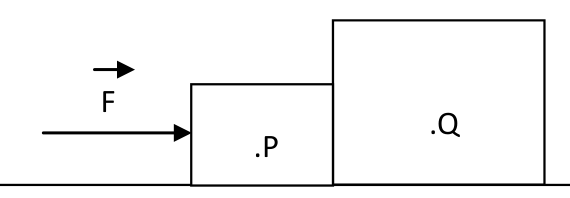
B. A student of mass 75 kg rides a bicycle of mass 25 kg. The student has a habit of standing on the paddle, one leg at a time, so that the force of his weight drives the bicycle. Distance between the top and the bottom positions of the pedal is 20 cm. Ratio of the paddle wheel (bigger) and the gear (or the rear wheel) is 10. Radius of the rear wheel of the cycle is 50 cm. the student takes 6 seconds for one full pedal (both the legs) and spends only that much energy so that the cycle runs continuously with constant velocity.
I) Calculate the average power that the student provides to the cycle. II) Calculate the kinetic (linear) velocity of the cycle during this uniform motion. III) What fraction of this kinetic energy (of the cycle) is the loss of energy in various dissipation mechanisms during one full pedal? [3.0]
[Total = 6 marks]
Topic: Newtonian Mechanics Metodi: Free-Body Diagram, Conservation of Energy Competenze: Diagrammatic Reasoning Objects: Block, Wheel, Gear Fonte: Testo (PDF) — p.13
A. Pralay spinge due solide scatole cubiche P e Q (che restano in contatto) lungo una tavola orizzontale ruvida applicando una forza orizzontale F su P. La scatola P ha una massa di 4,0 kg e la scatola Q ha una massa di 8,0 kg con la stessa densità. I coefficienti di attrito cinetico tra il blocco P e la tabella sono 0,4 e quelli tra il blocco Q e la tabella sono 0,6.
**I) ** Calcolare F, se entrambe le caselle si muovono a velocità costante. **II) ** Determina la magnitudine e la direzione della forza di reazione risultante esercitata dalla tabella sul blocco Q. **III) ** Disegnare un diagramma etichettato in giusta proporzione che indichi tutte le forze che agiscono su entrambi i blocchi. [3.0]
Quesito 32
B. Un studente di massa 75 kg guida una bicicletta di massa 25 kg. Lo studente ha l’abitudine di stare in piedi sulla paga, una gamba alla volta, in modo che la forza del suo peso guidi la bicicletta. La distanza tra la parte superiore e la parte inferiore del pedale è di 20 cm. Il rapporto tra la ruota di padella (più grande) e il cambio (o la ruota posteriore) è di 10. Il raggio di radius della ruota posteriore del ciclo è di 50 cm. lo studente richiede 6 secondi per un pedale completo (entrambe le gambe) e spende solo quella quantità di energia in modo che il ciclo corra continuamente a velocità costante.
**I) ** Calcolare la potenza media che lo studente fornisce al ciclo. **II) ** Calcolare la velocità cinetica (lineare) del ciclo durante questo movimento uniforme. **III) ** Quale frazione di questa energia cinetica (del ciclo) è la perdita di energia in vari meccanismi di dissipazione durante un pedale completo? [3.0]
[Total = 6 marchi]
Topic: Newtonian Mechanics Metodi: Free-Body Diagram, Conservation of Energy Competenze: Diagrammatic Reasoning Objects: Block, Wheel, Gear Fonte: Testo (PDF) — p.13
Whenever we charge a conductor, its electrical potential goes on increasing (as work is done). At any instant, the charge to potential always bear a constant ratio (q/V = constant). This constant is defined as the capacitance C of the conductor. Capacitor is just a mechanical arrangement to increase the capacity of an isolated conductor that makes it possible to store more charge at less potential. Electron volt (1 eV = J) is a much smaller unit of energy, popularly used for energies of electron.
In detection of nuclear radiation, scintillation detector is a very useful device which converts high energy radiation into a more readable quantity like voltage. This detector consists of a scintillator which converts high energy radiation into low energy photons. For a material called Anthracene 15 photons are generated per 1000 eV radiation absorbed. These low energy photons are then incident on a photomultiplier which generates electrons with an efficiency of 10% in its initial section. The number of electrons generated is too low to be read by any device. To convert the number of electrons to a measurable signal, later section of photo multiplier multiplies this number of electrons by a multiplication factor ‘F’. These electrons (basically charges) are then collected in a capacitor to produce a voltage across capacitor V.
Now let 10 keV β particles be incident on such a detector. Assume that all photons produced by the scintillator reach the photomultiplier. If the capacitance of the capacitor is 120 pF, and it produces a voltage of 2 mV, then find out the multiplication factor of photomultiplier.
[Total = 3 marks]
Topic: Electrostatics, Nuclear & Particle Physics Metodi: Physical Modeling Competenze: Mathematical Modeling Objects: Capacitor, Photon, Electron Fonte: Testo (PDF) — p.13
Ogni volta che carichiamo un conduttore, il suo potenziale elettrico continua ad aumentare (man mano che il lavoro viene fatto). In ogni momento, la carica al potenziale è sempre costante (q/V = costante). Questa costante è definita come la capacità C del conduttore. Il condensatore è solo un dispositivo meccanico per aumentare la capacità di un conduttore isolato che consente di immagazzinare più carica a un potenziale minore. L’elettrone volt (1 eV = J) è un’unità di energia molto più piccola, utilizzata popolari per le energie di elettroni.
Nel rilevare la radiazione nucleare, il rilevatore di scintillazione è un dispositivo molto utile che converte la radiazione ad alta energia in una quantità più leggibile come la tensione. Questo rilevatore è costituito da uno scintillatore che converte le radiazioni ad alta energia in fotoni a bassa energia. Per un materiale chiamato Anthracene vengono generati 15 fotoni per 1000 radiazioni eV assorbite. Questi fotoni a bassa energia sono quindi incidenti su un fotomultiplicatore che genera elettroni con un’efficienza del 10% nella sua sezione iniziale. Il numero di elettroni generati è troppo basso per essere letto da qualsiasi dispositivo. Per convertire il numero di elettroni in un segnale misurabile, la sezione successiva del moltiplicatore foto moltiplica questo numero di elettroni con un fattore di moltiplicazione “F”. Questi elettroni (in base cariche) vengono quindi raccolti in un condensatore per produrre una tensione attraverso il condensatore V.
Ora lasciate che 10 particelle di β keV siano incidenti su un tale rilevatore. Supponiamo che tutti i fotoni prodotti dallo scintillatore raggiungano il fotomultiplicatore. Se la capacità del condensatore è di 120 pF e produce una tensione di 2 mV, allora scopri il fattore di moltiplicazione del fotomultiplice.
[Total = 3 punti]
Topic: Electrostatics, Nuclear & Particle Physics Metodi: Physical Modeling Competenze: Mathematical Modeling Objects: Capacitor, Photon, Electron Fonte: Testo (PDF) — p.13
In 1883, Theodor W. Engelmann carried out an experiment to determine which wavelengths of light are most effective in driving photosynthesis. He illuminated a filamentous alga with white light that had been passed through a refracting prism, exposing different segments of algae to different wavelengths of light. He used aerobic bacteria that concentrate near an oxygen source indicating different rates of O₂ release. The picture below illustrates the result of the experiment.
Quesito 34
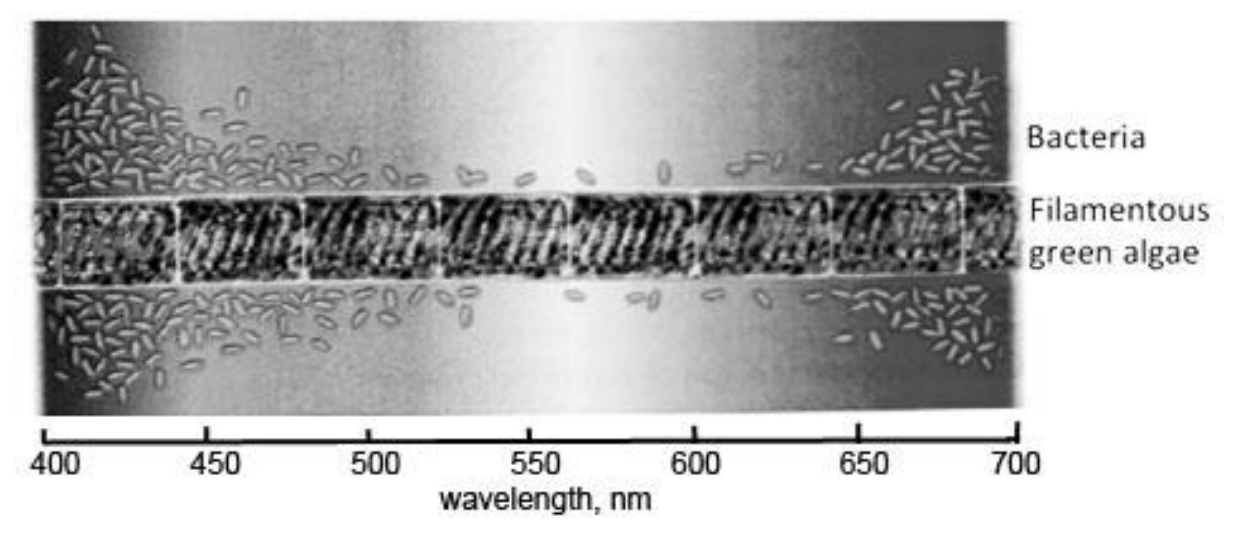
I) From the above figure which of the following wavelength(s) (nm) of light drive the highest rate of photosynthesis: (i) 400 (ii) ~425 (iii) 500 (iv) ~550 (v) 600 (vi) ~680 (vii) 700
II) What colors of the spectrum are absorbed in the wavelengths chosen by you in the above answer?
III) Which pigment in the leaves absorb the colors in the answer to (B) above?
IV) Plant leaves appear green in color because pigments in leaves ___________ violet-blue and red light and ___________ green light. [Choose between absorb and transmit to fill in the blank. Provide only the correct option in the correct order in your answer sheet.]
V) Can photosynthesis occur in red light? Yes/No
VI) Why was oxygen sensing bacteria used in this experiment? Answer with the help of a chemical equation representing photosynthesis.
VII) The ability of a pigment to absorb various wavelengths of light can be measured with an instrument called a ___________ [fill in the blank. Provide only the correct option in your answer sheet].
[Total = 5 marks]
Topic: Biology Metodi: Physical Modeling Competenze: Diagrammatic Reasoning Objects: Prism Fonte: Testo (PDF) — p.14
Nel 1883, Theodor W. Engelmann eseguì un esperimento per determinare quali lunghezze d’onda di luce sono più efficaci nel guidare la fotosintesi. Illuminò un’alga filamentosa con luce bianca che era stata passata attraverso un prisma rifrettante, espongono diversi segmenti di alghe a diverse lunghezze d’onda di luce. Ha usato batteri aerobici che si concentrano vicino a una fonte di ossigeno che indicava diversi tassi di rilascio di O2. L’immagine qui sotto illustra il risultato dell’esperimento.
Quesito 34
**I) ** Dalla figura di cui sopra quale delle seguenti lunghezze d’onda (nm) di luce guida il tasso di fotosintesi più alto: I) 400 (ii) ~425 (iii) 500 (iv) ~550 (v) 600 (vi) ~680 (vii) 700
**II) ** Quali colori dello spettro sono assorbiti nelle lunghezze d’onda scelte nella risposta sopra?
Quale pigmento nelle foglie assorbe i colori della risposta a (B) sopra?
Le foglie delle piante sono di colore verde perché i pigmenti nelle foglie sono di luce viola blu e rossa e di luce verde. ** [Scegli tra assorbimento e trasmissione per riempire il vuoto. Indicare solo l’opzione corretta nell’ordine corretto nella scheda di risposta.]**
**V) ** La fotosintesi può verificarsi alla luce rossa? Si/No
Perché i batteri che rilevano l’ossigeno sono stati utilizzati in questo esperimento? Rispondi con l’aiuto di un’equazione chimica che rappresenta la fotosintesi.
La capacità di un pigmento di assorbire varie lunghezze d’onda di luce può essere misurata con uno strumento chiamato ___________ . Inserire solo l’opzione corretta nella scheda di risposta].
[Total = 5 marchi]
Topic: Biology Metodi: Physical Modeling Competenze: Diagrammatic Reasoning Objects: Prism Fonte: Testo (PDF) — p.14
Acid base reactions are extremely common in nature and therefore it is of utmost interest to a chemist. A chemist gets a sample of clean cleaner and wants to find out the exact amount of sodium hydroxide present in it. He uses 23mL of 0.9M Phosphoric acid to completely neutralize the base.
I) Write the balanced chemical equation for the reaction. II) How many grams of Sodium hydroxide did the chemist find in the sample? III) A chemist needs to find the molarity of 10% w/w HCl. What is the molarity of the solution if the density of the solution is 1.047 g/cm³ and molecular weight of HCl is 36.5g/mole IV) There are many acid base reactions that take place in the body. If the acid content in the stomach is increased, antacids are used to neutralize it. A particular sample of antacid tablet contains sodium bicarbonate. When ingested, it reacts with the gastric juice (hydrochloric acid) in the stomach to give off carbon dioxide gas. When a 1.2 g tablet reacted with 40.00 mL of hydrochloric acid (density: 1.140 g/mL), carbon dioxide gas was evolved and the resulting solution weighed 46.7 g. Calculate the volume of carbon dioxide gas released at STP if its density is 1.98 g/L.
[Total=5 marks]
Topic: Chemistry Metodi: Physical Modeling Competenze: Mathematical Modeling Objects: — Fonte: Testo (PDF) — p.15
Le reazioni a base acida sono estremamente comuni in natura e quindi sono di grande interesse per un chimico. Un chimico prende un campione di detergente pulito e vuole scoprire la quantità esatta di idrossido di sodio presente in esso. Utilizza 23 ml di acido fosforo di 0,9 M per neutralizzare completamente la base.
**I) ** Scrivi l’equazione chimica equilibrata per la reazione. **II) ** Quanti grammi di idrossido di sodio ha trovato il chimico nel campione? **III) ** Un chimico deve trovare la molarità del 10% di HCl w/w. Qual è la molarità della soluzione se la densità della soluzione è di 1,047 g/cm3 e il peso molecolare dell’HCl è di 36,5 g/mole ** IV) ** Ci sono molte reazioni a base acida che si verificano nell’ organismo. Se il contenuto di acido nello stomaco aumenta, vengono usati antiacidi per neutralizzarlo. Un particolare campione di compressa antiacida contiene bicarbonato di sodio. Quando viene ingerito, reagisce con il succo gastrico (acido cloridrato) nello stomaco per rilasciare il gas di anidride carbonica. Quando una compressa di 1,2 g ha reagito con 40,00 mL di acido cloridrico (densità: 1,140 g/mL), è stato sviluppato un gas di anidride carbonica e la soluzione risultante pesava 46,7 g. Calcolare il volume di gas di anidride carbonica rilasciato a STP se la sua densità è di 1,98 g/L.
[Total=5 punti]
Topic: Chemistry Metodi: Physical Modeling Competenze: Mathematical Modeling Objects: — Fonte: Testo (PDF) — p.15
A. One of the popular astronomical objects is a black hole, having enormous density and hence enormous gravity. The gravity inside a boundary around a black hole is so immense that even light cannot escape from within this boundary (that is why these objects are called black hole). This boundary is called the event horizon. The event horizon is spherical. Radius of the event horizon of a black hole is known as Schwarzschild radius.
Schwarzschild radius depends upon mass (m) of the black hole, universal gravitational constant (G) and speed of light (c) in vacuum.
I) Determine x, y & z if the Schwarzschild radius of event horizon is given by . II) Calculate Schwarzschild radius of the earth (mass of the earth = kg) if it gets converted into a black hole. By how much will the gravitational force between the earth and the moon change? [2.0]
B. Milind and Prashant sit at x = 0 when he sees Milind at x = 6 m. Prashant now begins to run towards Milind with 5 m/s, while Milind begins to run towards Prashant with m/s².
I) When and where will they cross? Also plot their displacement – time plots together. II) Prove that Prashant will cross (meet) Milind twice if Milind accelerates away from Prashant (from his original position, at t = 0) with m/s². Also plot their displacement time plots together. [4.0]
[Total = 6 marks]
Topic: Gravitation, Astrophysics Metodi: Newton’s Law of Gravitation, Dimensional Analysis Competenze: Mathematical Modeling Objects: Black Hole, Planet Fonte: Testo (PDF) — p.16
Uno degli oggetti astronomici popolari è un buco nero, con una densità enorme e quindi una gravità enorme. La gravità all’interno di un confine intorno a un buco nero è così immensa che nemmeno la luce può sfuggire da questo confine (per questo questi oggetti sono chiamati buchi neri). Questo confine è chiamato orizzonte degli eventi. L’orizzonte degli eventi è sferica. Il raggio di orizzonte degli eventi di un buco nero è noto come raggio di Schwarzschild.
Il raggio di Schwarzschild dipende dalla massa (m) del buco nero, dalla costante gravitazionale universale (G) e dalla velocità della luce (c) nel vuoto.
**I) ** Determina x, y & z se il raggio di Schwarzschild dell’orizzonte degli eventi è dato da . **II) ** Calcolare il raggio di Schwarzschild della terra (massa della terra = kg) se viene convertita in buco nero. Quanto cambierà la forza gravitazionale tra la terra e la luna? [2.0]
B. Milind e Prashant si siedono a x = 0 quando vede Milind a x = 6 m. Prashant inizia ora a correre verso Milind con 5 m/s, mentre Milind inizia a correre * verso * Prashant con m/s2.
Quando e dove si attraverseranno? Tracciate anche i loro plot temporali di spostamento. **II) ** Prove che Prashant attraverserà (incontra) Milind due volte se Milind si allontana da Prashant (da sua posizione originale, a t = 0) con m/s2. E anche tracciare insieme i loro piani di spostamento. [4.0]
[Total = 6 marchi]
Topic: Gravitation, Astrophysics Metodi: Newton’s Law of Gravitation, Dimensional Analysis Competenze: Mathematical Modeling Objects: Black Hole, Planet Fonte: Testo (PDF) — p.16
Rising CO₂ levels are a cause of concern as it has been linked to many climate changes. A suggested solution is phytosequestration- storing CO₂ in plants instead of keeping it in the air.
CO₂ is “fixed” by the plants to produce sugars: in presence of sunlight, CO₂ reacts with water to form sugar (C₆H₁₂O₆) with release of O₂.
I) Write the balanced chemical reaction for the above process.
II) The idea behind phytosequestration is to grow enough plants so that the carbondioxide released by fossil fuel combustion is safely sequestered in the plant biomass. What weight of biomass (sugar) is made when the carbon from 1 ton of bituminite coal (70% weight of Carbon) is sequestered?
III) The heat of combustion of coal is 21 MJ/kg. Efficiency of converting heat to electricity of a standard coal fired bunsen burner is 30%. A thermoelectric power plant of capacity 500 MW runs for 8000 hours in a year. How much coal must be burned in a year to run the plant?
IV) How much realistic estimate of biomass growth rate puts it at 50 tons of biomass per hectare per year. How much land, in hectares, is necessary to sequester the carbon-dioxide emitted by one such 500 MW power plant?
V) At a given place, the average solar insolation is about 800 W/m² and there are about 2000 sunny hours in a year. (1 hectare is 10,000 m². ) Assuming that the heating value of biomass is equivalent to the heating value of the coal in (III) whose carbon it sequestered, what is the efficiency of solar radiation conversion by biomass i.e. what fraction of the solar radiation incident on the fields can be converted to electricity?
[Total = 5 marks]
Topic: Earth & Environmental Science, Chemistry Metodi: Physical Modeling Competenze: Mathematical Modeling Objects: — Fonte: Testo (PDF) — p.16
L’aumento dei livelli di CO2 è motivo di preoccupazione, in quanto è stato collegato a molti cambiamenti climatici. Una soluzione suggerita è quella di fitosequestrazione - stoccaggio di CO2 nelle piante * anziché * di mantenimento nell’aria.
La CO2 viene “fissa” dalle piante per produrre zuccheri: in presenza di luce solare, la CO2 reagisce con l’acqua per formare zucchero (C6H12O6) con rilascio di O2.
**I) ** Scrivi la reazione chimica equilibrata per il processo di cui sopra.
L’idea della fitosequestrazione è quella di coltivare piante sufficienti affinché il biossido di carbonio rilasciato dalla combustione dei combustibili fossili sia sequestrato in modo sicuro nella biomassa vegetale. Qual è il peso della biomassa (zucchero) prodotto quando il carbonio proveniente da 1 tonnellata di carbone bituminito (70% di carbonio) viene sequestrato?
**III) ** Il calore di combustione del carbone è di 21 MJ/kg. L’efficienza di conversione del calore in elettricità di un caldaio a carbone standard è del 30%. Una centrale termoelettrica di 500 MW è in funzione per 8000 ore all’anno. Quanto carbone deve essere bruciato in un anno per far funzionare l’impianto?
La stima realistica del tasso di crescita della biomassa lo rende 50 tonnellate di biomassa per ettaro e anno. Quanto terreno, in ettari, è necessario per sequestrare il biossido di carbonio emesso da una di tali centrali elettriche da 500 MW?
In un determinato luogo, l’insolazione solare media è di circa 800 W/m2 e ci sono circa 2000 ore di sole all’anno. 1 ettaro è di 10.000 m2. ) Supponendo che il valore di riscaldamento della biomassa sia equivalente al valore di riscaldamento del carbone nel (III) di cui il carbonio è stato sequestrato, qual è l’efficienza della conversione della radiazione solare da biomassa, cioè quale frazione dell’incidente di radiazioni solari sui campi può essere convertita in elettricità?
[Total = 5 marchi]
Topic: Earth & Environmental Science, Chemistry Metodi: Physical Modeling Competenze: Mathematical Modeling Objects: — Fonte: Testo (PDF) — p.16
Potassium chlorate (KClO₃) decomposes on heating into potassium chloride (KCl) and oxygen (O₂) gas. Potassium bicarbonate (KHCO₃) decomposes on heating to give potassium carbonate (K₂CO₃) and releases water vapour and carbon dioxide. Potassium carbonate (K₂CO₃) on further heating releases no potassium oxide (K₂O) and carbon dioxide. However, potassium chloride (KCl) does not decompose on further heating.
Dina has a mixture of potassium chlorate, potassium bicarbonate and potassium carbonate. When she heated 1000g of the mixture, she observed the 18g water vapour, 290g carbon dioxide and 40g oxygen gas. Assuming complete decomposition, what is the composition of the initial mixture in weight%?
[Total = 5 marks]
Topic: Chemistry Metodi: Physical Modeling Competenze: Mathematical Modeling Objects: — Fonte: Testo (PDF) — p.17
Il clorato di potassio (KClO3) si decompone al riscaldamento in gas cloruro di potassio (KCl) e ossigeno (O2). Il bicarbonato di potassio (KHCO3) si decompone al riscaldamento per produrre carbonato di potassio (K2CO3) e rilascia vapore d’acqua e anidride carbonica. Il carbonato di potassio (K2CO3) non rilascia ossido di potassio (K2O) e anidride carbonica durante il riscaldamento successivo. Tuttavia, il cloruro di potassio (KCl) non si decompone con il calore successivo.
Dina ha una miscela di clorato di potassio, bicarbonato di potassio e carbonato di potassio. Quando ha riscaldato 1000 g della miscela, ha osservato il vapore d’acqua di 18 g, 290 g di anidride carbonica e 40 g di gas ossigeno. Supponendo la completa decomposizione, qual è la composizione della miscela iniziale in peso%?
[Total = 5 marchi]
Topic: Chemistry Metodi: Physical Modeling Competenze: Mathematical Modeling Objects: — Fonte: Testo (PDF) — p.17
Two projectiles are fired simultaneously from ground level with same initial speed (u). Both cover same horizontal distance of 160 m on reaching the ground level. One of them reaches 6 sec earlier than other. Only gravitational acceleration g = 10 m/s² governs the motion of both the projectiles. Calculate (u).
[Total = 5 marks]
Topic: Newtonian Mechanics Metodi: Kinematic Equations Competenze: Mathematical Modeling Objects: Projectile Fonte: Testo (PDF) — p.17
Due proiettili vengono sparati simultaneamente dal livello del suolo con la stessa velocità iniziale (u). Entrambi coprono la stessa distanza orizzontale di 160 m al raggiungimento del livello del suolo. Uno di loro arriva 6 secondi prima dell’altro. Solo l’accelerazione gravitazionale g = 10 m/s2 regola il movimento di entrambi i proiettili. Calcolare (u).
[Total = 5 marchi]
Topic: Newtonian Mechanics Metodi: Kinematic Equations Competenze: Mathematical Modeling Objects: Projectile Fonte: Testo (PDF) — p.17
By the process of mechanical breaking such as homogenization in a blender homogenizer, the membranes of cells can be broken to make a cell homogenate. Sub-cellular organelles such as nucleus, mitochondria, ribosome particles and membrane fractions remain present in the homogenate. The different organelles from the above homogenate can be separated from one other by a process called as cell fractionation. Since, these organelles vary in their size; they can be selectively pelleted while the required relative centrifugal force (RCF) to pellet selectively one organelle while the other organelles remain in the supernatant. In the repeated centrifugation process of organelle isolation, the organelles are separated on the basis of their size, where the larger organelles are pelleted at low RCF (g) and smaller organelles are pelleted at higher RCF (g). Given below is a scheme of such an isolation process.
Quesito 40
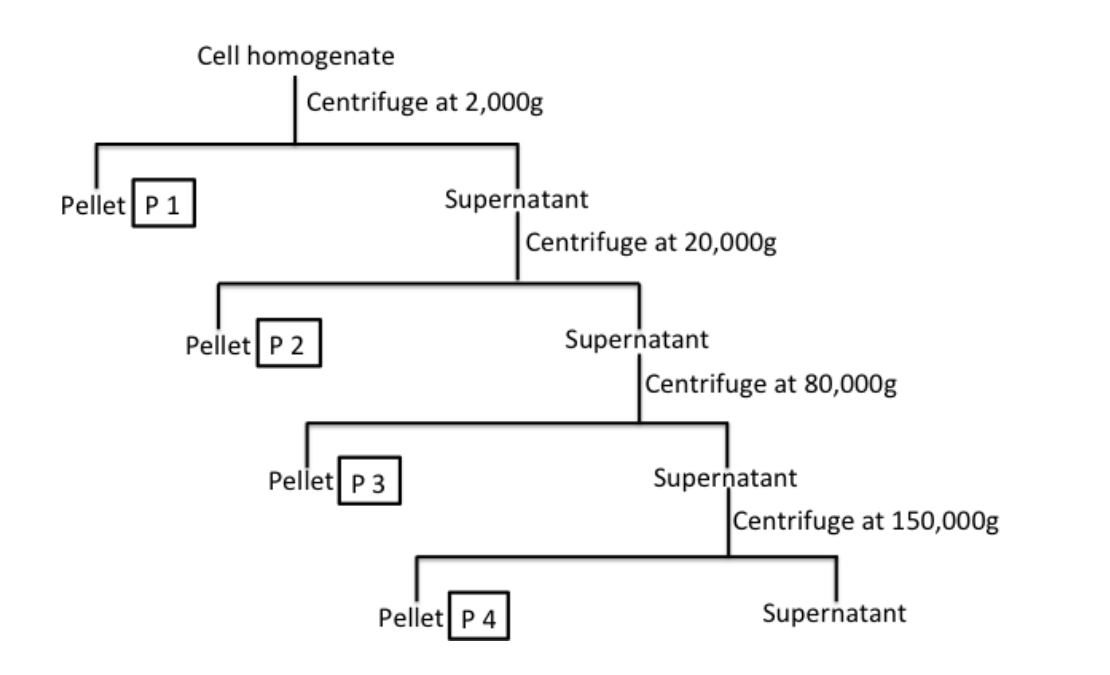
I) Predict which organelle(s) from the following: nuclei, mitochondria and ribosome, will be present in P1, P2 and P4 pellet fraction. P3 contains the membrane fractions. (Provide the correct answers in your answer script)
P1 ___________ P2 ___________ P3 Membrane Fraction P4 ___________
II) Different organelles can selectively be stained by taking into consideration their composition and function. Below is a chart of different type of stains used for staining different organelles. Predict which stain can be used for staining the P1, P2 and P3 fractions, independently. (Choose only the best stain for each from the list below, providing the correct answers in your answer sheet.)
| Stain | Specificity |
|---|---|
| Redox dyes | ATP generation centers |
| Hematoxylin (basic dye) | DNA and RNA |
| Acidic stain | Lysosome |
| Lipophilic stains | Lipid containing organelles |
P1 ___________ P2 ___________ P3 ___________
III) Slim tea presently used for shaping body, contains 2,4-Dinitrophenol (DNP) which acts as a proton ionophore, an agent that can shuttle protons (hydrogen cations) across biological membranes. It dissipates the proton gradient across membranes, collapsing the proton motive force that the cell uses to produce most of its ATP (chemical energy). Now in the cell the energy of the proton gradient is lost as heat instead of producing ATP. With this information, predict membranes of which sub-cellular organelle(s) of a plant and an animal cell will be mostly affected by consumption of slim tea.
IV) A person unknowingly consumed some poisonous substance. Which sub-cellular organelle of the patient would contain the maximum concentration of the toxin?
[Total = 5 marks]
Topic: Biology Metodi: Physical Modeling Competenze: Physical Reasoning Objects: — Fonte: Testo (PDF) — p.18
Con il processo di rottura meccanica come l’omogenizzazione in un omogenizzatore miscelatore, le membrane delle cellule possono essere rotte per fare un omogeneo cellulare. Gli organi organici sottocellulari come il nucleo, i mitocondri, le particelle ribosomiche e le frazioni della membrana rimangono presenti nell’omogenato. Le diverse organelle dell’omogenato di cui sopra possono essere separate tra loro mediante un processo chiamato frazionamento cellulare. Poiché queste organele variano di dimensione; possono essere pelletate selettivamente mentre la forza centrifugata relativa richiesta (RCF) per pelletare selettivamente un organole mentre gli altri organelli rimangono nel supernatante. Nel processo di centrifugazione ripetuto di isolamento degli organi, gli organi vengono separati in base alla loro dimensione, dove gli organi più grandi vengono pelletizzati a basso RCF (g) e gli organi più piccoli a più alto RCF (g). In seguito è riportato uno schema di tale isolamento.
Quesito 40
**I) ** Predicire quali organole (s) dei seguenti: nuclei, mitocondrie e ribosomi, saranno presenti nella frazione di pellet P1, P2 e P4. P3 contiene le frazioni della membrana. (Fornisci le risposte corrette nel tuo script di risposta)
P1 ___________ P2 ___________ P3 Frazione di membrana P4 ___________
**II) ** Diversi organelli possono essere colorati selettivamente tenendo conto della loro composizione e funzione. Di seguito è riportato un grafico dei diversi tipi di macchie utilizzate per macchiare le diverse organelle. Prevedere quale macchia può essere utilizzata per macchiare le frazioni P1, P2 e P3, indipendentemente. (Scelgi solo la macchia migliore per ciascuna dalla lista di seguito, fornendo le risposte corrette nella scheda di risposta.)
♬ Stagna ♬ Specificità ♬ | --- | --- | ♬ Redox coloranti ♬ ATP generazione centri ♬ ♬ Ematoxylin ♬ DNA e RNA ♬
Una macchia acida # # un lysosoma
♬ macchie lipofile ♬ lipido contenente organelli ♬
P1 ___________ P2 ___________ P3 ___________
Il tè sottile, attualmente usato per la formazione del corpo, contiene 2,4-dinitrophenolo (DNP) che agisce come ionofore protonico, un agente che può trasportare i protoni (cationi di idrogeno) attraverso le membrane biologiche. Essa dissipa il gradiente dei protoni attraverso le membrane, collassando la forza motrice dei protoni che la cellula utilizza per produrre la maggior parte del suo ATP (energia chimica). Ora nella cellula l’energia del gradiente dei protoni viene persa come calore invece di produrre ATP. Con queste informazioni, prevedi le membrane di cui le sottocellule di una pianta e di una cellula animale saranno maggiormente influenzate dal consumo di tè sottile.
** IV) ** Una persona ha consumatto inconsapevolmente una sostanza velenosa. Quale organole sottocellulare del paziente avrebbe la concentrazione massima della tossina?
[Total = 5 marchi]
Topic: Biology Metodi: Physical Modeling Competenze: Physical Reasoning Objects: — Fonte: Testo (PDF) — p.18
During the study of factors affecting germination, Lata used 4 tubes P, Q, R and S. Seeds of green gram were subjected to different condition as described below
Quesito 41
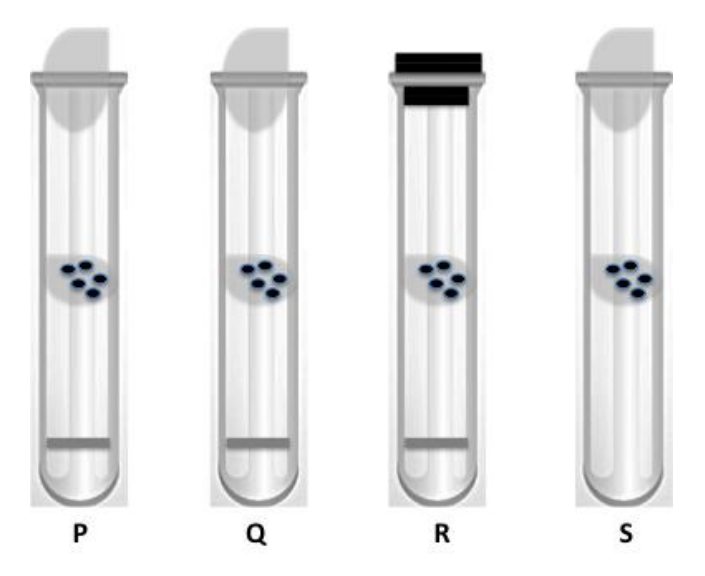
P- Seeds soaked in water were kept on moist cotton wool and placed in a tube with water. The tube was closed with loose cotton wool and kept at 25°C Q- Same arrangement as above (P) but tube stored at 4°C R- Seeds soaked in water was kept on moist cotton wool and placed in a tube with Pyrogallol instead of water. Pyrogallol removes oxygen. The tube was closed tightly with a wooden block and kept at 25°C S- Dry seeds kept on dry cotton wool, kept at 25°C without adding water.
Every experiment should have controls. A control can be positive or negative. Negative control is a condition where the phenomenon (germination of seeds in this example) is not expected to happen while in positive control the phenomenon is expected to happen with respect to the parameter being tested.
(For questions I-V, provide only the correct option number in your answer sheet.)
I) Which tube will have the highest frequency of germination (i) P (ii) Q (iii) R (iv) S
II) Which tube serves as a positive control? (i) P (ii) Q (iii) R (iv) S
III) Which tube works as negative control for oxygen? (i) P (ii) Q (iii) R (iv) S
IV) In the above experiment the influence of which of the following factor(s) on germination is/are being tested? (i) O₂ and H₂O only (ii) CO₂ and Pyrogallol only (iii) O₂, H₂O and temperature (iv) Only H₂O
V) What is most likely to happen to the frequency of germination in tube R if the wooden block is replaced with loose cotton wool? (i) No change in germination frequency (ii) Increase in germination frequency (iii) Decrease in germination frequency
[Total = 5 marks]
Topic: Biology Metodi: Physical Modeling Competenze: Diagrammatic Reasoning Objects: Container Fonte: Testo (PDF) — p.19
Durante lo studio dei fattori che influenzano la germinazione, Lata ha utilizzato 4 tubi P, Q, R e S. I semi di grama verde sono stati sottoposti a condizioni diverse come descritto di seguito
Quesito 41
P- I semi immersi in acqua venivano conservati su una lana di cotone umida e messi in un tubo con acqua. Il tubo è stato chiuso con lana di cotone scivolata e mantenuto a 25°C Q- Lo stesso sistema di cui sopra (P), ma in tubo conservato a 4°C R- I semi immersi in acqua sono stati conservati su una lana di cotone umida e collocati in un tubo con Pyrogallol invece di acqua. Il pirogallole rimuove l’ossigeno. Il tubo è stato chiuso con un blocco di legno e mantenuto a 25°C S- semi secchi conservati su lana di cotone secca, conservati a 25°C senza aggiunta di acqua.
Ogni esperimento dovrebbe avere dei controlli. Un controllo può essere positivo o negativo. Il controllo negativo è una condizione in cui il fenomeno (germinazione di semi in questo esempio) non è previsto mentre nel controllo positivo il fenomeno è previsto per il parametro in esame.
(Per le domande I-V, inserire solo il numero corretto della scelta nella scheda di risposta.)
**I) ** Quale tubo avrà la frequenza di germinazione più alta (i) P (ii) Q (iii) R (iv) S
Quale tubo serve come controllo positivo? (i) P (ii) Q (iii) R (iv) S
**III) ** Quale tubo funziona come controllo negativo dell’ ossigeno? (i) P (ii) Q (iii) R (iv) S
In questo esperimento, quale dei seguenti fattori (s) influisce sulla germinazione?
- solo O2 e H2O
- Solo CO2 e Pirogallolo
- O2, H2O e temperatura (iv) Solo H2O
**V) ** Che cosa è più probabile che accada alla frequenza di germinazione nel tubo R se il blocco di legno viene sostituito con lana di cotone sciolta? (i) Nessuna variazione della frequenza di germinazione
- Aumento della frequenza di germinazione
- diminuzione della frequenza di germinazione
[Total = 5 marchi]
Topic: Biology Metodi: Physical Modeling Competenze: Diagrammatic Reasoning Objects: Container Fonte: Testo (PDF) — p.19
The nephron is a basic unit of kidney which is made of Bowman’s capsule, proximal convoluted tubule, loop of Henle and distal convoluted tubule. The proximal convoluted tubule absorbs major amount of water, glucose, other essential elements from the filtrate but still around 180 liters of filtrate passes through loop of Henle daily, out of which only 1 – 2 liters is thrown out of body in the form of concentrated urine. Hence Loop of Henle plays a crucial role in reabsorption of water and salts. The Loop of Henle is located in medulla part of kidney and consists of descending and ascending limb. The ascending one has thicker walls which are non permeable to water. It is important factor for creating concentration gradient throughout the loop’s length. The filtrate entering the loop has 300 units concentration and it keeps on changing as shown in the figure due to reabsorption process. Study the diagram and answer the following questions.
Quesito 42
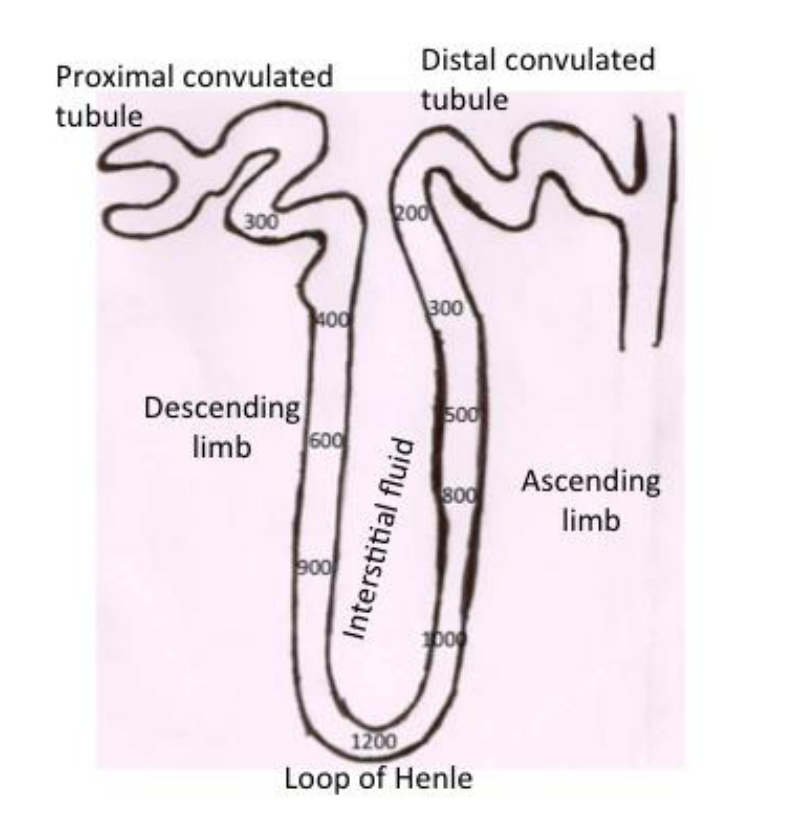
(For questions I-V, provide only the correct option number in your answer sheet.)
I) The concentration of filtrate increases as it passes down the descending tubule due to reabsorption of _________ in the interstitial fluid: (i) NaCl (ii) Water (iii) Amino acids (iv) Glucose
II) In ascending tubule the filtrate shows decrease in concentration as it reaches distal convoluted tubule. This is because of: (i) active transport of water from interstitial fluid to ascending tubule. (ii) active transport of salts from ascending tubule to interstitial fluid. (iii) passive transport of salts from interstitial fluid to ascending tubule. (iv) passive transport of water from interstitial fluid to ascending tubule.
III) In an animal ‘X’, Loop of Henle is shorter than normal length. The result would be: (i) It will excrete lesser amount of concentrated urine. (ii) It will excrete same amount of urine without any difference. (iii) It will excrete large amount of dilute urine. (iv) It will excrete lesser amount of dilute urine.
IV) What is the likely habitat of such animal ‘X’? (i) Aquatic (ii) Hot, Arid desert (iii) Polar (iv) Grasslands
V) An artificial kidney is a device to remove nitrogenous waste products from the blood during dialysis. The device contains tubes that are suspended in a tank filled with dialyzing fluid. The patient’s blood is passed through these tubes. During this passage, waste products from the blood pass into the dialyzing fluid. Pick the correct options given below to fill the blanks in the following statement:
“The tubes of the artificial kidney are ___________, while the dialyzing fluid is __________ to the blood. The waste products from the blood pass into the dialyzing fluid by ______________ transport.”
(i) semipermeable, isotonic, passive (ii) permeable, hypotonic, active (iii) permeable, isotonic, passive (iv) semipermeable, hypotonic, active
[Total = 5 marks]
Topic: Biology Metodi: Physical Modeling Competenze: Diagrammatic Reasoning Objects: — Fonte: Testo (PDF) — p.21
Il nefrone è un’unità di base del rene che è costituito dalla capsula di Bowman, tubule convolto proximale, ciclo di Henle e tubule convolto distale. Il tubule convolto proximale assorbe una grande quantità di acqua, glucosio, altri elementi essenziali dal filtro, ma ancora circa 180 litri di filtro passano attraverso il ciclo di Henle al giorno, di cui solo 1 2 litri vengono gettati fuori dal corpo sotto forma di urina concentrata. Pertanto, il ciclo di Henle svolge un ruolo cruciale nel riassorbimento dell’acqua e dei sali. Il loop di Henle si trova nella parte medulare del rene e consiste di arti discendenti e ascendenti. La montante ha pareti più spesse che non sono impermebili all’acqua. È un fattore importante per la creazione di gradienti di concentrazione lungo tutto il ciclo. Il filtro che entra nel circuito ha una concentrazione di 300 unità e continua a cambiare come mostrato nella figura a causa del processo di riassorbimento. Studiate il diagramma e risponda alle seguenti domande.
Quesito 42
(Per le domande I-V, inserire solo il numero di opzione corretto nella scheda di risposta.)
**I) ** La concentrazione di filtro aumenta mentre passa attraverso il tubo discendente a causa della riassorbimento di _________ nel fluido interstiziale: (i) NaCl (ii) Acqua
- acidi amini (iv) Glucosio
**II) ** Nel tubule ascendente il filtratto mostra una diminuzione della concentrazione quando raggiunge il tubule distal convolto. Questo è dovuto a:
- il trasporto attivo di acqua dal fluido interstiziale al tubo ascendente.
- il trasporto attivo dei sali dal tubo ascendente al fluido interstiziale.
- il trasporto passivo dei sali dal fluido interstiziale al tubo ascendente.
- il trasporto passivo di acqua dal fluido interstiziale al tubule ascendente.
**III) ** In un animale “X”, il loop di Henle è più breve della lunghezza normale. Il risultato sarebbe:
- Escluderà una quantità minore di urina concentrata.
- Escluderà la stessa quantità di urina senza alcuna differenza.
- Escluderà una grande quantità di urina diluita. (iv) Escluderà una minor quantità di urina diluita.
**IV) ** Qual è il probabile habitat di tale animale “X”? (i) Acqua (ii) Deserto caldo e arido (iii) Polari (iv) Paesi di pascoli
**V) ** Un rene artificiale è un dispositivo per rimuovere i prodotti di scarto azoto dal sangue durante la dialisi. Il dispositivo contiene tubi sospesi in un serbatoio pieno di liquido di dialisi. Il sangue del paziente passa attraverso questi tubi. Durante questo passaggio, i rifiuti del sangue passano nel liquido di dialisi. Scegliere le opzioni corrette indicate di seguito per riempire i vuoti nella seguente dichiarazione:
“I tubi del rene artificiale sono ___________, mentre il liquido di dialisi è __________ al sangue. I rifiuti del sangue passano nel liquido di dialisi attraverso il trasporto di ______________”.
- semipermeable, isotoniche, passive
- permeabili, ipotonici, attivi
- permeabili, isotonici, passivi
- semipermeable, hypotonic, attivo
[Total = 5 marchi]
Topic: Biology Metodi: Physical Modeling Competenze: Diagrammatic Reasoning Objects: — Fonte: Testo (PDF) — p.21