Section I (one option correct)
A body with a density is attached to a spring that is known to stretch linearly with the applied force. The spring is held vertically such that the body is fully immersed in a liquid of density (). In this case, the spring stretches by a length . When the same body is fully immersed in a liquid of density (), the spring stretches by . This implies that the density of the body () is given by the expression
- (A)
- (B)
- (C)
- (D)
Topic: Fluid Mechanics, Elasticity & Materials Metodi: Hooke’s Law, Hydrostatic Equilibrium Competenze: Physical Reasoning Objects: Spring, Block Fonte: Testo (PDF) — p.3 Soluzione: Soluzioni (PDF)
**Sezione I (correzione di una sola opzione) **
Un corpo con una densità è attaccato a una molla che si estende linearmente con la forza applicata. La molla è tenuta verticalmente in modo che il corpo sia completamente immerso in un liquido di densità (). In questo caso, la molla si estende per una lunghezza . Quando lo stesso corpo è completamente immerso in un liquido di densità (), la molla si estende di . Ciò implica che la densità del corpo () è data dall’espressione
- (A)
- (B)
- (C)
- (D)
Topic: Fluid Mechanics, Elasticity & Materials Metodi: Hooke’s Law, Hydrostatic Equilibrium Competenze: Physical Reasoning Objects: Spring, Block Fonte: Testo (PDF) — p.3 Soluzione: Soluzioni (PDF)
For any conductor, the thermal dependence of resistance is given by , where is the temperature difference in °C, is a constant having the dimensions of and is the resistance of the wire at 0°C.
A wire made of a conductor, with , is subjected to a constant voltage . Then, for the wire, as the time progresses,
- (A) the temperature as well as the current will go on decreasing.
- (B) the temperature will go on decreasing while the current will go on increasing.
- (C) the temperature as well as the current will go on increasing.
- (D) the temperature will go on increasing while the current will go on decreasing.
Topic: Circuits Metodi: Physical Modeling Competenze: Physical Reasoning Objects: Wire Fonte: Testo (PDF) — p.3 Soluzione: Soluzioni (PDF)
Per qualsiasi conduttore, la resistenza termico è data da , dove è la differenza di temperatura di °C, è una costante con le dimensioni di e è la resistenza del filo a 0°C.
Un filo di conduttore, con , è sottoposto a una tensione costante . Poi, per il filo, con il passare del tempo,
- (A) la temperatura e la corrente continueranno a diminuire.
- (B) la temperatura continuerà a diminuire mentre la corrente continuerà ad aumentare.
- (c) la temperatura e la corrente continueranno ad aumentare.
- (D) la temperatura continuerà ad aumentare mentre la corrente continuerà a diminuire.
Topic: Circuits Metodi: Physical Modeling Competenze: Physical Reasoning Objects: Wire Fonte: Testo (PDF) — p.3 Soluzione: Soluzioni (PDF)
On a standard chess board with squares, a chess piece starts to move from the lower left corner, which we shall label as square . This piece is allowed to move only upwards or rightwards. At any point, the piece cannot move downwards, leftwards or diagonally, e.g., from square , the piece may go towards or but not any other direction. If this piece continues to move only according to these rules, the number of different paths by which it can reach the square , starting from the square , is
- (A) 16
- (B) 18
- (C) 20
- (D) 24
Topic: Mathematics Metodi: Physical Modeling Competenze: Mathematical Modeling Objects: — Fonte: Testo (PDF) — p.3 Soluzione: Soluzioni (PDF)
Su una scacchiera standard con quadrati , un pezzo di scacchi inizia a muoversi dall’angolo inferiore sinistro, che segneremo come quadrato . Questo pezzo può muoversi solo verso l’alto o verso destra. In ogni momento, il pezzo non può muoversi verso il basso, verso sinistra o diagonalmente, ad esempio dal quadrato , il pezzo può andare verso o ma non in alcuna altra direzione. Se questo pezzo continua a muoversi solo secondo queste regole, il numero di percorsi diversi attraverso i quali può raggiungere il quadrato , partendo dal quadrato , è
- (A) 16
- (B) 18
- (C) 20
- (D) 24
Topic: Mathematics Metodi: Physical Modeling Competenze: Mathematical Modeling Objects: — Fonte: Testo (PDF) — p.3 Soluzione: Soluzioni (PDF)
A train is moving at a speed of towards a person standing just next to the rails. The train blows a whistle for . What is the time duration for which the whistle is heard by this person? Assume that the train does not reach or cross the person until the end of whistle. Speed of sound in air is .
- (A)
- (B)
- (C)
- (D)
Topic: Oscillations & Waves Metodi: Wave Equation Competenze: Physical Reasoning Objects: — Fonte: Testo (PDF) — p.3 Soluzione: Soluzioni (PDF)
Un treno si muove a una velocità verso una persona che sta proprio accanto ai binari. Il treno fa suonare un fischio per . Per quanto tempo la fischietta viene ascoltata da questa persona? Supponiamo che il treno non raggiunga o attraverserà la persona fino alla fine del fischietto. La velocità del suono nell’aria è .
- (A)
- (B)
- (C)
- (D)
Topic: Oscillations & Waves Metodi: Wave Equation Competenze: Physical Reasoning Objects: — Fonte: Testo (PDF) — p.3 Soluzione: Soluzioni (PDF)
A current carrying wire is bent in the shape shown below. Direction of current is also shown in the figure. The wire forms a three-dimensional cubical shape of side with a current flowing through it, with point at the centre. The direction of magnetic field at the center of the cubical shape will be
- (A) parallel to the axis.
- (B) parallel to the axis.
- (C) parallel to the axis.
- (D) undefined (field will be zero).
Quesito 5
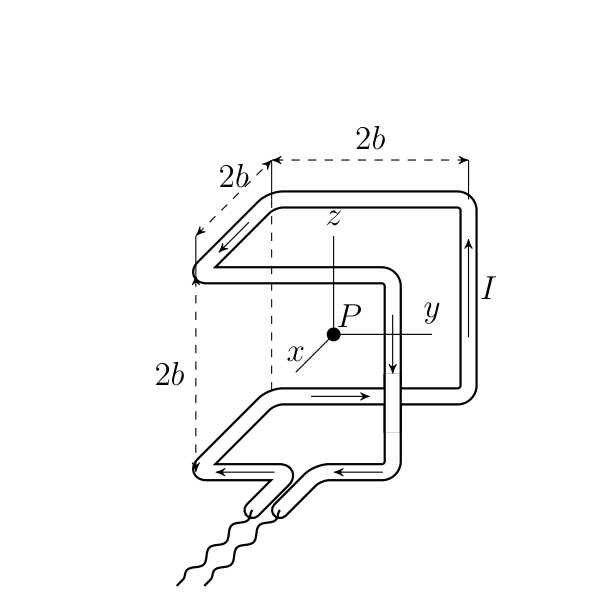
Topic: Magnetism Metodi: Biot-Savart Law, Symmetry Argument Competenze: Diagrammatic Reasoning Objects: Wire Fonte: Testo (PDF) — p.3 Soluzione: Soluzioni (PDF)
Un filo di carico corrente è piegato nella forma mostrata qui sotto. La direzione della corrente è mostrata anche nella figura. Il filo forma una forma cubica tridimensionale di lato con una corrente che fluisce attraverso di esso, con il punto al centro. La direzione del campo magnetico al centro della forma cubica sarà
- (A) parallelo all’asse .
- (B) parallelo all’asse .
- (C) parallelo all’asse .
- (D) indefinito (campo sarà zero).
Quesito 5
Topic: Magnetism Metodi: Biot-Savart Law, Symmetry Argument Competenze: Diagrammatic Reasoning Objects: Wire Fonte: Testo (PDF) — p.3 Soluzione: Soluzioni (PDF)
In the balanced chemical equation of the thermal decomposition of lead(II) nitrate to lead(II) oxide, if the coefficient of lead(II) nitrate is 2, then the coefficient of nitrogen dioxide is
- (A) 1
- (B) 2
- (C) 3
- (D) 4
Topic: Chemistry Metodi: Physical Modeling Competenze: Physical Reasoning Objects: — Fonte: Testo (PDF) — p.4 Soluzione: Soluzioni (PDF)
Nell’equazione chimica equilibrata della decomposizione termica del piombo (II) nitrato in piombo (II) ossido, se il coefficiente di piombo (II) nitrato è 2, allora il coefficiente di anidride nitrogenica è
- (A) 1
- (B) 2
- (C) 3
- (D) 4
Topic: Chemistry Metodi: Physical Modeling Competenze: Physical Reasoning Objects: — Fonte: Testo (PDF) — p.4 Soluzione: Soluzioni (PDF)
Metals react with oxygen to form metal oxides. If the metals considered are K, Cs, Mg and Sr, the correct order of the basic character of their oxides is
- (A)
- (B)
- (C)
- (D)
Topic: Chemistry Metodi: Physical Modeling Competenze: Physical Reasoning Objects: — Fonte: Testo (PDF) — p.4 Soluzione: Soluzioni (PDF)
I metalli reagiscono con l’ossigeno per formare ossidi metallici. Se i metalli considerati sono K, Cs, Mg e Sr, l’ordine corretto del carattere di base dei loro ossidi è
- (A)
- (B)
- (C)
- (D)
Topic: Chemistry Metodi: Physical Modeling Competenze: Physical Reasoning Objects: — Fonte: Testo (PDF) — p.4 Soluzione: Soluzioni (PDF)
A U-shaped tube with a semipermeable membrane is filled with 2 L of water as shown in figure I. When 0.1 mol of compound X is completely dissolved in the right arm of the tube, the level of solution rises as shown in the figure II. Assume that the rise in the solution level is proportional to the number of solute particles in an aqueous solution.
The height would be the highest when X is
- (A)
- (B)
- (C)
- (D) Cane Sugar
Quesito 8
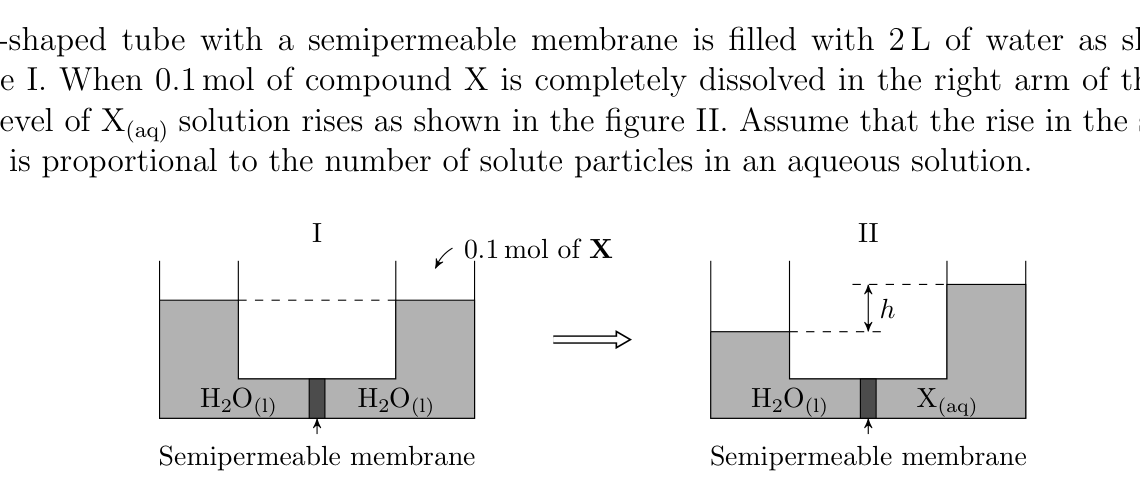
Topic: Chemistry Metodi: Physical Modeling Competenze: Physical Reasoning Objects: Tube, Membrane Fonte: Testo (PDF) — p.4 Soluzione: Soluzioni (PDF)
Un tubo a forma di U con membrana semipermeable è riempito di 2 L di acqua come mostrato alla figura I. Quando 0,1 mol di composto X è completamente disciolto nel braccio destro del tubo, il livello di soluzione aumenta come mostrato nella figura II. Supponiamo che l’aumento del livello della soluzione sia proporzionale al numero di particelle di soluto in una soluzione acquosa.
L’altezza sarebbe la più alta quando X è
- (A)
- (B)
- (C)
- (D) Zucchero di canna
Quesito 8
Topic: Chemistry Metodi: Physical Modeling Competenze: Physical Reasoning Objects: Tube, Membrane Fonte: Testo (PDF) — p.4 Soluzione: Soluzioni (PDF)
A more reactive metal displaces a less reactive metal from its salt solution. Observe the following figures in which a metal rod is suspended in 1 M salt solution. At room temperature, the displacement reaction will significantly occur in
- (A) Fe in
- (B) Al in
- (C) Mg in
- (D) Cu in
Topic: Chemistry Metodi: Physical Modeling Competenze: Physical Reasoning Objects: Rod Fonte: Testo (PDF) — p.4 Soluzione: Soluzioni (PDF)
Un metallo più reattivo sposta un metallo meno reattivo dalla sua soluzione di sale. Si osservano le seguenti cifre in cui una canna metallica è sospesa in una soluzione di sale di 1 M. A temperatura ambiente, la reazione di spostamento si verifica in modo significativo in
- (A) Fe in
- (B) Al in
- (C) Mg in
- (D) Cu in
Topic: Chemistry Metodi: Physical Modeling Competenze: Physical Reasoning Objects: Rod Fonte: Testo (PDF) — p.4 Soluzione: Soluzioni (PDF)
Soaps are sodium salts of fatty acids. Which of the following can be added to a pure soap to bring its pH to 7?
- (A) Lemon Juice
- (B) Common salt
- (C) Sodium Nitrate
- (D) Baking Soda
Topic: Chemistry Metodi: Physical Modeling Competenze: Physical Reasoning Objects: — Fonte: Testo (PDF) — p.4 Soluzione: Soluzioni (PDF)
I saponi sono sali di sodio di acidi grassi. Quale di queste cose può essere aggiunta a un sapone puro per portare il pH a 7?
- (A) Succo di limone
- (B) Sale comuni
- (C) Nitrato di sodio
- (D) Soda da cucire
Topic: Chemistry Metodi: Physical Modeling Competenze: Physical Reasoning Objects: — Fonte: Testo (PDF) — p.4 Soluzione: Soluzioni (PDF)
In case of diarrhea, oral rehydration salts (ORS) mixed with water is used as a simple therapy to rehydrate the patient. Rehydration occurs only if glucose and NaCl (both present in ORS) are added to water and given to the patient. Which of the diagrams given below correctly represents the initial steps in the working of ORS in the intestine?
The options (A), (B), (C) and (D) are the diagrams shown below, each depicting glucose and transport across the intestinal epithelial cells together with the Na-K ATPase pump.
Quesito 11
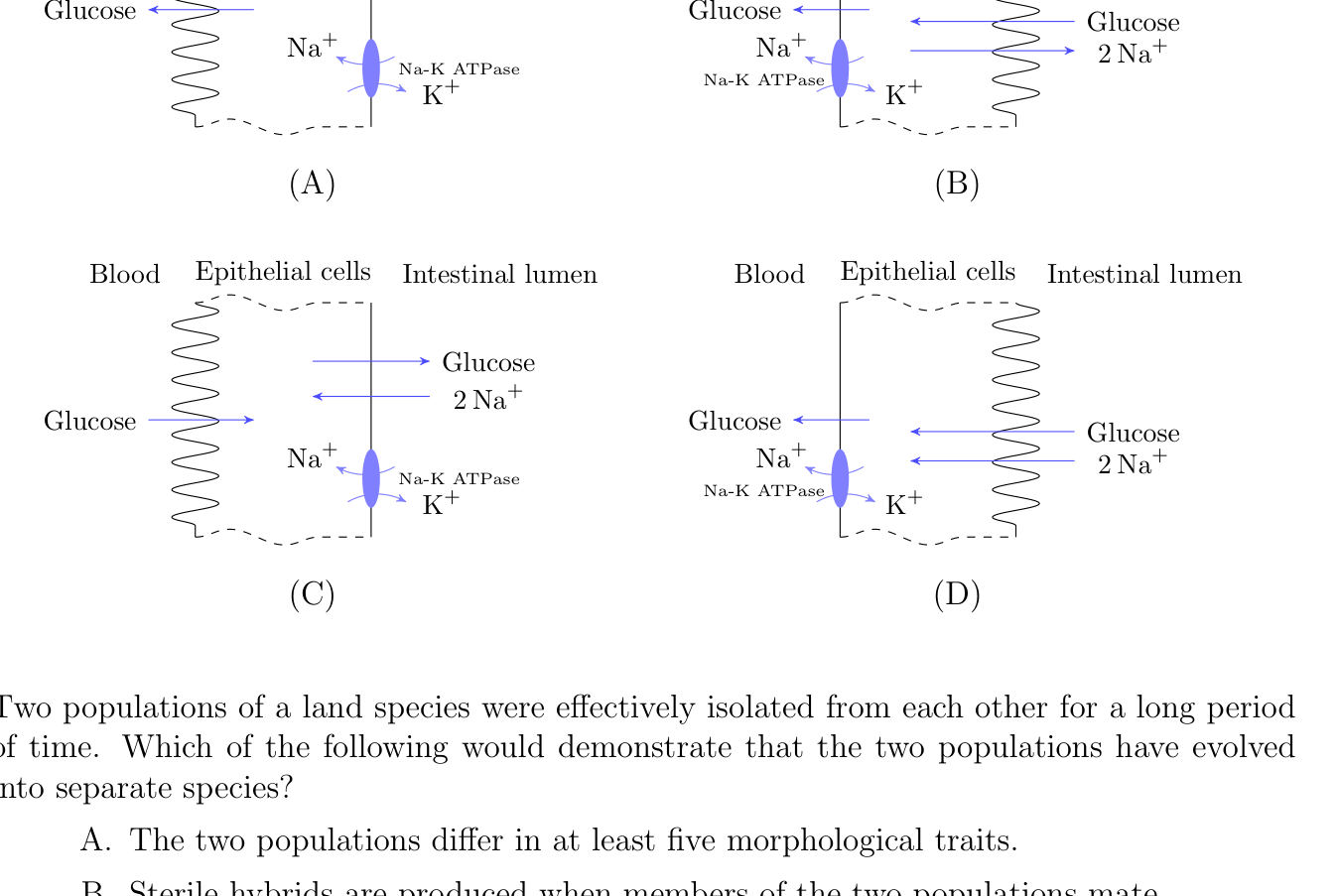
Topic: Biology Metodi: Physical Modeling Competenze: Diagrammatic Reasoning Objects: — Fonte: Testo (PDF) — p.5 Soluzione: Soluzioni (PDF)
In caso di diarrea, i sali di riidratazione orale (ORS) mescolati con acqua sono utilizzati come terapia semplice per riidratare il paziente. La riidratazione avviene solo se il glucosio e il NaCl (entrambi presenti nell’ ORS) vengono aggiunti all’ acqua e somministrati al paziente. Quale dei diagrammi riportati di seguito rappresenta correttamente i primi passaggi nel funzionamento dell’ORS nell’intestino?
Le opzioni (A), (B), (C) e (D) sono i diagrammi riportati di seguito, ognuno raffigurando il trasporto del glucosio e attraverso le cellule epiteliali intestinali insieme alla pompa ATPase Na-K.
Quesito 11
Topic: Biology Metodi: Physical Modeling Competenze: Diagrammatic Reasoning Objects: — Fonte: Testo (PDF) — p.5 Soluzione: Soluzioni (PDF)
Two populations of a land species were effectively isolated from each other for a long period of time. Which of the following would demonstrate that the two populations have evolved into separate species?
- (A) The two populations differ in at least five morphological traits.
- (B) Sterile hybrids are produced when members of the two populations mate.
- (C) Organisms of both the populations do not willingly mate with each other.
- (D) DNA sequences are different for the two populations.
Topic: Biology Metodi: Physical Modeling Competenze: Physical Reasoning Objects: — Fonte: Testo (PDF) — p.5 Soluzione: Soluzioni (PDF)
Due popolazioni di una specie terrestre sono state efficacemente isolate l’una dall’altra per un lungo periodo di tempo. Quale delle seguenti indicazioni dimostrerebbe che le due popolazioni si sono evolute in specie separate?
- (A) Le due popolazioni differiscono in almeno cinque tratti morfologici.
- (B) Gli ibridi sterili sono prodotti quando i membri delle due popolazioni si accoppiano.
- (C) Gli organismi di entrambe le popolazioni non si accoppiano volentieri.
- (D) Le sequenze del DNA sono diverse per le due popolazioni.
Topic: Biology Metodi: Physical Modeling Competenze: Physical Reasoning Objects: — Fonte: Testo (PDF) — p.5 Soluzione: Soluzioni (PDF)
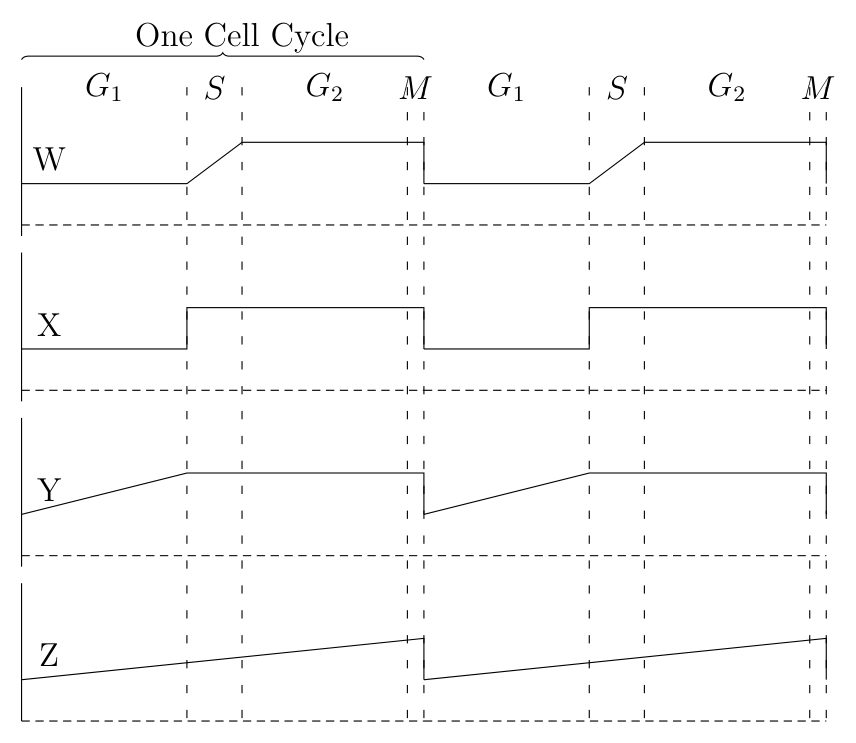
The figure on the right represents the cell cycle for Schwann cells. As Schwann cells grow, they remain metabolically active for a certain period of time and then either undergo apoptosis (cell death) or divide and form new daughter cells. Actively dividing cells undergo a normal cell cycle as shown in the diagram. A newly formed cell passes through , , phases, together called ‘interphase’, before entering mitotic division phase (M phase). Mitosis gives rise to two new daughter cells which are genetically identical to the mother cell.
Among the graphs shown below (W, X, Y, Z), one represents the trend shown by the ‘cell volume’ during the cell cycle and another represents the trend shown by the ‘amount of genomic DNA’. Identify the two graphs in the same order.
- (A) Y and W
- (B) Y and X
- (C) Z and X
- (D) Z and W
Quesito 13
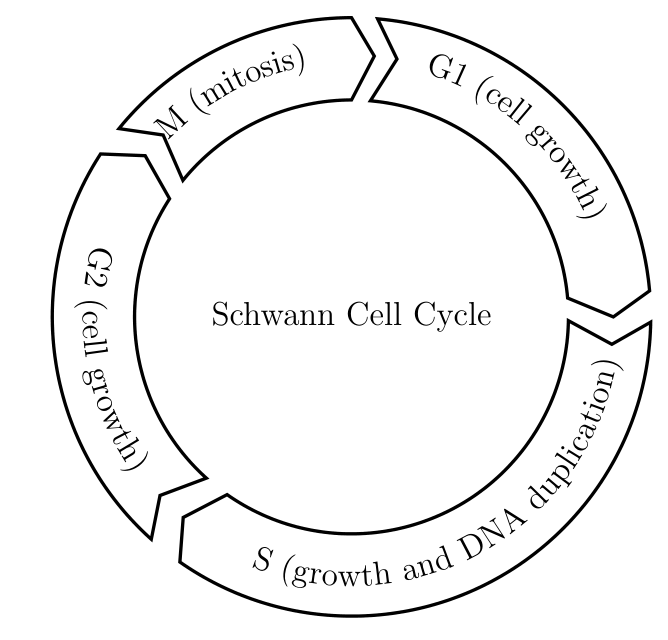
Quesito 13
Topic: Biology Metodi: Physical Modeling Competenze: Diagrammatic Reasoning Objects: — Fonte: Testo (PDF) — p.5 Soluzione: Soluzioni (PDF)
La figura a destra rappresenta il ciclo cellulare delle cellule Schwann. Man mano che le cellule di Schwann crescono, rimangono metabolicamente attive per un certo periodo di tempo e poi subiscono apoptosi (morte cellulare) o si dividono e formano nuove cellule figlia. Le cellule che dividono attivamente subiscono un ciclo cellulare normale come mostrato nel diagramma. Una cellula appena formata attraversa le fasi , , , chiamate insieme “interfase”, prima di entrare nella fase di divisione mitotica (fase M). La mitosi dà origine a due nuove cellule figlia che sono geneticamente identiche alla cellula madre.
Tra i grafici riportati di seguito (W, X, Y, Z), uno rappresenta la tendenza mostrata dal “volume cellulare” durante il ciclo cellulare e un altro rappresenta la tendenza mostrata dalla ” quantità di DNA genomica ”. Identificare i due grafici nello stesso ordine.
- (A) Y e W
- (B) Y e X
- (C) Z e X
- (D) Z e W
Quesito 13
Quesito 13
Topic: Biology Metodi: Physical Modeling Competenze: Diagrammatic Reasoning Objects: — Fonte: Testo (PDF) — p.5 Soluzione: Soluzioni (PDF)
Chromophores are commonly used as biological stains to view cell organelles better. When an epithelial cell (e.g. skin cell) is stained with a basic dye like methylene blue and observed under a light microscope (total magnification of 100X), the visible cell organelle(s) will be
- (A) Blue nucleus and blue mitochondria.
- (B) Blue nucleus and blue endosomes.
- (C) Blue nucleus and pink mitochondria.
- (D) Blue nucleus.
Topic: Biology Metodi: Physical Modeling Competenze: Physical Reasoning Objects: — Fonte: Testo (PDF) — p.6 Soluzione: Soluzioni (PDF)
I cromofori sono comunemente usati come macchie biologiche per vedere meglio gli organi cellulari. Quando una cellula epiteliale (ad esempio la cellula della pelle) è colorata con un colorante di base come il blu metilene e osservata sotto un microscopio luminoso (grandezza totale di 100X), gli organi cellulari visibili saranno
- (A) Nucleo blu e mitocondrie blu.
- (B) Nucleo blu e endosomi blu.
- (C) Nucleo blu e mitocondrie rosa.
- Nuocleo blu.
Topic: Biology Metodi: Physical Modeling Competenze: Physical Reasoning Objects: — Fonte: Testo (PDF) — p.6 Soluzione: Soluzioni (PDF)
Alleles are variant forms of a gene that are located at the same position, or genetic locus, on a chromosome. An allele frequency is calculated by dividing the number of times the allele of interest is observed in a population by the total number of all the alleles at that particular genetic locus in the population.
A cross is made between two pea plants, one bearing round seeds and the other bearing wrinkled seeds. All pea plants in the progeny had round seeds. When the progeny were self-pollinated and the progeny analyzed, it was observed that 300 plants had round seeds while 100 plants had wrinkled seeds. What is the frequency of the dominant allele that is responsible for seed shape in the progeny?
- (A) 25%
- (B) 50%
- (C) 75%
- (D) 100%
Topic: Biology Metodi: Physical Modeling Competenze: Physical Reasoning Objects: — Fonte: Testo (PDF) — p.6 Soluzione: Soluzioni (PDF)
Gli alleli sono forme varianti di un gene che si trovano nella stessa posizione, o locus genetico, su un cromosoma. Una frequenza di alleli viene calcolata dividendo il numero di volte che l’alele di interesse è osservato in una popolazione per il numero totale di tutti gli alleli a quel particolare locus genetico nella popolazione.
Si fa un croce tra due piante di piselli, una con semi rotondi e l’altra con semi arrugginiti. Tutte le piante di piselli della progenie avevano semi rotonde. Quando la progenie è stata autoimpollinata e la progenie analizzata, è stato osservato che 300 piante avevano semi rotonde mentre 100 piante avevano semi arrugginite. Qual è la frequenza dell’alele dominante responsabile della forma dei semi nella progenie ?
- (A) 25%
- (B) 50%
- (C) 75%
- (D) 100%
Topic: Biology Metodi: Physical Modeling Competenze: Physical Reasoning Objects: — Fonte: Testo (PDF) — p.6 Soluzione: Soluzioni (PDF)
Section II (one or more options correct)
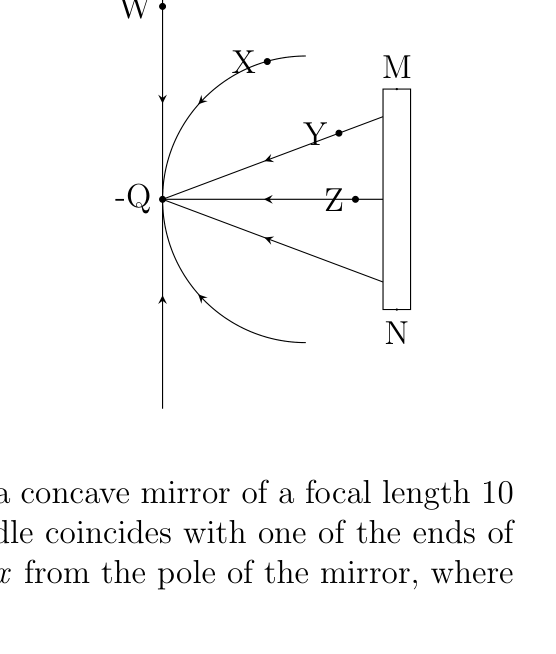
The figure on the right shows a negative point charge and a thick uncharged metal plate. In the two-dimensional figure, MN is a cross-section of the plate. As seen in the figure, the charge is located on the normal drawn from the centre of the plate.
A student was given this situation and was asked to draw lines of force through the points W, X, Y and Z. The diagram on the right is the answer given by the student. At which point(s) the drawn lines of force definitely do(es) NOT match the actual lines of force?
- (A) W
- (B) X
- (C) Y
- (D) Z
Quesito 16
Topic: Electrostatics Metodi: Gauss’s Law, Symmetry Argument Competenze: Diagrammatic Reasoning Objects: Point Charge Fonte: Testo (PDF) — p.7 Soluzione: Soluzioni (PDF)
**Sezione II (correzione di una o più opzioni) **
La figura a destra mostra una carica di punto negativo e una spessa piastra metallica non carica. Nella figura bidimensionale, MN è una sezione trasversale della piastra. Come si vede nella figura, la carica si trova sulla normale tratto dal centro della piastra.
Un studente ha avuto questa situazione e gli è stato chiesto di disegnare linee di forza attraverso i punti W, X, Y e Z. Il diagramma a destra è la risposta data dallo studente. A quali punti le linee di forza tracciate non corrispondono con le linee di forza effettive?
- (A) W
- (B) X
- (C) Y
- (D) Z
Quesito 16
Topic: Electrostatics Metodi: Gauss’s Law, Symmetry Argument Competenze: Diagrammatic Reasoning Objects: Point Charge Fonte: Testo (PDF) — p.7 Soluzione: Soluzioni (PDF)
A 5 cm long needle is placed along the principal axis of a concave mirror of a focal length 10 cm. It is observed that one end of the image of the needle coincides with one of the ends of the needle. The other end of the image is at a distance from the pole of the mirror, where is
- (A)
- (B)
- (C)
- (D)
Topic: Geometric Optics Metodi: Thin Lens & Mirror Equation Competenze: Physical Reasoning Objects: Mirror Fonte: Testo (PDF) — p.7 Soluzione: Soluzioni (PDF)
Un ago lungo 5 cm viene posizionato lungo l’asse principale di uno specchio concavo di 10 cm di lunghezza focale. Si osserva che una estremità dell’immagine dell’ago coincide con una delle estremità dell’ago. L’altra estremità dell’immagine è a una distanza dal polo dello specchio, dove è
- (A)
- (B)
- (C)
- (D)
Topic: Geometric Optics Metodi: Thin Lens & Mirror Equation Competenze: Physical Reasoning Objects: Mirror Fonte: Testo (PDF) — p.7 Soluzione: Soluzioni (PDF)
A body is performing one dimensional motion. After time instant , the body covers equal distances in two successive time intervals each. Also, the speed of the body at time instants and at happens to be the same. Therefore, the
- (A) acceleration may be zero.
- (B) body may be moving with a constant non-zero acceleration.
- (C) body may be moving with an acceleration proportional to displacement (from a suitably defined origin) and directed opposite to it.
- (D) body may be coming to a halt momentarily.
Topic: Newtonian Mechanics, Oscillations & Waves Metodi: Kinematic Equations, Simple Harmonic Motion Analysis Competenze: Physical Reasoning Objects: — Fonte: Testo (PDF) — p.7 Soluzione: Soluzioni (PDF)
Un corpo sta compiendo un movimento unidimensional. Dopo un istante di tempo , il corpo copre distanze uguali in due intervalli di tempo successivi ciascuno. Inoltre, la velocità del corpo in istanti temporali e a è la stessa. Pertanto, il
- (A) l’accelerazione può essere zero.
- (B) il corpo può essere in movimento con una costante accelerazione non zero.
- (C) il corpo può muoversi ad un’accelerazione proporzionale al spostamento (da un’origine adeguatamente definita) e diretto di fronte a esso.
- (D) il corpo potrebbe essere in sospeso momentaneamente.
Topic: Newtonian Mechanics, Oscillations & Waves Metodi: Kinematic Equations, Simple Harmonic Motion Analysis Competenze: Physical Reasoning Objects: — Fonte: Testo (PDF) — p.7 Soluzione: Soluzioni (PDF)
3.0 g of ethanoic acid reacts with 1.84 g of absolute ethanol in the presence of an acid catalyst to give an ester. Assuming that the reaction goes to completion, the correct statement(s) is/are
- (A) 0.05 mol of ester is formed.
- (B) 3.5 g of ester is produced.
- (C) molecules of ester are produced.
- (D) The product contains carbon atoms.
Topic: Organic Chemistry Metodi: Physical Modeling Competenze: Physical Reasoning Objects: — Fonte: Testo (PDF) — p.7 Soluzione: Soluzioni (PDF)
3,0 g di acido etanoico reagisce con 1,84 g di etanolo assoluto in presenza di un catalizzatore acido per dare un estero. Supponendo che la reazione vada a completare, la dichiarazione corretta (s) è/sono
- (A) si forma 0,05 mol di estero.
- (B) si producono 3,5 g di estero.
- (C) vengono prodotte molecole di esteri.
- (D) Il prodotto contiene atomi di carbonio.
Topic: Organic Chemistry Metodi: Physical Modeling Competenze: Physical Reasoning Objects: — Fonte: Testo (PDF) — p.7 Soluzione: Soluzioni (PDF)
One mole of ions contains
- (A) electrons.
- (B) protons.
- (C) neutrons.
- (D) protons.
Topic: Nuclear & Particle Physics, Chemistry Metodi: Physical Modeling Competenze: Physical Reasoning Objects: Atom, Electron, Nucleus Fonte: Testo (PDF) — p.7 Soluzione: Soluzioni (PDF)
Un mole di ioni contiene
- (A) elettroni.
- (B) protoni.
- (C) neutroni.
- (D) protoni.
Topic: Nuclear & Particle Physics, Chemistry Metodi: Physical Modeling Competenze: Physical Reasoning Objects: Atom, Electron, Nucleus Fonte: Testo (PDF) — p.7 Soluzione: Soluzioni (PDF)
Q, X, Z, J, E, L and G are some unknown elements. The pair(s) that show similar chemical properties is/are
- (A) ,
- (B) ,
- (C) ,
- (D) ,
(The subscript on each symbol denotes the atomic number of that element.)
Topic: Chemistry Metodi: Physical Modeling Competenze: Physical Reasoning Objects: — Fonte: Testo (PDF) — p.7 Soluzione: Soluzioni (PDF)
Q, X, Z, J, E, L e G sono alcuni elementi sconosciuti. Le coppie che presentano proprietà chimiche simili sono/sono
- (A) ,
- (B) ,
- (C) ,
- (D) ,
(Il sottoscritto di ogni simbolo indica il numero atomico di quell’elemento.)
Topic: Chemistry Metodi: Physical Modeling Competenze: Physical Reasoning Objects: — Fonte: Testo (PDF) — p.7 Soluzione: Soluzioni (PDF)
Karl Landsteiner (1868–1943) discovered the A, B and O blood groups in 1901, which was followed by the identification of AB blood group in 1902 by his student Struli. The ABO blood group system is based on the presence or absence of antigen A and/or B on the RBCs. Antibodies to A and B antigens are present or absent in the plasma, depending on the antigen which is present on the RBCs of an individual. Antibodies are generated in an individual against a foreign antigen, but not against an antigen that is inherently present in the individual. If RBCs carrying an antigen (say A) is mixed with a plasma carrying antibodies against the antigen (say anti-A), the RBCs will agglutinate (clump).
In an experiment, the RBCs and plasma were separated from five different individuals (P to T) and were mixed in different combinations as shown in the table below, which either resulted in agglutination (+) or no agglutination (−).
| Plasma P | Plasma Q | Plasma R | Plasma S | Plasma T | |
|---|---|---|---|---|---|
| RBC P | − | + | + | − | + |
| RBC Q | + | − | + | − | − |
| RBC R | − | − | − | − | − |
| RBC S | + | + | + | − | + |
| RBC T | + | − | + | − | − |
If it is known that individual Q has antibodies against antigen A, identify the blood groups of all the five individuals.
Topic: Biology Metodi: Physical Modeling Competenze: Diagrammatic Reasoning Objects: — Fonte: Testo (PDF) — p.8 Soluzione: Soluzioni (PDF)
Karl Landsteiner (18681943) scoprì i gruppi sanguigni A, B e O nel 1901, che fu seguito dall’identificazione del gruppo sanguigno AB nel 1902 dal suo studente Struli. Il sistema ABO del gruppo sanguigno si basa sulla presenza o l’assenza di antigeni A e/o B nelle CCR. Gli anticorpi contro gli antigeni A e B sono presenti o assenti nel plasma, a seconda dell’ antigene presente sulle CCR di un individuo. Gli anticorpi sono generati in un individuo contro un antigene straniero, ma non contro un antigene che è intrinsecamente presente nell’individuo. Se i CCR che trasportano un antigene (per esempio A) sono mescolati con un plasma che trasportano anticorpi contro l’ antigene (per esempio anti-A), i CCR si agglutinano (agglomerano).
In un esperimento, le RBC e il plasma sono stati separati da cinque individui diversi (P a T) e sono stati mescolati in diverse combinazioni come mostrato nella tabella di seguito, che hanno portato ad aglutinazione (+) o a nessuna aglutinazione (−).
| Plasma P | Plasma Q | Plasma R | Plasma S | Plasma T |
|---|
RBC P # - # + # -
RBC Q # + -
RBC R # - # RBC R # - # RBC R # - # RBC RBC R # - # RBC RBC RBC RBC RBC RBC RBC RBC RBC RBC RBC RBC RBC RBC RBC RBC RBC RBC RBC RBC RBC RBC RBC RBC RBC RBC RBC RBC RBC RBC RBC RBC RBC RBC RBC RBC RBC RBC RBC RBC RBC RBC RBC RBC RBC RBC RBC RBC RBC RBC RBC RBC RBC RBC RBC RBC RBC RBC RBC RBC RBC RBC RBC RBC RBC RBC RBC RBC RBC RBC RBC RBC RBC RBC RBC RBC RBC RBC RBC RBC RBC RBC RBC RBC RBC RBC RBC RBC RBC RBC RBC RBC RBC RBC RBC RBC RBC RBC RBC RBC RBC RBC RBC RBC RBC RBC RBC RBC RBC RBC RBC RBC RBC RBC RBC RBC RBC RBC RBC RBC RBC RBC RBC RBC RBC RBC RBC RBC RBC RBC RBC RBC RBC RBC RBC RBC RBC RBC RBC RBC RBC RBC RBC RBC RBC RBC RBC RBC RBC RBC RBC RBC RBC RBC RBC RBC RBC RBC RBC RBC RBC RBC RBC RBC RBC RBC RBC RBC RBC RBC RBC RBC RBC RBC RBC RBC RBC RBC RBC RBC RBC RBC RBC RBC RBC RBC R RBC RBC RBC R R RBC RBC RBC RBC RBC RBC R RBC R RBC RBC RBC RBC RBC RBC RBC RBC RBC R R RBC RBC RBC RBC RBC R R R R R RBC RBC R R R R RBC RBC R R RBC RBC RBC R RBC RBC R R RBC R R RBC R RBC R R RBC R RBC RBC R R R RBC RBC
RBC S # + # # # RBC S
RBC T # + -
Se si sa che Q individuale ha anticorpi contro l’antigene A, identificare i gruppi sanguigni di tutti e cinque gli individui.
Topic: Biology Metodi: Physical Modeling Competenze: Diagrammatic Reasoning Objects: — Fonte: Testo (PDF) — p.8 Soluzione: Soluzioni (PDF)
Molecular phylogeny is used to trace the changes in DNA or protein backwards in time to find out when each change led to divergence. The following are the amino acid sequences of a protein derived from the DNA sequences of 5 different organisms (sequences A to E).
K N S Y S G G R C S I I R  — Sequence A
K N S Y N G S R C S I I R  — Sequence B
K N S Y N G G R C S I I R  — Sequence C
K N S Y S G G R R S I I R  — Sequence D
K N S Y S G G R C S T I R  — Sequence E
How would you label the tree diagram below, which explains the evolution of this protein? Note: The most ancestral form of the sequence should be at the origin (leftmost box). Assume that each step involves one change.
Topic: Biology Metodi: Physical Modeling Competenze: Diagrammatic Reasoning Objects: — Fonte: Testo (PDF) — p.8 Soluzione: Soluzioni (PDF)
La filogenesi molecolare è usata per tracciare i cambiamenti nel DNA o nella proteina in ritardo nel tempo per scoprire quando ogni cambiamento ha portato alla divergenza. Le seguenti sono le sequenze di aminoacidi di una proteina derivata dalle sequenze del DNA di 5 organismi diversi (sequenze A-E).
K N S Y S G G R C S I I R  — Sequence A
K N S Y N G S R C S I I R  — Sequence B
K N S Y N G G R C S I I R  — Sequence C
K N S Y S G G R R S I I R  — Sequence D
K N S Y S G G R C S T I R  — Sequence E
Come etichettare il diagramma dell’albero qui sotto, che spiega l’evoluzione di questa proteina? Nota: la forma più ancestrale della sequenza deve essere all’origine (quadro più a sinistra). Supponiamo che ogni passo comporta un cambiamento.
Topic: Biology Metodi: Physical Modeling Competenze: Diagrammatic Reasoning Objects: — Fonte: Testo (PDF) — p.8 Soluzione: Soluzioni (PDF)
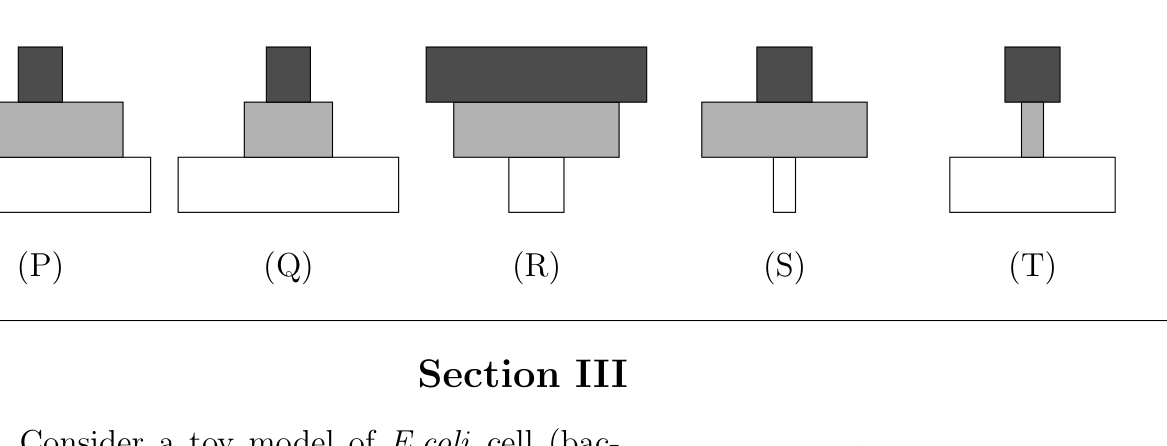
An ecological pyramid is a diagrammatic representation of the relationship between various organisms in an ecosystem. These pyramids can be drawn to represent the organic material (biomass), or number, or energy at each trophic level.
We list here four different ecosystems (i to iv) and five different ecological pyramids (P to T). Match the ecosystems with the correct pyramids.
Ecosystems: i. Number pyramid of an ecosystem consisting of grasses, snails and mice. ii. Number pyramid of an ecosystem consisting of a tree, caterpillars and mynas. iii. Biomass pyramid of an ecosystem consisting of a tree, caterpillars and mynas. iv. Number pyramid of an ecosystem consisting of a rose bush, aphids and parasites.
Pyramids (P), (Q), (R), (S), (T) are shown in the figure.
Quesito 24
Topic: Biology Metodi: Physical Modeling Competenze: Diagrammatic Reasoning Objects: — Fonte: Testo (PDF) — p.8 Soluzione: Soluzioni (PDF)
Una piramide ecologica è una rappresentazione diagrammatica della relazione tra vari organismi in un ecosistema. Queste piramidi possono essere disegnate per rappresentare il materiale organico (biomassa), o numero, o energia a ogni livello trofico.
Qui elencamo quattro diversi ecosistemi (i a iv) e cinque diverse piramidi ecologiche (P a T). Concorre gli ecosistemi con le corrette piramidi.
Ecosistemi: i. Piramide numerica di un ecosistema composto da erba, lumache e topi. ii. Numero piramide di un ecosistema composto da un albero, ortaggi e mina. iii. Piramide di biomassa di un ecosistema composto da un albero, ragnose e mina. iv. Numero piramide di un ecosistema composto da un cespuglio di rose, afidi e parassiti.
Le piramidi (P), (Q), (R), (S), (T) sono illustrate nella figura.
Quesito 24
Topic: Biology Metodi: Physical Modeling Competenze: Diagrammatic Reasoning Objects: — Fonte: Testo (PDF) — p.8 Soluzione: Soluzioni (PDF)
Section III (analytical)
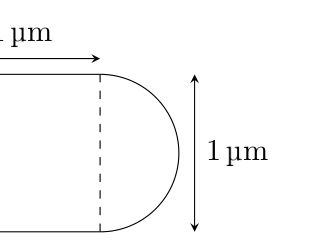
[6 marks] Consider a toy model of E. coli cell (bacterial cell) as a cylindrical body with hemispherical caps at both ends of the cylinder. The diameter of this cylinder is taken as and the length of its cylindrical part is also .
(a) Estimate the average distance between two E. coli cells (centre to centre distance) in a saturated growth medium having saturation density of E. coli cells of about .
(b) Many biochemical studies specify the concentration of proteins in a cell in units of nanomolar (nM) concentration. If such a protein species inside an E. coli cell has a concentration of at least 20 nM, how many minimum molecules of that protein species are present in each cell?
Quesito 25
Topic: Order-of-Magnitude Estimation Metodi: Order-of-Magnitude Estimation Competenze: Estimation & Approximation Objects: Cylinder, Sphere Fonte: Testo (PDF) — p.9 Soluzione: Soluzioni (PDF)
**Sezione III (analisi) **
[6 voti] Prendiamo un modello di giocattolo di E. cellula di coli (cellula batterica) come corpo cilindrico con tappe emisferiche alle entrambe estremità del cilindro. Il diametro di questo cilindro è preso come e la lunghezza della sua parte cilindrica è anche .
(a) Estimare la distanza media tra due E. cellule di coli (distanza centro-centro) in un mezzo di crescita saturo con densità di saturazione di E. cellule di coli di circa .
b) Molti studi biochimici specificano la concentrazione delle proteine in una cellula in unità di concentrazione nanomolar (nM). Se una tale specie di proteine all’interno di un E. la cellula di coli ha una concentrazione di almeno 20 nM, quante molecole minime di quella specie proteica sono presenti in ciascuna cellula?
Quesito 25
Topic: Order-of-Magnitude Estimation Metodi: Order-of-Magnitude Estimation Competenze: Estimation & Approximation Objects: Cylinder, Sphere Fonte: Testo (PDF) — p.9 Soluzione: Soluzioni (PDF)
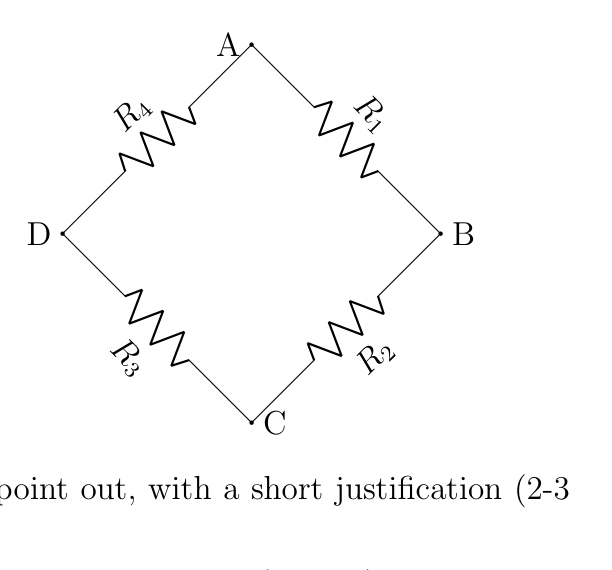
[5 marks] Resistances , , and are electrically connected between points A, B, C and D, as shown in the given figure. Their individual values can either be or an integral multiple of (all need not be different).
A multimeter connected between points A and C reads (say, ). Calculate , , , , , , , and .
Quesito 26
Topic: Circuits Metodi: Equivalent Circuit Reduction Competenze: Physical Reasoning Objects: Resistor Fonte: Testo (PDF) — p.9 Soluzione: Soluzioni (PDF)
[5 punti] Le resistenze , , e sono collegate elettricamente tra i punti A, B, C e D, come mostrato nella figura data. I loro valori individuali possono essere o un multiple integrale di (non tutti devono essere diversi).
Un multimetro collegato tra i punti A e C è (per esempio, ). Calcolare , , , , , , , e .
Quesito 26
Topic: Circuits Metodi: Equivalent Circuit Reduction Competenze: Physical Reasoning Objects: Resistor Fonte: Testo (PDF) — p.9 Soluzione: Soluzioni (PDF)
[4 marks] Read each of the following passages and point out, with a short justification (2–3 lines), the scientific mistakes, if any.
(a) A spherical lens is a transparent medium bound by spherical surfaces. A glass marble can therefore be considered as a lens. Consider a glass marble (refractive index 1.50) of radius 15.00 mm. Using the geometrical optics formulae taught in high school, Prajakta calculated the focal length of this marble to be 15.00 mm. Consider a group of parallel rays incident on the marble. These rays will pass through the marble and get converged at 15.00 mm on the other side.
(b) A ray of white light is incident on a rectangular slab at an angle . When the ray enters the glass slab from one surface, dispersion takes place. In other words, since the refractive index of glass is different for different constituent colours of white light, the angles of refraction are different, say , , , etc. After travelling along different directions inside the glass slab, the rays of different colours will be incident on the glass-air interface at the opposite parallel surface, at different angles of incidence. The rays of different colours will then leave this surface with different angles of refraction. Therefore, when white light passes through a glass slab, the constituent colours will spread out in different directions while leaving the slab.
Topic: Geometric Optics Metodi: Ray Tracing, Snell’s Law Competenze: Physical Reasoning Objects: Lens, Sphere, Prism Fonte: Testo (PDF) — p.9 Soluzione: Soluzioni (PDF)
[4 punti] Leggi ciascuno dei seguenti passaggi e indichi, con una breve giustificazione (23 righe), gli errori scientifici, se del caso.
a) Una lente sferica è un mezzo trasparente legato da superfici sferiche. Un marmo di vetro può quindi essere considerato come una lente. Si consideri un marmo di vetro (indice di refraczione 1.50) di raggio di 15,00 mm. Usando le formule di ottica geometrica insegnate al liceo, Prajakta calcolarà la lunghezza focale di questo marmo a 15,00 mm. Considerate un gruppo di raggi paralleli che incidono sul marmo. Questi raggi attraverseranno il marmo e si convergono a 15,00 mm dall’altra parte.
b) Un raggio di luce bianca si incide su una lastra rettangolare ad un angolo . Quando il raggio entra nella lastra di vetro da una superficie, si verifica la dispersione. In altre parole, poiché l’indice di rifrazione del vetro è diverso per i diversi colori costituenti della luce bianca, gli angoli di rifrazione sono diversi, ad esempio , , , ecc. Dopo aver percorso le diverse direzioni all’interno della lastra di vetro, i raggi di diversi colori si incideranno sull’interfaccia vetro-aria sulla superficie parallela opposta, ad angoli di incidenza diversi. I raggi di diversi colori lasciano quindi questa superficie con diversi angoli di rifrazione. Pertanto, quando la luce bianca passa attraverso una lastra di vetro, i colori costituenti si diffondono in diverse direzioni mentre la lastra esce.
Topic: Geometric Optics Metodi: Ray Tracing, Snell’s Law Competenze: Physical Reasoning Objects: Lens, Sphere, Prism Fonte: Testo (PDF) — p.9 Soluzione: Soluzioni (PDF)
[15 marks] The free body diagram (a diagram that shows forces on individual objects) for an Atwood’s machine (a system with a rope passing over a fixed pulley, with two masses attached at either end of the rope) yields the following equation:
where is the acceleration of the system of masses and .
The following data were recorded for an Atwood’s machine, with the total mass being kept constant. Each reading corresponds to a different value of the mass difference as shown in the table. In each case, at , the mass was resting on the ground below and the mass was at a height of . The time recorded in the data table is the time taken for the mass to hit the ground.
| (in g) | time (in s) |
|---|---|
| 10.0 | 8.35 |
| 20.0 | 5.03 |
| 30.0 | 3.95 |
| 40.0 | 3.40 |
| 50.0 | 2.95 |
Using the given data and equation of motion, plot a suitable graph and determine total mass strictly using the slope of the graph.
Topic: Newtonian Mechanics Metodi: Experimental Data Analysis, Graph Linearization Competenze: Graph Linearization Objects: String, Pulley, Block Fonte: Testo (PDF) — p.10 Soluzione: Soluzioni (PDF)
[15 punti] Il diagramma del corpo libero (un diagramma che mostra le forze su singoli oggetti) per una macchina di Atwood (un sistema con una corda che passa su una polla fissa, con due masse attaccate a entrambe le estremità della corda) dà la seguente equazione:
in cui è l’accelerazione del sistema di masse e .
I seguenti dati sono stati registrati per una macchina di Atwood, mantenendo costante la massa totale . Ogni lettura corrisponde a un valore diverso della differenza di massa come indicato nella tabella. In ogni caso, a , la massa si trovava a terra e la massa si trovava ad un’altezza di . Il tempo registrato nella tabella dei dati è il tempo necessario per raggiungere il terreno la massa .
| (in g) | time (in s) |
|---|---|
| 10.0 | 8.35 |
| 20.0 | 5.03 |
| 30.0 | 3.95 |
| 40.0 | 3.40 |
| 50.0 | 2.95 |
Usando i dati dati e l’equazione di movimento, tracciare un grafico appropriato e determinare la massa totale usando rigorosamente la pendenza del grafico.
Topic: Newtonian Mechanics Metodi: Experimental Data Analysis, Graph Linearization Competenze: Graph Linearization Objects: String, Pulley, Block Fonte: Testo (PDF) — p.10 Soluzione: Soluzioni (PDF)
[7 marks] Fossil fuels are used in car engines. These fuels, when burnt, emit different gases, which are responsible for air pollution.
A catalytic converter is an amazingly simple device that is highly effective at reducing harmful emissions produced by a car engine. Modern catalytic converters are constructed from a mixture of metals. One metal serves as a catalyst for oxidation and other serves as catalyst for reduction reaction. A certain heat resistant ceramic material is thus coated with catalyst Pt-Pd/Rh.
In this catalytic converter, up to 90% of carbon monoxide from the exhaust of a car engine is oxidized to carbon dioxide, while NO and NO are reduced to N.
For a certain amount of fuel, the amount of carbon dioxide emitted from a car engine, without a catalytic converter, was found to be 110 g. The same car engine, when fitted with a catalytic converter, emitted 132 g of carbon dioxide, for the same amount of fuel.
(a) Calculate the mass of carbon monoxide emitted by the engine, without the catalytic converter, for that amount of fuel.
(b) Arnav travelled from Jodhpur to Bikaner by car, a distance of 256 km. Fuel efficiency of the car is 16 km/L. Burning one litre of the fuel produces 2.3 kg of carbon dioxide in the engine of the car. The same catalytic converter (as described above) is fitted to the car engine. Find the mass of carbon dioxide emitted by Arnav’s car during the travel.
(c) How many moles of carbon dioxide does this mass correspond to?
(d) How much mass of CO produced in this journey remains unconverted?
Topic: Chemistry Metodi: Physical Modeling Competenze: Unit Conversion Objects: Gas Fonte: Testo (PDF) — p.10 Soluzione: Soluzioni (PDF)
[7 punti] I combustibili fossili sono utilizzati nei motori delle auto. Questi combustibili, quando bruciati, emettono diversi gas, che sono responsabili dell’inquinamento atmosferico.
Un catalizzatore è un dispositivo sorprendentemente semplice che è altamente efficace nel ridurre le emissioni nocive prodotte da un motore di auto. I moderni convertitori catalitici sono costruiti da una miscela di metalli. Un metallo serve come catalizzatore per l’ossidazione e un altro serve come catalizzatore per la reazione di riduzione. Un certo materiale ceramico resistente al calore è quindi rivestito con il catalizzatore Pt-Pd/Rh.
In questo convertitore catalitico, fino al 90% del monossido di carbonio proveniente dagli scarichi di un motore auto viene ossidato in anidride carbonica, mentre NO e NO vengono ridotti a N.
Per una certa quantità di carburante, la quantità di anidride carbonica emessa da un motore di auto, senza un catalizzatore, è stata di 110 g. Lo stesso motore di auto, quando equipaggiato con un catalizzatore, emetteva 132 g di anidride carbonica, per la stessa quantità di carburante.
a) Calcolare la massa di monossido di carbonio emesso dal motore, senza il catalizzatore, per tale quantità di carburante.
b) Arnav ha viaggiato da Jodhpur a Bikaner in auto, una distanza di 256 km. L’efficienza del carburante dell’auto è di 16 km/l. Bruciare un litro di carburante produce 2,3 kg di anidride carbonica nel motore dell’auto. Lo stesso catalizzatore (come descritto sopra) è montato sul motore dell’auto. Trova la massa di anidride carbonica emessa dall’auto di Arnav durante il viaggio.
(c) Quanti mol di anidride carbonica corrispondono a questa massa?
D) Quanto di CO prodotto in questo viaggio rimane inconvertito?
Topic: Chemistry Metodi: Physical Modeling Competenze: Unit Conversion Objects: Gas Fonte: Testo (PDF) — p.10 Soluzione: Soluzioni (PDF)
[16 marks] The year 2019 was proclaimed by UNESCO as the International Year of the Periodic Table (IYPT 2019), marking the 150th anniversary of the Mendeleev periodic table. In this question, some elements have had their symbols replaced by Greek letters , , , etc., but not in order. All such elements in this question have atomic number of 20 or less. In addition, two more elements in the periodic table have been assigned codes X and Q.
Use the information about their properties, as given below, to assign each element to its correct Greek/Roman alphabet code.
(a) Elements , and are unreactive monatomic gases. has the smallest atomic radius of the three, and has a higher boiling point than . Identify elements , and .
The elements , , , , , X and Q exist as diatomic molecules (i.e. , , , , , and ). We also know that, at room temperature, X is a liquid and Q is a solid; the other five are gases.
(b) Identify element X and Q.
forms compounds with each of the other six diatomic elements. Compounds of with , , and X result in diatomic gases that react with the liquid to form acidic solutions.
(c) Identify elements and . Also write a balanced chemical reaction to show how they combine with each other.
(d) has the highest electronegativity of these elements. The reaction between and is of immense industrial importance, the product being a gas that reacts with liquid to form a basic solution. Identify elements , and and write balanced chemical reactions of the processes described here.
(e) 1 g of element reacts with excess to produce of at 20°C and pressure of 1 atm. Write possible balanced chemical reaction(s), calculate possible atomic mass(es) of element and deduce the name of this element.
(f) is more reactive than . The stable ions formed from and in this reaction have the same electron configuration. Identify elements , , .
(g) Elements , and are also metals. They do not react with cold but do react with to form , and respectively. Out of these, contains the largest percentage of by mass. Identify the elements , , and write balanced chemical reactions.
Topic: Chemistry Metodi: Physical Modeling Competenze: Physical Reasoning Objects: Gas Fonte: Testo (PDF) — p.11 Soluzione: Soluzioni (PDF)
L’anno 2019 è stato proclamato dall’UNESCO come l’Anno Internazionale della Tavola Periodica (IYPT 2019), che segna il 150° anniversario della Tavola Periodica di Mendeleev. In questa domanda, alcuni elementi hanno avuto i loro simboli sostituiti con le lettere greche , , , ecc., ma non in ordine. Tutti questi elementi hanno un numero atomico di 20 o meno. Inoltre, al tavolo periodico sono stati assegnati altri due elementi ai codici X e Q.
Utilizzare le informazioni relative alle loro proprietà, come riportato di seguito, per assegnare ogni elemento al suo corretto codice alfabetico greco/romano.
a) Gli elementi , e sono gas monatomici non reattivi. ha il più piccolo raggio atomico dei tre, e ha un punto di ebollizione superiore a . Identificare gli elementi , e .
Gli elementi , , , , , X e Q esistono come molecole diatomiche (cioè: , , , , , e ). Sappiamo anche che a temperatura ambiente X è un liquido e Q un solido; gli altri cinque sono gas.
b) Identificare gli elementi X e Q.
forma composti con ciascuno degli altri sei elementi diatomici. I composti di con , e X producono gas diatomici che reagiscono con il liquido per formare soluzioni acide.
c) Identificare gli elementi e . Scrivi anche una reazione chimica equilibrata per mostrare come si combinano tra loro.
d) ha la più alta elettronegatività di questi elementi. La reazione tra e è di immensa importanza industriale, poiché il prodotto è un gas che reagisce con il liquido per formare una soluzione di base. Identificare gli elementi , e e scrivere le reazioni chimiche equilibrate dei processi qui descritti.
e) 1 g di elemento reagisce con un eccesso di per produrre di a 20°C e pressione di 1 atm. Scrivere le possibili reazioni chimiche equilibrate, calcolare le possibili masse atomiche dell’elemento e dedurre il nome di questo elemento.
f) è più reattivo di . Gli ioni stabili formati da e in questa reazione hanno la stessa configurazione elettronica. Identificare gli elementi , , .
g) Gli elementi , e sono anche metalli. Non reagiscono con freddo ma reagiscono con per formare rispettivamente , e . Di questi, contiene la percentuale di in massa maggiore. Identificare gli elementi , , e scrivere reazioni chimiche bilanciate.
Topic: Chemistry Metodi: Physical Modeling Competenze: Physical Reasoning Objects: Gas Fonte: Testo (PDF) — p.11 Soluzione: Soluzioni (PDF)
[7 marks] The pseudo-science of homeopathy began over two hundred years ago, long before modern medicine. The main claim in homeopathy is that the medicines become increasingly potent the more they are diluted.
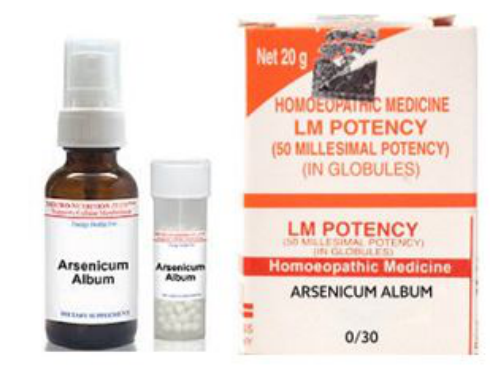
Homeopaths recommend a diluted solution of arsenic oxide () as a treatment for digestive disorders and anxiety. The oxide is prepared industrially by roasting arsenic containing ores, such as arsenopyrite (FeAsS), in air. The other products formed are Iron(III) oxide and sulphur dioxide.
(a) Write the balanced chemical reaction for the preparation of from FeAsS.
(b) is moderately soluble in water. When dissolved in water, the oxide reacts to form Arsenous acid (). Write a balanced chemical equation for the formation of Arsenous acid from .
(c) One litre of a saturated solution of at 25°C contains 20.6 g of . Calculate the concentration of the Arsenous acid in mol/L in the saturated solution.
In homeopathy, a ‘decimal-scale’ is often used to specify the dilution of a given sample: D1 (sometimes labelled 1X) means the sample has been diluted 1 part in 10. D2 (or 2X) means the sample has first been diluted 1 in 10, then 1 part of that solution has been further diluted 1 in 10 again to give a 1 part in 100 dilution. A D6 (or 6X) solution has repeated this process six times to give a final dilution of 1 in . Arsenicum album is often sold as a D30 preparation.
(d) Calculate the mass (in g) of present in 100 mL glass bottle of the D30 Arsenicum album.
(e) How many such bottles (in millions, 1 million = ) of the supposed medicine should one drink to be sure that at least one atom of arsenic has entered one’s body?
(f) Total volume of water on the Earth is estimated to be about . If our stock solution at the start is 1 L of saturated solution of , what is the maximum dilution of the entire stock solution one can achieve by utilizing all this water?
Quesito 31
Topic: Chemistry Metodi: Physical Modeling Competenze: Unit Conversion Objects: — Fonte: Testo (PDF) — p.12 Soluzione: Soluzioni (PDF)
La pseudo-scienza dell’omeopatia è iniziata oltre duecento anni fa, molto prima della medicina moderna. L’affermazione principale nell’omeopatia è che i medicinali diventano sempre più potenti più vengono diluiti.
Gli omeopati raccomandano una soluzione diluita di ossido di arsenico () come trattamento per disturbi digestivi e ansia. L’ossido viene preparato industrialmente arrostendo nell’aria arsenico contenente minerali, come l’arsenopirite (FeAsS). Gli altri prodotti formati sono l’ossido di ferro (III) e l’anidride solforosa.
a) Indicare la reazione chimica equilibrata per la preparazione di da FeAsS.
b) è moderatamente solubile in acqua. Quando si dissolve in acqua, l’ ossido reagisce per formare acido di arseno (). Scrivere un’equazione chimica equilibrata per la formazione di acido di arseno da .
c) Un litro di soluzione satura di a 25°C contiene 20,6 g di . Calcolare la concentrazione dell’acido di arseno in mol/L nella soluzione satura.
In homeopatia, una “scala decimale” è spesso usata per specificare la diluizione di un campione dato: D1 (a volte etichettato come 1X) significa che il campione è stato diluito in 1 parte su 10. D2 (o 2X) significa che il campione è stato prima diluito 1 su 10, poi una parte di tale soluzione è stata diluita di nuovo 1 su 10 per dare una parte in 100 diluzioni. Una soluzione D6 (o 6X) ha ripetuto questo processo sei volte per ottenere una diluzione finale di 1 in . L’album di arsenico è spesso venduto come preparazione D30.
d) Calcolare la massa (in g) di presente in bottiglia di vetro di 100 ml dell’album D30 Arsenicum.
(e) Quante bottiglie (in milioni, 1 milione = ) della presunta medicina si devono bere per essere sicuri che almeno un atomo di arsene sia entrato nel proprio corpo?
f) Il volume totale di acqua sulla Terra è stimato a circa . Se la nostra soluzione di scorte all’inizio è di 1 L di soluzione satura di , qual è la massima diluizione dell’intera soluzione di scorte che si può ottenere utilizzando tutta questa acqua?
Quesito 31
Topic: Chemistry Metodi: Physical Modeling Competenze: Unit Conversion Objects: — Fonte: Testo (PDF) — p.12 Soluzione: Soluzioni (PDF)
[10 marks] The malarial parasite (Plasmodium) matures into an infective form inside the mosquito gut and is then transmitted to humans by mosquito bites. A survey monitored the number of malarial infections per individual in different regions of India, over a 5 year period.
However, we also know that people who suffer from sickle cell anemia (a genetic disorder) seem to possess some inherent resistance to the malarial infection.
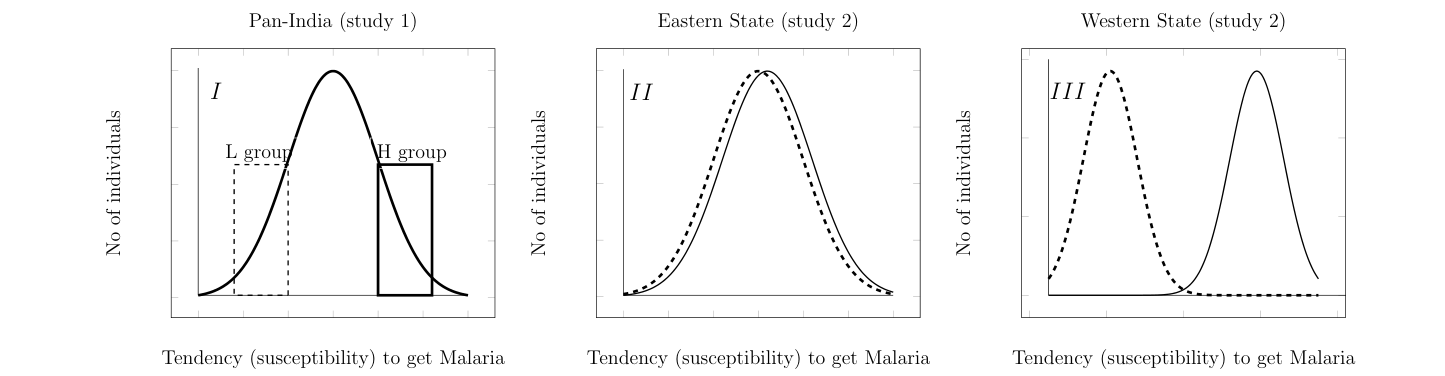
The results of the study, with randomly selected 100,000 individuals from all over the country, are shown in graph I. The L group (dashed box) were people with lower susceptibility to malaria, while the H group (solid box) had high susceptibility to malaria.
After 10 years the study was repeated for 5 more years in two states [Eastern and Western]. Graph II corresponds to the Eastern state and Graph III corresponds to the Western state.
For each of the following statements write True/False with a short (1–2 lines) justification:
(i) Graph I clearly indicates that there is no genetic basis for malarial resistance in India. (ii) From graph I, it can be said that the chance of mosquito bites for an individual in the Indian population is totally random. (iii) Susceptibility of individuals to malaria in the eastern state is pre-dominantly random. (iv) In the western state, susceptibility among the H group individuals may have a genetic basis. (v) If there is a global malarial epidemic, the H individuals in the western state have a higher chance of infection than the H individuals in the eastern state. (vi) If there is a global malarial epidemic, the graph of malarial susceptibility of the L individuals in the western state is likely to remain unchanged. (vii) If there is a random breakout of flu, both the L and H groups in the western state will be equally susceptible to flu. (viii) Among the individuals who have recovered from malaria, the individuals of the H group in the western state are more likely to have scurvy than the H group individuals in the eastern state. (ix) Some areas in the western state probably have a high incidence of waterlogging. (x) Chances of finding people having sickle cell anemia will be higher in the western state than in the eastern state.
Quesito 32
Topic: Biology Metodi: Experimental Data Analysis Competenze: Experimental Data Analysis Objects: — Fonte: Testo (PDF) — p.13 Soluzione: Soluzioni (PDF)
Il parassita malaria (Plasmodium) matura in forma infettiva all’interno dell’intestino della zanzara e poi si trasmette all’uomo attraverso morsi da zanzara. Un sondaggio ha monitorato il numero di infezioni da malaria per individuo in diverse regioni dell’India, per un periodo di 5 anni.
Tuttavia, sappiamo anche che le persone che soffrono di anemia falciforme (un disturbo genetico) sembrano avere una certa resistenza intrinseca all’infezione da malaria.
I risultati dello studio, con 100.000 individui selezionati a caso da tutto il paese, sono mostrati nel grafico I. Il gruppo L (quadro sfasciato) era costituito da persone con una sensibilità inferiore alla malaria, mentre il gruppo H (quadro solido) presentava una sensibilità elevata alla malaria.
Dopo 10 anni lo studio fu ripetuto per altri 5 anni in due stati [Orientale e Occidentale]. Il grafico II corrisponde allo stato orientale e il grafico III corrisponde allo stato occidentale.
Per ciascuna delle seguenti affermazioni scrivere True/False con una breve giustificazione (12 righe):
(i) Il grafico I indica chiaramente che non esiste una base genetica per la resistenza alla malaria in India. (ii) Dal grafico I si può dire che la probabilità di morsi da zanzare per un individuo nella popolazione indiana è totalmente casuale. (iii) La sensibilità degli individui alla malaria nello stato orientale è prevalentemente casuale. (iv) nello stato occidentale, la sensibilità tra gli individui del gruppo H può avere una base genetica. (v) Se vi è un’epidemia di malaria globale, gli individui H nello stato occidentale hanno una maggiore probabilità di infezione rispetto agli individui H nello stato orientale. (vi) Se vi è un’epidemia di malaria globale, è probabile che il grafico della sensibilità alla malaria degli individui L nello stato occidentale rimanga invariato. (vii) Se vi è un focolaio casuale di influenza, sia i gruppi L che H dello stato occidentale saranno ugualmente suscettibili alla influenza. (viii) Tra gli individui che si sono ripresi dalla malaria, gli individui del gruppo H nello stato occidentale hanno maggiori probabilità di avere lo scorbuteo rispetto agli individui del gruppo H nello stato orientale. (ix) Alcune zone dello stato occidentale hanno probabilmente un’elevata incidenza di insanguinamento. (x) Le probabilità di individuare persone affette da anemia falciforme saranno maggiori nello Stato occidentale rispetto allo Stato orientale.
Quesito 32
Topic: Biology Metodi: Experimental Data Analysis Competenze: Experimental Data Analysis Objects: — Fonte: Testo (PDF) — p.13 Soluzione: Soluzioni (PDF)
[7 marks] In any plant body, movement of the water highly depends on water potential of cells, denoted by . The of pure water is zero by definition. Typically, when solutes dissolve in water, becomes negative.
In a cellular environment, pressure exerted by the cell wall on the inner aqueous system also contributes to along with the dissolved solutes. Thus is comprised of and (solute potential and pressure potential). Due to the difference in solute potentials of adjacent cells, water moves from high to low until equilibrium is attained.
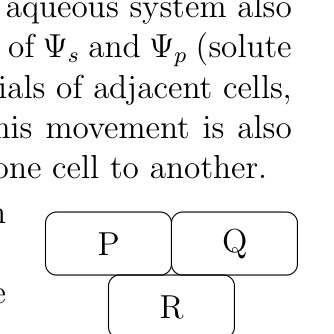
In a hypothetical situation, plant cells P, Q and R were placed in the arrangement shown (P adjacent to Q, Q adjacent to R).
(a) Based on the values given for the cells P and R at time zero, fill the missing values in the table below.
| Cell | (MPa) | (MPa) | (MPa) |
|---|---|---|---|
| P | −8 | 2 | |
| R | 2 | −3 |
(b) At a stage when the system is at equilibrium and there is no external solute being added or pressure acting on the above three cells, the water potential of the system is close to . What would be the of Q at time zero?
(c) Show the water movement immediately after time zero, using an arrow diagram. Draw all possible interactions in a single diagram.
(d) At time zero, which one of these three cells is most likely to represent guard cells when the stomata needs to be opened?
Quesito 33
Topic: Biology Metodi: Physical Modeling Competenze: Physical Reasoning Objects: — Fonte: Testo (PDF) — p.14 Soluzione: Soluzioni (PDF)
[7 punti] In qualsiasi organismo vegetale, il movimento dell’acqua dipende fortemente dal potenziale idrico delle cellule, indicato da . Il dell’acqua pura è zero per definizione. In genere, quando i soluti si sciolgono in acqua, diventa negativo.
In un ambiente cellulare, la pressione esercitata dalla parete cellulare sul sistema acquoso interno contribuisce anche a insieme ai soluti sciolti. Il è quindi composto da e (potenzial di soluzione e potenziale di pressione). A causa della differenza dei potenziali di soluzione delle celle adiacenti, l’acqua passa da elevata a bassa fino a raggiungere l’equilibrio.
In una situazione ipotetica, le cellule vegetali P, Q e R sono state posizionate nell’arrangamento mostrato (P adiacente a Q, Q adiacente a R).
a) Sulla base dei valori forniti per le celle P e R al momento zero, riempire i valori mancanti nella tabella seguente.
| Cell | (MPa) | (MPa) | (MPa) |
|---|---|---|---|
| P | −8 | 2 | |
| R | 2 | −3 |
b) In una fase in cui il sistema è in equilibrio e non si aggiunge soluto esterno o pressione che agisca sulle tre celle di cui sopra, il potenziale idrico del sistema è vicino a . Qual sarebbe il di Q al tempo zero?
c) Mostra il movimento dell’acqua immediatamente dopo il tempo zero, utilizzando un diagramma di freccia. Disegnare tutte le interazioni possibili in un unico diagramma.
(d) Al momento zero, quale di queste tre cellule è più probabile che rappresenti cellule di guardia quando occorre aprire lo stomaco?
Quesito 33
Topic: Biology Metodi: Physical Modeling Competenze: Physical Reasoning Objects: — Fonte: Testo (PDF) — p.14 Soluzione: Soluzioni (PDF)
[5 marks] Lions can feed on different wild animals such as zebra, wildebeest, pigs and gazelles. The efficiency of catching any particular prey will depend on a number of factors such as the net energy (E) gained by eating the prey, number of hours (s) required to search for the prey and handling time (h), i.e. the time taken to capture, kill and eat the prey. In order to maximize its overall rate of energy gain, a predator must consider the profitability (P) of the prey. It is defined as the ratio of energy gained to the time spent. Answer the following questions with a short justification (1–2 lines). Support your arguments with the data available to you.
| Species | kg | h (handling time, hours) | s (search time, hours) |
|---|---|---|---|
| Wildebeest | 85 | 12.5 | 2.6 |
| Zebra | 80 | 11.3 | 4.1 |
| Pig | 37 | 6.8 | 17.8 |
| Grant’s Gazelle | 27 | 8.0 | 10 |
(a) During the rainy season, both wildebeest and zebra are abundant. Which of them would be the preferred prey of the lion?
(b) On a regular hunt, while searching for its most preferred prey, the lion encounters a gazelle. Will it be more profitable for the lion to hunt the gazelle or leave it and continue the search?
(c) During a particular summer, all zebras and wildebeest from a jungle have migrated to another jungle. Thus, a lion is reduced to hunting either pigs or gazelles. In this situation, which would be the more profitable prey?
Topic: Biology Metodi: Experimental Data Analysis Competenze: Experimental Data Analysis Objects: — Fonte: Testo (PDF) — p.15 Soluzione: Soluzioni (PDF)
[5 punti di riferimento] I leoni possono nutrirsi di diversi animali selvatici come la zebra, i gnu, i maiali e i gazzelli. L’efficienza della cattura di una predata particolare dipenderà da una serie di fattori quali l’energia netta (E) ottenuta mangiando la preda, il numero di ore (ore) necessarie per la ricerca della preda e il tempo di gestione (h), ovvero: Il tempo necessario per catturare, uccidere e mangiare la preda. Per massimizzare il suo tasso complessivo di guadagno energetico, un predatore deve considerare la redditività (P) della preda. È definito come il rapporto tra energia guadagnata e tempo impiegato. Rispondi alle seguenti domande con una breve giustificazione (12 righe). Sostenere i vostri argomenti con i dati a vostra disposizione.
♬ Specie ♬ kg ♬ h (tempo di gestione, ore) ♬ s (tempo di ricerca, ore) ♬ |---|---|---|---| ♬ Wildbeest ♬ 85 ♬ 12.5 ♬ 2.6 ♬
Zebra # 80 # 11.3 # 4.1
# Per il porco # # 37 # 6.8 # 17.8
♬ Granto’s Gazelle 27 ♬ 8.0 ♬ 10 ♬
(a) Durante la stagione delle piogge, i gnu e le zebre sono abbondanti. Quale di loro sarebbe la preda preferita del leone?
(b) Durante una caccia regolare, mentre cerca la sua preda preferita, il leone incontra una gazela. Sarà più redditizio per il leone cacciare la gazela o lasciarla e continuare la ricerca?
(c) Durante una determinata estate, tutte le zebre e i gnu di una giungla sono migrati in un’altra giungla. Così, un leone viene ridotto alla caccia di maiali o gazzelli. In questa situazione, quale sarebbe la preda più redditizia?
Topic: Biology Metodi: Experimental Data Analysis Competenze: Experimental Data Analysis Objects: — Fonte: Testo (PDF) — p.15 Soluzione: Soluzioni (PDF)
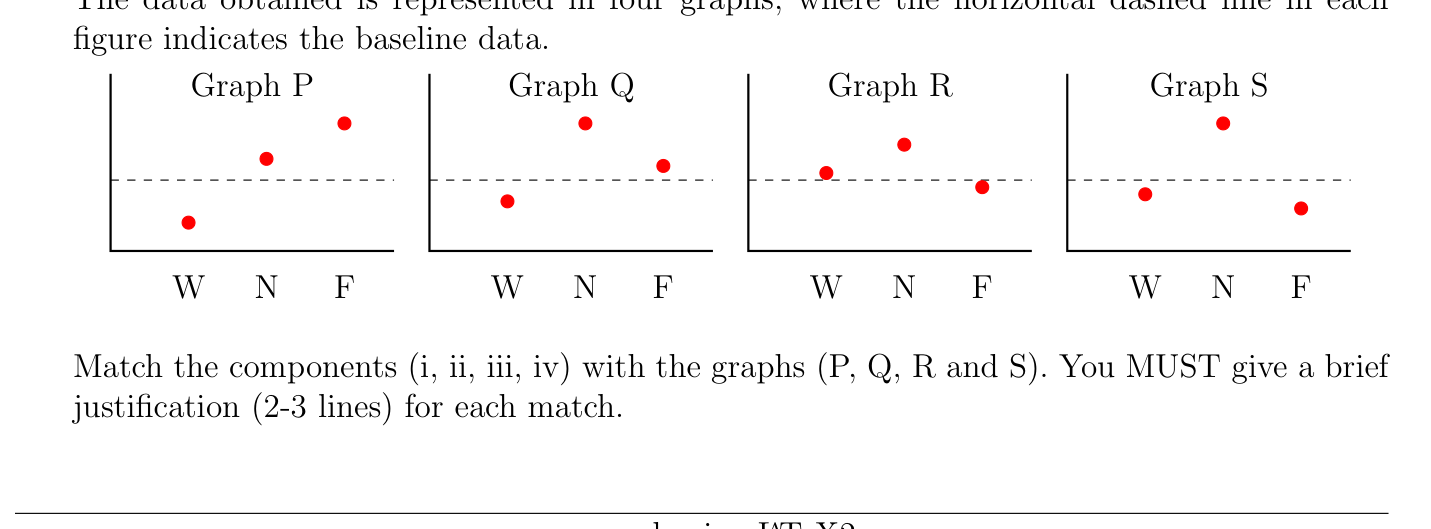
[8 marks] Any change in an environmental parameter can have a large effect on an ecosystem. Consider a pond ecosystem. Some researchers designed an experiment to study the effect of certain treatments on food webs in pond ecosystems.
Four artificial identical ponds (P, Q, R and S) were created and each was independently subjected to three treatments (W, N and F):
- W: warming of the water body
- N: addition of nutrients to the water
- F: introduction of predator fish.
Following the above treatments, each pond was studied for one of the following components: i. Number of floating plants. ii. Number of invertebrates. iii. Number of plants at the bottom of the pond. iv. Number of bacterial species.
The data obtained is represented in four graphs (P, Q, R, S), where the horizontal dashed line in each figure indicates the baseline data.
Match the components (i, ii, iii, iv) with the graphs (P, Q, R and S). You MUST give a brief justification (2–3 lines) for each match.
Quesito 35
Topic: Biology, Earth & Environmental Science Metodi: Experimental Data Analysis Competenze: Experimental Data Analysis Objects: — Fonte: Testo (PDF) — p.15 Soluzione: Soluzioni (PDF)
[8 punti] Qualsiasi modifica di un parametro ambientale può avere un effetto significativo sull’ecosistema. Considerate un ecosistema di stagni. Alcuni ricercatori hanno progettato un esperimento per studiare l’effetto di alcuni trattamenti sulle reti alimentari negli ecosistemi degli stagni.
Sono stati creati quattro stagni identici artificiali (P, Q, R e S) e ciascuno è stato sottoposto indipendentemente a tre trattamenti (W, N e F):
- W: riscaldamento del corpo idrico
- N: aggiunta di sostanze nutritive all’acqua
- F: introduzione di pesci predatori.
Dopo i trattamenti di cui sopra, ogni stagno è stato studiato per uno dei seguenti componenti: i. Numero di piante galleggianti. ii. Numero di invertebrati. iii. Numero di piante al fondo dell’acque. iv. Numero di specie batteriche.
I dati ottenuti sono rappresentati in quattro grafici (P, Q, R, S), dove la linea orizzontale tracciata in ciascuna figura indica i dati di base.
Concorre le componenti (i, ii, iii, iv) con i grafici (P, Q, R e S). DATE una breve giustificazione (23 righe) per ogni partita.
Quesito 35
Topic: Biology, Earth & Environmental Science Metodi: Experimental Data Analysis Competenze: Experimental Data Analysis Objects: — Fonte: Testo (PDF) — p.15 Soluzione: Soluzioni (PDF)