Section I (Single Correct MCQ)
One of the major challenges in creating “Dolly” the first cloned organism/animal, was the process of creating an enucleated egg (nucleus removed), as the artificial removal of the nucleus damaged the egg cell. The cloning of Dolly in 1996 was achieved by inserting the nucleus of a mammary epithelial cell, precisely into such an enucleated egg cell. If you were to choose to activate a naturally occurring molecular mechanism of enucleation in an egg cell, which of the following cell type would you study to mimic the mechanism?
- (a) Neurons / Neuroblasts
- (b) Erythrocytes / Erythroblasts
- (c) Muscle cell / Myoblasts
- (d) Bone tissue cells / Osteoblasts
Topic: Biology Metodi: Physical Modeling Competenze: Physical Reasoning Objects: — Fonte: Testo (PDF) — p.3 Soluzione: Soluzioni (PDF)
**Sezione I (MCQ corretto unico) **
Una delle principali sfide nella creazione di “Dolly”, il primo organismo/animale clonato, fu il processo di creazione di un uovo enucleato (nucleo rimosso), poiché la rimozione artificiale del nucleo danneggiò la cellula di uovo. La clonazione di Dolly nel 1996 è stata realizzata inserendo il nucleo di una cellula epiteliale mammaria, proprio in una cellula di uovo nucleata. Se dovessi scegliere di attivare un meccanismo molecolare di enucleamento naturale in una cellula di uovo, quale del seguente tipo di cellula studierai per imitare il meccanismo?
- (a) Neuroni / Neuroblasti
- (b) Eritrociti / eritroblasti
- (c) Cellule muscolari / mioblasti
- (d) cellule del tessuto osseo / osteo-blasti
Topic: Biology Metodi: Physical Modeling Competenze: Physical Reasoning Objects: — Fonte: Testo (PDF) — p.3 Soluzione: Soluzioni (PDF)
Which of these phenomena has not yet been observed in wild chimpanzees?
- (a) Demonstration of the ability to use stone and/or wooden tools
- (b) Demonstration of the ability to use of fire to process food
- (c) Demonstration of the ability to communicate using primitive language
- (d) Demonstration of ability to grieve in groups at the death of a member
Topic: Biology Metodi: Physical Modeling Competenze: Physical Reasoning Objects: — Fonte: Testo (PDF) — p.3 Soluzione: Soluzioni (PDF)
Quale di questi fenomeni non è ancora stato osservato nei scimpanzé selvatici?
- a) Dimostrazione della capacità di utilizzare strumenti di pietra e/o di legno
- b) dimostrazione della capacità di utilizzare il fuoco per la lavorazione dei prodotti alimentari
- (c) Dimostrazione della capacità di comunicare utilizzando un linguaggio primitivo
- (d) dimostrazione della capacità di lutto in gruppo per la morte di un membro
Topic: Biology Metodi: Physical Modeling Competenze: Physical Reasoning Objects: — Fonte: Testo (PDF) — p.3 Soluzione: Soluzioni (PDF)
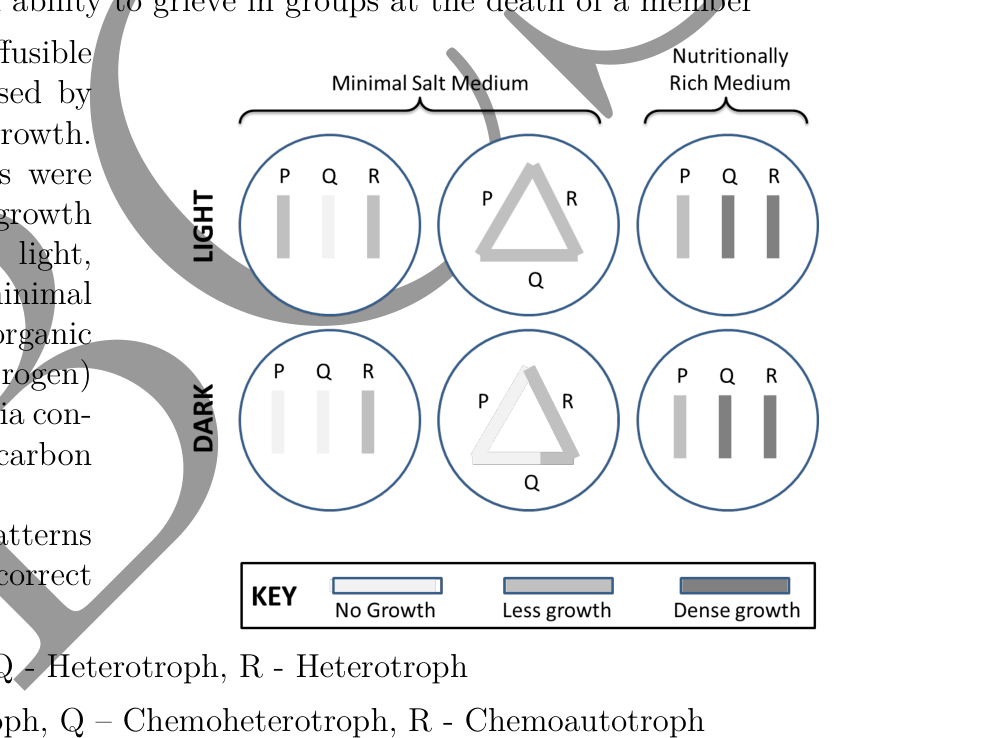
Some microbes produce diffusible metabolites that can be used by other microbes for their growth. Three such microorganisms were tested for their nutritional growth requirements (under +/- light, scheme below) either on minimal salt media (lacking any organic sources of carbon and nitrogen) OR on complete or rich media containing salts with organic carbon and nitrogen.
Based on the growth patterns shown after 24 hrs, pick the correct option:
- (a) P - Autotrophs, Q - Heterotroph, R - Heterotroph
- (b) P – Photoautotroph, Q – Chemoheterotroph, R - Chemoautotroph
- (c) P - Chemoautotrophs, Q - Chemoautotrophs, R – Heterotroph
- (d) P - Photoautotroph, Q - Chemoheterotroph, R - Saprophyte
Quesito 3
Topic: Biology Metodi: Physical Modeling Competenze: Physical Reasoning Objects: — Fonte: Testo (PDF) — p.3 Soluzione: Soluzioni (PDF)
Alcuni microbi producono metaboliti diffusibili che possono essere utilizzati da altri microbi per la loro crescita. Tre di questi microrganismi sono stati testati per i loro requisiti nutrizionali di crescita (sotto +/- luce, schema di seguito) su un contenuto di sale minimo (mancano fonti organiche di carbonio e azoto) O su un contenuto completo o ricco di sali contenenti carbonio e azoto organici.
Sulla base dei modelli di crescita mostrati dopo 24 ore, scegliere la scelta corretta:
- a) P - Autotrofi, Q - Heterotrofi, R - Heterotrofi
- b) P Photoautotrofo, Q Chemoeterotrofo, R - Chemoautotrofo
- (c) P - Chemoautotrofi, Q - Chemoautotrofi, R Heterotrofi
- d) P - Fotoautotrofo, Q - Chemoeterotrofo, R - Saprofito
Quesito 3
Topic: Biology Metodi: Physical Modeling Competenze: Physical Reasoning Objects: — Fonte: Testo (PDF) — p.3 Soluzione: Soluzioni (PDF)
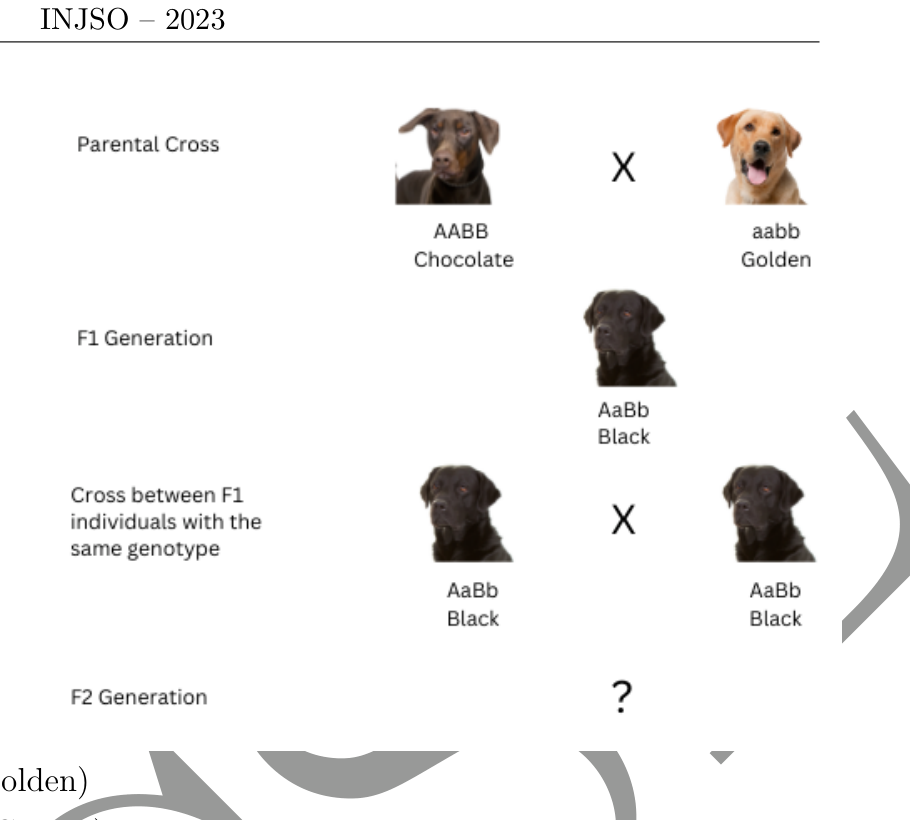
A breed of dogs show Black, Chocolate, and Golden coat colors due to the interaction of products of two genes, one that produces pigment and another that distributes the pigment to hair follicles. The final coat color is due to the interaction of products of these two genes. In this kind of gene interaction, the alleles of one gene in homozygous recessive condition masks/suppresses the expression of the allele of another gene either in dominant or recessive state. This kind of interaction is known as the epistasis. The gene that masks the expression is epistatic and the one that gets masked is hypostatic.
Assume that the allele that produces pigment is represented by ‘A’, so the ‘a’ would be the allele that cannot produce pigment and the allele that is responsible for pigment distribution is ‘B’ and the allele that is responsible for reduced distribution is ‘b’.
Now, consider the following pictorial demonstration of a cross. Which of the following ratios will be obtained in the F2 progeny due to this kind of interaction?
- (a) 9:3:4 (Black:Chocolate:Golden)
- (b) 12:3:1 (Black:Chocolate:Golden)
- (c) 15:1 (Chocolate:Golden)
- (d) 9:6:1 (Chocolate:Black:Golden)
Quesito 4
Topic: Biology Metodi: Physical Modeling Competenze: Physical Reasoning Objects: — Fonte: Testo (PDF) — p.4 Soluzione: Soluzioni (PDF)
Una razza di cani mostra colori di pelo nero, cioccolato e dorato a causa dell’interazione di prodotti di due geni, uno che produce il pigmento e l’altro che distribuisce il pigmento ai follicoli piliferi. Il colore finale del mantello è dovuto all’interazione dei prodotti di questi due geni. In questo tipo di interazione genica, gli alleli di un gene in stato recessivo omosigoto mascherano/supprimono l’espressione dell’alelo di un altro gene in stato dominante o recessivo. Questo tipo di interazione è conosciuta come epistazie. Il gene che maschera l’espressione è epistatico e quello che viene mascherato è ipostatico.
Supponiamo che l’alele che produce il pigmento sia rappresentato da “A”, quindi “a” sarebbe l’alele che non può produrre il pigmento e l’alele responsabile della distribuzione del pigmento è “B” e l’alele responsabile della riduzione della distribuzione è “b”.
Ora, considerate la seguente dimostrazione immaginaria di una croce. Quali dei seguenti rapporti si otterranno nella progenie F2 a causa di questo tipo di interazione?
- (a) 9:3:4 (Nero: Cioccolato: Oro)
- b) 12:3:1 (Nero:cioccolato:oro)
- (c) 15:1 (Coccolato: Oro)
- (d) 9:6:1 (cioccolato: nero: oro)
Quesito 4
Topic: Biology Metodi: Physical Modeling Competenze: Physical Reasoning Objects: — Fonte: Testo (PDF) — p.4 Soluzione: Soluzioni (PDF)
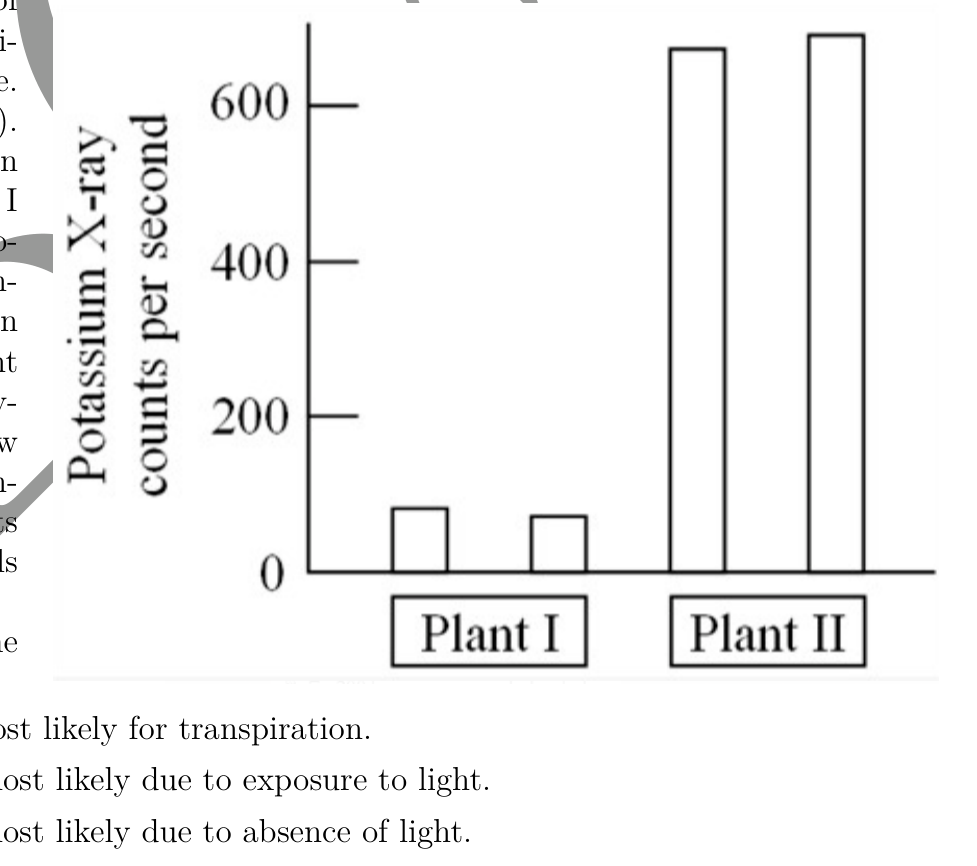
Movement of ions in and out of guard cells in plants is responsible for the stomatal activity (i.e. opening and closing of stomata). An experiment was carried out on two broad bean plants (Plant I and II) using a radioactive isotope of potassium. The concentration of potassium ions in the two guard cells of each plant was measured using a radioactivity counter. The graph below shows the K concentration (indicated as potassium X-ray counts per sec) in each of the guard cells in respective plants, I and II.
Based on the results, which of the following is true?
- (a) I has open stomata most likely for transpiration.
- (b) II has open stomata most likely due to exposure to light.
- (c) II has open stomata most likely due to absence of light.
- (d) I has open stomata for uptake of carbon dioxide.
Quesito 5
Topic: Biology Metodi: Physical Modeling Competenze: Diagrammatic Reasoning Objects: — Fonte: Testo (PDF) — p.4 Soluzione: Soluzioni (PDF)
Il movimento degli ioni dentro e fuori delle cellule di guardia nelle piante è responsabile dell’attività stomataria (cioè apertura e chiusura degli stomi). Un esperimento è stato condotto su due piante di fagioli larghi (Pianta I e II) utilizzando un isotopo radioattivo di potassio. La concentrazione di ioni di potassio nelle due celle di guardia di ciascuna pianta è stata misurata con un contatore di radioattività. Il grafico seguente mostra la concentrazione di K (indicata come conteggio dei raggi X di potassio al secondo) in ciascuna delle cellule di guardia delle rispettive piante, I e II.
Secondo i risultati, quale di questi è vero?
- (a) Ho lo stomaco aperto, molto probabilmente per la traspirazione.
- (b) II ha uno stomaco aperto più probabilmente a causa dell’ esposizione alla luce.
- (c) II ha uno stomaco aperto più probabilmente a causa dell’assenza di luce.
- (d) Ho gli stomaci aperti per l’assorbimento di anidride carbonica.
Quesito 5
Topic: Biology Metodi: Physical Modeling Competenze: Diagrammatic Reasoning Objects: — Fonte: Testo (PDF) — p.4 Soluzione: Soluzioni (PDF)
Two salts X and Y are heated strongly in two test tubes separately to study their decomposition process, and following observations are made during the experiments.
- Salt X evolves gases that are acidic in nature.
- One of the evolved gases from salt X helps in burning of a candle.
- A yellow-colored residue is formed after complete decomposition of salt X.
- Salt Y completely decomposes to produce gases.
- Salt Y generates a gas that makes you laugh.
The salts X & Y, respectively, are …
- (a) Zinc carbonate & Silver nitrate
- (b) Ammonium carbonate & Barium nitrate
- (c) Lead nitrate & Ammonium nitrate
- (d) Potassium iodide & Sodium nitrate
Topic: Chemistry Metodi: Physical Modeling Competenze: Physical Reasoning Objects: Gas Fonte: Testo (PDF) — p.5 Soluzione: Soluzioni (PDF)
Due sali X e Y vengono riscaldati fortemente in due tubi separati per studiare il loro processo di decomposizione, e durante gli esperimenti vengono effettuate le seguenti osservazioni.
- Il sale X sviluppa gas acidi di natura.
- Uno dei gas evoluti dal sale X aiuta a bruciare una candela.
- Si forma un residuo giallo dopo la completa decomposizione del sale X.
- Il sale Y si decompone completamente per produrre gas.
- Il sale Y genera un gas che ti fa ridere.
I sali X e Y, rispettivamente, sono …
- a) Carbonato di zinco e nitrato d’argento
- b) Carbonato di ammonio e nitrato di bario
- (c) Nitrato di piombo e nitrato di ammonio
- d) Ioduro di potassio e nitrato di sodio
Topic: Chemistry Metodi: Physical Modeling Competenze: Physical Reasoning Objects: Gas Fonte: Testo (PDF) — p.5 Soluzione: Soluzioni (PDF)
Wood pulp contains multiple compounds, including several polymers. Hydrolysis of one of the polymers produces compound . This compound undergoes anaerobic decomposition by microbes and produces compounds and .
Compounds , and , respectively, are:
- (a) Cellulose, ethanol, water
- (b) Glucose, ethanol, carbon dioxide
- (c) Lactose, lactic acid, carbon dioxide
- (d) Starch, ethanoic acid, carbon dioxide
Topic: Organic Chemistry Metodi: Physical Modeling Competenze: Physical Reasoning Objects: — Fonte: Testo (PDF) — p.5 Soluzione: Soluzioni (PDF)
La polpa di legno contiene più composti, tra cui diversi polimeri. L’idrolizia di uno dei polimeri produce composto . Questo composto subisce una decomposizione anaerbica da parte dei microbi e produce composti e .
I composti , e sono:
- a) Cellulosa, etanolo, acqua
- b) Glucosio, etanolo, anidride carbonica
- c) Lattozza, acido lattico, anidride carbonica
- d) Amido, acido etanoico, anidride carbonica
Topic: Organic Chemistry Metodi: Physical Modeling Competenze: Physical Reasoning Objects: — Fonte: Testo (PDF) — p.5 Soluzione: Soluzioni (PDF)
Read the statements given below:
(i) Dissolution of glucose in water is an exothermic process. (ii) Mixing of calcium oxide in water is an endothermic process. (iii) Melting of ice into water is an endothermic process. (iv) Dilution of sulphuric acid in water is an endothermic process. (v) Boiling of water is an exothermic process.
Of the above, the true statement/s is/are:
- (a) (iii)
- (b) (v) and (i)
- (c) (iv) and (v)
- (d) (i), (ii), and (iv)
Topic: Thermodynamics, Chemistry Metodi: Physical Modeling Competenze: Physical Reasoning Objects: — Fonte: Testo (PDF) — p.5 Soluzione: Soluzioni (PDF)
Leggi le dichiarazioni riportate qui sotto:
(i) La disoluzione del glucosio nell’acqua è un processo esotermo.
- la miscelazione di ossido di calcio in acqua è un processo endotermico.
- la fusione del ghiaccio in acqua è un processo endotermico. (iv) La diluizione dell’acido solforico in acqua è un processo endotermico. (v) L’acqua bollita è un processo esotermico.
Di quanto sopra, la/le affermazioni vere sono/sono:
- a) iii)
- b) le lettere v) e i)
- c) le lettere iv) e v)
- d) i), ii) e iv)
Topic: Thermodynamics, Chemistry Metodi: Physical Modeling Competenze: Physical Reasoning Objects: — Fonte: Testo (PDF) — p.5 Soluzione: Soluzioni (PDF)
Find the number of moles of hydrogen gas liberated when 39 g of potassium is treated with 7.8 g of water.
- (a) 0.22 mol
- (b) 0.43 mol
- (c) 0.50 mol
- (d) 1.0 mol
Topic: Chemistry Metodi: Physical Modeling Competenze: Mathematical Modeling Objects: Gas Fonte: Testo (PDF) — p.5 Soluzione: Soluzioni (PDF)
Trova il numero di mole di gas idrogeno rilasciato quando 39 g di potassio sono trattati con 7,8 g di acqua.
- a) 0,22 mol
- b) 0,43 mol
- c) 0,50 mol
- d) 1,0 mol
Topic: Chemistry Metodi: Physical Modeling Competenze: Mathematical Modeling Objects: Gas Fonte: Testo (PDF) — p.5 Soluzione: Soluzioni (PDF)
A closed container has a mixture of 48 g of sodium hydroxide, 52 g of water and 132 g ammonium sulphate. Find the number of moles of oxygen atoms present in that container.
- (a) 5
- (b) 7
- (c) 8
- (d) 10
Topic: Chemistry Metodi: Physical Modeling Competenze: Mathematical Modeling Objects: — Fonte: Testo (PDF) — p.5 Soluzione: Soluzioni (PDF)
Un contenitore chiuso contiene una miscela di 48 g di idrossido di sodio, 52 g di acqua e 132 g di solfato di ammonio. Trova il numero di mole di atomi di ossigeno presenti in quel contenitore.
- (a) 5
- (b) 7
- (c) 8
- (d) 10
Topic: Chemistry Metodi: Physical Modeling Competenze: Mathematical Modeling Objects: — Fonte: Testo (PDF) — p.5 Soluzione: Soluzioni (PDF)
Angular size of an object is the angle subtended by that object for that distance and size. From the surface of the Earth, the Sun and the Moon appear to be of the same size, because both subtend nearly the same angle at the surface of the Earth.
If someone observes the Moon from the equator of the Earth, it takes nearly 2 minutes for the full disc of the Moon to sink below the horizon. Angular size of the Earth, when observed from the Moon is nearly …
- (a)
- (b)
- (c)
- (d)
Topic: Astrophysics Metodi: Physical Modeling Competenze: Estimation & Approximation Objects: Star, Planet, Satellite Fonte: Testo (PDF) — p.6 Soluzione: Soluzioni (PDF)
La dimensione angolare di un oggetto è l’angolo sottoscritto da quell’oggetto per quella distanza e dimensione. Dalla superficie della Terra, il Sole e la Luna sembrano avere la stessa dimensione, perché entrambi sottendono quasi lo stesso angolo alla superficie della Terra.
Se qualcuno osserva la Luna dall’equatore della Terra, ci vogliono quasi 2 minuti per il disco completo della Luna per affondare sotto l’orizzonte. La dimensione angolare della Terra, osservata dalla Luna è quasi …
- (a)
- (b)
- (c)
- (d)
Topic: Astrophysics Metodi: Physical Modeling Competenze: Estimation & Approximation Objects: Star, Planet, Satellite Fonte: Testo (PDF) — p.6 Soluzione: Soluzioni (PDF)
Two identical iron balls of mass 10 g each are moving in space at speeds 10 m/s and 5 m/s along the same direction with the faster one following the slower one. The balls collide, stick together, and continue to move as a single object. The loss of kinetic energy during collision increases the temperature of the combined object. Rise in temperature of the combined object is roughly …
Note:
-
Specific heat capacity of iron is 451 J/(kg K).
-
Neglect any other process that may change the temperature.
-
Initial temperature of both the balls is assumed to be the same.
-
(a) 0.007 K
-
(b) 0.014 K
-
(c) 0.07 K
-
(d) 0.14 K
Topic: Conservation of Momentum, Thermodynamics Metodi: Conservation of Momentum, First Law of Thermodynamics Competenze: Mathematical Modeling Objects: Ball Fonte: Testo (PDF) — p.6 Soluzione: Soluzioni (PDF)
Due identiche sfere di ferro di massa 10 g ciascuno si muovono nello spazio a velocità di 10 m/s e 5 m/s lungo la stessa direzione, con la più veloce seguendo la più lenta. Le palle si collidono, si attaccano e continuano a muoversi come un unico oggetto. La perdita di energia cinetica durante la collisione aumenta la temperatura dell’oggetto combinato. L’ aumento della temperatura dell’ oggetto combinato è approssimativamente …
Nota:
-
La capacità termica specifica del ferro è di 451 J/kg K.
-
Ignorare qualsiasi altro processo che possa cambiare la temperatura.
-
Si presume che la temperatura iniziale delle due palle sia la stessa.
-
(a) 0.007 K
-
(b) 0.014 K
-
(c) 0.07 K
-
(d) 0.14 K
Topic: Conservation of Momentum, Thermodynamics Metodi: Conservation of Momentum, First Law of Thermodynamics Competenze: Mathematical Modeling Objects: Ball Fonte: Testo (PDF) — p.6 Soluzione: Soluzioni (PDF)
A car X starts moving with initial velocity and acceleration . Simultaneously from the same point, another car Y moves in the same direction with initial velocity and acceleration . All velocities and accelerations are in the same direction. Which of the following is true?
- (a) Cars X & Y will have the same speed when car Y overtakes car X.
- (b) Cars X & Y will have the same speed at some instance, but car Y will overtake car X at different instance.
- (c) Cars X & Y will have the same speed at some time but will never cross each other.
- (d) Car Y will overtake car X but the two will never have the same speed.
Topic: Newtonian Mechanics Metodi: Kinematic Equations Competenze: Physical Reasoning Objects: — Fonte: Testo (PDF) — p.6 Soluzione: Soluzioni (PDF)
Una vettura X inizia a muoversi con velocità iniziale e accelerazione . Simultaneamente, dallo stesso punto, un’altra vettura Y si muove nella stessa direzione con velocità iniziale e accelerazione . Tutte le velocità e le accelerazioni sono nella stessa direzione. Quale di queste parole è vero?
- (a) Le auto X e Y avranno la stessa velocità quando la macchina Y supererà la macchina X.
- (b) Le auto X e Y avranno la stessa velocità in alcuni casi, ma la macchina Y supererà la macchina X in altri casi.
- (c) Le auto X e Y avranno una velocità uguale in un certo momento ma non si incroceranno mai.
- (d) La macchina Y supererà la macchina X ma le due non avranno mai la stessa velocità.
Topic: Newtonian Mechanics Metodi: Kinematic Equations Competenze: Physical Reasoning Objects: — Fonte: Testo (PDF) — p.6 Soluzione: Soluzioni (PDF)
A thin convex lens forms real image of an object on a screen. If you add another thin lens, in contact with the convex lens, it is now observed that a real image is formed at a longer distance. Which of the following statements is correct?
- (a) The new lens added is a convex lens with a shorter focal length than the first lens.
- (b) The new lens added is a convex lens with a longer focal length than the first lens.
- (c) The new lens added is a concave lens with a shorter focal length than the first lens.
- (d) The new lens added is a concave lens with a longer focal length than the first lens.
Topic: Geometric Optics Metodi: Thin Lens & Mirror Equation Competenze: Physical Reasoning Objects: Lens Fonte: Testo (PDF) — p.6 Soluzione: Soluzioni (PDF)
Una lente sottile e convexa forma una vera immagine di un oggetto su uno schermo. Se aggiungi un’altra lente sottile, in contatto con la lente convexa, si osserva ora che si forma una vera immagine a una distanza più lunga. Quale delle seguenti affermazioni è corretta?
- (a) La nuova lente aggiunta è una lente convexa con una lunghezza focale più breve della prima.
- (b) La nuova lente aggiunta è una lente convexa con una lunghezza focale più lunga rispetto alla prima.
- (c) La nuova lente aggiunta è una lente concava con una lunghezza focale inferiore alla prima.
- (d) La nuova lente aggiunta è una lente concava con una lunghezza focale più lunga della prima.
Topic: Geometric Optics Metodi: Thin Lens & Mirror Equation Competenze: Physical Reasoning Objects: Lens Fonte: Testo (PDF) — p.6 Soluzione: Soluzioni (PDF)
Evaporation of water, in the form of sweat is an essential mechanism in human beings for maintaining normal body temperature. For human body, the specific heat capacity is 3.5 kJ/(kg K) and heat of vaporization of sweat at body temperature of 37 C is nearly 2.3 MJ/kg.
On consuming a certain prescribed diet, the body temperature of Balvinder of mass 82 kg is expected to increase by 2 C. To prevent this, Balvinder drinks bottles of mineral water (250 mL water in each) kept at ambient temperature (37 C). Assume that the entire amount of this water is converted into sweat, which vaporizes. is nearly …
- (a) 1
- (b) 2
- (c) 3
- (d) 4
Topic: Thermodynamics Metodi: First Law of Thermodynamics Competenze: Mathematical Modeling Objects: — Fonte: Testo (PDF) — p.6 Soluzione: Soluzioni (PDF)
L’evaporazione dell’acqua sotto forma di sudore è un meccanismo essenziale per mantenere la temperatura corporea normale. Per il corpo umano, la capacità termica specifica è di 3,5 kJ/(kg K) e il calore di vaporizzazione del sudore a temperatura corporea di 37 C è di quasi 2,3 MJ/kg.
Al consumo di una certa dieta prescritta, si prevede che la temperatura corporea di Balvinder di massa 82 kg aumenterà di 2 C. Per evitare questo, Balvinder beve bottiglie di acqua minerale (250 ml di acqua in ciascuna) tenute a temperatura ambiente (37 C). Supponiamo che l’intera quantità di questa acqua venga trasformata in sudore, che si vapora. è quasi …
- (a) 1
- (b) 2
- (c) 3
- (d) 4
Topic: Thermodynamics Metodi: First Law of Thermodynamics Competenze: Mathematical Modeling Objects: — Fonte: Testo (PDF) — p.6 Soluzione: Soluzioni (PDF)
Section II (Multiple Correct MCQ)
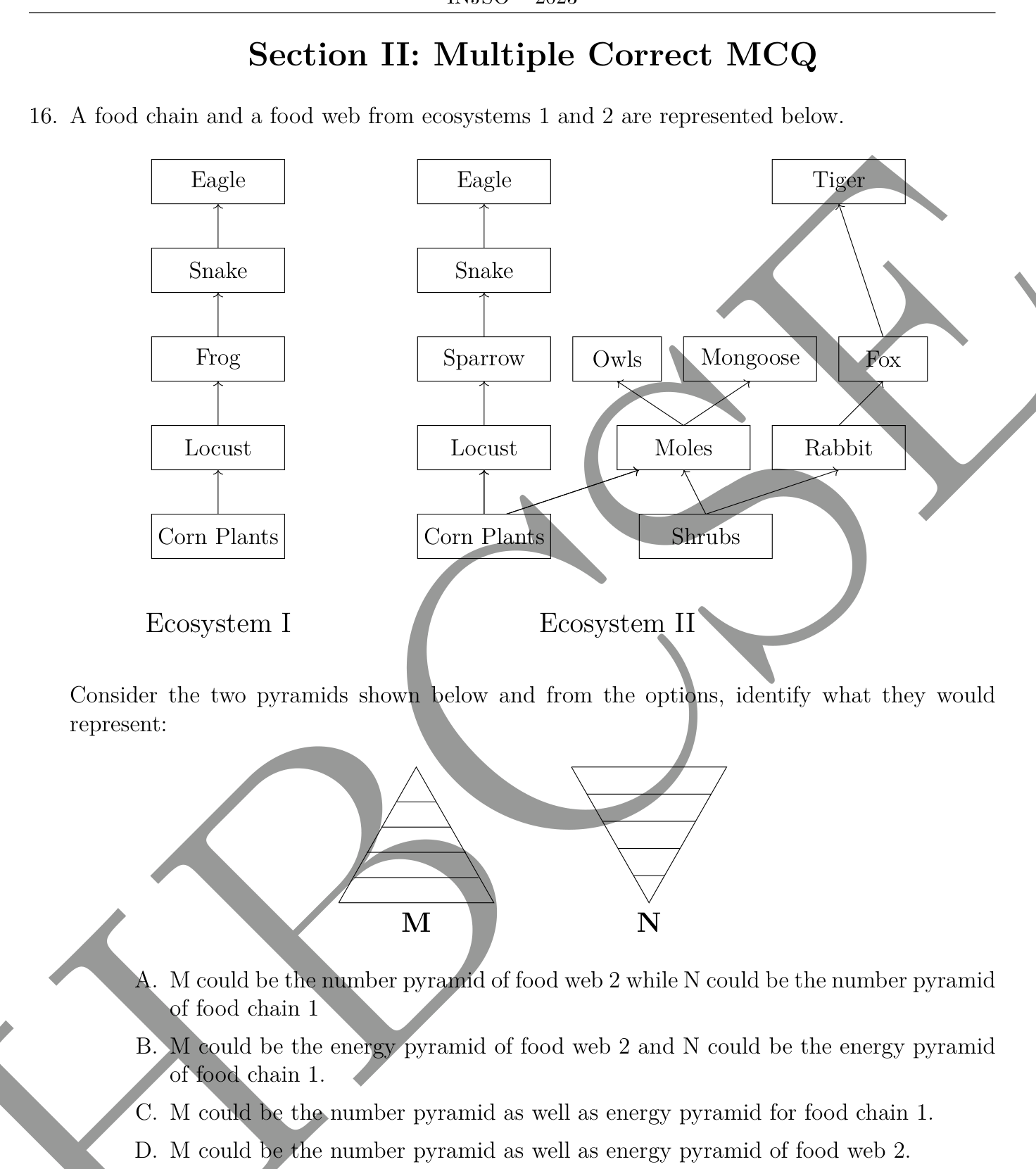
A food chain and a food web from ecosystems 1 and 2 are represented below.
Consider the two pyramids shown below and from the options, identify what they would represent:
- (a) M could be the number pyramid of food web 2 while N could be the number pyramid of food chain 1.
- (b) M could be the energy pyramid of food web 2 and N could be the energy pyramid of food chain 1.
- (c) M could be the number pyramid as well as energy pyramid for food chain 1.
- (d) M could be the number pyramid as well as energy pyramid of food web 2.
Quesito 16
Topic: Biology Metodi: Physical Modeling Competenze: Diagrammatic Reasoning Objects: — Fonte: Testo (PDF) — p.7 Soluzione: Soluzioni (PDF)
**Sezione II (Multiplici MCQ corretti) **
La catena alimentare e la rete alimentare degli ecosistemi 1 e 2 sono rappresentate di seguito.
Considerate le due piramidi mostrate di seguito e dalle opzioni, identificate cosa rappresenterebbero:
- (a) M potrebbe essere la piramide numero di rete alimentare 2 mentre N potrebbe essere la piramide numero di catena alimentare 1.
- (b) M potrebbe essere la piramide energetica della rete alimentare 2 e N potrebbe essere la piramide energetica della catena alimentare 1.
- (c) M potrebbe essere la piramide numerica e la piramide energetica per la catena alimentare 1.
- (d) M potrebbe essere la piramide dei numeri e la piramide energetica della rete alimentare 2.
Quesito 16
Topic: Biology Metodi: Physical Modeling Competenze: Diagrammatic Reasoning Objects: — Fonte: Testo (PDF) — p.7 Soluzione: Soluzioni (PDF)
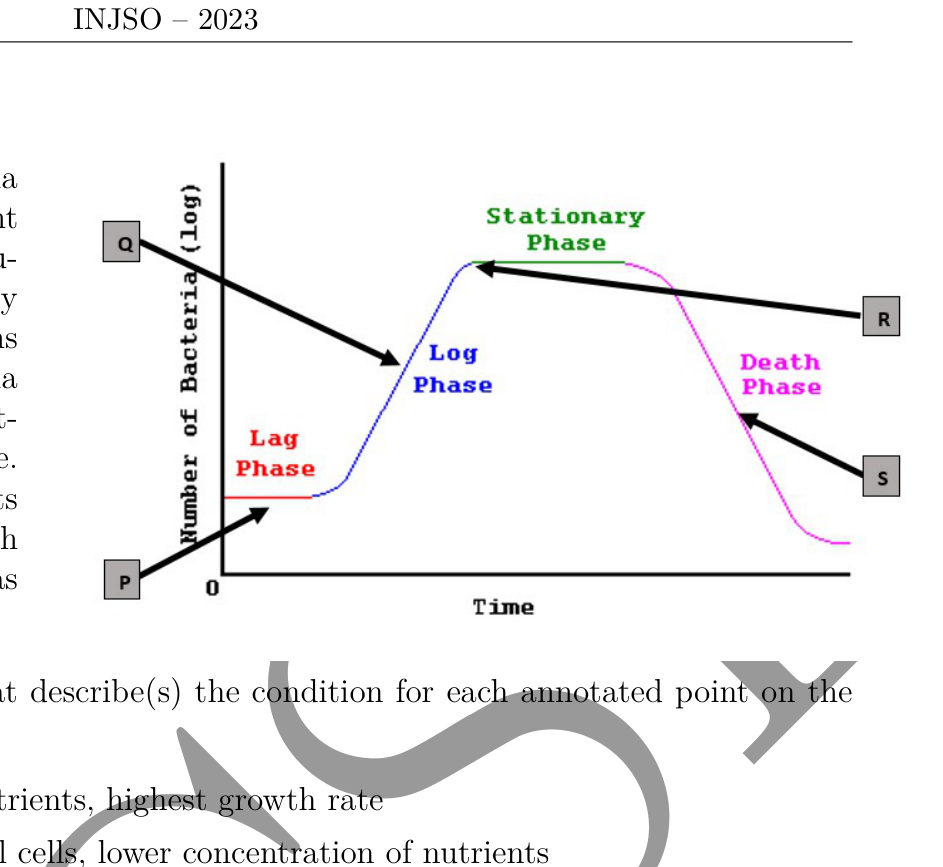
In the laboratory, bacteria are grown in a liquid nutrient medium. They reproduce asexually by successive cycles of binary fission. When such populations are grown in a flask, bacteria show a predictable growth pattern known as a growth curve. The following graph represents such a typical growth curve with the different phases of growth, as indicated.
Choose the correct option(s) that describe(s) the condition for each annotated point on the graph:
(i) Lowest concentration of nutrients, highest growth rate (ii) Highest number of bacterial cells, lower concentration of nutrients (iii) Lowest number of dividing bacterial cells, slow growth rate (iv) Highest growth rate, lesser toxic by-products (v) Highest concentration of nutrients, highest number of bacterial cells (vi) Highest concentration of nutrients, low numbers of bacterial cells (vii) Highest concentration of toxic by-products, least number of dividing bacterial cells
- (a) p-(vii) q-(iv) r-(ii) s-(iii)
- (b) p-(vi) q-(i) r-(vii) s-(iii)
- (c) p-(vi) q-(iv) r-(ii) s-(vii)
- (d) p-(vi) q-(ii) r-(iii) s-(vii)
Quesito 17
Topic: Biology Metodi: Physical Modeling Competenze: Diagrammatic Reasoning Objects: — Fonte: Testo (PDF) — p.8 Soluzione: Soluzioni (PDF)
In laboratorio, i batteri vengono coltivati in un mezzo nutriente liquido. Si riproducono asexualmente attraverso cicli successivi di fissione binaria. Quando tali popolazioni vengono coltivate in un flacone, i batteri mostrano un modello di crescita prevedibile noto come curva di crescita. Il grafico seguente rappresenta una curva di crescita tipica con le diverse fasi di crescita, come indicato.
Scegliere le opzioni corrette che descrivono la condizione di ogni punto annotato sul grafico:
-
la concentrazione di sostanze nutritive più bassa, il tasso di crescita più elevato
-
numero più elevato di cellule batteriche, concentrazione più bassa di sostanze nutritive
-
numero minimo di cellule batteriche che dividono, tasso di crescita lento
-
tasso di crescita più elevato, sottoprodotti tossici meno elevati (v) Concentrazione di sostanze nutritive più elevata, numero di cellule batteriche più elevato
-
concentrazione più elevata di sostanze nutritive, basso numero di cellule batteriche
-
la concentrazione più elevata di sottoprodotti tossici, il minor numero di cellule batteriche che si dividono
-
a) p- vii) q- iv) r- ii) s- iii)
-
b) p-(vi) q-(i) r-(vii) s-(iii)
-
c) p-(vi) q-(iv) r-(ii) s-(vii)
-
d) p- vi) q- ii) r- iii) s- vii)
Quesito 17
Topic: Biology Metodi: Physical Modeling Competenze: Diagrammatic Reasoning Objects: — Fonte: Testo (PDF) — p.8 Soluzione: Soluzioni (PDF)
In temperate regions, woody plants undergo dormant condition to adapt to the extreme winter season. Physiologically they show periodic changes in the cellular activity. For example, cambium tissue is actively dividing in normal conditions. During winter dormancy, cells show changes in the protoplasm, their metabolic activity and cellular content. Which of the following feature/s can be seen in dormant cambium cell as compared to actively dividing cell.
- (a) Very few golgi bodies
- (b) Lesser amount of rough endoplasmic reticulum
- (c) Large vacuole occupying much of the cell volume.
- (d) Increased hydration of cellulose microfibrils of the cell wall.
Topic: Biology Metodi: Physical Modeling Competenze: Physical Reasoning Objects: — Fonte: Testo (PDF) — p.8 Soluzione: Soluzioni (PDF)
Nelle regioni temperate, le piante boschive sono in condizioni di dorme per adattarsi alle estreme stagioni invernali. Fisiologicamente mostrano cambiamenti periodici nell’attività cellulare. Ad esempio, il tessuto cambium si divide attivamente in condizioni normali. Durante la dormanza invernale, le cellule mostrano cambiamenti nel protoplasma, nella loro attività metabolica e nel contenuto cellulare. Qual è una delle seguenti caratteristiche che si possono osservare nella cellula cambium dormiente rispetto alla cellula che si divide attivamente.
- a) Pochi corpi golgi
- b) Minore quantità di reticolo endoplasmico grezzo
- (c) Grande aspirapolvere che occupa gran parte del volume cellulare.
- (d) Aumento dell’idratazione delle microfibrille di celulosa della parete cellulare.
Topic: Biology Metodi: Physical Modeling Competenze: Physical Reasoning Objects: — Fonte: Testo (PDF) — p.8 Soluzione: Soluzioni (PDF)
Following table gives information on naturally occurring stable isotopes of three elements and the number of neutrons in these isotopes. Identify the position for the elements in the Modern Periodic Table. Select the correct option/s.
| Element Code | Number of stable Isotopes | Atomic mass (a.m.u.) | Number of neutrons |
|---|---|---|---|
| 2 | 120.90 | 70 | |
| 122.90 | 72 | ||
| 5 | 69.92 | 38 | |
| 71.92 | 40 | ||
| 72.92 | 41 | ||
| 73.92 | 42 | ||
| 75.92 | 44 | ||
| 2 | 106.90 | 60 | |
| 108.90 | 62 |
- (a) Element belongs to group 15 and period 5, Element belongs to group 4 and period 4
- (b) Element belongs to group 14 and period 4, Element belongs to group 1 and period 5
- (c) Element belongs to group 14 and period 5, Element belongs to group 13 and period 4
- (d) Element belongs to group 15 and period 5, Element belongs to group 11 and period 5
Topic: Chemistry Metodi: Physical Modeling Competenze: Diagrammatic Reasoning Objects: — Fonte: Testo (PDF) — p.9 Soluzione: Soluzioni (PDF)
La tabella seguente fornisce informazioni sugli isotopi stabili di tre elementi che si verificano naturalmente e sul numero di neutroni presenti in questi isotopi. Identificare la posizione degli elementi nella tabella periodica moderna. Selezionare l’opzione/s corretta.
∙ ∙ ∙ ∙ ∙ ∙ ∙ ∙ ∙ ∙ ∙ ∙ ∙ ∙ ∙ ∙ ∙ ∙ ∙ ∙ ∙ ∙ ∙ ∙ ∙ ∙ ∙ ∙ ∙ ∙ ∙ ∙ ∙ ∙ ∙ ∙ ∙ ∙ ∙ ∙ ∙ ∙ ∙ ∙ ∙ ∙ ∙ ∙ ∙ ∙ ∙ ∙ ∙ ∙ ∙ ∙ ∙ ∙ ∙
|---|---|---|---|
| | 2 | 120.90 | 70 |
| | | 122.90 | 72 |
| | 5 | 69.92 | 38 |
| | | 71.92 | 40 |
| | | 72.92 | 41 |
| | | 73.92 | 42 |
| | | 75.92 | 44 |
| | 2 | 106.90 | 60 |
| | | 108.90 | 62 |
- (a) L’elemento appartiene al gruppo 15 e al periodo 5, l’elemento appartiene al gruppo 4 e al periodo 4
- b) L’elemento appartiene al gruppo 14 e al periodo 4, l’elemento appartiene al gruppo 1 e al periodo 5.
- (c) L’elemento appartiene al gruppo 14 e al periodo 5, l’elemento appartiene al gruppo 13 e al periodo 4
- (d) L’elemento appartiene al gruppo 15 e al periodo 5, l’elemento appartiene al gruppo 11 e al periodo 5
Topic: Chemistry Metodi: Physical Modeling Competenze: Diagrammatic Reasoning Objects: — Fonte: Testo (PDF) — p.9 Soluzione: Soluzioni (PDF)
With a solution of I, chlorine (Cl) would react more vigorously at similar conditions and concentrations than bromine (Br) because,
- (a) atomic radius of bromine atom is larger than chlorine atom.
- (b) electronegativity of bromine is greater than chlorine.
- (c) shielding of nuclear charge within the chlorine atom is less than that in bromine atom.
- (d) nuclear charge in chlorine atom is less than that in bromine atom.
Topic: Chemistry Metodi: Physical Modeling Competenze: Physical Reasoning Objects: — Fonte: Testo (PDF) — p.9 Soluzione: Soluzioni (PDF)
Con una soluzione di I, il cloro (Cl) reagisce con maggiore forza in condizioni e concentrazioni simili al bromo (Br) perché,
- a) il raggio atomico dell’atomo di bromo è maggiore dell’atomo di cloro.
- b) l’elettronegatività del bromo è superiore al cloro.
- c) la protezione della carica nucleare all’interno dell’atomo di cloro è inferiore a quella dell’atomo di bromo.
- d) la carica nucleare dell’atomo di cloro è inferiore a quella dell’atomo di bromo.
Topic: Chemistry Metodi: Physical Modeling Competenze: Physical Reasoning Objects: — Fonte: Testo (PDF) — p.9 Soluzione: Soluzioni (PDF)
A member of alkene series X has a molecular mass 28 amu. A small quantity of X (150 cm) is burnt in just sufficient air (containing 20% oxygen) to form carbon dioxide and steam. If all the measurements are made at 1 atm pressure and 100 C, then the composition of the products formed and the unreacted air is …
- (a) 300 cm CO, 300 cm steam, and 450 cm the unreacted air, respectively
- (b) molecules of CO, molecules of steam, 1800 cm the unreacted air, respectively
- (c) molecules of CO, molecules of steam, 450 cm the unreacted air, respectively
- (d) 300 cm CO, 300 cm steam, and 1800 cm the unreacted air, respectively
Topic: Organic Chemistry Metodi: Ideal Gas Law Competenze: Mathematical Modeling Objects: Gas Fonte: Testo (PDF) — p.9 Soluzione: Soluzioni (PDF)
Un membro dell’alkene serie X ha una massa molecolare di 28 amu. Una piccola quantità di X (150 cm ) viene bruciata in aria sufficiente (contenente 20% di ossigeno) per formare anidride carbonica e vapore. Se tutte le misurazioni sono effettuate a 1 atm e 100 C, la composizione dei prodotti formati e l’aria non reagita è …
- a) 300 cm CO, 300 cm vapore e 450 cm aria non reagita, rispettivamente
- (b) molecules of CO, molecules of steam, 1800 cm the unreacted air, respectively
- c) molecole di CO, molecole di vapore, 450 cm l’aria non reagita, rispettivamente
- 300 cm CO, 300 cm vapore e 1800 cm aria non reagita, rispettivamente
Topic: Organic Chemistry Metodi: Ideal Gas Law Competenze: Mathematical Modeling Objects: Gas Fonte: Testo (PDF) — p.9 Soluzione: Soluzioni (PDF)
A pulse of sound is generated at the centre of a room of rectangular cross section having dimensions 20 m 20 m 30 m. Speed of sound is 350 m/s. Consider all possibilities of hearing echoes of this pulse. Some of the instances of time when echoes can be detected at the location of the source are …
- (a) 81 ms
- (b) 86 ms
- (c) 96 ms
- (d) 103 ms
Topic: Oscillations & Waves Metodi: Physical Modeling Competenze: Mathematical Modeling Objects: — Fonte: Testo (PDF) — p.9 Soluzione: Soluzioni (PDF)
Un impulso sonoro viene generato al centro di una stanza di sezione trasversale rettangolare con dimensioni 20 m 20 m 30 m. La velocità del suono è di 350 m/s. Considerate tutte le possibilità di sentire gli eco di questo pulso. Alcuni dei casi di tempo in cui gli eco possono essere rilevati nella posizione della fonte sono …
- (a) 81 ms
- (b) 86 ms
- (c) 96 ms
- (d) 103 ms
Topic: Oscillations & Waves Metodi: Physical Modeling Competenze: Mathematical Modeling Objects: — Fonte: Testo (PDF) — p.9 Soluzione: Soluzioni (PDF)
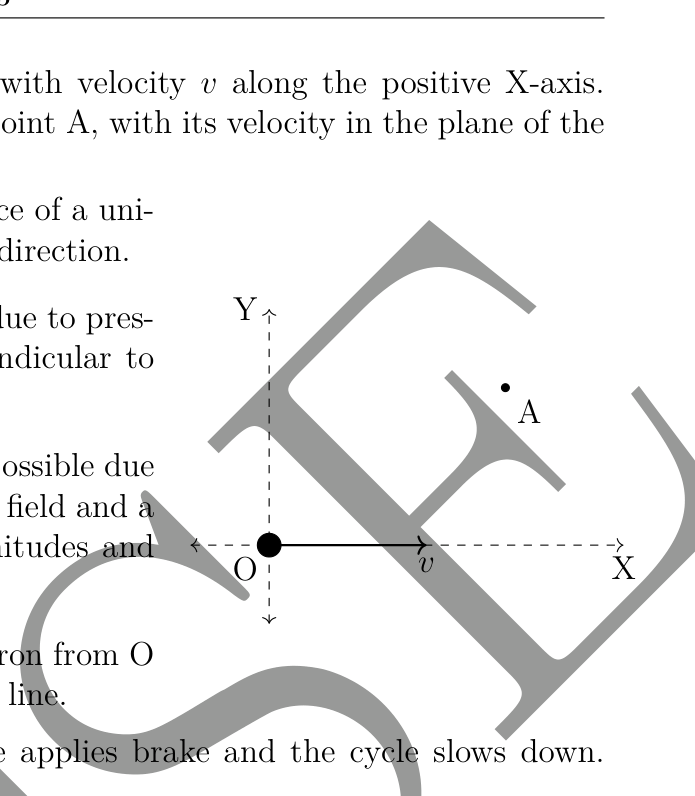
The figure shows an electron projected from O, with velocity along the positive X-axis. After a short time, the same electron is found at point A, with its velocity in the plane of the figure. Choose the correct option/s.
- (a) The above motion can be due to presence of a uniform electric field along the negative Y direction.
- (b) Motion of electron from O to A can be due to presence of a uniform magnetic field perpendicular to XOY plane and outwards.
- (c) Motion of electron from O to A can be possible due to presence of both, a uniform magnetic field and a uniform electric field with proper magnitudes and directions.
- (d) In the figure given, the path of the electron from O to A will necessarily be along a straight line.
Quesito 23
Topic: Electromagnetism Metodi: Lorentz Force Analysis Competenze: Diagrammatic Reasoning Objects: Electron Fonte: Testo (PDF) — p.10 Soluzione: Soluzioni (PDF)
La figura mostra un elettrone proiettato da O, con velocità lungo l’asse X positivo. Dopo un breve tempo, lo stesso elettrone viene trovato al punto A, con la sua velocità nel piano della figura. Scegliere l’opzione/s corretta.
- a) Il movimento di cui sopra può essere dovuto alla presenza di un campo elettrico uniforme lungo la direzione Y negativa.
- (b) Il movimento di un elettrone da O a A può essere dovuto alla presenza di un campo magnetico uniforme perpendicolare al piano XOY e verso l’esterno.
- (c) Il movimento di un elettrone da O a A può essere possibile grazie alla presenza di entrambi, un campo magnetico uniforme e un campo elettrico uniforme con magnitudini e direzioni adeguate.
- (d) Nella figura data, il percorso dell’elettrone da O a A sarà necessariamente lungo una linea retta.
Quesito 23
Topic: Electromagnetism Metodi: Lorentz Force Analysis Competenze: Diagrammatic Reasoning Objects: Electron Fonte: Testo (PDF) — p.10 Soluzione: Soluzioni (PDF)
Prajakta is riding her cycle on a level road. She applies brake and the cycle slows down. Select the correct statement/s.
- (a) If she applies only the front brake, the force due to both the tyres reduce her cycle’s speed.
- (b) If she applies only the front brake, the force due to ground reduces her cycle’s speed.
- (c) If she applies only the rear brake, the force due to the rear tyre reduces her cycle’s speed.
- (d) If she applies only the rear brake, the force due to ground reduces her cycle’s speed.
Topic: Newtonian Mechanics Metodi: Free-Body Diagram Competenze: Physical Reasoning Objects: Wheel Fonte: Testo (PDF) — p.10 Soluzione: Soluzioni (PDF)
Prajakta sta guidando la sua bici su una strada piatta. Applica il freno e il ciclo rallenta. Selezionare la dichiarazione/s corretta.
- a) Se si applica solo il freno anteriore, la forza dovuta a entrambi i pneumatici riduce la velocità del suo ciclo.
- b) Se si applica solo il freno anteriore, la forza dovuta al terreno riduce la velocità del suo ciclo.
- c) Se si applica solo il freno posteriore, la forza derivante dal pneumatico posteriore riduce la velocità del suo ciclo.
- (d) Se si applica solo il freno posteriore, la forza dovuta al suolo riduce la velocità del suo ciclo.
Topic: Newtonian Mechanics Metodi: Free-Body Diagram Competenze: Physical Reasoning Objects: Wheel Fonte: Testo (PDF) — p.10 Soluzione: Soluzioni (PDF)
Section III (Descriptive)
[8] Four bowls of milk were incubated at room temperature under different conditions (schematic below – either boiled or unboiled milk was mixed and incubated either with a ripe piece of tamarind OR a spoon full of curd). The results of curd formation after 20 hrs is tabulated below, where a number of characteristics are recorded (the more the number of ’+’ signs, the better the firmness of the curd formed, rancid = unpleasant/old taste):
| Bowl | Coagulation of milk into curd like solids | Total Acidity | Flavour |
|---|---|---|---|
| A | ++ | Medium | Good |
| B | +++ | Medium | Great |
| C | ++ | High | Rancid smell |
| D | +/- | Low | Rancid smell |
Quesito 25
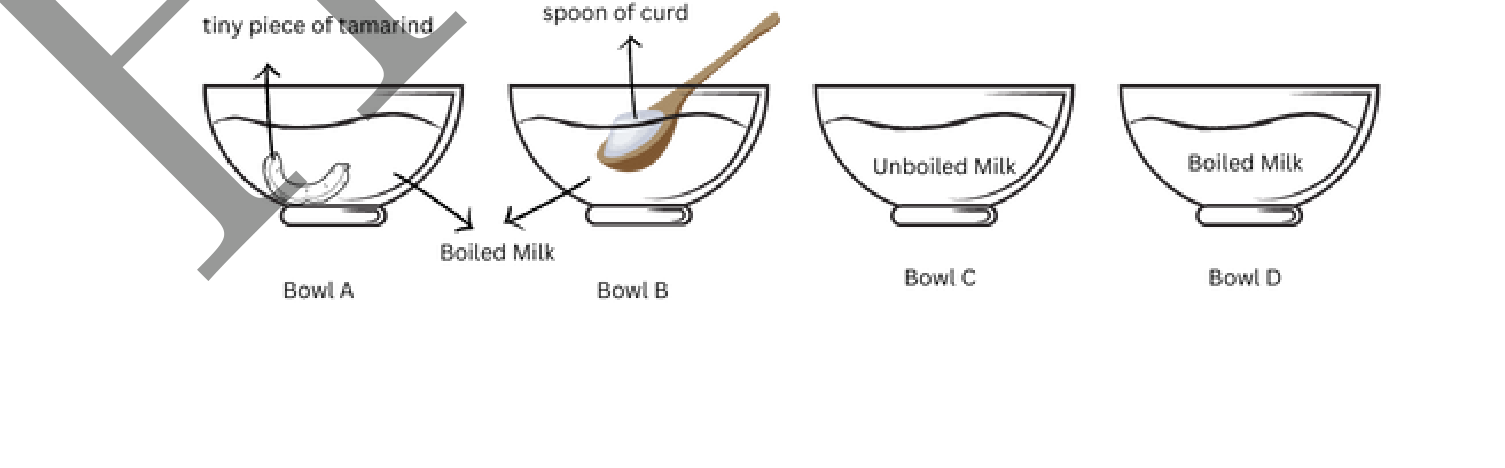
(a) Based on your knowledge of milk to curd formation, interpret which of the following is true?
- (a) Lactic acid and other bacteria are already present in the milk.
- (b) Controlled/desired fermentation of milk occurred in Bowls A, B and C.
- (c) The spoon of curd introduces lactic acid bacteria into the milk.
- (d) Bacteria from the air settled into sample D and prevented curd formation.
(b) A scientist claimed that the acid from tamarind helped in the curdling of milk. If you were the experimenter and had the option comparing unboiled/untreated samples versus those boiled for 10 min, which of the following observations would help you evaluate that the claim is false:
| Experiment | Procedure | Outcome |
|---|---|---|
| A | The juice/tamarind extract from that same piece was boiled and added (instead of whole piece) | didn’t curdle the milk |
| B | The juice/tamarind extract from the same piece of tamarind was added directly. | curdled the milk. |
| C | Tamarind extract was added to the boiled milk sample versus unboiled milk. | resulted in the unboiled milk curdling faster. |
| D | A raw piece of tamarind added to the boiled milk. | resulted in slower fermentation and curd formation. |
(c) Below are a few facts about the nature of milk and clues to the curdling process:
i. Milk is made up of proteins which in turn are made up of amino acids that contain varying amounts of weak acids–COOH and weak bases–NH depending on the amino acid content. These help act like a buffer that resists sudden changes of pH in milk. ii. As bacteria grow in milk, they can either break down these proteins (putrefaction) or utilize lactose to produce acids that contribute to the spoilage of milk. iii. Upon acid accumulation, proteins slowly tend to lose their overall structure, leading to aggregation and coagulation of milk. This is similar to the coagulation of egg albumin protein upon heating.
Based on this and the experiments above, which of the following statements is/are true?
- (a) Milk protein acts like a buffer and hence takes a long time to curdle, as bacterial acids produced, accumulate slowly.
- (b) Tamarind normally contain bacteria that utilize lactose to produce acids, which accumulate slowly eventually leading to curdling of milk.
- (c) Weak acids are released from the small piece of tamarind, and take a long time to denature the milk protein that leads to the curdling of milk.
- (d) Tamarind tends to inhibit spoilage of milk as the acids prevent putrefaction of milk proteins due to coagulation.
Topic: Biology Metodi: Physical Modeling Competenze: Diagrammatic Reasoning Objects: — Fonte: Testo (PDF) — p.10 Soluzione: Soluzioni (PDF)
**Sezione III (Descrizionale) **
[8] Quattro ciotole di latte sono state incubate a temperatura ambiente in diverse condizioni (sistematica sotto sia latte bollito che non bollito è stato mescolato e incubato con un pezzo maturo di tamarind O un cucchiaino pieno di gomito). I risultati della formazione di caramelle dopo 20 ore sono riportati in tabella seguente, dove sono riportate diverse caratteristiche (più è il numero di segni ’+’, meglio è la fermezza della formazione di caramelle, rancido = gusto sgradevole/vecchio):
♬ Bowl Coagulazione del latte in gomma come solidi ♬ Total Acidity Flavour ♬ |---|---|---|---|
Un # un # # un # # un # un # un # un # un # un # un # un # un # un # un # un # un # un # un # un # un # un # un # un # un # un # un # un # un # un # un # un # un # un # un # un # un # un # un # un # un # un # un # un # un # un # un # un # un # un # un # un # un # un # un # un # un # un # un # un # un # un # un # un # un # un # un # un # un # un # un # un # un # un # un # un # un # un # un # un # un # un # un # un # un # un # un # un # un # un # un # un # un # un # un # un # un # un # un # un # un # un # un # un # un # un # un # un # un # un # un # un # un # un # un # un # un # un # un # un # un # un # un # un # un # un # un # un # un # un # un # un # un # un # un # un # un # un # un # un # un # un # un # un # un # un # un # un # un # un # un # un # un # un # un # un # un # un # un # un # un # un # un # un # un # un # un # un # un # un # un # un # un # un # un # un # un # un # un # un # un # un # un # un # un # un # un # un # un # un # un # un # un # un # un # un # un # un # un # un # un # un # un # un # un # un # un # un # un # un # un # un # un # un # un # un # un # un # un # un # un # un # un # un # un # un # un # un # un # un # un # un # un # un # un # un # un # un # un # un # un # un # un # un # un # un # un # un # un # un # un # un # un # un # un
B # B # C# C# C# C# C# C# C# C# C# C# C# C# C# C# C# C# C# C# C# C# C# C# C# C# C# C# C# C# C# C# C# C# C# C# C# C# C# C# C# C# C# C# C# C# C# C# C# C# C# C# C# C# C# C# C# C# C# C# C# C# C# C# C# C# C# C# C# C# C# C# C# C# C# C# C# C# C# C# C# C# C# C# C# C# C# C# C# C# C# C# C# C# C# C# C# C# C# C# C# C# C# C# C# C# C# C# C# C# C# C# C# C# C# C# C# C# C# C# C# C# C# C# C# C# C# C# C# C# C# C# C# C# C# C# C# C# C# C# C# C# C# C# C# C# C# C# C# C# C# C# C# C# C# C# C# C# C# C# C# C# C# C# C# C# C# C# C# C# C# C# C# C# C# C# C# C# C# C# C# C# C# C# C# C# C# C# C# C# C# C# C# C# C# C# C# C# C# C# C# C# C# C# C# C# C# C# C# C# C# C# C# C# C# C# C# C# C# C# C# C# C# C# C# C# C# C# C# C# C# C# C# C# C# C# C# C# C# C# C# C# C# C# C# C# C# C# C# C# C# C# C# C# C#
# C ++ # # alto # # profumo di rancio
D ̊ +/- ̊ # Sotto # ̊ Odore di rance
Quesito 25
(a) Sulla base delle vostre conoscenze sul latte e sulla formazione di caramelle, quale delle seguenti interpretazioni è vera?
- (a) L’acido lattico e altri batteri sono già presenti nel latte.
- (b) Si è verificata una fermentazione controllata/desiderata del latte nei bolli A, B e C.
- (c) Il cucchiaio di zucchero di latte introduce i batteri dell’acido lattico nel latte.
- (d) I batteri dell’aria si sono stabiliti nel campione D e hanno impedito la formazione di gomma.
(b) Uno scienziato affermò che l’acido del tamarindo aiutava a formare il latte. Se si fosse stati i partecipanti alla sperimentazione e si fosse potuto confrontare campioni non bolliti/non trattati con quelli bolliti per 10 minuti, quale delle seguenti osservazioni vi avrebbe aiutato a valutare la falsità dell’affermazione:
♬ Esperimento ♬ Procedura ♬ Esito ♬ |---|---|---| ♬ A ♬ L’estratto di succo/tamarindato di quel pezzo è stato bollito e aggiunto (invece di pezzo intero) ♬ non ha rimpicciato il latte ♬ Il succo/estratto di tamarindolo dallo stesso pezzo di tamarindolo è stato aggiunto direttamente. Ho fatto il latte. | L’estratto di Tamarind è stato aggiunto al latte bollito rispetto al latte non bollito. Il latte non bollito si è rotturato più velocemente. | Un pezzo di tamarindina crudo aggiunto al latte bollito. Ha portato a una fermentazione più lenta e alla formazione di caramelle. |
c) Qui di seguito sono riportati alcuni fatti sulla natura del latte e indizi del processo di curdling:
i. Il latte è costituito da proteine che a loro volta sono costituite da aminoacidi contenenti quantità diverse di acidi deboli COOH e basi deboli NH a seconda del contenuto di aminoacidi. Questi aiutano a agire come un cuscinetto che resiste ai cambiamenti improvvisi del pH del latte. ii. Mentre i batteri crescono nel latte, possono abbattere queste proteine (deterraggio) o utilizzare il lattosio per produrre acidi che contribuiscono alla deterioramento del latte. iii. Quando si accumula acido, le proteine tendono lentamente a perdere la loro struttura complessiva, portando all’aggregazione e alla coagulazione del latte. Questo è simile alla coagulazione della proteina albumina dell’uovo durante il riscaldamento.
Sulla base di questo e degli esperimenti precedenti, quale delle seguenti affermazioni è/sono vera?
- (a) La proteina del latte agisce come un cuscinetto e, pertanto, richiede molto tempo per rimuovere, poiché gli acidi batterici prodotti si accumulano lentamente.
- (b) Il Tamarind contiene normalmente batteri che utilizzano il lattosio per produrre acidi, che si accumulano lentamente, portando alla fine a un rottura del latte.
- (c) dal piccolo pezzo di tamarindone vengono rilasciati acidi deboli e occorre un lungo tempo per denaturare la proteina del latte che porta alla rottura del latte.
- (d) Il Tamarindo tende a inibire la deterioramento del latte poiché gli acidi impediscono la putrefazione delle proteine del latte a causa della coagulazione.
Topic: Biology Metodi: Physical Modeling Competenze: Diagrammatic Reasoning Objects: — Fonte: Testo (PDF) — p.10 Soluzione: Soluzioni (PDF)
[8] The effects that organisms in a community have on each other are referred to as ecological interactions. Different types of ecological interactions exist based on the types of relationships between the same (intraspecific interactions) or different species (interspecific interactions). Consider the following situations:
Situation I: The African buffalo feeds on the grasses growing in the Savannas. The buffalo’s hide (skin) is infested with ticks. Oxpecker birds ride on the buffalo and feed on the ticks. While grazing, this large mammal unknowingly destroys insects and their nests present on the ground. These insects which fly around after they are disturbed are eaten by egret birds in the vicinity.
Situation II: Carnivores such as timberwolves hunt and kill herbivorous mammals. Grizzly bears in the vicinity attempt to take over the wolf’s prey/kill.
Situation III: Some kinds of detrivorous mites that need to feed on dung but cannot fly in search of fresh dung attach themselves to the bodies of dung beetles which are not only good at flying but are also good at locating fresh dung.
(a) For each of the situation (I – III), fill in the table to indicate the various type/s of interaction/s present, where ’+’ indicates positive effect, ’–’ indicates negative effect and ‘0’ indicates no effect. Put tick marks (✓) against the appropriate interaction to indicate presence and cross mark (X) to indicate absence.
| Serial No. | Effect on species 1 | Effect on species 2 | Type of interaction | Situation I | Situation II | Situation III |
|---|---|---|---|---|---|---|
| 1 | + | - | Predation | |||
| 2 | + | - | Herbivory | |||
| 3 | 0 | - | Amensalism | |||
| 4 | + | 0 | Commensalism | |||
| 5 | - | - | Competition | |||
| 6 | + | - | Parasitism | |||
| 7 | + | + | Mutualism |
(b) Antagonistic interactions are those in which one species benefits and the other is harmed. Choose the antagonistic interactions from the list of interactions given in the table in Q.26(a) and provide the solution in the answersheet with the corresponding serial numbers. Antagonistic interaction/s is/are:
(c) Fill in the table below with the type of antagonistic interaction/s observed in each of the situations I, II and III (as referred in the table – Q26a) and also indicate the species/organism that is benefited (indicated by + in the table) and the species that is harmed (indicated by – in the table). Indicate the absence of an antagonistic interaction by writing NONE in the table under the column type of antagonistic interaction.
| Situation | Type of antagonistic interaction | Species 1 (+) | Species 2 (–) |
|---|---|---|---|
| I | |||
| II | |||
| III |
Topic: Biology Metodi: Physical Modeling Competenze: Diagrammatic Reasoning Objects: — Fonte: Testo (PDF) — p.12 Soluzione: Soluzioni (PDF)
[8] Gli effetti che gli organismi di una comunità hanno l’uno sull’altro sono chiamati interazioni ecologiche. Esistono diversi tipi di interazioni ecologiche in base ai tipi di relazioni tra le stesse specie (interazioni specifiche) o diverse specie (interazioni specifiche). Considerate le seguenti situazioni:
**Situzione I: ** Il bufalo africano si nutre delle erbe che crescono nelle Savannas. La pelle del bufalo è infestata da zecche. Gli uccelli di scuro cavalcano il bufalo e si nutrono delle zecche. Mentre pascola, questo grosso mammifero distrugge inconsapevolmente gli insetti e i loro nidi presenti sul terreno. Questi insetti che volano intorno dopo essere stati disturbati vengono mangiati dagli uccelli di coccoli nelle vicinanze.
**Situzione II: ** Carnivori come i lupi legnosi cacciano e uccidono mammiferi erbivori. Gli orsi grizzliani nelle vicinanze tentano di prendere il sopravvento della preda/uccisione del lupo.
Situazione III: Alcuni tipi di acari deterioratori che devono nutrirsi di sterco ma non possono volare alla ricerca di sterco fresco si attaccano ai corpi di scarafaggi di sterco che non solo sono bravi a volare ma sono anche bravi a localizzare sterco fresco.
(a) Per ciascuna delle situazioni (I III), compilare la tabella per indicare i vari tipi di interazione/s presenti, dove ’+’ indica effetto positivo, ” indica effetto negativo e ‘0’ indica nessun effetto. Mettete i segni di zecca (✓) contro l’interazione appropriata per indicare la presenza e il segno incrociato (X) per indicare l’assenza.
♬ Serie No. ∙ ∙ ∙ ∙ ∙ ∙ ∙ ∙ ∙ ∙ ∙ ∙ ∙ ∙ ∙ ∙ ∙ ∙ ∙ ∙ ∙ ∙ ∙ ∙ ∙ ∙ ∙ ∙ ∙ ∙ ∙ ∙ ∙ ∙ ∙ ∙ ∙ ∙ ∙ ∙ ∙ ∙ ∙ ∙ ∙ ∙ ∙ ∙ ∙ ∙ ∙ ∙ ∙ ∙ ∙ ∙ ∙ ∙ ∙ ∙ ∙ ∙ ∙ ∙ ∙ ∙ ∙ ∙ ∙ ∙ ∙ ∙ ∙ ∙ ∙
|---|---|---|---|---|---|---|
# # # # # # # # # # # # # # # # # # # # # # # # # # # # # # # # # # # # # # # # # # # # # # # # # # # # # # # # # # # # # # # # # # # # # # # # # # # # # # # # # # # # # # # # # # # # # # # # # # # # # # # # # # # # # # # # # # # # # # # # # # # # # # # # # # # # # # # # # # # # # # # # # # # # # # # # # # # # # # # # # # # # # # # # # # # # # # # # # # # # # # # # # # # # # # # # # # # # # # # # # # # # # # # # # # # # # # # # # # # # # # # # # # # # # # # # # # # # # # # # # # # # # # # # # # # # # # # # # # # # # # # # # # # # # # # # # # # # # # # # # # # # # # # # # # # # # # # # # # # # # # # # # # # # # # # # # # # # # # # # # # # # # # # # # # # # # # # # # # # # # # # # # # # # # # # # # # # # # # # # # # # # # # # # # # # # # # # # # # # # # # # # # # # # # # # # # # # # # # # # # # # # # # # # # # # # # # # # # # # # # # # # # # # # # # # # # # # # # # # # # # # # # # # # # # # # # # # # # # # # # # # # # # # # # # # # # # # # # # # # # # # # # # # # # # # # # # # # # # # # # # # # # # # # #
# Sono un uomo che ha un’aria di merda
# Il mio amore # # il mio amore
4 # 0 # Commensalismo
# Il concorso # # il concorso # # il concorso # # il concorso # # il concorso # # il concorso # # il concorso # # il concorso # # il concorso # il concorso
# # # # # # # # # # # # # # # # # # # # # # # # # # # # # # # # # # # # # # # # # # # # # # # # # # # # # # # # # # # # # # # # # # # # # # # # # # # # # # # # # # # # # # # # # # # # # # # # # # # # # # # # # # # # # # # # # # # # # # # # # # # # # # # # # # # # # # # # # # # # # # # # # # # # # # # # # # # # # # # # # # # # # # # # # # # # # # # # # # # # # # # # # # # # # # # # # # # # # # # # # # # # # # # # # # # # # # # # # # # # # # # # # # # # # # # # # # # # # # # # # # # # # # # # # # # # # # # # # # # # # # # # # # # # # # # # # # # # # # # # # # # # # # # # # # # # # # # # # # # # # # # # # # # # # # # # # # # # # # # # # # # # # # # # # # # # # # # # # # # # # # # # # # # # # # # # # # # # # # # # # # # # # # # # # # # # # # # # # # # # # # # # # # # # # # # # # # # # # # # # # # # # # # # # # # # # # # # # # # # # # # # # # # # # # # # # # # # # # # # # # # # # # # # # # # # # # # # # # # # # # # # # # # # # # # # # # # # # # # # # # # # # # # # # # # # # # # # # # # # # # # # # # # # # #
# 7 # + # Mutualità
b) Interazioni antagoniste sono quelle in cui una specie beneficia e l’altra subisce danni. Scegliere le interazioni antagoniste dall’elenco delle interazioni riportato nella tabella di Q.26(a) e fornire la soluzione nella scheda di risposte con i numeri di serie corrispondenti. Interazione/interazioni antagoniste sono:
c) Completa la tabella di seguito con il tipo di interazione/s antagonistiche osservata/s in ciascuna delle situazioni I, II e III (come indicato nella tabella Q26a) e indica anche la specie/organismo che è beneficiato (indicato con + nella tabella) e la specie che è danneggiata (indicato con nella tabella). Indicare l’assenza di un’interazione antagonistica scrivendo NONE nella tabella sotto il tipo di colonna di interazione antagonistica.
Situazione Tipo di interazione antagonistica Specie 1 Specie 2 |---|---|---|---| | I | | | | | II | | | |
Il terzo
Topic: Biology Metodi: Physical Modeling Competenze: Diagrammatic Reasoning Objects: — Fonte: Testo (PDF) — p.12 Soluzione: Soluzioni (PDF)
[6] Our body organs are adapted to gravitational force present on earth’s surface. Our circulatory system, skeletal system, muscle structure and functions all are adapted according to normal gravitational force on the earth’s surface. Longer stay in space results in many physical and physiological changes in human body. Astronauts staying on the International Space Station (ISS) for extended periods of time face changes in regular bodily functions. For example, weight-bearing parts, balancing mechanisms, body fluids do not have to counter gravitational force in microgravity condition.
(a) Which one of the following changes in circulatory system occur(s) in case of an astronaut staying on ISS?
- (a) Heart shape changes under the influence of microgravity. It gets vertically elongated resulting in increased cardiac output.
- (b) Longer stay in space leads to gain in ventricular muscle mass as heart has to work harder to pump blood all over the body.
- (c) Heart rate of an individual on ISS is similar to the rate while lying down on the earth.
- (d) Astronaut continuously feel light headedness (dizziness) due to postural hypotension* during their stay in space but the feeling diminishes after landing on earth.
*Postural hypotension is a condition of low blood pressure that happens when standing after sitting or lying down.
(b) The skeletal system also gets affected due to microgravity. The functioning of osteoblasts (that make and regulate bone matrix) and osteoclasts (that breakdown and absorb bone matrix) are programmed as per the gravitational load present on the earth. During prolonged stay on ISS, both these types of cells show altered function. The ‘weightless’ condition results in 2–4% loss of bone matter. Interestingly, 97% of this loss is from part/s like: (Put a tick in correct box/es)
- A. Wrist bones (Carpels)
- B. Hip bone
- C. Skull
- D. Rib cage
- E. Vertebral column
(c) The International space station is revolving 400 km above the surface of the Earth. As you might have seen (in some movies or TV), the astronauts feel weightless inside the space station. What is the value of gravitational acceleration due to the earth as measured at the space station?
Topic: Biology Metodi: Physical Modeling Competenze: Physical Reasoning Objects: Satellite, Planet Fonte: Testo (PDF) — p.13 Soluzione: Soluzioni (PDF)
[6] I nostri organi sono adattati alla forza gravitazionale presente sulla superficie terrestre. Il nostro sistema circolatorio, il sistema scheletrico, la struttura muscolare e le funzioni sono tutti adattati secondo la normale forza gravitazionale sulla superficie terrestre. Il lungo soggiorno nello spazio porta a molti cambiamenti fisici e fisiologici nel corpo umano. Gli astronauti che soggiornano per lunghi periodi sulla Stazione Spaziale Internazionale (ISS) devono affrontare cambiamenti nelle loro normali funzioni fisiche. Per esempio, le parti che portano peso, i meccanismi di bilanciamento, i fluidi del corpo non devono contrastare la forza gravitazionale in condizioni di microgravità.
(a) Quali dei seguenti cambiamenti del sistema circolatorio si verificano in caso di soggiorno di un astronauta alla ISS?
- a) Cambiamenti della forma del cuore sotto l’ influenza della microgravità. Si allunga verticalmente, con conseguente aumento della produzione cardiaca.
- (b) Un periodo di permanenza più lungo nello spazio porta ad aumentare la massa muscolare ventricolare, poiché il cuore deve lavorare più duramente per pompare il sangue in tutto il corpo.
- (c) La frequenza cardiaca di un individuo sulla ISS è simile alla frequenza mentre si sdraiano sulla terra.
- (d) Gli astronauti sentono continuamente una leggera testaccia (vertigini) dovuta all’ipotensione posturale* durante il loro soggiorno nello spazio, ma la sensazione diminuisce dopo l’atterraggio sulla Terra.
*L’ ipotensione posturale è una condizione di bassa pressione sanguigna che si verifica quando si è in piedi dopo essere seduti o sdraiati.
b) Il sistema scheletrico è anche colpito dalla microgravità. Il funzionamento degli osteoblasti (che fanno e regolano la matrice ossea) e degli osteoclasti (che si decompongono e assorbono la matrice ossea) sono programmati in base al carico gravitazionale presente sulla terra. Durante un lungo soggiorno sulla ISS, entrambi questi tipi di cellule mostrano una funzione alterata. La condizione “senza peso” comporta una perdita di 24% di materia ossea. È interessante notare che il 97% di questa perdita è derivata da parti come:
- A. Oste del polso (carpel)
- B. Osso dell’anca
- C. Cappella
- D. Cage di costole
- E. Colonna vertebrale
c) La stazione spaziale internazionale ruota a 400 km sopra la superficie terrestre. Come forse avete visto (in alcuni film o in TV), gli astronauti si sentono senza peso all’interno della stazione spaziale. Qual è il valore dell’accelerazione gravitazionale dovuta alla terra misurato alla stazione spaziale?
Topic: Biology Metodi: Physical Modeling Competenze: Physical Reasoning Objects: Satellite, Planet Fonte: Testo (PDF) — p.13 Soluzione: Soluzioni (PDF)
[8] A plasmid is an extrachromosomal DNA present in bacteria, imparting them with additional function, for example those imparted by antibiotic resistance genes. In recombinant DNA technology, a foreign gene of interest is usually inserted at a site present within the antibiotic resistance gene. This helps screen the bacterial cells that contain the engineered recombinant plasmid.
Quesito 28
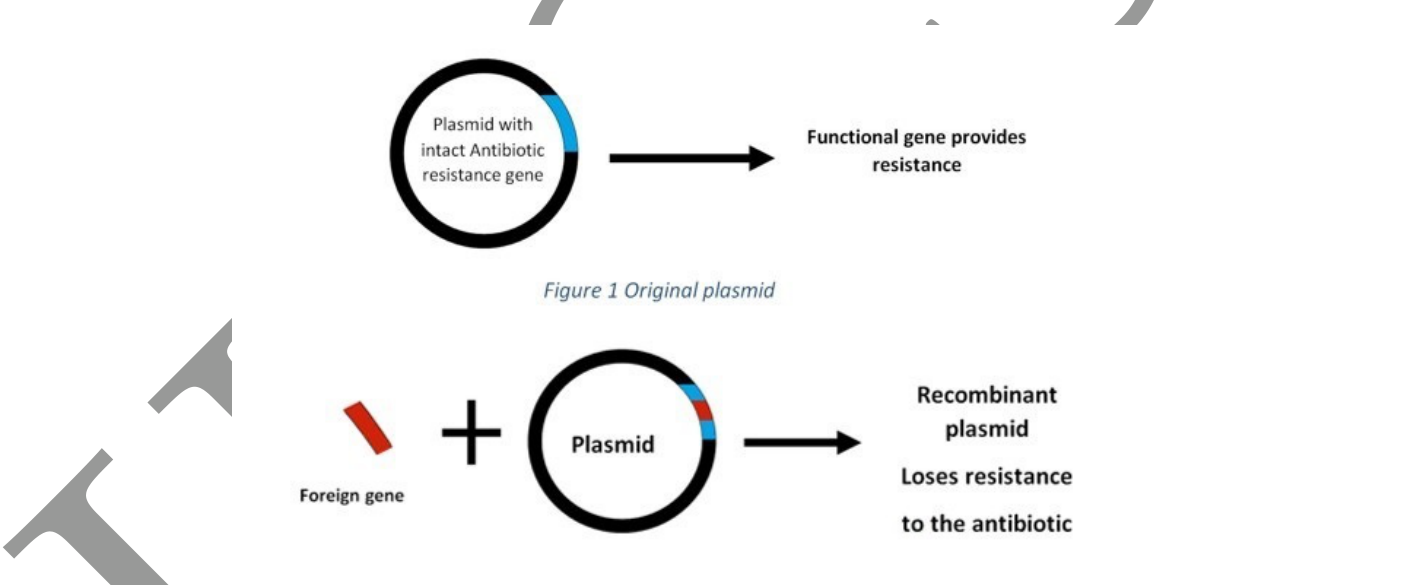
In an experiment, plasmid pBR322 is used, which has both tetracycline (tet) and ampicillin (amp) resistance genes. A foreign gene is inserted in this plasmid at a site present within the tetracycline resistance gene.
Quesito 28
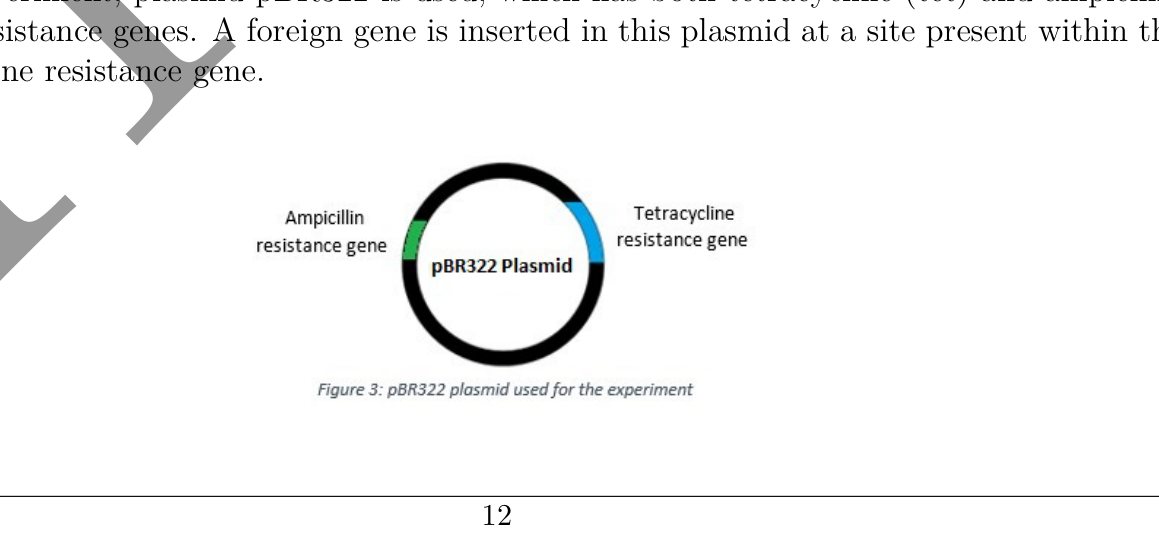
(a) Bacterial cultures with these recombinant plasmids were grown on solid media plates each containing a different combination of antibiotics. Based on the observations after the growth period, state which of the following statements would be true/false–
i. Bacterial cells with recombinant plasmid grow on media containing both ampicillin and tetracycline. ii. Bacterial cells with recombinant plasmid grow on media containing ampicillin only. iii. Bacterial cells that lose the plasmid grow on media containing tetracycline only. iv. Bacterial cells with recombinant plasmids will grow on media containing tetracycline only.
(b) Growth of the bacterial culture on ampicillin containing media would not be observed in which of the following cases of the same experiment–
- (a) A successful recombination where the DNA gets inserted at the expected locus.
- (b) A failed recombination where the DNA gets inserted outside both the antibiotic resistance genes.
- (c) No recombination at all.
- (d) Complete loss of plasmid from all the cells.
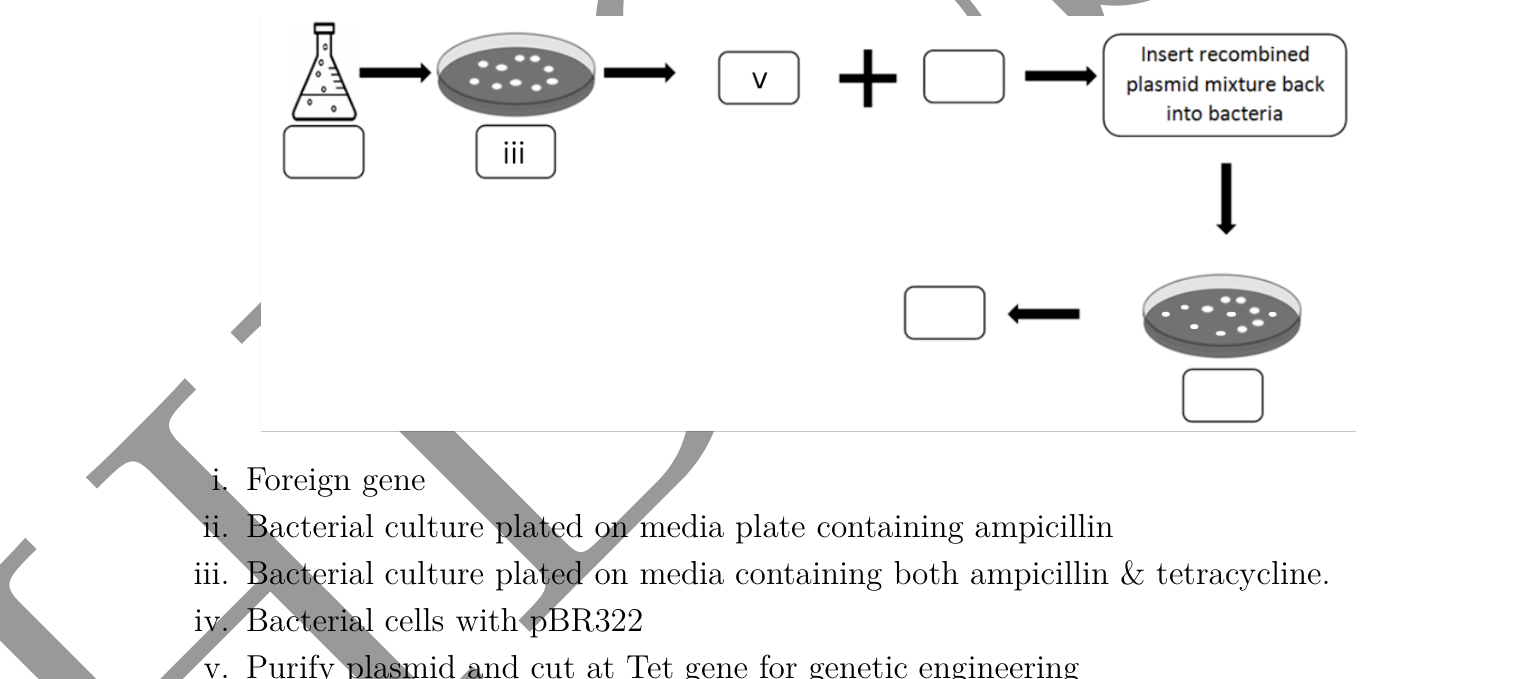
(c) As per the sequential flow of the above experiment, insert the corresponding roman numerals for each of the following statements at the correct places in the diagram below, as shown by the examples in the figure.
i. Foreign gene ii. Bacterial culture plated on media plate containing ampicillin iii. Bacterial culture plated on media containing both ampicillin & tetracycline. iv. Bacterial cells with pBR322 v. Purify plasmid and cut at Tet gene for genetic engineering vi. Isolate the bacteria with the desired recombinant plasmid
Quesito 28
Topic: Biology Metodi: Physical Modeling Competenze: Physical Reasoning Objects: — Fonte: Testo (PDF) — p.14 Soluzione: Soluzioni (PDF)
[8] Un plasmido è un DNA extracromosomico presente nei batteri, che li conferisce una funzione aggiuntiva, ad esempio quelle conferite dai geni di resistenza agli antibiotici. Nella tecnologia del DNA ricombinante, un gene straniero di interesse viene generalmente inserito in un sito presente all’interno del gene di resistenza agli antibiotici. Questo aiuta a controllare le cellule batteriche che contengono il plasmido ricombinante progettato.
Quesito 28
In un esperimento, viene utilizzato il plasmido pBR322, che ha sia i geni di resistenza alla tetracciclina (tet) che all’ampicillina (amp). Un gene straniero viene inserito in questo plasmide in un sito presente all’interno del gene di resistenza alle tetraccicline.
Quesito 28
(a) Le colture batteriche con questi plasmi ricombinanti sono state coltivate su piastre di supporto solide contenenti ciascuna una combinazione diversa di antibiotici. Sulla base delle osservazioni successive al periodo di crescita, indicare quale delle seguenti affermazioni sarebbe vera/falsa
i. Le cellule batteriche con plasmido ricombinante crescono su supporti contenenti sia ampicillina che tetraciclina. ii. Le cellule batteriche con plasmide ricombinante crescono su supporti contenenti solo ampicillina. iii. Le cellule batteriche che perdono il plasmide crescono su supporti contenenti solo tetraciclina. iv. Le cellule batteriche con plasmi recombinanti cresceranno su supporti contenenti solo tetraciclina.
b) La crescita della coltura batterica su supporti contenenti ampicillina non sarebbe stata osservata in quale dei seguenti casi dello stesso esperimento
- (a) Ricombinazione di successo in cui il DNA viene inserito al luogo previsto.
- (b) Una ricombinazione fallita in cui il DNA viene inserito al di fuori di entrambi i geni di resistenza agli antibiotici.
- (c) Nessuna ricombinazione.
- (d) Perdizione completa di plasmido da tutte le cellule.
c) In base al flusso sequenziale dell’esperimento di cui sopra, inserire i numeri romani corrispondenti per ciascuna delle seguenti affermazioni nei posti corretti del diagramma di seguito, come mostrato dagli esempi della figura.
i. Genetici stranieri ii. Coltura batterica rivestita su una piastra media contenente anpicilina iii. Coltura batterica rivestita su supporti contenenti sia ampicillina che tetraciclina. iv. cellule batteriche con pBR322 v. Purificare il plasmido e tagliare il gene Tet per l’ingegneria genetica vi. Isolare i batteri con il plasmido ricombinante desiderato
Quesito 28
Topic: Biology Metodi: Physical Modeling Competenze: Physical Reasoning Objects: — Fonte: Testo (PDF) — p.14 Soluzione: Soluzioni (PDF)
[13] Sumeet and Swapnil separately carried out experiments to find out the volume of dilute hydrochloric acid solutions required to react with a sample of 0.57 g of aluminum powder completely.
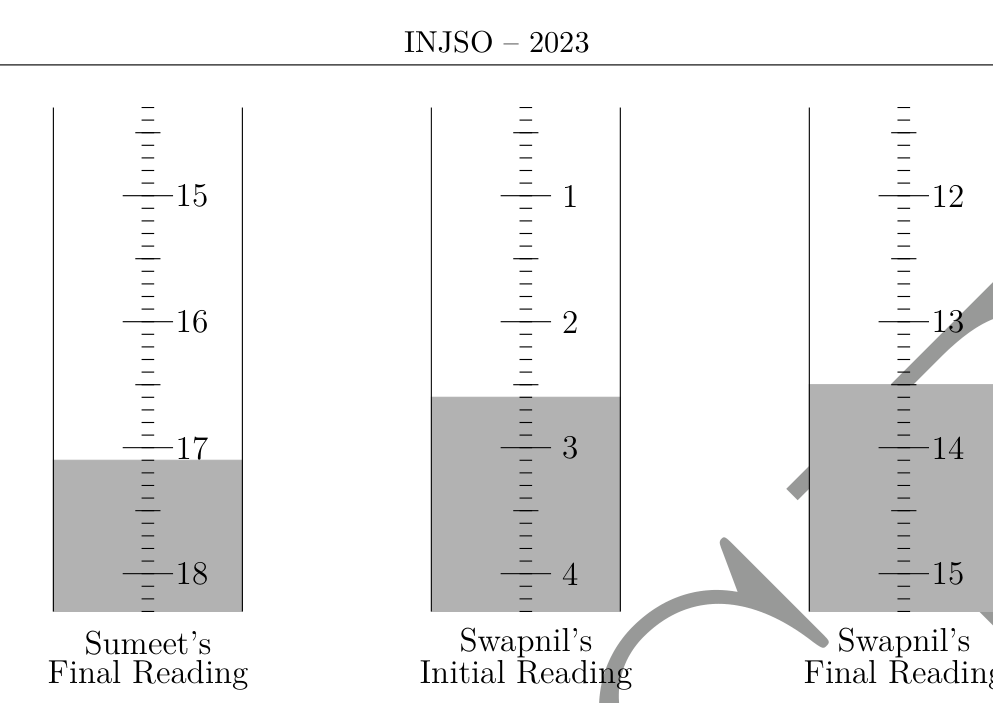
Sumeet filled a burette with dilute hydrochloric acid up to the zero mark. He placed 0.57 g of aluminum powder into a conical flask and then slowly added the acid until the reaction was complete, indicated by no effervescence. The leftmost panel in the diagram below reveals his burette reading.
Swapnil repeated the experiment with 0.57 g of Aluminum powder from the same sample source, but with a different sample of dilute hydrochloric acid. The middle panel in the diagram above reveals his initial burette reading and the rightmost panel reveals his final burette reading.
Quesito 29
(a) Write the balanced chemical equation for the reaction between aluminum and hydrochloric acid, stating the physical states of all chemicals.
(b) Use the information provided to complete the following table. Record the volumes to the nearest 0.1 cm
| Burette reading in mL | Sumeet’s Experiment | Swapnil’s Experiment |
|---|---|---|
| Final burette reading | ||
| Initial burette reading | ||
| Volume of acid added |
(c) The concentration of the acid used by Sumeet in the experiment was 3.5 mol/dm. What was the concentration of the acid used by Swapnil for the experiment, if both titrations were done accurately?
(d) After completing the experiment and removing conical flask from tip of the burette, Swapnil observed his burette has started leaking, as he had not properly closed the stopper of the burette. He closed the stopper properly to stop leak and observes reading once again. It was approximately additional 11% of the volume consumed in reaction earlier. Leaked acid had fallen on the table. To keep table clean, neat and tidy he puts excess Sodium bicarbonate on it. Sumeet checked pH of resultant mixture by pH paper.
i. Write complete balanced chemical reaction between hydrochloric acid and sodium bicarbonate. ii. What minimum quantity of sodium bicarbonate (in grams) is required to nullify the effect of spilled acid? iii. Find the percent purity of aluminum sample.
(e) To check the process works good on other metals, both took the same amount of sample (0.57 g) of pure Zinc instead of Aluminum and carried out the titration process.
i. Write balanced chemical reaction, mentioning physical states, between Zinc powder and Hydrochloric acid. ii. How many times Sumeet and Swapnil need to dilute their own acid solutions so as to get burette readings for the reaction with Zinc between 10 mL and 15 mL.
Topic: Chemistry Metodi: Physical Modeling Competenze: Measurement & Instrumentation Objects: — Fonte: Testo (PDF) — p.15 Soluzione: Soluzioni (PDF)
[13] Sumeet e Swapnil hanno effettuato separatamente esperimenti per determinare il volume di soluzioni di acido cloridrico diluito necessarie per reagire completamente con un campione di 0,57 g di polvere di alluminio.
Sumeet ha riempito una buretta con acido cloridrico diluito fino al punto zero. Ha messo 0,57 g di polvere di alluminio in un flacone conico e poi ha lentamente aggiunto l’acido fino a quando la reazione è stata completa, indicato da nessuna effervescenza. Il pannello a sinistra del diagramma di seguito rivela la lettura della buretta.
Swapnil ha ripetuto l’esperimento con 0,57 g di polvere di alluminio proveniente dalla stessa fonte di campione, ma con un campione diverso di acido cloridrico diluito. Il pannello centrale del diagramma sopra rivela la sua lettura iniziale di burette e il pannello più a destra rivela la sua lettura finale di burette.
Quesito 29
a) Scrivere l’equazione chimica equilibrata per la reazione tra alluminio e acido cloridrico, indicando gli stati fisici di tutte le sostanze chimiche.
b) Utilizzi le informazioni fornite per completare la tabella seguente. Registrare i volumi fino allo 0,1 cm più vicino
♬ Burette legge in inglese ♬ L’esperimento di Sumeet ♬ L’esperimento di Swapnil ♬ |---|---|---| ♬ L’ultima lettura di burette ♬ ♬ La prima buretta che legge ♬ ∙ ∙ ∙ ∙ ∙ ∙ ∙ ∙ ∙ ∙ ∙ ∙ ∙ ∙ ∙ ∙ ∙ ∙ ∙ ∙ ∙ ∙ ∙ ∙ ∙ ∙
(c) La concentrazione dell’acido utilizzato da Sumeet nell’esperimento è stata di 3,5 mol/dm. Qual era la concentrazione dell’acido utilizzato da Swapnil per l’esperimento, se entrambe le titolazioni fossero state fatte con precisione?
d) Dopo aver completato l’esperimento e aver rimosso il flacone conico dalla punta della buretta, Swapnil ha osservato che la sua buretta ha iniziato a perdere, poiché non aveva chiuso correttamente il tappo della buretta. Chiuse il tappo per fermare la perdita e osservò di nuovo la lettura. È stato di circa un ulteriore 11% del volume consumato in reazione prima. L’acido fuoriuscito era caduto sul tavolo. Per mantenere pulito, ordinato e ordinato il tavolo si aggiunge eccesso di bicarbonato di sodio. Sumeet ha verificato il pH della miscela risultante con carta pH.
i. Scrivere una reazione chimica completa e equilibrata tra acido cloridrico e bicarbonato di sodio. ii. Quanta quantità minima di bicarbonato di sodio (in grammi) è necessaria per annullare l’effetto dell’acido versato? iii. Trova la percentuale di purezza del campione di alluminio.
(e) Per verificare che il processo funziona bene su altri metalli, entrambi hanno prelevato la stessa quantità di campione (0,57 g) di zinco puro al posto di alluminio e hanno eseguito il processo di titolazione.
i. Scrivi una reazione chimica equilibrata, menzionando gli stati fisici, tra polvere di zinco e acido cloridrico. ii. Quante volte Sumeet e Swapnil devono diluire le proprie soluzioni acide per ottenere le letture di burette per la reazione con lo Zinc tra 10 ml e 15 ml.
Topic: Chemistry Metodi: Physical Modeling Competenze: Measurement & Instrumentation Objects: — Fonte: Testo (PDF) — p.15 Soluzione: Soluzioni (PDF)
[13] Shikimic acid is a natural product extracted from a spice called star anise, commonly used in India. It is a white solid with melting point 186 C and boiling point 401 C. It is also a raw material for synthesis of the antiviral drug Tamiflu.
The molecular structure of shikimic acid is shown below.
Quesito 30
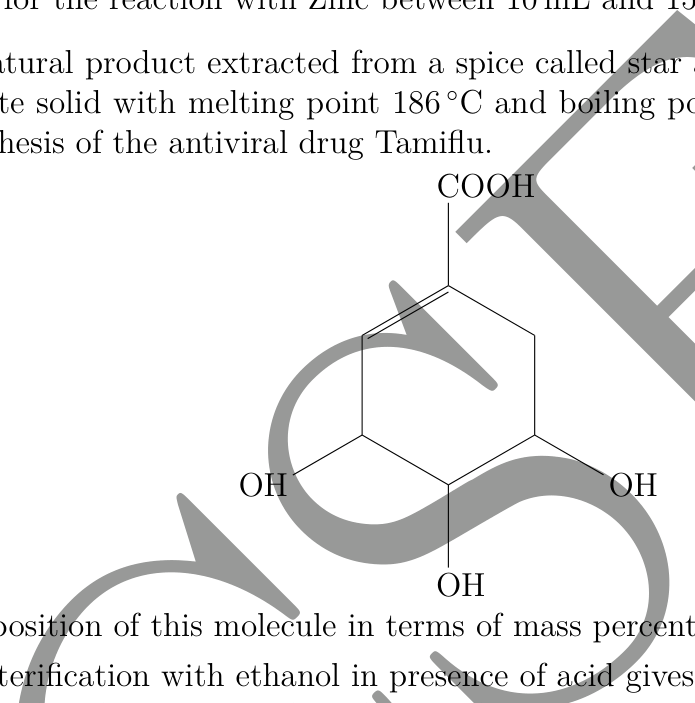
(a) What is the elemental composition of this molecule in terms of mass percentages?
(b) Shikimic acid (10.0 g) on esterification with ethanol in presence of acid gives compound A (8.5 g). When A was treated with aqueous sodium hydroxide, a new compound B was formed.
i. Give the structure of product A. ii. How many C–H bonds are present in the molecule A? iii. What happens to the pH value of the reaction mixture as shikimic acid converts to A, will it increase/decrease/remain the same? iv. Practically in many reactions, complete conversion of reactants to products does not happen. The ratio of moles of actual yield versus moles of theoretical expected yield gives the percent yield. Calculate the yield (%) of the product A obtained, based on the data given above. v. Which is more soluble in aqueous solution? Shikimic acid or A? vi. Give the general chemical equation for the formation of B. vii. Biryani is loved by many people in India. Star anise is a common flavouring agent for Biryani. Shyama added the whole spices including star anise with rice in water and half cooked it. Then she removed the whole spices from the half-cooked rice and layered the vessel with fried vegetables and again cooked the ingredients on a medium heat. Tina made the same dish by first boiling rice in water (without star anise) to half cooked stage, added fried vegetable, and then recooked it. Then, she tempered the whole spices (including star anise) in oil, sautéed for a while and added it to the cooked biryani. In whose Biryani the rice grains would have higher amount of shikimic acid? What property of shikimic acid leads to this difference in amount in the two recipes.
Topic: Organic Chemistry Metodi: Physical Modeling Competenze: Mathematical Modeling Objects: — Fonte: Testo (PDF) — p.17 Soluzione: Soluzioni (PDF)
[13] L’acido shikimico è un prodotto naturale estratto da una spezia chiamata anise stellare, comunemente usata in India. Si tratta di un solido bianco con punto di fusione 186 C e punto di ebollizione 401 C. È anche una materia prima per la sintesi del farmaco antivirale Tamiflu.
La struttura molecolare dell’acido shikimico è mostrata di seguito.
Quesito 30
(a) Qual è la composizione elementare di questa molecola in termini di percentuali di massa?
b) L’acido shikimico (10,0 g) in esterificazione con etanolo in presenza di acido dà composto A (8,5 g). Quando A è stato trattato con idrossido di sodio acquoso, si è formato un nuovo composto B.
i. Indicare la struttura del prodotto A. ii. Quanti legami CH sono presenti nella molecola A? iii. Che cosa succede al valore del pH della miscela di reazione quando l’acido shikimico si converte in A, aumenterà/diminui/renderà lo stesso? iv. Praticamente in molte reazioni non si verifica la completa conversione dei reagenti in prodotti. Il rapporto tra molli di rendimento effettivo e molli di rendimento atteso teorico dà il rendimento percentuale. Calcolare il rendimento (%) del prodotto A ottenuto, in base ai dati di cui sopra. v. Che cosa è più solubile in soluzione acquosa? Acido shikimico o A? vi. Fornisci l’equazione chimica generale per la formazione di B.
- il numero di persone Biryani è amato da molte persone in India. L’anise stellare è un aromatizzante comune per il biryani. Shyama aggiunse le spezie intere, compresa l’anise stellare, con riso in acqua e le ha cucinate a metà. Poi ha rimosso tutte le spezie dal riso a metà cotto e ha strato il vaso con verdure fritte e ha nuovamente cotto gli ingredienti a caldo medio. Tina ha fatto lo stesso piatto facendo prima bollire il riso in acqua (senza anise stellare) a metà cotto, aggiungendo verdura fritta e poi ricovendolo. Poi, temperò l’intera spezia (compreso l’anise stellare) in olio, la salse per un po’ e la aggiunse al biryani cotto. In cui Biryani i grano di riso avrebbero una maggiore quantità di acido shikimico? Che proprietà dell’acido shikimico porta a questa differenza di quantità nelle due ricette.
Topic: Organic Chemistry Metodi: Physical Modeling Competenze: Mathematical Modeling Objects: — Fonte: Testo (PDF) — p.17 Soluzione: Soluzioni (PDF)
[4] As a part of an experiment to study Tyndall effect, Aamir adds sugar to aqueous dispersion of gold nanoparticles of size 100 nm. Once the experiment is completed, he plans to recover gold nanoparticles and use them in another experiment. As he tries to separate gold nanoparticles and sugar, by mistake, he adds the mixture to a tube containing calcium carbonate. This results in a mixture containing gold nanoparticles, sugar, water, and calcium carbonate.
He separates the constituents in three steps by using set of apparatus available in the lab.
Instruments and materials available in the lab: Heater, sublimation set up, beaker, filter paper, funnel, centrifuge, centrifuge tubes, separating funnel, distillation set-up, fractional distillation set-up, and thermometer. Mention the separating methods in the correct sequence he used in order to obtain gold nanoparticles and sugar in their pure form with the least amount of loss. State which component is obtained at every step.
Topic: Chemistry Metodi: Physical Modeling Competenze: Measurement & Instrumentation Objects: — Fonte: Testo (PDF) — p.17 Soluzione: Soluzioni (PDF)
[4] Come parte di un esperimento per studiare l’effetto Tyndall, Aamir aggiunge zucchero alla dispersione acquosa di nanoparticelle d’oro di dimensioni 100 nm. Una volta completato l’esperimento, prevede di recuperare nanoparticelle d’oro e usarle in un altro esperimento. Mentre cerca di separare nanoparticelle d’oro e zucchero, per errore, aggiunge la miscela a un tubo contenente carbonato di calcio. Ciò si traduce in una miscela contenente nanoparticelle d’oro, zucchero, acqua e carbonato di calcio.
Egli separa i componenti in tre fasi utilizzando un set di apparecchi disponibili in laboratorio.
Strumenti e materiali disponibili in laboratorio: riscaldatore, sistema di sublimazione, coppiere, carta filtrante, funnel, centrifugatori, tubi di centrifugatori, funnel di separazione, sistema di distillazione, sistema di distillazione frazionaria e termometro. Menziona i metodi di separazione nella corretta sequenza utilizzati per ottenere nanoparticelle d’oro e zucchero nella loro forma pura con la minima quantità di perdita. Indicare quale componente si ottiene ad ogni passo.
Topic: Chemistry Metodi: Physical Modeling Competenze: Measurement & Instrumentation Objects: — Fonte: Testo (PDF) — p.17 Soluzione: Soluzioni (PDF)
[7] A steel ball of mass 100 g is attached to the ceiling of a cabin (of mass 4 kg) with an electromagnet of mass 0.5 kg resting on the upper side, as shown in the figure. At some instant, the electromagnet releases which allows the ball to fall and hit the floor of the cabin. Material of the floor is such that the ball comes to rest in a very short interval of time. For calculation purpose, treat the ball as a point mass.
Quesito 32
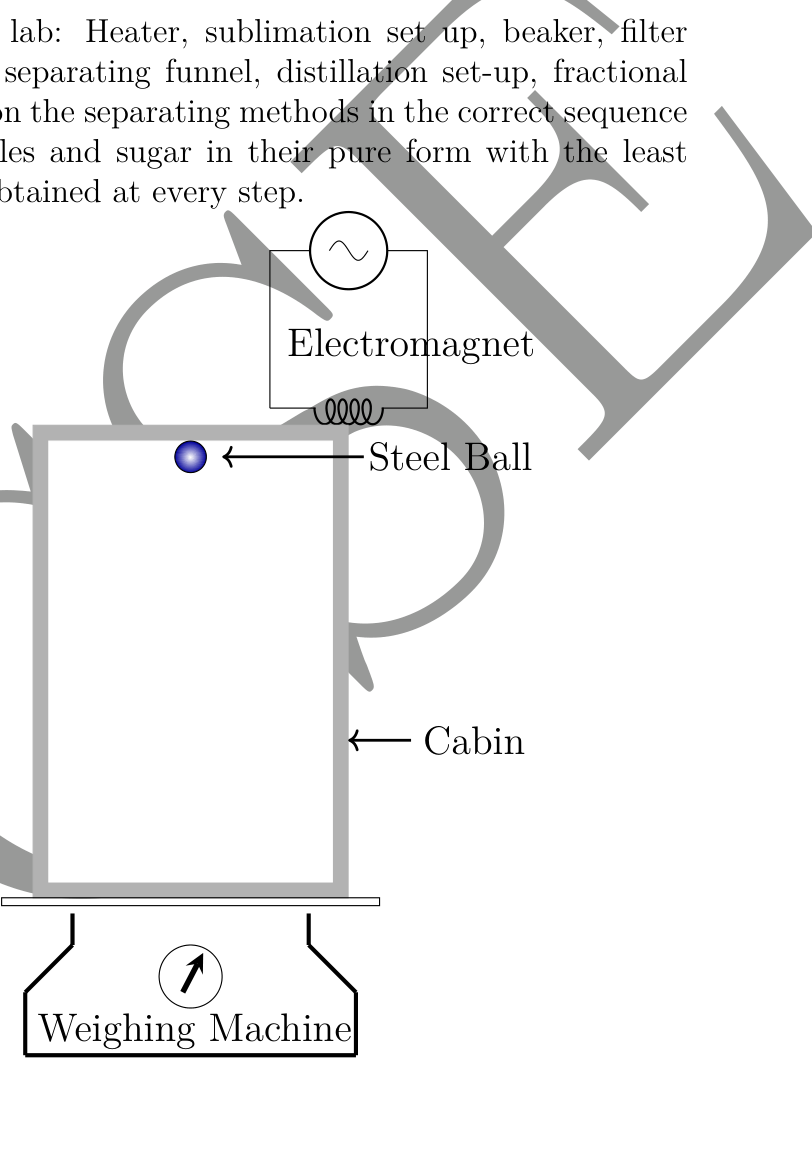
(a) For the following 4 graphs (Figures P, Q, R and S), the time interval of collision is too small to fit into the time scale on X-axis. Which of these four graphs would best represent the time variation of the force felt by the weighing machine while this process takes place?
Quesito 32
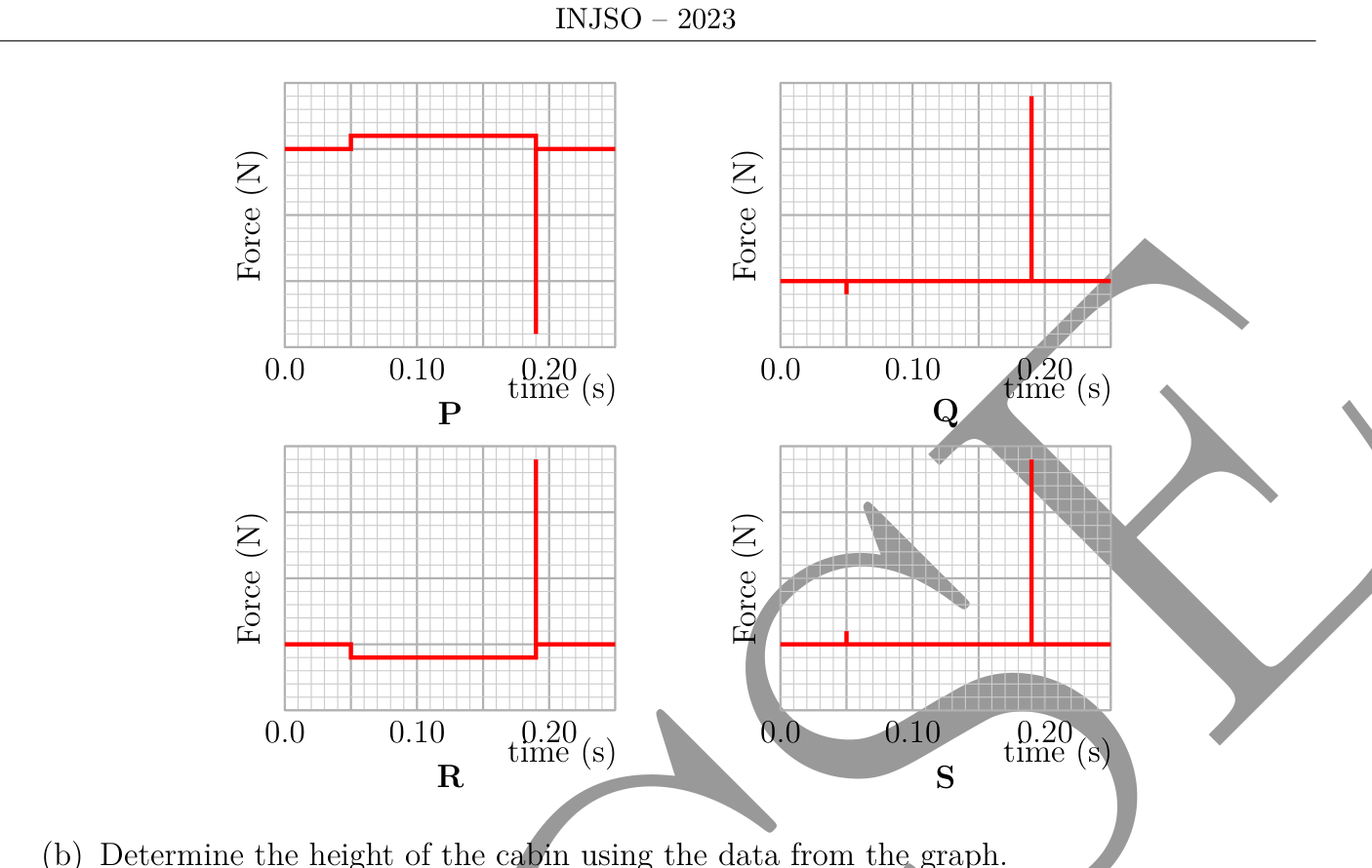
(b) Determine the height of the cabin using the data from the graph.
(c) Determine weighing machine reading in kilogram-weight during time of impact assuming that the colliding force is uniform for that time interval.
(d) Estimate the time interval for collision.
Topic: Newtonian Mechanics, Conservation of Energy Metodi: Conservation of Energy, Impulse-Momentum Theorem Competenze: Diagrammatic Reasoning Objects: Ball, Magnet Fonte: Testo (PDF) — p.18 Soluzione: Soluzioni (PDF)
[7] Un’obiettivo di acciaio di massa 100 g è fissato al soffitto di una cabina (di massa 4 kg) con un elettromagnetico di massa 0,5 kg appoggiato sul lato superiore, come mostrato nella figura. In un istante, l’elettromagnetico rilascia il che permette alla palla di cadere e colpire il pavimento della cabina. Il materiale del pavimento è tale che la palla si riposi in un breve intervallo di tempo. Per il calcolo, trattare la palla come una massa puntata.
Quesito 32
(a) Per i seguenti 4 grafici (Figure P, Q, R e S), l’intervallo temporale di collisione è troppo piccolo per adattarsi alla scala temporale sull’asse X. Quale di questi quattro grafici rappresenta meglio la variazione temporale della forza che la macchina di pesatura sente mentre si svolge questo processo?
Quesito 32
b) Determinare l’altezza della cabina utilizzando i dati del grafico.
c) Determinare la lettura della macchina pesante in kg di peso durante l’impatto, supponendo che la forza di collasso sia uniforme per tale intervallo di tempo.
d) Estimare l’intervallo di tempo per la collisione.
Topic: Newtonian Mechanics, Conservation of Energy Metodi: Conservation of Energy, Impulse-Momentum Theorem Competenze: Diagrammatic Reasoning Objects: Ball, Magnet Fonte: Testo (PDF) — p.18 Soluzione: Soluzioni (PDF)
[11] In a laboratory experiment, a student designs an electric circuit in which a battery of emf 18 V with negligible internal resistance is connected to a network of three resistors , and as shown in figure below. and .
She measures the potential difference across to be 14.4 V with the help of a non-ideal voltmeter. Now she disconnects the voltmeter and connects a non-ideal ammeter in this circuit to measure current flowing through . This ammeter reads 20 mA.
She now connects the same voltmeter and ammeter simultaneously to measure potential difference across and current flowing through respectively. Determine the voltmeter and ammeter readings in this case.
Quesito 33
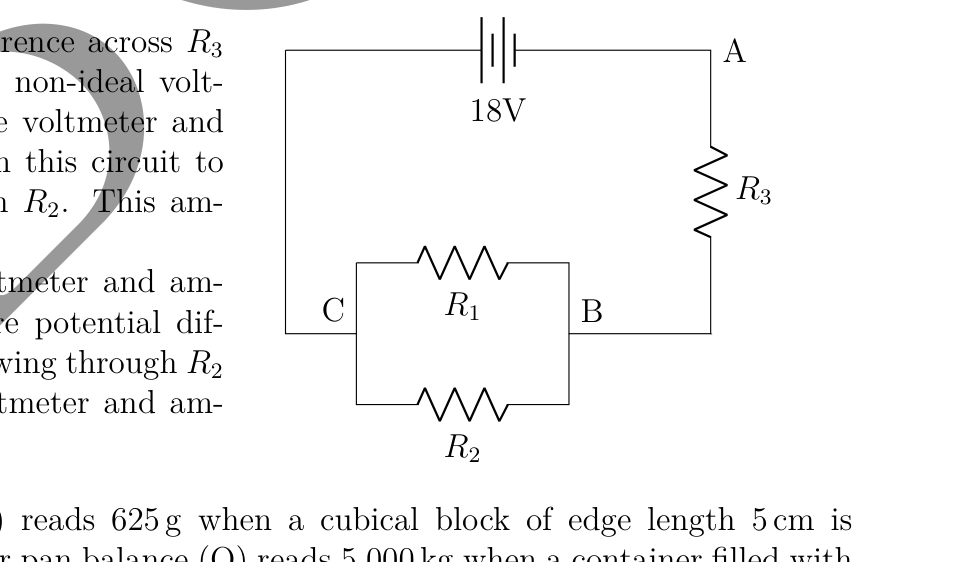
Topic: Circuits Metodi: Kirchhoff’s Laws, Equivalent Circuit Reduction Competenze: Measurement & Instrumentation Objects: Battery, Resistor Fonte: Testo (PDF) — p.19 Soluzione: Soluzioni (PDF)
[11] In un esperimento di laboratorio, uno studente progetta un circuito elettrico in cui una batteria di emf 18 V con una resistenza interna trascurabile è collegata a una rete di tre resistenti , e come mostrato nella figura seguente. e .
Misura la differenza potenziale di a 14,4 V con l’aiuto di un voltmeter non ideale. Ora, disconnette il voltmeter e collega un ammetro non ideale in questo circuito per misurare la corrente che scorre attraverso . Questo ammetro ha una portata di 20 mA.
Ora collega allo stesso voltmeter e all’ampimetro contemporaneamente per misurare la differenza di potenziale tra e corrente che scorre attraverso rispettivamente. Determina le letture di voltometro e di ammetro in questo caso.
Quesito 33
Topic: Circuits Metodi: Kirchhoff’s Laws, Equivalent Circuit Reduction Competenze: Measurement & Instrumentation Objects: Battery, Resistor Fonte: Testo (PDF) — p.19 Soluzione: Soluzioni (PDF)
[7] A spring balance (P) reads 625 g when a cubical block of edge length 5 cm is suspended in air from it. Another pan balance (Q) reads 5.000 kg when a container filled with a liquid of density 1.2 g/cm is put on its pan. These two preliminary readings are not shown as separate figures.
The spring balance, along with the cubical block suspended, is now arranged in such a way that the cubical block is partially submerged in the liquid inside the container. The height of the cube above the liquid is 3 cm (left panel of the figure). Neglect the upthrust of air.
Quesito 34
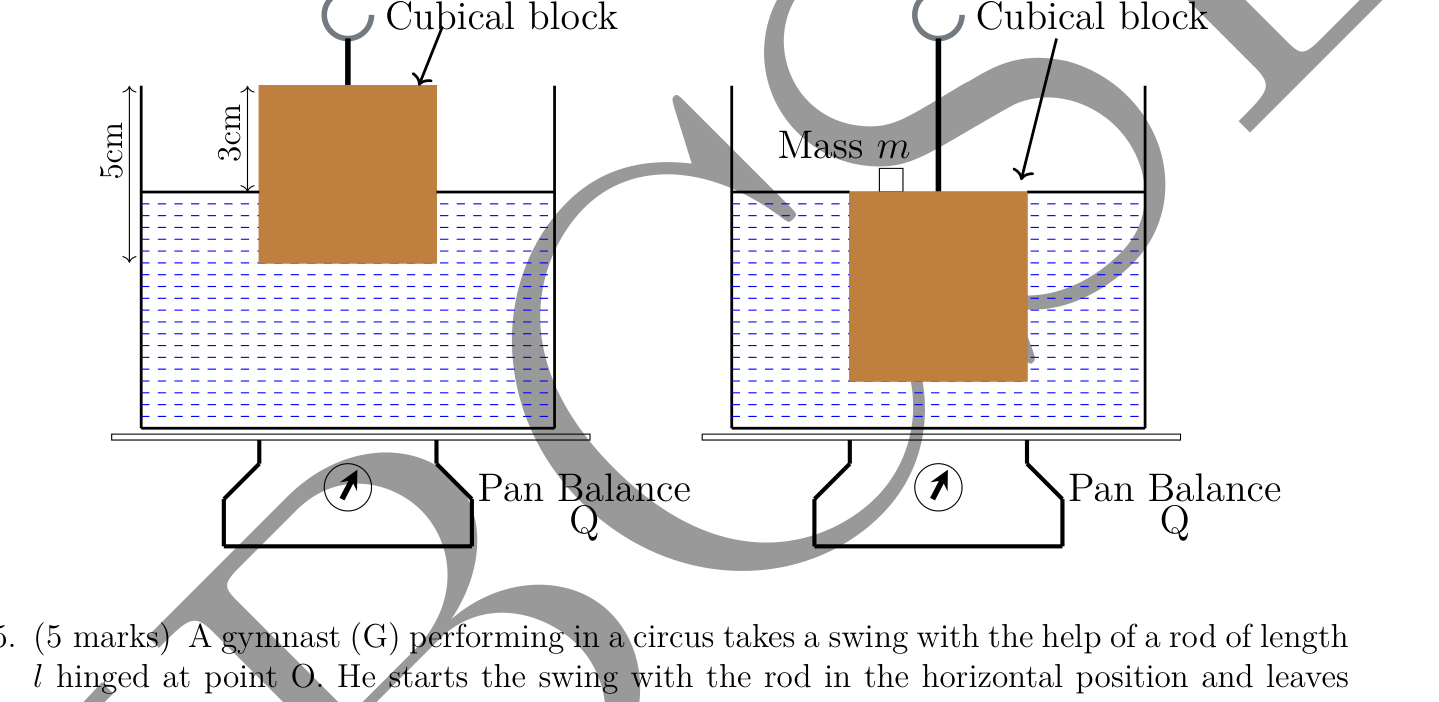
(a) Compute the respective readings of balances P and Q as shown in the left panel of the figure.
(b) Assuming that spring of the spring balance extends linearly with applied force at a rate 50 N/m, calculate the maximum additional mass that can be put on top of the block, such that only the upper mass remains above the liquid. What will be the respective readings of balance P and Q in this situation (right panel of the figure)?
Topic: Fluid Mechanics Metodi: Hydrostatic Equilibrium Competenze: Mathematical Modeling Objects: Spring, Block, Container Fonte: Testo (PDF) — p.20 Soluzione: Soluzioni (PDF)
[7] Un saldo di molla (P) è di 625 g quando un blocco cubico di lunghezza di bordo di 5 cm è sospeso in aria da esso. Un altro bilanciamento della padella (Q) è di 5.000 kg quando viene messo sulla padella un contenitore riempito di liquido di densità 1,2 g/cm. Queste due letture preliminari non sono indicate come figure separate.
Il saldo della molla, insieme al blocco cubico sospeso, è ora disposto in modo tale che il blocco cubico sia parzialmente sommerso nel liquido all’interno del contenitore. L’altezza del cubo sopra il liquido è di 3 cm (paraparte sinistra della figura). Lascia perdere l’aria che ti fa salire.
Quesito 34
a) Calcolare le rispettive letture delle bilanci P e Q come mostrato nel pannello a sinistra della figura.
b) Supponendo che la molla della molla si estenda linearmente con la forza applicata a una velocità di 50 N/m, calcolare la massa massima aggiuntiva che può essere posta sulla parte superiore del blocco, in modo che rimanga solo la massa superiore sopra il liquido. Quali saranno le rispettive letture di equilibrio P e Q in questa situazione (panele a destra della figura)?
Topic: Fluid Mechanics Metodi: Hydrostatic Equilibrium Competenze: Mathematical Modeling Objects: Spring, Block, Container Fonte: Testo (PDF) — p.20 Soluzione: Soluzioni (PDF)
[5] A gymnast (G) performing in a circus takes a swing with the help of a rod of length hinged at point O. He starts the swing with the rod in the horizontal position and leaves the rod at the lowest position of the swing. There is a protecting net at depth below the lowest point of the swing (see figure). Just for the sake of calculations, assume the gymnast to be a particle.
Quesito 35
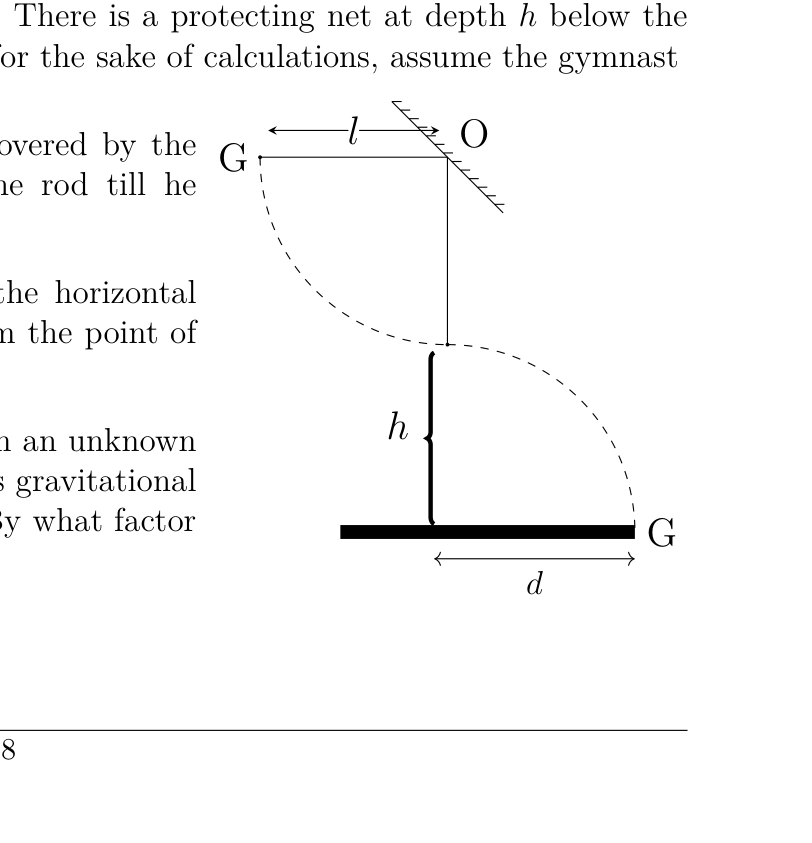
(a) Determine the horizontal distance covered by the gymnast from the point of leaving the rod till he reaches the protecting net.
(b) Obtain the ratio of and so that the horizontal distance covered by the gymnast from the point of release is maximum.
(c) The gymnast performs the same feat on an unknown planet almost like earth, except that its gravitational acceleration is half that of the earth. By what factor will be affected?
Topic: Conservation of Energy Metodi: Conservation of Energy, Kinematic Equations Competenze: Mathematical Modeling Objects: Rod, Projectile Fonte: Testo (PDF) — p.20 Soluzione: Soluzioni (PDF)
[5] Un ginnasta (G) che si esibisce in un circo fa un swing con l’aiuto di una barra di lunghezza inclinata al punto O. Inizia lo swing con la canna in posizione orizzontale e lascia la canna nella posizione più bassa dello swing. Si trova una rete protettiva a profondità al di sotto del punto più basso dello swing (vedere figura). Solo per i calcoli, supponiamo che la ginnasta sia una particella.
Quesito 35
a) Determinare la distanza orizzontale percorsa dal ginnasta dal punto di uscita della canna fino a raggiungere la rete protettiva.
b) Ottenere il rapporto di e in modo che la distanza orizzontale percorsa dal ginnasta dal punto di rilascio sia massima.
(c) Il ginnasta esegue lo stesso prodigio su un pianeta sconosciuto quasi simile alla terra, tranne che la sua accelerazione gravitazionale è la metà della terra. Per quale fattore sarà influenzato il ?
Topic: Conservation of Energy Metodi: Conservation of Energy, Kinematic Equations Competenze: Mathematical Modeling Objects: Rod, Projectile Fonte: Testo (PDF) — p.20 Soluzione: Soluzioni (PDF)