We define three quantities as follow:
Where is electron mass and other symbols have their usual meanings. For the hydrogen atom, express the radius of the Bohr orbit , the energy level , and the Rydberg constant in terms of any two of .
[5]
Topic: Modern-Quantum Physics Metodi: Bohr Model & Quantization, Dimensional Analysis Competenze: Mathematical Modeling Objects: Atom, Electron Fonte: Testo (PDF) — p.1
Definisco tre quantità come segue:
Se è massa di elettroni, gli altri simboli hanno il loro significato abituale. Per l’atomo di idrogeno, esprimere il raggio di orbita di Bohr , il livello di energia e la costante di Rydberg in termini di due di .
[5]
Topic: Modern-Quantum Physics Metodi: Bohr Model & Quantization, Dimensional Analysis Competenze: Mathematical Modeling Objects: Atom, Electron Fonte: Testo (PDF) — p.1
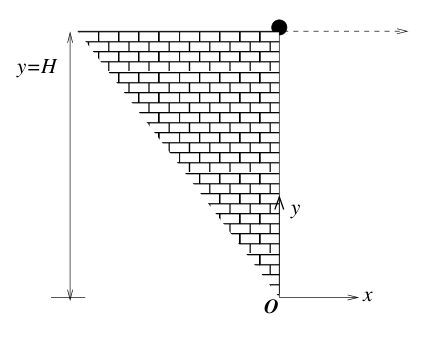
Consider a ball which is projected horizontally with speed from the edge of a cliff of height as shown in the Fig. (1). There is air resistance proportional to the velocity in both and direction i.e. the motion in the () direction has air resistance given by the () where is the proportionality constant and is the velocity in the () directions. Take the downward direction to be negative. The acceleration due to gravity is . Take the origin of the system to be at the bottom of the cliff as shown in Fig. (1).
(a) Obtain expression for and .
(b) Obtain the expression for the equation of trajectory.
Quesito 2
(c) Make a qualitative, comparative sketch of the trajectories with and without air resistance.
(d) Given that height of cliff is 500 m and . Obtain the approximate time in which the ball reaches the ground. Take .
[ 4 + 3 + 2 + 3 = 12 ]
Topic: Newtonian Mechanics Metodi: Differential Equations, Kinematic Equations Competenze: Mathematical Modeling Objects: Ball, Projectile Fonte: Testo (PDF) — p.1
Si consideri una palla che si proietta orizzontalmente con velocità dal bordo di una scogliera di altezza come mostrato nella figura. (1). C’è una resistenza all’aria proporzionale alla velocità sia nella direzione che nella direzione , ovvero il movimento nella direzione () ha una resistenza all’aria data dalla direzione () dove è la costante di proporzionalità e è la velocità nelle direzioni (). Prendi la direzione in discesa per essere negativa. L’accelerazione dovuta alla gravità è . Prendete l’origine del sistema come la parte inferiore della scogliera, come mostrato nella figura. (1).
(a) Ottenere espressione per e .
b) Ottenere l’espressione dell’equazione di traiettoria.
Quesito 2
c) Sviluppa uno schema qualitativo e comparativo delle traiettorie con e senza resistenza all’aria.
d) Dato che l’altezza della scogliera è di 500 m e . Ottenere il tempo approssimativo in cui la palla raggiunge il terreno. Prendi .
[ 4 + 3 + 2 + 3 = 12 ]
Topic: Newtonian Mechanics Metodi: Differential Equations, Kinematic Equations Competenze: Mathematical Modeling Objects: Ball, Projectile Fonte: Testo (PDF) — p.1
Free Standing Tower
Consider a tower of constant density () and cross sectional area () (see Fig. (2)) at the earth’s equator. The tower has a counter weight at one end. It is free standing. In other words its weight is balanced by the outward centrifugal weight so that it exerts no force on the ground beneath it and tension in the tower is zero at both ends. Consider the earth to be an isolated heavenly body and ignore gravitational effects due to the other heavenly bodies such as moon. Further assume that there is no bending of the tower.
Quesito 3
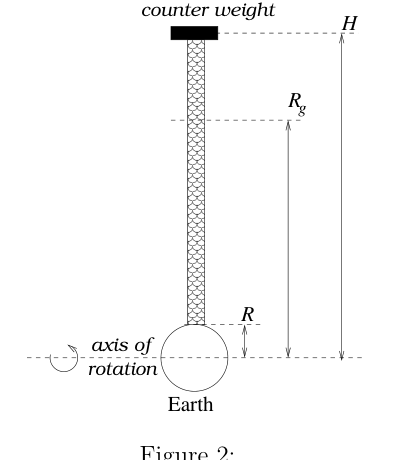
(a) Draw the free body diagram of the small element of this tower at distance from the center of the earth.
(b) Let be the tensile stress (tension per unit area) in the tower. Use Newton’s equations to write down the equation for in terms of , , geostationary height from the earth’s center and earth’s mass .
(c) Taking the boundary condition (), obtain the height of tower in terms of and . Note that is the radius of earth. Calculate the value of .
(d) The tensile stress in the tower changes as we move from to . Sketch this tensile stress .
(e) Steel has density of . The breaking tensile strength is 6.37 GPa. Calculate the maximum stress in the tower. State if a tower made of steel would be feasible.
Note: kg; km ; km
[ 0.5 + 1.5 + 5 + 3 + 2 = 12 ]
Topic: Gravitation Metodi: Newton’s Law of Gravitation, Calculus-Integration Competenze: Mathematical Modeling Objects: Planet Fonte: Testo (PDF) — p.2
Torre libera
Considera una torre di densità costante () e area sezionaria incrociata () (vedi figura. 2) all’equatore terrestre. La torre ha un peso di contatto ad una estremità. È un’esistenza libera. In altre parole, il suo peso è bilanciato dal peso centrifugato esterno in modo che non esercita alcuna forza sul terreno sotto di esso e la tensione nella torre è zero alle entrambe le estremità. Considerate la terra come un corpo celeste isolato e ignorate gli effetti gravitazionali dovuti agli altri corpi celesti come la luna. Supponiamo inoltre che non ci sia alcuna piega della torre.
Quesito 3
(a) Disegnare il diagramma del corpo libero del piccolo elemento di questa torre a distanza dal centro della terra.
b) Il deve essere la tensione di trazione (tensione per unità di superficie) della torre. Utilizzare le equazioni di Newton per scrivere l’equazione per in termini di , , altezza geostazionaria dal centro della terra e massa terrestre .
c) Prendendo la condizione di confine (), si ottiene l’altezza della torre in termini di e . Si noti che è il raggio della terra. Calcolare il valore di .
d) La tensione di trazione nella torre cambia quando si passa da a . Sketta questa tensione di trazione .
e) L’acciaio ha una densità . La resistenza alla trazione è di 6,37 GPa. Calcola la tensione massima nella torre. Indicare se una torre in acciaio sarebbe fattibile.
Nota: kg; km; km
[ 0.5 + 1.5 + 5 + 3 + 2 = 12 ]
Topic: Gravitation Metodi: Newton’s Law of Gravitation, Calculus-Integration Competenze: Mathematical Modeling Objects: Planet Fonte: Testo (PDF) — p.2
Two identical walls, each of width (=0.01 m), are separated by a distance (= 0.1 m) as shown in Fig. (3). Temperatures of the external face of the walls are fixed ( and , ). Coefficient of thermal conductivity of wall is . We define
where and are the temperatures of the internal face of the walls 1 and 2 respectively. Then will depend on the type of heat transfer process in central region (of width ) between the walls i.e. on the conduction, radiation or convection heat transfer. Assume that the heat transfer is a steady state process.
Quesito 4
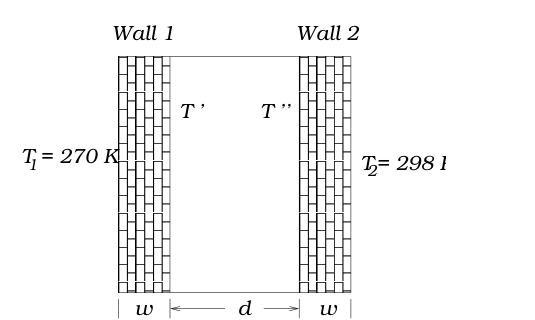
(a) Write down the expression for heat transfer flux () inside the wall 1 in terms of , , , and . Similarly also write the expression for wall 2.
(b) Rewrite in terms of , , , and .
As mentioned above, in the central region between the walls, heat is transmitted by conduction, convection and radiation. Also due to the steady state process, the corresponding fluxes are equal to . In what follows we will calculate the heat transfer fluxes between the walls due to these three processes each of these processes being considered separately. Radiation process will take place without the presence of material medium in the central region between the walls. We assume that the central region between the walls is vacuum. Let be the emissivity of the walls and and be the total heat flux due to radiation from wall 1 to 2 and vice versa. Thus where is Stefan constant. Similarly one may write the equation for .
(c) The net heat transfer is . Write the expression for in terms of , , and .
(d) Rewrite in terms of .
[ Hint: Eliminate using . ]
(e) Calculate if .
In the following two parts we are considering only convection between the walls.
(f) Now we assume that central region is filled with air of coefficient of thermal conductivity . In this condition, convected heat transfer between walls will take place. Equation for flux due to this process is given by
where is called the Nusselt number and for the given system . Due to the steady state nature of the process . Express in terms of .
(g) Calculate the value of if .
(h) Instead of air, the central region is now filled with sheathing material having coefficient of thermal conductivity . Hence heat transfer will take place by conduction between walls. Express heat transfer flux in terms of . We assume that no radiation passes through sheathing material.
(i) Taking , calculate the value of .
(j) Considering all possible heat transfer process in the central region between the walls, which insulation (sheathing, air, or vacuum) is the most efficient?
[ 1 + 1 + 1 + 3 + 2 + 1.5 + 1.5 + 2.5 + 1.5 + 1 = 16 ]
Topic: Thermodynamics Metodi: Physical Modeling Competenze: Physical Reasoning Objects: — Fonte: Testo (PDF) — p.3
Due pareti identiche, ciascuna di larghezza (=0,01 m), sono separate da una distanza (= 0,1 m), come mostrato nella figura. (3). Le temperature della superficie esterna delle pareti sono fissate ( e , ). Il coefficiente di conducibilità termica della parete è . Noi definiamo
dove e sono rispettivamente le temperature della superficie interna delle pareti 1 e 2. In questo caso, il dipenderà dal tipo di processo di trasferimento del calore nella regione centrale (di larghezza ) tra le pareti, ovvero per la trasmissione del calore mediante conduttività, radiazione o convezione. Supponiamo che il trasferimento di calore sia un processo in stato stazionario.
Quesito 4
a) Scrivere l’espressione per il flusso di trasferimento di calore () all’interno del muro 1 in termini di , , e . Scrivi in modo simile anche l’espressione per il muro 2.
b) Riscrivere in termini di , , e .
Come accennato sopra, nella regione centrale tra le pareti, il calore viene trasmesso mediante conduttività, convezione e radiazioni. Anche a causa del processo in stato stazionario, i flussi corrispondenti sono uguali a . In quanto segue calcoleremo i flussi di trasferimento di calore tra le pareti a causa di questi tre processi, ognuno di questi processi viene considerato separatamente. Il processo di radiazione si svolgerà senza la presenza di materiale medio nella regione centrale tra le pareti. Supponiamo che la regione centrale tra le pareti sia il vuoto. La temperatura di deve essere la emissività delle pareti e e deve essere il flusso di calore totale dovuto alle radiazioni da parete 1 a 2 e viceversa. Quindi dove è costante Stefan. Allo stesso modo si può scrivere l’equazione per .
c) Il trasferimento netto di calore è . Scrivere l’espressione per in termini di , e .
d) Riscritura in termini di .
[ Suggerimento: Elimina utilizzando . ]
e) Calcolare se .
Nelle due parti seguenti si considera solo la convezione tra le pareti.
f) Ora supponiamo che la regione centrale sia riempita di aria con coefficiente di conducibilità termica . In questa condizione, si svolgerà un trasferimento di calore convelato tra le pareti. L’equazione per il flusso dovuto a questo processo è data da
dove è chiamato numero Nusselt e per il sistema dato . A causa della natura in stato stazionario del processo . Esprimere in termini di .
g) Calcolare il valore di se .
h) Invece di aria, la regione centrale è ora riempita di materiale di rivestimento con coefficiente di conducibilità termica . Il trasferimento di calore si svolge quindi attraverso la conduzione tra le pareti. Il flusso di trasferimento di calore espresso in termini di . Supponiamo che nessuna radiazione passi attraverso il materiale di rivestimento.
(i) Prendendo , calcolare il valore di .
(j) Considerando tutti i possibili processi di trasferimento di calore nella regione centrale tra le pareti, quale isolamento (rivestimento, aria o vuoto) è più efficiente?
[ 1 + 1 + 1 + 3 + 2 + 1.5 + 1.5 + 2.5 + 1.5 + 1 = 16 ]
Topic: Thermodynamics Metodi: Physical Modeling Competenze: Physical Reasoning Objects: — Fonte: Testo (PDF) — p.3
Sunlight falls on the convex surface of the plano-convex lens of aperture 0.080 m. The radius of curvature of the convex surface of the lens is 0.100 m. The refractive indices of the material of the lens for extreme red and violet colours of sunlight are 1.600 and 1.700 respectively.
(a) Calculate the positions of the observed image of the Sun with violet and red center.
(b) Calculate the sizes of the observed image of the sun with violet and red center.
[ 3 + 7 = 10 ]
Topic: Geometric Optics Metodi: Thin Lens & Mirror Equation Competenze: Physical Reasoning Objects: Lens, Star Fonte: Testo (PDF) — p.4
La luce solare cade sulla superficie convexa della lente piano-convexa di apertura di 0,080 m. Il raggio di curvatura della superficie convexa della lente è di 0,100 m. Gli indici di rifrazione del materiale dell’obiettivo per i colori rosso estremo e viola della luce solare sono rispettivamente 1.600 e 1.700.
a) Calcolare le posizioni dell’immagine osservata del Sole con centro viola e rosso.
(b) Calcolare le dimensioni dell’immagine osservata del sole con centro viola e rosso.
[ 3 + 7 = 10 ]
Topic: Geometric Optics Metodi: Thin Lens & Mirror Equation Competenze: Physical Reasoning Objects: Lens, Star Fonte: Testo (PDF) — p.4
Determination of The Speed of Light:
The speed light maybe determined by an electrical circuit using low frequency ac fields only. Consider the arrangement shown in the Fig. (4). A sinusoidally varying voltage is applied to a parallel plate capacitor of radius and separation and also to the capacitor . The charge flowing into and out of constitutes the current in the two rings of radii and separation . When the voltage is turned off the two sides (the capacitor on one side and the rings on the other) are exactly balanced. Ignore wire resistance, inductance and gravitational effects.
(a) Obtain an expression for the time-averaged force between the plates of .
(b) Obtain an expression for the time-averaged force between the rings. The magnetic force between the two rings maybe approximated by those due to long straight wires since .
Quesito 6
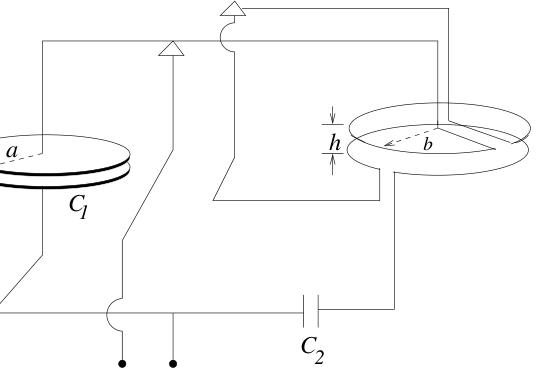
(c) Assume that and the various distances are so adjusted that the time-averaged downward force on the upper plate of is exactly balanced by the time-averaged downward force on the upper ring. Under these conditions obtain an expression for the speed of light.
(d) Numerically estimate the speed of light given that: m, m, m, m, Hz, nF (nano Farad) and (micro Farad).
[Hint: Not all the given quantities are required to obtain the estimate.]
[ 3 + 4 + 2 + 3 = 12 ]
Topic: Electromagnetism Metodi: Biot-Savart Law, Order-of-Magnitude Estimation Competenze: Mathematical Modeling Objects: Capacitor, Coil, Wire Fonte: Testo (PDF) — p.4
**Determinazione della velocità della luce: **
La velocità della luce potrebbe essere determinata da un circuito elettrico utilizzando solo campi ac a bassa frequenza. Considerate l’organizzazione mostrata nella figura. (4). Un tensione sinusoidale variabile è applicata a un condensatore di piastra parallela di raggio e di separazione e anche al condensatore . La carica che entra e esce da costituisce la corrente nei due anelli di radii e di separazione . Quando la tensione viene spenta i due lati (il condensatore da un lato e gli anelli dall’altro) sono esattamente equilibrati. Ignorare la resistenza dei fili, l’induzione e gli effetti gravitazionali.
(a) Ottenere un’espressione della forza media temporale tra le piastre di .
b) Ottenere un’espressione della forza media temporale tra gli anelli. La forza magnetica tra i due anelli potrebbe essere approssimata da quelle dovute a lunghi fili dritti da .
Quesito 6
c) Supponiamo che e le varie distanze siano regolate in modo tale che la forza in discesa media temporale sulla piastra superiore di sia esattamente bilanciata dalla forza in discesa media temporale sull’anello superiore. In queste condizioni si ottiene un’espressione della velocità della luce.
d) Estimare numericamente la velocità della luce, dato che: m, m, m, m, Hz, nF (nano Farad) e (micro Farad).
[Signore: non sono richieste tutte le quantità indicate per ottenere la stima.]
[ 3 + 4 + 2 + 3 = 12 ]
Topic: Electromagnetism Metodi: Biot-Savart Law, Order-of-Magnitude Estimation Competenze: Mathematical Modeling Objects: Capacitor, Coil, Wire Fonte: Testo (PDF) — p.4
An turn metallic ring of radius , resistance , and inductance is held fixed with its axis along a spatially uniform magnetic field whose magnitude is given by .
(a) Set up the emf equation for the current in the ring.
(b) Assuming that in the steady state oscillates with the same frequency as the magnetic field obtain the expression for .
(c) Obtain the force per unit length. Further obtain its oscillatory part and the time-averaged compressional part.
(d) Calculate the time-averaged compressional force per unit length given that tesla, , cm, radians/sec, , mH.
(e) Answer the following two questions without providing rigorous justification:
i. For Hz, the ring emits a humming sound. What is the frequency of this sound.
ii. A capacitor is included in the circuit. How does this affect the force on the ring?
[ 2 + 3.5 + 4 + 1.5 + 2 = 13 ]
Topic: Electromagnetic Induction Metodi: Faraday’s Law of Induction, Differential Equations Competenze: Mathematical Modeling Objects: Coil, Resistor, Inductor Fonte: Testo (PDF) — p.5
Un anello metallico di radio , resistenza e induttanza è tenuto fisso con il suo asse lungo un campo magnetico spazialmente uniforme la cui magnitudine è data da .
(a) Imposta l’equazione emf per la corrente nell’anello.
b) Supponendo che nello stato di stabilità oscilla con la stessa frequenza del campo magnetico si ottiene l’espressione per .
c) Ottenere la forza per unità di lunghezza. Inoltre si ottiene la sua parte oscillatrice e la parte compressiva media nel tempo.
d) Calcolare la forza di compressione media temporale per unità di lunghezza, data la densità di tesla, , cm, radiani/sec, , mH.
e) Rispondere alle due domande seguenti senza fornire una giustificazione rigorosa:
i. Per Hz, l’anello emette un rumore. Qual è la frequenza di questo suono?
ii. Un condensatore è incluso nel circuito. Come influisce questo sulla forza sull’anello?
[ 2 + 3.5 + 4 + 1.5 + 2 = 13 ]
Topic: Electromagnetic Induction Metodi: Faraday’s Law of Induction, Differential Equations Competenze: Mathematical Modeling Objects: Coil, Resistor, Inductor Fonte: Testo (PDF) — p.5