(Part A, Q1) Two skaters ( and ), each of mass 70 kg, are approaching each other on a frictionless surface, each with a speed of 1 m.s. Skater carries a ball of mass 10 kg. Both skaters can toss the ball at 5 m.s relative to themselves such that when tosses the ball at s to then the ball leaves at 6 m.s with respect to the ground. Further, they start ( s) tossing the ball back and forth when they are 10 m apart (see Fig. (1)). Assume that the motion is one dimensional, all collisions are completely inelastic and that the time delay between receiving the ball and tossing it back is 1 s.
[ 1 + 2 + 2 + 1.5 + 3.5 = 10 ]
Quesito 1
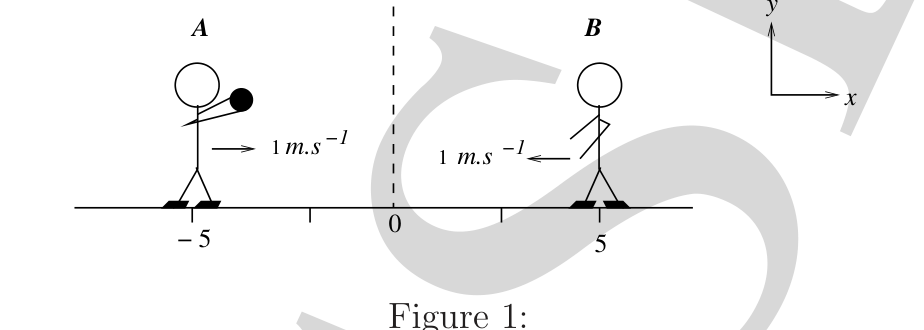
(a) State initial momenta of skaters (just before s). ;
(b) At s skater tosses the ball to skater . State momenta of both the skaters immediately after catches the ball. ;
(c) Indicate the minimum number of tosses by each skater required to avoid collision. Number of tosses by ; Number of tosses by
(d) Indicate motion of each skater on the following – plot from s till just after one round trip by the ball (from to and back to ). [Note: For this and the next part you must select the scale on the time axis appropriately. You may use a pencil for sketching.]
(e) Indicate motion of each skater on the following – plot from s till just after one round trip by the ball (from to and back to ).
Topic: Conservation of Momentum Metodi: Conservation of Momentum, Impulse-Momentum Theorem Competenze: Physical Reasoning Objects: Ball Fonte: Testo (PDF) — p.3
(Parte A, Q1) Due pattinatori ( e ), di massa 70 kg ciascuno, si avvicinano su una superficie senza attrito, ciascuno con una velocità di 1 m.s. Il pattinatore porta una palla di massa 10 kg. Entrambi gli skate possono lanciare la palla a 5 m.s rispetto a se stessi in modo tale che quando lancia la palla a s a la palla lascia a 6 m.s rispetto al terreno. Inoltre, iniziano ( s) a lanciare la palla avanti e indietro quando sono a 10 m di distanza (vedere figura. (1)). Supponiamo che il movimento sia unidimensionale, tutte le collisioni siano completamente inelasti e che il ritardo di tempo tra ricevere la palla e lanciarla indietro sia di 1 s.
[ 1 + 2 + 2 + 1.5 + 3.5 = 10 ]
Quesito 1
(a) Indicare i momenti iniziali dei pattinatori (quasi prima di s). ;
b) Al il pattinatore lancia la palla al pattinatore . Il momento di impatto di entrambi i pattinatori immediatamente dopo cattura la palla. ;
c) Indicare il numero minimo di lanci da parte di ciascun pattinatore richiesto per evitare collisioni. Numero di lanci di ; Numero di lanci di
d) Indicare il movimento di ciascun pattinatore sul seguente plot x$$t da s fino a poco dopo un giro di fila (da a e di ritorno a ). [Nota: per questa e la parte successiva è necessario selezionare adeguatamente la scala sull’asse temporale. Potete usare una matita per disegnare.]
e) Indicare il movimento di ciascun pattinatore sul seguente plot x$$t da s fino a poco dopo un giro di fila (da a e di ritorno a ).
Topic: Conservation of Momentum Metodi: Conservation of Momentum, Impulse-Momentum Theorem Competenze: Physical Reasoning Objects: Ball Fonte: Testo (PDF) — p.3
(Part A, Q2) Consider a closed cylinder whose walls are adiabatic. The cylinder lies in a horizontal position and is divided into three parts , and by means of pistons and , which can move along the length of the cylinder without friction. Piston is adiabatic while is conducting. Initially each of the parts , and has one mole of Helium gas at pressure , temperature , and volume (see Fig. (2)). Helium is to be regarded as an ideal monoatomic gas. Also and .
Now heat is slowly supplied to the gas in part till the temperature in part becomes .
[ 3.5 + 2 + 2 + 2.5 = 10 ]
Quesito 2
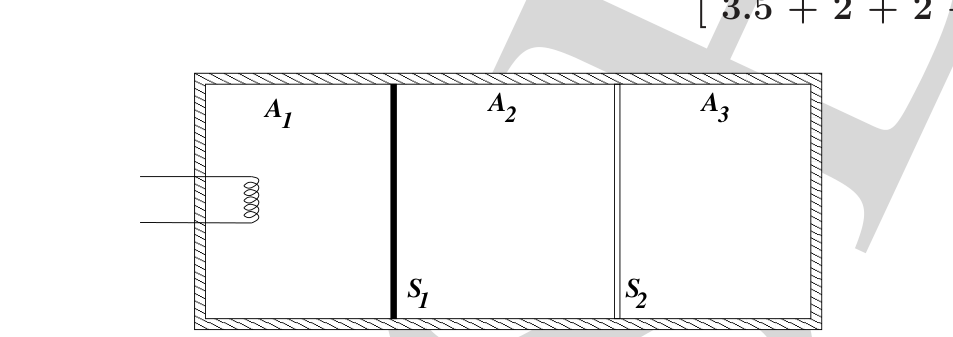
(a) Let the final thermodynamic coordinates of the partitions , and be , and respectively. Fill the table below expressing the pressure in terms of , volume in terms of and temperature in terms of .
| Part | Pressure | Volume | Temperature |
|---|---|---|---|
(b) What work is done by the gas in on the gases in and in terms of and related quantities? Work done
(c) What is the amount of heat supplied to the gas in part in terms of and related quantities? Heat supplied
(d) Obtain the entropy change in systems and ? Entropy Change in Entropy change in
Topic: Thermodynamics Metodi: Ideal Gas Law, First Law of Thermodynamics Competenze: Mathematical Modeling Objects: Cylinder, Piston, Gas Fonte: Testo (PDF) — p.5
(Parte A, Q2) Considerate un cilindro chiuso le cui pareti sono adiabatiche. Il cilindro si trova in posizione orizzontale e è diviso in tre parti , e mediante pistoni e , che possono muoversi lungo la lunghezza del cilindro senza attrito. Il pistone è adiabatico mentre è conduttore. Inizialmente ciascuna delle parti , e ha un mole di gas di elio a pressione , temperatura e volume (vedi figura 1). (2)). L’elio deve essere considerato un gas monoatomo ideale. Anche e .
Ora il calore viene lentamente fornito al gas nella parte fino a quando la temperatura nella parte diventa .
[ 3.5 + 2 + 2 + 2.5 = 10 ]
Quesito 2
a) Le coordinate termodinamiche finali delle partizioni , e siano rispettivamente , e . Compila la tabella seguente esprimendo la pressione in termini di , il volume in termini di e la temperatura in termini di .
Parte Presione Volume Temperatura
|------|----------|--------|-------------| | | | | | | | | | | | | | | |
b) Che lavoro è svolto dal gas in sui gas in e in termini di e di quantità correlate? Lavoro svolto
c) Qual è la quantità di calore fornita al gas in parte in termini di e di quantità correlate? Calore fornito
(d) Ottenere la variazione di entropia nei sistemi e ? Entropia Cambiamento in Cambiamento di entropia in
Topic: Thermodynamics Metodi: Ideal Gas Law, First Law of Thermodynamics Competenze: Mathematical Modeling Objects: Cylinder, Piston, Gas Fonte: Testo (PDF) — p.5
(Part A, Q3) A small angle prism of crown glass and a small angle prism of flint glass are arranged to deviate a light beam in opposite directions. A white light beam is incident on the crown glass prism of the arrangement. The refracting angle of the crown prism is and that of the flint prism is such that the net deviation of the light beam from both the prisms for the C and F spectral lines are equal. Assume minimum deviation condition for both the prisms. See Table 1 below.
Table 1: Values of (refractive indices) for three different spectral lines.
| C | D | F | |
|---|---|---|---|
| Flint | 1.644 | 1.650 | 1.665 |
| Crown | 1.517 | 1.520 | 1.527 |
[ 3 + 2 + 5 = 10 ]
(a) State the refracting angle () of the flint prism in degrees.
(b) State the net deviation for the D line in degrees.
(c) Draw a schematic ray diagram of the D line for this arrangement indicating the numerical values of the following important angles: (i) incidence on each prism; (ii) deviation from each prism and (iii) angle between the adjacent surfaces of the two prisms. You may use a pencil for this diagram.
Topic: Geometric Optics Metodi: Ray Tracing, Snell’s Law Competenze: Diagrammatic Reasoning Objects: Prism Fonte: Testo (PDF) — p.7
(Parte A, Q3) Un prisma a piccolo angolo di vetro di corona e un prisma a piccolo angolo di vetro di fiocco sono disposti per deviare un fascio di luce in direzioni opposte. Un raggio di luce bianca si trova sul prisma in vetro della corona dell’arrangimento. L’angolo di rifrazione del prisma della corona è e quello del prisma di filamento è tale che la deviazione netta del fascio luminoso da entrambi i prismi per le linee spettrali C e F sia uguale. Supponiamo la condizione di deviazione minima per entrambi i prismi. Cfr. tabella 1 qui sotto.
Tabella 1: Valori di (indici di rifrazione) per tre diverse linee spettrali.
| C | D | F |
|---|
Flint # 1,644 # 1,650 # 1,665
# La corona # # è # # 1.517 # 1.520 # 1.527
[ 3 + 2 + 5 = 10 ]
a) Indicare l’angolo di rifrazione () del prisma di fiocco in gradi.
b) Indicare la deviazione netta per la linea D in gradi.
(c) Disegnare un diagramma schematico del raggio della linea D per questa disposizione che indichi i valori numerici dei seguenti angoli importanti: (i) incidenza su ciascun prisma; (ii) deviazione da ciascun prisma e (iii) angolo tra le superfici adiacenti dei due prismi. Potresti usare una matita per questo diagramma.
Topic: Geometric Optics Metodi: Ray Tracing, Snell’s Law Competenze: Diagrammatic Reasoning Objects: Prism Fonte: Testo (PDF) — p.7
(Part A, Q4) Consider a long thin uniform electrically insulating and magnetically nonpermeable cylindrical shell of length , radius (with ) and moment of inertia about the horizontal axis (see Fig. 3). A massless string is wound around the shell surface and a vertically hanging mass is attached to its free end and released from rest at time .
[ 1 + 1 + 1 + 2 + 2 + 1 + 2 + 1.5 + 2 + 1.5 = 15 ]
Quesito 4
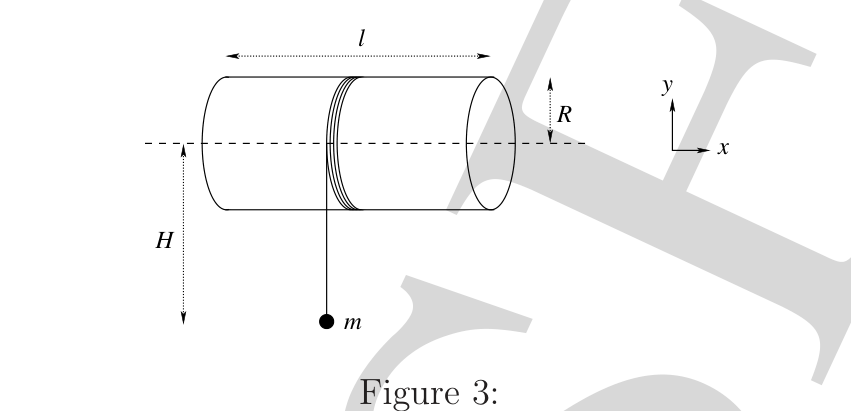
(a) State the magnitude of angular acceleration in terms of .
(b) State the magnitude of angular velocity of the shell in terms of . Here is the height through which mass has fallen.
(c) State the total kinetic energy () of the assembly in terms of , and .
Let a charge be uniformly distributed on the shell. As the shell rotates it will produce a magnetic field () and an electric field of magnitude associated with electromotive force in accordance with Faraday’s law of induction. Let and denote the magnitudes of angular acceleration and angular velocity of this rotating charged shell respectively. Ignore radiation losses due to acceleration.
(d) State magnetic field in terms of , and relevant quantities.
(e) State in terms of and relevant quantities.
(f) Electric field produces a torque on this shell. State in terms of and relevant quantities.
(g) State .
(h) State total kinetic energy of the shell in terms of , , and relevant quantities.
(i) State the difference in energies obtained in parts (4c) and (4h) in terms of , , and relevant quantities.
(j) Interpret .
Topic: Electromagnetic Induction Metodi: Faraday’s Law of Induction, Torque & Angular Momentum Analysis Competenze: Mathematical Modeling Objects: Cylinder, String, Block Fonte: Testo (PDF) — p.8
(Parte A, Q4) Considera un’isolazione elettrica uniforme e magneticamente impenetrabile con una lunghezza , un raggio (con ) e un momento di inerzia intorno all’asse orizzontale (vedi figura 1). 3). Una corda senza massa viene arrotolata intorno alla superficie della conchiglia e una massa appesa verticalmente è attaccata alla sua fine libera e rilasciata dal riposo al tempo .
[ 1 + 1 + 1 + 2 + 2 + 1 + 2 + 1.5 + 2 + 1.5 = 15 ]
Quesito 4
a) Indicare la magnitudine dell’accelerazione angolare in termini di .
b) Indicare la grandezza della velocità angolare della conchiglia in termini di . Qui è l’altezza attraverso cui è caduta la massa .
c) Indicare l’energia cinetica totale () dell’assemblaggio in termini di , e .
Lasciate che una carica sia distribuita uniformemente sullo strato. Mentre la conchiglia ruota produce un campo magnetico () e un campo elettrico di magnitudo associato alla forza elettromotrice in conformità con la legge di induzione di Faraday. e indichino rispettivamente le magnitudini di accelerazione angolare e velocità angolare di questa conchiglia carica rotante. Ignorare le perdite di radiazioni dovute all’accelerazione.
d) Campo magnetico di stato in termini di , e quantità pertinenti.
e) Indicare il in termini di e di quantità pertinenti.
f) Il campo elettrico produce una coppia su questa conchiglia. Indicare in termini di e quantità pertinenti.
g) Stato .
h) Indicare l’energia cinetica totale della conchiglia in termini di , , e quantità pertinenti.
i) Indicare la differenza di energie ottenuta nelle parti (4c) e (4h) in termini di , , e quantità pertinenti.
(j) Interpret .
Topic: Electromagnetic Induction Metodi: Faraday’s Law of Induction, Torque & Angular Momentum Analysis Competenze: Mathematical Modeling Objects: Cylinder, String, Block Fonte: Testo (PDF) — p.8
(Part A, Q5) radio-nuclide decays by -emission with a half-life of 6 hours and by -emission with a half-life of years. A small quantity of solution containing with an activity of Ci (micro Curie) is injected into the bloodstream of an adult person. The solution mixes rapidly and uniformly in the person’s blood. It is excreted from the kidneys with an effective half-life of 6 hours. A 1 ml sample of the blood taken after 3.0 hours reveals an activity of 3.70 disintegrations per second on an average. Note, 1 Ci (Curie) disintegrations per second.
[ 1 + 2 + 2 = 5 ]
(a) State the decay constant (in hour) for excretion from the kidney?
(b) State the total activity at the end of 3 hours?
(c) State the total volume () of blood in the person’s body in liters?
***** END OF “PART A” OF THE QUESTION PAPER *****
Topic: Nuclear & Particle Physics Metodi: Radioactive Decay Law Competenze: Physical Reasoning Objects: Nucleus Fonte: Testo (PDF) — p.10
(Parte A, Q5) radio-nuclidi decadono di emissione con una emivita di 6 ore e di emissione con una emivita di anni. Una piccola quantità di soluzione contenente con un’attività di Ci (micro Curie) viene iniettata nel flusso sanguigno di una persona adulta. La soluzione si mescola rapidamente e uniformemente nel sangue della persona. È escreto dai reni con una semivita’ efficace di 6 ore. Un campione di sangue di 1 ml prelevato dopo 3,0 ore rivela un’attività di disintegrazioni di 3,70 al secondo in media. Nota: 1 Ci (Curie) disintegrazioni al secondo.
[ 1 + 2 + 2 = 5 ]
(a) Indicare la costante di decadimento (in ore ) per l’escritazione dal rene?
b) Indicare l’attività totale al termine di 3 ore?
(c) Indicare il volume totale () di sangue nel corpo della persona in litri?
***** FINAL DELLA “PART A” DELLA QUESTIONE *****
Topic: Nuclear & Particle Physics Metodi: Radioactive Decay Law Competenze: Physical Reasoning Objects: Nucleus Fonte: Testo (PDF) — p.10
Part - B. (Conceptual multiple-choice questions. Mark the correct option in the Part B answer grid.)
-
An isolated hollow metal sphere is electrically neutral (no excess charge) and supported on an insulating stand. A small amount of negative charge is suddenly placed at one point P on this metal sphere. If we check on this excess negative charge a few seconds later we will find one of the following possibilities: (a) All of the excess charge remains right around P. (b) The excess charge has distributed itself evenly over the outside surface of the sphere. (c) The excess charge is evenly distributed over the inside and outside surface. (d) Most of the charge is still at point P, but some will have spread over the sphere. (e) There will be no excess charge left on the sphere.
-
A non-conducting wall is given a negative net charge. Next, a sheet of very flexible rubber with zero net charge is suspended from the ceiling near the charged wall as shown below. The rubber sheet will: (a) not be affected by the charges on the wall since rubber is an insulator. (b) not be affected by the charged wall because the rubber sheet has zero net charge. (c) bend away from the wall due to the electrical repulsion between the electrons in the rubber and the charges on the wall. (d) bend away from the wall due to the polarization of the rubber molecules by the charged wall. (e) bend towards the wall due to the polarization of the rubber molecules by the charged wall.
-
Two small objects each with a net charge of exert a force of magnitude on each other. We replace one of the objects with another whose net charge is . We move the and charges to be 3 times as far apart as they were. What is the magnitude of the force on the charge? (a) (b) (c) (d) (e)
-
The associated figure shows an electric charge located at the centre of a hollow uncharged conducting metal sphere. Outside the sphere is a second charge . Both charges are positive. Choose the description below that describes the net electrical forces on each charge in this situation. (a) Both charges experience the same net force directed away from each other. (b) No net force experienced by either charge. (c) There is no net force on but a net force on . (d) There is no net force on but a net force on . (e) Both charges experience a net force but they are different from each other.
FOR QUESTIONS 5–7: In the following figures, the dotted lines show the equipotential lines of electric fields. (A charge moving along a line of equal potential would have a constant electric potential energy.) A charged object is moved directly from point A to point B. The charge on the object is C.
-
How does the amount of work needed to move this charge compare for these three cases? (a) Most work required in I. (b) Most work required in II. (c) Most work required in III. (d) I and II require the same amount of work but less than III. (e) All three would require the same amount of work.
-
How does the magnitude of the electric field at B compare for these three cases? (a) I > III > II (b) I > II > III (c) III > I > II (d) II > I > III (e) I = II = III
-
For case III what is the direction of the electric force exerted by the field on the C charged object when at A and when at B? (a) left at A and left at B (b) right at A and right at B (c) left at A and right at B (d) right at A and left at B (e) no electric force at either positions.
-
Two identical charges of magnitude are fixed as shown. A third charge is placed midway between them at point P, then given a small displacement perpendicular to the line joining the two charges and released. The third charge will: (a) I and III (b) II and V (c) III and V (d) III and I (e) stable for any small displacement.
-
Salt water contains a sodium ion (Na) per cubic meter and a chloride ion (Cl) per cubic meter. A battery is connected to metal rods that dip into a beaker full of salt water. The ions are pulled along the wire by the battery. The magnitude of the drift velocity of the sodium ions is , and the magnitude of the drift velocity of the chloride ions is . Assume that ( is the charge of a proton). What is the magnitude of the ammeter reading? (a) (b) (c) (d) (e) zero
-
In these three circuits all the batteries are identical and have negligible internal resistance, and all the light bulbs are identical. Rank all 5 light bulbs in order of brightness from brightest to dimmest. (a) (b) (c) (d) (e)
-
Which of the following statements is true about the electric field inside the bulb filament? (a) The field must be zero because the filament is made of metal. (b) The field must be zero because a current is flowing. (c) The field must be non-zero because any excess charges are on the surface of the filament. (d) The field must be non-zero because the flowing current produces an electric field. (e) The field must be non-zero because no current will flow without an applied field.
-
The magnetic field lines due to a bar magnet are correctly shown in [figures (a)–(e)].
-
Two strong bar magnets A and B are placed on a horizontal table such that the axis of B intersects A at mid-point as shown in figure. B is fixed while A is free to move. There are no magnetic fields except those due to A and B. Then A will (a) rotate but not move toward or away from B. (b) rotate and move toward B. (c) move toward B and not rotate. (d) rotate and move away from B. (e) move away from B and not rotate.
-
A neutral metal bar is moving at constant velocity to the right through a region where there is a uniform magnetic field directed out of the page. The magnetic field is produced by some large coils which are not shown in the diagram. Which one of the following diagrams best describes the charge distribution on the metal bar? [(a)–(e)]
-
A wire is placed between the poles of two fixed bar magnets as shown. A small current in the wire is into the plane of the paper. The direction of the magnetic force on the wire is (a) (b) (c) (d) (e) out of the plane of the paper.
-
The Earth’s magnetic field at a point P near the equator has only a horizontal component. A horizontal overhead high tension wire above this point carries a current such that it completely nullifies this horizontal component of the field at P. The direction of the current in the wire is most likely (a) to south. (b) to north. (c) to east. (d) to west. (e) out of the page.
-
The figure below depicts a long wire carrying a current coming out of the plane of the paper. A charge at a distance from it is moving towards it with speed and experiences a magnetic force of magnitude . If the distance of the charge from the wire were (and all other conditions remaining the same) then the force would be (a) (b) (c) (d) (e) zero.
-
The figure separate figures below involve a cylindrical magnet and a tiny light bulb connected by the ends of a loop of copper wire. These figures are to be used in the following question. The bulb is connected to the loop by very long flexible wires that are not shown. The states of motion of the magnet and of the loop of wire are indicated in the diagram. Speed will be represented by and CCW represents counter clockwise. In which one of the above figures will the light bulb be glowing? (a) I, II, III (b) II, III, IV (c) I, III, IV (d) I, II, IV (e) I, II, III, IV
-
A metallic coin is sliding on a long frictionless horizontal table. A uniform vertical magnetic field exists between points P and P of this table as shown. Which figure below accurately depicts the speed of the coin as it slides across the table? [(a)–(e)]
-
Shown below is a long solenoid (coils of wire along a long cylinder), and an end view of the solenoid. Conventional current runs counter clockwise in the solenoid and is increasing with time. What is the direction of the electric field at location 1 (marked with )? (a) (b) (c) out of page (d) into page (e) Zero
***** END OF “PART B” OF THE QUESTION PAPER *****
Topic: Electrostatics Metodi: Physical Modeling Competenze: Physical Reasoning Objects: Conducting Sphere, Magnet, Wire, Solenoid, Battery Fonte: Testo (PDF) — p.11
Parte - B. (Domande concettuali di scelta multipla. Segnalare l’opzione corretta nella griglia di risposta della parte B.)
-
Una sfera metallica vuota isolata è elettricamente neutrale (senza carica in eccesso) e sostenuta su un supporto isolante. Una piccola quantità di carica negativa viene improvvisamente collocata in un punto P su questa sfera metallica. Se controlliamo questa carica negativa in eccesso pochi secondi dopo troveremo una delle seguenti possibilità: (a) L’intero carico in eccesso rimane proprio intorno a P. b) L’eccesso di carica si è distribuito uniformemente sulla superficie esterna della sfera. c) La carica in eccesso è distribuita uniformemente sulla superficie interna ed esterna. (d) La maggior parte della carica è ancora al punto P, ma alcune si saranno diffuse sulla sfera. e) Non resterà alcun eccesso di carico sulla sfera.
-
Un muro non conduttore riceve una carica netta negativa. Successivamente, un foglio di gomma molto flessibile con carica netta zero viene sospeso dal soffitto vicino al muro carico come mostrato di seguito. Il foglio di gomma:
- non siano influenzate dalle cariche sul muro, poiché la gomma è un isolante. b) non siano colpite dal muro caricato perché la lamiera di gomma ha una carica netta zero. c) si allontana dalla parete a causa della repulsione elettrica tra gli elettroni della gomma e le cariche sulla parete. d) si allontanano dal muro a causa della polarizzazione delle molecole di gomma da parte del muro carico.
- inclinarsi verso la parete a causa della polarizzazione delle molecole di gomma da parte del muro carico.
-
Due piccoli oggetti, ciascuno con una carica netta di , esercitano una forza di magnitudine l’uno sull’altro. Sostituiamo uno degli oggetti con un altro la cui carica netta è . Trasportiamo le cariche e a essere 3 volte più distanti di loro. Qual è la grandezza della forza sulla carica ? (a) (b) (c) (d) (e)
-
La figura associata mostra una carica elettrica situata al centro di una sfera metallica conduttrice vuota non carica. Al di fuori della sfera c’è una seconda carica . Entrambe le accuse sono positive. Scegli la descrizione di seguito che descrive le forze elettriche nette di ciascuna carica in questa situazione. (a) Entrambi i carichi hanno la stessa forza netta diretta l’uno dall’altra. b) Nessuna forza netta esercitata da una delle due cariche. c) Non esiste forza netta su ma una forza netta su . d) Non esiste forza netta su ma una forza netta su . e) Entrambe le cariche hanno una forza netta ma sono diverse tra loro.
** PER I DOMANDAI 57: ** Le linee puntate mostrano le linee equipotenziali dei campi elettrici nelle figure seguenti. (Una carica che si muove lungo una linea di uguale potenziale avrebbe una costante energia elettrica potenziale.) Un oggetto carico viene spostato direttamente dal punto A al punto B. La carica sull’oggetto è C.
-
Come si confronta la quantità di lavoro necessaria per spostare questa carica per questi tre casi? (a) La maggior parte dei lavori richiesti in I. b) La maggior parte dei lavori richiesti in II. (c) La maggior parte dei lavori richiesti in III. d) I e II richiedono la stessa quantità di lavoro, ma meno di III. (e) Tutte le tre richiederebbero la stessa quantità di lavoro.
-
Come si confronta la grandezza del campo elettrico a B per questi tre casi? (a) I > III > II b) I > II > III (c) III > I > II D) II > I > III e) I = II = III
-
Per il caso III, quale è la direzione della forza elettrica esercitata dal campo sull’oggetto carico C quando A e quando B? (a) a sinistra a A e a sinistra a B b) a destra di A e a destra di B c) a sinistra a A e a destra a B d) a destra a A e a sinistra a B e) nessuna forza elettrica in entrambe le posizioni.
-
Due cariche identiche di magnitudo sono fissate come mostrato. Una terza carica viene posta a metà tra di loro al punto P, quindi viene dato un piccolo spostamento perpendicolare alla linea che unisce le due cariche e rilasciato. La terza accusa sarà: I e III b) II e V c) III e V d) III e I
- stabilmente per qualsiasi piccolo spostamento.
-
L’acqua salata contiene un ione di sodio (Na) per metro cubo e un ione di cloruro (Cl) per metro cubo. Una batteria è collegata a bastone di metallo che si immerge in un bicchiere pieno di acqua salata. Gli ioni sono trascinati lungo il filo dalla batteria. La grandezza della velocità di deriva degli ioni di sodio è , e la grandezza della velocità di deriva degli ioni di cloruro è . Supponiamo che ( è la carica di un protone). Qual è la grandezza della lettura dell’ampimetro? (a) (b) (c) (d) e) zero
-
In questi tre circuiti tutte le batterie sono identiche e hanno una resistenza interna trascurabile, e tutte le lampadine sono identiche. Rendi tutti e 5 lampadine in ordine di luminosità dal più luminoso al più sottile. (a) (b) (c) (d) (e)
-
Quale delle seguenti affermazioni è vera riguardo al campo elettrico all’interno del filamento della lampadina? a) Il campo deve essere zero perché il filamento è di metallo. b) Il campo deve essere zero perché scorre una corrente. c) Il campo deve essere non zero perché le cariche in eccesso sono sulla superficie del filamento. d) Il campo deve essere non zero perché la corrente corrente produce un campo elettrico. (e) Il campo deve essere non zero perché nessuna corrente fluirà senza un campo applicato.
-
Le linee di campo magnetico dovute a un magnete a barre sono corretamente illustrate nelle [figure (a) (e)].
-
Due forti magneti a barre A e B sono posizionati su una tabella orizzontale in modo tale che l’asse di B incroci A al punto medio, come mostrato nella figura. B è fisso mentre A è libero di muoversi. Non ci sono campi magnetici eccetto quelli dovuti a A e B. Allora un testamento (a) ruotare ma non spostarsi verso o lontano da B. b) ruotare e muoversi verso B. (c) si muove verso B e non ruota. (d) ruotare e allontanarsi da B. (e) allontanarsi da B e non ruotare.
-
Una barra di metallo neutrale si muove a velocità costante a destra attraverso una regione in cui c’è un campo magnetico uniforme diretto fuori dalla pagina. Il campo magnetico è prodotto da alcune grandi bobine che non sono mostrate nel diagramma. Quale dei seguenti diagrammi descrive meglio la distribuzione delle cariche sulla barra metallica? [(a)–(e)]
-
Un filo viene posizionato tra i poli di due magneti fissi a barre come mostrato. Una piccola corrente nel filo è nel piano della carta. La direzione della forza magnetica sul filo è (a) (b) (c) (d) (e) fuori dal piano della carta.
-
Il campo magnetico terrestre in un punto P vicino all’equatore ha solo una componente orizzontale. Un filo di alta tensione orizzontale sopra questo punto porta una corrente tale da eliminare completamente questa componente orizzontale del campo a P. La direzione della corrente nel filo è molto probabile a) a sud. b) verso nord. c) a est. d) verso ovest. (e) fuori pagina.
-
La figura seguente raffigura un lungo cavo che porta una corrente che esce dal piano della carta. Una carica a distanza da essa si sta muovendo verso di essa con velocità e sperimenta una forza magnetica di magnitudo . Se la distanza della carica dal filo fosse (e tutte le altre condizioni restassero le stesse), la forza sarebbe (a) (b) (c) (d) (e) zero.
-
Le figure separate di seguito comprendono un magnete cilindrico e una piccola lampadina collegata dalle estremità di un ciclo di filo di rame. Queste cifre sono da utilizzare nella domanda seguente. La lampadina è collegata al circuito con lunghi fili flessibili che non vengono mostrati. Gli stati di movimento del magnete e del circuito del filo sono indicati nel diagramma. La velocità sarà rappresentata da e CCW è contraria al senso orario. In quale delle figure sopra riportate si accenderà la lampadina? I, II, III, II, III, IV, II, III, IV, III, IV, III, IV, IV, IV, IV, IV, IV, IV, IV, IV, IV, IV, IV, IV, IV, IV, IV, IV, IV, IV, IV, IV, IV, IV, IV, IV, IV, IV, IV, IV, IV, IV, IV, IV, IV, IV, IV, IV, IV, IV, IV, IV, IV, IV, IV, IV, IV, V, V, V, V, V, V, V, V, V, V, V, V, V, V, V, V, V, V, V, V, V, V, V, V, V, V, V, V, V, V, V, V, V, V, V, V, V, V, V, V, V, V, V, V, V, V, V, V, V, V, V, V, V, V, V, V, V, V, V, V, V, V, V, V, V, V, V, V, V, V, V, V, V, V, V, V, V, V, V, V, V, V, V, V, V, V, V, V, V, V, V, V, V, V, V, V, V, V, V, V, V, V, V, V, V, V, V, V, V, V, V, V, V, V, V, V, V, V, V, V, V, V, V, V, V, V, V, V, V, V, V, V, V, V, V, V, V, V, V, V, V, V, V, V, V, V, V, V, V, V, V, V, V, V, V, V, V, V, V, V, V, V, V, V, V, V, V, V, V, V, V, V, V, V, V, V, V, V, V, V, V, V, V, V, V, V, V, V, V, V, V, V, V, V, V, V, V, V
-
Una moneta metallica scivola su un lungo tavolo orizzontale senza attrito. Un campo magnetico verticale uniforme esiste tra i punti P e P di questa tabella come mostrato. Quale figura di seguito raffigura con precisione la velocità della moneta mentre scivola attraverso il tavolo? [(a)–(e)]
-
In seguito è mostrato un lungo solenoide (coil di filo lungo un lungo cilindro) e una vista finale del solenoide. La corrente convenzionale corre contro il senso dell’orologio nel solenoide e aumenta con il tempo. Qual è la direzione del campo elettrico alla posizione 1 (indicato con )? a) b) c) dalla pagina d) alla pagina e) Zero
***** FINAL DEL “PART B” DELLA BANDELLA D’INTERVISsione *****
Topic: Electrostatics Metodi: Physical Modeling Competenze: Physical Reasoning Objects: Conducting Sphere, Magnet, Wire, Solenoid, Battery Fonte: Testo (PDF) — p.11