A long wire of radius '' is carrying a direct current . From its surface at point , an electron of charge () escapes with velocity perpendicular to this surface (see Fig.(1)). Ignore gravity.
[ 2.5 + 4 + 1.5 = 8 ]
Quesito 1
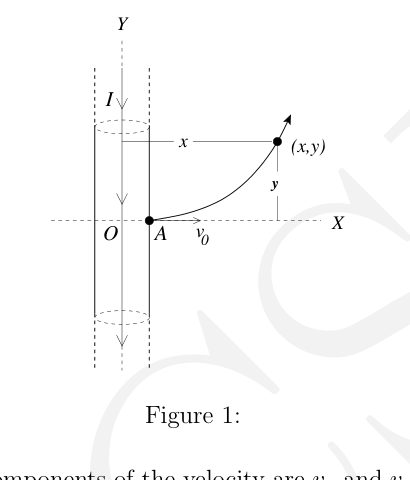
(a) At and the components of the velocity are and respectively. Obtain the components of force and on the electron at any arbitrary point .
(b) Integrate the equation of motion to obtain .
(c) Find the maximum distance of electron from the axis of the wire before it turns back.
Topic: Magnetism, Electromagnetism Metodi: Lorentz Force Analysis, Differential Equations Competenze: Mathematical Modeling Objects: Wire, Electron Fonte: Testo (PDF) — p.3
Un filo lungo di raggio porta una corrente continua . Dalla sua superficie al punto , un elettrone di carica () scappa con velocità perpendicolare a questa superficie (vedi figura 1.) Ignora la gravità.
[ 2.5 + 4 + 1.5 = 8 ]
Quesito 1
a) A e le componenti della velocità sono rispettivamente e . Ottenere le componenti di forza e sull’elettrone in qualsiasi punto arbitrario .
b) Integrare l’equazione di movimento per ottenere .
c) Trova la distanza massima di elettrone dall’asse del filo prima che si faccia ritorno.
Topic: Magnetism, Electromagnetism Metodi: Lorentz Force Analysis, Differential Equations Competenze: Mathematical Modeling Objects: Wire, Electron Fonte: Testo (PDF) — p.3
In a modified Young’s double slit experiment the region between screen and slits is immersed in a liquid whose refractive index varies with time (in seconds) as until it reaches a steady state value . The distance between the slits and the screen is m and the distance between the slits and is m. A glass plate of thickness m and refractive index is introduced in front of one of the slits. Note that the illuminations at and are from coherent sources with zero phase difference.
[ 2.5 + 2.5 + 1 + 2 + 2 = 10 ]
Quesito 2
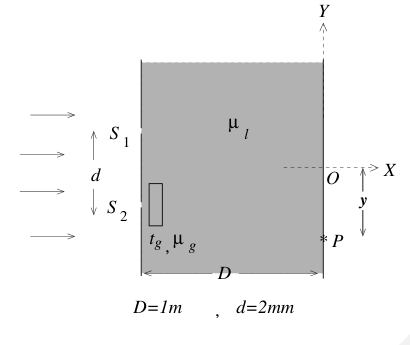
(a) Consider the point on the screen at distance from (; ). Obtain the expression for the optical path difference in terms of the refractive indices and the lengths mentioned in the problem.
(b) Now let denote the central maximum. Obtain the expression for as a function of time.
(c) Obtain the time () when central maximum is at point , equidistant from and i.e. .
(d) What is the speed () of the central maxima when it is at .
(e) If monochromatic light of wavelength 6000 Å is used to illuminate the slits, determine the time interval () between two consecutive maxima at before steady state is reached.
Topic: Wave Optics Metodi: Interference & Diffraction Analysis Competenze: Mathematical Modeling Objects: Slit, Screen Fonte: Testo (PDF) — p.5
In un esperimento modificato di Young, la regione tra schermo e fessura è immersa in un liquido il cui indice di rifrazione varia con il tempo (in secondi) da fino a raggiungere un valore di stato stazionario . La distanza tra le fessure e lo schermo è m e la distanza tra le fessure e è m. Si introduce una piastra di vetro di spessore m e indice di rifrazione davanti a una delle fessure. Si noti che le illuminazioni a e provengono da fonti coerenti con differenza di fase zero.
[ 2.5 + 2.5 + 1 + 2 + 2 = 10 ]
Quesito 2
a) Considerare il punto sullo schermo a distanza da (; ). Ottenere l’espressione per la differenza di percorso ottico in termini di indici di rifrazione e lunghezze menzionate nel problema.
b) Ora indica il massimo centrale. Ottenere l’espressione per come funzione del tempo.
c) Ottenere l’ora () quando il massimo centrale è al punto , equidistante da e , cioè .
d) Qual è la velocità () della massima centrale quando è a .
e) Se per illuminare le fessure si utilizza una luce monocromatica di lunghezza d’onda 6000 Å, determinare l’intervallo di tempo () tra due massime consecutive a prima di raggiungere lo stato di stabilità.
Topic: Wave Optics Metodi: Interference & Diffraction Analysis Competenze: Mathematical Modeling Objects: Slit, Screen Fonte: Testo (PDF) — p.5
A Carnot engine cycle is shown in the Fig. (2). The cycle runs between temperatures and (). Minimum and maximum volume at state 1 and state 3 are and respectively. The cycle uses one mole of an ideal gas with . Here and are the specific heats at constant pressure and volume respectively. You must express all answers in terms of the given parameters and universal gas constant .
[ 3 + 4 + 1 = 8 ]
Quesito 3
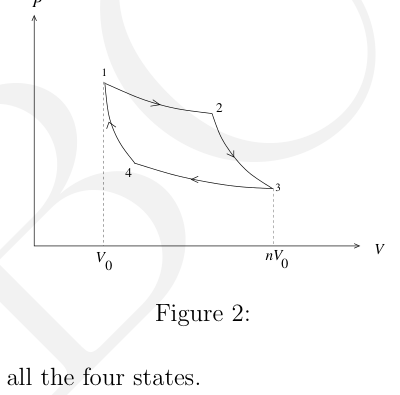
(a) List of all the four states.
| State | |||
|---|---|---|---|
| 1 | |||
| 2 | |||
| 3 | |||
| 4 |
(b) Calculate the work done by the engine in each process: , , , .
(c) Calculate , the heat absorbed in the cycle.
Topic: Thermodynamics Metodi: Thermodynamic Cycle Analysis, First Law of Thermodynamics Competenze: Mathematical Modeling Objects: Heat Engine, Gas Fonte: Testo (PDF) — p.7
Un ciclo del motore Carnot è mostrato nella figura. (2). Il ciclo si svolge tra le temperature e (). Il volume minimo e il volume massimo allo stato 1 e allo stato 3 sono rispettivamente e . Il ciclo utilizza un mol di gas ideale con . Qui e sono rispettivamente i calori specifici a pressione costante e volume. È necessario esprimere tutte le risposte in termini di parametri e costante universale del gas .
[ 3 + 4 + 1 = 8 ]
Quesito 3
a) Elenco di tutti e quattro gli Stati.
| State | |||
|---|---|---|---|
| 1 | |||
| 2 | |||
| 3 | |||
| 4 |
b) Calcolare il lavoro svolto dal motore in ciascun processo: , , , .
c) Calcolare , il calore assorbito nel ciclo.
Topic: Thermodynamics Metodi: Thermodynamic Cycle Analysis, First Law of Thermodynamics Competenze: Mathematical Modeling Objects: Heat Engine, Gas Fonte: Testo (PDF) — p.7
Consider a modification of Coulomb’s law by replacing it with the force between two charges , separated by given by
where is a constant. As far as possible express your answers in terms of the standard Bohr radius where the symbols have their usual meanings.
[ 3 + 4 + 1 = 8 ]
(a) Obtain the Bohr radius () for this modified law.
(b) Obtain the expression for the energy () for the orbit of this modified law.
(c) Take to be small (). Take the binding energy of the standard Bohr hydrogen atom to be 13.60 eV. Calculate the transition energy () from to for this modified law. For your calculation you may ignore terms of order and higher.
Topic: Modern-Quantum Physics Metodi: Bohr Model & Quantization, Approximation & Series Expansion Competenze: Mathematical Modeling Objects: Atom, Point Charge Fonte: Testo (PDF) — p.12
Considera una modifica della legge di Coulomb sostituendola con la forza tra due cariche , separate da data da
in cui è una costante. Per quanto possibile, esprimere le risposte in termini di raggio di Bohr standard , dove i simboli hanno il loro significato abituale.
[ 3 + 4 + 1 = 8 ]
(a) Ottenere il raggio di Bohr () per questa legge modificata.
b) Ottenere l’espressione per l’energia () per l’orbita della presente legge modificata.
(c) Prendere per essere piccolo (). Prendiamo l’energia di legame dell’atomo di idrogeno Bohr standard per essere 13,60 eV. Calcolare l’energia di transizione () da a per questa legge modificata. Per il calcolo si possono ignorare i termini di ordine e superiori.
Topic: Modern-Quantum Physics Metodi: Bohr Model & Quantization, Approximation & Series Expansion Competenze: Mathematical Modeling Objects: Atom, Point Charge Fonte: Testo (PDF) — p.12
Consider the motion of electrons in a metal in the presence of electric () and magnetic () fields. Due to collisions there arises a “retarding” force on the electron which is modeled by where is the electron mass, its velocity and a typical collision time. Take the magnitude of the electron charge to be (note is positive). Ignore gravity.
[ 1 + 2 + 2.5 + 3 + 2 + 1.5 = 12 ]
(a) State the equation of motion of the electron.
(b) Consider the case and . Obtain the expression for the angular cyclotron frequency and its numerical value for the case T.
(c) Consider the case of and . If is the number of free (valence) electrons per unit volume, obtain the expression for the conductivity of the sample. Obtain also the numerical value for the conductivity of Cu given that and s. We assume steady state i.e. the acceleration dies down and terminal speed is attained.
(d) Consider the case () and . Assume steady state and relate to . Here ‘s are the current densities (current per unit area).
where ‘s are to be written in terms of , and .
(e) Sketch (-axis) versus (-axis).
(f) Taking Cu as an example, for what value of the magnetic field will be a maximum?
Topic: Electromagnetism Metodi: Lorentz Force Analysis, Differential Equations Competenze: Mathematical Modeling Objects: Electron Fonte: Testo (PDF) — p.13
Considerare il movimento degli elettroni in un metallo in presenza di campi elettrici () e magnetici (). A causa delle collisioni si verifica una forza di “retardo” sull’elettrone che è modellata da dove è la massa dell’elettrone, la sua velocità e un tempo di collisione tipico. Prendete la grandezza della carica elettronica da (nota è positiva). Ignora la gravità.
[ 1 + 2 + 2.5 + 3 + 2 + 1.5 = 12 ]
a) Indicare l’equazione di movimento dell’elettrone.
b) Considerate i casi e . Ottenere l’espressione per la frequenza angolare del ciclotrone e il suo valore numerico per il caso T.
c) Considerate il caso di e . Se è il numero di elettroni liberi (valenza) per unità di volume, si ottiene l’espressione per la conduttività del campione. Ottenere anche il valore numerico della conduttività di Cu dato che e s. Supponiamo stato di stabilità, cioè l’accelerazione si abbassa e si raggiunge la velocità terminale.
d) Considerare i casi () e . Assumere lo stato di stabilità e correlare a . Qui sono le densità di corrente (corente per unità di superficie).
dove devono essere scritti in termini di , e .
e) Sketch (-asse) contro (-asse).
(f) Prendendo come esempio Cu, per quale valore del campo magnetico sarà il massimo?
Topic: Electromagnetism Metodi: Lorentz Force Analysis, Differential Equations Competenze: Mathematical Modeling Objects: Electron Fonte: Testo (PDF) — p.13
Two blocks, say and , each of mass are connected by a light spring of force constant and natural length . The whole system is resting on a frictionless table such that and , where and are the coordinates of the blocks and respectively. Another block (named ) of mass , which is travelling at speed collides head-on with the block at an instant (see Fig. (3)).
[ 3 + 2 + 2 + 3 = 10 ]
\begin{document}
\begin{tikzpicture}
% table
\draw[line width=1.2pt] (-0.5,0) -- (8,0);
% block A
\draw (0.5,0) rectangle (1.6,1.1) node[midway] {$A$};
% V0 arrow
\draw[->] (0.6,1.5) -- (1.7,1.5);
\node at (1.1,1.85) {$V_0$};
% block B
\draw (3.5,0) rectangle (4.6,1.0) node[midway] {$B$};
% spring (zig-zag)
\draw (4.6,0.5) -- (4.8,0.5) -- (4.95,0.75) -- (5.25,0.25) -- (5.55,0.75) -- (5.85,0.25) -- (6.0,0.5) -- (6.2,0.5);
% block C
\draw (6.2,0) rectangle (7.3,1.0) node[midway] {$C$};
\node at (4.0,-0.4) {Figure 3:};
\end{tikzpicture}
\end{document}
(a) Obtain the velocities of blocks , and just after the collision at ? Express the velocities in terms of and . Assume that the collision is elastic.
(b) Draw free body diagrams for the blocks and after the collision and write down the equation of motion.
Free body diagram:
Equation of motion:
(c) For the positions of the blocks are given by
Find in terms of and . Express and in terms of , and . (For this part, ignore the motion of block A.)
(d) Obtain the condition on such that the block will collide with the block again at some time ?
Condition on :
Topic: Conservation of Momentum, Oscillations & Waves Metodi: Conservation of Momentum, Simple Harmonic Motion Analysis Competenze: Mathematical Modeling Objects: Block, Spring Fonte: Testo (PDF) — p.16
Due blocchi, per esempio e , ognuno di massa sono collegati da una sorgente di luce di forza costante e da una lunghezza naturale . L’intero sistema si basa su una tavola senza attrito in modo tale che e , dove e sono rispettivamente le coordinate dei blocchi e . Un altro blocco (chiamato ) di massa , che viaggia a velocità , si schianta di fronte al blocco in un istante (vedi figura 1. (3)).
[ 3 + 2 + 2 + 3 = 10 ]
\begin{document}
\begin{tikzpicture}
% table
\draw[line width=1.2pt] (-0.5,0) -- (8,0);
% block A
\draw (0.5,0) rectangle (1.6,1.1) node[midway] {$A$};
% V0 arrow
\draw[->] (0.6,1.5) -- (1.7,1.5);
\node at (1.1,1.85) {$V_0$};
% block B
\draw (3.5,0) rectangle (4.6,1.0) node[midway] {$B$};
% spring (zig-zag)
\draw (4.6,0.5) -- (4.8,0.5) -- (4.95,0.75) -- (5.25,0.25) -- (5.55,0.75) -- (5.85,0.25) -- (6.0,0.5) -- (6.2,0.5);
% block C
\draw (6.2,0) rectangle (7.3,1.0) node[midway] {$C$};
\node at (4.0,-0.4) {Figure 3:};
\end{tikzpicture}
\end{document}
(a) Ottenere le velocità dei blocchi , e subito dopo la collisione a ? Esprimere le velocità in termini di e . Supponiamo che la collisione sia elastica.
b) Disegnare diagrammi di corpo libero per i blocchi e dopo la collisione e annotare l’equazione di movimento.
Diagramma del corpo libero:
Equazione di movimento:
c) Per le posizioni dei blocchi sono indicate da
Trova in termini di e . Esprimere e in termini di , e . (Per questa parte, ignorare il movimento del blocco A.)
d) Ottenere la condizione di tale che il blocco si schianti di nuovo con il blocco in un certo momento ?
Condizione di :
Topic: Conservation of Momentum, Oscillations & Waves Metodi: Conservation of Momentum, Simple Harmonic Motion Analysis Competenze: Mathematical Modeling Objects: Block, Spring Fonte: Testo (PDF) — p.16
The Cubic Potential: Consider a particle of mass moving in one dimension under the influence of potential energy
Here , and are real and positive.
[ 6 + 3 = 9 ]
(a) Sketch typical plots of and identify extrema if any.
(b) Consider the case where (in appropriate units) we have , , and . Sketch the potential energy . If the total energy of the particle moving in this one-dimensional potential is (in same units), discuss the motion of the particle in terms of allowed regions, boundedness and periodicity.
Topic: Oscillations & Waves Metodi: Physical Modeling, Differential Equations Competenze: Diagrammatic Reasoning Objects: — Fonte: Testo (PDF) — p.19
Il potenziale cubo: Considera una particella di massa che si muove in una dimensione sotto l’influenza di energia potenziale
Qui , e sono reali e positivi.
[ 6 + 3 = 9 ]
a) Sceneggiare i grafici tipici di e identificare se del caso gli estremi.
b) Considerare il caso in cui (in unità appropriate) abbiamo , , e . Segna l’energia potenziale . Se l’energia totale della particella in movimento in questo potenziale unidimensionale è (in unità uguali), discutere il movimento della particella in termini di regioni ammesse, di limitazione e di periodicità.
Topic: Oscillations & Waves Metodi: Physical Modeling, Differential Equations Competenze: Diagrammatic Reasoning Objects: — Fonte: Testo (PDF) — p.19