Figure (1) shows a mechanical system free of any dissipation. The two spheres ( and ) are each of equal mass , and a uniform connecting rod of length has mass . The collar is massless. Right above the position of sphere in Fig. (1) is a tunnel
Quesito 1
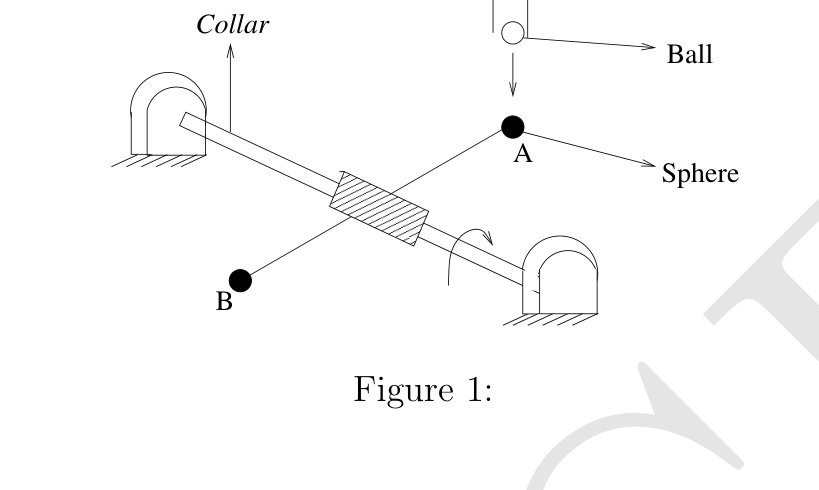
from which balls each of mass fall vertically at suitable intervals. The falling balls cause the rods and attached spheres to rotate. Sphere when it reaches the position now occupied by sphere , suffers a collision from another falling ball and so on. Just before striking, the falling ball has velocity . All collisions are elastic and the spheres as well as the falling balls can be considered to be point masses. [Marks: 12]
(a) Find the angular velocity of the assembly in terms of after the ball has struck it. [4]
(b) The rotating assembly eventually assumes constant angular speed . Obtain in terms of and by solving the equation obtained in part (a). Argue how a constant does not violate energy conservation. [2]
Argument:
(c) Solve the expression obtained in part (a) to obtain in terms of . [4]
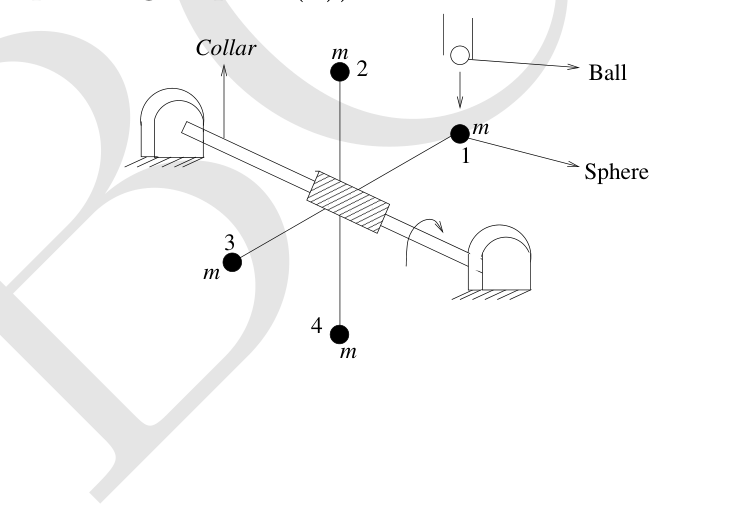
(d) If instead of a pair of spheres, we have two pairs of spheres as shown in figure below. What would be the new constant angular speed of the assembly (i.e. the answer corresponding to part (b)). [2]
Quesito 1
Topic: Rotational Dynamics, Conservation of Momentum Metodi: Torque & Angular Momentum Analysis, Conservation of Momentum Competenze: Physical Reasoning Objects: Sphere, Rod, Ball Fonte: Testo (PDF) — p.3
La figura (1) mostra un sistema meccanico privo di dissipazioni. Le due sfere ( e ) hanno ciascuna massa uguale , e una canna di connessione uniforme di lunghezza ha massa . Il collare è senza massa. Proprio sopra la posizione della sfera nella figura. (1) è un tunnel
Quesito 1
da cui ogni sfera di massa cade verticalmente ad intervalli adeguati. Le palle cadenti fanno girare le barre e le sfere attaccate. La sfera , quando raggiunge la posizione ora occupata dalla sfera , subisce una collisione da un’altra palla cadente e così via. Poco prima di colpire, la palla cadente ha velocità . Tutte le collisioni sono elastiche e le sfere così come le palle cadenti possono essere considerate masse puntate. [Marchi: 12]
a) Trova la velocità angolare dell’assemblaggio in termini di dopo che la palla l’ha colpita. [4]
b) L’assemblaggio rotante assume infine una velocità angolare costante . Ottenere in termini di e risolvendo l’equazione ottenuta nella parte (a). Argumentare come una costante non viola il risparmio energetico. [2]
Argumento:
c) Risolvere l’espressione ottenuta nella parte a) per ottenere in termini di . [4]
d) Se invece di un paio di sfere, abbiamo due coppie di sfere come mostrato nella figura seguente. Qual sarebbe la nuova velocità angolare costante dell’assemblaggio (cioè la risposta corrispondente alla lettera b). [2]
Quesito 1
Topic: Rotational Dynamics, Conservation of Momentum Metodi: Torque & Angular Momentum Analysis, Conservation of Momentum Competenze: Physical Reasoning Objects: Sphere, Rod, Ball Fonte: Testo (PDF) — p.3
Rear view mirrors
Rear view mirrors in automobiles are generally convex. Suppose a car moves with a constant speed of 40.0 kilometre per hour on a straight level road and is followed by another car moving with the constant speed 60.0 kilometre per hour. At a given instant of time, we denote:
- : distance of the car from the mirror of car ,
- : distance of the car from as seen by the driver of in the mirror,
- : speed of approach of relative to and
- : speed of approach of as seen in the mirror of .
[Marks: 6]
(a) Obtain an expression for in terms of , and the radius of curvature of the convex mirror used as the rear view mirror in the car . [3]
(b) Show a plot of against . [2]
vs :
(c) If m, what is the speed of approach of in kilometre per hour as seen by the driver of in the mirror for m. [1]
Topic: Geometric Optics Metodi: Thin Lens & Mirror Equation, Calculus-Integration Competenze: Mathematical Modeling Objects: Mirror Fonte: Testo (PDF) — p.6
Rispecchi retrovisori
Gli specchi retrovisori delle automobili sono generalmente convexi. Supponiamo che una macchina si muova a velocità costante di 40,0 chilometri all’ora su una strada a livello retto e sia seguita da un’altra macchina che si muove a velocità costante di 60,0 chilometri all’ora. In un momento determinato, denotamo:
- : distanza della macchina dallo specchio della macchina ,
- : distanza della vettura da vista dal conducente di nello specchio,
- : velocità di avvicinamento di rispetto a e
- : velocità di avvicinamento di come osservato nello specchio di .
[Marchi: 6]
a) Ottenere un’espressione per in termini di , e del raggio di curvatura dello specchio convexo utilizzato come specchio retrovisore nella vettura . [3]
b) Indicare un diagramma di rispetto a . [2]
vs :
c) Se m, qual è la velocità di avvicinamento di in chilometro/ora osservata dal conducente di nello specchio per m. [1]
Topic: Geometric Optics Metodi: Thin Lens & Mirror Equation, Calculus-Integration Competenze: Mathematical Modeling Objects: Mirror Fonte: Testo (PDF) — p.6
Cloud formation condition
Consider a simplified model of cloud formation. Hot air in contact with the earth’s surface contains water vapor. This air rises convectively till the water vapor content reaches its saturation pressure. When this happens, the water vapor starts condensing and droplets are formed. We shall estimate the height at which this happens. We assume that the atmosphere consists of the diatomic gases oxygen and nitrogen in the mass proportion 21:79 respectively. We further assume that the atmosphere is an ideal gas, the acceleration due to gravity is constant and air processes are adiabatic. Under these assumptions one can show that the pressure is given by
Here and is the pressure and temperature respectively at sea level (), is the lapse rate (magnitude of the change in temperature with height above the earth’s surface, i.e. ). [Marks: 14]
(a) Obtain an expression for the lapse rate in terms of , , and . Here is the ratio of specific heat at constant pressure to specific heat at constant volume; , the gas constant; and , the relevant molar mass. [4]
(b) Estimate the change in temperature when we ascend a height of one kilometer? [1]
(c) Show that pressure will depend on height as given by Eq. (1). Find an explicit expression for exponent in terms of . [3]
(d) According to this model what is the height to which the atmosphere extends? Take K and atm. [2]
(e) The pressure at which vapor and liquid can co-exist is called the saturation vapor pressure . The temperature dependence of is given by the Clausius-Clapeyron equation
Where is the latent heat of vaporisation and and are the specific volumes (volume per mass) of vapor and liquid respectively. Obtain an expression for in terms of temperature , gas constant , molar mass of water vapour and . You may assume that water vapour also obeys ideal gas law. You can also use the fact that and ignore in Eq. (2). [3]
(f) State the condition for condensation in terms of condensation height . [1]
Topic: Thermodynamics Metodi: First Law of Thermodynamics, Hydrostatic Equilibrium Competenze: Mathematical Modeling Objects: Gas, Droplet Fonte: Testo (PDF) — p.7
Condizione di formazione di nuvole
Prendiamo un modello semplificato della formazione di nuvole. L’aria calda che entra in contatto con la superficie terrestre contiene vapore idrico. Questa aria sale convectivamente fino a quando il contenuto del vapore d’acqua raggiunge la pressione di saturazione. Quando questo accade, il vapore d’acqua inizia a condensare e si formano goccioline. Estimeremo l’altezza a cui questo accade. Supponiamo che l’atmosfera sia composta da gas diatomici ossigeno e azoto nella proporzione di massa di 21,79 rispettivamente. Supponiamo inoltre che l’atmosfera sia un gas ideale, l’accelerazione dovuta alla gravità è costante e i processi dell’aria sono adiabatici. In base a queste ipotesi si può dimostrare che la pressione è data da
Qui e sono rispettivamente la pressione e la temperatura al livello del mare (), è il tasso di scadenza (magnitude of the change in temperature with height above the earth’s surface, i.e. ). [Marchi: 14]
(a) Ottenere un’espressione per il tasso di mancato tempo in termini di , , e . Qui è il rapporto tra calore specifico a pressione costante e calore specifico a volume costante; , la costante del gas; e , la relativa massa molare. [4]
(b) Calcoli il cambiamento di temperatura quando saliamo ad un chilometro di altezza? [1]
(c) Indicare che la pressione dipenderà dall’altezza data da Eq. (1). Trova un’espressione esplicita per l’esponente in termini di . [3]
d) Secondo questo modello, a che altezza si estende l’atmosfera? Prendi K e atm. [2]
e) La pressione a cui vapore e liquido possono coesistere si chiama pressione di saturazione del vapore . La dipendenza di temperatura di è data dall’equazione Clausius-Clapeyron
Se è il calore latente della vaporizzazione, e e sono rispettivamente i volumi specifici (volumi per massa) del vapore e del liquido. Ottenere un’espressione per in termini di temperatura , costante del gas , massa molare del vapore d’acqua e . Potreste presumere che anche il vapore idrico obbedisca alla legge dei gas ideali. È possibile anche utilizzare il fatto che e ignorare in Eq. (2). [3]
f) Indicare la condizione di condensazione in termini di altezza di condensazione . [1]
Topic: Thermodynamics Metodi: First Law of Thermodynamics, Hydrostatic Equilibrium Competenze: Mathematical Modeling Objects: Gas, Droplet Fonte: Testo (PDF) — p.7
A long solenoid of length m, radius m and total number of turns is carrying a current A. The axis of the solenoid coincides with the -axis. [Marks: 14]
(a) State the expression for the magnetic field of the solenoid and calculate its value? []
(b) Obtain the expression for the self-inductance () of the solenoid. Calculate its value. []
(c) Calculate the energy stored () when the solenoid carries this current? [1]
(d) Let the resistance of the solenoid be . It is connected to a battery of emf . Obtain the expression for the current () in the solenoid. [2]
(e) Let the solenoid with resistance described in part (d) be stretched at a constant speed ( is increased but and are constant). State Kirchhoff’s second law for this case. (Note: Do not solve for the current.) [2]
(f) Consider a time varying current (where A) flowing in the solenoid. Obtain an expression for the electric field due to the current in the solenoid. (Note: Part (e) is not operative, i.e. the solenoid is not being stretched.) [3]
(g) Consider and in the previous part. Plot the magnitude of the electric field as a function of the radial distance from the solenoid. Also, sketch the electric lines of force. [3]
Plot:
Lines of force:
Topic: Electromagnetic Induction Metodi: Faraday’s Law of Induction, Ampère’s Law Competenze: Mathematical Modeling Objects: Solenoid, Battery Fonte: Testo (PDF) — p.11
Un solenoide lungo di lunghezza m, raggio m e numero totale di giri porta una corrente A. L’asse del solenoide coincide con l’asse . [Marchi: 14]
(a) Indicare l’espressione del campo magnetico del solenoide e calcolare il suo valore? []
b) Ottenere l’espressione per l’autoinduzione () del solenoide. Calcola il suo valore. []
(c) Calcolare l’energia immagazzinata () quando il solenoide porta questa corrente? [1]
d) La resistenza del solenoide deve essere . È collegato a una batteria di emf . Ottenere l’espressione della corrente () nel solenoide. [2]
e) Il solenoide con resistenza descritto nella parte (d) deve essere esteso a velocità costante (si aumenta ma e sono costanti). La seconda legge di Kirchhoff per questo caso. (Nota: non risolvere per la corrente.) [2]
(f) Considerare una corrente variabile nel tempo (dove A) che scorre nel solenoide. Ottenere un’espressione per il campo elettrico dovuto alla corrente nel solenoide. (Nota: la parte (e) non è operativa, cioè il solenoide non si sta allungando.) [3]
g) Considerare e nella parte precedente. Tracciare la grandezza del campo elettrico in funzione della distanza radial dal solenoide. Inoltre, disegna le linee di forza elettriche. [3]
- Il film è stato un successo .
Linee di forza:
Topic: Electromagnetic Induction Metodi: Faraday’s Law of Induction, Ampère’s Law Competenze: Mathematical Modeling Objects: Solenoid, Battery Fonte: Testo (PDF) — p.11
Ionization of atoms
A Rydberg hydrogenic atom is one in which the electron possesses a very large quantum number e.g. . Take the electron charge to be (). The binding energy of the Rydberg electron may be taken as eV. [Marks: 14]
(a) Would a photon of angular frequency ionize such an atom? [1]
Now consider the electron in the Rydberg hydrogenic atom to be unbounded and free for all practical purposes. Supposing such Rydberg atoms are injected uniformly into an oscillating electric field provided by an electromagnetic wave. Let the speed of the electron at the time of injection (), be .
(b) Obtain an expression for the speed of the electron at a later time . [2]
(c) Obtain an expression for the average kinetic energy of the electron. [2]
(d) Assuming that the criterion for photo-ionization is that the average kinetic energy exceed estimate the value of the ionizing field () for microwave radiation of angular frequency . [2]
Next consider the ionization of an atom by a steady electric field. Consider a hydrogen atom at rest (at ) in a uniform steady electric field . We take the potential energy due to the electric field to be zero at .
(e) Write down the expression for the potential energy of the electron in this field. [1]
(f) For this and subsequent parts take . Sketch the potential energy due to this field along -axis and between . Identify important points. To make this plot select a system of units where , and . [3]
Plot:
(g) Let the energy of the electron confined in the atom be . At what would the atom ionize? [2]
(h) If we take eV, estimate the value of . Is this physically acceptable? [1]
Topic: Modern-Quantum Physics, Electrostatics Metodi: Photon Energy Relation, Electric Potential Method Competenze: Physical Reasoning Objects: Atom, Electron, Photon Fonte: Testo (PDF) — p.14
Ionizzazione degli atomi
Un atomo idrogeno di Rydberg è uno in cui l’elettrone possiede un numero quantistico molto grande ad esempio. . Prendete la carica elettronica da (). L’energia di legame dell’elettrone Rydberg può essere presa come eV. [Marchi: 14]
(a) Un fotone di frequenza angolare ionizzerebbe un tale atomo? [1]
Ora consideriamo l’elettrone nell’atomo idrogeno di Rydberg come illimitato e libero per tutti gli scopi pratici. Supponendo che tali atomi di Rydberg siano iniettati uniformemente in un campo elettrico oscillante fornito da un’onda elettromagnetica. La velocità dell’elettrone al momento dell’iniezione () deve essere .
b) Ottenere un’espressione della velocità dell’elettrone in un momento successivo . [2]
(c) Ottenere un’espressione per l’energia cinetica media dell’elettrone. [2]
d) Supponendo che il criterio di fotonionizzazione sia che l’energia cinetica media superi , si stima il valore del campo di ionizzazione () per le radiazioni a microonde di frequenza angolare . [2]
Prendiamo poi l’ionizzazione di un atomo da un campo elettrico costante. Considera un atomo di idrogeno in riposo (a ) in un campo elettrico uniforme e stabile . Prendiamo l’energia potenziale dovuta al campo elettrico a zero a .
(e) Scrivere l’espressione per l’energia potenziale dell’elettrone in questo campo. [1]
f) Per questa e le parti successive si prenda . Sineografia dell’energia potenziale dovuta a questo campo lungo l’asse e tra . Identifica i punti importanti. Per fare questo grafico, selezionare un sistema di unità in cui , e . [3]
- Il film è stato un successo .
g) L’energia dell’elettrone confinato nell’atomo sia . At what would the atom ionize? [2]
h) Se prendiamo eV, stimare il valore di . È fisicamente accettabile? [1]
Topic: Modern-Quantum Physics, Electrostatics Metodi: Photon Energy Relation, Electric Potential Method Competenze: Physical Reasoning Objects: Atom, Electron, Photon Fonte: Testo (PDF) — p.14