A parallel plate capacitor with plate area and separation ( lateral dimensions) is filled with a dielectric of dielectric constant where is a constant () and plate is at . The capacitor is charged to a potential . [Marks: 5]
(a) Obtain the capacitance . [2]
(b) Sketch vs . [1]
(c) Obtain the charge on the plates. [1]
(d) Obtain the electric field . [1]
Topic: Electrostatics Metodi: Gauss’s Law, Calculus-Integration Competenze: Mathematical Modeling Objects: Capacitor Fonte: Testo (PDF) — p.3
Un condensatore di piastra parallela con superficie di piastra e separazione (dimensioni laterali ) è riempito di un dielettrico di costante dielettrica dove è una costante () e la piastra è a . Il condensatore è caricato a un potenziale . [Marchi: 5]
(a) Ottenere la capacità . [2]
b) Sketch vs . [1]
(c) Ottenere la carica sulle targhe. [1]
d) Ottenere il campo elettrico . [1]
Topic: Electrostatics Metodi: Gauss’s Law, Calculus-Integration Competenze: Mathematical Modeling Objects: Capacitor Fonte: Testo (PDF) — p.3
The figure below depicts the reflection of normally incident monochromatic wave by two neighbouring surface atoms of crystal. Angle of reflection and nearest neighbour distance are and respectively. [Marks: 5]
Quesito 2
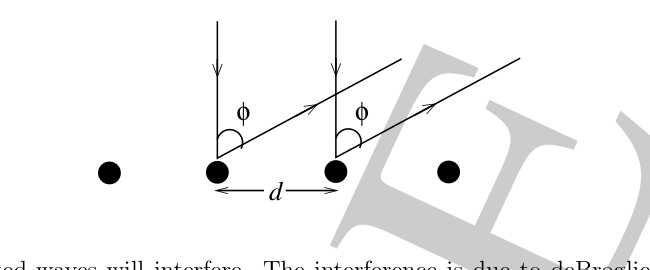
Two reflected waves will interfere. The interference is due to deBroglie wave of the electron accelerated from rest by less then 1 keV.
(a) Obtain a relationship between and the kinetic energy () of the electron with rest mass for the case of constructive interference. [3]
(b) Calculate if first maxima occurs at for eV electron. [2]
Topic: Modern-Quantum Physics, Wave Optics Metodi: de Broglie Relation, Interference & Diffraction Analysis Competenze: Mathematical Modeling Objects: Atom, Electron Fonte: Testo (PDF) — p.5
La figura seguente raffigura il riflesso di onde monocromatiche normalmente incidenti da due atomi di superficie vicini di cristallo. L’angolo di riflessione e la distanza più vicina sono rispettivamente e . [Marchi: 5]
Quesito 2
Due onde riflesse interferiranno. L’interferenza è dovuta all’onda deBroglie dell’elettrone accelerata dal riposo di meno di 1 keV.
(a) Ottenere un rapporto tra e l’energia cinetica () dell’elettrone con massa di riposo nel caso di interferenze costruttive. [3]
b) Calcolare se il primo massimo si verifica a per elettrone eV. [2]
Topic: Modern-Quantum Physics, Wave Optics Metodi: de Broglie Relation, Interference & Diffraction Analysis Competenze: Mathematical Modeling Objects: Atom, Electron Fonte: Testo (PDF) — p.5
Consider a bicycle in vertical position accelerating forward without slipping on a straight horizontal road. The combined mass of the bicycle and the rider is and the magnitude of the accelerating torque applied to the rear wheel by the pedal and gear system is . The radius and the moment of inertia of each wheel is and (with respect to axis) respectively. The acceleration due to gravity is . [Marks: 8]
(a) Draw the free body diagram of the system (bicycle and rider). [2]
Quesito 3
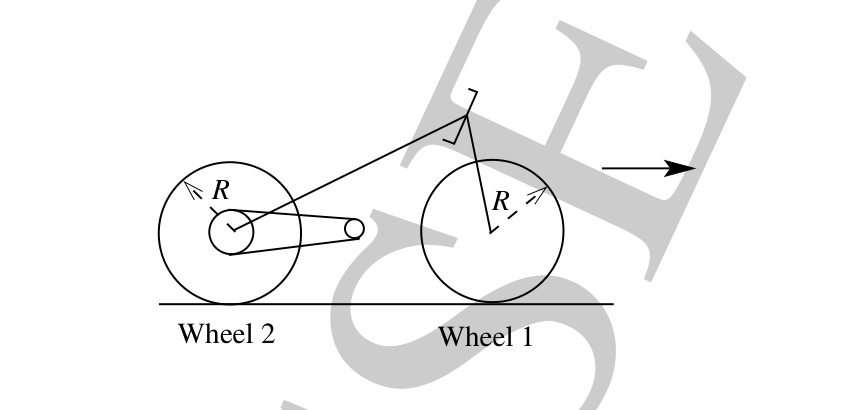
(b) Obtain the acceleration in terms of the above mentioned quantities. [2]
(c) For simplicity assume that the centre of mass of the system is at height from the ground and equidistant at from the centre of each of the two wheels. Let be the coefficient of friction (both static and dynamic) between the wheels and the ground. Consider and no slipping. Obtain the conditions for the maximum acceleration of the bike. [3]
(d) For calculate . [1]
Topic: Rotational Dynamics, Newtonian Mechanics Metodi: Torque & Angular Momentum Analysis, Free-Body Diagram Competenze: Mathematical Modeling Objects: Wheel, Gear Fonte: Testo (PDF) — p.7
Considera una bicicletta in posizione verticale che accelera in avanti senza scivolare su una strada orizzontale dritta. La massa combinata della bicicletta e del pilota è e la grandezza della coppia di accelerazione applicata alla ruota posteriore dal sistema di pedali e ingranaggi è . Il raggio e il momento di inerzia di ciascuna ruota sono rispettivamente e (rispetto all’asse). L’accelerazione dovuta alla gravità è . [Marchi: 8]
a) Disegnare il diagramma della carrozzeria libera del sistema (bicicletta e ciclista). [2]
Quesito 3
b) Ottenere l’accelerazione in termini di quantità sopra menzionate. [2]
c) Per semplicità, supponiamo che il centro di massa del sistema sia all’altezza dal terreno e equidistante a dal centro di ciascuna delle due ruote. Il deve essere il coefficiente di attrito (statico e dinamico) tra le ruote e il terreno. Considerare e non scorreggere. Ottenere le condizioni per l’accelerazione massima della moto. [3]
d) Per calcolare . [1]
Topic: Rotational Dynamics, Newtonian Mechanics Metodi: Torque & Angular Momentum Analysis, Free-Body Diagram Competenze: Mathematical Modeling Objects: Wheel, Gear Fonte: Testo (PDF) — p.7
The figure below depicts a concave mirror with center of curvature focus , and a horizontally drawn as the optic axis. The radius of curvature is () and . A ray of light , parallel to the optical axis and at a perpendicular distance () from it, is incident on the mirror at . It is reflected to the point on the optical axis, such that . Here is a measure of lateral aberration. [Marks: 8]
Quesito 4
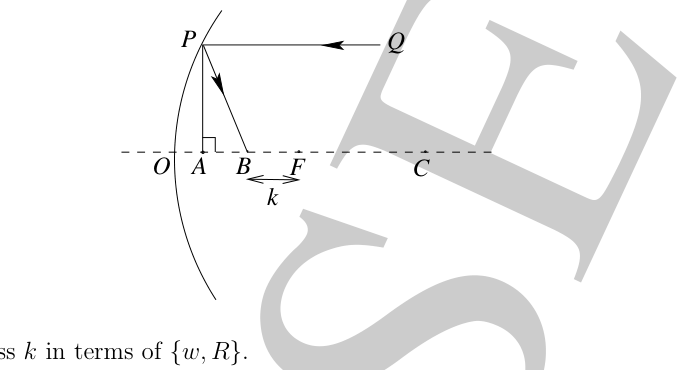
(a) Express in terms of . [3]
(b) Sketch vs for . [2]
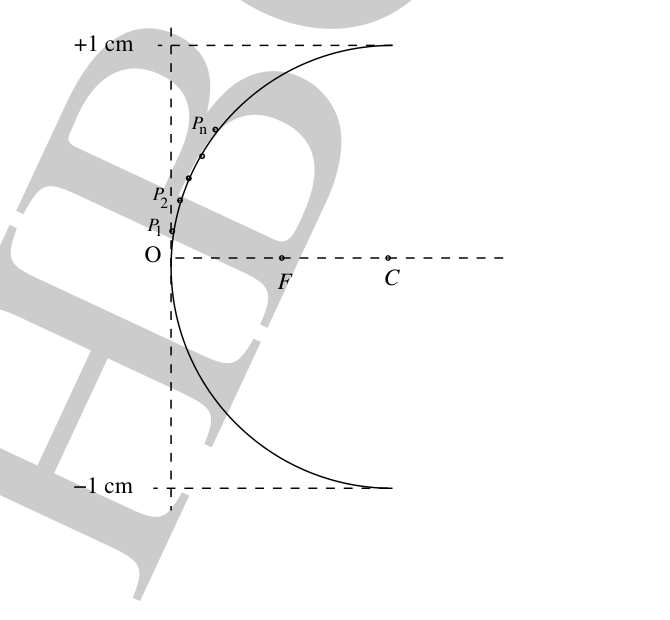
(c) Consider points on the concave mirror which are increasingly further away from the optic center and approximately equidistant from each other (see figure below). Rays parallel to the optic axis are incident at and reflected to points on the optic axis. Consider the points where these rays reflected from intersect the rays reflected from respectively. Qualitatively sketch the locus of these points in figure below for a mirror (shown with solid line) with radius of curvature . [3]
Quesito 4
Topic: Geometric Optics Metodi: Ray Tracing, Calculus-Integration Competenze: Mathematical Modeling Objects: Mirror Fonte: Testo (PDF) — p.7
La figura seguente raffigura uno specchio concavo con centro di curvatura foco e un disegnato orizzontalmente come asse ottico. Il raggio di curvatura è () e . Un raggio di luce , parallelo all’asse ottico e a una distanza perpendicolare () da esso, incide sullo specchio a . Si riflette al punto sull’asse ottico, in modo che . Qui è una misura di aberrazione laterale. [Marchi: 8]
Quesito 4
a) Esprimere in termini di . [3]
b) Sketch vs per . [2]
c) Considerare i punti dello specchio concavo che sono sempre più lontani dal centro ottico e approssimativamente a distanza uguale l’uno dall’altro (vedere figura seguente). I raggi paralleli all’asse ottico sono incidenti a e riflessi ai punti dell’asse ottico. Considerare i punti in cui questi raggi riflessi da intersecano rispettivamente i raggi riflessi da . Descrivere qualitativamente il luogo di riferimento di questi punti nella figura seguente per uno specchio (indicato con una linea solida) con raggio di curvatura . [3]
Quesito 4
Topic: Geometric Optics Metodi: Ray Tracing, Calculus-Integration Competenze: Mathematical Modeling Objects: Mirror Fonte: Testo (PDF) — p.7
Two long parallel wires in the plane at a distance apart carry a steady current in opposite directions. Midway between the wires is a rectangular loop of wire carrying current as shown in the figure (). The loop is free to rotate about the axis and the currents remain fixed to irrespective of the relative motion between the loop and the wire. [Marks: 8]
Quesito 5
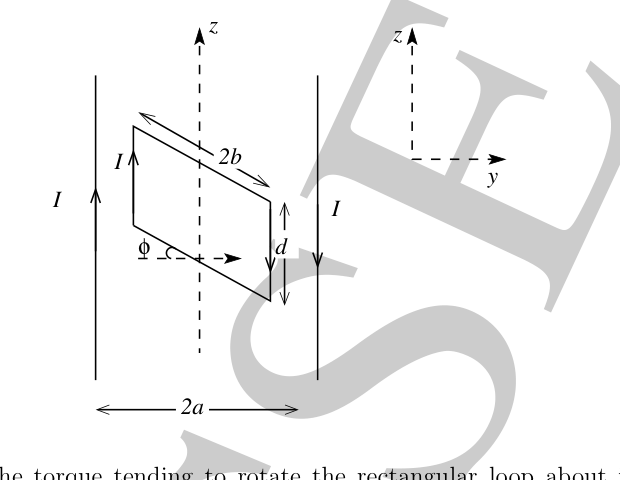
(a) Obtain the torque tending to rotate the rectangular loop about its axis as a function of . Here is the angle that plane of loop makes with the plane of wires. [5]
Torque is
(b) Obtain the value of for which the torque is maximum? [3]
Topic: Magnetism, Electromagnetism Metodi: Lorentz Force Analysis, Torque & Angular Momentum Analysis Competenze: Mathematical Modeling Objects: Wire, Coil Fonte: Testo (PDF) — p.9
Due lunghi fili paralleli nel piano a distanza da loro portano una corrente costante in direzioni opposte. Nel mezzo tra i fili è un ciclo rettangolare di filo con corrente come mostrato nella figura (). Il circuito può ruotare liberamente intorno all’asse e le correnti rimangono fisse a indipendentemente dal movimento relativo tra il circuito e il filo. [Marchi: 8]
Quesito 5
(a) Ottenere la coppia che tende a ruotare il ciclo rettangolare intorno al suo asse come funzione di . Qui è l’angolo che il piano di loop fa con il piano di fili. [5]
Torque è
b) Ottenere il valore di per il quale la coppia è massima? [3]
Topic: Magnetism, Electromagnetism Metodi: Lorentz Force Analysis, Torque & Angular Momentum Analysis Competenze: Mathematical Modeling Objects: Wire, Coil Fonte: Testo (PDF) — p.9
A planet of mass is orbiting a star of mass () under the influence of a central force. A central force () is a force that is directed from the particle towards (or away from) a fixed point in space, the center, and whose magnitude only depends on the distance from the planet to the center. Thus gravitational force is central force and it is generally known that the orbit is a conic section of a body under the influence of gravitational force. The planet’s position at some point can be shown in polar coordinates () as shown in figure below:
\begin{document}
\begin{tikzpicture}
\draw[->] (0,0) -- (4.2,0) node[right] {$x$};
\draw[->] (0,0) -- (0,3.2) node[above] {$y$};
\draw[thick] (0,0) -- (2.8,2.1);
\fill (2.8,2.1) circle (1.5pt) node[above left] {$P$};
\node at (1.3,1.3) {$\vec{r}$};
\draw (0.9,0) arc (0:36.87:0.9);
\node at (1.15,0.32) {$\theta$};
\end{tikzpicture}
\end{document}
The planet’s position (), velocity () and acceleration () can be written as
Consider central force to be gravitational force for parts (c–h). [Marks: 13]
(a) One can write scalar form of newton’s second law as
Obtain . [1]
(b) Show that the magnitude of the angular momentum () of planet is constant. [1/2]
(c) Obtain total energy () of the planet at distance from the center of the force. Take potential energy to be zero at large . [1]
(d) State the energy part in terms of and other quantities. [2]
(e) Sketch . [1½]
(f) Comment on the allowed regions and shape of the orbit if planet’s energy , and . [2]
(g) Obtain the radius () of the circular orbit in terms of and related quantities. [1]
(h) Hence forward we take that orbit is circular of radius and planet is slightly disturbed from its position such that its position is where . Show that planet will oscillate simple harmonically around mean position . Obtain time period () for these radial oscillations. [2]
(i) For this part we assume that planet moves under the force expressible as a power of as where () is a constant. For what values of a stable orbit is possible? [2]
Topic: Gravitation Metodi: Newton’s Law of Gravitation, Differential Equations Competenze: Mathematical Modeling Objects: Planet, Star Fonte: Testo (PDF) — p.11
Un pianeta di massa sta orbitando intorno a una stella di massa () sotto l’influenza di una forza centrale. Una forza centrale () è una forza che viene diretta dalla particella verso (o lontano da) un punto fisso nello spazio, il centro, e la cui magnitudine dipende solo dalla distanza dal pianeta al centro. La forza gravitazionale è quindi la forza centrale e si sa generalmente che l’orbita è una sezione conica di un corpo sotto l’influenza della forza gravitazionale. La posizione del pianeta in un certo punto può essere mostrata in coordinate polari () come mostrato nella figura seguente:
\begin{document}
\begin{tikzpicture}
\draw[->] (0,0) -- (4.2,0) node[right] {$x$};
\draw[->] (0,0) -- (0,3.2) node[above] {$y$};
\draw[thick] (0,0) -- (2.8,2.1);
\fill (2.8,2.1) circle (1.5pt) node[above left] {$P$};
\node at (1.3,1.3) {$\vec{r}$};
\draw (0.9,0) arc (0:36.87:0.9);
\node at (1.15,0.32) {$\theta$};
\end{tikzpicture}
\end{document}
La posizione del pianeta (), la velocità () e l’accelerazione () possono essere scritte come
Considera la forza centrale come forza gravitazionale per le parti (ch). [Marchi: 13]
(a) Si può scrivere la forma scalar della seconda legge di Newton come
Ottenere . [1]
b) Mostra che la magnitudine del momento angolare () del pianeta è costante. [1/2]
(c) Ottenere l’energia totale () del pianeta a distanza dal centro della forza. Prendiamo l’energia potenziale per essere zero in grande . [1]
d) Indicare la parte energetica in termini di e di altri quantitativi. [2]
e) Sketch . [1½]
f) Commento sulle regioni e sulla forma dell’orbita consentite se l’energia del pianeta è e . [2]
g) Ottenere il raggio () dell’orbita circolare in termini di e di quantità correlate. [1]
h) Da qui in avanti si assume che l’orbita è circolare di raggio e il pianeta è leggermente disturbato dalla sua posizione in modo che la sua posizione è dove . Mostra che il pianeta oscilla armonicamente intorno alla posizione media . Ottenere il periodo di tempo () per queste oscillazioni radiali. [2]
(i) Per questa parte supponiamo che il pianeta si muova sotto la forza espressibile come potenza di come dove () è una costante. Per quali valori di è possibile un’orbita stabile? [2]
Topic: Gravitation Metodi: Newton’s Law of Gravitation, Differential Equations Competenze: Mathematical Modeling Objects: Planet, Star Fonte: Testo (PDF) — p.11
Brunt-Väisälä Oscillations: A balloon containing inert gas Helium is used to study the weather. It rises up and rests at an equilibrium height in the atmosphere, where its weight is exactly balanced by the upward buoyant force. We shall assume ideal gas law to hold for all processes and neglect the mass of the balloon. If the balloon is displaced vertically, it is often found to oscillate about the equilibrium position. The frequency of this oscillation is called “Brunt-Väisälä” frequency. We shall investigate this phenomenon. [Marks: 13]
(a) Suppose the balloon is displaced upwards adiabatically from the equilibrium position. In the displaced position, let and be the temperature and molar mass of the gas in the balloon. Let and be the temperature and molar mass of the outside atmosphere at the same level. Let and be the rate of change of temperature with height for the gas in the balloon and the outside air respectively where the positive axis is vertically upwards and is the height from the ground. Derive and Calculate the lapse rate () for atmosphere given that the molar mass of air is and the gas constant is . Assume that acceleration due to gravity () remains constant and all air processes are adiabatic. [1]
(b) Assuming that the pressure inside the balloon is the same as that outside, derive an expression for in terms of the molar specific heat at constant pressure () of the gas in the balloon. [2]
(c) Obtain an expression for the vertical acceleration () of the balloon in terms of temperatures and molar masses. [2]
(d) Find the equilibrium height () in terms of molar masses, and relevant quantities? Assume that for both ballon and air, at . [2]
(e) State the condition for balloon to oscillate simple harmonically. Also obtain the frequency of oscillation () for balloon. [4]
Condition:
(f) Calculate approximately the time period () of the oscillating balloon if in a balloon consisting of Ar-He mixture in the mass ratio 1:1 (Atomic Weights of Ar = 36 amu and He = 4 amu). [2]
Topic: Thermodynamics, Oscillations & Waves Metodi: Ideal Gas Law, Simple Harmonic Motion Analysis Competenze: Mathematical Modeling Objects: Gas Fonte: Testo (PDF) — p.16
Oscillazioni Brunt-Väisälä: per studiare il tempo viene utilizzato un pallone contenente gas inerte, l’Elio. Si alza e riposa ad un’altezza di equilibrio nell’atmosfera, dove il suo peso è esattamente bilanciato dalla forza galleggiante ascendente. Supponiamo che la legge dei gas ideali sia valida per tutti i processi e trascureremo la massa del palloncino. Se il palloncino è spostato verticalmente, spesso si trova a oscillare intorno alla posizione di equilibrio. La frequenza di questa oscillazione è chiamata frequenza “Brunt-Väisälä”. In questo caso, la Commissione ha deciso di esaminare il fenomeno. [Marchi: 13]
(a) Supponiamo che il palloncino sia spostato verso l’alto adiabaticamente dalla posizione di equilibrio. Nella posizione spostata, e sono la temperatura e la massa molare del gas nel palloncino. La temperatura e la massa molare dell’atmosfera esterna devono essere uguali a e . Il tasso di variazione della temperatura con l’altezza del gas nel palloncino e dell’aria esterna, rispettivamente, è e , quando l’asse positivo è verticalmente verso l’alto e è l’altezza dal suolo. Derivare e calcolare la velocità di scadenza () per l’atmosfera, dato che la massa molare dell’aria è e la costante del gas è . Supponiamo che l’accelerazione dovuta alla gravità () rimanga costante e che tutti i processi aerei siano adiabatici. [1]
b) Supponendo che la pressione all’interno del palloncino sia la stessa di quella all’esterno, deriviamo un’espressione per in termini di calore specifico molare a pressione costante () del gas nel palloncino. [2]
c) Ottenere un’espressione dell’accelerazione verticale () del palloncino in termini di temperature e di masse molari. [2]
d) Trovare l’altezza di equilibrio () in termini di masse molari, e quantità rilevanti? Supponiamo che sia per il pallone che per l’aria, a . [2]
e) Indicare le condizioni per l’oscillazione armonica del palloncino. Ottenere anche la frequenza di oscillazione () per il palloncino. [4]
Condizione:
f) Calcolare approssimativamente il periodo di tempo () del palloncino oscillante se in un palloncino costituito da miscela Ar-He nel rapporto di massa 1:1 (Peso atomico di Ar = 36 amu e He = 4 amu). [2]
Topic: Thermodynamics, Oscillations & Waves Metodi: Ideal Gas Law, Simple Harmonic Motion Analysis Competenze: Mathematical Modeling Objects: Gas Fonte: Testo (PDF) — p.16