In a nucleus, the attractive central potential which binds the proton and the neutron is called the Yukawa potential. The associated potential energy is
Here fm (fm m), is the distance between nucleons, and is the nuclear force constant ( MeV J). Assume nuclear force constant to be . Here and is Planck’s constant. In order to compare the nuclear force to other fundamental forces of nature within the nucleus of Deuterium (H), let the constants associated with the electrostatic force and the gravitational force to be equal to and respectively. Here , and are dimensionless. State the expression and numerical values of , and . [Marks: 4]
Topic: Nuclear & Particle Physics Metodi: Dimensional Analysis, Physical Modeling Competenze: Physical Reasoning Objects: Nucleus Fonte: Testo (PDF) — p.2 Soluzione: Soluzioni (PDF)
In un nucleo, il potenziale centrale attraente che lega il protone e il neutrone è chiamato potenziale Yukawa. L’energia potenziale associata è
Qui fm (fm m), è la distanza tra i nucleoni e è la costante di forza nucleare ( MeV J). Supponiamo che la costante di forza nucleare sia . Qui e è la costante di Planck. Per confrontare la forza nucleare con altre forze fondamentali della natura nel nucleo di deuterio (H), le costanti associate alla forza elettrostatica e alla forza gravitazionale devono essere uguali rispettivamente a e . Qui , e sono dimensionless. Indicare l’espressione e i valori numerici di , e . [Marchi: 4]
Topic: Nuclear & Particle Physics Metodi: Dimensional Analysis, Physical Modeling Competenze: Physical Reasoning Objects: Nucleus Fonte: Testo (PDF) — p.2 Soluzione: Soluzioni (PDF)
An opaque sphere of radius lies on a horizontal plane. On the perpendicular through the point of contact, there is a point source of light at a distance above the top of the sphere (i.e. from the plane). [Marks: 8]
(a) Find the area of the shadow of the sphere on the plane. [2]
(b) A transparent liquid of refractive index is filled above the plane such that the sphere is just covered with liquid. Find the area of the shadow of the sphere on the plane now. [6]
Topic: Geometric Optics Metodi: Snell’s Law, Ray Tracing Competenze: Physical Reasoning Objects: Sphere Fonte: Testo (PDF) — p.2 Soluzione: Soluzioni (PDF)
Una sfera opaca di raggio si trova su un piano orizzontale. Sul punto di contatto perpendicolare, si trova una fonte di luce a una distanza sopra la parte superiore della sfera (cioè dal piano). [Marchi: 8]
a) Trova l’area dell’ombra della sfera sul piano. [2]
b) Si riempie sopra il piano un liquido trasparente di indice di rifrazione in modo tale che la sfera sia semplicemente coperta di liquido. Trova la zona dell’ombra della sfera sull’aereo. [6]
Topic: Geometric Optics Metodi: Snell’s Law, Ray Tracing Competenze: Physical Reasoning Objects: Sphere Fonte: Testo (PDF) — p.2 Soluzione: Soluzioni (PDF)
Consider an infinite ladder of resistors. The input current is indicated in the figure. [Marks: 12]
Quesito 3

(a) Find the equivalent resistance of the ladder. [2]
(b) Find the recursion relation obeyed by the currents through the horizontal resistors . You will get a relationship where will be related to (may be several) s, , . [2]
(c) Solve this for the special case to obtain and as explicit functions of . You may have to make a reasonable assumption about the behaviour of as becomes large. [4]
(d) If the ladder is chopped off after the -th node (so that ) what will the form of be for ? [4]
Topic: Circuits Metodi: Equivalent Circuit Reduction, Differential Equations Competenze: Mathematical Modeling Objects: Resistor Fonte: Testo (PDF) — p.2 Soluzione: Soluzioni (PDF)
Considerate un’infinita scala di resistenti. La corrente di ingresso è indicata nella figura. [Marchi: 12]
Quesito 3
a) Trova la resistenza equivalente della scala. [2]
b) Trova la relazione di ricorsione obbediente alle correnti attraverso le resistenze orizzontali . Otterrete una relazione in cui sarà correlato a (potrebbero essere diversi) s, , . [2]
c) Risolvere questo per il caso speciale per ottenere e come funzioni esplicite di . Potrebbe essere necessario fare un’ipotesi ragionevole sul comportamento di quando diventa grande. [4]
d) Se la scala viene tagliata dopo il nodo -th (in modo che ) quale sarà la forma di per ? [4]
Topic: Circuits Metodi: Equivalent Circuit Reduction, Differential Equations Competenze: Mathematical Modeling Objects: Resistor Fonte: Testo (PDF) — p.2 Soluzione: Soluzioni (PDF)
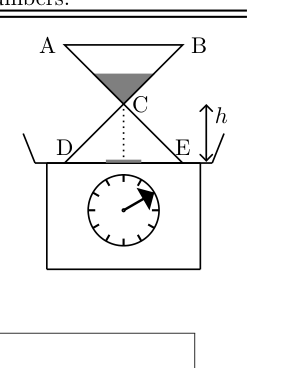
An hour glass is placed on a weighing scale. Initially all the sand of mass kg in the glass is held in the upper reservoir (ABC) and the mass of the glass alone is kg. At , the sand is released. It exits the upper reservoir at constant rate kg/s where is the mass of the sand in the upper reservoir at time sec. Assume that the speed of the falling sand is zero at the neck of the glass and after it falls through a constant height it instantaneously comes to rest on the floor (DE) of the hour glass. Obtain the reading on the scale for all times . Make a detailed plot of the reading vs time. [Marks: 9]
Quesito 4
Topic: Conservation of Momentum Metodi: Impulse-Momentum Theorem, Differential Equations Competenze: Physical Reasoning Objects: — Fonte: Testo (PDF) — p.3 Soluzione: Soluzioni (PDF)
Un bicchiere di un’ora viene posto su una bilancia. Inizialmente tutta la sabbia di massa kg nel vetro viene conservata nel serbatoio superiore (ABC) e la massa del vetro da solo è kg. A , la sabbia viene rilasciata. Esce dal serbatoio superiore a velocità costante kg/s, dove è la massa della sabbia nel serbatoio superiore al tempo sec. Supponiamo che la velocità della sabbia cadente sia zero al collo del vetro e che dopo aver caduto ad un’altezza costante , si riposi istantaneamente sul pavimento (DE) del vetro orario. Ottenere la lettura sulla scala per tutti i tempi . Fai un diagramma dettagliato della lettura contro il tempo. [Marchi: 9]
Quesito 4
Topic: Conservation of Momentum Metodi: Impulse-Momentum Theorem, Differential Equations Competenze: Physical Reasoning Objects: — Fonte: Testo (PDF) — p.3 Soluzione: Soluzioni (PDF)
[Marks: 10]
(a) Consider two short identical magnets each of mass and each of which maybe considered as point dipoles of magnetic moment . One of them is fixed to the floor with its magnetic moment pointing upwards and the other one is free and found to float in equilibrium at a height above the fixed dipole. The magnetic field due to a point dipole at a distance from it is
Obtain an expression for the magnitude of the dipole moment of the magnet in terms of and related quantities. [3]
(b) i. Consider a ring of mass rotating with uniform angular speed about its axis. A charge is smeared uniformly over it. Relate its angular momentum to its magnetic moment (). [1½]
ii. Assume that the electron is a sphere of uniform charge density rotating about its diameter with constant angular speed. Also assume that the same relation as in the previous part holds between its angular momentum and its magnetic dipole moment (). Further assume that where is Planck’s constant. Calculate . [1]
iii. Assume that the sole contribution to the dipole moment of a molecule comes from an unpaired electron. Also assume that the magnets in the part (5a) are kg each of and the unpaired electrons of the molecules are all aligned. Calculate the height . (Note: The molecular weight of ) [3]
iv. In an experiment is aligned along a magnetic field of T. It is flipped in a direction anti-parallel to the magnetic field by an incident photon. What should be the wavelength of this photon? [1½]
Topic: Magnetism, Modern-Quantum Physics Metodi: Physical Modeling, Torque & Angular Momentum Analysis Competenze: Physical Reasoning Objects: Magnet, Magnetic Dipole, Electron, Photon Fonte: Testo (PDF) — p.4 Soluzione: Soluzioni (PDF)
[Marchi: 10]
(a) Considerate due magneti identici brevi, ognuno di massa e ognuno dei quali può essere considerato come dipolo di punto di momento magnetico . Uno di essi è fissato al pavimento con il suo momento magnetico che punta verso l’alto e l’altro è libero e si trova a galleggiare in equilibrio ad un’altezza sopra il dipolo fisso. Il campo magnetico dovuto a un dipolo di punto a una distanza da esso è
Ottenere un’espressione della grandezza del momento di dipolo del magnete in termini di e di quantità correlate. [3]
(b) i. Considerate un anello di massa che ruota con velocità angolari uniformi intorno al suo asse. Una carica viene mescolata uniformemente sopra. Relazionare il suo momento angolare al suo momento magnetico (). [1½]
ii. Supponiamo che l’elettrone sia una sfera di densità di carica uniforme che ruota attorno al suo diametro con velocità angolare costante. Supponiamo inoltre che la stessa relazione che si verifica nella parte precedente sia tra il suo momento angolare e il suo momento di dipolo magnetico (). Supponiamo inoltre che dove è la costante di Planck. Calcolare . [1]
iii. Supponiamo che l’unico contributo al momento di dipole di una molecola proviene da un elettrone non accoppiato. Supponiamo inoltre che i magneti della parte (5a) siano kg ciascuno di e che gli elettroni non abbinati delle molecole siano tutti allineati. Calcolare l’altezza . (Nota: il peso molecolare di ) [3]
iv. In un esperimento è allineato lungo un campo magnetico di T. È girato in una direzione antiparallelle al campo magnetico da un fotone incidente. Qual dovrebbe essere la lunghezza d’onda di questo fotone? [1½]
Topic: Magnetism, Modern-Quantum Physics Metodi: Physical Modeling, Torque & Angular Momentum Analysis Competenze: Physical Reasoning Objects: Magnet, Magnetic Dipole, Electron, Photon Fonte: Testo (PDF) — p.4 Soluzione: Soluzioni (PDF)
The Van der Waals Gas:
Consider mole of a non-ideal (realistic) gas. Its equation of state maybe described by the Van der Waals equation
where and are positive constants. We take one mole of the gas (). You must bear in mind that one is often required to make judicious approximations to understand realistic systems. [Marks: 17]
(a) For this part only take . Obtain expressions in terms of , and constants for
i. the coefficient of volume expansion (); [1]
ii. the isothermal compressibility (). [1]
(b) Criticality:
The Van der Waals gas exhibits phase transition. A typical isotherm at low temperature is shown in the figure. Here L (G) represents the liquid (gas) phase and at there are three possible solutions for the volume (, , ). As the temperature is raised, at a certain temperature , the three values of the volume merge to a single value, (corresponding pressure being ). This is called the point of criticality. As the temperature is raised further there exists only one real solution for the volume and the isotherm resembles that of an ideal gas.
Quesito 6
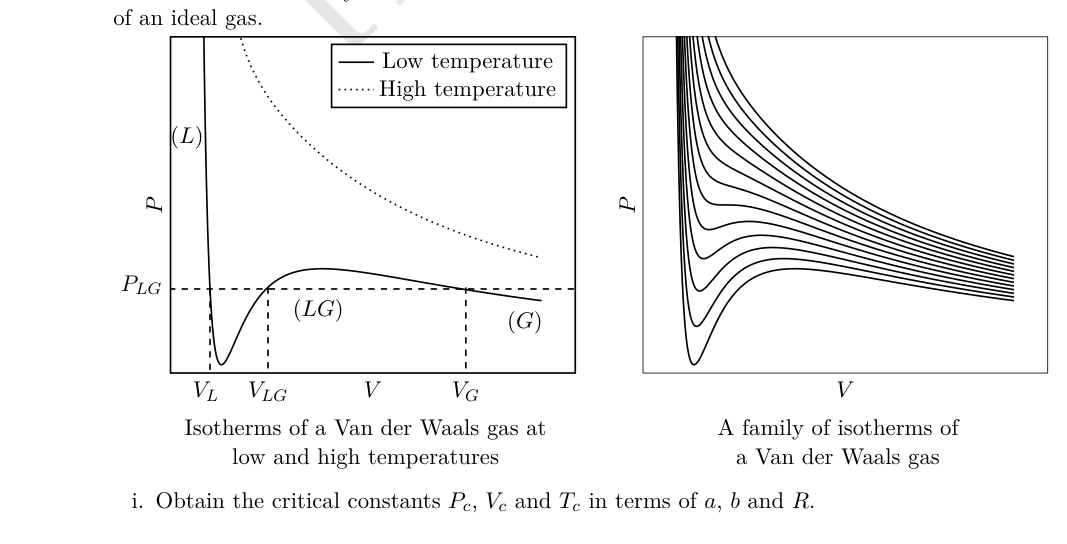
i. Obtain the critical constants , and in terms of , and . [4]
ii. Obtain the values of and for given K and . [1]
iii. The constant represents the volume of the gas molecules of the system. Estimate the size of a molecule. [1]
(c) The gas phase:
For the gaseous phase the volume . Let the pressure , the saturated vapour pressure.
i. Obtain the expression for in terms of , , and . [1½]
ii. State the corresponding expression for for an ideal gas. [½]
iii. Obtain for water given , Pa, and . Comment on your result. [2]
(d) The liquid phase:
For the liquid phase .
i. Obtain the expression for . [1½]
ii. Obtain the density of water (). You may take the molar mass to be . [1½]
iii. The heat of vaporization is the energy required to overcome the attractive intermolecular force as the system is taken from the liquid phase () to the gaseous phase (). The term represents this. Obtain the expression for the specific heat of vaporization per unit mass () and obtain its value for water. [2]
Topic: Thermodynamics, Kinetic Theory Metodi: Approximation & Series Expansion, Differential Equations Competenze: Mathematical Modeling Objects: Gas Fonte: Testo (PDF) — p.5 Soluzione: Soluzioni (PDF)
Il gas di Van der Waals:
Considerate la molina di un gas non ideale (realista). La sua equazione di stato forse descritta dall’equazione di Van der Waals
dove e sono costanti positive. Prendiamo un mole del gas (). Si deve tenere presente che spesso si richiede di fare approssimative ragionevoli per comprendere sistemi realistici. [Marchi: 17]
(a) Per questa parte si prenda solo . Ottenere espressioni in termini di , e costanti per
i. il coefficiente di espansione del volume (); [1]
ii. la compressibilità isotermica (). [1]
b) Criticità:
Il gas Van der Waals presenta una transizione di fase. La figura mostra un isotermo tipico a bassa temperatura. Qui L (G) rappresenta la fase liquida (gas) e a ci sono tre possibili soluzioni per il volume (, , ). Quando la temperatura è sollevata, a una certa temperatura , i tre valori del volume si fondono in un unico valore, (la pressione corrispondente è ). Questo è chiamato punto di criticalità. Quando la temperatura aumenta ulteriormente, esiste solo una soluzione reale per il volume e l’isoterma assomiglia a quella di un gas ideale.
Quesito 6
i. Ottenere le costanti critiche , e in termini di , e . [4]
ii. Ottenere i valori di e per dati K e . [1]
iii. La costante rappresenta il volume delle molecole di gas del sistema. Calcolare la dimensione di una molecola . [1]
c) La fase a gas:
Per la fase gassosa il volume . Lascia che la pressione , la pressione del vapore saturo.
i. Ottenere l’espressione per in termini di , , e . [1½]
ii. Indicare l’espressione corrispondente per per un gas ideale. [½]
iii. Ottenere per l’acqua con , Pa, e . Commenta il tuo risultato. [2]
d) Fase liquida:
Per la fase liquida .
i. Ottenere l’espressione per . [1½]
ii. Ottenere la densità dell’acqua (). Si può prendere la massa molare a . [1½]
iii. Il calore di vaporizzazione è l’energia necessaria per superare la forza intermolecolare attraente in quanto il sistema viene portato dalla fase liquida () alla fase gassosa (). Il termine lo rappresenta. Ottenere l’espressione per il calore specifico di vaporizzazione per unità di massa () e ottenere il suo valore per acqua. [2]
Topic: Thermodynamics, Kinetic Theory Metodi: Approximation & Series Expansion, Differential Equations Competenze: Mathematical Modeling Objects: Gas Fonte: Testo (PDF) — p.5 Soluzione: Soluzioni (PDF)
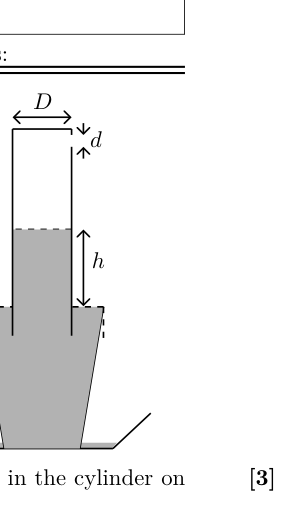
A small circular hole of diameter is punched on the side and the near the bottom of a transparent cylinder of diameter . The hole is initially sealed and the cylinder is filled with water of density . It is then inverted onto a bucket filled to the brim with water. The seal is removed, air rushes in and height of the water level (as measured from the surface level of the water in the bucket) is recorded at different times (). The figure below and the table in part (c) illustrates this process. Assume that air is an incompressible fluid with density and its motion into the cylinder is a streamline flow. Thus its speed is related to the pressure difference by the Bernoulli relation. Take the outside pressure to be atmospheric pressure Pa. [Marks: 15]
Quesito 7
(a) Obtain the dependence of the instantaneous speed of the water level in the cylinder on . [3]
(b) Obtain the dependence of on time. [3]
(c) The table gives the height as function of time . Draw a suitable linear graph ( on axis) from this data on the graph paper provided. Two graph papers are provided with this booklet in case you make a mistake. [4]
| (sec) | (cm) |
|---|---|
| 0.57 | 21.54 |
| 1.20 | 20.10 |
| 1.81 | 18.67 |
| 2.47 | 17.23 |
| 3.07 | 15.80 |
| 3.86 | 14.36 |
| 4.55 | 12.92 |
| 5.34 | 11.49 |
(d) From the graph and the following data: cm, , obtain [5]
i. The height at .
ii. The value of .
iii. The initial speed () of the water level.
Topic: Fluid Mechanics Metodi: Bernoulli’s Equation, Graph Linearization Competenze: Graph Linearization Objects: Cylinder Fonte: Testo (PDF) — p.7 Soluzione: Soluzioni (PDF)
Un piccolo buco circolare di diametro viene perforato sul lato e sulla parte inferiore di un cilindro trasparente di diametro . Il buco è inizialmente sigillato e il cilindro è riempito di acqua di densità . Poi viene invertito su un secchio pieno fino al bordo di acqua. Il sigillo viene rimosso, l’aria entra e l’altezza del livello dell’acqua (misurata dal livello superficiale dell’acqua nel secchio) viene registrata in tempi diversi (). La figura seguente e la tabella della parte c) illustrano questo processo. Supponiamo che l’aria sia un fluido incompressibile con densità e che il suo movimento nel cilindro sia un flusso di linea. La sua velocità è quindi correlata alla differenza di pressione dalla relazione di Bernoulli. Prendete la pressione esterna per essere la pressione atmosferica Pa. **[Marchi: 15] **
Quesito 7
(a) Ottenere la dipendenza della velocità istantanea del livello dell’acqua nel cilindro da . [3]
b) Ottenere la dipendenza di dal tempo. [3]
c) La tabella indica l’altezza in funzione del tempo . Disegnare un grafico lineare appropriato ( sull’asse ) a partire da questi dati sulla carta grafica fornita. In caso di errore, questo opuscolo contiene due carte grafiche. [4]
| (sec) | (cm) |
|---|---|
| 0.57 | 21.54 |
| 1.20 | 20.10 |
| 1.81 | 18.67 |
| 2.47 | 17.23 |
| 3.07 | 15.80 |
| 3.86 | 14.36 |
| 4.55 | 12.92 |
| 5.34 | 11.49 |
d) Dal grafico e dai seguenti dati: cm, , ottenere [5]
i. L’altezza a .
ii. Il valore di .
iii. La velocità iniziale () del livello dell’acqua.
Topic: Fluid Mechanics Metodi: Bernoulli’s Equation, Graph Linearization Competenze: Graph Linearization Objects: Cylinder Fonte: Testo (PDF) — p.7 Soluzione: Soluzioni (PDF)