- In the lower part of the earth’s atmosphere, the temperature decreases with increase of height. Choose the origin of the coordinate system at the ground level with the -axis vertically upward and the -axis horizontal. We assume a linear decrease of temperature such that the temperature at a height from the ground level is where is the temperature at the ground level. The constant . We consider the propagation of sound in the - plane. Ignore any attenuation, reflection, and diffraction of sound.
(a) [1] If is the speed of sound at the ground level, obtain an expression for the speed of sound at height , in terms of and .
(b) [2] Suppose sound propagates from the origin with an initial angle with the -axis. Obtain an expression for the angle made by the direction of propagation of sound with the horizontal at height , in terms of and .
(c) [3] Obtain an expression for the and coordinates of a point on the path of propagation as functions of .
(d) [3] For this part assume the direction of propagation of sound to be horizontal at the origin. For the case where is of the order 100 m or less, obtain an approximated expression relating and i.e. . Obtain for m. Value of
Topic: Oscillations & Waves Metodi: Wave Equation, Snell’s Law Competenze: Mathematical Modeling Objects: — Fonte: Testo (PDF) — p.2 Soluzione: Soluzioni (PDF)
- Nella parte inferiore dell’atmosfera terrestre, la temperatura diminuisce con l’aumento dell’altezza. Scegliere l’origine del sistema di coordinate a livello di terra con l’asse verticalmente verso l’alto e l’asse orizzontale. Supponiamo una diminuzione lineare della temperatura tale che la temperatura a un’altezza dal livello del suolo è dove è la temperatura a livello del suolo. La costante . Considerando la propagazione del suono nel piano -. Ignorare qualsiasi attenuazione, riflessione e diffrazione di
- Sono un suono.
(a) [1] Se è la velocità del suono a livello di terra, ottenere un’espressione per la velocità del suono ad altezza , in termini di e .
(b) [2] Supponiamo che il suono si propaga dall’origine con un angolo iniziale con l’asse . Ottenere un espressione per l’angolo ottenuto dalla direzione di propagazione del suono con l’orizzontale a altezza , in termini di e .
(c) [3] Ottenere un’espressione per le coordinate e di un punto sul percorso di propagazione come funzioni di .
(d) [3] Per questa parte si presume che la direzione di propagazione del suono sia orizzontale all’origine. Per se è dell’ordine di 100 m o meno, ottenere un’espressione approssimativa relativa e , ovvero . Ottenere per m. Valore di
Topic: Oscillations & Waves Metodi: Wave Equation, Snell’s Law Competenze: Mathematical Modeling Objects: — Fonte: Testo (PDF) — p.2 Soluzione: Soluzioni (PDF)
- Consider a particle of mass confined to a one dimensional box of length . The particle moves in the box with momentum colliding elastically with the walls. We consider the quantum mechanics of this system. As far as possible, express your answers in terms of .
(a) [1] At each energy state, the particle may be represented by a standing wave given by the de Broglie hypothesis. Express its wavelengths in terms of in the th energy state.
(b) [1] Write the energy of the th energy state, .
(c) [2] Let there be (mass ) electrons in this box where is an even number. Obtain the expression for the lowest possible total energy of the system (e.g., the ground state energy of this -particle system). Neglect coulombic interaction between the electrons.
(d) [3½] Express the total energy in terms of and relevant quantities when the system is in the first excited state. Also express the total energy in terms of and relevant quantities when the system is in the second excited state.
(e) [1] When the system is in the ground state, let the length of the box change slowly from to . Obtain the magnitude of the force on each wall in terms of , when .
(f) [1] Assuming is large () obtain the ratio of to the energy level of the highest occupied ground state.
(g) [1½] We assume once again that is large. Consider the possibility of the electrons forming a uniform continuum of length with constant linear density. Using dimensional analysis, calculate the gravitational energy of this system assuming that it depends on its total mass, universal gravitational constant and . Equate this (attractive) energy to the (repulsive) energy . Obtain in terms of and related quantities.
Topic: Modern-Quantum Physics Metodi: de Broglie Relation, Bohr Model & Quantization Competenze: Mathematical Modeling Objects: Electron Fonte: Testo (PDF) — p.2 Soluzione: Soluzioni (PDF)
- Considera una particella di massa confinata in una scatola unidimensional di lunghezza . La particella si muove nella scatola con impulso che colpisce elasticamente le pareti. Considerate il quantum la meccanica di questo sistema. Per quanto possibile, esprimere le risposte in termini di .
(a) [1] A ciascun stato energetico, la particella può essere rappresentata da un’onda in piedi data dal L’ipotesi di Broglie. Esprimere le sue lunghezze d’onda in termini di nello stato energetico .
(b) [1] Scrivere l’energia dello stato energetico , .
(c) [2] In questa casella ci siano elettroni (massa ) in cui è un numero pari. Ottenere il espressione per l’energia totale del sistema più bassa possibile (ad esempio, energia di stato di base) di questo sistema -particelle). Ignorare l’interazione coulombica tra gli elettroni.
(d) [3½] Esprimere l’energia totale in termini di e quantità rilevanti quando il sistema è in fase di
- Il primo stato eccitato. Esprimere anche l’energia totale in termini di e quantità pertinenti quando il sistema è in secondo stato eccitato.
(e) [1] Quando il sistema è in stato di scarico, lasciare che la lunghezza della scatola cambie lentamente da a . Ottenere la magnitudine della forza su ogni muro in termini di , quando .
(f) [1] Supponendo che sia grande () si ottiene il rapporto di al livello energetico del livello più alto lo stato di terra occupato.
(g) [1½] Supponiamo ancora una volta che sia grande. Considerate la possibilità che gli elettroni formino un continuum uniforme di lunghezza con densità lineare costante. Usando l’analisi dimensionale, calcolare l’energia gravitazionale di questo sistema supponendo che dipenda dal suo totale massa, costante gravitazionale universale e . Equazione di questa energia (attraente) alla (rifuorente) energia . Ottenere in termini di e quantità correlate.
Topic: Modern-Quantum Physics Metodi: de Broglie Relation, Bohr Model & Quantization Competenze: Mathematical Modeling Objects: Electron Fonte: Testo (PDF) — p.2 Soluzione: Soluzioni (PDF)
- A chain of length and linear density hangs from a horizontal support with both ends A and B fixed to a horizontal support as shown. The two fixed ends are close to each other. At time the end A is released. All vertical distances () are measured with respect to the horizontal support with the downward direction taken as positive (A and B are initially at ).
Quesito 3
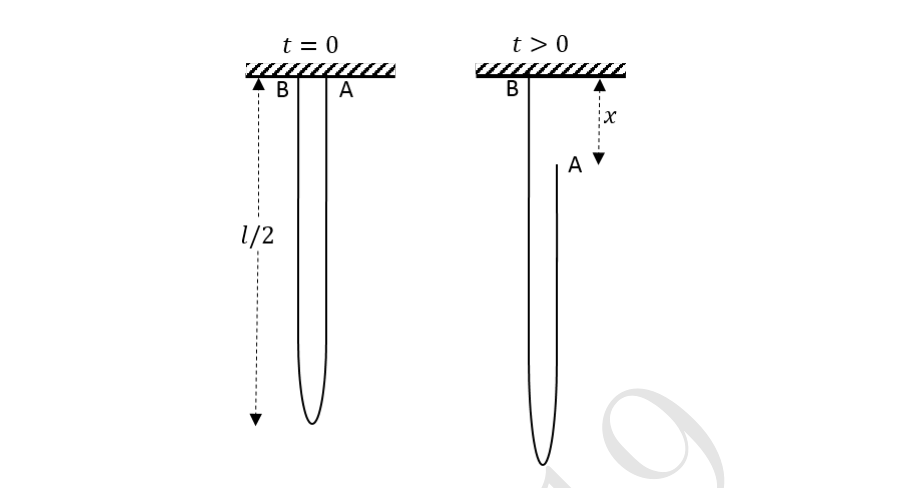
(a) [2] Obtain the momentum of the center of mass of the system when the end A has fallen by a distance , in terms of and speed .
(b) [1] Assume that the end A is falling freely under gravity, i.e., . Obtain the tension at the fixed end B just before the chain completes the fall and becomes entirely vertical.
Experimentally, the value of tension is found to be different from the above result. We adopt an alternative approach assuming conservation of mechanical energy.
(c) [2½] Obtain the potential energy of the chain and plot it versus . Take the potential energy of a point mass placed at the horizontal support to be zero.
(d) [2½] Obtain the speed when the end A has fallen by a distance . Assume that all sections of the falling (right side) part of the chain have the same speed.
(e) [3] Hence obtain at B as a function of and related quantities. You are advised to simplify your expression as far as possible.
(f) [1] Qualitatively sketch versus .
Topic: Newtonian Mechanics Metodi: Conservation of Energy, Conservation of Momentum Competenze: Mathematical Modeling Objects: String Fonte: Testo (PDF) — p.4 Soluzione: Soluzioni (PDF)
- Una catena di lunghezza e densità lineare pende da un supporto orizzontale con entrambe le estremità A e B fissate a un supporto orizzontale come mostrato. Le due estremità fisse sono vicine tra loro. All’istante l’estremità A viene rilasciata. Tutte le distanze verticali () sono misurate rispetto al supporto orizzontale, assumendo positiva la direzione verso il basso (A e B sono inizialmente a ).
Quesito 3
(a) [2] Ricava la quantità di moto del centro di massa del sistema quando l’estremità A è scesa di una distanza , in funzione di e della velocità .
(b) [1] Supponi che l’estremità A cada liberamente sotto l’azione della gravità, cioè . Ricava la tensione all’estremità fissa B appena prima che la catena completi la caduta e diventi interamente verticale.
Sperimentalmente, il valore della tensione risulta diverso dal risultato precedente. Adottiamo un approccio alternativo assumendo la conservazione dell’energia meccanica.
(c) [2½] Ricava l’energia potenziale della catena e tracciane il grafico in funzione di . Assumi nulla l’energia potenziale di una massa puntiforme posta in corrispondenza del supporto orizzontale.
(d) [2½] Ricava la velocità quando l’estremità A è scesa di una distanza . Assumi che tutte le sezioni della parte (lato destro) della catena in caduta abbiano la stessa velocità.
(e) [3] Ricava quindi in B in funzione di e di grandezze correlate. Ti consigliamo di semplificare la tua espressione il più possibile.
(f) [1] Traccia qualitativamente il grafico di in funzione di .
Topic: Newtonian Mechanics Metodi: Conservation of Energy, Conservation of Momentum Competenze: Mathematical Modeling Objects: String Fonte: Testo (PDF) — p.4 Soluzione: Soluzioni (PDF)
- Consider a long narrow cylinder of cross section filled with a compressible liquid up to height whose density is a function of the pressure as where and are constants. The depth is measured from the free surface of the liquid where the pressure is equal to the atmospheric pressure ().
Quesito 4
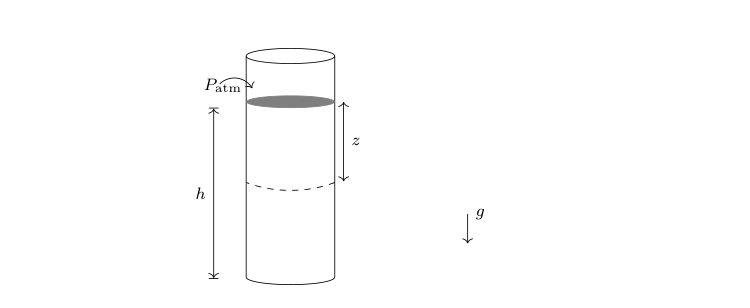
(a) [5] Obtain the pressure () as a function of . Obtain the mass () of liquid in the tube.
(b) [2] Let be the pressure at , if the liquid were incompressible with density . Assuming that obtain an approximated expression for .
Topic: Fluid Mechanics Metodi: Hydrostatic Equilibrium, Calculus-Integration Competenze: Mathematical Modeling Objects: Cylinder Fonte: Testo (PDF) — p.5 Soluzione: Soluzioni (PDF)
- Considera un cilindro lungo e stretto di sezione trasversale pieno di un liquido compressibile fino all’altezza la cui densità è una funzione della pressione come in cui e sono costanti. La profondità viene misurata dalla superficie libera del liquido dove la pressione è pari alla pressione atmosferica ().
Quesito 4
(a) [5] Ottenere la pressione () come funzione di . Ottenere la massa () del liquido nel tubo.
(b) [2] Se il liquido è incompressibile con densità , deve essere la pressione a . Presupposto che ottenga un’espressione approssimativa per .
Topic: Fluid Mechanics Metodi: Hydrostatic Equilibrium, Calculus-Integration Competenze: Mathematical Modeling Objects: Cylinder Fonte: Testo (PDF) — p.5 Soluzione: Soluzioni (PDF)
- A pair of long parallel metallic rails of negligible resistance and separation are placed horizontally. A horizontal metal rod (dark thick line) of mass and resistance is placed perpendicularly onto the rails at one end (as shown). A uniform magnetic field exists perpendicular to the plane of the paper (pointing into the page). One end of the rail track is connected to a key (K) and a capacitor of capacitance charged to voltage . At the key is closed. Neglect friction and self inductance of the loop.
Quesito 5
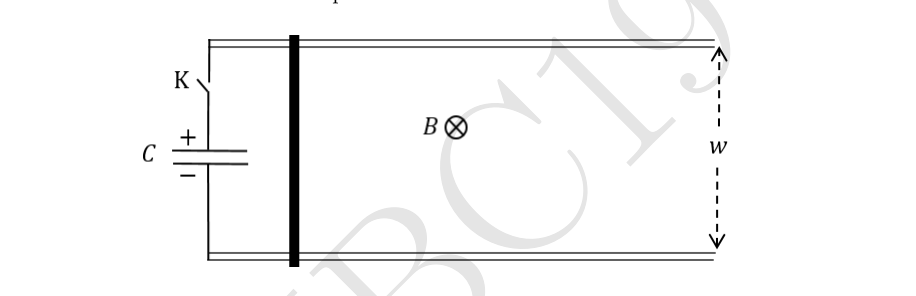
(a) [6] What is the final speed () attained by the rod?
(b) [2] Consider the ratio of the maximum kinetic energy attained by the rod to the energy initially stored in the capacitor. What is , the maximum possible value of , by appropriately choosing ?
(c) [1] Let kg, m, V and a bank of capacitors ensures that F. If , calculate the value of .
Topic: Electromagnetic Induction Metodi: Faraday’s Law of Induction, Differential Equations Competenze: Mathematical Modeling Objects: Rod, Capacitor, Switch, Wire Fonte: Testo (PDF) — p.6 Soluzione: Soluzioni (PDF)
- Una coppia di lunghe rotaie metalliche parallele di resistenza trascurabile e separazione è disposta orizzontalmente. Un’asta metallica orizzontale (linea spessa scura) di massa e resistenza è posta perpendicolarmente sulle rotaie a un’estremità (come mostrato). Un campo magnetico uniforme è presente perpendicolarmente al piano del foglio (entrante nella pagina). Un’estremità del binario è collegata a un interruttore (K) e a un condensatore di capacità carico alla tensione . A l’interruttore viene chiuso. Trascura l’attrito e l’autoinduttanza del circuito.
Quesito 5
(a) [6] Qual è la velocità finale () raggiunta dall’asta?
(b) [2] Considera il rapporto tra la massima energia cinetica raggiunta dall’asta e l’energia inizialmente immagazzinata nel condensatore. Qual è , il massimo valore possibile di , scegliendo opportunamente ?
(c) [1] Siano kg, m, V e un banco di condensatori garantisce che F. Se , calcola il valore di .
Topic: Electromagnetic Induction Metodi: Faraday’s Law of Induction, Differential Equations Competenze: Mathematical Modeling Objects: Rod, Capacitor, Switch, Wire Fonte: Testo (PDF) — p.6 Soluzione: Soluzioni (PDF)
- Consider moles of a monoatomic non-ideal (realistic) gas. Its equation of state may be described by the van der Waal’s equation where and are positive constants and other symbols have their usual meanings. The internal energy change of a realistic gas can be given by As indicated in the above expression, the derivative of pressure is taken at constant volume. We take one mole of the gas () through a Diesel cycle (ABCDA) as shown in the following - diagram (diagram is not to scale). During the whole cycle assume that the molar heat capacity at constant volume () remains constant at . Path AB and CD are reversible adiabats. (, with , , .)
Quesito 6
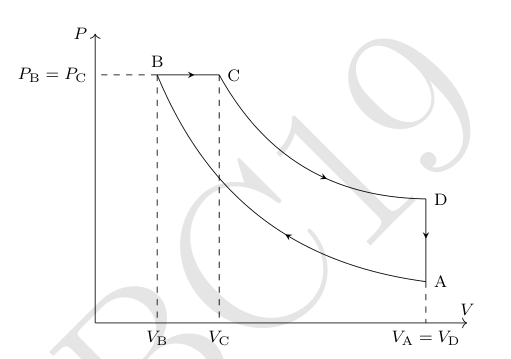
(a) [2½] Obtain the temperature at B () in terms of temperature at A (), , and constants only.
(b) [1½] Let temperature at A to be K, l, l, l, , and l/mol. Calculate the highest temperature reached during the whole cycle. Highest temperature =
(c) [3] Calculate the efficiency of the cycle. Value of
(d) [7] Draw the corresponding - (entropy) and - diagram for the Diesel cycle. Wherever possible, mention the numerical values of , , and on the diagrams.
Topic: Thermodynamics Metodi: First Law of Thermodynamics, Thermodynamic Cycle Analysis Competenze: Mathematical Modeling Objects: Gas Fonte: Testo (PDF) — p.7 Soluzione: Soluzioni (PDF)
- Si consideri molli di un gas monoatomo non ideale (realistico). La sua equazione di stato può essere descritta per l’equazione di van der Waal dove e sono costanti positive e altri simboli hanno il loro significato usuale. Il sistema interno Il cambio energetico di un gas realistico può essere dato da Come indicato nell’espressione di cui sopra, la derivata della pressione viene presa a volume costante. Prendiamo un mole del gas () attraverso un ciclo Diesel (ABCDA) come mostrato di seguito: - diagramma (il diagramma non è a scala). Durante l’intero ciclo si presume che il calore molare La capacità a volume costante () rimane costante a . Il percorso AB e CD sono reversibili
- Adiabat. (, con , , .)
Quesito 6
(a) [2½] Ottenere la temperatura a B () in termini di temperatura a A (), , e costanti
- Solo.
(b) [1½] La temperatura a A deve essere K, l, l, l, e l/mol. Calcolare la temperatura più alta raggiunta durante il tutto il ciclo. Temperatura massima =
(c) [3] Calcolare l’efficienza del ciclo. Valore di
(d) [7] Disegnare il diagramma corrispondente - (entropia) e - per il ciclo Diesel. Dovunque se possibile, menzionare i valori numerici di , e sui diagrammi.
Topic: Thermodynamics Metodi: First Law of Thermodynamics, Thermodynamic Cycle Analysis Competenze: Mathematical Modeling Objects: Gas Fonte: Testo (PDF) — p.7 Soluzione: Soluzioni (PDF)
- As shown, a magnet of mass g slides on a rough non-magnetic metallic inclined plane which makes an angle with the horizontal. One can change the angle of inclination of the plane. Due to relative motion between the magnet and the plane, eddy currents are generated inside the metal which retard motion of the magnet. Assume that the magnitude of the resistive force on the magnet is where is a positive constant and is the instantaneous speed of the magnet. Let be the coefficient of kinetic friction between the magnet and the plane.
Quesito 7
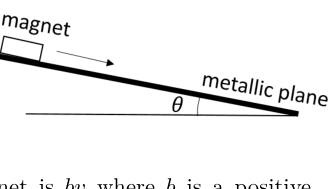
(a) [2] If the magnet starts moving from rest at time , obtain the expression of its terminal velocity . Also obtain the displacement along the inclined plane as a function of time. Take .
(b) [4] For a fixed a student records for all values of as shown in the table below. Draw a suitable graph and obtain the terminal velocity of the magnet from this graph. For this and the next part, three graph papers are provided with this booklet. No extra graph papers will be provided.
| (s) | (m) |
|---|---|
| 0.016 | 0.001 |
| 0.049 | 0.003 |
| 0.070 | 0.006 |
| 0.090 | 0.010 |
| 0.120 | 0.017 |
| 0.174 | 0.029 |
| 0.230 | 0.046 |
| 0.270 | 0.058 |
| 0.320 | 0.074 |
| 0.370 | 0.091 |
Graph is plotted on page no. : ____
(c) [7] The above process is repeated for various values of . The obtained values of terminal velocities for the different are given below.
| (degree) | (m/s) |
|---|---|
| 19 | 0.15 |
| 24 | 0.23 |
| 28 | 0.29 |
| 35 | 0.40 |
| 40 | 0.46 |
| 45 | 0.53 |
| 48 | 0.58 |
| 52 | 0.62 |
Plot a suitable graph and obtain the values of and from this graph. Graph is plotted on page no. : ____
Topic: Electromagnetic Induction Metodi: Free-Body Diagram, Differential Equations Competenze: Experimental Data Analysis Objects: Magnet, Inclined Plane Fonte: Testo (PDF) — p.8 Soluzione: Soluzioni (PDF)
- Come mostrato, un magnete di massa g si scivola su una Piano inclinato metallico non magnetico che fa un angolo con l’orizzontale. Si può cambiare l’angolo di inclinazione dell’aereo. A causa del movimento relativo tra il magnete e il piano, correnti eddy sono generati all’interno del metallo che ritardano il movimento del magnete. Supponiamo che la grandezza della forza di resistenza sul magnete sia dove è un costante e è la velocità istantanea del magnete. Il coefficiente di kinetica è frattura tra il magnete e il piano.
Quesito 7
(a) [2] Se il magnete inizia a muoversi dal riposo al tempo , ottenere l’espressione del suo terminale velocità . Ottenere anche il spostamento lungo il piano inclinato come funzione di
- Il tempo. Prendi .
(b) [4] Per un fisso, uno studente registra per tutti i valori di come mostrato nella tabella seguente. Scatta un grafico appropriato e ottenere la velocità terminale del magnete da questo grafico. Per In questa e nella parte successiva, sono forniti tre documenti grafici con questo opuscolo. Nessun grafico extra
- saranno forniti documenti.
| (s) | (m) |
|---|---|
| 0.016 | 0.001 |
| 0.049 | 0.003 |
| 0.070 | 0.006 |
| 0.090 | 0.010 |
| 0.120 | 0.017 |
| 0.174 | 0.029 |
| 0.230 | 0.046 |
| 0.270 | 0.058 |
| 0.320 | 0.074 |
| 0.370 | 0.091 |
Il grafico è tracciato sulla pagina n. : ____
(c) [7] Il procedimento di cui sopra è ripetuto per vari valori di . Valori ottenuti del terminal le velocità per le diverse sono indicate di seguito.
| (degree) | (m/s) |
|---|---|
| 19 | 0.15 |
| 24 | 0.23 |
| 28 | 0.29 |
| 35 | 0.40 |
| 40 | 0.46 |
| 45 | 0.53 |
| 48 | 0.58 |
| 52 | 0.62 |
Tracciare un grafico appropriato e ottenere da questo grafico i valori di e . Il grafico è tracciato sulla pagina n. : ____
Topic: Electromagnetic Induction Metodi: Free-Body Diagram, Differential Equations Competenze: Experimental Data Analysis Objects: Magnet, Inclined Plane Fonte: Testo (PDF) — p.8 Soluzione: Soluzioni (PDF)