A certain gas obeys the equation of state , where is a dimensioned constant. Here represents the internal energy of the gas, the entropy, the volume and the fixed number of particles of the system.
(a) [3] Let such a gas be filled in a box of volume and the internal energy of the system be . A partition is placed to divide the box into two equal parts, each having volume . For each part, the internal energy is now and the dimensioned constant be . Obtain and .
(b) [2] The temperature can be expressed in terms of the derivative of internal energy as where the subscripts indicate that the differentiation has been carried out keeping and constant. In a similar way, express pressure in terms of a derivative of the internal energy.
(c) [1] Find the equation of state of the given system relating , , and .
(d) [7] One mole of this gas executes a Carnot cycle between reservoirs at temperatures and (). Obtain the heat change in the process () and work done by the system in the processes and (, ) of the cycle. Express your answers only in terms of temperatures , , volumes , , and the other constants.
\begin{document}
\begin{tikzpicture}
\draw[->] (0,0) -- (5,0) node[right] {$V$};
\draw[->] (0,0) -- (0,4) node[above] {$P$};
\draw[thick] (1,3.4) .. controls (1.6,2.6) and (2.2,2.2) .. (2.8,1.9);
\draw[thick] (2.8,1.9) .. controls (3.2,1.7) and (3.6,1.5) .. (4.0,1.35);
\draw[thick] (4.0,1.35) .. controls (3.4,1.1) and (2.6,0.95) .. (1.8,0.85);
\draw[thick] (1.8,0.85) .. controls (1.5,1.7) and (1.1,2.6) .. (1,3.4);
\node[above left] at (1,3.4) {$A$};
\node[above right] at (2.8,1.9) {$B$};
\node[right] at (4.0,1.35) {$C$};
\node[below] at (1.8,0.85) {$D$};
\draw[dashed] (1,3.4) -- (1,0) node[below] {$V_A$};
\draw[dashed] (2.8,1.9) -- (2.8,0) node[below] {$V_B$};
\end{tikzpicture}
\end{document}
Topic: Thermodynamics Metodi: First Law of Thermodynamics, Thermodynamic Cycle Analysis Competenze: Mathematical Modeling Objects: Gas Fonte: Testo (PDF) — p.2 Soluzione: Soluzioni (PDF)
Un certo gas obbedisce all’equazione dello stato , dove è una costante dimensionata. Qui rappresenta l’energia interna del gas, l’entropia, il volume e il numero fisso di particelle del sistema.
a) [3] Un tale gas deve essere riempito in una scatola di volume e l’energia interna del sistema deve essere . Si colloca una partizione per dividere la scatola in due parti uguali, ognuna con un volume . Per ciascuna parte, l’energia interna è ora e la costante dimensionata è . Ottenere e .
b) [2] La temperatura può essere espressa in termini di derivata di energia interna come quando i sottoscrizioni indicano che la differenziazione è stata effettuata mantenendo le costanti e . In modo simile, esprime la pressione in termini di derivata dell’energia interna.
c) [1] Trova l’equazione dello stato del sistema dato relativa a , e .
d) [7] Un mole di questo gas esegue un ciclo di Carnot tra i serbatoi a temperature e (). Ottenere il cambiamento di calore nel processo () e il lavoro svolto dal sistema nei processi e (, ) del ciclo. Esprimere le risposte solo in termini di temperature , , volumi , e altre costanti.
\begin{document}
\begin{tikzpicture}
\draw[->] (0,0) -- (5,0) node[right] {$V$};
\draw[->] (0,0) -- (0,4) node[above] {$P$};
\draw[thick] (1,3.4) .. controls (1.6,2.6) and (2.2,2.2) .. (2.8,1.9);
\draw[thick] (2.8,1.9) .. controls (3.2,1.7) and (3.6,1.5) .. (4.0,1.35);
\draw[thick] (4.0,1.35) .. controls (3.4,1.1) and (2.6,0.95) .. (1.8,0.85);
\draw[thick] (1.8,0.85) .. controls (1.5,1.7) and (1.1,2.6) .. (1,3.4);
\node[above left] at (1,3.4) {$A$};
\node[above right] at (2.8,1.9) {$B$};
\node[right] at (4.0,1.35) {$C$};
\node[below] at (1.8,0.85) {$D$};
\draw[dashed] (1,3.4) -- (1,0) node[below] {$V_A$};
\draw[dashed] (2.8,1.9) -- (2.8,0) node[below] {$V_B$};
\end{tikzpicture}
\end{document}
Topic: Thermodynamics Metodi: First Law of Thermodynamics, Thermodynamic Cycle Analysis Competenze: Mathematical Modeling Objects: Gas Fonte: Testo (PDF) — p.2 Soluzione: Soluzioni (PDF)
[12] An insulating uniformly charged cylindrical shell of radius lies with its axis along the axis. The shell’s moment of inertia per unit length about the axis and the surface charge density are and respectively. The cylinder is placed in an external uniform magnetic field , and is initially at rest. Starting at the external magnetic field is slowly reduced to zero. What is the final angular velocity of the cylinder?
Quesito 2
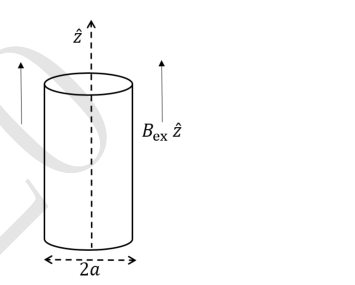
Topic: Electromagnetic Induction Metodi: Faraday’s Law of Induction, Torque & Angular Momentum Analysis Competenze: Mathematical Modeling Objects: Cylinder Fonte: Testo (PDF) — p.3 Soluzione: Soluzioni (PDF)
[12] Un involucro cilindrico isolante con carica uniforme del raggio si trova con il suo asse lungo l’asse . Il momento di inerzia della conchiglia per unità di lunghezza circa l’asse e la densità di carica superficiale sono rispettivamente e . Il cilindro è collocato in un campo magnetico esterno uniforme e iniziale a riposo. A partire da il campo magnetico esterno viene lentamente ridotto a zero. Qual è la velocità angolare finale del cilindro?
Quesito 2
Topic: Electromagnetic Induction Metodi: Faraday’s Law of Induction, Torque & Angular Momentum Analysis Competenze: Mathematical Modeling Objects: Cylinder Fonte: Testo (PDF) — p.3 Soluzione: Soluzioni (PDF)
Consider the Bohr model of the hydrogen atom. Let and be the mass and magnitude of the charge of the electron respectively. Let be the ground state radius (Bohr radius).
(a) [1] Obtain an expression for the ionisation energy of the ground state of the hydrogen atom in terms of and constants.
(b) [2] Consider a singly ionised helium atom . Obtain the ground state ionisation energy of in terms of .
(c) [1] Now consider a two electron system with arbitrary atomic number . Use the Bohr model to obtain the ground state radius () in terms of and . Assume the two electrons are in the same circular orbit and as far apart as possible.
(d) [3] Derive an expression for the first ionisation energy for two electron system with arbitrary in terms of and .
(e) [8] The table below contains the experimental data of (in units of Rydberg where ) versus for various two-electron systems.
| Ion | ||
|---|---|---|
| 1 | 0.055 | |
| He | 2 | 1.81 |
| 3 | 5.56 | |
| 4 | 11.32 | |
| 5 | 19.07 | |
| 6 | 28.83 | |
| 7 | 40.60 | |
| 8 | 54.37 | |
| 9 | 70.15 |
Experimental values were not found to be equal to the theoretical predictions. This difference arises mainly from non-inclusion of Pauli’s principle in the theoretical derivation of part (d). It was suggested that if the value of was reduced by some fixed amount () in the final expression of obtained in part (d), then . Draw a suitable linear plot and from the graph find . Two graph papers are provided with this booklet in case you make a mistake.
Topic: Modern-Quantum Physics Metodi: Bohr Model & Quantization, Coulomb’s Law Competenze: Mathematical Modeling Objects: Atom, Electron Fonte: Testo (PDF) — p.3 Soluzione: Soluzioni (PDF)
Considerate il modello di Bohr dell’atomo di idrogeno. e siano rispettivamente la massa e la magnitudine della carica dell’elettrone. Il valore di deve essere il raggio di stato di terra (raggio di Bohr).
a) [1] Ottenere un’espressione dell’energia di ionizzazione dello stato di base dell’atomo di idrogeno in termini di e di costanti.
b) [2] Considerare un atomo di elio ionizzato singolo . Ottenere l’energia di ionizzazione dello stato di base di in termini di .
(c) [1] Ora consideriamo un sistema a due elettroni con numero atomico arbitrario . Utilizzare il modello di Bohr per ottenere il raggio di stato di terra () in termini di e . Supponiamo che i due elettroni siano nella stessa orbita circolare e distanti il più possibile.
(d) [3] Derivare un’espressione per la prima energia di ionizzazione per due sistemi elettronici con arbitrario in termini di e .
e) [8] La tabella seguente contiene i dati sperimentali di (in unità di Rydberg dove ) rispetto a per vari sistemi a due elettroni.
| Ion | ||
|---|---|---|
| 1 | 0.055 | |
| He | 2 | 1.81 |
| 3 | 5.56 | |
| 4 | 11.32 | |
| 5 | 19.07 | |
| 6 | 28.83 | |
| 7 | 40.60 | |
| 8 | 54.37 | |
| 9 | 70.15 |
I valori sperimentali non sono stati trovati uguali alle previsioni teoriche. Questa differenza deriva principalmente dalla non inclusione del principio di Pauli nella derivazione teorica della parte (d). È stato suggerito che se il valore di è stato ridotto di un certo importo fisso () nell’espressione finale di ottenuta nella parte (d), allora . Disegnare un grafico lineare appropriato e trovare dal grafico . In caso di errore, questo opuscolo contiene due carte grafiche.
Topic: Modern-Quantum Physics Metodi: Bohr Model & Quantization, Coulomb’s Law Competenze: Mathematical Modeling Objects: Atom, Electron Fonte: Testo (PDF) — p.3 Soluzione: Soluzioni (PDF)
A sound source is performing uniform circular motion with time period . It is continuously emitting sound of a fixed frequency . Two detectors 1 and 2 are placed somewhere in the same plane as the circular trajectory of the source. The frequency , of the sound received by the two detectors is plotted as a function of time as shown below (the clocks of the two detectors are synchronized).
Quesito 4
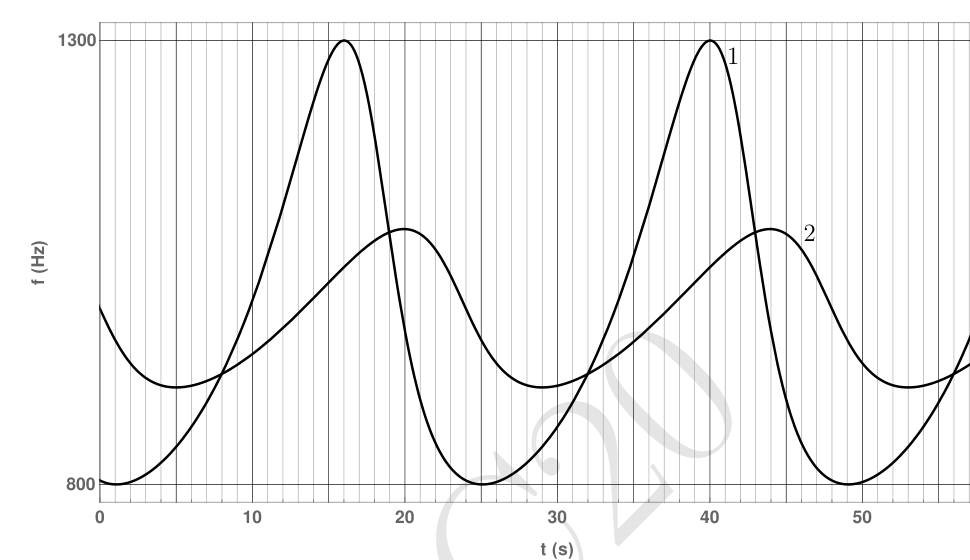
Take the speed of sound in the medium to be 330 m/s.
(a) [2] Determine the time period of the source.
(b) [6] The figure below shows the circular trajectory of the source . Qualitatively mark the positions of both the detectors by indicating 1 and 2. Here denotes the centre of the trajectory. You must provide detailed justification of your answer in the detailed answer sheet.
Quesito 4
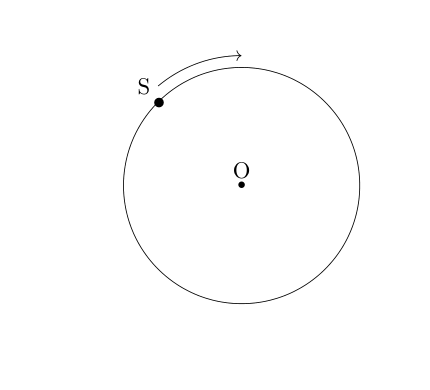
(c) [3] Obtain the frequency of the source.
(d) [9] Calculate the distance () between the detectors.
Topic: Oscillations & Waves Metodi: Physical Modeling, Approximation & Series Expansion Competenze: Experimental Data Analysis Objects: — Fonte: Testo (PDF) — p.5 Soluzione: Soluzioni (PDF)
Una fonte sonora esegue un movimento circolare uniforme con periodo di tempo . Esso emette continuamente un suono di frequenza fissa . Due sensori 1 e 2 sono posizionati in qualche luogo nello stesso piano della traiettoria circolare della fonte. La frequenza del suono ricevuto dai due sensori è tracciata come funzione del tempo come mostrato di seguito (gli orologi dei due sensori sono sincronizzati).
Quesito 4
Si deve prendere la velocità del suono nel mezzo a 330 m/s.
a) [2] Determinare il periodo di tempo della fonte.
b) [6] La figura seguente mostra la traiettoria circolare della fonte . Marcare qualitativamente le posizioni di entrambi i sensori indicando 1 e 2. Qui indica il centro della traiettoria. La risposta deve essere giustificata in dettaglio nella scheda delle risposte.
Quesito 4
c) [3] Ottenere la frequenza della fonte.
(d) [9] Calcolare la distanza () tra i sensori.
Topic: Oscillations & Waves Metodi: Physical Modeling, Approximation & Series Expansion Competenze: Experimental Data Analysis Objects: — Fonte: Testo (PDF) — p.5 Soluzione: Soluzioni (PDF)
[20] The following is the top view of an assembly kept on a smooth horizontal table.
Quesito 5
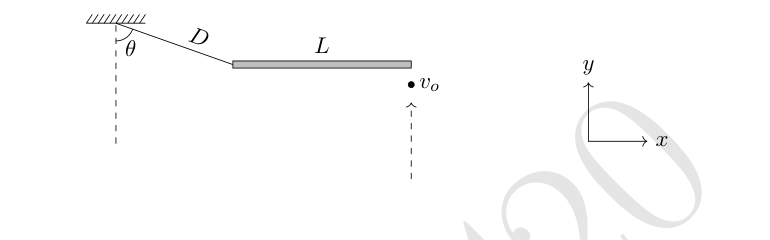
A massless inextensible string of length lies with one end fixed, while the other is attached to one end of a uniform rod of length . The system is initially at rest with the rod aligned along the -axis and the string stretched to its natural length at an angle with the negative -axis (). At a certain instant, a bullet of the same mass as the rod and negligible dimensions is fired horizontally along the positive -direction. The bullet hits the rod at its right end with velocity and gets lodged in it, the impact being nearly instantaneous. What is the tension () in the string immediately after the impact? Assume the string doesn’t break.
Topic: Rotational Dynamics, Conservation of Momentum Metodi: Torque & Angular Momentum Analysis, Conservation of Momentum Competenze: Mathematical Modeling Objects: String, Rod, Projectile Fonte: Testo (PDF) — p.6 Soluzione: Soluzioni (PDF)
[20] La seguente è la vista di cima di un assemblaggio tenuto su un tavolo orizzontale liscio.
Quesito 5
Una corda inestensibile senza massa di lunghezza si trova con una estremità fissa, mentre l’altra è attaccata ad una estremità di una canna uniforme di lunghezza . Il sistema è inizialmente a riposo con la canna allineata lungo l’asse e la corda estesa alla sua lunghezza naturale in un angolo con l’asse negativo (). In un certo istante, un proiettile di massa e dimensioni trascurabili della canna viene sparato orizzontalmente lungo la direzione positiva. Il proiettile colpisce la canna alla sua estremità destra con velocità e si allontana in essa, l’impatto è quasi istantaneo. Qual è la tensione () nella corda immediatamente dopo l’impatto? Supponiamo che la corda non si rompa.
Topic: Rotational Dynamics, Conservation of Momentum Metodi: Torque & Angular Momentum Analysis, Conservation of Momentum Competenze: Mathematical Modeling Objects: String, Rod, Projectile Fonte: Testo (PDF) — p.6 Soluzione: Soluzioni (PDF)