A Newtonian reflector type of telescope has a concave mirror with a 2.00 m radius of curvature as its primary mirror. It is fitted with camera at primary focus with an achromatic camera lens of 4.00 cm focal length.
(a) [2] What is the angular magnification of this system?
(b) [3] We observe a 25 000 km diameter sunspot with this system. What will be the angular size of the sunspot in the image?
(c) [7] The camera lens is now removed and an image detector is placed in such a way that a well-focused sunspot image due to primary mirror could be observed with yellow light (wavelength 550 nm). We wish to observe the same region now in green light (wavelength 465 nm). For this, we introduce a green filter, which blocks all other wavelengths except green light, in front of the detector. If the thickness of this plane parallel glass plate (refractive index 1.53) is mm, how much will be the change in the position of the image?
Topic: Geometric Optics Metodi: Thin Lens & Mirror Equation, Snell’s Law Competenze: Physical Reasoning Objects: Mirror, Lens Fonte: Testo (PDF) — p.2 Soluzione: Soluzioni (PDF)
Un tipo di telescopio riflettore newtoniano ha uno specchio concavo con un raggio di curvatura di 2,00 m come specchio principale. È dotato di una fotocamera a foco primario con un obiettivo fotocamera acromatica di 4,00 cm di lunghezza focale.
(a) [2] Qual è l’ingrandimento angolare di questo sistema?
b) [3] Con questo sistema si osserva una macchia solare di 25 000 km di diametro. Qual sarà la dimensione angolare della macchia solare nell’immagine?
c) [7] L’obiettivo della fotocamera viene ora rimosso e un rilevatore di immagini è posizionato in modo tale che un’immagine di macchia solare ben focalizzata a causa dello specchio primario possa essere osservata con luce gialla (lunghezza d’onda 550 nm). Desideriamo osservare la stessa regione ora a luce verde (lunghezza d’onda 465 nm). Per questo, introduciamo un filtro verde, che blocca tutte le altre lunghezze d’onda tranne la luce verde, davanti al rilevatore. Se lo spessore di questa piastra di vetro parallelo piano (indice di refratto 1,53) è mm, quanto sarà il cambiamento nella posizione dell’immagine?
Topic: Geometric Optics Metodi: Thin Lens & Mirror Equation, Snell’s Law Competenze: Physical Reasoning Objects: Mirror, Lens Fonte: Testo (PDF) — p.2 Soluzione: Soluzioni (PDF)
A rectangular sheet of paper was rolled to form a cylinder, with exactly two layers of sheet along the curved surface. This cylinder is cut such that the plane of the cut makes an angle of with the axis of cylinder. The paper was then unrolled and spread on a flat table.
(a) [2] Draw a figure to show how the unrolled paper would appear.
(b) [4] Justify your answer with appropriate mathematical arguments.
Topic: Mathematics Metodi: Physical Modeling, Calculus-Integration Competenze: Mathematical Modeling Objects: Cylinder Fonte: Testo (PDF) — p.2 Soluzione: Soluzioni (PDF)
Un foglio rettangolare di carta fu rotolato per formare un cilindro, con esattamente due strati di foglio lungo la superficie curva. Questo cilindro è tagliato in modo tale che il piano del taglio faccia un angolo di con l’asse del cilindro. Il giornale veniva poi sfiorato e ripiegato su un tavolo piatto.
a) [2] Disegnare una figura per mostrare l’aspetto della carta non laminata.
(b) [4] giustifica la tua risposta con argomenti matematici appropriati.
Topic: Mathematics Metodi: Physical Modeling, Calculus-Integration Competenze: Mathematical Modeling Objects: Cylinder Fonte: Testo (PDF) — p.2 Soluzione: Soluzioni (PDF)
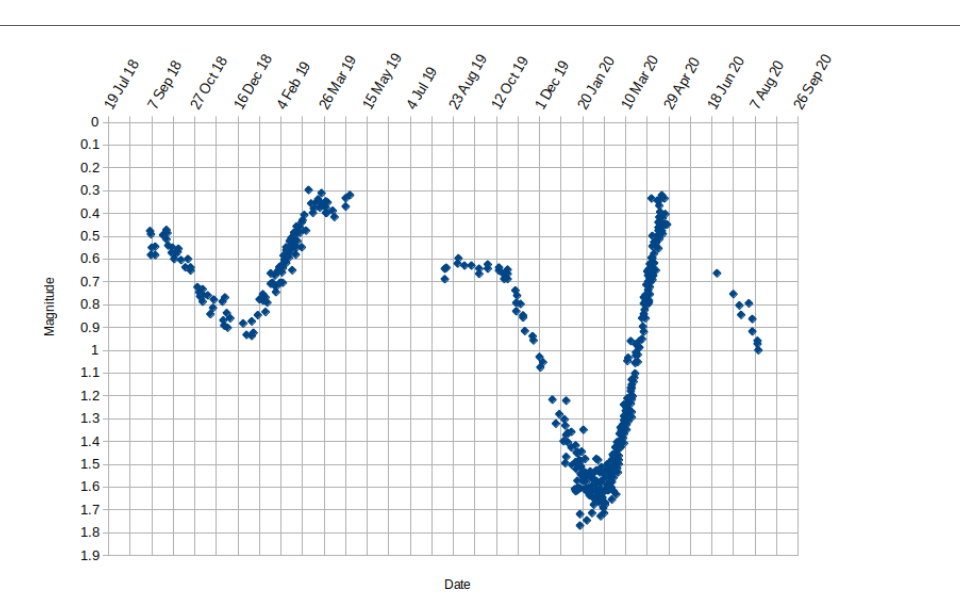
Betelgeuse, a red supergiant star, in the constellation of Orion, is known as an irregular variable star. Its magnitude varies between to from time to time. However, last year the astronomers were surprised to observe an unexpected dimming of Betelgeuse. We may assume this event started from 12 October 2019. Given below is a plot of the observed magnitude vs time (light-curve) of Betelgeuse.
Notes:
- The relation between magnitude of the star and light flux received from it is given by: where and are magnitudes measured in two different observations and and are corresponding light fluxes.
- Mass of Betelgeuse: kg
- Distance of Betelgeuse from the Earth: pc
- Typical radius of Betelgeuse: m
(a) [8] One of the proposed models for this dimming was that the whole star suddenly started expanding and hence cooled down. Let us assume that the star is still acting as perfect black body at each stage of expansion (and subsequent contraction). By other measurements, we know that the star’s effective temperature at the start of expansion was K and the effective temperature at the most expanded state is K. Find the average velocity of the expansion of gas.
(b) [9] Some other astronomers proposed that the said dimming is caused due to the transit of a giant exoplanet with radius orbiting Betelgeuse. Argue if such a scenario is possible for an edge-on circular orbit of the exoplanet with orbital radius .
(c) [7] A popular model to explain this dimming states that this event started with a large plume of hot material getting ejected from the star’s surface. This material cooled down after ejection and became opaque to block light from a part of the star. As this dense cloud expanded, it kept blocking more and more part of the star dimming it further. However, as this expansion lowered the density of the cloud, the cloud’s opaqueness started reducing after a few weeks and the star started brightening again.
Here we will consider a simpler version of this model. We assume that this material ejection happened in a narrow cone in very short timescale from a single point on the non-rotating stellar surface. The total mass of the ejected material was approximately equal to mass of the earth and the axis of the cone was exactly along our line of sight. Let us assume that at each instant during the expansion the density of material is constant throughout the cone and the vertex of the cone is still attached to the stellar surface.
We assume that the star starts brightening again when the average density inside the cone falls to kg m. Find the time averaged velocity of particles, which form the front of the expanding cone.
Quesito 3
Topic: Astrophysics Metodi: Physical Modeling, Order-of-Magnitude Estimation Competenze: Estimation & Approximation Objects: Star, Planet Fonte: Testo (PDF) — p.2 Soluzione: Soluzioni (PDF)
Betelgeuse, una stella supergigante rossa, nella costellazione di Orione, è conosciuta come una stella variabile irregolare. La sua magnitudine varia da a di volta in volta. L’anno scorso gli astronomi sono rimasti sorpresi di notare un inaspettato sfumamento di Betelgeuse. Possiamo presumere che questo evento abbia avuto inizio dal 12 ottobre 2019. Qui sotto è riportato un diagramma della grandezza osservata contro il tempo (curva della luce) di Betelgeuse.
Nota:
- La relazione tra la grandezza della stella e il flusso luminoso ricevuto da essa è data da: dove e sono magnitudini misurate in due diverse osservazioni e e sono corrispondenti flussi luminosi.
- Massa di Betelgeuse: kg
- Distanza di Betelgeuse dalla Terra: pc
- Radius tipico di Betelgeuse: m
(a) [8] Uno dei modelli proposti per questo svanimento era che l’intera stella improvvisamente iniziò a espandersi e quindi si raffreddò. Supponiamo che la stella agisca ancora come un corpo nero perfetto in ogni fase di espansione (e successiva contrazione). Per altre misurazioni, sappiamo che la temperatura effettiva della stella all’inizio dell’espansione era K e la temperatura effettiva allo stato più ampliato è K. Trova la velocità media dell’espansione del gas.
(b) [9] Alcuni altri astronomi hanno proposto che il suddetto sfumamento sia causato dal transito di un esoplaneta gigante con raggio che orbita Betelgeuse. Argumentare se tale scenario è possibile per un’orbita circolare di bordo dell’esoplaneta con raggio orbitale .
(c) [7] Un modello popolare per spiegare questo sfumamento afferma che questo evento è iniziato con una grande piuma di materiale caldo che viene espulsa dalla superficie della stella. Questo materiale si raffreddò dopo l’ejezione e divenne opaco per bloccare la luce da una parte della stella. Mentre questa densa nuvola si espandette, bloccava sempre più parte della stella e la oscurava ulteriormente. Tuttavia, poiché questa espansione abbassò la densità della nuvola, l’opacità della nuvola iniziò a diminuire dopo poche settimane e la stella iniziò a risplendere.
Qui considereremo una versione più semplice di questo modello. Supponiamo che questa ejectzione di materiale sia avvenuta in un cono stretto in un periodo molto breve da un singolo punto sulla superficie stellare non rotante. La massa totale del materiale espulso era approssimativamente uguale alla massa della terra e l’asse del cono era esattamente lungo la nostra linea di vista. Supponiamo che in ogni istante durante l’espansione la densità del materiale sia costante in tutto il cono e che il vertice del cono sia ancora attaccato alla superficie stellare.
Supponiamo che la stella ricomincia a brilare quando la densità media all’interno del cono scende a kg m. Trova la velocità media temporale delle particelle, che formano la parte anteriore del cono in espansione.
Quesito 3
Topic: Astrophysics Metodi: Physical Modeling, Order-of-Magnitude Estimation Competenze: Estimation & Approximation Objects: Star, Planet Fonte: Testo (PDF) — p.2 Soluzione: Soluzioni (PDF)
[20] A space agency would like to put an artificial satellite in a highly elliptical orbit around the Earth in the ecliptic plane (the plane of the Earth’s orbit around the Sun). What can be the maximum eccentricity () for such an orbit? Also provide the perigee () and apogee () distances (in km) from the centre of the Earth.
Topic: Gravitation Metodi: Kepler’s Laws, Newton’s Law of Gravitation Competenze: Physical Reasoning Objects: Satellite, Planet Fonte: Testo (PDF) — p.3 Soluzione: Soluzioni (PDF)
[20] Un’agenzia spaziale vorrebbe mettere un satellite artificiale in un’orbita altamente ellittica attorno alla Terra nel piano eclittico (il piano dell’orbita terrestre attorno al Sole). Qual è la massima eccentricità () di una tale orbita? Indicare anche le distanze di perigeo () e apogeo () (in km) dal centro della Terra.
Topic: Gravitation Metodi: Kepler’s Laws, Newton’s Law of Gravitation Competenze: Physical Reasoning Objects: Satellite, Planet Fonte: Testo (PDF) — p.3 Soluzione: Soluzioni (PDF)
[18] Five friends from various cities of India observed the Sun and made the following statements. For their observations of shadows they all used a metre stick placed vertically on a flat ground.
- I observed sunrise at 04:56 on 12th June.
- I observed sunrise at 05:24 on 12th June, which was the second earliest out of the five cities on that day.
- I observed sunset at 16:55 on 24th December.
- I observed sunset at 17:35 on 24th December, which was the third earliest out of the five cities on that day.
- I observed sunset at 18:50 on 1st September, which was the last sunset on that day.
- At local noon (i.e. noon as per each local time) on 21st June, shadow at my location was the longest amongst all.
- The shortest shadow of the year at my location was observed on 21st June.
- The shortest shadow of the year at my location was observed on 5th June.
- The shortest shadow of the year at my location was observed on 26th May.
- The shortest shadow of the year at my location was observed on 15th April.
- On 1st July, I had a longer day as compared to other observers.
- On 1st February, I had a longer day as compared to other observers.
Below are the locations of our observers along with the coordinates of their cities:
| Observer | Location | Coordinates |
|---|---|---|
| Kamal | Kolkata | N, E |
| Naeem | Nagpur | N, E |
| Chandrika | Chandigarh | N, E |
| Kate | Kochi | N, E |
| Mayank | Mumbai | N, E |
Assume that all observers have their watches synchronised to correct Indian Standard Time. Find out, for each statement, which statement was made by which observer.
Note: You don’t have to give reasons. Only a table with observer name and statement numbers is enough. Each correct pair gives you 1.5 marks. However, for each wrong pair, you will lose 0.5 mark.
Topic: Astrophysics Metodi: Physical Modeling, Symmetry Argument Competenze: Diagrammatic Reasoning Objects: Star Fonte: Testo (PDF) — p.4 Soluzione: Soluzioni (PDF)
[18] Cinque amici provenienti da varie città dell’India osservarono il Sole e fecero le seguenti dichiarazioni. Per le loro osservazioni delle ombre, tutti usavano un palo di metro posizionato verticalmente su un terreno piatto.
- Ho osservato l’alba alle 04:56 del 12 giugno.
- Ho osservato il sorgere del sole alle 05:24 del 12 giugno, che era la seconda più presto di tutte le cinque città di quel giorno.
- Ho osservato il tramonto alle 16:55 del 24 dicembre.
- Ho osservato il tramonto alle 17:35 del 24 dicembre, che era il terzo più presto tra le cinque città di quel giorno.
- Ho osservato il tramonto alle 18:50 del 1° settembre, che fu l’ultimo tramonto di quel giorno.
- Al mezzogiorno locale (cioè Il 21 giugno, l’ombra della mia posizione era la più lunga di tutte.
- L’ombra più breve dell’anno è stata osservata nel mio luogo il 21 giugno.
- L’ombra più breve dell’anno è stata osservata nel mio luogo il 5 giugno.
- L’ombra più breve dell’anno è stata osservata nel mio luogo il 26 maggio.
- La più breve ombra dell’anno è stata osservata nel mio luogo il 15 aprile.
- Il 1° luglio ho avuto una giornata più lunga rispetto agli altri osservatori.
- Il 1° febbraio ho avuto una giornata più lunga rispetto agli altri osservatori.
Di seguito sono riportate le posizioni dei nostri osservatori e le coordinate delle loro città:
♬ Osservatore ♬ Coordinate di posizione ♬ |---|---|---| | Kamal | Kolkata | N, E | | Naeem | Nagpur | N, E | | Chandrika | Chandigarh | N, E | | Kate | Kochi | N, E | | Mayank | Mumbai | N, E |
Supponiamo che tutti gli osservatori abbiano sincronizzato i loro orologi per correggere l’ora standard indiana. Scopri, per ogni dichiarazione, quale dichiarazione è stata fatta da quale osservatore.
Nota: non devi dare ragioni. Basta una tabella con nome dell’osservatore e numeri delle dichiarazioni. Ogni coppia corretta ti dà 1,5 punti. Tuttavia, per ogni coppia sbagliata, perderai 0,5 punto.
Topic: Astrophysics Metodi: Physical Modeling, Symmetry Argument Competenze: Diagrammatic Reasoning Objects: Star Fonte: Testo (PDF) — p.4 Soluzione: Soluzioni (PDF)