Transported to an unknown planet
Imagine that you are kidnapped by some aliens and they drop you on an arbitrary planet in an arbitrary arm of the Milky Way, which does not even have a star to support it. Before leaving you there, the aliens tell you: “Far away from here, in the direction of the star you call Spica, there is a portal which will take you back to the Earth.”
You see that the stars appear to go around you once in 25.1 earth hours, around a well-defined axis, which is exactly horizontal at your location. The planet has a tiny moon, which orbits in the planet’s equatorial plane with roughly the same angular size at all times. The direction of the moon’s revolution is the same as the rotation of the planet. You measure the angular speed of the moon with respect to the distant stars when it is rising and find it to be rad s. You do the same when the moon is directly overhead and find it to be rad s.
(a) [5] Use this information to find the revolution period () of the moon with respect to the distant stars. Assume ( is the distance to the moon from the centre of the planet and is the radius of the planet).
(b) [6] Calculate the value of .
(c) [4] You drop some objects on the planet, and realise the acceleration of gravity at the surface to be 7.92 m s. Estimate the radius () of the planet.
(d) [2] Find the mass () of the planet.
(e) [3] To escape from this planet, you build a spacecraft, which can carry 1% of its own weight. What is the minimum energy () needed to reach the portal using this spacecraft?
You launch yourself up, when you see Spica correctly positioned. Once you are through the portal you will be back at the exam hall and you may continue solving further.
Topic: Gravitation, Astrophysics Metodi: Kepler’s Laws, Newton’s Law of Gravitation Competenze: Physical Reasoning Objects: Planet, Satellite, Star Fonte: Testo (PDF) — p.2 Soluzione: Soluzioni (PDF)
Trasportato su un pianeta sconosciuto
Immaginate di essere rapiti da qualche alieno e vi gettano su un pianeta arbitrario, in un braccio arbitrario della Via Lattea, che non ha nemmeno una stella per sostenerlo. Prima di lasciarvi là, gli alieni vi dicono: “Lontano da qui, nella direzione della stella che chiamate Spica, c’è un portale che vi porterà indietro sulla Terra”.
Vedete che le stelle sembrano girare intorno a voi una volta ogni 25,1 ore terrestri, intorno ad un asse ben definito, che è esattamente orizzontale nella vostra posizione. Il pianeta ha una piccola luna, che orbita nel piano equatoriale del pianeta con la stessa dimensione angolare in ogni momento. La direzione della rivoluzione della luna è la stessa della rotazione del pianeta. Si misura la velocità angolare della luna rispetto alle stelle distanti quando si alza e si trova a essere rad s. Fai lo stesso quando la luna è direttamente sopra di te e trovi che è rad s.
(a) [5] Utilizza queste informazioni per determinare il periodo di rivoluzione () della luna rispetto alle stelle lontane. Supponiamo ( è la distanza dalla luna al centro del pianeta e è il raggio del pianeta).
b) [6] Calcolare il valore di .
(c) [4] Si gettano alcuni oggetti sul pianeta, e si rende conto che l’accelerazione della gravità alla superficie è di 7,92 m s. Estima il raggio () del pianeta.
(d) [2] Trova la massa () del pianeta.
(e) Per sfuggire a questo pianeta, costruisci una nave spaziale, che può trasportare l’1% del suo peso. Qual è l’energia minima () necessaria per raggiungere il portale utilizzando questa sonda spaziale?
Ti lanci quando vedi Spica posizionata correttamente. Una volta che avrete attraversato il portale sarete di nuovo in sala esami e potete continuare a risolvere ulteriormente.
Topic: Gravitation, Astrophysics Metodi: Kepler’s Laws, Newton’s Law of Gravitation Competenze: Physical Reasoning Objects: Planet, Satellite, Star Fonte: Testo (PDF) — p.2 Soluzione: Soluzioni (PDF)
Radiation pressure
Consider two stationary identical uniform solid spheres of mass and radius placed in a vacuum. Their centres are distance apart (). Assume that the spheres are ideal black bodies. Each body is maintained at a temperature and the system is placed in a large perfectly insulated box. The walls of the box are maintained at 0 K.
(a) [6] Find the force that the spheres exert on each other.
(b) [2] Find the temperature at which the net force is exactly zero.
(c) [12] Sketch the graphs vs , vs , vs . In each, indicate intercepts on axes and slopes wherever appropriate.
(d) [3] Estimate the force () between two 0.5 kg balls of radius 5.0 cm and at K, placed 10 m away from each other. Is the net force attractive or repulsive?
(e) [2] In his historic experiment to measure the value of the universal gravitational constant , Lord Cavendish used a similar setup with almost same values of the parameters. However, there was one crucial difference, which enabled him to measure without worrying about the radiation pressure. What could be that difference?
Topic: Astrophysics, Gravitation Metodi: Newton’s Law of Gravitation, Physical Modeling Competenze: Physical Reasoning Objects: Sphere Fonte: Testo (PDF) — p.2 Soluzione: Soluzioni (PDF)
Pressione radiologica
Considera due sfere solide identiche e fisse di massa e di raggio immesse in vuoto. I loro centri sono distanti (). Supponiamo che le sfere siano corpi neri ideali. Ogni corpo viene mantenuto a una temperatura e il sistema viene inserito in una grande scatola perfettamente isolata. Le pareti della scatola sono mantenute a 0 K.
(a) [6] Trova la forza che le sfere esercitano l’una sull’altra.
b) [2] Trova la temperatura alla quale la forza netta è esattamente zero.
(c) [12] Sketta i grafici vs , vs , vs . In ciascuna delle due, indicare le intercepte su assi e pendici, ove opportuno.
(d) [3] Estimare la forza () tra due sfere da 0,5 kg di raggio di 5,0 cm e a K, posizionate a 10 m l’una dall’altra. La forza della rete è attraente o repulsiva?
(e) [2] Nel suo esperimento storico per misurare il valore della costante gravitazionale universale , Lord Cavendish utilizzò una configurazione simile con quasi gli stessi valori dei parametri. Tuttavia, c’era una differenza cruciale, che gli permise di misurare senza preoccuparsi della pressione radiologica. Che differenza potrebbe esserci?
Topic: Astrophysics, Gravitation Metodi: Newton’s Law of Gravitation, Physical Modeling Competenze: Physical Reasoning Objects: Sphere Fonte: Testo (PDF) — p.2 Soluzione: Soluzioni (PDF)
Spherical aberration
A spherical concave mirror gives a real image of a distant object with some spherical aberration. Consider a concave spherical mirror with radius of curvature . The radius of its rim is .
(a) [12] For monochromatic light rays coming from infinity and parallel to the optic axis, calculate the size of the image () at the focal plane (taken to be at distance away from the centre of the mirror) if mm and mm.
(b) [3] What limit does this spherical aberration place on the angular resolution ()?
Topic: Geometric Optics Metodi: Ray Tracing, Thin Lens & Mirror Equation Competenze: Diagrammatic Reasoning Objects: Mirror Fonte: Testo (PDF) — p.2 Soluzione: Soluzioni (PDF)
Aberrazione sferica
Uno specchio concavo sferica dà una vera immagine di un oggetto lontano con qualche aberrazione sferica. Considerate uno specchio concavo sferica con raggio di curvatura . Il raggio del suo bordo è .
a) [12] Per i raggi di luce monocromatici provenienti dall’infinito e paralleli all’asse ottico, calcolare la dimensione dell’immagine () al piano focale (presumibilmente a distanza dal centro dello specchio) se mm e mm.
b) [3] Che limite pone questa aberrazione sferica sulla risoluzione angolare ()?
Topic: Geometric Optics Metodi: Ray Tracing, Thin Lens & Mirror Equation Competenze: Diagrammatic Reasoning Objects: Mirror Fonte: Testo (PDF) — p.2 Soluzione: Soluzioni (PDF)
Venn Diagram
Here is a list of categories of astronomical objects:
Stars, Planets, Dwarf planets, Asteroids, Kuiper belt objects, Trojans, Comets, Satellites, Solar System Objects
(a) [8] Draw a Venn diagram that correctly represents these sets.
(b) [8] Read the list of objects given below. In the Venn diagram that you have drawn, put each of these objects in appropriate section.
Sirius B, Vesta, Ceres, Charon, Eris, Triton, Shoemaker Levy 9 (SL9), 51 Pegasi b
Topic: Astrophysics Metodi: Physical Modeling Competenze: Diagrammatic Reasoning Objects: — Fonte: Testo (PDF) — p.3 Soluzione: Soluzioni (PDF)
Venn Diagram
Ecco un elenco di categorie di oggetti astronomici:
Stelle, pianeti, pianeti nani, asteroidi, oggetti della cintura di Kuiper, trojanini, comete, satelliti, oggetti del sistema solare
(a) [8] Disegnare un diagramma Venn che rappresenti correttamente questi set.
b) [8] Leggi l’elenco degli oggetti riportato di seguito. Nel diagramma Venn che hai disegnato, metti ciascuno di questi oggetti nella sezione appropriata.
Sirius B, Vesta, Ceres, Charon, Eris, Triton, Scarpaio Levy 9 (SL9), 51 Pegasi b
Topic: Astrophysics Metodi: Physical Modeling Competenze: Diagrammatic Reasoning Objects: — Fonte: Testo (PDF) — p.3 Soluzione: Soluzioni (PDF)
The Earth’s orbit intersects the orbits of several comets around the Sun. As the Earth passes through such an intersection point on a particular day of the year (“peak date”), the trail of debris left behind by the comet produces a large number of meteors over a few hours. These events are known as “meteor showers”. The tracks of all the meteors appear to diverge from a fixed point in the sky, called the “radiant point”. The shower is named according to the constellation in which this radiant point lies.
(a) [7] The radiant points of 7 prominent meteor showers are indicated by the triangles and labeled as letters A to G in the skymap below. Identify these showers from among the ones listed in the table and write the label in the corresponding row (you may ignore the showers that are not shown on the map). You need not write any justification.
These meteor showers occur when the Earth crosses the trail of debris left behind by some comet in the ecliptic plane. Clearly, this is correlated to the Sun’s position at that time. The vertical lines in the given skymap indicate the Right Ascension (RA) – a celestial coordinate (similar to longitudes in geography), expressed in “hours” ranging from 0h to 24h, that is used to specify the position of an object in the sky. Distant stars have fixed RA, but close objects like the Sun change their RA due to the revolution of the Earth. The Sun’s RA is 0h at the vernal (spring) equinox, and increases over the year, sweeping out the entire range, as the Sun passes through the zodiacal constellations. For example, the Sun lies in the Scorpio constellation in November.
(b) [7] Using the above information, identify the peak dates of the 7 meteor showers from among the list given below and write in the given table. You need not write any justification.
List of dates of the peaks of 7 meteor showers: 12 Aug, 1 Sep, 21 Oct, 17 Nov, 19 Dec, 8 Feb, 14 Mar.
Quesito 5
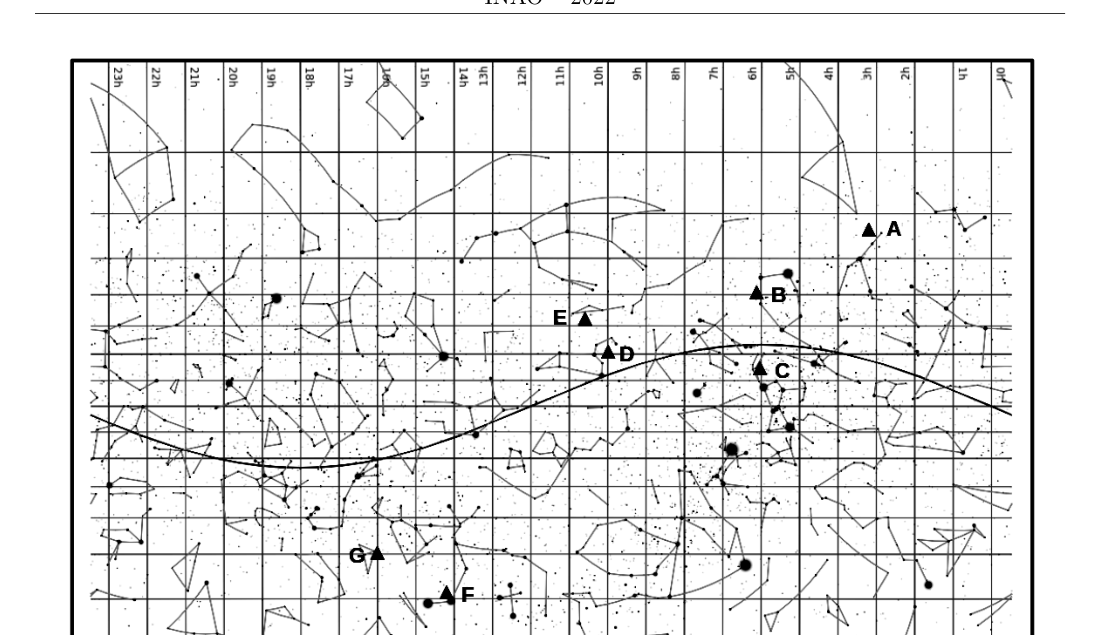
Figure 1: Here filled circles/points represents stars, filled triangles represents radiants of meteor showers and the sinusoidal curve represents the yearly path of Sun (Ecliptic).
| Meteor Shower Names | Alphabetic Label | Peak Date |
|---|---|---|
| Alpha Capricornids | ||
| Alpha Centaurids | ||
| Aurigids | ||
| December Leonis Minorids | ||
| Draconids | ||
| Gamma Normids | ||
| Gamma Ursae Minorids | ||
| Geminids | ||
| Leonids | ||
| Lyrids | ||
| Orionids | ||
| Perseids |
Topic: Astrophysics Metodi: Physical Modeling Competenze: Diagrammatic Reasoning Objects: Planet, Star Fonte: Testo (PDF) — p.3 Soluzione: Soluzioni (PDF)
L’orbita terrestre interseca le orbite di diverse comete attorno al Sole. Mentre la Terra passa attraverso un tale punto di intersezione in un determinato giorno dell’anno (“data di picco”), la traccia di detriti lasciati dalla cometa produce un gran numero di meteori in poche ore. Questi eventi sono noti come “piogge di meteori”. Le tracce di tutti i meteoriti sembrano divergere da un punto fisso nel cielo, chiamato “punto radiante”. La doccia prende il nome dalla costellazione in cui si trova questo punto radiante.
(a) [7] I punti radianti di 7 piogge di meteore proeminenti sono indicati dai triangoli e etichettati come lettere da A a G nella mappa celeste di seguito. Identifica queste docce tra quelle elencate nella tabella e scrivi l’etichetta nella riga corrispondente (potresti ignorare le docce che non sono mostrate sulla mappa). Non devi scrivere alcuna giustificazione.
Queste piogge di meteoriti si verificano quando la Terra attraversa la traccia di detriti lasciati da qualche cometa nel piano eclittico. Chiaramente, questo è correlato alla posizione del Sole in quel momento. Le linee verticali della data schematica indicano l’Ascensione destra (RA) una coordinata celeste (simile alle longitudini in geografia), espressa in “ore” che vanno da 0h a 24h, che viene utilizzata per specificare la posizione di un oggetto nel cielo. Le stelle lontane hanno un’AR fissa, ma gli oggetti vicini come il Sole cambiano la loro RA a causa della rivoluzione della Terra. La RA del Sole è di 0h all’equinozio vernale (primavera) e aumenta nel corso dell’anno, spazzando l’intero intervallo, mentre il Sole passa attraverso le costellazioni zodiacali. Ad esempio, il Sole si trova nella costellazione dello Scorpione a novembre.
b) [7] Con le informazioni di cui sopra, identificare le date di picco delle 7 piogge di meteoriti tra le liste di seguito indicate e scrivere nella tabella data. Non devi scrivere alcuna giustificazione.
Elenco delle date dei picchi di 7 piogge di meteoriti: 12 agosto, 1 settembre, 21 ottobre, 17 novembre, 19 dicembre, 8 febbraio, 14 marzo.
Quesito 5
Figura 1: Qui i cerchi/punti pieni rappresentano le stelle, i triangoli pieni rappresentano i radianti delle piogge di meteori e la curva sinusoidale rappresenta il percorso annuale del Sole (Ecliptica).
♬ Nome della doccia di meteoriti ♬ Etichetta alfabetica ♬ Data di picco ♬ | --- | --- | --- | ♬ Alpha Capricornio ♬ ♬ Alpha Centaurids ♬
Le origini
Diciembre Leonis Minorids
Dragoni
Gamma Normids ♬ Gamma Ursae Minorids ♬ ♬ Gemini ♬
Leoni
Le liriche
Orionidi
Perseids.
Topic: Astrophysics Metodi: Physical Modeling Competenze: Diagrammatic Reasoning Objects: Planet, Star Fonte: Testo (PDF) — p.3 Soluzione: Soluzioni (PDF)