Section I. The autonomous nervous system regulates involuntary functions of the body and can be subdivided into the sympathetic and the parasympathetic nervous system. Both of these systems control the same group of body functions, but have opposite effects on the functions they regulate. The sympathetic nervous system prepares the body for intense physical activity like the fight-or-flight response. The parasympathetic nervous system has the opposite effect and relaxes the body and inhibits or slows many high energy functions. Which of the following involuntary effects in the body are brought about by the sympathetic nervous system during a fight-or-flight situation?
i. Increased salivation ii. Increased digestion iii. Loss of bowel and bladder control iv. Body shivering v. Crying vi. Pupil dilation
- (A) i, ii and vi
- (B) i, iv and v
- (C) iii, iv and vi
- (D) iii and v
Topic: Biology Metodi: Physical Modeling Competenze: Physical Reasoning Objects: — Fonte: Testo (PDF) — p.3 Soluzione: Soluzioni (PDF)
Sezione I. Il sistema nervoso autonomo regola le funzioni involontarie del corpo e può essere suddiviso in sistema nervoso simpatico e parasimpatico. Entrambi questi sistemi controllano lo stesso gruppo di funzioni corporee, ma hanno effetti opposti sulle funzioni che regolano. Il sistema nervoso simpatico prepara il corpo ad intense attività fisiche come la risposta di combattimento o fuga. Il sistema nervoso parasimpatico ha l’effetto opposto e rilassa il corpo e inibisce o rallenta molte funzioni ad alta energia. Quali dei seguenti effetti involontari nel corpo sono causati dal sistema nervoso simpatico durante una situazione di combattimento o fuga?
i. Aumento della salivazione ii. Aumento della digestione iii. Perdita la capacità di controllare l’intestino e la vescica iv. Trema del corpo v. Piangere vi. Dilazione pupillare
- (A) i, ii e vi
- (B) i, iv e v
- (C) iii, iv e vi
- D) iii e v
Topic: Biology Metodi: Physical Modeling Competenze: Physical Reasoning Objects: — Fonte: Testo (PDF) — p.3 Soluzione: Soluzioni (PDF)
When a person starts exercising, many body parameters change from the original state of rest. The trends in two such parameters are shown in the graph during the initial phase of exercise.
Quesito 2
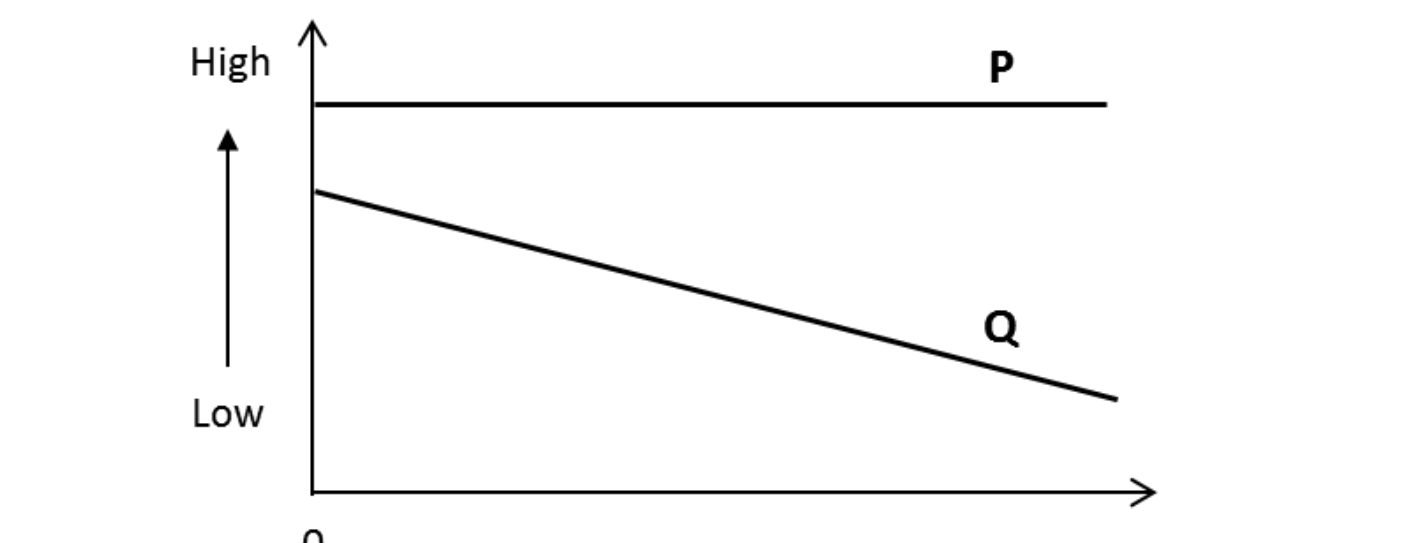
P and Q most likely represent:
- (A) P: carbon dioxide level in vein — Q: oxygen level in artery.
- (B) P: breathing rate — Q: carbon dioxide level in artery.
- (C) P: oxygen level in artery — Q: carbon dioxide level in vein.
- (D) P: oxygen level in artery — Q: oxygen level in vein.
Topic: Biology Metodi: Physical Modeling Competenze: Graph Linearization Objects: — Fonte: Testo (PDF) — p.3 Soluzione: Soluzioni (PDF)
Quando una persona inizia a fare esercizio fisico, molti parametri del corpo cambiano dallo stato di riposo originale. Le tendenze di due parametri di questo tipo sono illustrate nel grafico durante la fase iniziale dell’esercizio.
Quesito 2
Le P e Q rappresentano probabilmente:
- (A) ** P **: livello di anidride carbonica nelle vene ** Q **: livello di ossigeno nelle arterie.
- (B) ** P **: frequenza respiratoria ** Q **: livello di anidride carbonica nell’ arteria.
- (C) ** P **: livello di ossigeno nelle arterie ** Q **: livello di anidride carbonica nelle vene.
- (D) ** P : livello di ossigeno nelle arterie ** Q: livello di ossigeno nelle vene.
Topic: Biology Metodi: Physical Modeling Competenze: Graph Linearization Objects: — Fonte: Testo (PDF) — p.3 Soluzione: Soluzioni (PDF)
Descriptions of four biological samples (I - IV) are given below.
I: Can be viewed using a light microscope with a total magnification of 1000X; possesses cell wall and does not possess mitochondria. II: Can be seen using a light microscope with a total magnification of 100X; possesses cell wall and has a nucleus. III: Needs electron microscope for viewing; can be found attached to the membrane system in the cytoplasm. IV: Needs electron microscope for viewing; cannot replicate on its own, needs other specific cells for replication.
I, II, III, and IV respectively represent:
- (A) virus; plant cell; ribosome; bacteria.
- (B) plant cell; bacteria; vacuole; virus.
- (C) bacteria; plant cell; ribosome; virus.
- (D) bacteria; protist; plant cell vacuole; mitochondria.
Topic: Biology Metodi: Physical Modeling Competenze: Physical Reasoning Objects: — Fonte: Testo (PDF) — p.3 Soluzione: Soluzioni (PDF)
Qui di seguito sono riportati i risultati di quattro campioni biologici (I - IV).
I: Può essere visto con un microscopio luminoso con una ingrandimento totale di 1000X; possiede parete cellulari e non possiede mitocondrie. II: Può essere visto utilizzando un microscopio luminoso con una ingrandimento totale di 100X; possiede una parete cellulare e un nucleo. III: Necessita di un microscopio elettronico per la visualizzazione; può essere trovato attaccato al sistema di membrana del citoplasma. IV: Necessita di un microscopio elettronico per la visualizzazione; non può replicarsi da sola, necessita di altre cellule specifiche per la replicazione.
I, II, III e IV rappresentano rispettivamente:
- (A) virus; cellula vegetale; ribosoma; batteri.
- (B) cellule vegetali; batteri; vacuole; virus.
- (C) batteri; cellule vegetali; ribosoma; virus.
- (D) batteri; protisti; vacuole di cellule vegetali; mitocondrie.
Topic: Biology Metodi: Physical Modeling Competenze: Physical Reasoning Objects: — Fonte: Testo (PDF) — p.3 Soluzione: Soluzioni (PDF)
Raja’s mother collects all the kitchen waste every day and puts it in a pot. She then adds a few cut pieces of old papers, a spoonful of sour buttermilk and some soil. She covers the pots, and keeps it aside with intermittent mixing. After several days, it turns into a nutrient-rich compost to grow plants. In the context of decomposition in this composting process, the most appropriate statement among the following is
- (A) Paper acts as a good source of carbon while buttermilk gives the correct acidity to the mixture.
- (B) Soil acts as a good source of inorganic nitrogen while buttermilk is a good source of proteins.
- (C) Paper is a good source of carbon while buttermilk is a good source of starter bacteria.
- (D) Paper is a good source of fibre while buttermilk is a good source of fat.
Topic: Biology, Chemistry Metodi: Physical Modeling Competenze: Physical Reasoning Objects: — Fonte: Testo (PDF) — p.4 Soluzione: Soluzioni (PDF)
La madre di Raja raccoglie tutti i rifiuti della cucina ogni giorno e li mette in un vaso. Poi aggiunge alcuni pezzi tagliati di carta vecchia, un cucchiaino di latte acido e un po’ di terra. Copri le pentole e le tiene da parte con un mescolante intermittente. Dopo diversi giorni, si trasforma in un compost ricco di nutrienti per coltivare piante. Nel contesto della decomposizione in questo processo di compostaggio, la dichiarazione più appropriata tra le seguenti è:
- (A) La carta è una buona fonte di carbonio, mentre il latte di burro dà alla miscela la corretta acidità.
- (B) Il suolo è una buona fonte di azoto inorganico, mentre il latte di burro è una buona fonte di proteine.
- (C) La carta è una buona fonte di carbonio mentre il latte di burro è una buona fonte di batteri di partenza.
- D) La carta è una buona fonte di fibre mentre il latte di burro è una buona fonte di grassi.
Topic: Biology, Chemistry Metodi: Physical Modeling Competenze: Physical Reasoning Objects: — Fonte: Testo (PDF) — p.4 Soluzione: Soluzioni (PDF)
A girl (G) walks into a room along the path shown by the dashed line (see figure on right). She tries to observe images of small toys numbered 1, 2, and 3 in the plane mirror on the wall.
Quesito 5
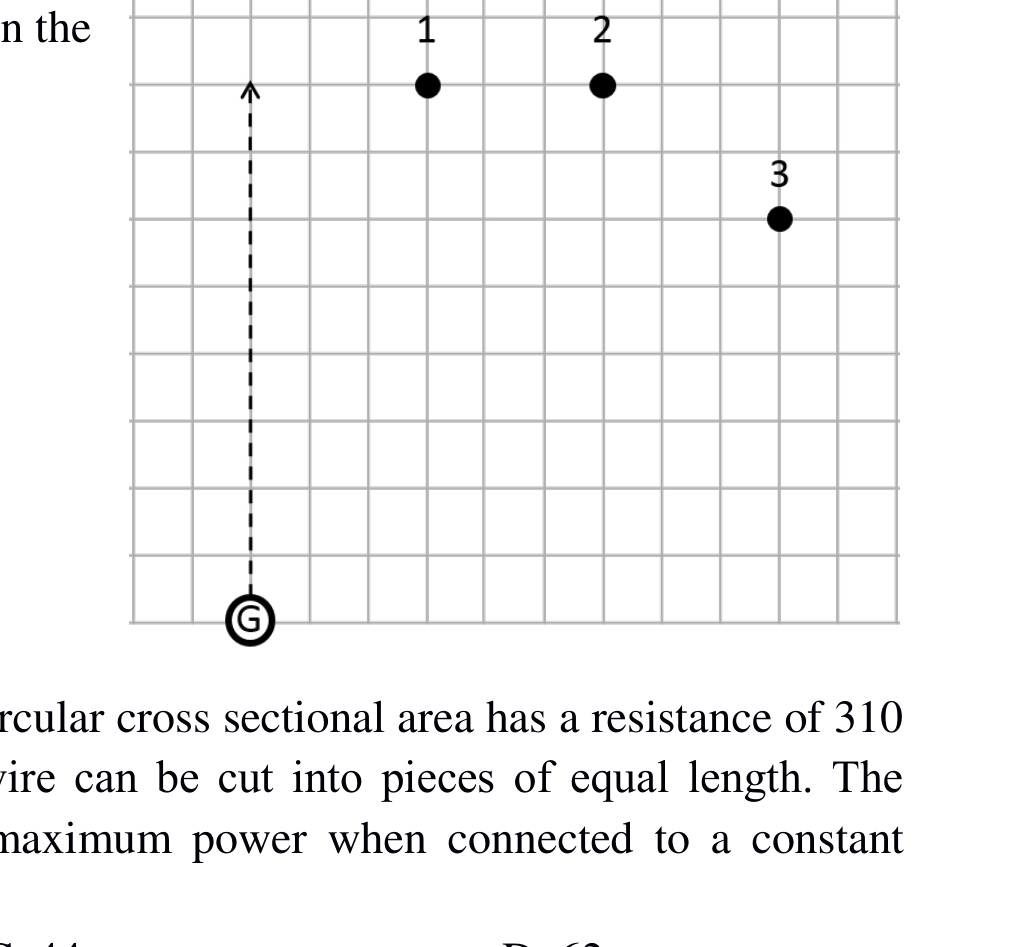
The order in which she will see images of the toys is:
- (A) 3, 2, 1.
- (B) 3, 2.
- (C) 1, 2, 3
- (D) 2, 3.
Topic: Geometric Optics Metodi: Ray Tracing Competenze: Diagrammatic Reasoning Objects: Mirror Fonte: Testo (PDF) — p.4 Soluzione: Soluzioni (PDF)
Una ragazza (G) entra in una stanza lungo il sentiero indicato dalla linea a tracce (vedi figura a destra). Cerca di osservare immagini di piccoli giocattoli numerati 1, 2 e 3 nello specchio di piano sul muro.
Quesito 5
L’ ordine in cui vedrà le immagini dei giocattoli è:
- (A) 3, 2, 1.
- (B) 3, 2.
- (C) 1, 2, 3
- (D) 2, 3.
Topic: Geometric Optics Metodi: Ray Tracing Competenze: Diagrammatic Reasoning Objects: Mirror Fonte: Testo (PDF) — p.4 Soluzione: Soluzioni (PDF)
A heating element in the form of a wire with uniform circular cross sectional area has a resistance of 310 , and can bear a maximum current of 5.0 A. The wire can be cut into pieces of equal length. The number of pieces, arranged suitably, so as to draw maximum power when connected to a constant voltage of 220 V, is
- (A) 7.
- (B) 8.
- (C) 44.
- (D) 62.
Topic: Circuits Metodi: Equivalent Circuit Reduction Competenze: Estimation & Approximation Objects: Wire, Resistor Fonte: Testo (PDF) — p.4 Soluzione: Soluzioni (PDF)
Un elemento di riscaldamento a forma di filo con superficie di sezione incrociata circolare uniforme ha una resistenza di 310 e può sopportare una corrente massima di 5,0 A. Il filo può essere tagliato in pezzi di uguale lunghezza. Il numero di pezzi, disposti in modo adeguato per ottenere la potenza massima quando collegati a una tensione costante di 220 V, è
- (A) 7.
- (B) 8.
- (C) 44.
- (D) 62.
Topic: Circuits Metodi: Equivalent Circuit Reduction Competenze: Estimation & Approximation Objects: Wire, Resistor Fonte: Testo (PDF) — p.4 Soluzione: Soluzioni (PDF)
Consider the following two statements:
Statement S1: If you put 100 g ice at 0°C and 100 g water at 0°C into a freezer, which is maintained at −10°C, the ice will eventually lose the larger amount of heat.
Statement S2: At 0°C, water is denser than ice.
Choose the correct statement among the following.
- (A) Both S1 and S2 are true and S2 is the correct explanation of S1.
- (B) Both S1 and S2 are true but S2 is not the correct explanation of S1.
- (C) S1 is true but S2 is false.
- (D) S1 is false but S2 is true.
Topic: Thermodynamics Metodi: Physical Modeling Competenze: Physical Reasoning Objects: — Fonte: Testo (PDF) — p.4 Soluzione: Soluzioni (PDF)
Considerate le seguenti due affermazioni:
Dichiarazione S1: Se si mettono 100 g di ghiaccio a 0°C e 100 g di acqua a 0°C in un congelatore, che viene mantenuto a −10°C, il ghiaccio alla fine perderà la maggior quantità di calore.
Dichiarazione S2: A 0°C, l’acqua è più densa del ghiaccio.
Scegli la frase corretta tra le seguenti.
- (A) Sia S1 che S2 sono veri e S2 è la corretta spiegazione di S1.
- (B) Sia S1 che S2 sono veri, ma S2 non è la corretta spiegazione di S1.
- (C) S1 è vero ma S2 è falso.
- (D) S1 è falso ma S2 è vero.
Topic: Thermodynamics Metodi: Physical Modeling Competenze: Physical Reasoning Objects: — Fonte: Testo (PDF) — p.4 Soluzione: Soluzioni (PDF)
Consider the paths of (1) Halley’s Comet near the sun, and (2) an alpha particle scattered by a nucleus. In the figures below, the dots represent the Sun/Nuclei, and the curves with arrows mark the paths of the comet/alpha particles schematically.
Quesito 8

The correct statement about the trajectories is:
- (A) I represents trajectory for Halley’s Comet and II for the scattering of alpha particles.
- (B) III represents trajectory for Halley’s Comet and II for the scattering of alpha particles.
- (C) II represents trajectory for Halley’s Comet and I for scattering of alpha particles.
- (D) II represents trajectory for Halley’s Comet and III for the scattering of alpha particles.
Topic: Gravitation, Nuclear & Particle Physics Metodi: Kepler’s Laws Competenze: Diagrammatic Reasoning Objects: Star, Nucleus Fonte: Testo (PDF) — p.4 Soluzione: Soluzioni (PDF)
Considerate i percorsi di (1) la cometa di Halley vicino al sole e (2) di una particella alfa sparpagliata da un nucleo. Nelle figure di seguito, i punti rappresentano il Sole/Nuovo e le curve con frecce segnano schematicamente i percorsi delle particelle comete/alfa.
Quesito 8
La dichiarazione corretta sulle traiettorie è:
- (A) Rappresento la traiettoria della cometa di Halley e II per la dispersione delle particelle alfa.
- (B) III rappresenta la traiettoria della cometa di Halley e II per la dispersione delle particelle alfa.
- (C) II rappresenta la traiettoria della cometa di Halley e I per la dispersione delle particelle alfa.
- (D) II rappresenta la traiettoria della cometa di Halley e III per la dispersione delle particelle alfa.
Topic: Gravitation, Nuclear & Particle Physics Metodi: Kepler’s Laws Competenze: Diagrammatic Reasoning Objects: Star, Nucleus Fonte: Testo (PDF) — p.4 Soluzione: Soluzioni (PDF)
When water changes phase from liquid to vapor, some bonds are broken. The correct statement relating to this change is:
- (A) New bonds are formed between nearby H/H and O/O while H–O bonds break.
- (B) Hydrogen bonds between H₂O molecules are broken.
- (C) Covalent bonds existing within the H₂O molecules are broken.
- (D) Ionic bonds existing between H⁺ ions and OH⁻ ions are broken.
Topic: Chemistry Metodi: Physical Modeling Competenze: Physical Reasoning Objects: — Fonte: Testo (PDF) — p.5 Soluzione: Soluzioni (PDF)
Quando l’acqua cambia fase da liquido a vapore, alcuni legami si rompono. La corretta dichiarazione relativa a tale modifica è:
- (A) Si formano nuovi legami tra H/H e O/O vicini mentre si rompono gli legami HO.
- (B) I legami di idrogeno tra le molecole di H2O sono rotti.
- (C) I legami covalenti presenti all’interno delle molecole di H2O sono rotti.
- (D) I legami ionici esistenti tra gli ioni H+ e gli ioni OH− sono rotti.
Topic: Chemistry Metodi: Physical Modeling Competenze: Physical Reasoning Objects: — Fonte: Testo (PDF) — p.5 Soluzione: Soluzioni (PDF)
Jyoti was asked by her mother to add a pinch of potassium permanganate to water in a container to disinfect it. As she added the crystals and observed the changes in water, the phenomena of diffusion came to her mind. She wrote the following statements. Identify the statement which Jyoti wrote that is incorrect.
- (A) When the entire liquid is of uniform color, no further diffusion can be observed.
- (B) The diffusion gets completed almost instantaneously.
- (C) Diffusion will take place faster if the water is colder.
- (D) Maximum color in liquid originates from the bottom of the flask.
Topic: Kinetic Theory Metodi: Statistical Averaging Competenze: Physical Reasoning Objects: — Fonte: Testo (PDF) — p.5 Soluzione: Soluzioni (PDF)
Jyoti fu chiesto da sua madre di aggiungere un pizzico di permanganato di potassio all’acqua in un contenitore per disinfettarlo. Mentre aggiungeva i cristalli e osservava i cambiamenti nell’acqua, i fenomeni della diffusione le venivano in mente. Ha scritto le seguenti dichiarazioni. Indicare la dichiarazione che Jyoti ha scritto che è incorrecta.
- (A) Quando l’intero liquido è di colore uniforme, non si può osservare ulteriore diffusione.
- (B) La diffusione si completa quasi istantaneamente.
- (C) La diffusione si svolgerà più velocemente se l’acqua è più fredda.
- (D) Il colore massimo in liquido proviene dal fondo del flacone.
Topic: Kinetic Theory Metodi: Statistical Averaging Competenze: Physical Reasoning Objects: — Fonte: Testo (PDF) — p.5 Soluzione: Soluzioni (PDF)
Ramen collected rain water and measured its electrical conductivity. He boiled the water for a few minutes. Then he covered the container and allowed the water to cool to room temperature. Electrical conductivity of water now measured was lower than that measured before boiling. The reason for this most likely is:
- (A) precipitation of CaCO₃ from the water during boiling.
- (B) removal of dissolved oxygen from the water.
- (C) removal of dissolved carbon dioxide from the water.
- (D) reaction of cationic species in the water with atmospheric oxygen.
Topic: Chemistry Metodi: Physical Modeling Competenze: Physical Reasoning Objects: — Fonte: Testo (PDF) — p.5 Soluzione: Soluzioni (PDF)
Ramen raccolse l’acqua piovana e misurò la sua conduttività elettrica. Ha bollito l’acqua per qualche minuto. Poi coprì il contenitore e lasciò che l’acqua si raffreddasse a temperatura ambiente. La conducibilità elettrica dell’acqua ora misurata era inferiore a quella misurata prima di bollire. La ragione di questo è probabilmente:
- (A) precipitazione di CaCO3 dall’acqua durante l’ebollizione.
- (B) rimozione dell’ossigeno dissoluto dall’acqua.
- (C) rimozione dell’acqua di anidride carbonica dissoluta.
- (D) reazione di specie cationiche nell’acqua con ossigeno atmosferico.
Topic: Chemistry Metodi: Physical Modeling Competenze: Physical Reasoning Objects: — Fonte: Testo (PDF) — p.5 Soluzione: Soluzioni (PDF)
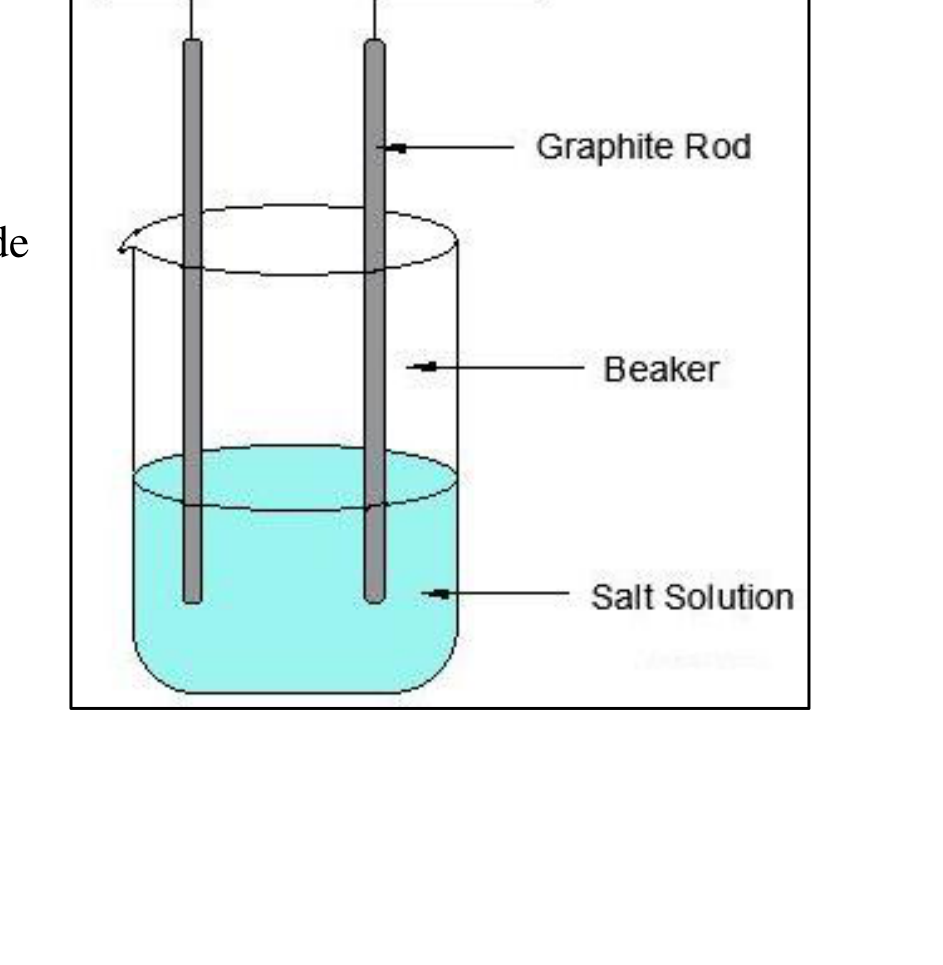
Consider a setup in which two graphite rods are immersed in a 2 M NaCl (aq.) solution. The rods are connected to two terminals of a 9 V battery with a bulb in series as shown in the figure. Of the following, the change that will NOT be observed when the circuit is closed for a few minutes is:
Quesito 12
- (A) The bulb will glow.
- (B) The pH of solution near the cathode will increase.
- (C) Oxygen gas would be generated near the +ve electrode which will oxidize the graphite electrode.
- (D) Total mass of liquid in the beaker will decrease.
Topic: Chemistry Metodi: Physical Modeling Competenze: Diagrammatic Reasoning Objects: Rod, Battery Fonte: Testo (PDF) — p.5 Soluzione: Soluzioni (PDF)
Si consideri un’impostazione in cui due barre di grafite sono immerse in una soluzione di 2 M di NaCl (aq.). Le barre sono collegate a due terminali di una batteria da 9 V con una lampadina in serie come mostrato nella figura. Tra i seguenti, la variazione che si osserverà quando il circuito è chiuso per alcuni minuti è:
Quesito 12
- (A) La lampadina accenderà.
- (B) Il pH della soluzione vicino al catodo aumenterà.
- (C) Si genererebbe gas ossigeno vicino all’elettrodo +ve che ossificherà l’elettrodo di grafite.
- (D) La massa totale del liquido nella tazza diminuirà.
Topic: Chemistry Metodi: Physical Modeling Competenze: Diagrammatic Reasoning Objects: Rod, Battery Fonte: Testo (PDF) — p.5 Soluzione: Soluzioni (PDF)
Section II. [3 marks] A student was given 2.89 g of a mixture containing anhydrous MgCl₂ and KNO₃, and had to quantify the amount of MgCl₂ in the mixture. The student uses excess AgNO₃(aq) to precipitate the chloride ion as AgCl(s), and finds the mass of the AgCl precipitate to be 5.32 g. Calculate the mass percentage of MgCl₂ in the original mixture. (Atomic masses should be taken as per the data given.)
Topic: Chemistry Metodi: Physical Modeling Competenze: Significant Figures Objects: — Fonte: Testo (PDF) — p.6 Soluzione: Soluzioni (PDF)
Sezione II. [3 voti] A uno studente è stato somministrato 2,89 g di una miscela contenente MgCl2 e KNO3 anidro e ha dovuto quantificare la quantità di MgCl2 nella miscela. Lo studente utilizza l’eccesso di AgNO3 ((aq) per precipitare l’ion cloruro come AgCl ((s), e trova che la massa del precipitato AgCl è di 5,32 g. Calcolare la percentuale di massa di MgCl2 nella miscela originale. (Le masse atomiche devono essere prese in base ai dati forniti.)
Topic: Chemistry Metodi: Physical Modeling Competenze: Significant Figures Objects: — Fonte: Testo (PDF) — p.6 Soluzione: Soluzioni (PDF)
[12 marks] Iodine is an essential element for humans, naturally present in some marine fishes, plants and ecosystems at large. Solubility of elemental iodine in water is negligible but is high in non-polar organic solvents. The most common form of iodine used in the diet of humans and animals is potassium iodide (KI), a white solid powder at room temperature, which is highly soluble in water.
14.1. In a chemistry laboratory period, 56 students of a class had to perform the following tests.
i. 0.5 gram KI is dissolved in about 5 cm³ distilled water. A drop of this solution is put on a moist pH paper. ii. 0.5 gram KI is dissolved in about 5 cm³ distilled water. Part of this solution is mixed with lead (II) nitrate solution. The colour changes in the mixture are observed. iii. 0.5 gram KI is put in a test tube containing about 5 cm³ distilled water. Then they are to observe whether the test tube becomes hot or cool on mixing.
In test ii, a yellow precipitate is observed. In test iii, no test tube becomes cool as KI dissolves.
- (a) Identify the colour imparted on pH paper in test i.
- (b) Being very expensive, KI should be economically used. What is the minimum amount of KI (in grams) required for the complete class for carrying out the above three test procedures? Write necessary calculations/reasoning needed to arrive at your answer.
14.2. An aqueous solution of KI treated with acidified solution of hydrogen peroxide (in sulphuric acid) gives a precipitate of Iodine crystals.
- (a) Write the balanced molecular equation for the reaction.
- (b) Identify the reducing agent in the reaction.
- (c) The most appropriate option to separate iodine from the above mixture is:
- (A) filtration (B) distillation (C) steam distillation (D) chromatography (E) using a magnet
14.3. When solid KI is heated in an open dry test tube, a gas is liberated from the test tube.
- (a) What is the colour of the gas?
- (b) After the gas evolution stops, what remains in the test tube? Write its chemical symbol/formula (if mixture, write formulae of components) and its state (solid/liquid).
- (c) The reaction can be classified as (identify the correct option(s)):
- (A) chemical combination (B) thermal decomposition
- (C) double displacement (D) displacement reaction
14.4. Tincture iodine is an antiseptic, also effective in inactivating the novel coronavirus. It is prepared by dissolving 20 g of Iodine and 25 g of KI in 500 mL alcohol and then adding distilled water to make the volume 1000 mL. In this process, iodine combines with I⁻ to produce I₃⁻ species.
Sumit and Rekha were separately preparing tincture iodine using the above procedure. Sumit was working hurriedly, as he wanted to join a birthday party. By mistake, he added carbon tetrachloride in the flask instead of alcohol. At the end of the procedure, two immiscible liquid layers appeared in his flask. Sumit shook the flask vigorously and kept it for some time. The two layers remained separate. He observed that the lower layer had a deeper colour while the upper layer had a faint colour due to a homogeneous mixture.
Identify the compositions of the top and the bottom layers in Sumit’s flask.
Topic: Chemistry Metodi: Physical Modeling Competenze: Unit Conversion Objects: — Fonte: Testo (PDF) — p.6 Soluzione: Soluzioni (PDF)
L’io è un elemento essenziale per l’uomo, presente naturalmente in alcuni pesci marini, in alcune piante e in molti ecosistemi. La solubilità dell’iodio elementare in acqua è trascurabile ma è elevata nei solventi organici non polari. La forma più comune di iodio utilizzata nella dieta umana ed animale è l’ioduro di potassio (KI), una polvere solida bianca a temperatura ambiente, altamente solubile in acqua.
In un periodo di laboratorio di chimica, 56 studenti di una classe hanno dovuto eseguire i seguenti test.
i. 0,5 grammi di KI si sciolgono in circa 5 cm3 di acqua distillata. Una goccia di questa soluzione viene messa su una carta pH umida. ii. 0,5 grammi di KI si sciolgono in circa 5 cm3 di acqua distillata. Parte di questa soluzione è mescolata con soluzione di nitrato di piombo (II). Si osservano i cambiamenti di colore nella miscela. iii. 0,5 grammi di KI vengono inseriti in un tubo di prova contenente circa 5 cm3 di acqua distillata. In seguito devono osservare se il tubo di prova diventa caldo o freddo durante la miscelazione.
Nel test ii si osserva una precipitazione gialla. Nel test iii, nessun tubo di prova si raffredda quando il KI si dissolve.
- a) Indicare il colore conferito sulla carta pH nel test i.
- (b) Essendo molto costoso, il KI dovrebbe essere utilizzato economicamente. Qual è la quantità minima di KI (in grammi) necessaria per la classe completa per l’esecuzione delle tre procedure di prova sopra indicate? Scrivi i calcoli/ragioni necessari per arrivare alla tua risposta.
14.2. Una soluzione acquosa di KI trattata con soluzione acidificata di perossido di idrogeno (in acido solforico) produce un precipitato di cristalli di iodio.
- (a) Scrivere l’equazione molecolare equilibrata per la reazione.
- (b) Identificare l’agente riduttore nella reazione.
- c) L’opzione più appropriata per separare l’io da questa miscela è:
- A) filtrazione B) distillazione C) distillazione a vapore D) cromatografia E) magnetismo
Quando il KI solido viene riscaldato in un tubo di prova aperto e secco, viene rilasciato un gas dal tubo di prova.
- a) Qual è il colore del gas?
- (b) Dopo che l’evoluzione del gas si è fermata, cosa rimane nel tubo di prova? Scrivere il suo simbolo/formula chimico (se miscela, scrivere le formule dei componenti) e il suo stato (solido/liquido).
- (c) La reazione può essere classificata come (indicare la corretta opzione)
- A) combinazione chimica B) decomposizione termica
- (C) doppio spostamento (D) reazione di spostamento
**14.4. ** L’ iodio in tintura è un antisettico, efficace anche nell’ inattivazione del nuovo coronavirus. Si prepara sciogliendo 20 g di iodio e 25 g di KI in 500 ml di alcol e aggiungendo quindi acqua distillata per rendere il volume 1000 ml. In questo processo, l’iodio si combina con I− per produrre specie I3−.
Sumit e Rekha preparavano separatamente iodio di tintura utilizzando la procedura sopra indicata. Sumit lavorava in fretta, perché voleva partecipare a una festa di compleanno. Per errore, ha aggiunto il tetracloruro di carbonio nella bottiglia invece di alcol. Alla fine del procedimento, nel suo flacone sono apparsi due strati liquidi immiscibili. Sumit scuotette il flacone con forza e lo tenne per un po’. I due strati rimangono separati. Ha osservato che lo strato inferiore aveva un colore più profondo mentre lo strato superiore aveva un colore debole a causa di una miscela omogenea.
Identifica le composizioni dei strati superiori e inferiori del flacone di Sumit.
Topic: Chemistry Metodi: Physical Modeling Competenze: Unit Conversion Objects: — Fonte: Testo (PDF) — p.6 Soluzione: Soluzioni (PDF)
[8 marks] Flame is a hot bright stream of burning gases. Flames have different structures and properties depending on fuel and burning conditions. The attached figure (drawn approximately to scale) shows a candle flame burning in open air in which three regions are distinctly visible surrounding a dark zone: an innermost zone that is pale yellow in colour, surrounded by a red zone, with a bluish envelope at the outside. Combustion of the flame is different in these different locations in the flame. Consider wax to have chemical formula C₂₅H₅₂.
Quesito 15
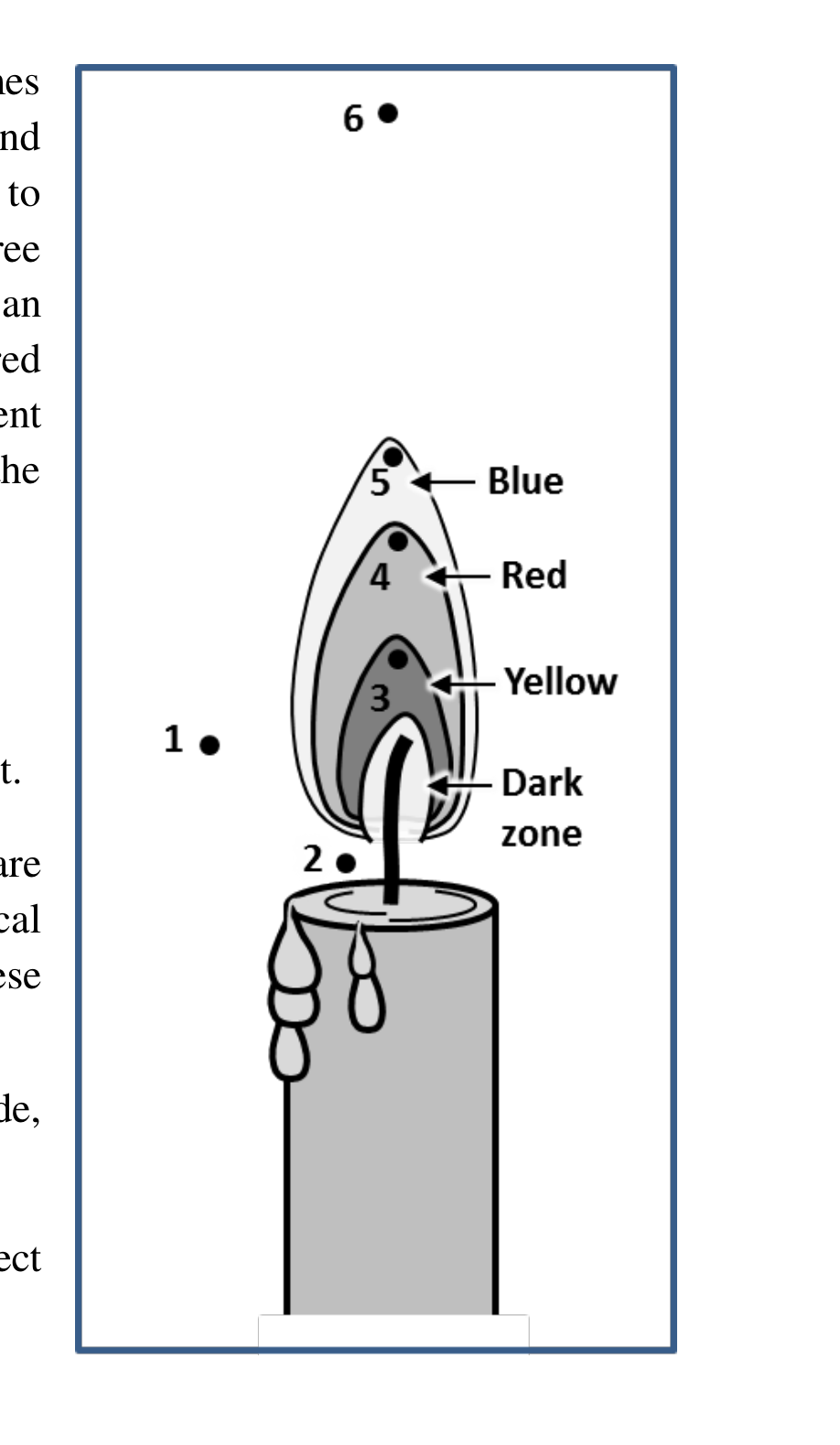
15.1. Among points 1 - 6, identify
- (a) the hottest point.
- (b) the coldest point.
- (c) the point where water vapour concentration is the highest.
15.2. From the following list, identify two substances that are present at point 3 but are absent at point 6. Also write chemical equations for the reactions causing removal of these substances.
List: Oxygen, Nitrogen, Carbon, Wax, Carbon dioxide, Carbon monoxide, Water.
15.3. The space at point 2 prominently has (identify the correct option):
- (A) only air.
- (B) air with freshly evaporating wax vapour.
- (C) air with extra carbon dioxide released from combustion.
- (D) oxygen rich air (as oxygen concentration has locally increased due to diffusion).
15.4. Another flame used in laboratories is produced from a Bunsen burner. It is used for heating, combustion, sterilisation processes, etc. By adjusting the ratio of gas (fuel) and air in a Bunsen burner, it is possible to get a stable blue flame, which is largely non-luminous. Shlok was given two different organic compounds: naphthalene (C₁₀H₈) and citric acid (C₆H₈O₇). He burned 1.0 g of each compound separately in a porcelain piece in a blue Bunsen burner flame.
For which of the two compounds would the flame emit more yellow light? Write reason for your answer, along with necessary supporting calculations/arguments.
Topic: Chemistry Metodi: Physical Modeling Competenze: Diagrammatic Reasoning Objects: — Fonte: Testo (PDF) — p.7 Soluzione: Soluzioni (PDF)
La fiamma è un fiume caldo e luminoso di gas ardenti. Le fiamme hanno strutture e proprietà diverse a seconda delle condizioni di combustibile e di combustione. La figura allegata (tratta in proporzione approssimativa) mostra una fiamma di candela che brucia all’aria aperta, in cui tre regioni sono chiaramente visibili intorno a una zona scura: una zona più interna di colore giallo pallido, circondata da una zona rossa, con una busta bluosa all’esterno. La combustione della fiamma è diversa in questi diversi luoghi della fiamma. Considera la cera con la formula chimica C25H52.
Quesito 15
15.1. Tra i punti 1 - 6, identificare
- (a) il punto più caldo.
- b) il punto più freddo.
- il punto in cui la concentrazione di vapore idrico è più alta.
15.2. Dal seguente elenco, identificare due sostanze presenti al punto 3 ma assenti al punto 6. Scrivere anche equazioni chimiche per le reazioni che causano la rimozione di queste sostanze.
Lista: * Ossigeno, azoto, carbonio, cera, anidride carbonica, monossido di carbonio, acqua.
15.3. Lo spazio al punto 2 presenta in modo prominente (indicate l’opzione corretta):
- A) solo aria.
- (B) aria con vapore di cera appena evaporato.
- (C) aria con anidride carbonica in eccesso rilasciata dalla combustione.
- (D) aria ricca di ossigeno (come concentrazione di ossigeno è aumentata localmente a causa della diffusione).
Un’altra fiamma utilizzata in laboratorio viene prodotta da un bruciatore Bunsen. È utilizzato per il riscaldamento, la combustione, i processi di sterilizzazione, ecc. Aggiustando il rapporto tra gas (carburante) e aria in un bruciatore Bunsen, è possibile ottenere una fiamma blu stabile, che è in gran parte non luminosa. Shlok ha ricevuto due composti organici diversi: il naftalene (C10H8) e l’ acido citrico (C6H8O7). Ha bruciato 1,0 g di ogni composto separatamente in un pezzo di porcellana in una fiamma blu Bunsen burner.
Per quale dei due composti la fiamma emetterebbe più luce gialla? Scrivi la ragione della tua risposta, insieme ai necessari calcoli/argumenti di supporto.
Topic: Chemistry Metodi: Physical Modeling Competenze: Diagrammatic Reasoning Objects: — Fonte: Testo (PDF) — p.7 Soluzione: Soluzioni (PDF)
[5 marks] A famous experiment performed by Tolman and Honzik (in 1930) studied the behaviour of rats in a complex maze (shown in the figure) for a period of 17 days. The rats had to find their way around the maze once every day. All rats were healthy and were given regular meals throughout the experiment.
Quesito 16
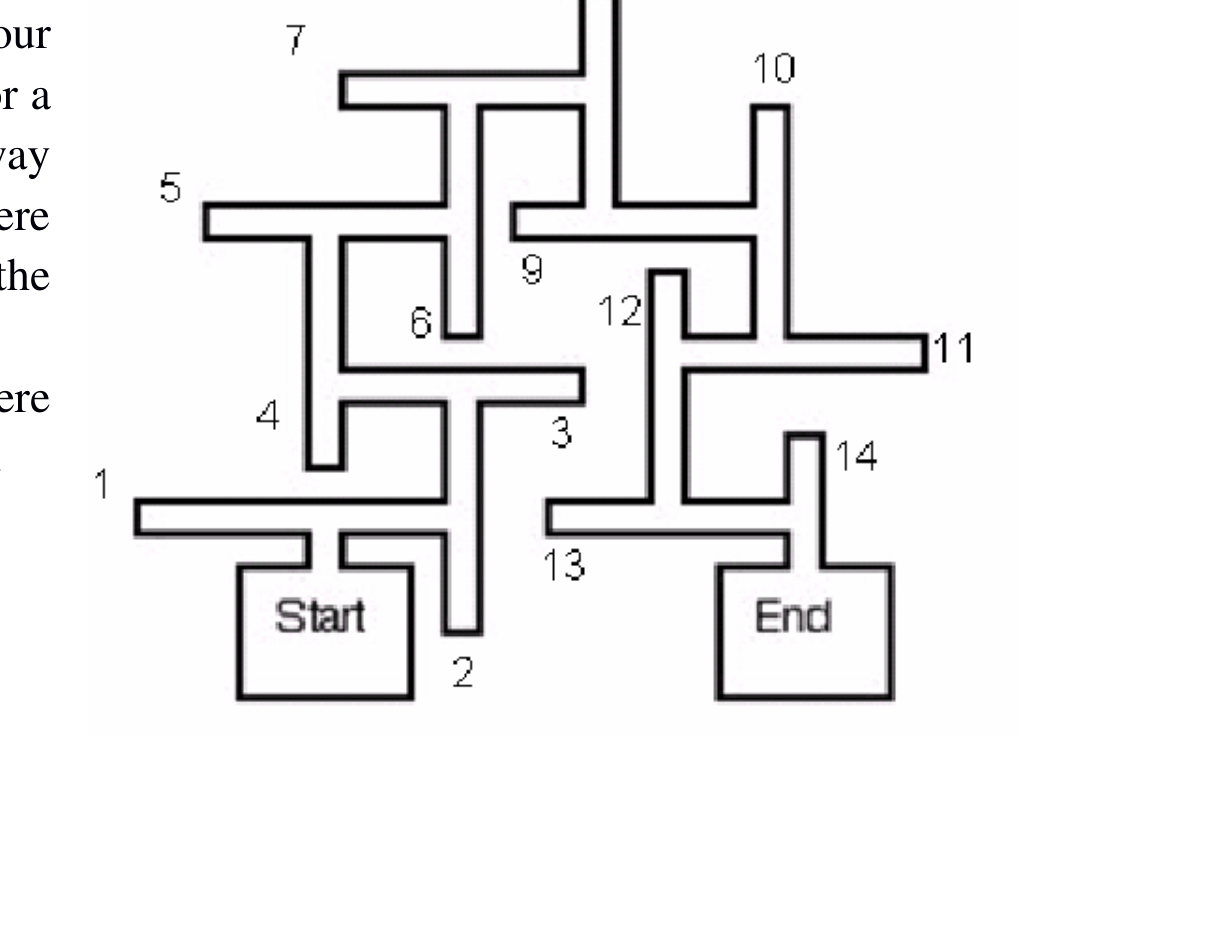
The rats were divided into 3 groups, which were treated as follows on reaching the end of the maze.
Group 1: Day 1-17: every time the rats reached the end, they were given additional food.
Group 2: Day 1-10: every time the rats reached the end, they were removed from the maze. Day 11-17: every time the rats reached the end, they were given additional food.
Group 3: Day 1-17: every time the rats reached the end, they were removed from the maze.
The average number of errors (any deviation from the shortest correct path to reach the end) observed for each group of rats is shown in the graph below.
Quesito 16
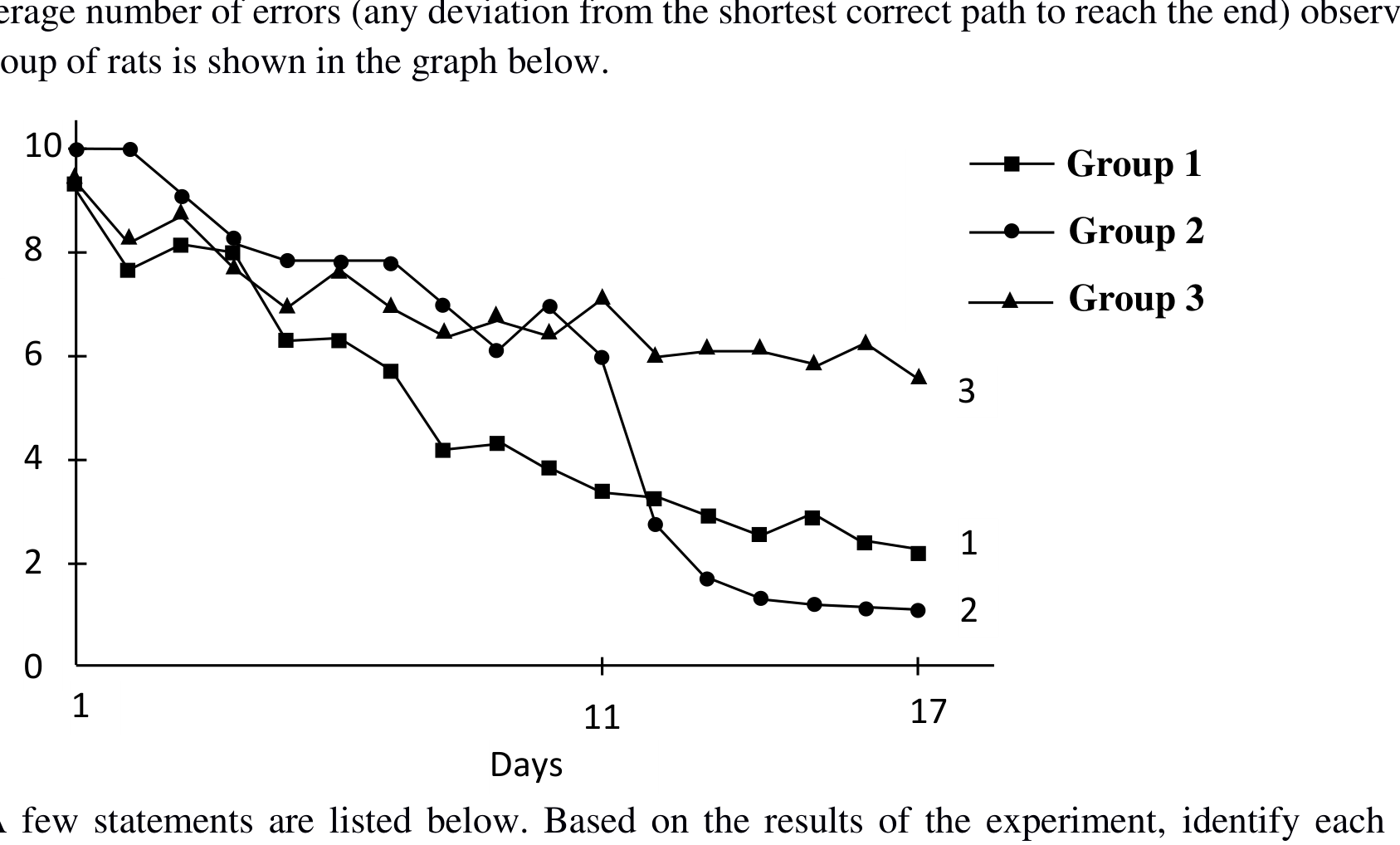
16.1. A few statements are listed below. Based on the results of the experiment, identify each of the statements as True or False.
- (a) Rats need good nutritional status to perform well in the maze.
- (b) Result shows characteristic stimulus (maze) - response (reaching the end) behavior which is genetically determined and hence not changeable.
- (c) Performance improvement at the food end of the maze is innate and not due to learning.
- (d) Rewarding the rats has improved the end results.
- (e) There was active learning happening in rats in group 2 even before day 11.
16.2. What response can be expected if the rats in group 1 were kept hungry before the experiment? Assume that all other conditions in the above experimental setup remain the same. Choose the most appropriate option from choices below and justify your choice based on the experimental observations presented above (only). Also give reasons for rejecting the other three options.
- A. Overall rise of line 1 above line 3.
- B. Increase in errors as the experiment proceeds.
- C. Steeper decrease in line 1 in lesser time.
- D. Same response as line 1 in the graph.
Topic: Biology Metodi: Physical Modeling Competenze: Diagrammatic Reasoning Objects: — Fonte: Testo (PDF) — p.7 Soluzione: Soluzioni (PDF)
[5 punti] Un famoso esperimento condotto da Tolman e Honzik (nel 1930) ha studiato il comportamento dei ratti in un labirinto complesso (visto nella figura) per un periodo di 17 giorni. I ratti dovevano trovare la strada intorno al labirinto una volta al giorno. Tutti i ratti erano sani e venivano dati pasti regolari durante tutto l’esperimento.
Quesito 16
I ratti sono stati divisi in 3 gruppi, che sono stati trattati come segue al raggiungimento della fine del labirinto.
Gruppo 1: Il giorno 1-17: ogni volta che i ratti raggiungevano la fine, venivano forniti cibo aggiuntivo.
Gruppo 2: Il giorno 1-10: ogni volta che i topi raggiungevano la fine, venivano rimossi dal labirinto. Il giorno 11-17: ogni volta che i ratti raggiungevano la fine, venivano forniti cibo supplementare.
Gruppo 3: Il giorno 1-17: ogni volta che i ratti raggiungevano la fine, venivano rimossi dal labirinto.
Il numero medio di errori (qualsiasi deviazione dal percorso corretto più corto per raggiungere la fine) osservato per ciascun gruppo di ratti è indicato nella grafica seguente.
Quesito 16
16.1. Al di sotto sono elencate alcune affermazioni. Sulla base dei risultati dell’esperimento, identificare ciascuna delle affermazioni come Vera o Falsa.
- (a) I ratti hanno bisogno di un buon stato nutrizionale per avere un buon rendimento nel labirinto.
- b) Il risultato mostra un comportamento caratteristico di stimolo (maze) - risposta (arrivo alla fine) che è geneticamente determinato e quindi non variabile.
- (c) Il miglioramento delle prestazioni all’estremità del labirinto è innato e non dovuto all’apprendimento.
- (d) La ricompensa dei ratti ha migliorato i risultati finali.
- (e) Si è verificato un apprendimento attivo nei ratti del gruppo 2 anche prima dell’ 11° giorno.
** 16.2. ** Che risposta si può aspettare se i ratti del gruppo 1 sono stati tenuti affamati prima dell’ esperimento? Supponiamo che tutte le altre condizioni della precedente configurazione sperimentale rimangano le stesse. Scegli l’opzione più appropriata tra le scelte di seguito e giustifica la tua scelta sulla base delle osservazioni sperimentali presentate sopra (solo). Indicare anche le ragioni per cui si rifiutano le altre tre opzioni.
- A. Aumento complessivo della linea 1 sopra la linea 3.
- B. Aumentano gli errori mentre l’esperimento procede.
- C. Una diminuzione più rapida nella linea 1 in meno tempo.
- D. La stessa risposta come la riga 1 del grafico.
Topic: Biology Metodi: Physical Modeling Competenze: Diagrammatic Reasoning Objects: — Fonte: Testo (PDF) — p.7 Soluzione: Soluzioni (PDF)
[7 marks] In the early nineteenth century, two scientists Payen and Persoz ground barley seeds in water to prepare a crude extract (A). The scientists then carried out a series of treatments on the extract A. At every step, iodine tests were carried out as follows.
Iodine test: Mixture (Starch + sample) → Wait for 10 mins → Add iodine → Check for colour changes
The different steps of treatment and the results recorded are shown in the flow chart below.
Quesito 17
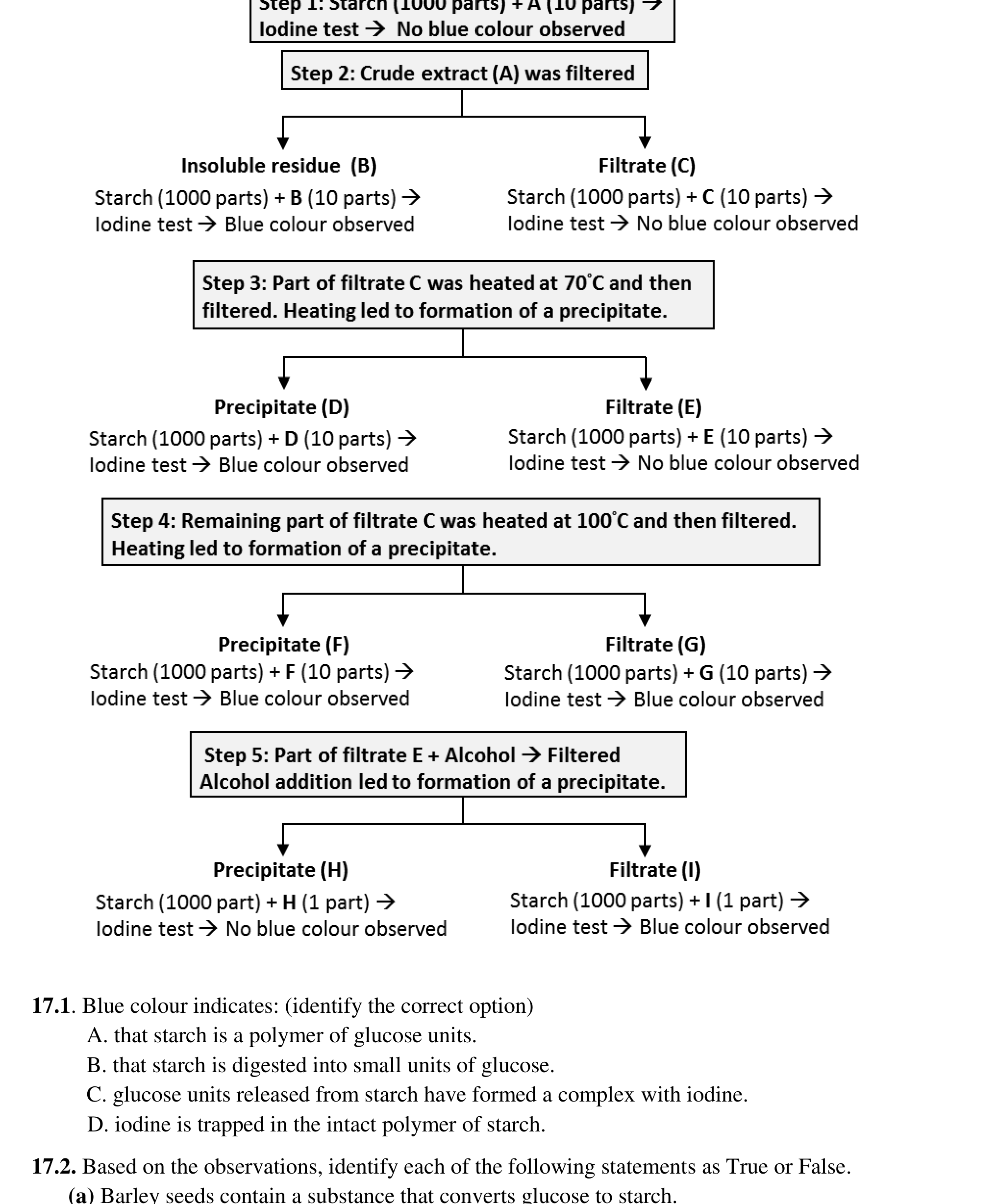
17.1. Blue colour indicates: (identify the correct option)
- A. that starch is a polymer of glucose units.
- B. that starch is digested into small units of glucose.
- C. glucose units released from starch have formed a complex with iodine.
- D. iodine is trapped in the intact polymer of starch.
17.2. Based on the observations, identify each of the following statements as True or False.
- (a) Barley seeds contain a substance that converts glucose to starch.
- (b) The substance present in barley seeds is water soluble and breaks starch into small units.
- (c) The substance present in barley seeds is more active at 70°C than at 100°C.
- (d) The substance present in barley seeds is destroyed by heat at 70°C.
17.3. Which of the preparation/s (A to I) indicate/s the presence of the ‘active substance’ being analyzed in barley?
Topic: Biology Metodi: Physical Modeling Competenze: Experimental Data Analysis Objects: — Fonte: Testo (PDF) — p.9 Soluzione: Soluzioni (PDF)
[7 punti] All’inizio del XIX secolo, due scienziati Payen e Persoz hanno seminato semi di orzo in acqua per preparare un estratto di orzo greggio (A). Gli scienziati hanno quindi effettuato una serie di trattamenti con l’ estratto A. A ogni passo sono stati effettuati i test dell’iodio come segue.
Test di iodio: miscela (farsa + campione) → Aspetta 10 minuti → Aggiungi iodio → Controlla le variazioni di colore
Le diverse fasi del trattamento e i risultati registrati sono riportati nella tabella di flusso di seguito.
Quesito 17
17.1. Il colore blu indica: (indicare l’opzione corretta)
- A. che l’amido è un polimero di unità di glucosio.
- B. che l’amido viene digerito in piccole unità di glucosio.
- C. Le unità di glucosio rilasciate dall’amido hanno formato un complesso con l’iodio.
- D. L’iodio è intrappolato nel polimero intatto dell’amido.
17.2. In base alle osservazioni, identificare come Verdi o Falsi ciascuna delle seguenti affermazioni.
- (a) I semi di orzo contengono una sostanza che trasforma il glucosio in amido.
- b) La sostanza presente nei semi di orzo è solubile in acqua e rompe l’amido in piccole unità.
- (c) La sostanza presente nei semi di orzo è più attiva a 70°C che a 100°C.
- (d) La sostanza presente nei semi di orzo viene distrutta dal calore a 70°C.
Qual è il preparato (A a I) che indica la presenza della ” sostanza attiva” da analizzare nell’ orzo?
Topic: Biology Metodi: Physical Modeling Competenze: Experimental Data Analysis Objects: — Fonte: Testo (PDF) — p.9 Soluzione: Soluzioni (PDF)
[7 marks] Different types of respiratory organs in animals occupying different habitats are represented in the figures (W – Z) below.
Quesito 18
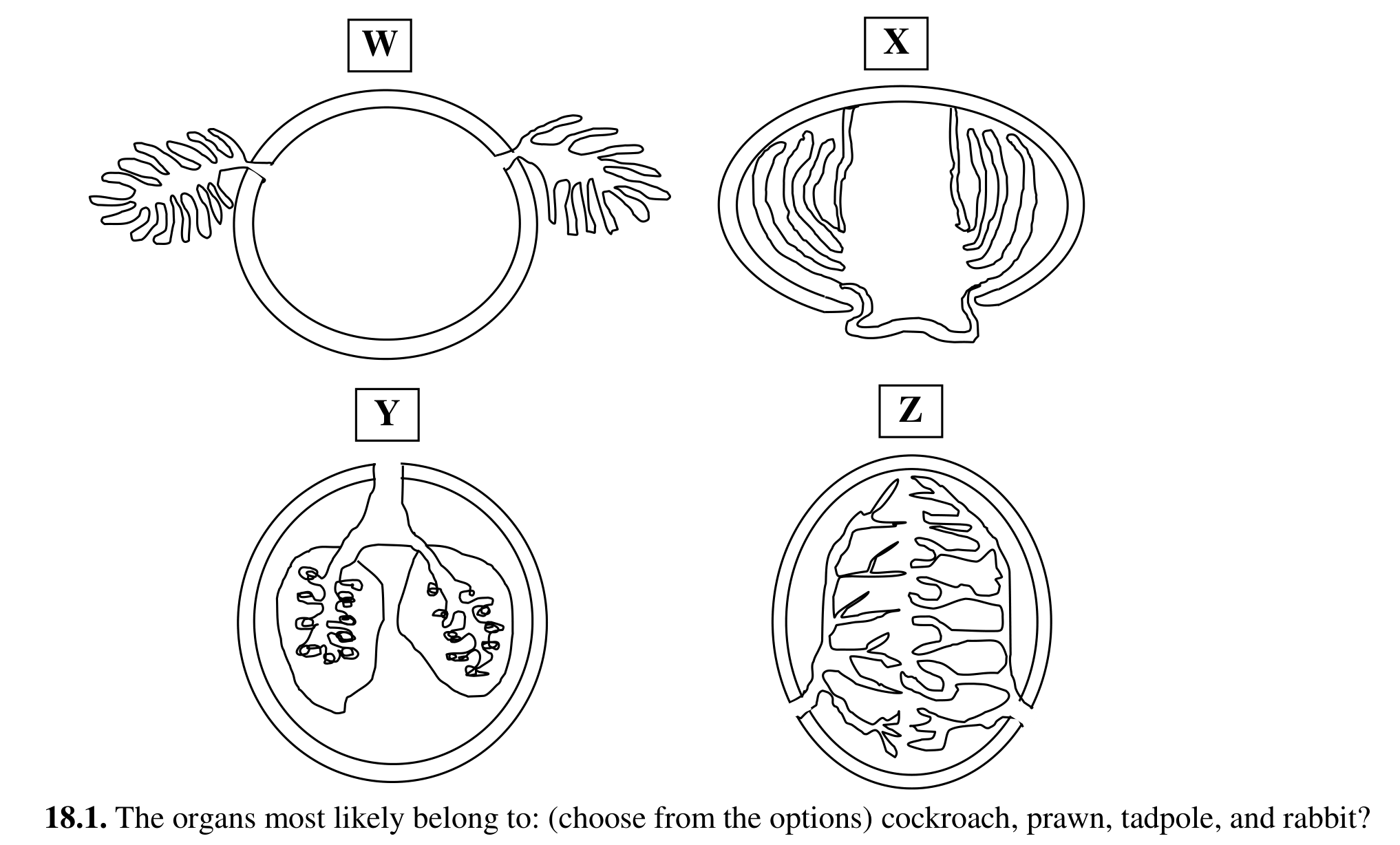
18.1. The organs most likely belong to: (choose from the options) cockroach, prawn, tadpole, and rabbit?
The Fick’s law of diffusion describes how the surface area influences the rate of diffusion and is represented as:
Where: Q = rate at which a gas such as O₂ diffuses between two locations D = diffusion coefficient, which is characteristic of the diffusing substance (e.g., a gas), the medium and the temperature gradient A = cross sectional area over which the gas is diffusing P1 and P2 are the partial pressures of the gas at the two locations L = path length or distance between the two locations
18.2. If the temperatures of the habitats, in which the four animals having the organs of type W – Z live, are the same, then, based on the medium and type of gas exchange, the value of D would be highest for animals possessing respiratory organs of the types (a)__________ as compared to animals with organs of types (b)__________ (choose from W – Z).
18.3. Two features of organisms of type W are listed in Column I in the given table. Fill in:
- column II with the appropriate factor from Fick’s law equation that will be affected by the feature mentioned in column I.
- column III with the effect that the feature will have on the factor mentioned in Column II, and
- column IV with the corresponding effect on the rate of diffusion (Q).
(Marks will be given only for completely correct row.)
| Column I — Feature | Column II — Factor affected ((I / A / P1 or P2 / L) or none) | Column III — Effect (increase / decrease / no change) | Column IV — Effect on Q (increase / decrease / no change) |
|---|---|---|---|
| 1. Highly branched and folded extensions | |||
| 2. Presence of very thin-walled tissues |
Topic: Biology Metodi: Physical Modeling Competenze: Mathematical Modeling Objects: — Fonte: Testo (PDF) — p.10 Soluzione: Soluzioni (PDF)
[7 punti] I diversi tipi di organi respiratori negli animali che occupano habitat diversi sono rappresentati nelle figure (W Z) di seguito.
Quesito 18
Gli organi più probabili appartengono a: (scelta tra le opzioni) scarafaggio, gamberetto, ciambellone e coniglio?
La legge di diffusione di Fick descrive come l’area superficiale influenza il tasso di diffusione ed è rappresentata come:
Dove: Q = velocità con cui un gas come l’O2 si diffonde tra due luoghi D = coefficiente di diffusione, caratteristico della sostanza diffusrice (ad esempio un gas), del mezzo e del gradiente di temperatura A = superficie trasversale su cui il gas si diffonde P1 e P2 sono le pressioni parziali del gas nelle due posizioni L = lunghezza o distanza tra le due posizioni
Se le temperature degli habitat in cui vivono i quattro animali con gli organi del tipo W Z sono le stesse, il valore di D sarebbe più alto per gli animali con gli organi respiratori dei tipi (a)\______________________________ (scelta da W Z).
Le caratteristiche di due organismi del tipo W sono elencate nella colonna I della tabella di cui sopra. Compila:
- colonna II con il fattore appropriato dell’equazione di Fick che sarà influenzato dalla caratteristica menzionata nella colonna I.
- colonna III, con l’effetto che la caratteristica avrà sul fattore di cui alla colonna II, e
- colonna IV con l’effetto corrispondente sul tasso di diffusione (Q).
(Le marchi saranno indicate solo per la riga completamente corretta.)
Colonna I Caratteristiche Colonna II fattore influenzato ((I / A / P1 o P2 / L) o niente) Colonna III Effetto (aumento / diminuzione / nessuna modifica) Colonna IV Effetto su * Q * (aumento / diminuzione / nessuna modifica) |---|---|---|---| | 1. Estensioni altamente ramificate e pieghevoli. | 2. Presenza di tessuti molto sottili.
Topic: Biology Metodi: Physical Modeling Competenze: Mathematical Modeling Objects: — Fonte: Testo (PDF) — p.10 Soluzione: Soluzioni (PDF)
[7 marks] Four identical beakers, as shown below, contain the same amount of water. Beaker ‘a’ contains only water. A steel ball (mass 0.800 kg) is held submerged in the beaker ‘b’ by a string from above. A same-sized plastic TT ball (mass 0.020 kg) is held submerged in beaker ‘c’ by a string attached to a stand from outside, as shown in the figure. Beaker ‘d’ contains same sized TT ball held submerged from a string attached to the bottom of the beaker. The volume of each ball is m³. These beakers (without stands) are placed on weighing pans and register readings and for a, b, c and d, respectively.
Quesito 19
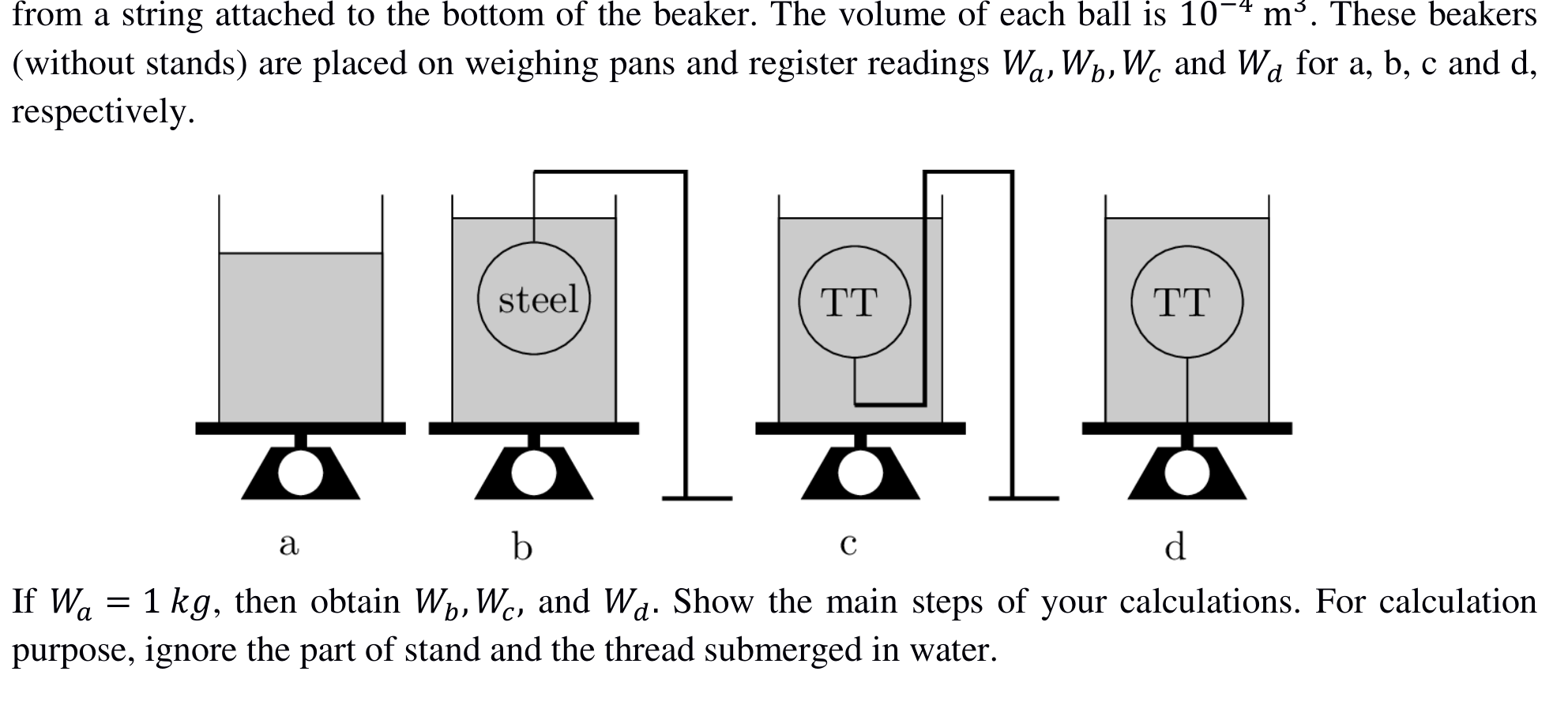
If , then obtain , and . Show the main steps of your calculations. For calculation purpose, ignore the part of stand and the thread submerged in water.
Topic: Fluid Mechanics Metodi: Hydrostatic Equilibrium Competenze: Physical Reasoning Objects: Ball, String, Container Fonte: Testo (PDF) — p.11 Soluzione: Soluzioni (PDF)
[7 punti] Quattro coppe identiche, come illustrato di seguito, contengono la stessa quantità di acqua. Il bicchiere “a” contiene solo acqua. Una palla di acciaio (massa 0,800 kg) è tenuta immersa nel bicchiere “b” da una corda dall’alto. Una palla di plastica TT della stessa dimensione (massa 0,020 kg) è tenuta immersa nel bicchiere “c” da una corda attaccata da fuori a un supporto, come mostrato nella figura. Il bicchiere “d” contiene una palla TT della stessa dimensione tenuta immersa in una corda attaccata alla parte inferiore del bicchiere. Il volume di ciascuna palla è m3. Questi bicchieri (senza supporto) sono collocati su pesi e letture di registro e per a, b, c e d, rispettivamente.
Quesito 19
Se , si ottengono e . Mostra i principali passi dei tuoi calcoli. Per calcolo, ignorare la parte del supporto e il filo immerso in acqua.
Topic: Fluid Mechanics Metodi: Hydrostatic Equilibrium Competenze: Physical Reasoning Objects: Ball, String, Container Fonte: Testo (PDF) — p.11 Soluzione: Soluzioni (PDF)
[6 marks] Smartphones can be used to perform simple experiments related to sound. There are various apps which record the intensity of an audio signal. An app (WaveEditor™ here) displays the audio signal in the form of a wave, whose amplitude is proportional to the loudness of the audio signal.
Quesito 20
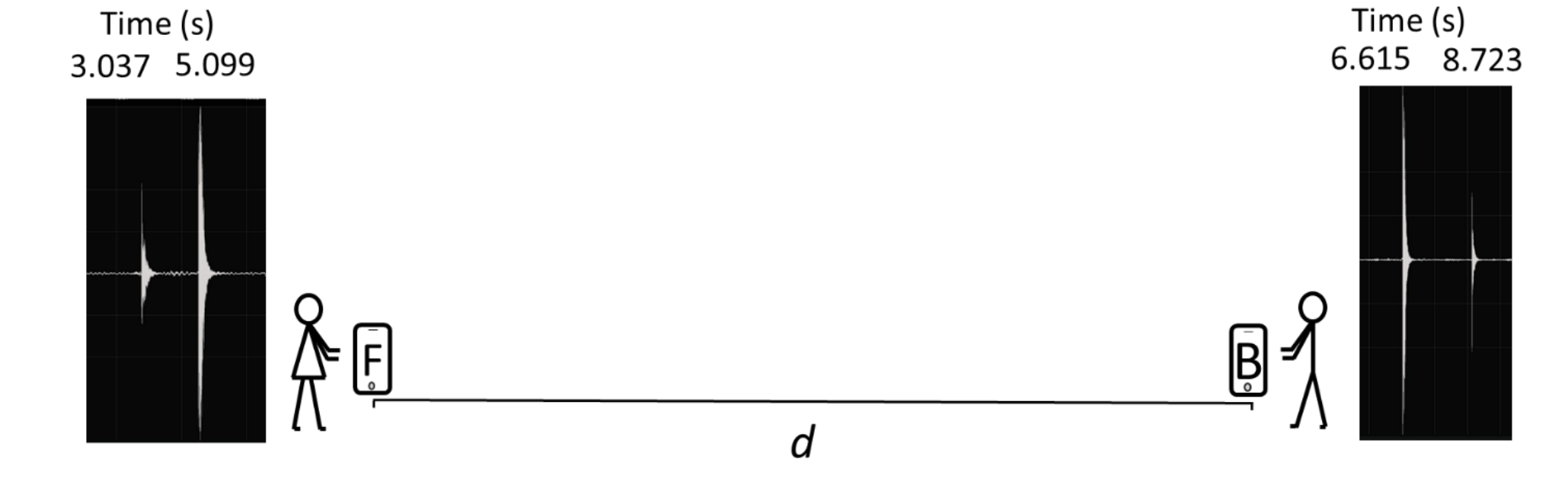
Two students Fatima (F) and Bharat (B) conduct a simple experiment using smartphones. In an open field, both place their smartphones at a distance d from each other as shown in the figure. They stand next to their smartphones, and clap one after another. The audio signals from the claps are digitally recorded by WaveEditor™ and the output produced on their smartphone screens are shown next to their sketches. Note that the figure is not to scale. The time mentioned above the screen image is the time of the peak amplitude for each clap’s audio signal received in their phones, respectively. They determine the speed of sound from this experiment to be 363 m/s.
Calculate the distance d (in m). Show the main steps of your calculation.
Topic: Oscillations & Waves Metodi: Physical Modeling Competenze: Estimation & Approximation Objects: — Fonte: Testo (PDF) — p.11 Soluzione: Soluzioni (PDF)
[6 punti] Gli smartphone possono essere utilizzati per eseguire semplici esperimenti relativi al suono. Ci sono varie app che registrano l’intensità di un segnale audio. Un’app (WaveEditorTM qui) visualizza il segnale audio sotto forma di un’onda, la cui amplitudine è proporzionale alla altezza del segnale audio.
Quesito 20
Due studenti Fatima (F) e Bharat (B) condurono un semplice esperimento utilizzando smartphone. In un campo aperto, entrambi posizionano i loro smartphone a distanza d l’uno dall’altro come mostrato nella figura. Stanno accanto ai loro smartphone e si applaudiscono uno dopo l’altro. I segnali audio provenienti dalle applaudite sono registrati digitalmente da WaveEditorTM e le output prodotte sugli schermi dei loro smartphone sono mostrate accanto ai loro schizzi. Si noti che la cifra non è a scala. Il tempo menzionato sopra nell’immagine dello schermo è il tempo dell’ampiezza di picco per il segnale audio di ciascuna appaggia ricevuta nei loro telefoni, rispettivamente. Hanno determinato che la velocità del suono da questo esperimento è di 363 m/s.
Calcolare la distanza d (in m). Mostra i principali passaggi del calcolo.
Topic: Oscillations & Waves Metodi: Physical Modeling Competenze: Estimation & Approximation Objects: — Fonte: Testo (PDF) — p.11 Soluzione: Soluzioni (PDF)
[6 marks] With about half of its surface always having day, Earth constantly receives heat from the Sun and maintains an average temperature of 288 K. From this heat, an average power of 4.3 × 10¹⁶ W goes into the evaporation of water. The water evaporated from the Earth finally precipitates over its surface. Suppose one collects this water for one year and the thickness of this water shell is h over the surface of the Earth; this value in meters is the well-known average annual rainfall on the globe. For the following two questions, make suitable assumptions wherever needed.
21.1. Estimate h.
21.2. The fresh water requirement is about 6800 l/day per head, which includes domestic water usage and water used for irrigation and industry. Estimate the ratio of water requirement for the population of the world and the total water received through rain over the land annually.
Topic: Earth & Environmental Science, Order-of-Magnitude Estimation Metodi: Order-of-Magnitude Estimation Competenze: Estimation & Approximation Objects: Planet, Star Fonte: Testo (PDF) — p.11 Soluzione: Soluzioni (PDF)
[6 punti] Con circa la metà della sua superficie che è sempre di giorno, la Terra riceve costantemente calore dal Sole e mantiene una temperatura media di 288 K. Da questo calore, una potenza media di 4.3 × 10¹⁶ W va nell’evaporazione dell’acqua. L’acqua evaporata dalla Terra precipita infine sulla sua superficie. Supponiamo che si raccolga questa acqua per un anno e lo spessore di questo guscio d’acqua è h sulla superficie della Terra; questo valore in metri è la pioggia media annuale ben nota sul globo. Per le seguenti due domande, se necessario, fare ipotesi adeguate.
21.1. Estimare h.
21.2. Il fabbisogno di acqua dolce è di circa 6800 l/giorno per abitante, che comprende l’uso di acqua domestica e l’acqua utilizzata per l’irrigazione e l’industria. Estimare il rapporto tra il fabbisogno di acqua per la popolazione mondiale e l’acqua totale ricevuta annualmente attraverso la pioggia sulla terra.
Topic: Earth & Environmental Science, Order-of-Magnitude Estimation Metodi: Order-of-Magnitude Estimation Competenze: Estimation & Approximation Objects: Planet, Star Fonte: Testo (PDF) — p.11 Soluzione: Soluzioni (PDF)