Problema Teorico n. 2: Osservando una sbarra in moto
Situazione fisica. Una camera oscura, il cui foro d’apertura puntiforme si trova in corrispondenza di ed è posto ad una distanza dall’asse , prende fotografie di una sbarra mediante l’apertura del foro per un tempo molto breve. Come mostrato nella figura, lungo l’asse sono riportate delle tacche equidistanti che consentono di misurare la lunghezza apparente della sbarra sulle fotografie prese con la camera oscura. Su una fotografia della sbarra a riposo la sua lunghezza risulta pari a . La sbarra però nel problema non è ferma, ma si muove con velocità costante lungo l’asse .
Relazioni fondamentali. Una foto presa con la camera oscura mostra, nella posizione , l’immagine di un sottile trattino presente sulla sbarra.
2.1 (0.6) Qual è la posizione effettiva di questo trattino nell’istante in cui la foto viene scattata? Esprimi la tua risposta in funzione di , , , e della velocità della luce . Usa le quantità e se sono utili per semplificare il tuo risultato.
2.2 (0.9) Trova anche la corrispondente relazione inversa, cioè esprimi in funzione di , , , e .
Nota: La posizione effettiva è la posizione misurata nel sistema di riferimento nel quale la camera oscura è ferma.
Lunghezza apparente della sbarra. La camera oscura scatta una foto nell’istante in cui la posizione effettiva del centro della sbarra si trova in un certo punto .
2.3 (1.5) Determina, in funzione delle variabili date, la lunghezza apparente della sbarra in questa foto.
2.4 (1.5) Scegli una delle alternative di risposta presenti nel Foglio risposte per indicare come cambia al trascorrere del tempo la lunghezza apparente:
- all’inizio aumenta, raggiunge un valore massimo, poi diminuisce.
- all’inizio diminuisce, raggiunge un valore minimo, poi aumenta.
- diminuisce sempre.
- aumenta sempre.
Foto simmetrica. Una delle foto scattate con la camera mostra entrambe le estremità della sbarra alla stessa distanza dal foro.
2.5 (0.8) Determina la lunghezza apparente della sbarra in questa foto.
2.6 (1.0) Qual è la posizione effettiva del centro della sbarra nell’istante in cui viene scattata questa foto?
2.7 (1.2) Dove è collocata in questa foto l’immagine del centro della sbarra?
Foto scattate molto presto e molto tardi. La camera ha preso un’immagine molto presto, quando la sbarra era molto lontana e in fase di avvicinamento, e prende un’altra foto molto tardi, quando la sbarra è molto lontana e in fase di allontanamento. Su una delle immagini la lunghezza apparente è , sull’altra è .
2.8 (0.5) Scegli una delle alternative di risposta presenti nel Foglio Risposte per indicare quale lunghezza è rilevata in quale immagine:
- La lunghezza apparente vale nella foto presa molto presto e in quella presa molto tardi.
- La lunghezza apparente vale nella foto presa molto presto e in quella presa molto tardi.
2.9 (1.0) Determina la velocità .
2.10 (0.6) Determina la lunghezza della sbarra a riposo.
2.11 (0.4) Ricava la lunghezza apparente nella foto simmetrica.
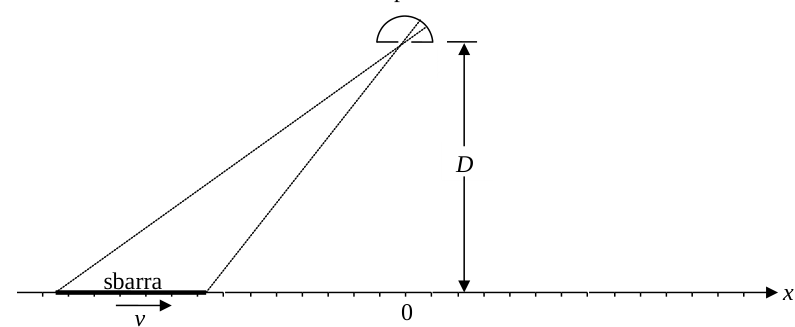 Camera oscura con foro e sbarra in moto
Topic: Special Relativity, Geometric Optics Metodi: Lorentz Transformation, Relativistic Energy-Momentum, Approximation & Series Expansion Competenze: Mathematical Modeling, Physical Reasoning Objects: Rod Fonte: Testo (PDF) — p.1
# Theoretical problem # 2: Watching a motorcycle bar
Physical situation. A dark chamber, the pointed opening hole of which is located at and is placed at a distance from the axis, takes photographs of a bar by opening the hole for a very short time. As shown in the figure, along the axis, equidistant tiles are shown to measure the apparent length of the bar on photographs taken with the dark camera. On a photograph of the resting bar its length is . The bar in the problem is not fixed, however, but moves at a constant speed along the axis.
Fundamental Relations. A camera-shadow image shows, in the position , the image of a thin strip on the bar.
2.1 (0.6) Qual è la posizione effettiva di questo trattino nell’istante in cui la foto viene scattata? Express your response in terms of , , , and the speed of light . Use the amounts and if they are useful to simplify your result.
2.2 (0.9) Also finds the corresponding inverse relationship, i.e. express as a function of , , , and .
Note: The actual position is the measured position in the reference system in which the dark chamber is stationary.
Apparent length of bar. The camera takes a picture the instant the actual position of the bar centre is at a certain point .
2.3 (1.5) Determine, depending on the given variables, the apparent length of the bar in this photo.
2.4 (1.5) Select one of the response alternatives in the Answer Sheet to indicate how the apparent length changes over time:
- at first it increases, reaches a maximum value, then it decreases.
- at first it decreases, reaches a minimum value, then increases.
- It keeps getting smaller.
- It’s always going up.
Symmetrical photo. One of the camera shots shows both ends of the bar at the same distance from the hole.
2.5 (0.8) Determine the apparent length of the bar in this photo.
2.6 (1.0) What is the actual position of the centre of the bar at the moment this image is taken?
2.7 (1.2) Dove è collocata in questa foto l’immagine del centro della sbarra?
Foto scattate molto presto e molto tardi. La camera ha preso un’immagine molto presto, quando la sbarra era molto lontana e in fase di avvicinamento, e prende un’altra foto molto tardi, quando la sbarra è molto lontana e in fase di allontanamento. On one image the apparent length is , on the other it is .
2.8 (0.5) Select one of the answer alternatives in the Answer Sheet to indicate which length is detected in which image:
- The apparent length is in the very early photo and in the very late photo.
- The apparent length is in the very early photo and in the very late photo.
2.9 (1.0) Determina la velocità .
2.10 (0.6) Determine the length of the resting bar .
2.11 (0.4) Takes the apparent length in the symmetrical photo.
Dark camera with hole and bar in motion
Topic: Special Relativity, Geometric Optics Metodi: Lorentz Transformation, Relativistic Energy-Momentum, Approximation & Series Expansion Competenze: Mathematical Modeling, Physical Reasoning Objects: Rod Fonte: Testo (PDF) — p.1