Macchina fotografica digitale
Considera una macchina fotografica digitale con un chip CCD quadrato di lato mm che ha Mpix ( Mpix pixels). La lente di questa macchina fotografica ha una lunghezza focale mm. La nota sequenza di numeri che appare sulla lente si riferisce al cosiddetto numero F, che viene indicato con ed è definito come il rapporto tra la lunghezza focale della lente e il diametro dell’apertura della lente, .
3.1 (1.0 pt) Trova, nella posizione del chip, la migliore risoluzione spaziale possibile , limitata dalla diffrazione della lente, della macchina fotografica. Esprimi il tuo risultato in funzione della lunghezza d’onda e del numero F, , e fornisci il valore numerico per nm.
Topic: Wave Optics, Order-of-Magnitude Estimation Metodi: Interference & Diffraction Analysis, Order-of-Magnitude Estimation Competenze: Estimation & Approximation, Physical Reasoning Objects: Lens Fonte: Testo (PDF) — p.1
Macchina fotografica digitale
Consider a digital camera with a side-square mm CCD chip that has Mpix ( Mpix pixels). The lens of this camera has a focal length mm. The note sequence of numbers that appears on the lens refers to the so-called number F, which is denoted by and is defined as the ratio between the focal length of the lens and the diameter of the lens aperture, .
3.1 (1.0 pt) Trova, nella posizione del chip, la migliore risoluzione spaziale possibile , limitata dalla diffrazione della lente, della macchina fotografica. Express your result in terms of the wavelength and the number F, , and provide the numerical value for nm.
Topic: Wave Optics, Order-of-Magnitude Estimation Metodi: Interference & Diffraction Analysis, Order-of-Magnitude Estimation Competenze: Estimation & Approximation, Physical Reasoning Objects: Lens Fonte: Testo (PDF) — p.1
Macchina fotografica digitale (segue)
Considera la stessa macchina fotografica digitale con chip CCD quadrato di lato mm, lunghezza focale mm.
3.2 (0.5 pt) Trova il necessario numero di Mpix che il chip del CCD dovrebbe possedere per garantire la risoluzione ottimale limitata dalla diffrazione (calcolata in 3.1).
Topic: Wave Optics, Order-of-Magnitude Estimation Metodi: Interference & Diffraction Analysis, Order-of-Magnitude Estimation Competenze: Estimation & Approximation, Mathematical Modeling Objects: Lens Fonte: Testo (PDF) — p.1
The following table shows the number of units in the manufacturer’s inventory:
Consider the same digital camera with a side-square CCD chip mm, focal length mm.
Find the required Mpix number that the CCD chip should have to ensure the optimal diffraction-limited resolution (calculated in 3.1).
Topic: Wave Optics, Order-of-Magnitude Estimation Metodi: Interference & Diffraction Analysis, Order-of-Magnitude Estimation Competenze: Estimation & Approximation, Mathematical Modeling Objects: Lens Fonte: Testo (PDF) — p.1
Macchina fotografica digitale (segue)
Considera ora una macchina fotografica con Mpix e con il lato del chip e la lunghezza focale uguali a quelli di prima ( mm, mm).
3.3 (0.5 pt) Talvolta i fotografi cercano di usare la macchina fotografica con la minima apertura possibile. Quale valore bisogna scegliere per in modo tale che la qualità dell’immagine non sia deteriorata per motivi dovuti all’ottica?
Topic: Wave Optics, Order-of-Magnitude Estimation Metodi: Interference & Diffraction Analysis, Order-of-Magnitude Estimation Competenze: Estimation & Approximation, Physical Reasoning Objects: Lens Fonte: Testo (PDF) — p.1
The following table shows the number of units in the manufacturer’s inventory:
Consider a camera with Mpix and with the chip side and focal length equal to the previous ones ( mm, mm).
Sometimes photographers try to use the camera with the least possible aperture. What value should be chosen for so that the image quality is not impaired for optical reasons?
Topic: Wave Optics, Order-of-Magnitude Estimation Metodi: Interference & Diffraction Analysis, Order-of-Magnitude Estimation Competenze: Estimation & Approximation, Physical Reasoning Objects: Lens Fonte: Testo (PDF) — p.1
Macchina fotografica digitale (segue)
Sapendo che l’occhio umano ha una risoluzione angolare di circa arcsec e che una tipica stampante fotografica stampa con un minimo di 300 dpi (dot per inch, ovvero punti per pollice).
Dati: 1 inch = 25.4 mm; rad.
3.4 (0.5 pt) A quale distanza minima dai tuoi occhi dovresti tenere la pagina stampata in modo da non vedere i singoli punti?
Topic: Wave Optics, Order-of-Magnitude Estimation Metodi: Order-of-Magnitude Estimation, Small-Angle Approximation Competenze: Estimation & Approximation, Unit Conversion Objects: — Fonte: Testo (PDF) — p.1
Macchina fotografica digitale (segue)
Knowing that the human eye has an angular resolution of about arcsec and that a typical photographic printer prints with a minimum of 300 dpi (dot per inch, or points per inch).
Dati: 1 inch = 25.4 mm; rad.
3.4 (0.5 pt) A quale distanza minima dai tuoi occhi dovresti tenere la pagina stampata in modo da non vedere i singoli punti?
Topic: Wave Optics, Order-of-Magnitude Estimation Metodi: Order-of-Magnitude Estimation, Small-Angle Approximation Competenze: Estimation & Approximation, Unit Conversion Objects: — Fonte: Testo (PDF) — p.1
Un uovo sodo
Un uovo, preso direttamente dal frigorifero ad una temperatura , è gettato in un pentolino contenente acqua mantenuta costantemente alla temperatura .
Dati:
- Densità dell’uovo: kg m
- Calore specifico dell’uovo: J K g
- Raggio dell’uovo: cm
- Temperatura di coagulazione dell’albume:
- Conducibilità termica: W K m
3.5 (0.5 pt) Qual è la quantità di energia necessaria per coagulare completamente l’uovo?
Topic: Thermodynamics, Order-of-Magnitude Estimation Metodi: Order-of-Magnitude Estimation, Physical Modeling Competenze: Estimation & Approximation, Physical Reasoning Objects: — Fonte: Testo (PDF) — p.1
The following table shows the number of eggs:
An egg taken directly from the refrigerator at is dropped into a pen containing water kept constantly at .
The following information is provided for in the Annex to Implementing Regulation (EU) No 1303/2013.
- Egg density: kg m
- Specific heat of the egg: J K g
- Egg beam: cm
- Coagulation temperature of the album:
- Thermal conductivity: W K m
3.5 (0.5 pt) What is the amount of energy required to fully clot the egg?
Topic: Thermodynamics, Order-of-Magnitude Estimation Metodi: Order-of-Magnitude Estimation, Physical Modeling Competenze: Estimation & Approximation, Physical Reasoning Objects: — Fonte: Testo (PDF) — p.1
Un uovo sodo (segue)
Un uovo (raggio cm, conducibilità termica W K m) è immerso in acqua a . Si può usare la forma semplificata della legge di Fourier: , dove è la differenza di temperatura associata alla lunghezza di scala tipica del problema. Il flusso termico è espresso in W m.
3.6 (0.5 pt) Qual è il flusso di calore che penetra nell’uovo?
Topic: Thermodynamics, Order-of-Magnitude Estimation Metodi: Order-of-Magnitude Estimation, Physical Modeling Competenze: Estimation & Approximation, Physical Reasoning Objects: — Fonte: Testo (PDF) — p.2
**A hard (seag) egg **
An egg (radius cm, thermal conductivity W K m) is immersed in water at . One can use the simplified form of Fourier’s law: , where is the temperature difference associated with the typical length of scale of the problem. The heat flow is expressed in W m.
3.6 (0.5 pt) What is the heat flow that enters the egg?
Topic: Thermodynamics, Order-of-Magnitude Estimation Metodi: Order-of-Magnitude Estimation, Physical Modeling Competenze: Estimation & Approximation, Physical Reasoning Objects: — Fonte: Testo (PDF) — p.2
Un uovo sodo (segue)
Un uovo (raggio cm) è immerso in acqua a .
3.7 (0.5 pt) Qual è la potenza termica trasferita all’uovo?
Topic: Thermodynamics, Order-of-Magnitude Estimation Metodi: Order-of-Magnitude Estimation, Physical Modeling Competenze: Estimation & Approximation, Physical Reasoning Objects: — Fonte: Testo (PDF) — p.2
**A hard (seag) egg **
An egg (radius cm) is immersed in water at .
3.7 (0.5 pt) What is the thermal power transferred to the egg?
Topic: Thermodynamics, Order-of-Magnitude Estimation Metodi: Order-of-Magnitude Estimation, Physical Modeling Competenze: Estimation & Approximation, Physical Reasoning Objects: — Fonte: Testo (PDF) — p.2
Un uovo sodo (segue)
Un uovo, preso dal frigorifero a , è immerso in acqua a . Si conoscono l’energia necessaria alla coagulazione (calcolata in 3.5) e la potenza termica (calcolata in 3.7).
3.8 (0.5 pt) Per quanto tempo occorre cuocere l’uovo in modo da renderlo sodo?
Topic: Thermodynamics, Order-of-Magnitude Estimation Metodi: Order-of-Magnitude Estimation, Physical Modeling Competenze: Estimation & Approximation, Physical Reasoning Objects: — Fonte: Testo (PDF) — p.2
**A hard (seag) egg **
An egg taken from the refrigerator at is immersed in water at . The coagulation energy (calculated in 3.5) and the thermal power (calculated in 3.7) are known.
How long does it take to cook the egg to make it solid?
Topic: Thermodynamics, Order-of-Magnitude Estimation Metodi: Order-of-Magnitude Estimation, Physical Modeling Competenze: Estimation & Approximation, Physical Reasoning Objects: — Fonte: Testo (PDF) — p.2
Fulmine
Viene proposto un modello estremamente semplificato del processo di produzione di un fulmine. Il fulmine è prodotto dall’accumularsi di carica elettrostatica nelle nuvole. La base della nube si carica positivamente e la parte superiore negativamente; il suolo sotto la nube si carica negativamente. Quando il corrispondente campo elettrico supera la rigidità dielettrica dell’aria, si verifica una violenta scarica: il fulmine.
Dati:
- Distanza tra la base della nube ed il suolo: km
- Rigidità dielettrica dell’aria umida: kV m
- Numero totale di fulmini che in media colpiscono la Terra in un anno:
- Popolazione umana complessiva: persone
Fai riferimento alla curva semplificata dell’impulso di corrente in funzione del tempo tra nube e suolo durante il fulmine (figura sul testo originale).
3.9 (0.5 pt) Qual è la carica totale liberata durante un fulmine?
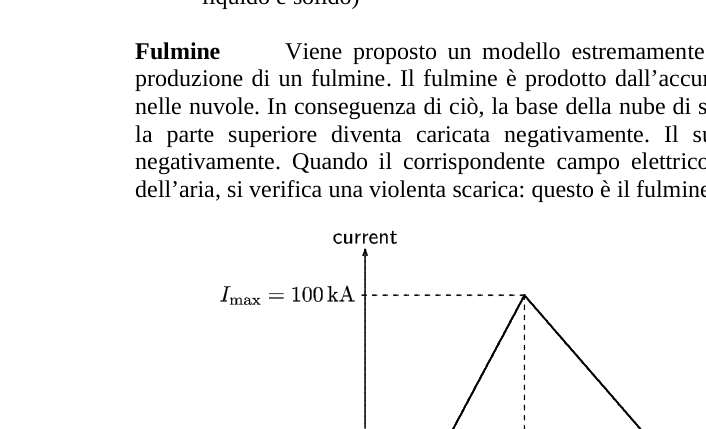 Impulso di corrente fulmine vs tempo
Topic: Electrostatics, Order-of-Magnitude Estimation Metodi: Order-of-Magnitude Estimation, Physical Modeling Competenze: Estimation & Approximation, Physical Reasoning Objects: — Fonte: Testo (PDF) — p.2
The following table shows the results of the study:
A very simplified model of the process of producing a lightning bolt is proposed. Lightning is produced by the accumulation of electrostatic charge in the clouds. The base of the cloud is charged positively and the top negatively; the ground under the cloud is charged negatively. When the corresponding electric field exceeds the dielectric stiffness of the air, a violent discharge occurs: lightning.
The following information is provided for in the Annex to Implementing Regulation (EU) No 1303/2013.
- Distance between the base of the cloud and the ground: km
- Dielectric rigidity of the wet air: kV m
- Total number of lightning strikes on average on Earth in a year:
- Total human population: people
Refer to the simplified current pulse curve as a function of the time between clouds and ground during lightning (figure on the original text).
3.9 (0.5 pt) What is the total charge released during a lightning strike?
The following is the list of the current and the current values of the electrical power generated by the electrical power generated by the electrical power generated by the electrical power generated by the electrical power generated by the electrical power generated by the electrical power generated by the electrical power generated by the electrical power generated by the electrical power generated by the electrical power generated by the electrical power generated by the electrical power generated by the electrical power generated by the electrical power generated by the electrical power generated by the electrical power generated by the electrical power generated by the electrical power generated by the electrical power generated by the electrical power generated by the electrical power generated electrical power generated by the electrical power generated electrical power generated by the electrical power generated electrical power generated by the electrical power generated electrical power generated electrical power generated by the electrical power generated electrical power generated electrical power generated electrical power generated by the electrical power generated electrical power generated electrical power generated electrical power generated electrical power generated electrical power generated electrical power generated by the electrical power generated electrical power generated electrical power generated electrical power generated electrical power generated electrical power generated electrical power generated electrical power generated electrical power generated electrical power generated electrical power generated electrical power generated electrical power generated electrical power generated electrical power generated electrical power.
Topic: Electrostatics, Order-of-Magnitude Estimation Metodi: Order-of-Magnitude Estimation, Physical Modeling Competenze: Estimation & Approximation, Physical Reasoning Objects: — Fonte: Testo (PDF) — p.2
Fulmine (segue)
Stesse condizioni del problema 3.9 (fulmine tra nube a km e suolo, curva corrente-tempo semplificata).
3.10 (0.5 pt) Qual è la corrente elettrica media che passa tra la base della nube ed il suolo durante il fulmine?
Topic: Electrostatics, Order-of-Magnitude Estimation Metodi: Order-of-Magnitude Estimation, Physical Modeling Competenze: Estimation & Approximation, Physical Reasoning Objects: — Fonte: Testo (PDF) — p.3
The following table shows the results of the evaluation:
The same conditions as in problem 3.9 (lightning between clouds at km and ground, simplified current-time curve).
**3.10 ** (0.5 pt) What is the mean electric current passing between the base of the cloud and the ground during lightning?
Topic: Electrostatics, Order-of-Magnitude Estimation Metodi: Order-of-Magnitude Estimation, Physical Modeling Competenze: Estimation & Approximation, Physical Reasoning Objects: — Fonte: Testo (PDF) — p.3
Fulmine (segue)
Stesse condizioni e dati del problema 3.9.
3.11 (1.0 pt) Supponi che l’energia di tutti i temporali che si verificano in un anno sia raccolta ed egualmente distribuita tra tutta la popolazione ( persone). Per quanto tempo potresti tenere accesa continuamente una lampadina da 100 W con la tua quota di energia?
Topic: Electrostatics, Order-of-Magnitude Estimation Metodi: Order-of-Magnitude Estimation, Physical Modeling, Electric Potential Method Competenze: Estimation & Approximation, Physical Reasoning Objects: — Fonte: Testo (PDF) — p.3
The following table shows the results of the evaluation:
The same conditions and data as in problem 3.9.
**3.11 ** (1.0 pt) Assume that the energy of all storms that occur in a year is collected and equally distributed among the entire population ( people). How long can you keep a 100W light bulb on continuously with your own power share?
Topic: Electrostatics, Order-of-Magnitude Estimation Metodi: Order-of-Magnitude Estimation, Physical Modeling, Electric Potential Method Competenze: Estimation & Approximation, Physical Reasoning Objects: — Fonte: Testo (PDF) — p.3
Vasi capillari
Consideriamo il sangue come un fluido viscoso incomprimibile con una densità simile a quella dell’acqua ed una viscosità dinamica kg m s. Modelliziamo i vasi sanguigni come tubi cilindrici rettilinei di raggio e lunghezza e descriviamo il flusso sanguigno mediante la legge di Poiseuille:
dove è la differenza di pressione tra ingresso e uscita, è la portata volumetrica e è la velocità del sangue (con ).
Per la circolazione sistemica, il flusso totale vale cm s per un uomo a riposo. Tutti i vasi capillari sono connessi in parallelo; ciascuno ha raggio m, lunghezza mm, ed è sottoposto a kPa.
3.12 (1.0 pt) Quanti vasi capillari ci sono nel corpo umano?
Topic: Fluid Mechanics, Order-of-Magnitude Estimation Metodi: Order-of-Magnitude Estimation, Physical Modeling, Continuity Equation Competenze: Estimation & Approximation, Mathematical Modeling Objects: Tube Fonte: Testo (PDF) — p.3
The following table summarizes the results of the studies:
We consider blood as an incompressible viscous fluid with a density similar to that of water and a dynamic viscosity kg m s. We model the blood vessels as straight cylindrical tubes of radius and length and we describe blood flow using Poiseuille’s law:
where is the difference in pressure between input and output, is the volumetric flow and is the blood velocity (with ).
For systemic circulation, the total flow is cm s for a resting man. All capillary vessels are connected in parallel; each has a radius m, length mm, and is subjected to kPa.
How many capillaries are there in the human body?
Topic: Fluid Mechanics, Order-of-Magnitude Estimation Metodi: Order-of-Magnitude Estimation, Physical Modeling, Continuity Equation Competenze: Estimation & Approximation, Mathematical Modeling Objects: Tube Fonte: Testo (PDF) — p.3
Vasi capillari (segue)
Stesse condizioni del problema 3.12 (capillari in parallelo, m, mm, kPa, kg m s, legge di Poiseuille).
3.13 (0.5 pt) Qual è la velocità con la quale il sangue scorre attraverso un vaso capillare?
Topic: Fluid Mechanics, Order-of-Magnitude Estimation Metodi: Order-of-Magnitude Estimation, Continuity Equation Competenze: Estimation & Approximation, Physical Reasoning Objects: Tube Fonte: Testo (PDF) — p.3
Vasi capillari (segue)
The same conditions as in problem 3.12 (parallel capillaries, m, mm, kPa, kg m s, Poiseuille’s law).
3.13 (0.5 pt) Qual è la velocità con la quale il sangue scorre attraverso un vaso capillare?
Topic: Fluid Mechanics, Order-of-Magnitude Estimation Metodi: Order-of-Magnitude Estimation, Continuity Equation Competenze: Estimation & Approximation, Physical Reasoning Objects: Tube Fonte: Testo (PDF) — p.3
Un grattacielo
Alla base di un grattacielo alto 1000 m, la temperatura esterna è . L’obiettivo è stimare la temperatura esterna in cima. Considera un sottile strato di aria (gas azoto perfetto con coefficiente adiabatico ) che sale lentamente ad un’altezza dove la pressione è minore, e supponi che questo strato si espanda adiabaticamente in modo tale che la sua temperatura si porti alla temperatura dell’aria circostante.
Dati:
- Costante di Boltzmann: J K
- Massa di una molecola di azoto: kg
- Accelerazione di gravità: m s
3.14 (0.5 pt) Quanto vale la variazione relativa di temperatura in funzione della variazione relativa di pressione ?
Topic: Thermodynamics, Order-of-Magnitude Estimation Metodi: Order-of-Magnitude Estimation, Ideal Gas Law, Thermodynamic Cycle Analysis Competenze: Estimation & Approximation, Mathematical Modeling Objects: Gas Fonte: Testo (PDF) — p.3
The following is the list of the official languages of the European Union:
At the base of a 1000 m high skyscraper, the outside temperature is . The objective is to estimate the outside temperature at the top. Consider a thin layer of air (perfect nitrogen gas with adiabatic coefficient ) that slowly rises to a height where the pressure is lower, and assume that this layer expands adiabatically so that its temperature is carried to the temperature of the surrounding air.
The following information is provided for in the Annex to Implementing Regulation (EU) No 1303/2013.
- Boltzmann constant: J K
- Mass of one nitrogen molecule: kg
- Acceleration by gravity: m s
3.14 (0.5 p) What is the relative temperature change according to the relative pressure change ?
Topic: Thermodynamics, Order-of-Magnitude Estimation Metodi: Order-of-Magnitude Estimation, Ideal Gas Law, Thermodynamic Cycle Analysis Competenze: Estimation & Approximation, Mathematical Modeling Objects: Gas Fonte: Testo (PDF) — p.3
Un grattacielo (segue)
Stesse condizioni del problema 3.14 (strato di aria che si espande adiabaticamente, gas azoto, m s, kg, J K).
3.15 (0.5 pt) Esprimi la differenza di pressione in funzione di , la variazione di quota.
Topic: Thermodynamics, Fluid Mechanics, Order-of-Magnitude Estimation Metodi: Hydrostatic Equilibrium, Ideal Gas Law, Order-of-Magnitude Estimation Competenze: Estimation & Approximation, Mathematical Modeling Objects: Gas Fonte: Testo (PDF) — p.4
The following is the list of the official languages of the European Union:
The same conditions as in problem 3.14 (air layer expanding adiabatically, nitrogen gas, m s, kg, J K).
3.15 (0.5 pt) Express the pressure difference as a function of , the change in altitude.
Topic: Thermodynamics, Fluid Mechanics, Order-of-Magnitude Estimation Metodi: Hydrostatic Equilibrium, Ideal Gas Law, Order-of-Magnitude Estimation Competenze: Estimation & Approximation, Mathematical Modeling Objects: Gas Fonte: Testo (PDF) — p.4
Un grattacielo (segue)
Stesse condizioni e dati dei problemi 3.14–3.15. Si sa che alla base (quota 0) e che il grattacielo è alto 1000 m.
3.16 (1.0 pt) Qual è la temperatura che si ottiene in cima all’edificio?
Topic: Thermodynamics, Order-of-Magnitude Estimation Metodi: Ideal Gas Law, Order-of-Magnitude Estimation, Differential Equations Competenze: Estimation & Approximation, Mathematical Modeling Objects: Gas Fonte: Testo (PDF) — p.4
Un grattacielo (segue)
The same conditions and data for problems 3.143.15. It is known that at the base (quota 0) and that the skyscraper is 1000 m high.
3.16 (1.0 pt) Qual è la temperatura che si ottiene in cima all’edificio?
Topic: Thermodynamics, Order-of-Magnitude Estimation Metodi: Ideal Gas Law, Order-of-Magnitude Estimation, Differential Equations Competenze: Estimation & Approximation, Mathematical Modeling Objects: Gas Fonte: Testo (PDF) — p.4