Un pendolo con un peso che cade
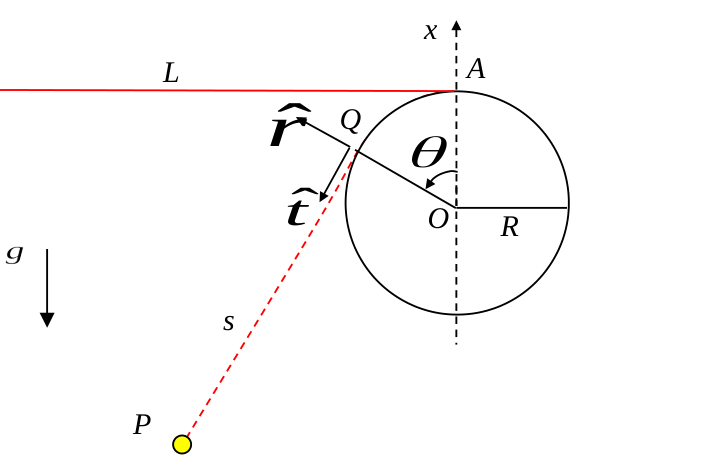
Una bacchetta cilindrica di raggio viene tenuta orizzontalmente, in alto rispetto al suolo. Un piccolo corpo di massa viene sospeso dal punto più alto del cilindro, , con un filo di massa trascurabile e lunghezza (), come si vede in Figura 1a. Il corpo viene alzato fino al livello di e poi lasciato cadere, come un pendolo, dalla quiete mentre il filo è teso. Trascura qualsiasi allungamento del filo. Fai l’ipotesi che il corpo possa essere trattato come punto materiale e che oscilli solo in un piano ortogonale all’asse del cilindro. Per queste ragioni chiameremo particella il corpo. L’accelerazione gravitazionale sia .
Poniamo in l’origine di un sistema di coordinate. Quando la particella è nel punto il filo è tangente in alla superficie del cilindro. Sia la lunghezza del segmento . Il versore tangente e il versore radiale in siano rispettivamente e . La deviazione angolare del raggio si considera positiva se misurata in verso antiorario a partire dall’asse verticale lungo .
Quando la lunghezza è uguale a e l’energia potenziale gravitazionale della particella è posta uguale a zero. Quando la particella si muove, indichiamo con e rispettivamente le derivate temporali di e .
Salvo esplicita indicazione in contrario, tutte le velocità e i loro moduli sono riferite al punto fisso .
Parte A
Nella parte A, il filo è sempre teso durante il moto della particella. Trova, in funzione delle quantità definite in precedenza (cioè , , , , , , , e ):
(a) La relazione fra e . [0,5 punti]
(b) La velocità del punto mobile rispetto ad . [0,5 punti]
(c) La velocità della particella quando si trova in , rispetto al punto mobile . [0,7 punti]
(d) La velocità della particella quando si trova in , rispetto al punto . [0,7 punti]
(e) La componente lungo dell’accelerazione della particella quando si trova in , rispetto al punto . [0,7 punti]
(f) L’energia potenziale gravitazionale della particella quando si trova in . [0,5 punti]
(g) Il modulo della velocità della particella nel punto più basso della sua traiettoria. [0,7 punti]
Parte B
Nella parte B, il rapporto fra e vale:
(h) Qual è il modulo della velocità della particella nella posizione per la quale il tratto di filo fra e è ancora rettilineo ma ha il valore minimo? (esprimila in termini di e ) [2,4 punti]
(i) Qual è il modulo della velocità della particella nel punto più alto che essa raggiunge dopo essere oscillata dall’altra parte della bacchetta rispetto al punto di partenza? (esprimila in termini di e ) [1,9 punti]
Parte C
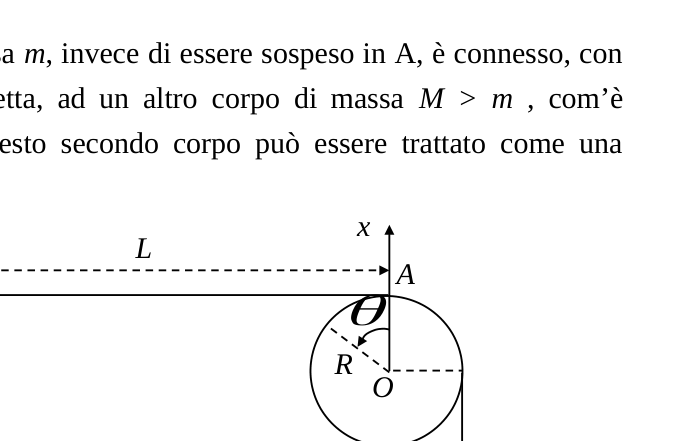
Nella parte C, il pendolo di massa , invece di essere sospeso in , è connesso, con un filo che passa sopra la bacchetta, ad un altro corpo di massa , come mostrato in Figura 1b. Anche questo secondo corpo può essere trattato come una particella.
Inizialmente il pendolo viene tenuto allo stesso livello di in modo che, quando il peso di massa pende al di sotto del livello di , il filo sia teso con un tratto orizzontale di lunghezza . Poi il pendolo viene lasciato libero a partire dalla quiete e il peso inizia a cadere. Supponi che il pendolo rimanga in un piano verticale e che esso possa oscillare liberamente al di là del peso che scende, senza intoppi.
L’attrito dinamico fra il filo e la superficie della bacchetta cilindrica è trascurabile. Ma si suppone che l’attrito statico sia abbastanza grande perché il peso resti fermo se, dopo la caduta, la sua velocità si annulla.
(j) Fai l’ipotesi che il peso si fermi effettivamente dopo essere sceso di un tratto e che . Se in tal caso il pendolo può ruotare di intorno alla bacchetta mentre entrambi i tratti del filo che non toccano la bacchetta restano rettilinei, si trova che il rapporto non può essere minore di un valore critico . Trascurando i termini dell’ordine di o più alti, dai una stima di in termini di . [3,4 punti]
p.1 — Figura 1a: pendolo con peso attorno al cilindro
p.2 — Figura 1b: filo avvolto sulla bacchetta
Topic: Newtonian Mechanics, Conservation of Energy, Oscillations & Waves Metodi: Free-Body Diagram, Kinematic Equations, Vector Decomposition, Energy Conservation Method, Conservation Laws Competenze: Diagrammatic Reasoning, Mathematical Modeling, Physical Reasoning Objects: Rod, Pendulum, String Fonte: Testo (PDF) — p.1
**A pendulum with a weight falling **
A cylindrical rod of radius shall be held horizontally, high above the ground. A small mass body is suspended from the top of the cylinder, , with a slender mass wire and length (), as shown in Figure 1a. The body is raised to the level of and then dropped, like a pendulum, from the stillness while the wire is stretched. Trace any stretch of the wire. Assume that the body can be treated as a material point and that it only oscillates in an orthogonal plane to the cylinder’s axis. Per queste ragioni chiameremo particella il corpo. The gravitational acceleration is .
Poniamo in l’origine di un sistema di coordinate. When the particle is at the wire is tangent in to the surface of the cylinder. The length of the segment shall be . The tangent and radial flow rates in are and respectively. The angle deviation of the radius shall be considered positive if measured clockwise from the vertical axis along .
When the length is equal to and the gravitational potential energy of the particle is set to zero. When the particle moves, we indicate with and the time derivatives of and respectively.
Unless otherwise specified, all speeds and their modules shall be referred to the fixed point .
Part A
In Part A, the wire is always stretched during the motion of the particle. Find, according to the quantities defined above (i.e. , , , , , , , and ):
(a) La relazione fra e . The following points shall be added:
**(b) ** The speed of the moving point with respect to . The following points shall be added:
**(c) ** The speed of the particle when it is in , relative to the movable point . The following points shall be added:
**(d) ** The speed of the particle when it is in , relative to the point. The following points shall be added:
**(e) ** The long component of the *acceleration * of the particle when it is in , relative to the point. The following points shall be added:
**(f) ** The gravitational potential energy of the particle when it is in . The following points shall be added:
**(g) ** The modulation of the particle velocity at the lowest point of its trajectory. The following points shall be added:
Part B
In Part B, the ratio between and shall be:
**(h) ** What is the modulation of particle velocity in the position where the wire length between and is still straight but has the minimum value? (expressed in terms of and ) [2,4 points]
**(i) ** What is the modulation of the particle velocity at the highest point it reaches after oscillating from the other side of the rod relative to the starting point? (expressed in terms of and ) [1,9 points]
Part C
In Part C, the mass pendulum , instead of being suspended in , is connected, by a wire passing over the rod, to another mass body , as shown in Figure 1b. This second body can also be treated as a particle.
Initially the pendulum shall be held at the same level as so that when the mass weight is below the level of , the wire is stretched with a horizontal length . Then the pendulum is released from the stillness and the weight begins to fall. Suppose the pendulum remains in a vertical plane and can swing freely beyond the weight that descends, without any bumps.
The dynamic friction between the wire and the cylindrical rod surface is negligible. But it is assumed that static friction is large enough for the weight to remain stationary if, after the fall, its speed is cancelled.
(j) Fai l’ipotesi che il peso si fermi effettivamente dopo essere sceso di un tratto e che . If the pendulum can then rotate around the rod while both strands of wire that do not touch the rod remain straight, the ratio shall not be less than a critical value . If the order of or higher is not met, give an estimate of in terms of . The Commission shall adopt implementing acts in accordance with Article 21 of this Regulation.
p.1 Figure 1a: pendulum with weight around the cylinder
p.2 Figure 1b: wire wrapped around the cane
Topic: Newtonian Mechanics, Conservation of Energy, Oscillations & Waves Metodi: Free-Body Diagram, Kinematic Equations, Vector Decomposition, Energy Conservation Method, Conservation Laws Competenze: Diagrammatic Reasoning, Mathematical Modeling, Physical Reasoning Objects: Rod, Pendulum, String Fonte: Testo (PDF) — p.1