Parte A: proprietà meccaniche
Considera una sbarra uniforme di lunghezza a riposo e sezione trasversale di area (Figura 2a). La sua lunghezza cambia di quando forze uguali in intensità, , e in direzione, ma di verso opposto sono applicate ortogonalmente alle facce opposte della sbarra. Lo stress sulla superficie di ognuna estremità della sbarra è definito come . La variazione relativa della sua lunghezza, ossia , viene chiamata strain della sbarra. In termini di stress e strain, la legge di Hooke può essere espressa come
dove è detto modulo di Young del materiale della sbarra. Notare che uno stress in compressione corrisponde a e ad un decremento in lunghezza (cioè ). Un tale stress è pertanto negativo in valore ed è collegato alla pressione dalla relazione .
Per una sbarra uniforme di densità , il modulo della velocità di propagazione di onde longitudinali (per esempio, il modulo della velocità del suono) lungo la sbarra è dato da
Gli effetti prodotti da smorzamenti e dissipazioni possono essere trascurati nel rispondere alle sottostanti domande.
Una sbarra uniforme di lunghezza semi-infinita, cioè che si estende da a (vedi Figura 2b), ha una densità . Inizialmente è ferma e non sottoposta a stress. Successivamente sulla sua estremità sinistra, nel punto , un pistone esercita per un tempo brevissimo una piccola pressione di valore mediamente pari a , generando un’onda di pressione che si propaga verso destra con velocità in modulo pari a .
(a) Se il pistone induce l’estremità sinistra della sbarra a muoversi ad una velocità costante (Figura 2b), quali sono lo strain e la pressione all’estremità sinistra della sbarra durante il tempo ? (Le risposte devono essere date solamente in termini di , , e .)
[1.6 punti]
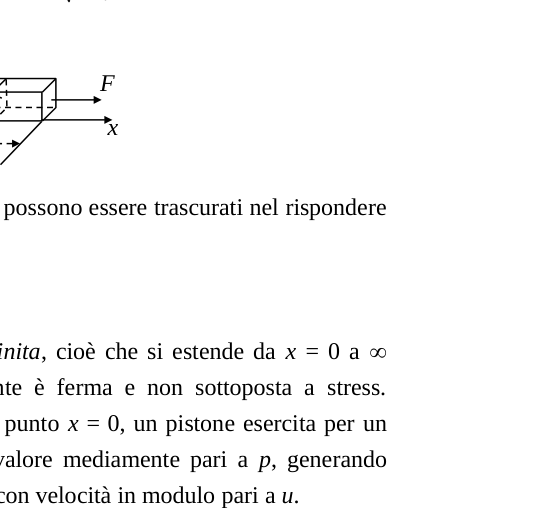 Bar under force F, stress T = F/A
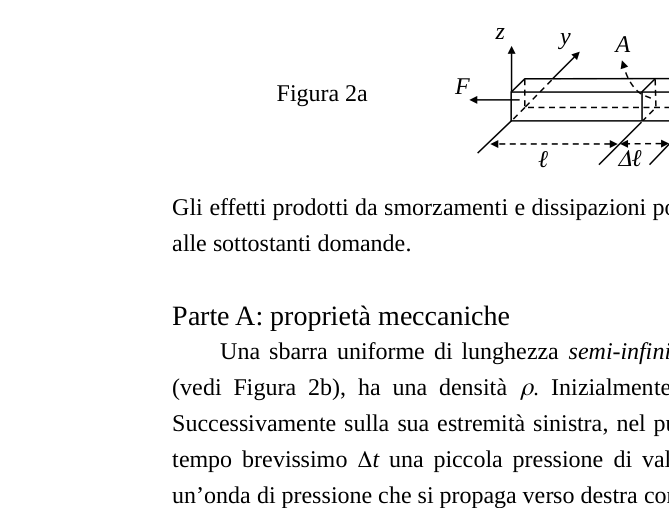 Semi-infinite bar, piston at x=0
Topic: Oscillations & Waves, Elasticity & Materials, Newtonian Mechanics Metodi: Wave Equation, Hooke’s Law, Kinematic Equations Competenze: Physical Reasoning, Mathematical Modeling Objects: Rod, Piston Fonte: Testo (PDF) — p.1
The following information is provided by the manufacturer:
Consider a uniform rest length bar and cross section of area (Figure 2a). Its length changes from when equal forces in intensity, , and direction, but opposite sides are applied orthogonal to the opposite sides of the bar. The stress on the surface of each end of the bar is defined as . The relative variation in its length, i.e. , is called the bar strain . In terms of stress and strain, Hooke’s law can be expressed as
where is called the Young bar material module. Note that a compression stress corresponds to and a length decrease (i.e. ). This stress is therefore negative in value and is related to the pressure by the ratio .
For a uniform bar of density, the modulus of the propagation rate of longitudinal waves (e.g. the sound speed module) along the bar is given by
The effects of dampening and dissipation may be overlooked in answering the questions below.
A semi-finite-length uniform bar, i.e. extending from to (see Figure 2b), has a density of . Initially, it is still and not stressed. Subsequently on its left end, at the point, a piston exerts for a very short time a small pressure of an average value of , generating a pressure wave that propagates to the right with a speed in the module of .
If the piston causes the left end of the bar to move at a constant speed (Figure 2b), what is the strain and the pressure at the left end of the bar during the time ? (The answers shall be given only in terms of , , and .)
The Commission shall adopt delegated acts in accordance with Article 21 of this Regulation.
The following table shows the results of the tests:
The test chemical shall be tested in accordance with the following conditions:
Topic: Oscillations & Waves, Elasticity & Materials, Newtonian Mechanics Metodi: Wave Equation, Hooke’s Law, Kinematic Equations Competenze: Physical Reasoning, Mathematical Modeling Objects: Rod, Piston Fonte: Testo (PDF) — p.1
(b) Considera un’onda longitudinale che si sta propagando nella sbarra lungo la direzione . Assumendo in la sezione trasversale della sbarra non deformata (Figura 2c), sia lo spostamento dell’onda al tempo ed assumi
dove e sono delle costanti. Determina la corrispondente velocità , lo strain , e la pressione in funzione di e .
[2.4 punti]
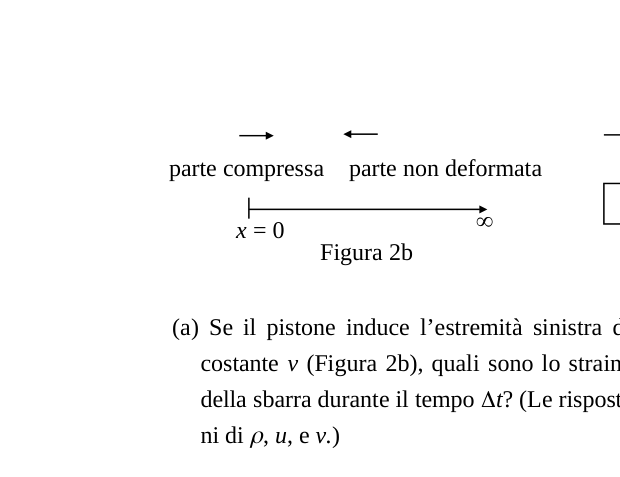 Traveling wave cross-section, displacement ξ(x,t)
Topic: Oscillations & Waves, Elasticity & Materials Metodi: Wave Equation, Hooke’s Law, Simple Harmonic Motion Analysis Competenze: Mathematical Modeling, Physical Reasoning Objects: Rod Fonte: Testo (PDF) — p.2
**(b) ** It is a longitudinal wave propagating in the bar in the direction . Assuming in the cross section of the non-deformed bar (Figure 2c), both the wave shift to and assumes
where and are constants. Determine the corresponding speed , stress , and pressure as a function of and .
The Commission shall adopt implementing acts in accordance with Article 21 of this Regulation.
The following is the list of the types of transport services:
Topic: Oscillations & Waves, Elasticity & Materials Metodi: Wave Equation, Hooke’s Law, Simple Harmonic Motion Analysis Competenze: Mathematical Modeling, Physical Reasoning Objects: Rod Fonte: Testo (PDF) — p.2
Parte B: proprietà elettromeccaniche (compreso l’effetto piezoelettrico)
Considera una lastra di cristallo di quarzo di lunghezza , spessore e larghezza (Figura 2d). La sua lunghezza ed il suo spessore sono diretti rispettivamente lungo gli assi e . Nelle superfici superiore ed inferiore della lastra (vedi Figura 2d) due sottili rivestimenti metallici formano degli elettrodi. Connessioni elettriche, che svolgono anche la funzione di sostegno della lastra (Figura 2e), sono saldate nel centro degli elettrodi, i quali possono essere supposti fermi per oscillazioni longitudinali lungo la direzione .
Il cristallo di quarzo in esame ha una densità kg/m³ ed un modulo di Young N/m². La lunghezza della lastra è 1.00 cm e l’ampiezza e l’altezza della lastra sono tali che e .
Con l’interruttore lasciato aperto, assumiamo che nella lastra di quarzo sono eccitati solamente i modi longitudinali dell’oscillazione di onde stazionarie nella direzione . Per un’onda stazionaria di frequenza , lo spostamento al tempo di una sezione trasversale della lastra intorno alla posizione di equilibrio , può essere scritta come
dove è una costante positiva e la funzione spaziale è esprimibile in generale nella forma
ha valore massimo pari a 1 e . Ricorda che i centri degli elettrodi non si muovono e che le estremità sinistra e destra della lastra sono libere e devono avere stress (o pressione) nullo.
(c) Determina i valori di e nell’Eq. (4b) per un’onda stazionaria longitudinale presente nella lastra di quarzo.
[1.2 punti]
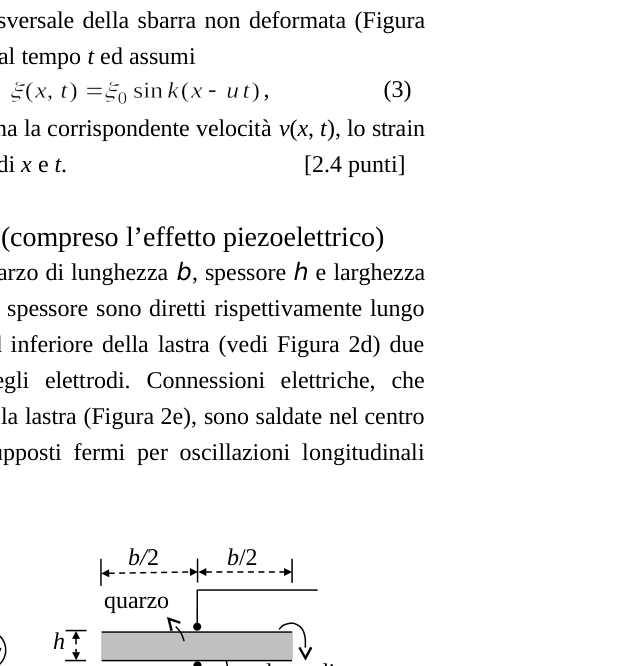 Quartz crystal slab with electrodes, switch K
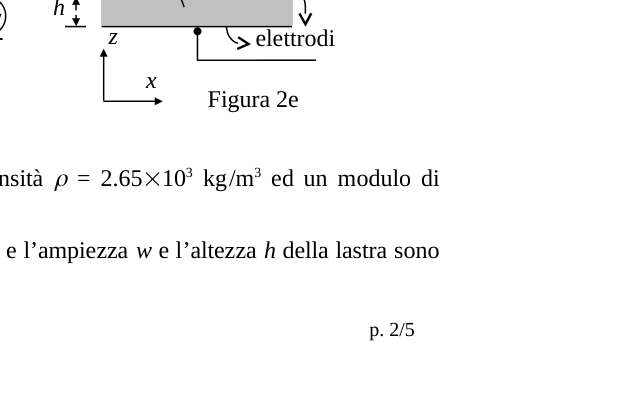 Electrode connection detail, Figura 2e
Topic: Oscillations & Waves, Elasticity & Materials Metodi: Wave Equation, Simple Harmonic Motion Analysis, Superposition Principle Competenze: Mathematical Modeling, Physical Reasoning Objects: Switch Fonte: Testo (PDF) — p.2
**Part B: electromechanical properties (including piezoelectric effect) **
Consider a quartz crystal plate of length , thickness and width (Figure 2d). Its length and thickness are directed along the and axes respectively. On the upper and lower surfaces of the plate (see Figure 2d) two thin metal coatings form electrodes. Electrical connections, which also serve as the supporting function of the plate (Figure 2e), are welded in the centre of the electrodes, which can be assumed to be stationary for longitudinal oscillations along the direction .
The quartz crystal under examination has a density kg/m3 and a Young N/m2 modulus. The length of the sheet shall be 1,00 cm and the width and height of the sheet shall be such as and .
With the switch left open, we assume that in the quartz plate only the longitudinal modes of stationary wave oscillation in the direction are excited. For a stationary wave of frequency, the shift of a cross section of the plate around the equilibrium position to time can be written as
where is a positive constant and the spatial function is generally expressed in the form
has a maximum value of 1 and . Remember that the electrode centers do not move and that the left and right ends of the plate are free and must have zero stress (or pressure).
(c) Determina i valori di e nell’Eq. (4b) for a longitudinal stationary wave present in the quartz plate.
The following points shall be added:
Quartz crystal slab with electrodes, switch K
Electrode connection detail, Figura 2e
Topic: Oscillations & Waves, Elasticity & Materials Metodi: Wave Equation, Simple Harmonic Motion Analysis, Superposition Principle Competenze: Mathematical Modeling, Physical Reasoning Objects: Switch Fonte: Testo (PDF) — p.2
(d) Quali sono le prime due frequenze più basse alle quali nella lastra di quarzo possono essere eccitate onde stazionarie longitudinali?
[1.2 punti]
Topic: Oscillations & Waves, Elasticity & Materials Metodi: Simple Harmonic Motion Analysis, Wave Equation Competenze: Mathematical Modeling, Physical Reasoning Objects: — Fonte: Testo (PDF) — p.3
**(d) ** What are the first two lowest frequencies at which longitudinal stationary waves can be excited in the quartz plate?
The following points shall be added:
Topic: Oscillations & Waves, Elasticity & Materials Metodi: Simple Harmonic Motion Analysis, Wave Equation Competenze: Mathematical Modeling, Physical Reasoning Objects: — Fonte: Testo (PDF) — p.3
L’effetto piezoelettrico costituisce una speciale proprietà di un cristallo di quarzo. La compressione o la dilatazione del cristallo generano un potenziale elettrico attraverso il cristallo, e di converso, un potenziale elettrico esterno applicato attraverso il cristallo induce il cristallo ad espandersi o a contrarsi a seconda della polarità del potenziale elettrico. Di conseguenza, oscillazioni meccaniche ed elettriche possono essere accoppiate e fatte risonare per mezzo di un cristallo di quarzo.
Per considerare l’effetto piezoelettrico, siano rispettivamente e la densità superficiale di carica elettrica sugli elettrodi superiore ed inferiore, quando la lastra di quarzo è sottoposta ad un campo elettrico nella direzione . Indica con e rispettivamente lo strain e lo stress della lastra nella direzione . Quindi l’effetto piezoelettrico del cristallo di quarzo può essere descritto dal seguente insieme di equazioni
dove m²/N, con modulo di Young a campo elettrico costante e F/m è la permeabilità elettrica a stress costante, ed infine m/V è il coefficiente piezoelettrico.
Chiudiamo ora l’interruttore in Fig. 2d. Il potenziale elettrico alternato adesso agisce attraverso gli elettrodi e nella lastra di quarzo viene generato un campo elettrico uniforme nella direzione . Nella lastra, quando si raggiunge uno stato stazionario, appare lungo la direzione un’oscillazione di un’onda stazionaria longitudinale di frequenza angolare . Con uniforme, la lunghezza d’onda e la frequenza di un’onda stazionaria longitudinale nella lastra sono ancora collegate dall’espressione con dato dall’Eq. (2). Ma, come mostrato dall’Eq (5a), ora la relazione non è più valida, sebbene le definizioni di strain e di stress rimangono le stesse e le superfici finali della lastra rimangono libere con stress nullo.
(e) Prendendo in considerazione le equazioni (5a) e (5b), l’espressione in funzione di e della densità superficiale di carica elettrica nell’elettrodo inferiore è della forma
dove . Trova le espressioni di e .
[2.2 punti]
Topic: Oscillations & Waves, Electromagnetism Metodi: Wave Equation, Simple Harmonic Motion Analysis, Superposition Principle Competenze: Mathematical Modeling, Physical Reasoning Objects: Switch Fonte: Testo (PDF) — p.3
The piezoelectric effect is a special property of quartz crystal. The compression or dilation of the crystal generates an electric potential through the crystal, and conversely, an external electric potential applied through the crystal causes the crystal to expand or contract depending on the polarity of the electric potential. As a result, mechanical and electrical oscillations can be coupled and resonated by a quartz crystal.
For the purposes of considering the piezoelectric effect, the surface electric charge density on the upper and lower electrodes shall be and respectively when the quartz plate is subjected to an electric field in the direction . Indica con e rispettivamente lo strain e lo stress della lastra nella direzione . So the piezoelectric effect of quartz crystal can be described by the following set of equations
where m2/N, with Young constant electric field module and F/m is the constant stress electrical permeability, and finally m/V is the piezoelectric coefficient.
Now close the switch in Fig. 2d. The alternating electric potential now acts through the electrodes and a uniform electric field is generated in the direction in the quartz plate. In the plate, when a stationary state is reached, a longitudinal stationary wave oscillation of angular frequency appears along the direction . With uniform , the wavelength and frequency of a longitudinal stationary wave in the plate are still connected by the expression with given by the equ. (2). However, as shown in Equal (5a), the ratio is no longer valid, although the definitions of stress and stress remain the same and the final surfaces of the plate remain free with zero stress.
**(e) ** Taking into account equations (5a) and (5b), the expression in the function and of the surface electrical charge density in the lower electrode is as follows:
where . Find the expressions and .
The Commission shall adopt implementing acts in accordance with Article 21 of this Regulation.
Topic: Oscillations & Waves, Electromagnetism Metodi: Wave Equation, Simple Harmonic Motion Analysis, Superposition Principle Competenze: Mathematical Modeling, Physical Reasoning Objects: Switch Fonte: Testo (PDF) — p.3
(f) La carica elettrica superficiale totale sull’elettrodo inferiore è collegata a dalla relazione
Trova l’espressione per e l’espressione ed il valore numerico di .
[1.4 punti]
Topic: Oscillations & Waves, Electromagnetism, Electrostatics Metodi: Wave Equation, Simple Harmonic Motion Analysis, Calculus-Integration Competenze: Mathematical Modeling, Physical Reasoning Objects: — Fonte: Testo (PDF) — p.4
The total surface electrical charge on the lower electrode is connected to by the ratio
Find the expression for and the expression and numerical value of .
The Commission shall adopt delegated acts in accordance with Article 21 of this Regulation.
Topic: Oscillations & Waves, Electromagnetism, Electrostatics Metodi: Wave Equation, Simple Harmonic Motion Analysis, Calculus-Integration Competenze: Mathematical Modeling, Physical Reasoning Objects: — Fonte: Testo (PDF) — p.4