Parte A — Massa del neutrino e decadimento del neutrone
Un neutrone libero di massa , in quiete nel riferimento del laboratorio, decade in tre particelle praticamente non interagenti: da un lato un protone e un antineutrino, e dall’altro un elettrone. La massa di riposo del protone è , quella dell’antineutrino è supposta non-nulla ma molto minore di quella dell’elettrone . Si indichi con la velocità della luce nel vuoto. I valori misurati delle masse di riposo sono:
Nel seguito tutte le energie e velocità di cui si parla sono riferite al riferimento del laboratorio. Sia l’energia totale dell’elettrone che emerge dal decadimento.
(a) Trova il massimo valore possibile di e la velocità dell’antineutrino quando . Entrambe le risposte devono essere date in termini delle masse a riposo delle particelle e della velocità della luce. Sapendo che , trova e il rapporto con 3 cifre significative.
Parte B — Levitazione con la luce
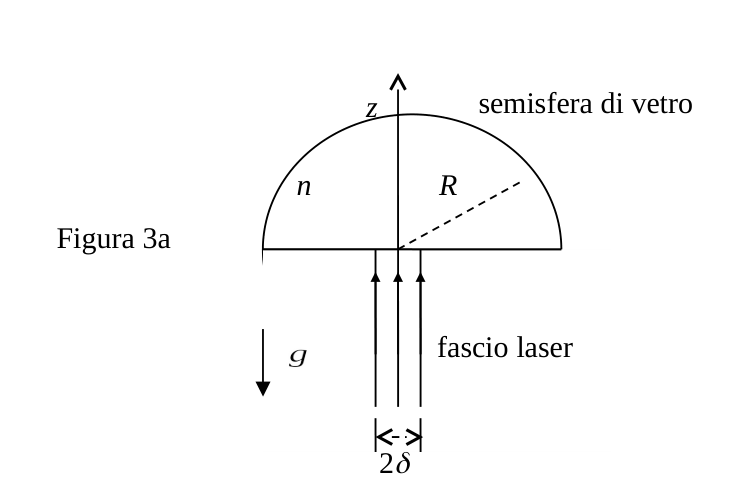
Una semisfera di vetro trasparente di raggio e massa ha un indice di rifrazione . Al di fuori di essa l’indice di rifrazione è . Un fascio parallelo di luce laser monocromatica incide uniformemente e in incidenza normale sulla porzione centrale della superficie piana della semisfera (vedi Figura 3a). L’accelerazione di gravità è diretta verticalmente verso il basso. Il raggio della sezione circolare del fascio laser è molto minore di . Sia la semisfera di vetro che il fascio laser hanno simmetria assiale intorno all’asse .
La semisfera di vetro non assorbe affatto la luce del laser. La sua superficie è ricoperta con uno strato sottile di materiale trasparente in modo che siano trascurabili le riflessioni quando la luce entra nella semisfera o ne esce. Anche il cammino ottico percorso dalla luce del laser attraverso lo strato antiriflettente può essere trascurato.
(b) Trascurando i termini dell’ordine di o superiori, si trovi la potenza del laser occorrente per generare una forza che eguagli il peso della semisfera di vetro.
Suggerimento: se è molto minore di .
p.2 — Semisfera di vetro con fascio laser, asse z
Topic: Special Relativity, Nuclear & Particle Physics, Geometric Optics Metodi: Relativistic Energy-Momentum, Conservation Laws, Ray Tracing, Approximation & Series Expansion Competenze: Mathematical Modeling, Physical Reasoning, Significant Figures Objects: Electron Fonte: Testo (PDF) — p.1
Part A. Neutrin mass and neutron decay
Un neutrone libero di massa , in quiete nel riferimento del laboratorio, decade in tre particelle praticamente non interagenti: da un lato un protone e un antineutrino, e dall’altro un elettrone. The resting mass of the proton is , that of the antineutrine is assumed to be non-zero but much smaller than that of the electron . The speed of light in vacuum shall be indicated by . The measured values of resting masses are:
The following all the energies and speeds mentioned are referred to in the laboratory reference. Whether the total electron energy that emerges from decay.
(a) Trova il massimo valore possibile di e la velocità dell’antineutrino quando . Both answers must be given in terms of the particle rest masses and the speed of light. Knowing that , you find and the ratio with 3 significant digits.
Part B Lifting with light
A transparent glass hemisphere of radius and mass has a refractive index . Outside it the refractive index is . A parallel monochrome laser beam of light affects uniformly and normally the central portion of the half-sphere flat surface (see Figure 3a). The acceleration of gravity is directed vertically downwards. The radius of the circular section of the laser beam is much less than . Both the glass hemisphere and the laser beam have axial symmetry around the axis.
The glass hemisphere does not absorb laser light at all. Its surface is covered with a thin layer of transparent material so that reflections are negligible when light enters or exits the hemisphere. The optical path taken by laser light through the anti-reflective layer can also be overlooked.
**(b) ** By omitting terms of the order of or higher, the laser power required to generate a force equal to the weight of the glass hemisphere is found.
**Suggest: ** if is much smaller than .
**p.2 ** Laser beam glass half-sphere, z axis
Topic: Special Relativity, Nuclear & Particle Physics, Geometric Optics Metodi: Relativistic Energy-Momentum, Conservation Laws, Ray Tracing, Approximation & Series Expansion Competenze: Mathematical Modeling, Physical Reasoning, Significant Figures Objects: Electron Fonte: Testo (PDF) — p.1