Problema T1. Grafici assortiti (13 punti) Parte A. Balistica (4.5 punti) Una palla lanciata con velocità iniziale si muove in un campo gravitazionale uniforme nel piano , dove l’asse è orizzontale, e l’asse è verticale e antiparallelo all’accelerazione di gravità ; trascurare l’attrito dell’aria. i. (0.8 punti) Lanciando una palla dall’origine con velocità iniziale si possono colpire bersagli all’interno della regione data da
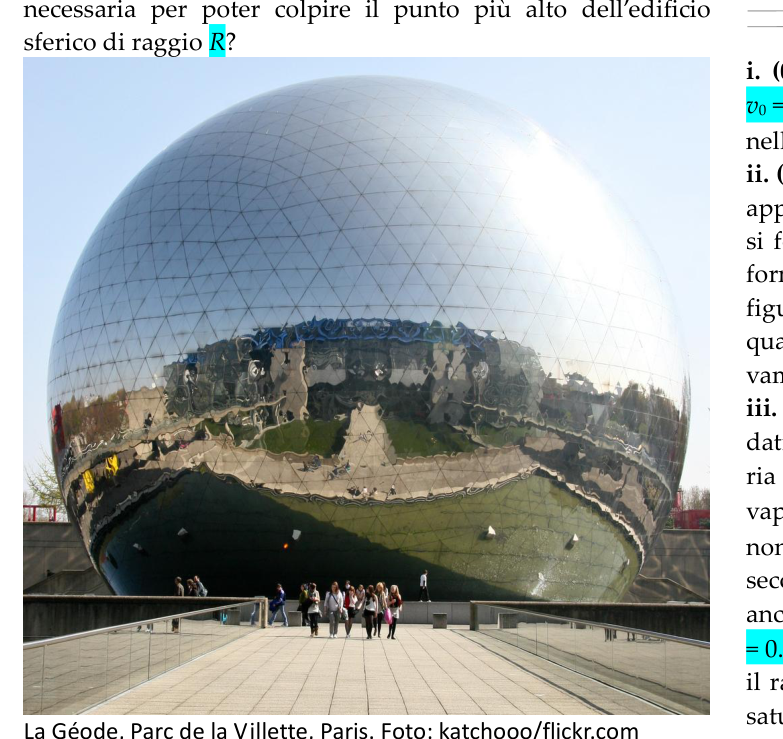
aggiustando l’angolo di lancio. Puoi usare questo fatto senza provarlo. Trova le costanti e . ii. (1.2 punti) Si vuole colpire il punto più alto di un edificio sferico di raggio (vedi figura) imprimendo alla palla una velocità iniziale la più piccola possibile. Prima di colpire il bersaglio, la palla non può rimbalzare sull’edificio in altri punti. Il punto di lancio può essere scelto liberamente al livello del terreno e l’angolo di lancio può essere aggiustato nel modo che si desidera. Disegna qualitativamente la forma della traiettoria ottimale per la palla (usa l’apposito spazio nel foglio risposta). NOTA: Il punteggio viene assegnato solamente per il disegno. iii. (2.5 punti) Qual’è la minima velocità di lancio necessaria per poter colpire il punto più alto dell’edificio sferico di raggio ?
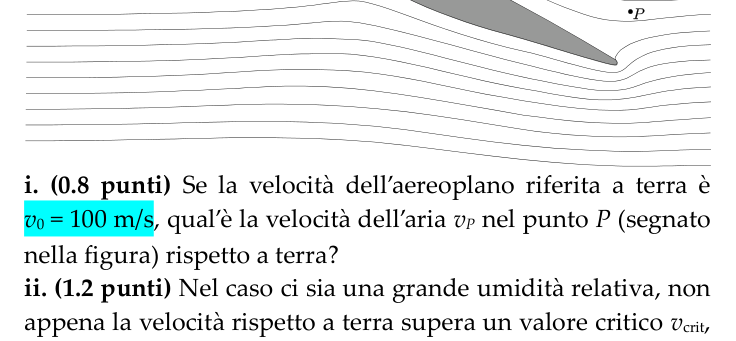
La Géode, Parc de la Villette, Paris. Foto: katchooo/flickr.com Parte B. Flusso d’aria attorno ad un’ala (4 punti) Per questa Parte del Problema può essere utile la seguente informazione: nel caso di un liquido o di un gas che fluisce, si ha che la quantità è costante lungo una linea di campo, nel caso in cui la velocità sia molto minore della velocità del suono. Qui è la densità, l’altezza, l’accelerazione di gravità e la pressione idrostatica. Le linee di campo sono definite come le traiettorie delle particelle di fluido (ammettendo che la distribuzione del flusso sia stazionaria). Il termine è chiamato pressione dinamica. Nella figura seguente, è disegnata la sezione dell’ala di un aereoplano assieme alle linee di campo del flusso d’aria attorno all’ala, così come appare nel sistema di riferimento dell’ala. Assumi che (a) il flusso d’aria sia puramente bidimensionale (ovvero che i vettori velocità dell’aria giacciono tutti nel piano della figura); (b) la configurazione delle linee di campo non dipende dalla velocità dell’aereoplano; (c) non c’è vento; (d) la pressione dinamica è molto più piccola della pressione atmosferica . Puoi usare un righello per effettuare misure sulla figura nel foglio risposte.
i. (0.8 punti) Se la velocità dell’aereoplano riferita a terra è , qual’è la velocità dell’aria nel punto (segnato nella figura) rispetto a terra? ii. (1.2 punti) Nel caso ci sia una grande umidità relativa, non appena la velocità rispetto a terra supera un valore critico , si forma una scia di gocce d’acqua dietro all’ala. Le gocce si formano a partire da un certo punto . Segna il punto nella figura sul foglio risposte. Spiega (usando formule e la minor quantità di testo possibile) come ne hai determinato qualitativamente la posizione. iii. (2.0 punti) Stima la velocità critica usando i seguenti dati: umidità relativa dell’aria , calore specifico dell’aria a pressione costante , pressione del vapor d’acqua saturo: alla temperatura dell’aria non perturbata e a . A seconda delle tue approssimazioni potresti aver bisogno anche del calore specifico dell’aria a volume costante . NOTA: l’umidità relativa è definita come il rapporto fra la pressione di vapore e la pressione di vapor saturo alla stessa temperatura. La pressione di vapor saturo è definita come quella a cui il vapore è in equilibrio con il liquido.
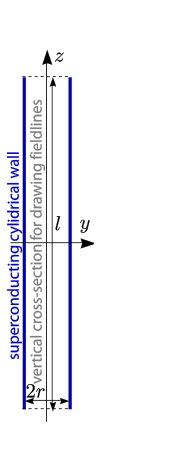
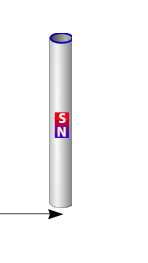
Parte C. Cannucce magnetiche (4.5 punti) Considera un tubo cilindrico fatto di materiale superconduttore. La lunghezza del tubo è e il suo raggio interno è ; inoltre . Il centro del tubo coincide con l’origine, e il suo asse coincide con l’asse . Nel tubo c’è un flusso magnetico attraverso la sezione centrale del tubo, ovvero la regione , . Un materiale superconduttore ha la proprietà di espellere qualsiasi campo magnetico dal suo interno (il campo al suo interno è zero).
i. (0.8 punti) Disegna cinque linee di flusso del campo magnetico nell’apposito spazio del foglio risposte. Fai in modo che passino per i cinque punti rossi disegnati nella figura che rappresenta una sezione del tubo passante per il suo asse. ii. (1.2 punti) Trova la tensione lungo nel mezzo del tubo (ovvero la forza con la quale le due metà del tubo, e , interagiscono fra di loro). iii. (2.5 punti) Aggiungiamo ora un secondo tubo, identico e parallelo al primo. Il secondo tubo ha il campo magnetico in verso opposto e il suo centro è posizionato in , (cosicché i tubi formano i lati opposti di un enorme quadrato). Determina la forza di interazione magnetica fra i due tubi.
p.2 — Linee di flusso d’aria attorno all’ala
p.2 — Edificio sferico La Géode
p.3 — Sezione verticale del tubo, assi z-y
p.3 — Tubo con magnete S-N interno
Topic: Newtonian Mechanics, Fluid Mechanics, Magnetism Metodi: Kinematic Equations, Bernoulli’s Equation, Gauss’s Law, Vector Decomposition, Approximation & Series Expansion, Physical Modeling Competenze: Diagrammatic Reasoning, Mathematical Modeling, Estimation & Approximation Objects: Ball, Tube Fonte: Testo (PDF) — p.2 Soluzione: Soluzioni (PDF)
Problem T1. The following table shows the results of the calculation of the total cost of the project: Part A. Basics (4.5 points) A ball thrown at initial speed moves in a uniform gravitational field in the plane , where the axis is The axis is vertical and counterparallel to the acceleration of gravity ; neglect air friction. i. (0.8 points) Throwing a ball from the origin with speed Initial can be hit within the region given by
Adjusting the angle of launch. You can use this fact without Try it. Find the constants and . ii. (1.2 points) You want to hit the point higher than a spherical building of radius (see figure) by printing on the ball a the initial speed as small as possible. Before you hit the target, the Ball cannot bounce on the building in other points. The launch point may be freely chosen at the ground level and the angle of The launch can be adjusted as desired. Describe qualitatively the shape of the optimal trajectory for the ball (use the appropriate space in the answer sheet). Please note: The score is assigned only to the drawing. The Commission shall adopt implementing acts. (2.5 points) What is the minimum launch speed Necessary to hit the highest point of the building The radius of the sphere ?
The geode, the park of the villette, Paris. Photo by katchooo/flickr.com Part B. Air flow around a hole (4 points) For this Part of the Problem the following may be useful: Information: in the case of a liquid or a gas flowing, has the quantity constant along a line The speed of the is much less than the speed of the the speed of sound. Here is density, height, gravity acceleration and hydrostatic pressure. Field lines are defined as the trajectories of fluid particles (assuming that the flow distribution is stationary). Il The term is called dynamic pressure. The following figure shows the wing section of a aircraft together with airflow field lines around the wheel, as shown in the reference system The wings. Assume that (a) the airflow is purely two-dimensional (i.e. that the air velocity vectors lie (b) the configuration of the lines the field is not dependent on the speed of the aeroplane; (d) the dynamic pressure is much lower than the the atmospheric pressure . You can use a reel. to measure the figure in the reply sheet.
i. (0.8 points) If the ground-related speed of the aeroplane is , which is the air velocity in (signed (Figure 1) compared to the ground? ii. The average humidity of the water is about 0. as soon as the ground speed exceeds a critical value , A trail of water droplets forms behind the wing. The drops are They form from a certain point . The mark in the The answering machine shall be shown on the answering machine. Explain (using the formulas and the minor The Commission has already decided to take a decision on the following: The Commission shall adopt implementing acts. (2.0 points) Estimate the critical speed using the following: Data: relative humidity of the air , specific heat of the air at constant pressure , pressure of the air Saturated water vapor: at air temperature non perturbata e a . A Depending on your estimates, you might need a also the specific heat of the constant volume air . NOTE: relative humidity is defined as the ratio of steam pressure to steam pressure saturated at the same temperature. The saturated vapor pressure is defined as the one at which the steam is in equilibrium with the It’s liquid.
Part C. Magnetic cannulates (4.5 points) Consider a cylindrical tube made of superconducting material. The length of the tube It is and its inner radius is ; moreover, . Il The centre of the tube coincides with the source, and the its axis is the same as the axis. There’s a tube in the tube. magnetic flux through the central section of the tube, or the region , . A superconducting material has the property of expelling any magnetic field from its interior (the field inside it is zero).
i. (0.8 points) Draw five flow lines of the field The magnetic field is located in the appropriate space on the answer sheet. You go in. The first is the way in which the five red dots are drawn in the Figure representing a section of the tube passing through the his axis. ii. Find the voltage length in the middle of the tube (i.e. the force with which the two halves of the tube, and , They interact with each other). The Commission shall adopt implementing acts. (2.5 points) Now we add a second tube, identical and parallel to the first. The second tube has the magnetic field on the back. The centre of the object is located in the , (as the tubes form the sides opposites of a huge square. The Commission shall adopt implementing acts. the magnetic interaction force between the two The pipes.
p.2 Air flow lines around the wing
p.2 — Edificio sferico La Géode
p.3 — Sezione verticale del tubo, assi z-y
p.3 — Tubo con magnete S-N interno
Topic: Newtonian Mechanics, Fluid Mechanics, Magnetism Metodi: Kinematic Equations, Bernoulli’s Equation, Gauss’s Law, Vector Decomposition, Approximation & Series Expansion, Physical Modeling Competenze: Diagrammatic Reasoning, Mathematical Modeling, Estimation & Approximation Objects: Ball, Tube Fonte: Testo (PDF) — p.2 Soluzione: Soluzioni (PDF)
Problema T2. Gocciolatore di Kelvin (8 punti) Per la soluzione di questo problema possono essere utili le seguenti informazioni sulla tensione superficiale. Per le molecole di un liquido, le posizioni all’interfaccia liquido-aria sono meno favorevoli rispetto alle posizioni all’interno del liquido. Perciò a questa interfaccia è associata la cosiddetta energia superficiale dove è l’area della superficie dell’interfaccia e è la tensione superficiale del liquido. Inoltre due parti adiacenti della superficie del liquido si attirano reciprocamente con una forza dove è la lunghezza del bordo che separa le due parti.
Un lungo capillare metallico con diametro interno è disposto verticalmente; l’acqua sgocciola lentamente dal forellino della sua estremità inferiore, come puoi vedere in figura. Si può considerare l’acqua come un conduttore elettrico; la sua tensione superficiale è e la sua densità è . Assumi sempre che . Con si indica il raggio di una goccia che pende dal forellino e che cresce lentamente nel tempo fino a quando si separa dal capillare a causa dell’accelerazione di gravità . Parte A. Capillare singolo (4 punti) i. (1.2 punti) Trova il raggio di una goccia subito prima che si stacchi dal capillare. ii. (1.2 punti) Sia il potenziale elettrostatico del capillare, avendo posto a zero il potenziale elettrico a grande distanza. Trova la carica quando il raggio della goccia è . iii. (1.6 punti) In questa domanda, assumi che sia mantenuto costante e che venga aumentato lentamente. Se la pressione idrostatica al suo interno diventa più piccola della pressione atmosferica allora la goccia diventa instabile e si rompe in più parti. Trova il potenziale critico a cui accadrà ciò.
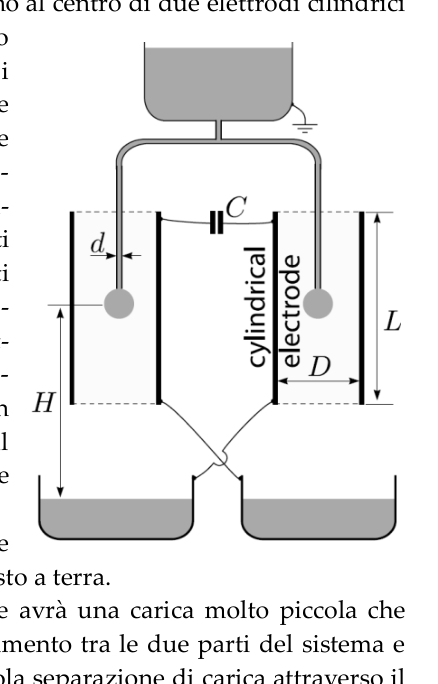
Parte B. Due capillari (4 punti) Un apparato chiamato “Gocciolatore di Kelvin” consiste di due capillari (identici a quello descritto nella Parte A), collegati attraverso una giunzione a T, come in figura. Le estremità di entrambi i capillari sono al centro di due elettrodi cilindrici (con altezza e diametro , ); da entrambi i capillari cadono gocce per unità di tempo. Le gocce cadono da una altezza all’interno di recipienti conduttori posti sotto i forellini, e collegati agli elettrodi come mostrato in figura; gli elettrodi sono connessi attraverso una capacità . Non c’è alcuna carica netta sul sistema dei recipienti e degli elettrodi. Si noti che il contenitore superiore dell’acqua è posto a terra. La prima goccia a cadere avrà una carica molto piccola che provocherà uno sbilanciamento tra le due parti del sistema e di conseguenza una piccola separazione di carica attraverso il condensatore. i. (1.2 punti) Esprimi il modulo della carica delle gocce che si staccano dai capillari nell’istante in cui la carica nel condensatore è in funzione di (della Parte A-i). Trascura gli effetti descritti nella Parte A-iii. ii. (1.5 punti) Trova la dipendenza di dal tempo approssimandola con una funzione continua e assumendo che . iii. (1.3 punti) Il funzionamento del gocciolatore può essere ostacolato dall’effetto mostrato nella Parte A-iii. Inoltre, la repulsione elettrostatica fra una goccia e il recipente sottostante fa sì che la differenza di potenziale fra i due elettrodi abbia un limite superiore ; trova .
p.4 — Apparato gocciolatore di Kelvin con elettrodi
Topic: Electrostatics, Fluid Mechanics, Thermodynamics Metodi: Electric Potential Method, Hydrostatic Equilibrium, Differential Equations, Conservation of Energy, Physical Modeling Competenze: Mathematical Modeling, Physical Reasoning, Diagrammatic Reasoning Objects: Tube, Droplet, Capacitor Fonte: Testo (PDF) — p.4 Soluzione: Soluzioni (PDF)
Problem T2. What is it? The number of points in the table below is the number of points. The Commission has already adopted a proposal for a directive on the the following information on surface tension. For the Molecules of a liquid, positions at the liquid-air interface The following are the main factors: It’s liquid. So this interface is associated with the so-called surface energy where is the surface area dell’interfaccia e è la tensione superficiale del liquido. In addition, two adjacent parts of the liquid surface are They attract each other with a force where is the length of the edge separating the two sides.
A metal long capillary with diameter The interior is laid vertically; water He’s slowly taking it out of his oven. lower extremity, as you can see in the figure. Water can be considered as a electrical conductor; its surface tension is and its density is . Always take it che . indicates the radius of a drop that hangs from the hole and grows Slowly over time until it separates from the capillary to the cause of the gravitational acceleration . Part A. The following points shall be added: i. Find the radius of a drop immediately before It’s getting out of the capillary. ii. (b) The electrical potential of the capillary is , By zeroing the electrical potential at a great distance. Find the charge when the drop radius is . The Commission shall adopt implementing acts. In this query, assume that is kept constant and is increased slowly. Se la The hydrostatic pressure inside it becomes smaller than the The pressure of the atmosphere then the drop becomes unstable and you It breaks into several parts. Find the critical potential at which That’s what’s going to happen.
Part B. Two capillaries (4 points) A device called a Kelvin glacier consists of two capillaries (identical to that described in Part A), connected by a T-joint, as shown in Figure 1. The ends The two capillaries are centered on two cylindrical electrodes. (with height and diameter) , ); da entrambi i Hair loss drops per unit of time. Le drops fall from a height inside containers Other, of a kind used for the manufacture of goods Seats under the furnaces, and connected the electrodes as shown in Figure; the electrodes are connected via a capacity . I ‘m not . There is no net charge on the container system and the electrodes. Please note that the container The top of the water is placed on the ground. The first drop will have a very small charge that It will cause a imbalance between the two parts of the system and The result is a small load separation through the The condenser. i. (b) Express the form of the drop load The amount of the blood is less than the amount of the blood. The capacitor is in function of (Part A-i). Other the effects described in Part A-iii. ii. Find the dependence on the time by approximating it with a continuous function and assuming that . The Commission shall adopt implementing acts. The operation of the drip can be: the effect shown in Part A-iii. In addition, the electrostatic repulsion between a droplet and the underlying container So the difference in potential between the two electrodes has a limite superiore ; trova .
p.4 — Apparato gocciolatore di Kelvin con elettrodi
Topic: Electrostatics, Fluid Mechanics, Thermodynamics Metodi: Electric Potential Method, Hydrostatic Equilibrium, Differential Equations, Conservation of Energy, Physical Modeling Competenze: Mathematical Modeling, Physical Reasoning, Diagrammatic Reasoning Objects: Tube, Droplet, Capacitor Fonte: Testo (PDF) — p.4 Soluzione: Soluzioni (PDF)
Problema T3. Formazione di una protostella (9 punti) Modellizziamo la formazione di una stella come segue. Una nube sferica di gas interstellare rarefatto, inizialmente a riposo, comincia a collassare a causa della sua stessa gravità. Il raggio iniziale della sfera è e la sua massa è . La temperatura al di fuori della nube (dove il gas è molto più rarefatto del gas della nube) e la temperatura iniziale del gas della nube è uniformemente . Il gas può essere trattato come un gas perfetto. La massa molare media del gas è e il rapporto tra i calori molari è . Assumi che , dove è la costante dei gas e è la costante di gravitazione universale. i. (0.8 punti) Durante la maggior parte del processo di collasso, il gas è così trasparente che qualsiasi calore generato è immediatamente irradiato verso l’esterno, ovvero la sfera è in equilibrio termodinamico con l’esterno. Di quante volte () aumenta la pressione se si dimezza il raggio ()? Assumi che la densità del gas rimanga uniforme. ii. (1 punto) Stima il tempo necessario perché il raggio della nube diminuisca da ad . Trascura la variazione del campo gravitazionale nel tratto percorso da una particella di gas durante questa fase della caduta. iii. (2.5 punti) Facendo l’ipotesi che la pressione rimanga trascurabile, trova il tempo necessario affinché la sfera collassi da un raggio ad un raggio molto più piccolo, usando le Leggi di Keplero per le orbite ellittiche. iv. (1.7 punti) Per un certo valore del raggio , il gas diventa sufficientemente denso da diventare opaco alla radiazione termica. Calcola la quantità di calore irraggiato verso l’esterno durante il collasso dal raggio fino al raggio . v. (1 punto) Per raggi più piccoli di puoi trascurare l’irraggiamento. Determina in che modo la temperatura della sfera dipende dal suo raggio . vi. (2 punti) Alla fine del processo non possiamo più trascurare l’effetto della pressione sulla dinamica del gas, infatti il collasso si ferma ad un raggio (dove ). Tuttavia, l’irraggiamento può essere ancora trascurato e la temperatura non è ancora sufficientemente alta da innescare la fusione nucleare. La pressione di tale protostella non è più uniforme, ma una stima grossolana, a meno di fattori numerici moltiplicativi, può essere fatta ugualmente. Stima il raggio finale e la rispettiva temperatura .
Topic: Astrophysics, Gravitation, Thermodynamics Metodi: Newton’s Law of Gravitation, Ideal Gas Law, Kepler’s Laws, First Law of Thermodynamics, Approximation & Series Expansion, Physical Modeling Competenze: Mathematical Modeling, Estimation & Approximation, Physical Reasoning Objects: Gas, Star Fonte: Testo (PDF) — p.5 Soluzione: Soluzioni (PDF)
Problem T3. What is it? Formation of a protostar (9 points) Let’s model the formation of a star as follows. One of them. A spherical cloud of rarefied interstellar gas, initially at rest, begins to collapse due to its own gravity. Il The initial radius of the sphere is and its mass is . The temperature outside the cloud (where the gas is much more rarefied) The first is the temperature of the gas in the cloud. The cloud is uniformly . Gas can be treated as a It’s a perfect gas. The mean molar mass of the gas is and the ratio The molar heat is . Assume that , where is the gas constant and is the universal gravitational constant. i. (0.8 points) During most of the collapse process, the gas is so transparent that any heat generated is immediately radiated outward, i.e. the sphere is in the The thermodynamic balance with the outside. How many times () Does the pressure increase if the radius is halved ()? Assume the density of the gas remains uniform. ii. (1 point) Estimate the time required for the radius of the cloud decreases from to . The change in the gravitational field in the trajectory of a particle of gas during this phase of the fall. The Commission shall adopt implementing acts. (2.5 points) Assuming that the pressure remains negligible, find the time needed for the sphere to fall from a radius to a much smaller radius, using Kepler’s laws for elliptical orbits. iv. For a certain value of the radius , the gas It becomes dense enough to become opaque to thermal radiation. Calculate the amount of heat radiated to The outer layer during collapse from to . v. For radii smaller than you can ignore The radiation. Determine how the temperature is The radius of the sphere is . vi. (2 points) At the end of the process we can no longer neglect the effect of pressure on gas dynamics, The collapse is stopped at a radius (where ). However, irradiation can still be neglected and the The temperature is not yet high enough to trigger. The nuclear fusion. The pressure of this protostar is no longer uniform but a gross estimate, with no factors And the number of times that we can do is equal to the number of times that we can do. Estimate of the The final radius and the respective temperature .
Topic: Astrophysics, Gravitation, Thermodynamics Metodi: Newton’s Law of Gravitation, Ideal Gas Law, Kepler’s Laws, First Law of Thermodynamics, Approximation & Series Expansion, Physical Modeling Competenze: Mathematical Modeling, Estimation & Approximation, Physical Reasoning Objects: Gas, Star Fonte: Testo (PDF) — p.5 Soluzione: Soluzioni (PDF)