A.1 Usando il grafico (Figura 1), determina la resistenza dell’elemento nel ramo superiore della curva caratteristica , e nel ramo inferiore, rispettivamente.
Il ramo intermedio è descritto dall’equazione
Trovare il valore dei parametri e .
 Curva caratteristica I-V elemento non-lineare X
Topic: Circuits, Electrostatics Metodi: Physical Modeling, Free-Body Diagram Competenze: Diagrammatic Reasoning, Physical Reasoning Objects: Resistor Fonte: Testo (PDF) — p.2 Soluzione: Soluzioni (PDF)
A.1 Using the graph (Figure 1), it determines the resistance of the element in the upper branch of the characteristic curve , and in the lower branch, respectively.
The intermediate branch is described by the equation
Find the values of the parameters and .
The following table shows the characteristics of the measurement of the measurement of the measurement of the measurement of the measurement of the measurement of the measurement of the measurement of the measurement of the measurement of the measurement of the measurement of the measurement of the measurement of the measurement of the measurement of the measurement of the measurement of the measurement of the measurement of the measurement of the measurement of the measurement of the measurement of the measurement of the measurement of the measurement of the measurement of the measurement of the measurement of the measurement of the measurement of the measurement of the measurement of the measurement of the measurement of the measurement.
Topic: Circuits, Electrostatics Metodi: Physical Modeling, Free-Body Diagram Competenze: Diagrammatic Reasoning, Physical Reasoning Objects: Resistor Fonte: Testo (PDF) — p.2 Soluzione: Soluzioni (PDF)
A.2 Quali sono i possibili numeri di stati stazionari che il circuito di figura 2 può avere per un dato valore della d.d.p. del generatore e per ? Come cambia la risposta per ?
 Circuito con X, R, L e generatore E
Topic: Circuits, Oscillations & Waves Metodi: Kirchhoff’s Laws, Physical Modeling Competenze: Physical Reasoning, Diagrammatic Reasoning Objects: Resistor, Inductor, Battery Fonte: Testo (PDF) — p.2 Soluzione: Soluzioni (PDF)
A.2 What are the possible stationary state numbers that the circuit in Figure 2 can have for a given value of the d.d.p. the generator and for ? How does the answer change for ?
Circuit with X, R, L and generator E
Topic: Circuits, Oscillations & Waves Metodi: Kirchhoff’s Laws, Physical Modeling Competenze: Physical Reasoning, Diagrammatic Reasoning Objects: Resistor, Inductor, Battery Fonte: Testo (PDF) — p.2 Soluzione: Soluzioni (PDF)
A.3 Sia , ed nel circuito mostrato in figura 2. Determina il valore della corrente e della d.d.p. ai capi dell’elemento non-lineare , nello stato stazionario.
Topic: Circuits Metodi: Kirchhoff’s Laws, Physical Modeling Competenze: Mathematical Modeling, Physical Reasoning Objects: Resistor, Inductor, Battery Fonte: Testo (PDF) — p.3 Soluzione: Soluzioni (PDF)
A.3 Whether , and in the circuit shown in Figure 2. Determine the current and the d.d.p. to the heads of the non-linear element , in the stationary state.
Topic: Circuits Metodi: Kirchhoff’s Laws, Physical Modeling Competenze: Mathematical Modeling, Physical Reasoning Objects: Resistor, Inductor, Battery Fonte: Testo (PDF) — p.3 Soluzione: Soluzioni (PDF)
A.4 Usa i valori numerici della domanda A.3 e studia la stabilità dello stato stazionario con . È stabile o instabile?
Nota: Il circuito di figura 2 è in uno stato stazionario con . Questo stato stazionario è detto stabile se, a seguito di un piccolo spostamento (la corrente cresce o decresce), la corrente torna al valore dello stato stazionario. Se invece il sistema tende ad allontanarsi ulteriormente dallo stato stazionario, si dice che questo è instabile.
Topic: Circuits, Oscillations & Waves Metodi: Differential Equations, Physical Modeling Competenze: Physical Reasoning, Mathematical Modeling Objects: Resistor, Inductor, Battery Fonte: Testo (PDF) — p.3 Soluzione: Soluzioni (PDF)
A.4 Use the numerical values of the A.3 request and study the stability of the steady state with . Is it stable or unstable?
Note: The circuit in Figure 2 is in a stationary state with . This stationary state is said to be stable if, following a small shift (current increases or decreases), the current returns to the value of the stationary state. If the system tends to move further away from the stationary state, it is said to be unstable.
Topic: Circuits, Oscillations & Waves Metodi: Differential Equations, Physical Modeling Competenze: Physical Reasoning, Mathematical Modeling Objects: Resistor, Inductor, Battery Fonte: Testo (PDF) — p.3 Soluzione: Soluzioni (PDF)
B.1 Consideriamo adesso una diversa configurazione circuitale (figura 3): l’elemento non-lineare è collegato in parallelo ad un condensatore di capacità . Questo blocco è collegato in serie al resistore di resistenza e a un generatore ideale di d.d.p. costante . Viene fuori che il circuito inizia ad oscillare con l’elemento non lineare che salta da un ramo della curva caratteristica ad un altro, nel corso di un ciclo.
Traccia il ciclo dell’oscillazione sul grafico della curva caratteristica , precisando il suo verso (orario o antiorario). Giustifica la tua risposta con equazioni e schizzi.
 Circuito con X, C, R e generatore E
Topic: Circuits, Oscillations & Waves Metodi: Kirchhoff’s Laws, Physical Modeling, Simple Harmonic Motion Analysis Competenze: Diagrammatic Reasoning, Mathematical Modeling Objects: Capacitor, Resistor, Battery Fonte: Testo (PDF) — p.3 Soluzione: Soluzioni (PDF)
B.1 Consider now a different circuit configuration (Figure 3): the nonlinear element is connected in parallel to a capacitor . This block is serial-connected to the resistor and an ideal d.d.p. generator. costante . It turns out that the circuit starts oscillating with the nonlinear element jumping from one branch of the characteristic curve to another, during a cycle.
Trace the cycle of oscillation on the graph of the characteristic curve , specifying its direction (time or countertime). Justify your answer with equations and sketches.
Circuit with X, C, R and generator E
Topic: Circuits, Oscillations & Waves Metodi: Kirchhoff’s Laws, Physical Modeling, Simple Harmonic Motion Analysis Competenze: Diagrammatic Reasoning, Mathematical Modeling Objects: Capacitor, Resistor, Battery Fonte: Testo (PDF) — p.3 Soluzione: Soluzioni (PDF)
B.2 Trova le espressioni dei tempi e durante i quali il sistema si trova in ciascuno dei due rami della curva caratteristica durante il periodo di un’oscillazione. Determina i loro valori numerici. Trova il valore numerico del periodo di oscillazione facendo l’ipotesi che i tempi necessari a saltare da un ramo ad un altro della curva siano trascurabili.
Topic: Circuits, Oscillations & Waves Metodi: Differential Equations, Physical Modeling, Kirchhoff’s Laws Competenze: Mathematical Modeling, Physical Reasoning Objects: — Fonte: Testo (PDF) — p.3 Soluzione: Soluzioni (PDF)
Find the time expressions and during which the system is located in each of the two branches of the characteristic curve during the period of oscillation. Determine their numerical values. Find the numerical value of the oscillation period assuming that the time required to jump from one branch to another of the curve is negligible.
Topic: Circuits, Oscillations & Waves Metodi: Differential Equations, Physical Modeling, Kirchhoff’s Laws Competenze: Mathematical Modeling, Physical Reasoning Objects: — Fonte: Testo (PDF) — p.3 Soluzione: Soluzioni (PDF)
B.3 Stima la potenza media dissipata nell’elemento non-lineare nel corso di un’oscillazione. È sufficiente dare l’ordine di grandezza.
Topic: Circuits, Oscillations & Waves Metodi: Physical Modeling, Order-of-Magnitude Estimation Competenze: Estimation & Approximation, Physical Reasoning Objects: Resistor Fonte: Testo (PDF) — p.3 Soluzione: Soluzioni (PDF)
B.3 Estimate the mean power dissipated in the non-linear element during oscillation. It is enough to give the order of magnitude.
Topic: Circuits, Oscillations & Waves Metodi: Physical Modeling, Order-of-Magnitude Estimation Competenze: Estimation & Approximation, Physical Reasoning Objects: Resistor Fonte: Testo (PDF) — p.3 Soluzione: Soluzioni (PDF)
B.4 Il circuito di figura 3 viene usato per costruire una trasmittente radio. Per questo scopo l’elemento viene connesso ad un’estremità di un’antenna lineare (un lungo filo rettilineo) di lunghezza . L’altra estremità del filo è libera. Nell’antenna si forma un’onda elettromagnetica. La velocità dell’onda elettromagnetica lungo l’antenna è la stessa del vuoto. Il trasmettitore usa l’armonica principale del sistema che ha il periodo della domanda B.2.
Qual è il valore ottimale di assumendo che esso non possa superare la lunghezza di 1 km?
Topic: Oscillations & Waves, Circuits Metodi: Physical Modeling, Wave Equation Competenze: Physical Reasoning, Mathematical Modeling Objects: Wire Fonte: Testo (PDF) — p.4 Soluzione: Soluzioni (PDF)
The figure 3 circuit is used to construct a radio transmitter. For this purpose the element is connected to an end of a linear antenna (a long straight wire) of length . The other end of the wire is free. An electromagnetic wave is formed in the antenna. The speed of the electromagnetic wave along the antenna is the same as that of the vacuum. The transmitter shall use the main system harmonic which has the period of application B.2.
What is the optimal value of assuming that it cannot exceed 1 km in length?
Topic: Oscillations & Waves, Circuits Metodi: Physical Modeling, Wave Equation Competenze: Physical Reasoning, Mathematical Modeling Objects: Wire Fonte: Testo (PDF) — p.4 Soluzione: Soluzioni (PDF)
C.1 In questa parte del problema consideriamo un’applicazione degli elementi bistabili non-lineari per modellizzare dei processi biologici. Un neuristor (da neurone e transistor) è un chip semiconduttore progettato per simulare l’eccitabilità e la propagazione di un impulso.
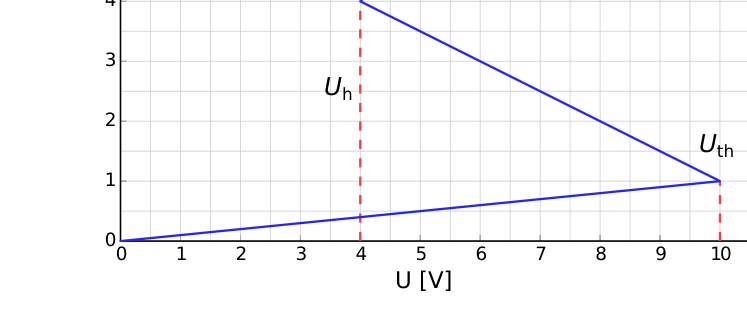
Per modellizzare un semplice neuristor, la d.d.p. nel circuito di figura 3 viene diminuita al valore . Le oscillazioni si interrompono e il sistema raggiunge uno stato stazionario. In seguito la d.d.p. viene improvvisamente riportata al valore , e dopo un intervallo di tempo (con ) viene fissata di nuovo al valore (v. figura 4).
Si vede che esiste un certo valore critico , e che il sistema mostra un diverso comportamento a seconda che sia oppure .
Fai uno schizzo del grafico della corrente che attraversa l’elemento non-lineare nel caso e nel caso .
 d.d.p. generatore in funzione del tempo
Topic: Circuits, Oscillations & Waves Metodi: Differential Equations, Physical Modeling, Kirchhoff’s Laws Competenze: Diagrammatic Reasoning, Physical Reasoning Objects: Battery Fonte: Testo (PDF) — p.4 Soluzione: Soluzioni (PDF)
In this part of the problem we consider the application of nonlinear bistable elements to model biological processes. A neuristor (from neuron and transistor) is a semiconductor chip designed to simulate the excitation and propagation of an impulse.
To model a simple neuristor, the D.D.P. in the circuit in Figure 3 is reduced to . The oscillations stop and the system reaches a stationary state. Later the D.D.P. It is suddenly returned to , and after a time interval (with ) it is set back to (v. The Commission shall adopt implementing acts in accordance with Article 4 (1) of this Regulation.
You can see that there is a certain critical value , and that the system shows a different behavior depending on whether it is or .
Draw a diagram of the current passing through the nonlinear element in the case and in the case .
d.d.p. The time-dependent generator
Topic: Circuits, Oscillations & Waves Metodi: Differential Equations, Physical Modeling, Kirchhoff’s Laws Competenze: Diagrammatic Reasoning, Physical Reasoning Objects: Battery Fonte: Testo (PDF) — p.4 Soluzione: Soluzioni (PDF)
C.2 Trova l’espressione e il valore numerico del tempo critico per il quale il comportamento cambia.
Topic: Circuits, Oscillations & Waves Metodi: Differential Equations, Physical Modeling Competenze: Mathematical Modeling, Physical Reasoning Objects: — Fonte: Testo (PDF) — p.5 Soluzione: Soluzioni (PDF)
Find the expression and numerical value of the critical time for which the behavior changes.
Topic: Circuits, Oscillations & Waves Metodi: Differential Equations, Physical Modeling Competenze: Mathematical Modeling, Physical Reasoning Objects: — Fonte: Testo (PDF) — p.5 Soluzione: Soluzioni (PDF)
C.3 Il circuito con rappresenta un neuristor?
Topic: Circuits, Oscillations & Waves Metodi: Physical Modeling, Order-of-Magnitude Estimation Competenze: Physical Reasoning, Estimation & Approximation Objects: — Fonte: Testo (PDF) — p.5 Soluzione: Soluzioni (PDF)
C.3 Does the circuit with represent a neuristor?
Topic: Circuits, Oscillations & Waves Metodi: Physical Modeling, Order-of-Magnitude Estimation Competenze: Physical Reasoning, Estimation & Approximation Objects: — Fonte: Testo (PDF) — p.5 Soluzione: Soluzioni (PDF)