A.1 (0.7 pt)
Assumi che i protoni siano stati accelerati da una differenza di potenziale tale che la loro velocità sia molto vicina a quella della luce e trascura ogni perdita di energia dovuta all’emissione di radiazione o a urti con altre particelle.
Trova l’espressione esatta per la velocità finale dei protoni in funzione del potenziale accelerante , e delle costanti fisiche.
Topic: Special Relativity, Nuclear & Particle Physics Metodi: Relativistic Energy-Momentum, Kinematic Equations Competenze: Mathematical Modeling, Physical Reasoning Objects: Particle Beam Fonte: Testo (PDF) — p.1 Soluzione: Soluzioni (PDF)
A.1 (0.7 pt)
Assume that protons have been accelerated by a potential difference such that their speed is very close to that of light and neglects any energy loss due to radiation emission or collisions with other particles.
Find the exact expression for the ultimate speed of protons in terms of the accelerating potential , and the physical constants.
Topic: Special Relativity, Nuclear & Particle Physics Metodi: Relativistic Energy-Momentum, Kinematic Equations Competenze: Mathematical Modeling, Physical Reasoning Objects: Particle Beam Fonte: Testo (PDF) — p.1 Soluzione: Soluzioni (PDF)
A.2 (0.8 pt)
Per particelle con grande energia e piccola massa la deviazione relativa della velocità finale dalla velocità della luce è molto piccola. Trova un’approssimazione al primo ordine per e calcola per elettroni con un’energia di 60.0 GeV usando il potenziale che li ha accelerati e le costanti fisiche.
Topic: Special Relativity, Nuclear & Particle Physics Metodi: Approximation & Series Expansion, Relativistic Energy-Momentum Competenze: Mathematical Modeling, Estimation & Approximation Objects: Electron Fonte: Testo (PDF) — p.2 Soluzione: Soluzioni (PDF)
A.2 (0.8 pt)
For particles with high energy and small mass the relative deviation of the final speed from the speed of light is very small. Find a first order approximation for and calculate for electrons with an energy of 60.0 GeV using the potential that accelerated them and the physical constants.
Topic: Special Relativity, Nuclear & Particle Physics Metodi: Approximation & Series Expansion, Relativistic Energy-Momentum Competenze: Mathematical Modeling, Estimation & Approximation Objects: Electron Fonte: Testo (PDF) — p.2 Soluzione: Soluzioni (PDF)
A.3 (1.0 pt)
Torniamo ora ai protoni in LHC. Assumi che il tubo in cui si muove il fascio abbia forma di un anello.
Ricava un’espressione per il campo magnetico uniforme necessario per mantenere il fascio di protoni su una traiettoria circolare. L’espressione deve contenere solo l’energia dei protoni, la lunghezza della circonferenza, costanti fondamentali e numeri. Puoi usare opportune approssimazioni se il loro effetto è più piccolo della precisione data dal minimo numero di cifre significative.
Calcola il campo magnetico per un’energia del protone , trascurando le interazioni tra i protoni.
Dati: Circonferenza dell’anello , energia dei protoni .
Topic: Special Relativity, Electromagnetism Metodi: Lorentz Force Analysis, Relativistic Energy-Momentum Competenze: Mathematical Modeling, Physical Reasoning Objects: Particle Beam Fonte: Testo (PDF) — p.2 Soluzione: Soluzioni (PDF)
A.3 (1.0 pt)
Now back to the protons in the LHC. Assume that the tube through which the beam moves is ring-shaped.
It gives an expression for the uniform magnetic field needed to keep the proton beam on a circular trajectory. The expression must contain only the energy of the protons, the length of the circumference, fundamental constants and numbers. You can use appropriate approximations if their effect is less than the precision given by the minimum number of significant figures.
It calculates the magnetic field for a proton energy , ignoring the interactions between protons.
Dati: Circonferenza dell’anello , energia dei protoni .
Topic: Special Relativity, Electromagnetism Metodi: Lorentz Force Analysis, Relativistic Energy-Momentum Competenze: Mathematical Modeling, Physical Reasoning Objects: Particle Beam Fonte: Testo (PDF) — p.2 Soluzione: Soluzioni (PDF)
A.4 (1.0 pt)
Una particella carica accelerata irradia energia sotto forma di onde elettromagnetiche. La potenza irradiata da una particella carica che compie un moto circolare a velocità angolare costante dipende solo dalla sua accelerazione , dalla sua carica , dalla velocità della luce e dalla costante dielettrica del vuoto .
Utilizzando l’analisi dimensionale, trova un’espressione per la potenza irradiata .
Topic: Electromagnetism, Special Relativity Metodi: Dimensional Analysis Competenze: Mathematical Modeling, Physical Reasoning Objects: — Fonte: Testo (PDF) — p.2 Soluzione: Soluzioni (PDF)
A.4 (1.0 pt)
An accelerated charged particle radiates energy in the form of electromagnetic waves. The power radiated by a charged particle performing a circular motion at constant angular speed depends only on its acceleration , its charge , the speed of light and the dielectric constant of the vacuum .
Using dimensional analysis, find an expression for the irradiated power .
Topic: Electromagnetism, Special Relativity Metodi: Dimensional Analysis Competenze: Mathematical Modeling, Physical Reasoning Objects: — Fonte: Testo (PDF) — p.2 Soluzione: Soluzioni (PDF)
A.5 (1.0 pt)
La formula reale per la potenza irradiata contiene un fattore numerico ; inoltre, con una derivazione completamente relativistica si ricava un ulteriore fattore moltiplicativo , con .
Calcola , la potenza totale irradiata di LHC, per un’energia dei protoni di (nota la Tabella 1). Puoi usare le approssimazioni adeguate.
Dati dalla Tabella 1: numero di grappoli per fascio , numero di protoni per grappolo , due fasci di protoni.
Topic: Electromagnetism, Special Relativity Metodi: Dimensional Analysis, Relativistic Energy-Momentum Competenze: Mathematical Modeling, Physical Reasoning Objects: Particle Beam Fonte: Testo (PDF) — p.2 Soluzione: Soluzioni (PDF)
A.5 (1.0 pt)
The actual formula for the irradiated power contains a numerical factor ; furthermore, with a completely relativistic derivation an additional multiplier is obtained, with .
Calculate , the total irradiated power of the LHC, for a proton energy of (see Table 1). You can use the appropriate approximations.
Data from Table 1: number of clusters per beam , number of protons per cluster , two proton beams.
Topic: Electromagnetism, Special Relativity Metodi: Dimensional Analysis, Relativistic Energy-Momentum Competenze: Mathematical Modeling, Physical Reasoning Objects: Particle Beam Fonte: Testo (PDF) — p.2 Soluzione: Soluzioni (PDF)
A.6 (1.5 pt)
Al CERN, i protoni a riposo sono accelerati da un acceleratore lineare di lunghezza attraverso una differenza di potenziale . Assumi che il campo elettrico sia uniforme. Un acceleratore lineare consiste di due armature come rappresentato in Figura 1.
Determina il tempo che i protoni impiegano a passare attraverso questo campo.
 Acceleratore lineare con armature e tensione V
Topic: Special Relativity, Nuclear & Particle Physics Metodi: Relativistic Energy-Momentum, Kinematic Equations, Differential Equations Competenze: Mathematical Modeling, Physical Reasoning Objects: Particle Beam, Capacitor Fonte: Testo (PDF) — p.2 Soluzione: Soluzioni (PDF)
A.6 (1.5 pt)
At CERN, protons at rest are accelerated by a linear accelerator of length through a potential difference . Assume the electric field is uniform. A linear accelerator consists of two frames as shown in Figure 1.
Determines the time protons take to pass through this field.
![Figure 1: Representation of the linear accelerator.]
Linear accelerator with armor and voltage V *
Topic: Special Relativity, Nuclear & Particle Physics Metodi: Relativistic Energy-Momentum, Kinematic Equations, Differential Equations Competenze: Mathematical Modeling, Physical Reasoning Objects: Particle Beam, Capacitor Fonte: Testo (PDF) — p.2 Soluzione: Soluzioni (PDF)
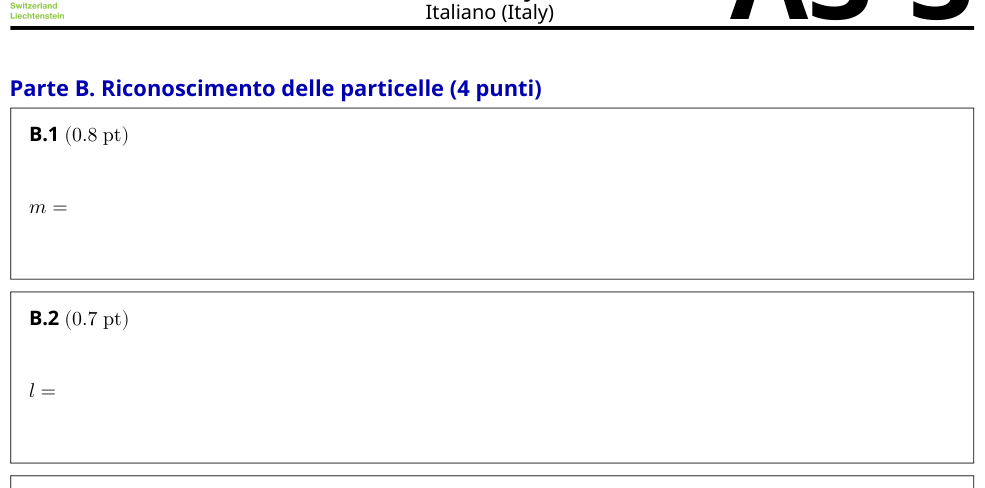
B.1 (0.8 pt)
Identificare le particelle ad alta energia generate nella collisione è importante per interpretare il processo di interazione. Un semplice metodo consiste nel misurare il tempo () che una particella con quantità di moto nota impiega a percorrere una lunghezza in un cosiddetto rivelatore Time-of-Flight (ToF). Le tipiche particelle che vengono identificate nel rivelatore sono elencate, insieme alle loro masse, in Tabella 2.
| Particella | Massa [MeV/] |
|---|---|
| Deutone | 1876 |
| Protone | 938 |
| Kaone carico | 494 |
| Pione carico | 140 |
| Elettrone | 0.511 |
Esprimi la massa in funzione della quantità di moto , della lunghezza di volo e del tempo di volo , assumendo che queste particelle abbiano carica elementare , che viaggino con velocità vicina a su percorsi rettilinei nel rivelatore ToF e che viaggino perpendicolarmente alle due armature (vedi Figura 2).
Topic: Special Relativity, Nuclear & Particle Physics Metodi: Relativistic Energy-Momentum Competenze: Mathematical Modeling, Physical Reasoning Objects: — Fonte: Testo (PDF) — p.4 Soluzione: Soluzioni (PDF)
B.1 (0.8 pt)
Identifying high-energy particles generated in collision is important to interpret the interaction process. A simple method is to measure the time () a particle with known motion quantity takes to travel a length in a so-called Time-of-Flight (ToF) detector. The typical particles identified in the detector are listed, together with their masses, in Table 2.
| Particella | Massa [MeV/] |
|---|---|
| ♪ I’m not a fan ♪ | |
| What is this? | |
| ♪ I’m not going to be able to get you ♪ | |
| ♪ I’m going to be a big fan ♪ | |
| What is it? |
Express the mass in terms of the engine quantity , the flight length and the flight time , assuming that these particles have an elementary load , traveling at a speed close to on straight paths in the ToF detector and traveling perpendicular to the two frames (see Figure 2).
Topic: Special Relativity, Nuclear & Particle Physics Metodi: Relativistic Energy-Momentum Competenze: Mathematical Modeling, Physical Reasoning Objects: — Fonte: Testo (PDF) — p.4 Soluzione: Soluzioni (PDF)
B.2 (0.7 pt)
Calcola la minima lunghezza di un rivelatore ToF che permette di distinguere in modo certo un kaone carico da un pione carico, sapendo che la quantità di moto di entrambi è stata misurata ed è . Per una buona separazione è richiesto che la differenza tra i tempi di volo sia maggiore del triplo della risoluzione temporale del rivelatore. La tipica risoluzione di un rivelatore ToF è ().
Topic: Special Relativity, Nuclear & Particle Physics Metodi: Relativistic Energy-Momentum, Approximation & Series Expansion Competenze: Mathematical Modeling, Estimation & Approximation Objects: — Fonte: Testo (PDF) — p.5 Soluzione: Soluzioni (PDF)
B.2 (0.7 pt)
Calculate the minimum length of a ToF detector that allows a loaded borehole to be distinguished from a loaded borehole with certainty, knowing that the amount of motion of both has been measured and is . For good separation, the difference between the flight times shall be greater than three times the time resolution of the detector. The typical resolution of a ToF detector is ().
Topic: Special Relativity, Nuclear & Particle Physics Metodi: Relativistic Energy-Momentum, Approximation & Series Expansion Competenze: Mathematical Modeling, Estimation & Approximation Objects: — Fonte: Testo (PDF) — p.5 Soluzione: Soluzioni (PDF)
B.3 (1.7 pt)
Nella parte seguente, le particelle prodotte in un tipico rivelatore di LHC sono identificate in un rivelatore a due fasi composto da un tracciatore e da un rivelatore ToF. La Figura 3 mostra l’apparato in un piano trasversale e in un piano longitudinale ai fasci di protoni. Entrambi i rivelatori sono tubi che circondano la regione degli urti, con il fascio che passa nella parte centrale dei tubi. Il tracciatore misura la traiettoria di una particella carica che passa attraverso un campo magnetico la cui direzione è parallela ai fasci di protoni. Il raggio della traiettoria permette di determinare la quantità di moto trasversale della particella. Dato che l’istante della collisione è noto, il rivelatore ToF necessita solo di un tubo per misurare il tempo di volo che è misurato dal punto di collisione al tubo ToF. Questo tubo ToF è situato appena fuori dal tracciatore. In questa domanda puoi assumere che tutte le particelle create nell’urto viaggino perpendicolarmente ai fasci di protoni, cioè che le particelle che si creano nell’urto non abbiano una componente della quantità di moto nella direzione dei fasci di protoni.
Esprimi la massa della particella in funzione del campo magnetico , del raggio del tubo ToF, delle costanti fondamentali e delle quantità misurate: il raggio della traiettoria e il tempo di volo .
Topic: Special Relativity, Magnetism, Nuclear & Particle Physics Metodi: Lorentz Force Analysis, Relativistic Energy-Momentum Competenze: Mathematical Modeling, Physical Reasoning Objects: — Fonte: Testo (PDF) — p.5 Soluzione: Soluzioni (PDF)
B.3 (1.7 pt)
In the following part, the particles produced in a typical LHC detector are identified in a two-phase detector consisting of a tracker and a ToF detector. Figure 3 shows the apparatus in a transverse plane and in a longitudinal plane to the proton beams. Both detectors are tubes surrounding the impact region, with the beam passing through the central part of the tubes. The tracer measures the trajectory of a charged particle passing through a magnetic field whose direction is parallel to the proton beams. The radius of the trajectory allows the quantity of cross motion of the particle to be determined. Since the moment of collision is known, the ToF detector only needs a tube to measure flight time which is measured from the point of collision to the ToF tube. This ToF tube is located just outside the tracker. In this question you can assume that all the particles created in the impact travel perpendicular to the proton beams, that is, that the particles created in the impact do not have a component of the amount of motion in the direction of the proton beams.
Express the particle mass in terms of the magnetic field , the radius of the ToF tube, the fundamental constants and the quantities measured: the radius of the trajectory and the flight time .
Topic: Special Relativity, Magnetism, Nuclear & Particle Physics Metodi: Lorentz Force Analysis, Relativistic Energy-Momentum Competenze: Mathematical Modeling, Physical Reasoning Objects: — Fonte: Testo (PDF) — p.5 Soluzione: Soluzioni (PDF)
B.4 (0.8 pt)
Abbiamo rilevato quattro particelle e vogliamo identificarle. Il campo magnetico nel tracciatore era . Il raggio del tubo ToF era . Qui sono riportate le misurazioni ():
| Particella | Raggio della traiettoria [m] | Tempo di volo [ns] |
|---|---|---|
| A | 5.10 | 20 |
| B | 2.94 | 14 |
| C | 6.06 | 18 |
| D | 2.31 | 25 |
Identifica le quattro particelle calcolando la loro massa.
Topic: Special Relativity, Nuclear & Particle Physics Metodi: Relativistic Energy-Momentum, Lorentz Force Analysis, Experimental Data Analysis Competenze: Physical Reasoning, Experimental Data Analysis Objects: — Fonte: Testo (PDF) — p.6 Soluzione: Soluzioni (PDF)
B.4 (0.8 pt)
We’ve detected four particles and we’re trying to identify them. The magnetic field in the tracker was . The radius of the ToF tube was . The following measurements are given ():
| Particella | Raggio della traiettoria [m] | Tempo di volo [ns] |
|---|---|---|
| A | 5.10 | 20 |
| B | 2.94 | 14 |
| C | 6.06 | 18 |
| D | 2.31 | 25 |
Identify the four particles by calculating their mass.
Topic: Special Relativity, Nuclear & Particle Physics Metodi: Relativistic Energy-Momentum, Lorentz Force Analysis, Experimental Data Analysis Competenze: Physical Reasoning, Experimental Data Analysis Objects: — Fonte: Testo (PDF) — p.6 Soluzione: Soluzioni (PDF)