Laser beams can be used to exert forces on microscopic particles. The operation of an optical tweezer, which is used for example in the study of biological systems, is based on this phenomenon. In 2018, Arthur Ashkin was awarded the Nobel Prize in Physics, among other things for his work on this technique. For particles that are much larger than the wavelength of the laser light used, the force effect can be understood through the refraction of light rays.
Consider a transparent and fixed polymer sphere with radius and refractive index . A laser beam strikes the sphere, as sketched in the figure, at a distance from the central axis drawn in. Assume that no light is reflected.
3.a) Draw the path of the laser beam as it passes through the polymer sphere and determine the angle by which the laser beam is deflected from its original direction.
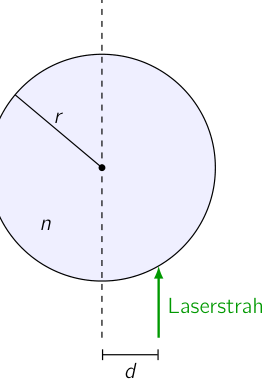 Polymer sphere radius r refractive index n laser offset d
Topic: Geometric Optics, Wave Optics Metodi: Snell’s Law, Ray Tracing Competenze: Diagrammatic Reasoning, Mathematical Modeling Objects: Sphere Fonte: Testo (PDF) — p.1
I raggi laser possono essere utilizzati per esercitare forze su particelle microscopiche. Il funzionamento di un pinzetto ottico, che viene utilizzato per esempio nello studio dei sistemi biologici, è basato su questo fenomeno. Nel 2018, Arthur Ashkin è stato premiato con il Premio Nobel di Fisica, tra le altre cose per il suo lavoro su questa tecnica. Per le particelle molto più grandi della lunghezza d’onda della luce laser utilizzata, l’effetto forza può essere compreso attraverso la refrazione dei raggi luminosi.
Considerare una sfera polimerica trasparente e fissa con radius e indice refraettivo . Un fascio laser colpisce la sfera, come illustrato nella figura, a una distanza dall’asse centrale tracciata. Supponiamo che non si rifletta luce.
**3.a) ** Draw the path of the laser beam as it passes through the polymer sphere and determine the angle by which the laser beam is deflected from its original direction.
Polymer sphere radius r refractive index n laser offset d
Topic: Geometric Optics, Wave Optics Metodi: Snell’s Law, Ray Tracing Competenze: Diagrammatic Reasoning, Mathematical Modeling Objects: Sphere Fonte: Testo (PDF) — p.1
Laser beams can be used to exert forces on microscopic particles. The operation of an optical tweezer, which is used for example in the study of biological systems, is based on this phenomenon. In 2018, Arthur Ashkin was awarded the Nobel Prize in Physics, among other things for his work on this technique. For particles that are much larger than the wavelength of the laser light used, the force effect can be understood through the refraction of light rays.
Consider a transparent and fixed polymer sphere with radius and refractive index . A laser beam strikes the sphere, as sketched in the figure, at a distance from the central axis drawn in. Assume that no light is reflected.
3.a) Draw the path of the laser beam as it passes through the polymer sphere and determine the angle by which the laser beam is deflected from its original direction.
Polymer sphere radius r refractive index n laser offset d
Topic: Geometric Optics, Wave Optics Metodi: Snell’s Law, Ray Tracing Competenze: Diagrammatic Reasoning, Mathematical Modeling Objects: Sphere Fonte: Testo (PDF) — p.1
Consider a photon of the laser beam with momentum magnitude that is deflected by the polymer sphere. Due to the refraction, the momentum changes its direction, but the momentum magnitude remains conserved to a very good approximation.
3.b) Determine the resulting changes of the momentum components along the original direction of propagation and perpendicular to it.
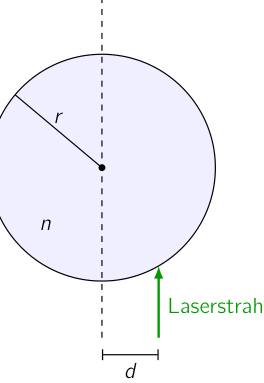 Polymer sphere radius r refractive index n laser offset d
Topic: Geometric Optics, Modern-Quantum Physics Metodi: Conservation of Momentum, Photon Energy Relation, Vector Decomposition Competenze: Mathematical Modeling, Physical Reasoning Objects: Sphere, Photon Fonte: Testo (PDF) — p.1
Consider a photon of the laser beam with momentum magnitude that is deflected by the polymer sphere. A causa della refrazione, il momento cambia la sua direzione, ma la magnitudine del momento rimane conservata ad una buona approssimazione.
**3.b) ** Determine i risultati dei cambiamenti dei componenti di momentum lungo la direzione originale di propagazione e perpendicolare a essa.
Polymer sphere radius r refractive index n laser offset d
Topic: Geometric Optics, Modern-Quantum Physics Metodi: Conservation of Momentum, Photon Energy Relation, Vector Decomposition Competenze: Mathematical Modeling, Physical Reasoning Objects: Sphere, Photon Fonte: Testo (PDF) — p.1
Consider a photon of the laser beam with momentum magnitude that is deflected by the polymer sphere. Due to the refraction, the momentum changes its direction, but the momentum magnitude remains conserved to a very good approximation.
**3.b) ** Determine the resulting changes of the momentum components along the original direction of propagation and perpendicular to it.
The radius of the polymer sphere r refractive index n laser offset d*
Topic: Geometric Optics, Modern-Quantum Physics Metodi: Conservation of Momentum, Photon Energy Relation, Vector Decomposition Competenze: Mathematical Modeling, Physical Reasoning Objects: Sphere, Photon Fonte: Testo (PDF) — p.1
The polymer sphere is now irradiated at the marked location with a laser of wavelength and a power of .
3.c) Determine the forces acting on the polymer sphere due to the refraction of the laser light, along the original direction of propagation and perpendicular to it.
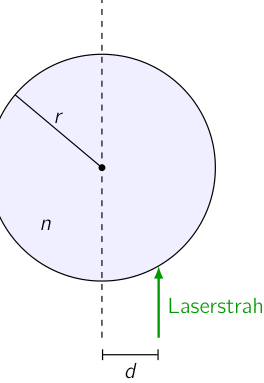 Polymer sphere radius r refractive index n laser offset d
Topic: Geometric Optics, Modern-Quantum Physics Metodi: Photon Energy Relation, Conservation of Momentum, Physical Modeling Competenze: Mathematical Modeling, Physical Reasoning Objects: Sphere Fonte: Testo (PDF) — p.1
La sfera polimerica è ora irradiata alla posizione segnata con un laser di lunghezza d’onda e una potenza di .
**3.c) ** Determine le forze che agiscono sulla sfera polimerica a causa della refrazione della luce laser, lungo la direzione originale di propagazione e perpendicolare a essa.
Polymer sphere radius r refractive index n laser offset d
Topic: Geometric Optics, Modern-Quantum Physics Metodi: Photon Energy Relation, Conservation of Momentum, Physical Modeling Competenze: Mathematical Modeling, Physical Reasoning Objects: Sphere Fonte: Testo (PDF) — p.1
The polymer sphere is now irradiated at the marked location with a laser of wavelength and a power of .
**3.c) ** Determine the forces acting on the polymer sphere due to the refraction of the laser light, along the original direction of propagation and perpendicular to it.
The radius of the polymer sphere r refractive index n laser offset d*
Topic: Geometric Optics, Modern-Quantum Physics Metodi: Photon Energy Relation, Conservation of Momentum, Physical Modeling Competenze: Mathematical Modeling, Physical Reasoning Objects: Sphere Fonte: Testo (PDF) — p.1