Problem 1 – Sinking Body
When a solid body of density sinks at constant velocity through viscous oil of density , then …
- A. … no gravitational force acts on the body.
- B. … the mass of the body equals the mass of the displaced fluid.
- C. … the gravitational force on the body is in equilibrium with the frictional force.
- D. … the buoyant force on the body equals the frictional force.
Topic: Fluid Mechanics, Newtonian Mechanics Metodi: Free-Body Diagram, Hydrostatic Equilibrium Competenze: Physical Reasoning Objects: — Fonte: Testo (PDF) — p.5
Problema 1 Sinking Body
Quando un corpo solido di densità si scende a velocità costante attraverso olio viscoso di densità , allora …
- A. … no gravitational force acts on the body.
- B. … la massa del corpo equivale alla massa del fluido dislocato.
- C. … la forza gravitazionale sul corpo è in equilibrio con la forza frizionale.
- **D ** … la forza buoyant sul corpo equivale alla forza fratturale.
Topic: Fluid Mechanics, Newtonian Mechanics Metodi: Free-Body Diagram, Hydrostatic Equilibrium Competenze: Physical Reasoning Objects: — Fonte: Testo (PDF) — p.5
The following is the list of the types of water treatment plants used:
When a solid body of density sinks at constant velocity through viscous oil of density , then …
- A. … no gravitational force acts on the body.
- **B ** … the mass of the body equals the mass of the displaced fluid.
- **C ** … the gravitational force on the body is in equilibrium with the frictional force.
- **D ** … the buoyant force on the body equals the frictional force.
Topic: Fluid Mechanics, Newtonian Mechanics Metodi: Free-Body Diagram, Hydrostatic Equilibrium Competenze: Physical Reasoning Objects: — Fonte: Testo (PDF) — p.5
Problem 2 – Cork in a Bucket
A bucket filled with water hangs from a rope. Inside the bucket there is a cork attached to the bottom of the bucket by a thread. When the thread is cut, the cork rises to the water surface. When the rope holding the bucket is cut, the bucket falls downward together with its contents.
How does the cork move relative to the bucket immediately after the rope and the thread are cut simultaneously?
- A. The cork rises faster toward the water surface.
- B. The cork rises to the water surface just as fast.
- C. The cork stays at rest.
- D. The cork sinks to the bottom of the bucket.
Topic: Fluid Mechanics, Newtonian Mechanics Metodi: Free-Body Diagram, Physical Modeling Competenze: Physical Reasoning, Diagrammatic Reasoning Objects: Container, String Fonte: Testo (PDF) — p.6
Problema 2 Cork in a bucket
Un secchio pieno di acqua è appeso a una corda. All’interno del secchio c’è un cannuccio attaccato al fondo del secchio da un filo. Quando il filo è tagliato, il canne si eleva alla superficie dell’acqua. Quando la corda che tiene il secchio viene tagliata, il secchio cade verso il basso insieme al suo contenuto.
Come si muove il canne rispetto al secchio immediatamente dopo che la corda e il filo sono tagliati simultaneamente?
- A. Il cork si eleva più velocemente verso la superficie dell’acqua.
- B. Il cork si eleva alla superficie dell’acqua quasi.
- C. Il cork sta sta at rest.
- D. Il cannuccio si fonda al fondo del secchio.
Topic: Fluid Mechanics, Newtonian Mechanics Metodi: Free-Body Diagram, Physical Modeling Competenze: Physical Reasoning, Diagrammatic Reasoning Objects: Container, String Fonte: Testo (PDF) — p.6
The problem is that the two main types of cork are not the same.
A bucket filled with water hangs from a rope. Inside the bucket there is a cork attached to the bottom of the bucket by a thread. When the thread is cut, the cork rises to the water surface. When the rope holding the bucket is cut, the bucket falls downward together with its contents.
How does the cork move relative to the bucket immediately after the rope and the thread are cut simultaneously?
- The cork rises faster towards the water surface.
- B. The cork rises to the water surface just as fast.
- The cork stays at rest.
- The cork sinks to the bottom of the bucket.
Topic: Fluid Mechanics, Newtonian Mechanics Metodi: Free-Body Diagram, Physical Modeling Competenze: Physical Reasoning, Diagrammatic Reasoning Objects: Container, String Fonte: Testo (PDF) — p.6
Problem 3 – Stone in a Glass of Water
A glass filled with water of density stands on a balance. By placing a weight on it, the balance is brought into equilibrium.
Now a stone with a volume of and a density of is immersed in the water, hanging from a thin thread attached to a stand, without touching the bottom.
To bring the balance back into equilibrium, one must …
- A. … do nothing, since the balance remains in equilibrium.
- B. … place a weight of mass on the left side of the balance.
- C. … place a weight of mass on the left side of the balance.
- D. … place a weight of mass on the left side of the balance.
Topic: Fluid Mechanics, Newtonian Mechanics Metodi: Hydrostatic Equilibrium, Free-Body Diagram Competenze: Physical Reasoning Objects: Container, String Fonte: Testo (PDF) — p.7
Problema 3 Pietra in un bicchiere di acqua
Un bicchiere pieno di acqua di densità è in equilibrio. Mettendo un peso su di esso, il equilibrio viene portato in equilibrio.
Ora una pietra con un volume di e una densità di è immersa nell’acqua, appesa a un filo sottile attaccato a un stand, senza toccare il fondo.
Per riportare l’equilibrio, bisogna
- **A ** … non fare nulla, poiché il saldo rimane in equilibrio.
- B. … place a weight of mass on the left side of the balance.
- C. … place a weight of mass on the left side of the balance.
- D. … place a weight of mass on the left side of the balance.
Topic: Fluid Mechanics, Newtonian Mechanics Metodi: Hydrostatic Equilibrium, Free-Body Diagram Competenze: Physical Reasoning Objects: Container, String Fonte: Testo (PDF) — p.7
The problem is that the water is not a source of energy.
A glass filled with water of density stands on a balance. By placing a weight on it, the balance is brought into balance.
Now a stone with a volume of and a density of is immersed in the water, hanging from a thin thread attached to a stand, without touching the bottom.
To bring the balance back into balance, one must
- **A ** … do nothing, since the balance remains in equilibrium.
- B. … place a weight of mass on the left side of the balance.
- C. … place a weight of mass on the left side of the balance.
- D. … place a weight of mass on the left side of the balance.
Topic: Fluid Mechanics, Newtonian Mechanics Metodi: Hydrostatic Equilibrium, Free-Body Diagram Competenze: Physical Reasoning Objects: Container, String Fonte: Testo (PDF) — p.7
Problem 4 – Ice Cube in a Glass
In three glasses filled with water, an ice cube floats in each. The ice cube in glass 1 has an air bubble inside, the ice cube in glass 2 has a core of liquid water, and in glass 3 an ice cube with an aluminum core floats.
What can be said about the water levels in the glasses immediately after the ice cubes have melted?
- A. The water level in glass 1 has risen, the levels in the other glasses are unchanged.
- B. The water level in glass 3 has fallen, the levels in the other glasses are unchanged.
- C. The water levels in glasses 1 and 3 have risen, the level in glass 2 is unchanged.
- D. The water levels in all glasses are unchanged.
Topic: Fluid Mechanics, Thermodynamics Metodi: Hydrostatic Equilibrium, Conservation of Energy Competenze: Physical Reasoning, Diagrammatic Reasoning Objects: Container, Bubble Fonte: Testo (PDF) — p.8
Problema 4 Ice Cube in a Glass
In tre bicchieri pieni d’acqua, un cubo di ghiaccio flotta in ciascuno. Il cubo di ghiaccio in vetro 1 ha una bolla d’aria all’interno, il cubo di ghiaccio in vetro 2 ha un nucleo di acqua liquida, e in vetro 3 un cubo di ghiaccio con un nucleo di alluminio galleggia.
Cosa si può dire dei livelli d’acqua nei bicchieri immediatamente dopo che i cubetti di ghiaccio sono fusi?
- A. Il livello dell’acqua nei bicchieri 1 ha aumentato, i livelli negli altri bicchieri sono invariati.
- B. Il livello dell’acqua nei bicchieri 3 è diminuito, i livelli negli altri bicchieri sono invariati.
- C. I livelli di acqua in bicchieri 1 e 3 sono aumentati, il livello in bicchiere 2 è invariato.
- D. I livelli di acqua in tutti i bicchieri sono invariati.
Topic: Fluid Mechanics, Thermodynamics Metodi: Hydrostatic Equilibrium, Conservation of Energy Competenze: Physical Reasoning, Diagrammatic Reasoning Objects: Container, Bubble Fonte: Testo (PDF) — p.8
The problem is that the problem is that the water is not a liquid.
In three glasses filled with water, an ice cube floats in each. The ice cube in glass 1 has an air bubble inside, the ice cube in glass 2 has a core of liquid water, and in glass 3 an ice cube with an aluminum core floats.
What can be said about the water levels in the glasses immediately after the ice cubes have melted?
- A. The water level in glass 1 has risen, the levels in the other glasses are unchanged.
- B. The water level in glass 3 has fallen, the levels in the other glasses are unchanged.
- C. The water levels in glasses 1 and 3 have risen, the level in glass 2 is unchanged.
- D. The water levels in all glasses are unchanged.
Topic: Fluid Mechanics, Thermodynamics Metodi: Hydrostatic Equilibrium, Conservation of Energy Competenze: Physical Reasoning, Diagrammatic Reasoning Objects: Container, Bubble Fonte: Testo (PDF) — p.8
Problem 5 – Ruler Displacement
The end of a ruler rests on a cylindrical can, which in turn rests on a table. The ruler is moved horizontally so that the can rolls across the table. Neither the ruler nor the can slips in the process.
By what distance has the ruler moved relative to the table when the can has completed one full revolution?
- A. Half the circumference of the can
- B. The circumference of the can
- C. Twice the circumference of the can
- D. More than twice the circumference of the can
Topic: Newtonian Mechanics, Rotational Dynamics Metodi: Kinematic Equations, Physical Modeling Competenze: Physical Reasoning, Diagrammatic Reasoning Objects: Cylinder, Rod Fonte: Testo (PDF) — p.9
**Problema 5 Dislocazione dei ruoli **
L’estremità di un ruoter si trova su un cilindrico, che a sua volta si trova su un tavolo. Il ruoter è spostato orizzontalmente in modo che il can ruota attraverso il tavolo. Né il ruotatore né il can scivolare nel processo.
Per quale distanza si è spostato il rucker rispetto al tavolo quando il can ha completato una rivoluzione completa?
- A. Half the circumference of the can
- B. The circumference of the can
- C. Twice the circumference of the can
- D. More than twice the circumference of the can
Topic: Newtonian Mechanics, Rotational Dynamics Metodi: Kinematic Equations, Physical Modeling Competenze: Physical Reasoning, Diagrammatic Reasoning Objects: Cylinder, Rod Fonte: Testo (PDF) — p.9
The following is the list of the types of vehicles that are used in the manufacture of the vehicle:
The end of a ruler rests on a cylindrical can, which in turn rests on a table. The ruler is moved horizontally so that the can rolls across the table. Neither the ruler nor the can slips in the process.
By what distance has the ruler moved relative to the table when the can has completed one full revolution?
- A. Half the circumference of the can
- B. The circumference of the can
- **C ** Twice the circumference of the can
- D. More than twice the circumference of the can
Topic: Newtonian Mechanics, Rotational Dynamics Metodi: Kinematic Equations, Physical Modeling Competenze: Physical Reasoning, Diagrammatic Reasoning Objects: Cylinder, Rod Fonte: Testo (PDF) — p.9
Problem 6 – Motion!
The graph alongside shows the acceleration of a body in one-dimensional motion as a function of time .
Which of the following graphs correctly represents the velocity of the body as a function of time?
- A. Graph A
- B. Graph B
- C. Graph C
- D. Graph D
Topic: Newtonian Mechanics Metodi: Kinematic Equations, Physical Modeling Competenze: Graph Linearization, Physical Reasoning Objects: — Fonte: Testo (PDF) — p.10
Problem 6 – Motion!
The graph alongside shows the acceleration of a body in one-dimensional motion as a function of time .
Quale dei seguenti grafici rappresenta correttamente la velocità del corpo come funzione di tempo?
- A. Grafico A
- B. Grafico B
- C. Grafico C
- D. Grafico D
Topic: Newtonian Mechanics Metodi: Kinematic Equations, Physical Modeling Competenze: Graph Linearization, Physical Reasoning Objects: — Fonte: Testo (PDF) — p.10
Problem 6 – Motion!
The graph alongside shows the acceleration of a body in one-dimensional motion as a function of time .
Which of the following graphs correctly represents the velocity of the body as a function of time?
- A. Graph A
- B. Graph B
- C. Graph C
- D. Graph D
Topic: Newtonian Mechanics Metodi: Kinematic Equations, Physical Modeling Competenze: Graph Linearization, Physical Reasoning Objects: — Fonte: Testo (PDF) — p.10
Problem 7 – Sliding Boxes
Two boxes slide frictionlessly down an inclined plane each from the same height. The two inclined planes have different slopes, but both boxes cover the same total height difference. One box is twice as heavy as the other.
Which of the following statements is correct?
- A. Both boxes initially have the same potential energy.
- B. The boxes take the same time to slide down the inclined planes.
- C. At the bottom of the inclined planes both boxes have the same kinetic energy.
- D. At the bottom of the inclined planes both boxes are equally fast.
Topic: Newtonian Mechanics, Conservation of Energy Metodi: Conservation of Energy, Kinematic Equations Competenze: Physical Reasoning Objects: Block, Inclined Plane Fonte: Testo (PDF) — p.11
Problema 7 Sliding boxes
Due scatole scorrono senza frattura verso il basso in un piano inclinato, ognuna dalla stessa altezza. I due piani inclinati hanno pendenze diverse, ma entrambe le scatole coprono la stessa differenza totale di altezza. Una scatola è doppia più pesante dell’altra.
Quale delle seguenti affermazioni è corretta?
- A. Entrambe le scatole inizialmente hanno la stessa energia potenziale. Le scatole prendono lo stesso tempo per slide down the inclined planes.
- C. Al fondo dei piani inclinati entrambe le scatole hanno la stessa energia cinetica.
- D. Al fondo dei piani inclinati entrambe le scatole sono uguali.
Topic: Newtonian Mechanics, Conservation of Energy Metodi: Conservation of Energy, Kinematic Equations Competenze: Physical Reasoning Objects: Block, Inclined Plane Fonte: Testo (PDF) — p.11
The following is the list of the types of products which are included in the list of products:
Two boxes slide frictionlessly down an inclined plane each from the same height. The two inclined planes have different slopes, but both boxes cover the same total height difference. One box is twice as heavy as the other.
Which of the following statements is correct?
- A. Both boxes initially have the same potential energy.
- The boxes take the same time to slide down the inclined planes.
- C. At the bottom of the inclined planes both boxes have the same kinetic energy.
- D. At the bottom of the inclined planes both boxes are equally close.
Topic: Newtonian Mechanics, Conservation of Energy Metodi: Conservation of Energy, Kinematic Equations Competenze: Physical Reasoning Objects: Block, Inclined Plane Fonte: Testo (PDF) — p.11
Problem 8 – Water Jet
The bottom of a container filled with water is located at a height of above the floor. The height of the water in the container is .
A small hole is now drilled into the container at a height above the bottom, so that a jet of water pours out of the container and initially hits the floor at a distance .
Which of the graphs correctly represents the distance of the impact point as a function of the height at which the hole is drilled?
- A. Graph A
- B. Graph B
- C. Graph C
- D. Graph D
Topic: Fluid Mechanics, Newtonian Mechanics Metodi: Bernoulli’s Equation, Kinematic Equations Competenze: Physical Reasoning, Mathematical Modeling Objects: Container Fonte: Testo (PDF) — p.12
Il problema 8 è che il gas d’acqua è stato utilizzato per la produzione di acqua.
Il fondo di un contenitore pieno di acqua è situato ad un’altezza di sopra il pavimento. L’altezza dell’acqua contenuta nel contenitore è .
Un piccolo buco è ora perforato nel contenitore ad un’altezza sopra il fondo, in modo che un jet di acqua si riversasse fuori dal contenitore e inizialmente colpisse il pavimento a una distanza .
Qual è il grafico che rappresenta correttamente la distanza del punto di impatto come funzione dell’altezza alla quale il buco è stato perforato?
- A. Grafico A
- B. Grafico B
- C. Grafico C
- D. Grafico D
Topic: Fluid Mechanics, Newtonian Mechanics Metodi: Bernoulli’s Equation, Kinematic Equations Competenze: Physical Reasoning, Mathematical Modeling Objects: Container Fonte: Testo (PDF) — p.12
The problem is that the water is not a source of energy.
The bottom of a container filled with water is located at a height of above the floor. The height of the water in the container is .
A small hole is now drilled into the container at a height above the bottom, so that a jet of water pours out of the container and initially hits the floor at a distance .
Which of the graphs correctly represents the distance of the impact point as a function of the height at which the hole is drilled?
- A. Graph A
- B. Graph B
- C. Graph C
- D. Graph D
Topic: Fluid Mechanics, Newtonian Mechanics Metodi: Bernoulli’s Equation, Kinematic Equations Competenze: Physical Reasoning, Mathematical Modeling Objects: Container Fonte: Testo (PDF) — p.12
Problem 9 – Puck on a String
A very small puck can move without friction on an air-cushion table. It is attached to a fixed rod by a thin string and is now given a push so that it rotates around the rod, with the always-taut string winding up around the rod.
How does the orbital speed of the puck behave during the motion?
- A. It remains constant.
- B. It increases.
- C. It decreases.
- D. This cannot be answered as stated.
Topic: Newtonian Mechanics, Rotational Dynamics Metodi: Conservation of Energy, Conservation of Momentum Competenze: Physical Reasoning Objects: Disk, String, Rod Fonte: Testo (PDF) — p.14
Problema 9 Puck on a String
Un piccolo puck può muoversi senza attrito su un tavolo a cuscino d’aria. È attaccato a una barra fissa da una corda sottile e ora viene dato un push in modo che ruota intorno alla barra, con la corda sempre-taut che si snoda intorno alla barra.
Come si comporta la velocità orbitale del puck durante il movimento?
- A. Rimane costante.
- ** B.**
- C. Si riduce.
- D. This cannot be answered as stated.
Topic: Newtonian Mechanics, Rotational Dynamics Metodi: Conservation of Energy, Conservation of Momentum Competenze: Physical Reasoning Objects: Disk, String, Rod Fonte: Testo (PDF) — p.14
Problem 9 Puck on a string
A very small puck can move without friction on an air cushion table. It’s attached to a fixed rod by a thin string and is now given a push so that it rotates around the rod, with the always-taut string winding up around the rod.
How does the orbital speed of the puck behave during motion?
- **A ** It remains constant.
- ** B.** It increases.
- It decreases.
- D. This cannot be answered as stated.
Topic: Newtonian Mechanics, Rotational Dynamics Metodi: Conservation of Energy, Conservation of Momentum Competenze: Physical Reasoning Objects: Disk, String, Rod Fonte: Testo (PDF) — p.14
Problem 10 – Fall on an Exoplanet
On the surface of an extrasolar planet (exoplanet), the fall time of a body from a small height , neglecting all friction effects, is exactly twice as large as on Earth.
Which of the following statements is consistent with this, assuming a spherically symmetric structure of the exoplanet?
The exoplanet has …
- A. … half the Earth’s mass and twice the Earth’s radius.
- B. … exactly the Earth’s mass and four times the Earth’s radius.
- C. … twice the Earth’s mass and twice the Earth’s radius.
- D. … four times the Earth’s mass and four times the Earth’s radius.
Topic: Gravitation, Newtonian Mechanics Metodi: Newton’s Law of Gravitation, Kinematic Equations Competenze: Physical Reasoning, Mathematical Modeling Objects: Planet Fonte: Testo (PDF) — p.15
Problem 10 – Fall on an Exoplanet
On the surface of an extrasolar planet (exoplanet), the fall time of a body from a small height , neglecting all friction effects, is exactly twice as large as on Earth.
Quali delle seguenti affermazioni sono coerenti con questo, assumendo una struttura sfericamente simmetrica dell’esoplaneta?
Il pianeta esoplanet ha …
- **A ** … metà della massa terrestre e due volte il raggio terrestre.
- B. … exactly the Earth’s mass and four times the Earth’s radius.
- **C ** … due volte la massa della Terra e due volte il raggio della Terra.
- **D ** … 4 volte la massa della Terra e 4 volte il raggio della Terra.
Topic: Gravitation, Newtonian Mechanics Metodi: Newton’s Law of Gravitation, Kinematic Equations Competenze: Physical Reasoning, Mathematical Modeling Objects: Planet Fonte: Testo (PDF) — p.15
Problem 10 – Fall on an Exoplanet
On the surface of an extrasolar planet (exoplanet), the fall time of a body from a small height , neglecting all friction effects, is exactly twice as large as on Earth.
Which of the following statements is consistent with this, assuming a spherically symmetrical structure of the exoplanet?
The exoplanet has …
- **A ** … half the Earth’s mass and twice the Earth’s radius.
- B. … exactly the Earth’s mass and four times the Earth’s radius.
- **C ** … twice the mass of the Earth and twice the radius of the Earth.
- **D ** … four times the mass of the Earth and four times the radius of the Earth.
Topic: Gravitation, Newtonian Mechanics Metodi: Newton’s Law of Gravitation, Kinematic Equations Competenze: Physical Reasoning, Mathematical Modeling Objects: Planet Fonte: Testo (PDF) — p.15
Problem 11 – Rotating Cube
Let denote the moment of inertia of the cube shown for rotation about the indicated axis through the centers of two opposite faces.
What is the corresponding moment of inertia of a cube made of the same material but with twice the edge length ?
- A.
- B.
- C.
- D.
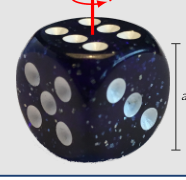 Cube with axis of rotation
Topic: Rotational Dynamics Metodi: Torque & Angular Momentum Analysis, Dimensional Analysis Competenze: Physical Reasoning, Mathematical Modeling Objects: — Fonte: Testo (PDF) — p.16
Problema 11 Rotating Cube
Let denota il momento di inerzia del cubo mostrato per rotazione circa l’asse indicato attraverso i centri di due facce opposte.
What is the corresponding moment of inertia of a cube made of the same material but with twice the edge length ?
- A.
- B.
- C.
- D.
Cube with axis of rotation
Topic: Rotational Dynamics Metodi: Torque & Angular Momentum Analysis, Dimensional Analysis Competenze: Physical Reasoning, Mathematical Modeling Objects: — Fonte: Testo (PDF) — p.16
The following is the list of the types of rotating cube:
Let denote the moment of inertia of the cube shown for rotation about the indicated axis through the centers of two opposite faces.
What is the corresponding moment of inertia of a cube made of the same material but with twice the edge length ?
- A.
- B.
- C.
- D.
Cube with axis of rotation
Topic: Rotational Dynamics Metodi: Torque & Angular Momentum Analysis, Dimensional Analysis Competenze: Physical Reasoning, Mathematical Modeling Objects: — Fonte: Testo (PDF) — p.16
Problem 12 – Pendulum in an Elevator
Two elevator cabins of masses and with hang from the ends of a long rope that runs over a fixed pulley. The mass of the pulley and the rope can be neglected. In the left cabin hangs a string pendulum of length . When the cabins are at rest and for small displacements, the period of the pendulum is .
When the cabins are released, they move without friction under the influence of gravity.
How must the length of the string pendulum in the left cabin be chosen so that, after the cabin is released, it oscillates with period ?
- A.
- B.
- C.
- D.
Topic: Oscillations & Waves, Newtonian Mechanics Metodi: Simple Harmonic Motion Analysis, Free-Body Diagram Competenze: Physical Reasoning, Mathematical Modeling Objects: String, Pulley, Pendulum Fonte: Testo (PDF) — p.17
Problema 12 Pendolo in ascensore
Due elevator cabins di masse e con hang from the ends of a long rope that runs over a fixed pulley. La massa della polla e della corda può essere trascurata. In quella cabina sinistra è appeso un pendolo di string di lunghezza . Quando le cabine sono a riposo e per piccoli spostamenti, il periodo del pendolo è .
Quando le cabine sono rilasciate, si muovono senza attrito sotto l’influenza della gravità.
How must the length of the string pendulum in the left cabin be chosen so that, after the cabin is released, it oscillates with period ?
- A.
- B.
- C.
- D.
Topic: Oscillations & Waves, Newtonian Mechanics Metodi: Simple Harmonic Motion Analysis, Free-Body Diagram Competenze: Physical Reasoning, Mathematical Modeling Objects: String, Pulley, Pendulum Fonte: Testo (PDF) — p.17
The problem is that the engine is not running at the same speed.
Two elevator cabins of masses and with hang from the ends of a long rope that runs over a fixed pulley. The mass of the pulley and the rope can be neglected. In the left cabin hangs a string pendulum of length . When the cabins are at rest and for small displacements, the period of the pendulum is .
When the cabins are released, they move without friction under the influence of gravity.
How must the length of the string pendulum in the left cabin be chosen so that, after the cabin is released, it oscillates with period ?
- A.
- B.
- C.
- D.
Topic: Oscillations & Waves, Newtonian Mechanics Metodi: Simple Harmonic Motion Analysis, Free-Body Diagram Competenze: Physical Reasoning, Mathematical Modeling Objects: String, Pulley, Pendulum Fonte: Testo (PDF) — p.17
Problem 13 – Earth and Mars
The following figures are intended to show, from right to left, five snapshots each of the orbital positions of Earth and Mars, taken at equal time intervals. The ratios of the orbital radii are to scale, but the planets are greatly enlarged.
State which of the figures is correct and justify your answer.
- A. Figure A
- B. Figure B
- C. Figure C
- D. Figure D
Topic: Gravitation, Astrophysics Metodi: Kepler’s Laws, Physical Modeling Competenze: Physical Reasoning, Diagrammatic Reasoning Objects: Planet Fonte: Testo (PDF) — p.18
Il problema 13 Terra e Marte
Le seguenti figure sono destinate a mostrare, da destra a sinistra, cinque snapshot di ciascuna delle posizioni orbitali di Terra e Marte, prese a intervalli di tempo uguali. I rapporti dei raggi orbitali sono scalabili, ma i pianeti sono molto più grandi.
Indicare quale delle cifre sia corretta e giustificare la tua risposta.
- A. Figura A
- B. Figura B
- C. Figura C
- D. Figura D
Topic: Gravitation, Astrophysics Metodi: Kepler’s Laws, Physical Modeling Competenze: Physical Reasoning, Diagrammatic Reasoning Objects: Planet Fonte: Testo (PDF) — p.18
The problem is that the Earth and Mars
The following figures are intended to show, from right to left, five snapshots of each of the orbital positions of Earth and Mars, taken at equal time intervals. The ratios of the orbital radii are to scale, but the planets are greatly enlarged.
State which of the figures is correct and justify your answer.
- A. Figure A
- B. Figure B
- C. Figure C
- D. Figure D
Topic: Gravitation, Astrophysics Metodi: Kepler’s Laws, Physical Modeling Competenze: Physical Reasoning, Diagrammatic Reasoning Objects: Planet Fonte: Testo (PDF) — p.18
Problem 14 – Black Hole in the Milky Way
The 2020 Nobel Prize in Physics was awarded for the discovery of a very massive, compact object at the center of our galaxy, the Milky Way. The figure alongside shows the observed position of a star at various dates relative to the presumed position of the center of the Milky Way. The position is given in astronomical units, with . For simplicity, assume that the orbit of the star lies in the plane of the drawing and that the orbit is not affected by relativistic effects.
What mass can be estimated from the data for the black hole presumed to be at the center of the Milky Way, as a multiple of the solar mass with ?
The mass of the black hole most closely corresponds to …
- A. … solar masses.
- B. … solar masses.
- C. … solar masses.
- D. … solar masses.
Topic: Gravitation, Astrophysics Metodi: Kepler’s Laws, Newton’s Law of Gravitation, Order-of-Magnitude Estimation Competenze: Estimation & Approximation, Physical Reasoning Objects: Black Hole, Star Fonte: Testo (PDF) — p.19
Il problema 14 è che il buco nero nella Via Lattea
Il premio Nobel per la fisica del 2020 è stato assegnato per la scoperta di un oggetto molto massiccio e compatto al centro della nostra galassia, la Via Lattea. La figura che si trova al fianco mostra la posizione osservata di una stella a varie date in relazione alla presunta posizione del centro della Via Lattea. La posizione è data in unità astronomiche, con . Per semplicità, supponiamo che l’orbita della stella sia nel piano del disegno e che l’orbita non sia influenzata da effetti relativistici.
Che massa può essere stimata dai dati per il buco nero presunto essere al centro della Via Lattea, come un multiple della massa solare con ?
La massa del buco nero corrisponde più strettamente a …
- A. … mass solar.
- B. … mass solar.
- C. … mass solar.
- D. … mass solar.
Topic: Gravitation, Astrophysics Metodi: Kepler’s Laws, Newton’s Law of Gravitation, Order-of-Magnitude Estimation Competenze: Estimation & Approximation, Physical Reasoning Objects: Black Hole, Star Fonte: Testo (PDF) — p.19
Problem 14 Black hole in the Milky Way
The 2020 Nobel Prize in Physics was awarded for the discovery of a very massive, compact object at the center of our galaxy, the Milky Way. The figure alongside shows the observed position of a star at various dates relative to the presumed position of the center of the Milky Way. The position is given in astronomical units, with . For simplicity, assume that the orbit of the star is in the plane of the drawing and that the orbit is not affected by relativistic effects.
What mass can be estimated from the data for the black hole presumed to be at the center of the Milky Way, as a multiple of the solar mass with ?
The mass of the black hole most closely corresponds to …
- **A ** … solar masses.
- **B ** … solar masses.
- **C ** … solar masses.
- **D ** … solar masses.
Topic: Gravitation, Astrophysics Metodi: Kepler’s Laws, Newton’s Law of Gravitation, Order-of-Magnitude Estimation Competenze: Estimation & Approximation, Physical Reasoning Objects: Black Hole, Star Fonte: Testo (PDF) — p.19
Problem 15 – Oscillation with an obstacle
A small metal ball hangs from the ceiling on a thin string of length . When this pendulum is displaced slightly to the side and released, it swings parallel to the wall with an oscillation period .
Now a nail is driven firmly into the wall at a distance of from the ceiling. As it swings to the right, the pendulum string strikes the nail and is obstructed by it. The ball is released from the position shown in the figure on the right.
Which of the following figures shows the position of the ball after release?
- A. Position A
- B. Position B
- C. Position C
- D. Position D
Topic: Oscillations & Waves, Newtonian Mechanics Metodi: Simple Harmonic Motion Analysis, Physical Modeling Competenze: Physical Reasoning, Diagrammatic Reasoning Objects: Pendulum, Ball Fonte: Testo (PDF) — p.21
Problema 15 Oscillazione con un ostacolo
A small metal ball hangs from the ceiling on a thin string of length . Quando questo pendolo è spostato leggermente verso il lato e rilasciato, oscilla in parallelo al muro con un periodo di oscillazione .
Ora un unghie è spinto saldamente nel muro a una distanza di dal soffitto. Mentre si svinge a destra, la corda del pendolo colpisce il chiodo ed è ostruita da esso. La palla viene rilasciata dalla posizione mostrata nella figura a destra.
Which of the following figures shows the position of the ball after release?
- A. voce A
- B. voce B
- C. C
- D. voce D
Topic: Oscillations & Waves, Newtonian Mechanics Metodi: Simple Harmonic Motion Analysis, Physical Modeling Competenze: Physical Reasoning, Diagrammatic Reasoning Objects: Pendulum, Ball Fonte: Testo (PDF) — p.21
Problem 15 – Oscillation with an obstacle
A small metal ball hangs from the ceiling on a thin string of length . When this pendulum is displaced slightly to the side and released, it swings parallel to the wall with an oscillation period .
Now a nail is driven firmly into the wall at a distance of from the ceiling. As it swings to the right, the pendulum string strikes the nail and is obstructed by it. The ball is released from the position shown in the figure on the right.
Which of the following figures shows the position of the ball after release?
- A. heading A
- **B ** heading B
- C. heading C
- D. heading D
Topic: Oscillations & Waves, Newtonian Mechanics Metodi: Simple Harmonic Motion Analysis, Physical Modeling Competenze: Physical Reasoning, Diagrammatic Reasoning Objects: Pendulum, Ball Fonte: Testo (PDF) — p.21
Problem 16 – Double spring pendulum
In each of the two spring pendulums shown, a body of mass oscillates without friction. However, the spring constants and of the two Hookean springs are different. As a result, the bodies oscillate at different frequencies and after being displaced.
What is the oscillation frequency (natural frequency) of the system shown below, in which the springs are coupled?
- A.
- B.
- C.
- D.
Topic: Oscillations & Waves Metodi: Simple Harmonic Motion Analysis, Hooke’s Law, Superposition Principle Competenze: Physical Reasoning, Mathematical Modeling Objects: Spring Fonte: Testo (PDF) — p.22
Problema 16 Double spring pendulum
In each of the two spring pendulums shown, a body of mass oscillates without friction. Tuttavia, le costanti di primavera e delle due Hookean springs sono diverse. Come risultato, i corpi oscillavano a diverse frequenze e dopo essere stati spostati.
Qual è la frequenza di oscillazione (frequenza naturale) del sistema mostrato qui sotto, in cui le springs sono accoppiate?
- A.
- B.
- C.
- D.
Topic: Oscillations & Waves Metodi: Simple Harmonic Motion Analysis, Hooke’s Law, Superposition Principle Competenze: Physical Reasoning, Mathematical Modeling Objects: Spring Fonte: Testo (PDF) — p.22
Problem 16 – Double spring pendulum
In each of the two spring pendulums shown, a body of mass oscillates without friction. However, the spring constants and of the two Hookean springs are different. As a result, the bodies oscillate at different frequencies and after being displaced.
What is the oscillation frequency (natural frequency) of the system shown below, in which the springs are coupled?
- A.
- B.
- C.
- D.
Topic: Oscillations & Waves Metodi: Simple Harmonic Motion Analysis, Hooke’s Law, Superposition Principle Competenze: Physical Reasoning, Mathematical Modeling Objects: Spring Fonte: Testo (PDF) — p.22
Problem 17 – Coulomb force
Two equally sized charged metal spheres are located at a very large distance from each other. The charge of one sphere is three times as large as that of the other. The force the spheres exert on each other is . Now the spheres are brought into contact with each other and then positioned at a distance twice as large as the initial one.
What is now approximately the force between them?
- A.
- B.
- C.
- D. The force remains the same.
Topic: Electrostatics Metodi: Coulomb’s Law Competenze: Physical Reasoning, Mathematical Modeling Objects: Conducting Sphere Fonte: Testo (PDF) — p.24
Il problema 17 Coulomb force
Due sfere di metallo caricate di dimensioni uguali si trovano a una grande distanza l’una dall’altra. La carica di una sfera è tre volte più grande di quella dell’altra. La forza che le sfere esercitano l’una sull’altra è . Ora le sfere vengono messe in contatto tra loro e poi posizionate a una distanza due volte maggiore di quella iniziale.
Cosa c’è ora circa la forza tra loro?
- A.
- B.
- C.
- **D ** La forza rimane la stessa.
Topic: Electrostatics Metodi: Coulomb’s Law Competenze: Physical Reasoning, Mathematical Modeling Objects: Conducting Sphere Fonte: Testo (PDF) — p.24
The following is the list of the types of problems:
Two equally sized charged metal spheres are located at a very large distance from each other. The charge of one sphere is three times as large as that of the other. The force the spheres exert on each other is . Now the spheres are brought into contact with each other and then positioned at a distance twice as large as the initial one.
What is now approximately the force between them?
- A.
- B.
- C.
- The force remains the same.
Topic: Electrostatics Metodi: Coulomb’s Law Competenze: Physical Reasoning, Mathematical Modeling Objects: Conducting Sphere Fonte: Testo (PDF) — p.24
Problem 18 – Coaxial cable
A coaxial cable consists of a long thin cylinder with resistivity , surrounded by a hollow cylinder with resistivity . A current of strength flows through the cable.
A second coaxial cable, which looks identical from the outside, consists internally of only a single material with resistivity and carries the current .
At how many of the marked points A, B and C do the magnetic fields produced by the respective cable differ?
- A. 0
- B. 1
- C. 2
- D. 3
Topic: Magnetism, Electromagnetism Metodi: Ampère’s Law, Symmetry Argument Competenze: Physical Reasoning, Diagrammatic Reasoning Objects: Wire, Cylinder Fonte: Testo (PDF) — p.25
Problema 18 Cable coassiale
Un cavo coaxial consiste di un lungo cilindro sottile con resistività , circondato da un cilindro vuoto con resistività . Un corrente di forza scorre attraverso il cavo.
Un secondo cavo coaxial, che sembra identico dall’esterno, è costituito internamente da un solo materiale con resistività e porta il corrente .
A quanti dei punti segnati A, B e C si differenziano i campi magnetici prodotti dal cavo rispettivo?
- A. 0
- B. 1
- C. 2
- D. 3
Topic: Magnetism, Electromagnetism Metodi: Ampère’s Law, Symmetry Argument Competenze: Physical Reasoning, Diagrammatic Reasoning Objects: Wire, Cylinder Fonte: Testo (PDF) — p.25
Problem 18 – Coaxial cable
A coaxial cable consists of a long thin cylinder with resistivity , surrounded by a hollow cylinder with resistivity . A current of strength flows through the cable.
A second coaxial cable, which looks identical from the outside, consists internally of only a single material with resistivity and carries the current .
At how many of the marked points A, B and C do the magnetic fields produced by the respective cable differ?
- A. 0
- B. 1
- C. 2
- D. 3
Topic: Magnetism, Electromagnetism Metodi: Ampère’s Law, Symmetry Argument Competenze: Physical Reasoning, Diagrammatic Reasoning Objects: Wire, Cylinder Fonte: Testo (PDF) — p.25
Problem 19 – Fields
A very light charged particle is accelerated through a voltage . It then flies into a region permeated by a constant magnetic field perpendicular to the direction of motion of the particle. In this region the particle describes a circular arc with a radius of .
Now an electric field of constant field strength is switched on, oriented perpendicular to both the magnetic field and the instantaneous direction of motion of the particle. As a result, the particle continues to move in a straight line.
What is the voltage with which the particle was initially accelerated?
- A.
- B.
- C.
- D.
Topic: Electromagnetism, Electrostatics Metodi: Lorentz Force Analysis, Energy Conservation Method Competenze: Physical Reasoning, Mathematical Modeling Objects: Point Charge Fonte: Testo (PDF) — p.26
Problema 19 Fields
Una particella molto leggera è accelerata attraverso una tensione . Poi vola in una regione permeata da un campo magnetico costante perpendicolare alla direzione del movimento della particella. In questa regione la particella descrive un arco circolare con un raggio di .
Now an electric field of constant field strength is switched on, oriented perpendicular to both the magnetic field and the instantaneous direction of motion of the particle. Di conseguenza, la particella continua a muoversi in linea retta.
What is the voltage with which the particle was initially accelerated?
- A.
- B.
- C.
- D.
Topic: Electromagnetism, Electrostatics Metodi: Lorentz Force Analysis, Energy Conservation Method Competenze: Physical Reasoning, Mathematical Modeling Objects: Point Charge Fonte: Testo (PDF) — p.26
Problem 19 – Fields
A very light charged particle is accelerated through a voltage . It then flies into a region permeated by a constant magnetic field perpendicular to the direction of motion of the particle. In this region the particle describes a circular arc with a radius of .
Now an electric field of constant field strength is switched on, oriented perpendicular to both the magnetic field and the instantaneous direction of motion of the particle. As a result, the particle continues to move in a straight line.
What is the voltage with which the particle was initially accelerated?
- A.
- B.
- C.
- D.
Topic: Electromagnetism, Electrostatics Metodi: Lorentz Force Analysis, Energy Conservation Method Competenze: Physical Reasoning, Mathematical Modeling Objects: Point Charge Fonte: Testo (PDF) — p.26
Problem 20 – Charged dust
Six identical, initially resting dust particles with mass and charge are arranged in a vacuum in a regular hexagon with edge length . At the center of the hexagon there is an initially resting seventh dust particle with the same mass but opposite charge . Now the particles are released.
What is the speed of one of the positively charged dust particles relative to the negatively charged dust particle after the particles have moved far apart?
- A. about
- B. about
- C. about
- D. about
Topic: Electrostatics, Conservation of Energy Metodi: Coulomb’s Law, Energy Conservation Method, Conservation of Energy Competenze: Physical Reasoning, Mathematical Modeling Objects: Point Charge Fonte: Testo (PDF) — p.27
Problema 20 Polvere carica
Sei identiche particelle di polvere inizialmente rilassate con massa e carico sono disposte in un vuoto in un hexagono regolare con lunghezza di bordo . Al centro dell’esagono c’è una inizialmente restante settima polvere particella con la stessa massa ma carica opposta . Ora le particelle sono rilasciate.
Qual è la velocità di una delle particelle di polvere cariche positivamente rispetto alla particella di polvere carica negativamente dopo che le particelle si sono spostate lontano?
- A. about
- B. about
- C. about
- D. about
Topic: Electrostatics, Conservation of Energy Metodi: Coulomb’s Law, Energy Conservation Method, Conservation of Energy Competenze: Physical Reasoning, Mathematical Modeling Objects: Point Charge Fonte: Testo (PDF) — p.27
The following is the list of the types of dust that are used:
Six identical, initially resting dust particles with mass and charge are arranged in a vacuum in a regular hexagon with edge length . At the center of the hexagon there is an initially resting seventh dust particle with the same mass but opposite charge . Now the particles are released.
What is the speed of one of the positively charged dust particles relative to the negatively charged dust particles after the particles have moved far apart?
- A. about
- B. about
- C. about
- D. about
Topic: Electrostatics, Conservation of Energy Metodi: Coulomb’s Law, Energy Conservation Method, Conservation of Energy Competenze: Physical Reasoning, Mathematical Modeling Objects: Point Charge Fonte: Testo (PDF) — p.27
Problem 21 – Induction in conducting loops
The four conducting loops shown (a to d) each have edge lengths or . They move with constant velocity into a sharply bounded region with a homogeneous magnetic field of flux density , oriented into the plane of the drawing.
How do the voltages to induced in the loops directly upon entering the region with the magnetic field compare to one another?
- A.
- B.
- C.
- D.
Topic: Electromagnetic Induction Metodi: Faraday’s Law of Induction, Lorentz Force Analysis Competenze: Physical Reasoning, Diagrammatic Reasoning Objects: Coil Fonte: Testo (PDF) — p.29
Problema 21 Induzione in conducting loops
I quattro circuiti che conducono mostrati (a a d) hanno lunghezze di bordo o . Si muovono con velocità costante in una regione nettamente limitata con un campo magnetico omogeneo di densità di flusso , orientato verso il piano del disegno.
How do the voltages to induced in the loops directly upon entering the region with the magnetic field compare to one another?
- A.
- B.
- C.
- D.
Topic: Electromagnetic Induction Metodi: Faraday’s Law of Induction, Lorentz Force Analysis Competenze: Physical Reasoning, Diagrammatic Reasoning Objects: Coil Fonte: Testo (PDF) — p.29
The problem is that the output of the input is not enough to make the output of the input.
The four conducting loops shown (a to d) each have edge lengths or . They move with constant velocity into a sharply bounded region with a homogeneous magnetic field of flux density , oriented into the plane of the drawing.
How do the voltages to induced in the loops directly upon entering the region with the magnetic field compare to each other?
- A.
- B.
- C.
- D.
Topic: Electromagnetic Induction Metodi: Faraday’s Law of Induction, Lorentz Force Analysis Competenze: Physical Reasoning, Diagrammatic Reasoning Objects: Coil Fonte: Testo (PDF) — p.29
Problem 22 – Falling Magnet
A cylindrical magnet is dropped through three different vertically mounted tubes. The tubes have identical dimensions but are made of different materials – one of Plexiglas, one of brass and one of aluminium.
For a fall distance of in the tubes, the following fall times of the magnet are measured:
| Material | Fall time |
|---|---|
| Plexiglas | |
| Brass | |
| Aluminium |
The electrical conductivity of aluminium is .
What value for the electrical conductivity is obtained as an estimate from the fall times?
- A.
- B.
- C.
- D.
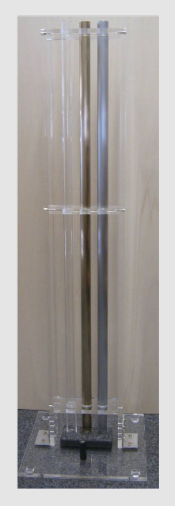 Magnet falls in three tubes
Topic: Electromagnetic Induction, Circuits Metodi: Faraday’s Law of Induction, Experimental Data Analysis, Physical Modeling Competenze: Experimental Data Analysis, Estimation & Approximation Objects: Magnet, Tube Fonte: Testo (PDF) — p.30
Problema 22 Magnete cadente
Un magnete cilindrico viene scaricato attraverso tre diversi tubi montati verticalmente. I tubi hanno dimensioni identiche ma sono fatti di materiali diversi. Uno di plexiglas, uno di rame e uno di alluminio.
Per una distanza di caduta di nei tubi, sono misurati i seguenti tempi di caduta del magnete:
♬ Materiale ♬ Tempo di caso ♬ |---|---| | Plexiglas | | | Brass | | | Aluminium | |
La conductività elettrica dell’alluminio è .
What value for the electrical conductivity is obtained as an estimate from the fall times?
- A.
- B.
- C.
- D.
Magnet falls in three tubes
Topic: Electromagnetic Induction, Circuits Metodi: Faraday’s Law of Induction, Experimental Data Analysis, Physical Modeling Competenze: Experimental Data Analysis, Estimation & Approximation Objects: Magnet, Tube Fonte: Testo (PDF) — p.30
Problem 22 – Falling Magnet
A cylindrical magnet is dropped through three different vertically mounted tubes. The tubes have identical dimensions but are made of different materials one of plexiglass, one of brass and one of aluminium.
For a fall distance of in the tubes, the following fall times of the magnet are measured:
♪ The material is fall time ♪ |---|---| | Plexiglas | | | Brass | | | Aluminium | |
The electrical conductivity of aluminium is .
What value for the electrical conductivity is obtained as an estimate from the fall times?
- A.
- B.
- C.
- D.
Magnet falls in three tubes
Topic: Electromagnetic Induction, Circuits Metodi: Faraday’s Law of Induction, Experimental Data Analysis, Physical Modeling Competenze: Experimental Data Analysis, Estimation & Approximation Objects: Magnet, Tube Fonte: Testo (PDF) — p.30
Problem 23 – Falling Conducting Loop in a Magnetic Field
A square conducting loop with edge length , resistance and mass falls from rest into a sharply bounded region of width containing a uniform magnetic field of flux density oriented into the plane of the page. The graphs A, B, C and D are meant to represent the time evolution of the velocity of the conducting loop for various magnetic field strengths.
Which of the graphs shows a physically possible process?
- A. Graph A
- B. Graph B
- C. Graph C
- D. Graph D
Topic: Electromagnetic Induction, Newtonian Mechanics Metodi: Faraday’s Law of Induction, Lenz’s Law, Free-Body Diagram Competenze: Physical Reasoning, Diagrammatic Reasoning Objects: Coil Fonte: Testo (PDF) — p.31
Problema 23 Falling Conducting Loop in a Magnetic Field
Un quadrato conduttore loop con lunghezza di bordo , resistenza e massa cade da rest in una regione di larghezza che contiene un campo magnetico uniforme di densità di flusso orientato verso il piano della pagina. I grafici A, B, C e D sono destinati a rappresentare la tempo di evoluzione della velocità del loop conduttore per varie forze di campo magnetico.
Quale dei grafici mostra un processo fisicamente possibile?
- A. Grafico A
- B. Grafico B
- C. Grafico C
- D. Grafico D
Topic: Electromagnetic Induction, Newtonian Mechanics Metodi: Faraday’s Law of Induction, Lenz’s Law, Free-Body Diagram Competenze: Physical Reasoning, Diagrammatic Reasoning Objects: Coil Fonte: Testo (PDF) — p.31
The problem is that the magnetic field is not a magnetic field.
A square conducting loop with edge length , resistance and mass falls from rest into a sharply bounded region of width containing a uniform magnetic field of flux density oriented into the plane of the page. The graphs A, B, C and D are meant to represent the time evolution of the velocity of the conducting loop for various magnetic field strengths.
Which of the graphs shows a physically possible process?
- A. Graph A
- B. Graph B
- C. Graph C
- D. Graph D
Topic: Electromagnetic Induction, Newtonian Mechanics Metodi: Faraday’s Law of Induction, Lenz’s Law, Free-Body Diagram Competenze: Physical Reasoning, Diagrammatic Reasoning Objects: Coil Fonte: Testo (PDF) — p.31
Problem 24 – Pentagon of Resistors
A battery with a voltage of is connected in series with an ideal ammeter. The series combination can be connected to any two corners of the resistor pentagon shown, with resistances , , , , .
What is the smallest current magnitude that flows through the ammeter in this case?
- A.
- B.
- C.
- D.
Topic: Circuits Metodi: Equivalent Circuit Reduction, Kirchhoff’s Laws Competenze: Physical Reasoning, Mathematical Modeling Objects: Battery, Resistor, Galvanometer Fonte: Testo (PDF) — p.34
Il problema 24 è il Pentagono delle Resistors
Una batteria con una voltage di è collegata in serie con un ammetro ideale. La combinazione di serie può essere collegata a due angoli del pentagono resistente mostrato, con resistenze , , , , .
Qual è la più piccola grandezza di corrente che scorre attraverso l’ammetro in questo caso?
- A.
- B.
- C.
- D.
Topic: Circuits Metodi: Equivalent Circuit Reduction, Kirchhoff’s Laws Competenze: Physical Reasoning, Mathematical Modeling Objects: Battery, Resistor, Galvanometer Fonte: Testo (PDF) — p.34
The problem is that the Pentagon of Resistors is a very important part of the security system.
A battery with a voltage of is connected in series with an ideal amp. The series combination can be connected to any two corners of the resistor pentagon shown, with resistances , , , , .
What is the smallest current magnitude that flows through the ammeter in this case?
- A.
- B.
- C.
- D.
Topic: Circuits Metodi: Equivalent Circuit Reduction, Kirchhoff’s Laws Competenze: Physical Reasoning, Mathematical Modeling Objects: Battery, Resistor, Galvanometer Fonte: Testo (PDF) — p.34
Problem 25 – Battery Operation
A single battery can light a light bulb for a time . Assume for simplicity that the bulb shines with constant brightness until the battery is depleted, and that the resistance of the bulb is constant.
Which statement is correct if two of these batteries are used to operate two of the light bulbs?
- A. If the batteries are connected in series and the bulbs are connected in series, the bulbs can be operated for about a time .
- B. If the batteries are connected in series and the bulbs are connected in parallel, the bulbs can be operated for about a time .
- C. If the batteries are connected in parallel and the bulbs are connected in series, the bulbs can be operated for about a time .
- D. If the batteries are connected in parallel and the bulbs are also connected in parallel, the bulbs can be operated for about a time .
Topic: Circuits Metodi: Kirchhoff’s Laws, Equivalent Circuit Reduction, Energy Conservation Method Competenze: Physical Reasoning, Mathematical Modeling Objects: Battery Fonte: Testo (PDF) — p.35
Problema 25 Operazione della batteria
A single battery can light a light bulb for a time . Supponiamo per semplicità che la lampadina brilla con costante luminosità fino a quando la batteria non è esaurita, e che la resistenza della lampadina è costante.
Quale dichiarazione è corretta se due di queste batterie sono usate per operare due delle lampadine?
- A. Se le batterie sono collegate in serie e le bulbe sono collegate in serie, le bulbe possono essere operate per circa un tempo .
- B. Se le batterie sono collegate in serie e le lampadine sono collegate in parallelo, le lampadine possono essere operate per circa un tempo .
- C. Se le batterie sono collegate in parallelo e le lampadine sono collegate in serie, le lampadine possono essere operate per circa un tempo .
- D. Se le batterie sono collegate in parallelo e le bulbe sono collegate in parallelo, le bulbe possono essere operate per circa un tempo .
Topic: Circuits Metodi: Kirchhoff’s Laws, Equivalent Circuit Reduction, Energy Conservation Method Competenze: Physical Reasoning, Mathematical Modeling Objects: Battery Fonte: Testo (PDF) — p.35
Problem 25 – Battery Operation
A single battery can light a light bulb for a time . Assume for simplicity that the bulb shines with constant brightness until the battery is depleted, and that the resistance of the bulb is constant.
Which statement is correct if two of these batteries are used to operate two of the light bulbs?
- A. If the batteries are connected in series and the bulbs are connected in series, the bulbs can be operated for about a time .
- B. If the batteries are connected in series and the bulbs are connected in parallel, the bulbs can be operated for about a time .
- C. If the batteries are connected in parallel and the bulbs are connected in series, the bulbs can be operated for about a time .
- D. If the batteries are connected in parallel and the bulbs are also connected in parallel, the bulbs can be operated for about a time .
Topic: Circuits Metodi: Kirchhoff’s Laws, Equivalent Circuit Reduction, Energy Conservation Method Competenze: Physical Reasoning, Mathematical Modeling Objects: Battery Fonte: Testo (PDF) — p.35
Problem 26 – Diode and Resistors
A diode is an electronic component that, in simplified terms, acts as a complete insulator in one direction (reverse direction). In the opposite direction (forward direction) the diode lets almost no current pass up to a certain voltage; above this voltage it behaves approximately like an ideal conductor.
A circuit contains a diode and two resistors with resistance values and . The graph alongside shows measured values of the current in the circuit as a function of the applied voltage .
Which resistance values best match the measured values shown?
- A. and
- B. and
- C. and
- D. and
Topic: Circuits Metodi: Kirchhoff’s Laws, Experimental Data Analysis, Equivalent Circuit Reduction Competenze: Experimental Data Analysis, Graph Linearization Objects: Resistor Fonte: Testo (PDF) — p.36
Problema 26 Diode and Resistors
Un diodo è un componente elettronico che, in termini semplificati, agisce come un isolatore completo in una direzione (direzione inversa). In direzione opposta (forward direction) il diodo lascia quasi nessun passaggio di corrente fino a una certa voltage; sopra questa voltage si comporta approximately like an ideal conductor.
Un circuito contiene un diodo e due resistori con valori di resistenza e . Il grafico lungo mostra i valori misurati del corrente nel circuito come funzione del tensione applicata .
Quali valori di resistenza corrispondono meglio ai valori misurati mostrati?
- A. and
- B. and
- C. and
- D. and
Topic: Circuits Metodi: Kirchhoff’s Laws, Experimental Data Analysis, Equivalent Circuit Reduction Competenze: Experimental Data Analysis, Graph Linearization Objects: Resistor Fonte: Testo (PDF) — p.36
The problem is that the system is not a single unit.
A diode is an electronic component that, in simplified terms, acts as a complete insulator in one direction (reverse direction). In the opposite direction (forward direction) the diode lets almost no current pass up to a certain voltage; above this voltage it behaves approximately like an ideal conductor.
A circuit contains a diode and two resistors with resistance values and . The graph alongside shows measured values of the current in the circuit as a function of the applied voltage .
Which resistance values best match the measured values shown?
- A. and
- **B ** and
- **C ** and
- **D ** and
Topic: Circuits Metodi: Kirchhoff’s Laws, Experimental Data Analysis, Equivalent Circuit Reduction Competenze: Experimental Data Analysis, Graph Linearization Objects: Resistor Fonte: Testo (PDF) — p.36
Problem 27 – Oscillating Circuits
A circuit consisting of an ideal inductor and an ideal capacitor is called an oscillating circuit (LC circuit). The two upper electrical oscillating circuits with the same inductance but different capacitances oscillate without resistance at the given frequencies:
What is the oscillation frequency (natural frequency) of the following coupled system, in which , and are connected together?
- A.
- B.
- C.
- D.
Topic: Oscillations & Waves, Circuits Metodi: Simple Harmonic Motion Analysis, Equivalent Circuit Reduction, Superposition Principle Competenze: Physical Reasoning, Mathematical Modeling Objects: Inductor, Capacitor Fonte: Testo (PDF) — p.38
Problema 27 Circuiti oscillanti
Un circuito costituito da un induttore ideale e da un capacitore ideale è chiamato circuito oscillatore (LC). I due circuiti oscillanti elettrici superiori con la stessa induttanza ma con capacità diverse oscillavano senza resistenza alle frequenze indicate:
Qual è la frequenza di oscillazione (natural frequency) del seguente sistema accoppiato, in cui , e sono collegati insieme?
- A.
- B.
- C.
- D.
Topic: Oscillations & Waves, Circuits Metodi: Simple Harmonic Motion Analysis, Equivalent Circuit Reduction, Superposition Principle Competenze: Physical Reasoning, Mathematical Modeling Objects: Inductor, Capacitor Fonte: Testo (PDF) — p.38
The following is the list of the types of electrical power generated by the electrical power generated by the electrical power generated by the electrical power generated by the electrical power generated by the electrical power generated by the electrical power generated by the electrical power generated by the electrical power generated by the electrical power generated by the electrical power generated by the electrical power generated by the electrical power generated by the electrical power generated by the electrical power generated by the electrical power generated by the electrical power generated by the electrical power generated by the electrical power generated by the electrical power generated by the electrical power generated electrical power generated by the electrical power generated electrical power generated by the electrical power generated electrical power generated electrical power generated by the electrical power generated electrical power generated electrical power generated electrical power.
A circuit consisting of an ideal inductor and an ideal capacitor is called an oscillating circuit (LC circuit). The two upper electrical oscillating circuits with the same inductance but different capacitances oscillate without resistance at the given frequencies:
What is the oscillation frequency (natural frequency) of the following coupled system, in which , and are connected together?
- A.
- B.
- C.
- D.
Topic: Oscillations & Waves, Circuits Metodi: Simple Harmonic Motion Analysis, Equivalent Circuit Reduction, Superposition Principle Competenze: Physical Reasoning, Mathematical Modeling Objects: Inductor, Capacitor Fonte: Testo (PDF) — p.38
Problem 28 – AC Circuit
A resistor with resistance value , a capacitor of capacitance and an inductor of inductance are connected to an AC voltage source. The amplitude of the AC voltage is and the components can be assumed to be ideal.
The following graph shows the amplitude of the current in the circuit as a function of the frequency of the sinusoidal AC voltage.
Which of the following circuit diagrams correctly represents the circuit used?
- A. , , in series
- B. in series with a parallel connection of and
- C. in parallel connection with and in series
- D. in series with , in parallel with
Topic: Circuits, Oscillations & Waves Metodi: Equivalent Circuit Reduction, Physical Modeling Competenze: Physical Reasoning, Graph Linearization Objects: Resistor, Capacitor, Inductor Fonte: Testo (PDF) — p.40
Problema 28 Circuito AC
Un resistore con valore di resistenza , un condensatore di capacità e un induttore di induttanza sono collegati a una fonte di voltage AC. L’ampiezza della tensione AC è e i componenti possono essere presunti come ideali.
Il grafico seguente mostra l’amplitudine del corrente nel circuito come funzione della frequenza del sinusoidale voltage AC.
Quale dei seguenti diagrammi di circuito rappresenta correttamente il circuito utilizzato?
- A. , , in serie
- B. in series with a parallel connection of and
- C. in parallel connection with and in series
- D. in serie con , in parallelo con
Topic: Circuits, Oscillations & Waves Metodi: Equivalent Circuit Reduction, Physical Modeling Competenze: Physical Reasoning, Graph Linearization Objects: Resistor, Capacitor, Inductor Fonte: Testo (PDF) — p.40
The following is the list of the types of electricity generated by the electricity generated by the electricity generated by the electricity generated by the electricity generated by the electricity generated by the electricity generated by the electricity generated by the electricity generated by the electricity generated by the electricity generated by the electricity generated by the electricity generated by the electricity generated by the electricity generated by the electricity generated by the electricity generated by the electricity generated by the electricity generated by the electricity generated by the electricity generated by the electricity generated by the electricity generated by the electricity generated electricity generated by the electricity generated electricity generated by electricity.
A resistor with resistance value , a capacitor of capacitance and an inductor of inductance are connected to an AC voltage source. The amplitude of the AC voltage is and the components can be assumed to be ideal.
The following graph shows the amplitude of the current in the circuit as a function of the frequency of the sinusoidal AC voltage.
Which of the following circuit diagrams correctly represents the circuit used?
- **A ** , , in series
- B. in series with a parallel connection of and
- C. in parallel connection with and in series
- D. in series with , in parallel with
Topic: Circuits, Oscillations & Waves Metodi: Equivalent Circuit Reduction, Physical Modeling Competenze: Physical Reasoning, Graph Linearization Objects: Resistor, Capacitor, Inductor Fonte: Testo (PDF) — p.40
Problem 29 – Hot Disc
A metal disc with a hole in its centre is heated.
What happens during heating?
- A. The hole becomes larger.
- B. The hole becomes smaller.
- C. The hole stays the same size.
- D. This question cannot be answered without further information.
Topic: Thermodynamics, Elasticity & Materials Metodi: Physical Modeling, Approximation & Series Expansion Competenze: Physical Reasoning Objects: Disk Fonte: Testo (PDF) — p.42
problema 29 Hot Disc
Un disco metallico con un buco al centro è riscaldato.
Cosa succede durante il riscaldamento?
- A. Il buco diventa più grande.
- B. Il buco diventa più piccolo.
- C. Il buco rimane la stessa dimensione.
- D. Questa domanda non può essere risolta senza ulteriori informazioni.
Topic: Thermodynamics, Elasticity & Materials Metodi: Physical Modeling, Approximation & Series Expansion Competenze: Physical Reasoning Objects: Disk Fonte: Testo (PDF) — p.42
The following is the list of the types of data that are used in the database:
A metal disc with a hole in its center is heated.
What happens during heating?
- The hole becomes larger.
- The hole becomes smaller.
- The hole stays the same size.
- D. This question cannot be answered without further information.
Topic: Thermodynamics, Elasticity & Materials Metodi: Physical Modeling, Approximation & Series Expansion Competenze: Physical Reasoning Objects: Disk Fonte: Testo (PDF) — p.42
Problem 30 – Temperature Units
The fictitious temperature unit Nups is defined by setting , , and a linear variation with temperature.
Which temperature in corresponds most closely to ?
- A.
- B.
- C.
- D.
Topic: Thermodynamics Metodi: Dimensional Analysis, Physical Modeling Competenze: Unit Conversion, Physical Reasoning Objects: — Fonte: Testo (PDF) — p.42
Problema 30 Temperature Units
Il fictitious temperature unit Nups è definito per impostazione , , and a linear variation with temperature.
Qual è la temperatura in che corrisponde più strettamente a ?
- A.
- B.
- C.
- D.
Topic: Thermodynamics Metodi: Dimensional Analysis, Physical Modeling Competenze: Unit Conversion, Physical Reasoning Objects: — Fonte: Testo (PDF) — p.42
The following is the list of the types of energy sources used in the production of energy:
The fictitious temperature unit Nups is defined by setting , , and a linear variation with temperature.
Which temperature in corresponds most closely to ?
- A.
- B.
- C.
- D.
Topic: Thermodynamics Metodi: Dimensional Analysis, Physical Modeling Competenze: Unit Conversion, Physical Reasoning Objects: — Fonte: Testo (PDF) — p.42
Problem 31 – Heat Capacity
The same amount of thermal energy is supplied to four samples of different substances. The temperature of of substance A rises by , the temperature of of substance B by , the temperature of of substance C by , and the temperature of of substance D by .
Which substance has the highest specific heat capacity?
- A. A
- B. B
- C. C
- D. D
Topic: Thermodynamics Metodi: First Law of Thermodynamics, Physical Modeling Competenze: Physical Reasoning, Mathematical Modeling Objects: — Fonte: Testo (PDF) — p.43
Problema 31 Capacità di calore
La stessa quantità di energia termica viene fornita a quattro campioni di sostanze diverse. La temperatura di di sostanza A rises by , la temperatura di di sostanza B by , la temperatura di di sostanza C by , e la temperatura di di sostanza D by .
Quale sostanza ha la più alta capacità di calore specifica?
- A. A
- B. B
- C. C
- D. D
Topic: Thermodynamics Metodi: First Law of Thermodynamics, Physical Modeling Competenze: Physical Reasoning, Mathematical Modeling Objects: — Fonte: Testo (PDF) — p.43
The problem is that the heat capacity of the system is less than the heat capacity of the system.
The same amount of thermal energy is supplied to four samples of different substances. The temperature of of substance A rises by , the temperature of of substance B by , the temperature of of substance C by , and the temperature of of substance D by .
Which substance has the highest specific heat capacity?
- A. A
- B. B
- C. C
- D. D
Topic: Thermodynamics Metodi: First Law of Thermodynamics, Physical Modeling Competenze: Physical Reasoning, Mathematical Modeling Objects: — Fonte: Testo (PDF) — p.43
Problem 32 – Kettle with Ice Cube
Water is heated in a kettle. During heating, an ice cube at temperature is dropped into the water. Figure 7 shows the temperature of the water as a function of time. The heating power of the kettle is . The specific heat capacity of water is and the specific latent heat of fusion of ice is .
What was the mass of the ice cube when it was dropped into the water?
- A.
- B.
- C.
- D.
Topic: Thermodynamics Metodi: First Law of Thermodynamics, Experimental Data Analysis, Physical Modeling Competenze: Experimental Data Analysis, Graph Linearization Objects: — Fonte: Testo (PDF) — p.44
Problema 32 Kettle with Ice Cube
L’acqua è riscaldata in una bombola. Durante il riscaldamento, un cubo di ghiaccio a temperatura viene scaricato nell’acqua. La figura 7 mostra la temperatura dell’acqua in funzione del tempo. Il potere di riscaldamento del pozzolo è . The specific heat capacity of water is and the specific latent heat of fusion of ice is .
Qual era la massa del cubo di ghiaccio quando è stato gettato in acqua?
- A.
- B.
- C.
- D.
Topic: Thermodynamics Metodi: First Law of Thermodynamics, Experimental Data Analysis, Physical Modeling Competenze: Experimental Data Analysis, Graph Linearization Objects: — Fonte: Testo (PDF) — p.44
The following is the list of the main types of ice:
Water is heated in a kettle. During heating, an ice cube at temperature is dropped into the water. Figure 7 shows the temperature of the water as a function of time. The heating power of the kettle is . The specific heat capacity of water is and the specific latent heat of fusion of ice is .
What was the mass of the ice cube when it was dropped into the water?
- A.
- B.
- C.
- D.
Topic: Thermodynamics Metodi: First Law of Thermodynamics, Experimental Data Analysis, Physical Modeling Competenze: Experimental Data Analysis, Graph Linearization Objects: — Fonte: Testo (PDF) — p.44
Problem 33 – Melting Ice
On a cold winter day, three identical, non-insulated wooden boxes stand outside the house, each filled with the same amount of ice at temperature . To melt the ice, an electric heating element is placed in each of the boxes. The heating elements are identical but are operated at different voltages.
In the first box, the heating element is operated at a voltage of . All of the ice then melts in . A voltage of is applied to the heating element of the second box, after which the ice melts completely in only . In the third box, a voltage of is used for the heating element.
Which of the following statements is then correct for the melting of the ice in the third box?
- A. Melting all of the ice in the third box takes about .
- B. Melting all of the ice in the third box takes about .
- C. Melting all of the ice in the third box takes about .
- D. With the voltage used, it is not possible to melt all of the ice.
Topic: Thermodynamics, Circuits Metodi: First Law of Thermodynamics, Physical Modeling, Experimental Data Analysis Competenze: Physical Reasoning, Mathematical Modeling Objects: Container Fonte: Testo (PDF) — p.46
Problema 33 Melting Ice
In un giorno di inverno freddo, tre scatole di legno identiche e non isolate erano fuori casa, ciascuna piena della stessa quantità di ghiaccio a temperatura . Per fondere il ghiaccio, un elemento di riscaldamento elettrico viene posto in ciascuna delle scatole. I calori sono identici ma operano a tensioni diverse.
In the first box, the heating element is operated at a voltage of . All of the ice then melts in . Un voltage di viene applicato all’elemento di riscaldamento della seconda casella, dopo il quale il ghiaccio si melta completamente in only . In the third box, a voltage of is used for the heating element.
Quale delle seguenti affermazioni è corretta per il melting of the ice in the third box?
- Melting all of the ice in the third box takes about .
- B. Melting all of the ice in the third box takes about .
- Melting all of the ice in the third box takes about .
- D. Con la voltage utilizzata, non è possibile fondere tutto l’ice.
Topic: Thermodynamics, Circuits Metodi: First Law of Thermodynamics, Physical Modeling, Experimental Data Analysis Competenze: Physical Reasoning, Mathematical Modeling Objects: Container Fonte: Testo (PDF) — p.46
The following is the list of the types of ice used:
On a cold winter day, three identical, non-insulated wooden boxes stood outside the house, each filled with the same amount of ice at temperature . To melt the ice, an electric heating element is placed in each of the boxes. The heating elements are identical but are operated at different voltages.
In the first box, the heating element is operated at a voltage of . All of the ice then melts to . A voltage of is applied to the heating element of the second box, after which the ice melts completely in only . In the third box, a voltage of is used for the heating element.
Which of the following statements is correct for the melting of the ice in the third box?
Melting all of the ice in the third box takes about . Melting all of the ice in the third box takes about . Melting all of the ice in the third box takes about . With the voltage used, it is not possible to melt all of the ice.
Topic: Thermodynamics, Circuits Metodi: First Law of Thermodynamics, Physical Modeling, Experimental Data Analysis Competenze: Physical Reasoning, Mathematical Modeling Objects: Container Fonte: Testo (PDF) — p.46
Problem 34 – Heat Conduction
The ends of three round metal rods made of identical material are each held at constant temperatures:
- Rod I: diameter , length , temperatures: and
- Rod II: diameter , length , temperatures: and
- Rod III: diameter , length , temperatures: and
How do the heat powers , , and transmitted through the rods by heat conduction compare to one another?
- A.
- B.
- C.
- D.
Topic: Thermodynamics Metodi: Physical Modeling, Dimensional Analysis Competenze: Physical Reasoning, Mathematical Modeling Objects: Rod Fonte: Testo (PDF) — p.48
Problema 34 Calore di condotta
Le estremità di tre barre di metallo rotondo fatte di materiale identico sono ciascuna tenuta a temperature costanti:
- Rod I: diametro , lunghezza , temperature: e
- Rod II: diametro , lunghezza , temperature: e
- Rod III: diametro , lunghezza , temperature: e
How do the heat powers , , and transmitted through the rods by heat conduction compare to one another?
- A.
- B.
- C.
- D.
Topic: Thermodynamics Metodi: Physical Modeling, Dimensional Analysis Competenze: Physical Reasoning, Mathematical Modeling Objects: Rod Fonte: Testo (PDF) — p.48
Problem 34 – Heat Conduction
The ends of three round metal rods made of identical material are each held at constant temperatures:
- Rod I: diameter , length , temperatures: and
- Rod II: diameter , length , temperatures: and
- Rod III: diameter , length , temperatures: and
How do the heat powers , , and transmitted through the rods by heat conduction compare to one another?
- A.
- B.
- C.
- D.
Topic: Thermodynamics Metodi: Physical Modeling, Dimensional Analysis Competenze: Physical Reasoning, Mathematical Modeling Objects: Rod Fonte: Testo (PDF) — p.48
Problem 35 – Resistor Heating
Two resistors of identical design are connected in parallel to a voltage source with a voltage of . A total current of flows. An image of the circuit is taken with an infrared camera. The camera measures the surface temperatures of the two resistors to be and . The ambient temperature is .
What are the approximate values of the two resistors?
- A. and
- B. and
- C. and
- D. and
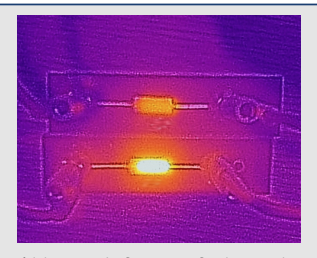 Infrared image of the resistors
Topic: Circuits, Thermodynamics Metodi: Kirchhoff’s Laws, Experimental Data Analysis, Physical Modeling Competenze: Experimental Data Analysis, Physical Reasoning Objects: Resistor Fonte: Testo (PDF) — p.49
Problema 35 Resistor Heating
Due resistori di design identico sono collegati in parallelo a una fonte di tensione con una tensione di . A total current of flows. Un’immagine del circuito è stata scattata con una fotocamera infrarossa. La macchina misura le temperature di superficie dei due resistori per essere e . La temperatura ambiente è .
Quali sono i valori approssimativi dei due resistori?
- A. and
- B. and
- C. and
- D. and
Immagine infrarossa dei resistori
Topic: Circuits, Thermodynamics Metodi: Kirchhoff’s Laws, Experimental Data Analysis, Physical Modeling Competenze: Experimental Data Analysis, Physical Reasoning Objects: Resistor Fonte: Testo (PDF) — p.49
The following is the list of the types of heating systems used:
Two resistors of identical design are connected in parallel to a voltage source with a voltage of . A total current of flows. An image of the circuit is taken with an infrared camera. The camera measures the surface temperatures of the two resistors to be and . The ambient temperature is .
What are the approximate values of the two resistors?
- A. and
- **B ** and
- **C ** and
- **D ** and
Infrared image of the resistors
Topic: Circuits, Thermodynamics Metodi: Kirchhoff’s Laws, Experimental Data Analysis, Physical Modeling Competenze: Experimental Data Analysis, Physical Reasoning Objects: Resistor Fonte: Testo (PDF) — p.49
Problem 36 – Thermal Radiation
A piece of metal at a temperature of emits thermal radiation with a power .
What is the radiated power when the temperature of the metal is raised to ?
- A. etwa
- B. etwa
- C. etwa
- D. etwa
Topic: Thermodynamics Metodi: Physical Modeling, Approximation & Series Expansion Competenze: Physical Reasoning, Mathematical Modeling Objects: — Fonte: Testo (PDF) — p.51
Problema 36 Radiamento termico
Un pezzo di metallo a una temperatura di emette radiazioni termiche con una potenza .
Qual è la potenza irradiata quando la temperatura del metallo è sollevata a ?
- A. circa
- B. circa
- C. circa
- D. circa
Topic: Thermodynamics Metodi: Physical Modeling, Approximation & Series Expansion Competenze: Physical Reasoning, Mathematical Modeling Objects: — Fonte: Testo (PDF) — p.51
The following is the list of the most commonly used methods for calculating the maximum energy consumption:
A piece of metal at a temperature of emits thermal radiation with a power .
What is the radiated power when the temperature of the metal is raised to ?
- A. or
- B. about
- C. or
- D. about
Topic: Thermodynamics Metodi: Physical Modeling, Approximation & Series Expansion Competenze: Physical Reasoning, Mathematical Modeling Objects: — Fonte: Testo (PDF) — p.51
Problem 37 – Stopping Global Warming
The mad scientist Knox has found a method to stop global warming. To do this, he wants to increase the radius of the Earth’s orbit, assumed to be circular, by .
By approximately how much could the mean temperature at the Earth’s surface, which is currently about , decrease as a result?
- A. etwa
- B. etwa
- C. etwa
- D. etwa
Topic: Thermodynamics, Astrophysics Metodi: Physical Modeling, Approximation & Series Expansion Competenze: Estimation & Approximation, Mathematical Modeling Objects: Planet, Star Fonte: Testo (PDF) — p.52
Problema 37 Stopping Global Warming
Il scienziato pazzo Knox ha trovato un metodo per fermare il riscaldamento globale. Per fare questo, vuole aumentare il raggio dell’orbita terrestre, presunto circolare, da .
By approximately how much could the mean temperature at the Earth’s surface, which is currently about , decrease as a result?
- A. circa
- B. circa
- C. circa
- D. circa
Topic: Thermodynamics, Astrophysics Metodi: Physical Modeling, Approximation & Series Expansion Competenze: Estimation & Approximation, Mathematical Modeling Objects: Planet, Star Fonte: Testo (PDF) — p.52
Problem 37 – Stopping Global Warming
The mad scientist Knox has found a method to stop global warming. To do this, he wants to increase the radius of the Earth’s orbit, assumed to be circular, by .
By approximately how much could the mean temperature at the Earth’s surface, which is currently about , decrease as a result?
- A. or
- B. about
- C. or
- D. about
Topic: Thermodynamics, Astrophysics Metodi: Physical Modeling, Approximation & Series Expansion Competenze: Estimation & Approximation, Mathematical Modeling Objects: Planet, Star Fonte: Testo (PDF) — p.52
Problem 38 – Cyclic Process
An ideal gas undergoes a cyclic process. Starting from state A, it is first heated at constant volume to a state B, then it expands without a change in temperature to a state C, and is finally compressed isobarically back to the initial state A.
Let , , and denote the pressure, volume, and temperature of the gas.
Which of the following graphs correctly represent the cyclic process?
- A. Only graphs I and II.
- B. Only graphs I and III.
- C. Only graphs II and III.
- D. All three graphs.
Topic: Thermodynamics Metodi: Thermodynamic Cycle Analysis, Ideal Gas Law Competenze: Physical Reasoning, Diagrammatic Reasoning Objects: Gas Fonte: Testo (PDF) — p.53
Problema 38 Process ciclo
Il gas ideale subisce un processo ciclico. Partendo dallo stato A, viene riscaldato a volume costante a uno stato B, poi si espandono senza un cambiamento di temperatura a uno stato C, e viene infine compresso isobaricamente indietro allo stato iniziale A.
Let , , and denotano la pressione, volume e temperatura del gas.
Quali dei seguenti grafici rappresentano correttamente il processo ciclico?
- A. Only graphs I and II.
- B. Only graphs I and III.
- C. Only graphs II and III.
- D. Tutti e tre i grafici.
Topic: Thermodynamics Metodi: Thermodynamic Cycle Analysis, Ideal Gas Law Competenze: Physical Reasoning, Diagrammatic Reasoning Objects: Gas Fonte: Testo (PDF) — p.53
The following is the list of the types of cyclic processes:
The ideal gas undergoes a cyclic process. Starting from state A, it is first heated at constant volume to a state B, then it expands without a change in temperature to a state C, and is finally compressed isobarically back to the initial state A.
Let , , and denote the pressure, volume, and temperature of the gas.
Which of the following graphs correctly represents the cyclic process?
- A. Only graphs I and II.
- B. Only graphs I and III.
- C. Only graphs II and III.
- D. All three graphs.
Topic: Thermodynamics Metodi: Thermodynamic Cycle Analysis, Ideal Gas Law Competenze: Physical Reasoning, Diagrammatic Reasoning Objects: Gas Fonte: Testo (PDF) — p.53
Problem 39 – Humid Bathroom Air
After a long shower, the temperature in the bathroom is and the relative humidity is .
The adjacent figure shows the saturation vapour pressure curve for water vapour. It gives the maximum water vapour pressure that is possible at a temperature before the water vapour in the air condenses.
How much water vapour (in ) is present in the air in the bathroom? Use the value for the molar mass of water.
- A. etwa
- B. etwa
- C. etwa
- D. etwa
Topic: Thermodynamics, Kinetic Theory Metodi: Ideal Gas Law, Physical Modeling Competenze: Physical Reasoning, Mathematical Modeling Objects: Gas Fonte: Testo (PDF) — p.54
Problema 39 Umido aria del bagno
Dopo un lungo bagno, la temperatura in bagno è e l’umidità relativa è .
La figura adiacente mostra la curva di pressione di saturazione del vapore per il vapore acqueo. It gives the maximum water vapour pressure that is possible at a temperature before the water vapour in the air condenses.
Quanto vapore d’acqua (in ) è presente nell’aria del bagno? Usare il valore per la massa molare di acqua.
- A. circa
- B. circa
- C. circa
- D. circa
Topic: Thermodynamics, Kinetic Theory Metodi: Ideal Gas Law, Physical Modeling Competenze: Physical Reasoning, Mathematical Modeling Objects: Gas Fonte: Testo (PDF) — p.54
The following is the list of the air quality requirements for the manufacturer:
After a long shower, the temperature in the bathroom is and the relative humidity is .
The adjacent figure shows the saturation vapor pressure curve for water vapor. It gives the maximum water vapour pressure that is possible at a temperature before the water vapour in the air condenses.
How much water vapour (in ) is present in the air in the bathroom? Use the value for the molar mass of water.
- A. or
- B. about
- C. about
- D. about
Topic: Thermodynamics, Kinetic Theory Metodi: Ideal Gas Law, Physical Modeling Competenze: Physical Reasoning, Mathematical Modeling Objects: Gas Fonte: Testo (PDF) — p.54
Problem 40 – Refraction of Light
A light ray strikes an arrangement of two equally sized glass cuboids set up perpendicular to each other and is refracted upon entering the first cuboid. The refractive index of the glass is . Outside the cuboids there is air.
Which of the following figure sections shows the path of the refracted light ray after it exits the second cuboid? The path of the light ray inside the cuboid is not shown, and the dashed line indicates the path of the unrefracted light ray.
Angle of incidence:
- A. Figure A
- B. Figure B
- C. Figure C
- D. Figure D
Topic: Geometric Optics Metodi: Snell’s Law, Ray Tracing Competenze: Physical Reasoning, Diagrammatic Reasoning Objects: — Fonte: Testo (PDF) — p.55
Problema 40 Refraction of Light
Un raggio di luce colpisce un’arrangamento di due cuboidi di vetro di dimensioni uguali, montati perpendicolare l’uno all’altro e si refracta all’entrata nel primo cuboide. L’indice di refraczione del vetro è . Al di fuori dei cuboids c’è aria.
Quale delle seguenti sezioni mostra il percorso del raggio di luce refratto dopo che esce dal secondo cuboide? Il percorso del raggio di luce all’interno del cuboide non è mostrato, e la linea dashed indica il percorso del raggio di luce non rifratto.
Angolo di incidenza:
- A. Figura A
- B. Figura B
- C. Figura C
- D. Figura D
Topic: Geometric Optics Metodi: Snell’s Law, Ray Tracing Competenze: Physical Reasoning, Diagrammatic Reasoning Objects: — Fonte: Testo (PDF) — p.55
Problem 40 – Refraction of Light
A light ray strikes an arrangement of two equally sized glass cuboids set up perpendicular to each other and is refracted upon entering the first cuboid. The refractive index of the glass is . Outside the cuboids there’s air.
Which of the following figure sections shows the path of the refracted light ray after it exits the second cuboid? The path of the light ray inside the cuboid is not shown, and the dashed line indicates the path of the unrefracted light ray.
Angle of incidence:
- A. Figure A
- B. Figure B
- C. Figure C
- D. Figure D
Topic: Geometric Optics Metodi: Snell’s Law, Ray Tracing Competenze: Physical Reasoning, Diagrammatic Reasoning Objects: — Fonte: Testo (PDF) — p.55
Problem 41 – Glass Cuboid
A laser beam travelling in the plane of the drawing strikes a glass cuboid (refractive index ) with side lengths and from the left at an angle of incidence . As indicated in the sketch (Figure 11), inside the glass cuboid it finally hits exactly the lower right corner.
What is the distance of the entry point from the upper boundary surface of the cuboid?
- A.
- B.
- C.
- D.
Topic: Geometric Optics Metodi: Snell’s Law, Ray Tracing Competenze: Physical Reasoning, Mathematical Modeling Objects: — Fonte: Testo (PDF) — p.57
Il problema 41 è il cuboide di vetro
Un fascio laser che viaggia nel piano del disegno colpisce un cuboide di vetro (indice refrattivo ) con lunghezze laterali e da sinistra ad un angolo di incidenza . Come indicato nello schizzo (Figura 11), all’interno del cuboide di vetro, finalmente colpisce esattamente il canto inferiore destro.
Qual è la distanza del punto di ingresso dalla superficie di confine superiore del cuboide?
- A.
- B.
- C.
- D.
Topic: Geometric Optics Metodi: Snell’s Law, Ray Tracing Competenze: Physical Reasoning, Mathematical Modeling Objects: — Fonte: Testo (PDF) — p.57
The following is the list of the types of glass cuboids used:
A laser beam travelling in the plane of the drawing strikes a glass cuboid (refractive index ) with side lengths and from the left at an angle of incidence . As indicated in the sketch (Figure 11), inside the glass cuboid it finally hits exactly the lower right corner.
What is the distance of the entry point from the upper boundary surface of the cuboid?
- A.
- B.
- C.
- D.
Topic: Geometric Optics Metodi: Snell’s Law, Ray Tracing Competenze: Physical Reasoning, Mathematical Modeling Objects: — Fonte: Testo (PDF) — p.57
Problem 42 – Converging Lens
A thin converging lens produces, from an object located at a distance from the lens, an image whose distance from the lens is also .
At what distance from the lens is the image formed when the distance between the object and the lens is doubled?
- A. etwa
- B. etwa
- C. etwa
- D. etwa
Topic: Geometric Optics Metodi: Thin Lens & Mirror Equation, Ray Tracing Competenze: Physical Reasoning, Mathematical Modeling Objects: Lens Fonte: Testo (PDF) — p.59
Problema 42 Converging Lens
Un thin converging lens produce, da un oggetto situato a una distanza dalla lente, un’immagine la cui distanza dalla lente è anche .
A che distanza dalla lente si forma l’immagine quando la distanza tra l’oggetto e la lente è raddoppiata?
- A. circa
- B. circa
- C. circa
- D. circa
Topic: Geometric Optics Metodi: Thin Lens & Mirror Equation, Ray Tracing Competenze: Physical Reasoning, Mathematical Modeling Objects: Lens Fonte: Testo (PDF) — p.59
The following is the list of the main types of convergence lenses:
A thin converging lens produces, from an object located at a distance from the lens, an image whose distance from the lens is also .
At what distance from the lens is the image formed when the distance between the object and the lens is doubled?
- A. or
- B. about
- C. about
- D. about
Topic: Geometric Optics Metodi: Thin Lens & Mirror Equation, Ray Tracing Competenze: Physical Reasoning, Mathematical Modeling Objects: Lens Fonte: Testo (PDF) — p.59
Problem 43 – Lens Collection
From the depths of the physics collection, your physics teacher has dug out a box with three thin lenses labelled I, II, and III. Lenses I and II are biconvex, whereas lens III is concave on both sides. To determine the focal lengths of the lenses, imaging experiments were carried out with an object at a distance of from a single lens or from a combination of two lenses placed close together one behind the other.
The measured image distances are:
| Experiment | Image distance |
|---|---|
| 1 (Lens I) | |
| 2 | |
| 3 | |
| 4 | |
| 5 |
Which lens(es) was/were used in each of the experiments?
- A. 2: I & III; 3: I & II; 4: II; 5: II & III
- B. 2: I & III; 3: II; 4: II & III; 5: I & II
- C. 2: II; 3: I & II; 4: I & III; 5: II & III
- D. 2: II & III; 3: II; 4: I & II; 5: I & III
Topic: Geometric Optics Metodi: Thin Lens & Mirror Equation, Experimental Data Analysis Competenze: Experimental Data Analysis, Mathematical Modeling Objects: Lens Fonte: Testo (PDF) — p.60
Problema 43 Lens Collection
Dal depths of the physics collection, il tuo insegnante di fisica ha scoperto una scatola con tre lenti sottili etichettate come I, II e III. I e II sono biconvex, mentre il III è concavo su entrambi i lati. Per determinare le lunghezze focali dei lenti, sono stati condotti esperimenti di imaging con un oggetto a una distanza di da una singola lente o da una combinazione di due lenti posizionate vicine l’una dietro l’altra.
Le distanze di immagine misurate sono:
♬ Sperimentazione ♬ Distanza immagine ♬ |---|---| | 1 (Lens I) | | | 2 | | | 3 | | | 4 | | | 5 | |
Quali obiettivi sono stati usati in ciascun esperimento?
- A. 2: I & III; 3: I & II; 4: II; 5: II & III
- B. 2: I & III; 3: II; 4: II & III; 5: I & II
- C. 2: II; 3: I & II; 4: I & III; 5: II & III
- D. 2: II & III; 3: II; 4: I & II; 5: I & III
Topic: Geometric Optics Metodi: Thin Lens & Mirror Equation, Experimental Data Analysis Competenze: Experimental Data Analysis, Mathematical Modeling Objects: Lens Fonte: Testo (PDF) — p.60
Problem 43 – Lens Collection
From the depths of the physics collection, your physics teacher has dug out a box with three thin lenses labeled I, II, and III. Lenses I and II are biconvex, whereas lens III is concave on both sides. To determine the focal lengths of the lenses, imaging experiments were carried out with an object at a distance of from a single lens or from a combination of two lenses placed close together one behind the other.
The measured image distances are:
♪ experiment with image distance ♪ |---|---| | 1 (Lens I) | | | 2 | | | 3 | | | 4 | | | 5 | |
Which lens (s) were used in each of the experiments?
- A. 2: I & III; 3: I & II; 4: II; 5: II & III
- B. 2: I & III; 3: II; 4: II & III; 5: I & II
- C. 2: II; 3: I & II; 4: I & III; 5: II & III
- D. 2: II & III; 3: II; 4: I & II; 5: I & III
Topic: Geometric Optics Metodi: Thin Lens & Mirror Equation, Experimental Data Analysis Competenze: Experimental Data Analysis, Mathematical Modeling Objects: Lens Fonte: Testo (PDF) — p.60
Problem 44 – Two Images
A photo of a drinking bottle located at a distance of about from the camera is taken with a smartphone camera. In the photo, the background about away appears blurred. If a lens is now positioned directly in front of the camera, the background appears sharp through the lens in the photo.
What is the focal length of the lens? (Positive focal lengths denote converging lenses and negative ones diverging lenses.)
- A. etwa
- B. etwa
- C. etwa
- D. etwa
 Photo without lens, bottle sharp
 Photo with lens, background sharp
Topic: Geometric Optics Metodi: Thin Lens & Mirror Equation, Physical Modeling Competenze: Physical Reasoning, Mathematical Modeling Objects: Lens Fonte: Testo (PDF) — p.62
Problem 44 – Two Images
Una foto di una bottiglia da bere situata a una distanza di circa dalla fotocamera è stata scattata con una fotocamera smartphone. In the photo, the background about away appears blurred. Se un obiettivo è ora posizionato direttamente davanti alla fotocamera, il fondo appare nitido attraverso il obiettivo nella foto.
Qual è la lunghezza focale della lente? (Lenti di convergenza e di divergenza)
- A. circa
- B. circa
- C. circa
- D. circa
Photo without lens, bottle sharp
Photo with lens, background sharp
Topic: Geometric Optics Metodi: Thin Lens & Mirror Equation, Physical Modeling Competenze: Physical Reasoning, Mathematical Modeling Objects: Lens Fonte: Testo (PDF) — p.62
Problem 44 – Two Images
A photo of a drinking bottle located at a distance of about from the camera is taken with a smartphone camera. In the photo, the background about away appears blurred. If a lens is now positioned directly in front of the camera, the background appears sharp through the lens in the photo.
What is the focal length of the lens? (Positive focal lengths denote converging lenses and negative ones diverging lenses.)
- A. or
- B. about
- C. or
- D. about
Photo without lens, bottle sharp
Photo with lens, background sharp
Topic: Geometric Optics Metodi: Thin Lens & Mirror Equation, Physical Modeling Competenze: Physical Reasoning, Mathematical Modeling Objects: Lens Fonte: Testo (PDF) — p.62
Problem 45 – Interference
In an experiment, monochromatic laser light falls perpendicularly on an optical grating with . Behind the grating, the interference pattern is observed on a screen. The distance from the screen to the grating is very large compared to the extent of the interference pattern.
The adjacent greyscale images show the interference patterns produced on the screen when using two lasers with different wavelengths. The wavelength of the first laser is .
What is the wavelength of the laser light emitted by the second laser?
- A. etwa
- B. etwa
- C. etwa
- D. etwa
 Interference pattern, 650 nm laser
 Interference pattern, second laser
Topic: Wave Optics Metodi: Interference & Diffraction Analysis, Experimental Data Analysis Competenze: Experimental Data Analysis, Physical Reasoning Objects: Diffraction Grating, Screen Fonte: Testo (PDF) — p.64
Problema 45 Interferenza
In un esperimento, la luce laser monocromatica cade perpendicularmente su una griglia ottica con . Behind the grating, il pattern di interferenza è osservato su uno schermo. La distanza dallo schermo alla griglia è molto grande rispetto all’entità del modello di interferenza.
Le immagini adiacenti a scala di grigio mostrano i pattern di interferenza prodotti sullo schermo quando si utilizzano due laser con lunghezze d’onda diverse. La lunghezza d’onda del primo laser è .
Qual è la lunghezza d’onda della luce laser emessa dal secondo laser?
- A. circa
- B. circa
- C. circa
- D. circa
Interference pattern, laser da 650 nm
Interference pattern, second laser
Topic: Wave Optics Metodi: Interference & Diffraction Analysis, Experimental Data Analysis Competenze: Experimental Data Analysis, Physical Reasoning Objects: Diffraction Grating, Screen Fonte: Testo (PDF) — p.64
The following is the list of the problems:
In an experiment, monochromatic laser light falls perpendicularly on an optical grating with . Behind the grating, the interference pattern is observed on a screen. The distance from the screen to the grating is very large compared to the extent of the interference pattern.
The adjacent greyscale images show the interference patterns produced on the screen when using two lasers with different wavelengths. The wavelength of the first laser is .
What is the wavelength of the laser light emitted by the second laser?
- A. or
- B. about
- C. about
- D. about
The following is the list of the main characteristics of the product:
The following is the list of the main types of interference patterns:
Topic: Wave Optics Metodi: Interference & Diffraction Analysis, Experimental Data Analysis Competenze: Experimental Data Analysis, Physical Reasoning Objects: Diffraction Grating, Screen Fonte: Testo (PDF) — p.64
Problem 46 – Reflection from a Water Layer
The surface of a smooth, horizontal glass plate is covered with a thin, flat layer of water. Monochromatic light of wavelength falls from above onto the water surface at an angle to the surface normal. The refractive index of the glass plate is and that of the water is .
Due to evaporation of the water, the intensity of the reflected light changes periodically. A time of elapses between the occurrence of two intensity maxima.
At what rate does the thickness of the water layer on the glass decrease?
- A. etwa
- B. etwa
- C. etwa
- D. etwa
Topic: Wave Optics, Geometric Optics Metodi: Interference & Diffraction Analysis, Snell’s Law Competenze: Physical Reasoning, Mathematical Modeling Objects: — Fonte: Testo (PDF) — p.65
Problema 46 Reflection from a Water Layer
La superficie di una piastra di vetro liscia e orizzontale è coperta da un sottile e piatto strato d’acqua. La luce monocromatica di lunghezza d’onda cade da sopra sulla superficie dell’acqua ad un angolo sulla superficie normale. L’indice di refraczione della piastra è e quello dell’acqua è .
A causa dell’evaporazione dell’acqua, l’intensità della luce riflessa cambia periodicamente. A time of elapses between the occurrence of two intensity maxima.
At what rate does the thickness of the water layer on the glass decrease?
- A. circa
- B. circa
- C. circa
- D. circa
Topic: Wave Optics, Geometric Optics Metodi: Interference & Diffraction Analysis, Snell’s Law Competenze: Physical Reasoning, Mathematical Modeling Objects: — Fonte: Testo (PDF) — p.65
Problem 46 – Reflection from a Water Layer
The surface of a smooth horizontal glass plate is covered with a thin, flat layer of water. Monochromatic light of wavelength falls from above onto the water surface at an angle to the surface normal. The refractive index of the glass plate is and that of the water is .
Due to evaporation of the water, the intensity of the reflected light changes periodically. A time of elapses between the occurrence of two intensity maxima.
At what rate does the thickness of the water layer on the glass decrease?
- A. or
- B. about
- C. about
- D. about
Topic: Wave Optics, Geometric Optics Metodi: Interference & Diffraction Analysis, Snell’s Law Competenze: Physical Reasoning, Mathematical Modeling Objects: — Fonte: Testo (PDF) — p.65
Problem 47 – Two Transmitters
Two identical electric transmitting dipole antennas, oriented perpendicular to the plane of the drawing, radiate into space from the points and in phase at the frequency . A receiver E is moved on a circle around , starting from . The distance . The intensity measured at the receiver as a function of the angle shows distinct maxima and minima.
What is the frequency of the radiation?
- A.
- B.
- C.
- D.
Topic: Wave Optics, Oscillations & Waves Metodi: Interference & Diffraction Analysis, Superposition Principle Competenze: Physical Reasoning, Experimental Data Analysis Objects: — Fonte: Testo (PDF) — p.67
Problema 47 Due trasmettitori
Due identiche antenne elettriche di trasmissione dipole, orientate perpendicolare al piano del disegno, irradiano nello spazio dai punti e in fase alla frequenza . Un ricevitore E è spostato su un cerchio intorno a , partendo da . La distanza . L’intensità misurata al ricevitore come funzione dell’angolo mostra distinti massimi e minimi.
Qual è la frequenza della radiazione?
- A.
- B.
- C.
- D.
Topic: Wave Optics, Oscillations & Waves Metodi: Interference & Diffraction Analysis, Superposition Principle Competenze: Physical Reasoning, Experimental Data Analysis Objects: — Fonte: Testo (PDF) — p.67
Problem 47 – Two Transmitters
Two identical electric transmitting dipole antennas, oriented perpendicular to the plane of the drawing, radiate into space from the points and in phase at the frequency . A receiver E is moved on a circle around , starting from . The distance . The intensity measured at the receiver as a function of the angle shows distinct maxima and minima.
What is the frequency of the radiation?
- A.
- B.
- C.
- D.
Topic: Wave Optics, Oscillations & Waves Metodi: Interference & Diffraction Analysis, Superposition Principle Competenze: Physical Reasoning, Experimental Data Analysis Objects: — Fonte: Testo (PDF) — p.67
Problem 48 – Lead Glass Window
Rooms with X-ray equipment are shielded by thick walls and windows made of lead glass. A lead glass window with a thickness of can already shield of the intensity of X-ray radiation.
How thick must the lead glass window be so that the intensity of the radiation behind the window is only of the intensity in front of the window?
- A. etwa
- B. etwa
- C. etwa
- D. etwa
Topic: Nuclear & Particle Physics, Wave Optics Metodi: Radioactive Decay Law, Physical Modeling Competenze: Physical Reasoning, Mathematical Modeling Objects: — Fonte: Testo (PDF) — p.68
Problema 48 Lead Glass Window
Le camere con apparecchiature a raggi X sono protette da pareti e finestre spesse di vetro di piombo. Un lead glass window with a thickness of può già proteggere dell’intensità delle radiazioni X.
Quanto deve essere spessa la finestra di vetro di piombo in modo che l’intensità della radiazione dietro la finestra sia solo dell’intensità di fronte alla finestra?
- A. circa
- B. circa
- C. circa
- D. circa
Topic: Nuclear & Particle Physics, Wave Optics Metodi: Radioactive Decay Law, Physical Modeling Competenze: Physical Reasoning, Mathematical Modeling Objects: — Fonte: Testo (PDF) — p.68
The following is the list of the types of products which are included in the list of products:
Rooms with X-ray equipment are shielded by thick walls and windows made of lead glass. A lead glass window with a thickness of can already shield of the intensity of X-ray radiation.
How thick must the lead glass window be so that the intensity of the radiation behind the window is only of the intensity in front of the window?
- A. or
- B. about
- C. about
- D. about
Topic: Nuclear & Particle Physics, Wave Optics Metodi: Radioactive Decay Law, Physical Modeling Competenze: Physical Reasoning, Mathematical Modeling Objects: — Fonte: Testo (PDF) — p.68
Problem 49 – Spectra
The atoms of a fictitious element occupy states at the energy levels
where is a constant. Only the lines of the series of transitions to the ground state lie in the optical range, but these lie entirely within it.
Which of the spectra shown below, scaled linearly in wavelength, correctly represents the emission lines of the described element?
- A. Spektrum A
- B. Spektrum B
- C. Spektrum C
- D. Spektrum D
Topic: Modern-Quantum Physics Metodi: Bohr Model & Quantization, Photon Energy Relation Competenze: Physical Reasoning, Mathematical Modeling Objects: Atom Fonte: Testo (PDF) — p.69
Problema 49 Spectra
Gli atomi di un elemento fittizio occupano stati a livelli energetici
dove è una costante. Only the lines of the series of transitions to the ground state lie in the optical range, but these lie entirely within it.
Quale dei spettrini mostrati di seguito, scalato linearmente in lunghezza d’onda, rappresenta correttamente le linee di emissione dell’elemento descritto?
- A. Spettro A
- B. Spettro B
- C. Spettro C
- D. Spettro D
Topic: Modern-Quantum Physics Metodi: Bohr Model & Quantization, Photon Energy Relation Competenze: Physical Reasoning, Mathematical Modeling Objects: Atom Fonte: Testo (PDF) — p.69
Problem 49 – Spectra
The atoms of a fictitious element occupy states at the energy levels
where is a constant. Only the lines of the series of transitions to the ground state lie in the optical range, but these lie entirely within it.
Which of the spectra shown below, scaled linearly in wavelength, correctly represents the emission lines of the described element?
- A. Spectrum A
- **B ** Spectrum B
- C. Spectrum C
- D. Spectrum D
Topic: Modern-Quantum Physics Metodi: Bohr Model & Quantization, Photon Energy Relation Competenze: Physical Reasoning, Mathematical Modeling Objects: Atom Fonte: Testo (PDF) — p.69
Problem 50 – Radioactive Decay
In the following, three radioactive samples are considered. Initially, at time , they consist of a single radioactive isotope, the respective parent nuclide. The initial activity of the samples is denoted by in each case. The direct decay products, the daughter nuclides, are also radioactive and decay. The parent and daughter nuclides of the three samples are:
- Sample 1: () ()
- Sample 2: () ()
- Sample 3: () ()
The graphs I, II, III represent the time evolution of the activities of both nuclides as well as the total activity for the three samples.
Which of the three nuclide pairs belongs to which diagram?
- A. 1→I, 2→II, 3→III
- B. 1→II, 2→III, 3→I
- C. 1→III, 2→II, 3→I
- D. 1→III, 2→I, 3→II
Topic: Nuclear & Particle Physics Metodi: Radioactive Decay Law, Physical Modeling Competenze: Physical Reasoning, Diagrammatic Reasoning Objects: Nucleus Fonte: Testo (PDF) — p.70
Problema 50 Decadimento radioattivo
In seguito, tre campioni radioattivi sono considerati. Inizialmente, a tempo , consistono di un singolo isotopo radioattivo, il rispettivo nucleide genitore. L’attività iniziale dei campioni è denotata da in ogni caso. I prodotti di decomposizione diretta, i daughter nuclides, sono anche radioattivi e decompongono. I nuclidi genitori e figli dei tre campioni sono:
- campione 1: () ()
- campione 2: () ()
- campione 3: () ()
I grafici I, II, III rappresentano la tempo di evoluzione delle attività di entrambi i nuclidi e l’attività totale per i tre campioni.
Quale delle tre coppie di nuclidi appartiene a quale diagramma?
- A. 1→I, 2→II, 3→III
- **B ** 1→II, 2→III, 3→I
- C. 1→III, 2→II, 3→I
- D. 1→III, 2→I, 3→II
Topic: Nuclear & Particle Physics Metodi: Radioactive Decay Law, Physical Modeling Competenze: Physical Reasoning, Diagrammatic Reasoning Objects: Nucleus Fonte: Testo (PDF) — p.70
Problem 50 – Radioactive Decay
In the following, three radioactive samples are considered. Initially, at time , they consist of a single radioactive isotope, the respective parent nuclide. The initial activity of the samples is denoted by in each case. The direct decay products, the daughter nuclides, are also radioactive and decay. The parent and daughter nuclides of the three samples are:
- Sample 1: () ()
- Sample 2: () ()
- Sample 3: () ()
The graphs I, II, III represent the time evolution of the activities of both nuclides as well as the total activity for the three samples.
Which of the three nuclide pairs belongs to which diagram?
- **A ** 1→I, 2→II, 3→III
- **B ** 1→II, 2→III, 3→I
- **C ** 1→III, 2→II, 3→I
- **D ** 1→III, 2→I, 3→II
Topic: Nuclear & Particle Physics Metodi: Radioactive Decay Law, Physical Modeling Competenze: Physical Reasoning, Diagrammatic Reasoning Objects: Nucleus Fonte: Testo (PDF) — p.70
Problem 51 – Galactic Message in a Bottle
A spaceship departs from Earth at the constant speed , where denotes the speed of light in vacuum. After on board, the space travellers throw a message in a bottle at a speed of relative to the spaceship in the direction of Earth.
How long must the inhabitants of Earth wait between the launch of the spaceship and the arrival of the message in a bottle?
- A. etwa
- B. etwa
- C. etwa
- D. etwa
Topic: Special Relativity Metodi: Lorentz Transformation, Relativistic Energy-Momentum Competenze: Physical Reasoning, Mathematical Modeling Objects: — Fonte: Testo (PDF) — p.72
Il problema 51 è il messaggio galattico in una bottiglia
Una nave spaziale parte dalla Terra alla velocità costante , dove indica la velocità della luce in vuoto. Dopo a bordo, i viaggiatori spaziali gettano un messaggio in una bottiglia a una velocità di relativa alla nave spaziale in direzione della Terra.
Quanto tempo dovranno aspettare gli abitanti della Terra tra il lancio della nave spaziale e l’arrivo del messaggio in bottiglia?
- A. circa
- B. circa
- C. circa
- D. circa
Topic: Special Relativity Metodi: Lorentz Transformation, Relativistic Energy-Momentum Competenze: Physical Reasoning, Mathematical Modeling Objects: — Fonte: Testo (PDF) — p.72
The problem is that the galactic message in a bottle is a galactic message.
A spacecraft departs from Earth at the constant speed , where denotes the speed of light in vacuum. After on board, the space travellers throw a message in a bottle at a speed of relative to the spacecraft in the direction of Earth.
How long must the inhabitants of Earth wait between the launch of the spacecraft and the arrival of the message in a bottle?
- A. or
- B. about
- C. about
- D. about
Topic: Special Relativity Metodi: Lorentz Transformation, Relativistic Energy-Momentum Competenze: Physical Reasoning, Mathematical Modeling Objects: — Fonte: Testo (PDF) — p.72
Problem 52 – Power of Wind Turbines
Wind turbines generate electrical power by using energy from the wind to drive generators. At a moderate wind speed, the power made available by the wind to a turbine, and thus the theoretically maximum usable power, is .
What power made available by the wind to the turbine results when the wind speed is doubled?
- A.
- B.
- C.
- D.
 Wind turbine
Topic: Newtonian Mechanics, Order-of-Magnitude Estimation Metodi: Dimensional Analysis, Physical Modeling, Conservation of Energy Competenze: Physical Reasoning, Estimation & Approximation Objects: — Fonte: Testo (PDF) — p.73
Problema 52 Potenza dei turbini a vento
Le turbine eoliche generano energia elettrica utilizzando energia dal vento per guidare i generatori. A moderata velocità del vento, la potenza resa disponibile dal vento a una turbina, e quindi la potenza usable teoricamente massima, è .
Che potenza è resa disponibile dal vento alla turbina quando la velocità del vento è raddoppiata?
- A.
- B.
- C.
- D.
turbina a vento
Topic: Newtonian Mechanics, Order-of-Magnitude Estimation Metodi: Dimensional Analysis, Physical Modeling, Conservation of Energy Competenze: Physical Reasoning, Estimation & Approximation Objects: — Fonte: Testo (PDF) — p.73
The Commission has also adopted a proposal for a regulation on the management of the energy sector.
Wind turbines generate electrical power by using energy from the wind to drive generators. At a moderate wind speed, the power made available by the wind to a turbine, and thus the theoretically maximum usable power, is .
What power is made available by the wind to the turbine results when the wind speed is doubled?
- A.
- B.
- C.
- D.
The following is the list of the types of wind turbines:
Topic: Newtonian Mechanics, Order-of-Magnitude Estimation Metodi: Dimensional Analysis, Physical Modeling, Conservation of Energy Competenze: Physical Reasoning, Estimation & Approximation Objects: — Fonte: Testo (PDF) — p.73
Problem 53 – Power of Gravitational Waves
The general theory of relativity predicts the existence of gravitational waves. These waves are generated by accelerated masses and propagate at the speed of light.
For two bodies of equal mass orbiting each other at a distance , the power radiated by gravitational waves can be expressed using the gravitational constant and the speed of light in vacuum .
Which of the following expressions could be a suitable expression for the power ?
- A.
- B.
- C.
- D.
Topic: Special Relativity, Gravitation Metodi: Dimensional Analysis, Physical Modeling Competenze: Physical Reasoning, Mathematical Modeling Objects: — Fonte: Testo (PDF) — p.74
Il problema 53 Potenza delle onde gravitazionali
La teoria generale della relatività predice l’esistenza di onde gravitazionali. Queste onde sono generate da masse accelerate e si propagano alla velocità della luce.
Per due corpi di massa uguale orbitando a distanza , la potenza irradiata da onde gravitazionali può essere espressa usando la costante gravitazionale e la velocità della luce in vuoto .
Quale delle seguenti espressioni potrebbe essere una espressione adatta per la potenza ?
- A.
- B.
- C.
- D.
Topic: Special Relativity, Gravitation Metodi: Dimensional Analysis, Physical Modeling Competenze: Physical Reasoning, Mathematical Modeling Objects: — Fonte: Testo (PDF) — p.74
The power of gravitational waves
The general theory of relativity predicts the existence of gravitational waves. These waves are generated by accelerated masses and propagate at the speed of light.
For two bodies of equal mass orbiting each other at a distance , the power radiated by gravitational waves can be expressed using the gravitational constant and the speed of light in vacuum .
Which of the following expressions could be a suitable expression for the power ?
- A.
- B.
- C.
- D.
Topic: Special Relativity, Gravitation Metodi: Dimensional Analysis, Physical Modeling Competenze: Physical Reasoning, Mathematical Modeling Objects: — Fonte: Testo (PDF) — p.74
Problem 54 – Tidal Heating
Although a thick layer of ice reflects a large part of the sunlight incident on Saturn’s moon Enceladus, the Cassini space probe was able to photograph water fountains several hundred kilometres high on its surface. The moon obtains the energy required for this from tidal forces.
Consider a celestial body of radius orbiting a planet of mass on an orbit with semi-major axis and eccentricity . The heating power experienced by the body can be expressed as:
What are the values of the exponents , , and ?
- A. , ,
- B. , ,
- C. , ,
- D. , ,
Topic: Gravitation, Astrophysics Metodi: Dimensional Analysis, Physical Modeling Competenze: Mathematical Modeling, Estimation & Approximation Objects: Planet, Satellite Fonte: Testo (PDF) — p.75
Problema 54 Calore di mare
Sebbene un’épace strata di ghiaccio rifletta una grande parte dell’incidente di luce solare sulla luna di Saturno Enceladus, la sonda spaziale Cassini è stata in grado di fotografare fonti d’acqua diverse centinaia di chilometri di altezza sulla sua superficie. La luna ottiene l’energia necessaria per questo dalle forze del marea.
Considerare un corpo celeste di radius orbitando un pianeta di massa in un’orbita con semi-asse maggiore e eccentricità . Il potere di riscaldamento sperimentato dal corpo può essere espresso come:
Quali sono i valori degli esponenti , e ?
- A. , ,
- B. , ,
- C. , ,
- D. , ,
Topic: Gravitation, Astrophysics Metodi: Dimensional Analysis, Physical Modeling Competenze: Mathematical Modeling, Estimation & Approximation Objects: Planet, Satellite Fonte: Testo (PDF) — p.75
The following is the list of the types of heat pumps used:
Although a thick layer of ice reflects a large part of the sunlight incident on Saturn’s moon Enceladus, the Cassini space probe was able to photograph water fountains several hundred kilometers high on its surface. The moon gets the energy required for this from tidal forces.
Consider a celestial body of radius orbiting a planet of mass on an orbit with semi-major axis and eccentricity . The heating power experienced by the body can be expressed as:
What are the values of the exponents , , and ?
- A. , ,
- B. , ,
- C. , ,
- D. , ,
Topic: Gravitation, Astrophysics Metodi: Dimensional Analysis, Physical Modeling Competenze: Mathematical Modeling, Estimation & Approximation Objects: Planet, Satellite Fonte: Testo (PDF) — p.75
Problem 55 – Two Plates in Vacuum
Two conducting, parallel plates of area are located at a distance apart in vacuum. Due to the quantum-mechanical Casimir effect, a force acts between the plates that depends on the speed of light in vacuum and on the reduced Planck constant .
Which of the following expressions could be a suitable expression for the force with which the plates are pushed together?
- A.
- B.
- C.
- D.
Topic: Modern-Quantum Physics, Electrostatics Metodi: Dimensional Analysis, Physical Modeling Competenze: Mathematical Modeling, Physical Reasoning Objects: — Fonte: Testo (PDF) — p.77
Problema 55 Due piastre in vuoto
Due conducenti, plates parallele di area sono situate a distanza separate in vuoto. A causa dell’effetto quantomeccanico di Casimir, una forza agisce tra le piastre che dipende dalla velocità di luce in vuoto e sulla costante di Planck ridotta .
Which of the following expressions could be a suitable expression for the force with which the plates are pushed together?
- A.
- B.
- C.
- D.
Topic: Modern-Quantum Physics, Electrostatics Metodi: Dimensional Analysis, Physical Modeling Competenze: Mathematical Modeling, Physical Reasoning Objects: — Fonte: Testo (PDF) — p.77
Problem 55 – Two Plates in Vacuum
Two conducting, parallel plates of area are located at a distance apart in vacuum. Due to the quantum-mechanical Casimir effect, a force acts between the plates that depends on the speed of light in vacuum and on the reduced Planck constant .
Which of the following expressions could be a suitable expression for the force with which the plates are pushed together?
- A.
- B.
- C.
- D.
Topic: Modern-Quantum Physics, Electrostatics Metodi: Dimensional Analysis, Physical Modeling Competenze: Mathematical Modeling, Physical Reasoning Objects: — Fonte: Testo (PDF) — p.77