LIQUIDO IN ROTAZIONE
IPhO 2001 — Gara Sperimentale — Sabato 30 giugno 2001
Questo esperimento consiste di tre parti principali:
- Studio del profilo della superficie del liquido in rotazione e determinazione dell’accelerazione di gravità.
- Studio del liquido rotante come sistema ottico.
- Determinazione dell’indice di rifrazione del liquido.
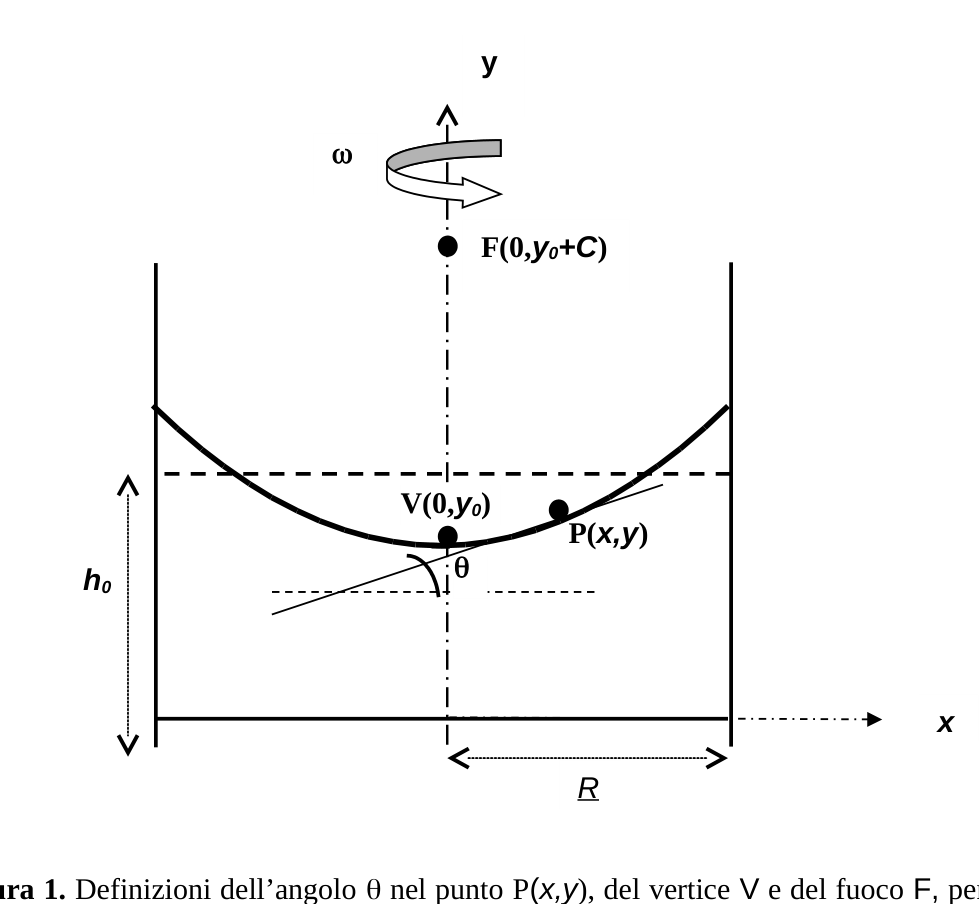
Quando un contenitore cilindrico riempito con liquido ruota intorno all’asse verticale passante per il suo centro, con velocità angolare costante , la superficie del liquido diventa parabolica. All’equilibrio, la tangente alla superficie nel punto forma un angolo con l’orizzontale, tale che
dove è il raggio del contenitore e è l’accelerazione di gravità.
Si può dimostrare che, per (dove è la velocità alla quale il centro del liquido raggiunge il fondo), per
si ha che , cioè l’altezza del liquido è la stessa come se il liquido non rotasse.
Il profilo del liquido rotante è una parabola descritta dall’equazione
dove il vertice è in e il fuoco è in . I raggi luminosi paralleli all’asse di simmetria (asse ottico) riflessi dalla superficie parabolica sono focalizzati nel punto .
Apparato e materiale a disposizione
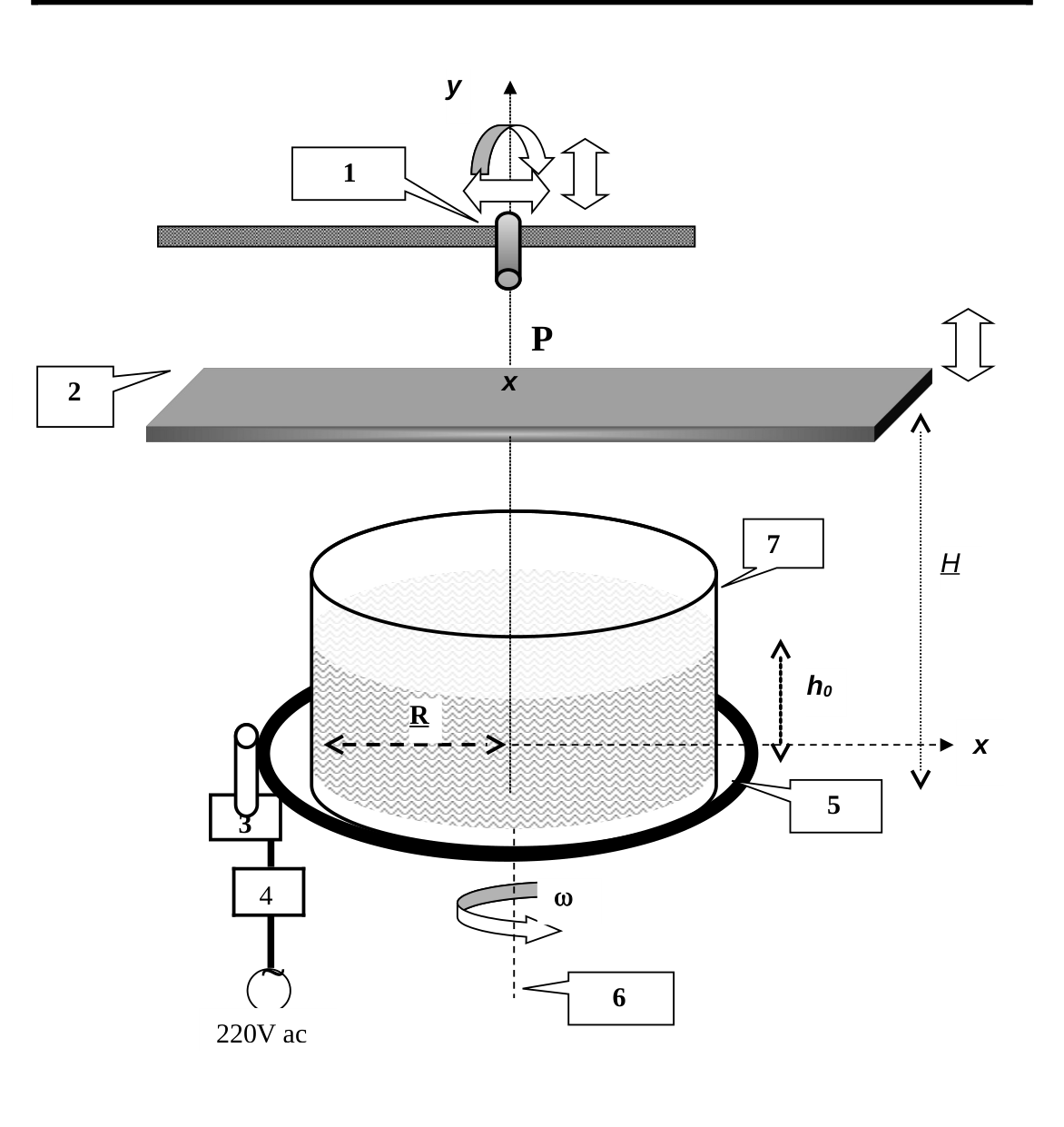
- Un contenitore cilindrico di plastica rigida contenente glicerina liquida. Scale millimetrate sono applicate sul fondo e sulle pareti del contenitore.
- Una piattaforma rotante azionata da un piccolo motore alimentato da una tensione variabile, che controlla la velocità angolare.
- Uno schermo orizzontale trasparente su cui si possono appoggiare scale millimetrate trasparenti o semitrasparenti. La posizione dello schermo può essere aggiustata sia verticalmente che orizzontalmente.
- Un laser montato su un sostegno. La posizione del laser può essere aggiustata. La testina del laser può essere cambiata.
- Testina addizionale per il laser (produce un fascio divergente di forma ben definita al posto di un raggio stretto).
- Un righello.
- Un pennarello evidenziatore.
- Un cronometro.
- Reticolo di diffrazione, con 500 o 1000 linee/mm.
- Livella a bolla d’aria.
- Occhiali protettivi.
NOTE IMPORTANTI: NON GUARDARE DIRETTAMENTE IL RAGGIO LASER. LA LUCE DEL LASER PUÒ ESSERE PERICOLOSA ANCHE QUANDO È RIFLESSA DA UNA SUPERFICIE LUCIDA. USARE GLI OCCHIALI FORNITI. Maneggiare con cura il contenitore con la glicerina. La piattaforma rotante è già disposta orizzontalmente; usare la livella a bolla soltanto per mettere in orizzontale lo schermo. Cambiare la velocità gradualmente e attendere che il liquido raggiunga l’equilibrio prima di eseguire le misure.
PARTE 1 — Determinazione di usando un liquido in rotazione [7,5 pt]
- Dimostra l’Equazione (1).
- Misura l’altezza del liquido nel contenitore e il diametro interno di quest’ultimo.
- Interponi lo schermo tra la sorgente di luce e il contenitore. Misura la distanza fra lo schermo e la piattaforma rotante.
- Allinea il laser in modo che il raggio punti verticalmente verso il basso e colpisca la superficie del liquido a una distanza dal centro del contenitore.
- Metti in rotazione lenta la piattaforma. Assicurati che il centro del liquido rotante non tocchi il fondo del contenitore.
- È noto che, alla distanza , l’altezza del liquido rimane al valore originario indipendentemente da . Facendo uso di questo fatto e misurando l’angolo della superficie per diversi valori di , esegui un esperimento per determinare l’accelerazione gravitazionale .
- Rappresenta in tabella le quantità misurate e quelle calcolate per ciascun valore di .
- Traccia il grafico necessario per calcolare .
- Calcola il valore di e il relativo errore sperimentale.
- Riporta i valori , , , , il valore sperimentale di e il suo errore sul foglio risposte.
PARTE 2 — Sistema ottico
In questa parte dell’esperimento il liquido in rotazione sarà trattato come un sistema ottico che forma un’immagine. Poiché la curvatura della superficie liquida varia con la velocità angolare, la distanza focale di questo sistema ottico dipende da .
2a) Determinazione della distanza focale [5,5 pt]
- Allinea il laser in modo che il raggio sia diretto verticalmente verso il basso nel centro del contenitore. Contrassegna il punto in cui il raggio colpisce lo schermo: la retta che passa per questo punto e per il centro del contenitore è l’asse ottico di questo sistema.
- Poiché la superficie del liquido si comporta come uno specchio parabolico, ogni raggio incidente parallelo all’asse ottico passerà, dopo la riflessione, attraverso il fuoco sull’asse ottico.
- Regola la velocità di rotazione in modo che il fuoco si trovi sullo schermo. Misura la velocità angolare e la distanza tra lo schermo e il piatto rotante.
- Ripeti i passi precedenti per valori differenti di .
- Riporta i valori misurati per e e il valore di per ciascun valore di sul foglio risposte.
- Con l’aiuto di un grafico appropriato, trova la relazione fra la lunghezza focale e la velocità angolare . Riporta i tuoi dati sul foglio risposte.
2b) Analisi dell’immagine [3,5 pt]
In questa parte vengono analizzate le proprietà dell‘“immagine” (ciò che si può osservare sullo schermo) prodotta da questo sistema ottico.
- Rimuovi la testina del laser ruotandola in senso antiorario.
- Monta la nuova testina girandola in senso orario: il laser produce ora un fascio divergente di forma ben definita al posto di un raggio stretto.
- Regola la posizione del laser in modo che il fascio, quasi verticale, sia diretto verso il centro del fondo del recipiente.
- Sullo schermo orizzontale, disposto subito sopra al contenitore, poni un foglio di carta semitrasparente in modo che il fascio di luce diretto non colpisca la carta, ma che la carta sia colpita dal fascio riflesso.
- Osserva le dimensioni e l’orientamento dell’immagine prodotta sia dal fascio uscente dal laser che da quello riflesso dal liquido quando non ruota.
- Metti in rotazione il liquido e aumenta gradualmente fino al massimo ottenibile, osservando lo schermo. Al crescere di si osservano intervalli di frequenza diversi in cui le proprietà dell’immagine sono nettamente diverse. Per descrivere le osservazioni completa la tabella nel foglio risposte aggiungendo una riga per ogni intervallo, usando le seguenti notazioni:
- Orientazione (rispetto alla figura del fascio incidente): Invertita = INV, Diritta = ER
- Variazione delle dimensioni all’aumentare di : Aumento = I, Diminuzione = D, Nessun Cambiamento = NC
- Indica se lo schermo si trova sopra o sotto il fuoco.
PARTE 3 — Indice di rifrazione [3,5 pt]
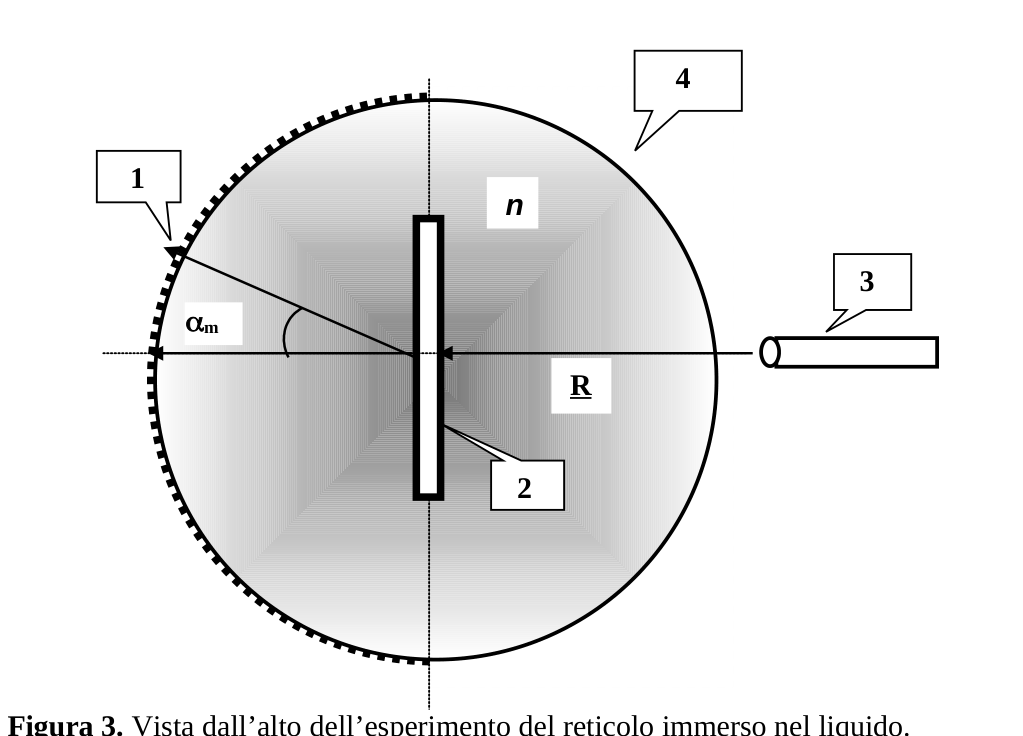
In questa parte verrà determinato l’indice di rifrazione del liquido usando un reticolo di diffrazione. Quando una radiazione di lunghezza d’onda incide perpendicolarmente su un reticolo, i massimi della figura di diffrazione vengono osservati ad angoli dati dalla relazione
dove è l’ordine di diffrazione e è la distanza tra le fenditure del reticolo.
- Usa il reticolo per determinare la lunghezza d’onda del laser. Riporta il risultato sul foglio risposte.
- Immergi il reticolo, disponendolo verticalmente, al centro del contenitore.
- Allinea il raggio laser in modo che entri nel liquido attraverso una parete del contenitore e colpisca perpendicolarmente il reticolo.
- Osserva la figura di diffrazione prodotta su una scala millimetrata applicata sulla parete opposta del contenitore.
- Esegui ogni misura di lunghezza necessaria.
- Calcola l’indice di rifrazione del liquido usando le tue misure. (Ignora l’effetto del recipiente sul cammino della luce.)
- Riporta il risultato del tuo esperimento sul foglio risposte.
p.7 — Profilo parabolico del liquido rotante
p.8 — Dispositivo sperimentale laser schermo contenitore rotante
p.9 — Vista dall’alto reticolo immerso nel liquido
Topic: Fluid Mechanics, Geometric Optics, Newtonian Mechanics Metodi: Hydrostatic Equilibrium, Ray Tracing, Graph Linearization, Experimental Data Analysis, Error Propagation Competenze: Experimental Data Analysis, Graph Linearization, Error Propagation Objects: Container, Cylinder, Screen, Diffraction Grating, Mirror Fonte: Testo (PDF) — p.1
LIQUIDO IN ROTAZIONE
IPhO 2001 — Gara Sperimentale — Sabato 30 giugno 2001
This experiment consists of three main parts:
- Study of the surface profile of the rotating liquid and determination of gravitational acceleration.
- Study of the rotating fluid as an optical system.
- Determination of the refractive index of the liquid.
When a cylindrical container filled with liquid rotates around the vertical axis passing through its center, with a constant angular velocity , the surface of the liquid becomes parabolic. At equilibrium, the tangent to the surface at the point forms an angle with the horizontal, such that
where is the container radius and is the acceleration of gravity.
It can be shown that, for (where is the speed at which the center of the liquid reaches the bottom), for
si ha che , cioè l’altezza del liquido è la stessa come se il liquido non rotasse.
The profile of the rotating liquid is a parabola described by the equation
where the summit is in and the fire is in . The parallel light rays to the symmetry axis (optical axis) reflected from the parabolic surface shall be focused at .
Appliance and material available
- A cylindrical rigid plastic container containing liquid glycerin. Millimeter scales shall be applied to the bottom and to the walls of the container.
- A rotating platform powered by a small engine powered by a variable voltage, which controls the angular velocity.
- A transparent horizontal screen on which transparent or semi-transparent millimeter stairs can be supported. The position of the screen can be adjusted either vertically or horizontally.
- A laser mounted on a support. The position of the laser can be adjusted. The laser head can be changed.
- Additional laser test (produces a divergent beam of a well defined shape instead of a narrow beam).
- A reel.
- A highlighted pin.
- A timepiece.
- Diffraction lattice, with 500 or 1000 lines/mm.
- It’s a level of air bubble.
- Protective glasses.
**ICHTE NOTES: ** Do not look directly at the laser beam. The laser light can be dangerous even when reflected from a bright surface. Use the provided glasses. Carefully handle the container with the glycerin. The rotating platform is already horizontal; use the bubble level only to horizontally position the screen. Change the speed gradually and wait for the liquid to reach equilibrium before performing the measurements.
Part 1 Determination of using a rotating liquid [7,5 pt]
- Show the equation (1).
- Measure the height of the liquid in the container and the internal diameter of the container.
- Put the screen between the light source and the container. Measure the distance between the screen and the rotating platform.
- Align the laser so that the beam points vertically downwards and hits the surface of the liquid at a distance from the center of the container.
- Slowly rotate the platform. Make sure the center of the rotating liquid does not touch the bottom of the container.
- It is known that at the distance the height of the liquid remains at the original value regardless of . Using this fact and measuring the angle of the surface for different values of , run an experiment to determine gravitational acceleration .
- It represents in the table the measured quantities and the calculated quantities for each value.
- Draw the graph needed to calculate .
- Calculate the value of and the corresponding experimental error.
- Riporta i valori , , , , il valore sperimentale di e il suo errore sul foglio risposte.
Part 2 Optical system
In this part of the experiment, the rotating fluid will be treated like an optical system that forms an image. Since the curvature of the liquid surface varies with angular velocity, the focal length of this optical system depends on .
Determination of the focal length
- Align the laser so that the beam is directed vertically downwards in the center of the container. It counters the point where the beam hits the screen: the straight line passing through this point and through the center of the container is the optical axis of this system.
- Since the surface of the liquid behaves like a parabolic mirror, any incident ray parallel to the optical axis will pass, after reflection, through the focus on the optical axis.
- Adjust the rotation speed so that the fire is on the screen. Measure the angular speed and the distance between the screen and the rotating plate.
- Repeat the previous steps for different values of .
- Returns the measured values for and and the value of for each value on the reply sheet.
- Using an appropriate graph, find the relationship between focal length and angular velocity . Put your data back on the answer sheet.
2b) Image analysis
In this section, the properties of the “image” (which can be seen on the screen) produced by this optical system are analyzed.
- Remove the laser head by rotating it clockwise.
- He mounted the new head and turned it clockwise: the laser now produced a divergent beam of well-defined shape instead of a narrow beam.
- Adjusts the position of the laser so that the beam, almost vertical, is directed towards the center of the bottom of the container.
- On the horizontal screen, placed directly above the container, place a semi-transparent sheet of paper so that the beam of direct light does not hit the paper, but that the paper is hit by the reflected beam.
- Observe the size and orientation of the image produced by both the laser beam and the beam reflected by the fluid when it does not rotate.
- Rotate the liquid and gradually increase to the maximum possible, looking at the screen. The growth observes different frequency ranges where the image properties are distinctly different. To describe the observations, complete the table in the answer sheet by adding a row for each interval, using the following notations:
- ** Orientation ** (in relation to the figure of the incident beam): Inverted = INV, Direct = ER
- Variation of size to increase of : Increase = I, Decrease = D, No Change = NC
- Indicates if the screen is above or below the fire.
The rate of refraction of the sample is calculated as follows:
In this part the refractive index of the liquid will be determined using a diffractive mesh. When a wavelength radiation is perpendicular to a lattice, the maximum diffraction figures are observed at angles given by the report
where is the order of diffraction and is the distance between the cracks of the reticulum.
- Use the lattice to determine the laser wavelength. Report the result on the reply sheet.
- Soak the mesh, positioning it vertically, in the centre of the container.
- It aligns the laser beam so that it enters the liquid through a wall of the container and hits the mesh perpendicularly.
- Observe the diffraction figure produced on a millimeter scale applied to the opposite wall of the container.
- Perform any length measurement required.
- Calcola l’indice di rifrazione del liquido usando le tue misure. (Ignorates the effect of the container on the path of light.)
- Report the result of your experiment on the answer sheet.
p.7 — Profilo parabolico del liquido rotante
p.8 — Dispositivo sperimentale laser schermo contenitore rotante
p.9 View from the top of the mesh submerged in the liquid
Topic: Fluid Mechanics, Geometric Optics, Newtonian Mechanics Metodi: Hydrostatic Equilibrium, Ray Tracing, Graph Linearization, Experimental Data Analysis, Error Propagation Competenze: Experimental Data Analysis, Graph Linearization, Error Propagation Objects: Container, Cylinder, Screen, Diffraction Grating, Mirror Fonte: Testo (PDF) — p.1