KLYSTRON
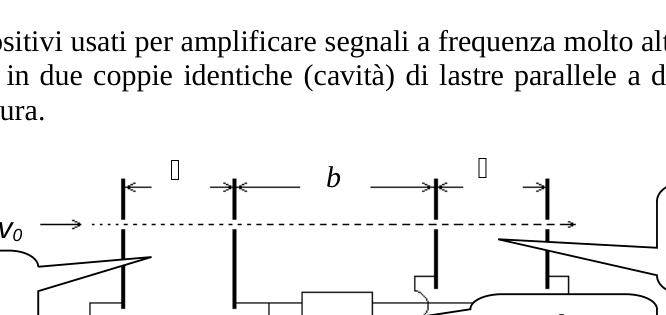
I klystron sono dispositivi usati per amplificare segnali a frequenza molto alta. Essenzialmente un klystron consiste in due coppie identiche (cavità) di lastre parallele a distanza fra loro, come mostrato in figura.
Un fascio di elettroni con velocità iniziale attraversa l’intero sistema passando attraverso piccoli fori nelle lastre.
La tensione ad alta frequenza da amplificare è applicata ad entrambe le coppie di lastre con una certa differenza di fase tra loro (il periodo corrisponde alla fase ). Essa produce campi elettrici alternati orizzontali nelle cavità.
Gli elettroni che entrano nella cavità di ingresso quando in essa il campo è diretto verso destra sono frenati, contrariamente a quando il campo è diretto verso sinistra. Di conseguenza gli elettroni uscenti si raggruppano ad una certa distanza.
Se la cavità di uscita è disposta in corrispondenza della posizione in cui avviene il raggruppamento, il campo elettrico in questa cavità potrà assorbire potenza dal fascio se la sua fase è scelta in maniera adeguata.
Il segnale è costituito da una tensione ad onda quadra con periodo , che oscilla tra i valori estremi . La velocità iniziale degli elettroni è e il rapporto carica/massa è . La distanza è così piccola che il tempo di transito nelle cavità può essere trascurato.
Calcola, con quattro cifre significative:
a) la distanza alla quale gli elettroni si raggruppano.
b) la differenza di fase necessaria, prodotta dal regolatore di fase.
p.2 — Schema klystron con cavità e fascio elettroni
Topic: Newtonian Mechanics, Electrostatics Metodi: Kinematic Equations, Free-Body Diagram, Physical Modeling Competenze: Mathematical Modeling, Physical Reasoning, Significant Figures Objects: Particle Beam, Electron, Capacitor Fonte: Testo (PDF) — p.2
The following table shows the results of the tests:
Klystrons are devices used to amplify very high frequency signals. Essentially a klystron consists of two identical pairs (cavities) of parallel plates at a distance from each other, as shown in Figure 1.
An electron beam with initial speed passes through the entire system through small holes in the plates.
The high frequency voltage to be amplified shall be applied to both pairs of plates with a phase difference between them (the period corresponds to the phase). It produces horizontal alternating electric fields in the cavities.
Electrons entering the entrance cavity when the field is directed to the right are brake, as opposed to when the field is directed to the left. As a result, the outgoing electrons cluster at a certain distance.
If the output cavity is arranged in the position where the grouping takes place, the electric field in this cavity can absorb power from the beam if its phase is chosen appropriately.
The signal consists of a square wave voltage with period , which oscillates between the extreme values . The initial velocity of the electrons is and the charge-to-mass ratio is . The distance is so small that the transit time in the cavities can be neglected.
Calculate, with four significant digits:
(a) the distance at which the electrons cluster.
(b) the necessary phase difference produced by the phase regulator.
**p.2 ** Characteristic of klystron with cavity and electron beam
Topic: Newtonian Mechanics, Electrostatics Metodi: Kinematic Equations, Free-Body Diagram, Physical Modeling Competenze: Mathematical Modeling, Physical Reasoning, Significant Figures Objects: Particle Beam, Electron, Capacitor Fonte: Testo (PDF) — p.2
DISTANZA INTERMOLECOLARE
Le quantità e rappresentano le distanze medie fra le molecole di acqua, rispettivamente in fase liquida e in fase di vapore. Entrambe queste fasi sono alla temperatura di e alla pressione atmosferica; il vapore può essere trattato come un gas perfetto.
Usando i dati seguenti calcola il rapporto e riporta i tuoi risultati nel foglio risposte. [2.5 pts]
- Densità dell’acqua in fase liquida:
- Massa molare dell’acqua:
- Pressione atmosferica:
- Costante dei gas:
- Numero di Avogadro:
Topic: Kinetic Theory, Thermodynamics Metodi: Ideal Gas Law, Physical Modeling, Order-of-Magnitude Estimation Competenze: Mathematical Modeling, Physical Reasoning, Estimation & Approximation Objects: Gas Fonte: Testo (PDF) — p.3
The following table shows the number of units of measurement used:
The quantities and represent the mean distances between water molecules in the liquid phase and vapor phase respectively. Both of these phases are at temperature and atmospheric pressure; the steam can be treated as a perfect gas.
Using the following data, calculate the ratio and report your results to the answer sheet. The following is the list of the countries of the European Union:
- Density of water in liquid phase:
- Molar mass of water:
- Air pressure:
- Gas constant:
- Avogadro number:
Topic: Kinetic Theory, Thermodynamics Metodi: Ideal Gas Law, Physical Modeling, Order-of-Magnitude Estimation Competenze: Mathematical Modeling, Physical Reasoning, Estimation & Approximation Objects: Gas Fonte: Testo (PDF) — p.3
SEMPLICE GENERATORE DI SEGNALI A DENTE DI SEGA
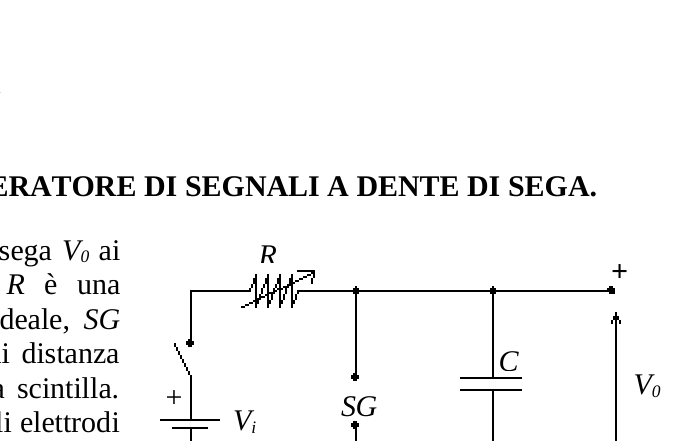
Si può ottenere una tensione a dente di sega ai capi del condensatore (Fig. 1). è una resistenza variabile, è una batteria ideale, SG (spark gap) è una coppia di elettrodi, di distanza regolabile, fra i quali può scoccare una scintilla. Quando la differenza di potenziale tra gli elettrodi raggiunge la tensione di scarica , nell’aria si produce una scarica che cortocircuita gli elettrodi. La scarica permane finché la differenza di potenziale tra gli stessi elettrodi non diventa molto piccola.
a) Disegna la forma d’onda di come funzione del tempo , dopo la chiusura dell’interruttore. [0.5 pts]
b) Quale condizione deve essere soddisfatta per ottenere un’onda a dente di sega che cresce in maniera praticamente lineare? Riporta il tuo risultato nel foglio risposte. [0.2 pts]
c) Deriva un’espressione semplificata per il periodo della forma d’onda, valida quando questa condizione è soddisfatta. Riporta il tuo risultato nel foglio risposte. [0.4 pts]
d) Cosa dovresti variare ( e/o SG) per cambiare soltanto il periodo? Riporta il tuo risultato nel foglio risposte. [0.2 pts]
e) Cosa dovresti variare ( e/o SG) per cambiare soltanto l’ampiezza? Riporta il tuo risultato nel foglio risposte. [0.2 pts]
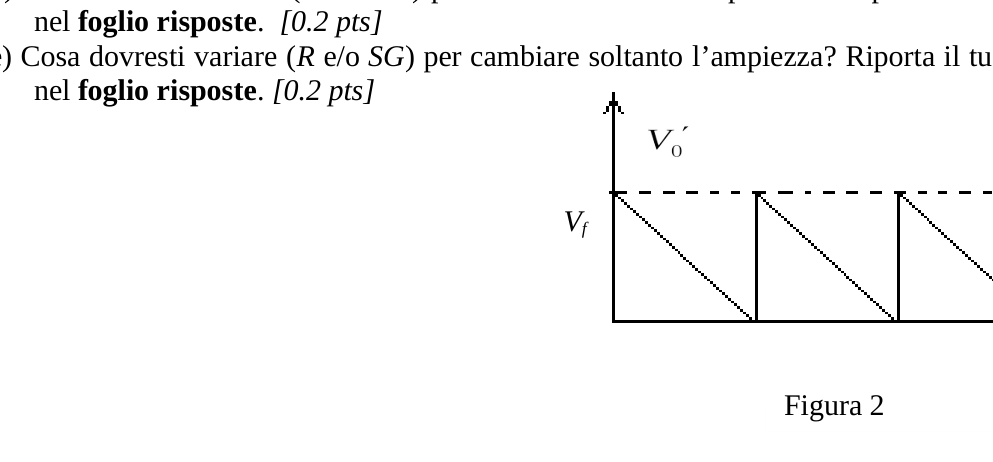
f) Ti viene fornita una ulteriore sorgente, variabile, di tensione continua. Progetta e disegna un nuovo circuito indicando i terminali dove ottenere una tensione che abbia la forma d’onda indicata in Fig. 2 (dente di sega con offset di tensione variabile). [1.0 pts]
p.3 — Circuito generatore dente di sega (Fig. 1)
p.3 — Forma d’onda dente di sega (Fig. 2)
Topic: Circuits, Oscillations & Waves Metodi: Kirchhoff’s Laws, Differential Equations, Approximation & Series Expansion Competenze: Mathematical Modeling, Physical Reasoning, Diagrammatic Reasoning Objects: Capacitor, Resistor, Battery, Switch Fonte: Testo (PDF) — p.3
The following information is provided for in the Annex to this Regulation:
A saw-tooth voltage can be obtained at the capacitor heads (Fig. 1). is a variable resistance, is an ideal battery, SG (spark gap) is a pair of electrodes, adjustable distance, between which a spark can be triggered. When the potential difference between the electrodes reaches the discharge voltage , a discharge in the air is produced that shortens the electrodes. The discharge remains until the potential difference between the same electrodes becomes very small.
(a) Draw the waveform of as a function of the time after the switch is closed. The following information shall be provided:
(b) What condition must be met to obtain a wave of sawdust that grows in a practically linear manner? Report your results in the answer sheet. The following information is provided:
(c) Derives a simplified expression for the period of the waveform, valid when this condition is met. Report your results in the answer sheet. The following is the list of the countries of the European Union:
d) What should you change ( and/or SG) to change only the period? Report your results in the answer sheet. The following information is provided:
What should you vary ( and/or SG) to change only the width? Report your results in the answer sheet. The following information is provided:
(f) You are provided with an additional, variable, continuous voltage source. Design and draw a new circuit indicating the terminals where to obtain a voltage that has the waveform indicated in Fig. 2 (sawing teeth with variable voltage offset). The following is the list of the countries of the European Union:
The following table shows the results of the calculations: 1)
The following table shows the results of the calculation of the weighted average weight of the samples: 2)
Topic: Circuits, Oscillations & Waves Metodi: Kirchhoff’s Laws, Differential Equations, Approximation & Series Expansion Competenze: Mathematical Modeling, Physical Reasoning, Diagrammatic Reasoning Objects: Capacitor, Resistor, Battery, Switch Fonte: Testo (PDF) — p.3
FASCIO DI ATOMI
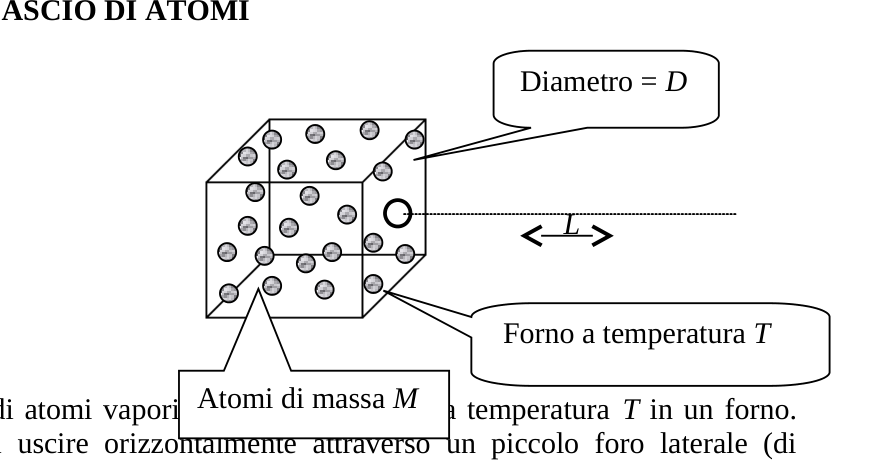
Viene preparato un fascio di atomi vaporizzando un campione a temperatura in un forno. Gli atomi vengono lasciati uscire orizzontalmente attraverso un piccolo foro laterale (di dimensioni atomiche) di diametro .
Stima il diametro del fascio dopo che ha percorso orizzontalmente una lunghezza . La massa di un atomo è . [2.5 pts]
p.4 — Forno con foro e fascio di atomi
Topic: Kinetic Theory, Newtonian Mechanics Metodi: Kinetic Theory of Gases, Order-of-Magnitude Estimation, Physical Modeling Competenze: Estimation & Approximation, Mathematical Modeling, Physical Reasoning Objects: Particle Beam, Atom Fonte: Testo (PDF) — p.4
The following table shows the number of atoms in the sample:
A beam of atoms is prepared by vaporizing a sample at temperature in an oven. The atoms are allowed out horizontally through a small lateral hole (atomic size) of diameter.
Estimate the beam diameter after it has traveled horizontally a length . The mass of an atom is . The following is the list of the countries of the European Union:
**p.4 ** Furnace with hole and atomic beam
Topic: Kinetic Theory, Newtonian Mechanics Metodi: Kinetic Theory of Gases, Order-of-Magnitude Estimation, Physical Modeling Competenze: Estimation & Approximation, Mathematical Modeling, Physical Reasoning Objects: Particle Beam, Atom Fonte: Testo (PDF) — p.4