SISTEMA STELLARE BINARIO
a) È noto che molte stelle appartengono a sistemi binari. Un tipo di sistema binario consiste in una stella ordinaria di massa e raggio , e una stella di neutroni compatta e più massiva, di massa maggiore , che ruotano l’una intorno all’altra. Nel seguito ignora il movimento della Terra. L’osservazione di un tale sistema binario rivela le seguenti informazioni:
- Il massimo spostamento angolare della stella ordinaria è , mentre quello della stella di neutroni è (vedi Fig. 1).
- Il tempo impiegato per questo massimo spostamento è .
- Le caratteristiche della radiazione della stella ordinaria indicano che la sua temperatura superficiale è e che l’energia irradiata, incidente sulla superficie della Terra per unità di area e tempo, è .
- La linea del Calcio in questa radiazione ha una lunghezza d’onda che differisce di una quantità dal suo valore normale , soltanto a causa del campo gravitazionale della stella ordinaria. (Per questo calcolo puoi considerare che il fotone abbia una massa equivalente .)
Trova un’espressione per la distanza del sistema dalla Terra, in funzione soltanto delle quantità osservate e di costanti universali. Riporta il tuo risultato sul foglio risposte. [7 pts]
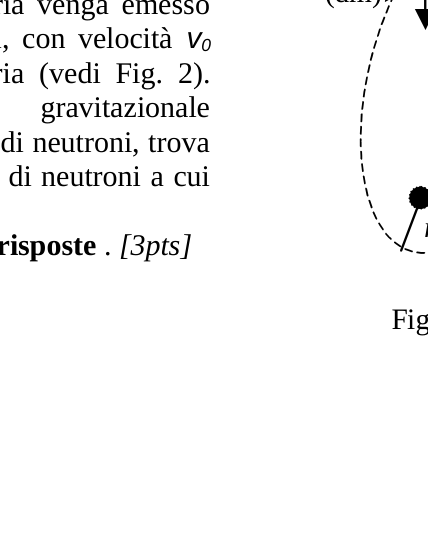
b) Assumi che . In queste ipotesi la stella ordinaria ruota essenzialmente intorno a quella di neutroni, in un’orbita circolare di raggio . Supponi che dalla stella ordinaria venga emesso del gas verso quella di neutroni, con velocità relativamente alla stella ordinaria (vedi Fig. 2).
Assumendo che il campo gravitazionale dominante sia quello della stella di neutroni, trova la distanza minima dalla stella di neutroni a cui passa il gas (vedi Fig. 2).
Riporta il tuo risultato sul foglio risposte. [3 pts]
p.1 — Sistema binario con stella di neutroni e telescopio
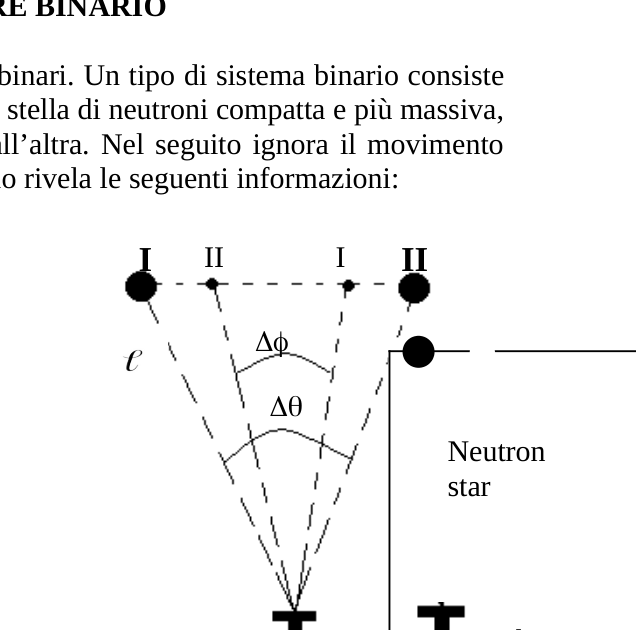
p.1 — Geometria orbitale del sistema binario
Topic: Astrophysics, Gravitation Metodi: Newton’s Law of Gravitation, Conservation Laws, Conservation of Energy, Conservation of Momentum Competenze: Physical Reasoning, Mathematical Modeling Objects: Star, Gas, Photon Fonte: Testo (PDF) — p.1
System to set up binary
It is known that many stars belong to binary systems. A type of binary system consists of an ordinary star of mass and radius , and a compact and more massive neutron star of greater mass , which rotate around each other. In the following, he ignores the motion of the Earth. The observation of such a binary system reveals the following information:
- The maximum angular displacement of the ordinary star is , while that of the neutron star is (see Fig. 1).
- The time taken for this maximum shift is .
- The radiation characteristics of the ordinary star indicate that its surface temperature is and that the irradiated energy, incident on the Earth’s surface per unit area and time, is .
- The calcium line in this radiation has a wavelength that differs by a quantity from its normal value , only because of the gravitational field of the ordinary star. (For this calculation you can consider that the photon has an equivalent mass .)
Find an expression for the distance of the system from the Earth, based only on the observed quantities and universal constants. Put your score on the answer sheet. The following information is provided for in the Annex to Implementing Regulation (EU) No 1303/2013.
**b) ** Assume that . In these cases, the ordinary star essentially orbits around the neutron star in a circular orbit of radius. Suppose that gas is emitted from the ordinary star towards the neutron star at a rate relative to the ordinary star (see Fig. 2).
Assuming that the dominant gravitational field is that of the neutron star, it finds the minimum distance from the neutron star to which the gas passes (see Fig. 2).
Put your score on the answer sheet. The following table shows the results of the calculations:
Neutron star binary system and telescope
The following is the list of the parameters of the measurement of the measurement of the measurement of the measurement of the measurement of the measurement of the measurement of the measurement of the measurement of the measurement of the measurement of the measurement of the measurement of the measurement of the measurement of the measurement of the measurement of the measurement of the measurement of the measurement of the measurement of the measurement of the measurement of the measurement of the measurement of the measurement of the measurement of the measurement of the measurement of the measurement of the measurement of the measurement of the measurement of the measurement of the measurement of the measurement of the measurement of the measurement of the measurement of the measurement of the measurement of the measurement of the measurement of the measurement of the measurement of the measurement of the measurement of the measurement of the measurement of the measurement of the measurement of the measurement of the measurement of the measurement of the measurement.
Topic: Astrophysics, Gravitation Metodi: Newton’s Law of Gravitation, Conservation Laws, Conservation of Energy, Conservation of Momentum Competenze: Physical Reasoning, Mathematical Modeling Objects: Star, Gas, Photon Fonte: Testo (PDF) — p.1