GENERATORE MAGNETOIDRODINAMICO
Una conduttura rettangolare orizzontale di plastica, di larghezza e altezza , che si chiude su sé stessa, è riempita con mercurio di resistività . Una turbina produce una sovrapressione mantenendo in moto il fluido ad una velocità . Le due pareti opposte verticali di un tratto di lunghezza della conduttura sono di rame.
Il moto del fluido è molto complesso. Per semplificare la situazione assumiamo le seguenti condizioni:
- Sebbene il fluido sia viscoso, la sua velocità è uniforme su tutta la sezione del condotto.
- La velocità del fluido è sempre proporzionale alla forza totale esterna che agisce su di esso.
- Il fluido è incomprimibile.
Le due pareti di rame sono cortocircuitate esternamente e un campo magnetico uniforme diretto verso l’alto viene applicato, solo in questa sezione, ad un certo istante.
La disposizione è illustrata nella figura precedente con i versori , , , che devono essere usati nella soluzione.
a) Trova la forza che agisce sul fluido, dovuta al campo magnetico (in funzione di , , , , e della nuova velocità ). Riporta il risultato sul foglio risposte.
b) Deriva un’espressione per la nuova velocità del fluido dopo l’applicazione del campo magnetico (in funzione di , , , , ). Riporta il risultato sul foglio risposte.
c) Deriva un’espressione per la potenza aggiuntiva che deve essere fornita dalla turbina per riportare la velocità al suo valore originale . Riporta il risultato sul foglio risposte.
d) Adesso il campo magnetico viene tolto e il mercurio sostituito con acqua che scorre a velocità . Un’onda elettromagnetica monocromatica viene inviata in direzione del flusso verso la sezione di lunghezza . L’indice di rifrazione dell’acqua è e . Trova un’espressione per il contributo del moto del fluido alla differenza di fase delle onde fra l’entrata e l’uscita della sezione . Riporta il risultato sul foglio risposte.
p.1 — Condotto rettangolare con campo B e velocità
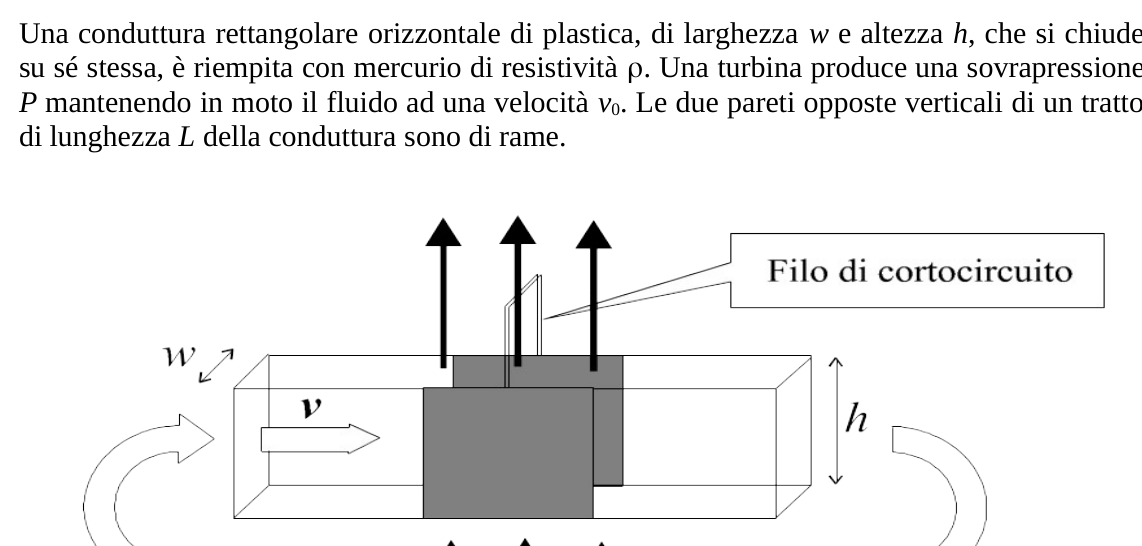
Topic: Electromagnetism, Fluid Mechanics, Wave Optics Metodi: Lorentz Force Analysis, Faraday’s Law of Induction, Energy Conservation Method, Wave Equation Competenze: Physical Reasoning, Mathematical Modeling Objects: Tube Fonte: Testo (PDF) — p.1
The manufacturer shall provide the manufacturer with the following information:
A rectangular plastic pipe, of a width and a height , which closes on itself, is filled with resistivity mercury . A turbine produces overpressure by keeping the fluid moving at a speed . The two opposite vertical walls of a length of the pipe shall be of copper.
The motion of the fluid is very complex. To simplify the situation, we assume the following conditions:
- Although the fluid is viscous, its velocity is uniform across the entire section of the pipe.
- The speed of the fluid is always proportional to the total external force acting on it.
- The fluid is incompressible.
The two copper walls are short-circuited externally and a uniform upward magnetic field is applied, only in this section, at a certain moment.
The arrangement is shown in the previous figure with the lines , , , which shall be used in the solution.
Find the force acting on the fluid due to the magnetic field (depending on the , , , , and the new speed ). Report the result on the reply sheet.
**b) ** Derives an expression for the new speed of the fluid after the application of the magnetic field (in the function of , , , , ). Report the result on the reply sheet.
**c) ** Derives an expression for the additional power to be provided by the turbine to bring the speed back to its original value . Report the result on the reply sheet.
Now the magnetic field is removed and the mercury replaced with water flowing at a speed of . A monochrome electromagnetic wave is sent in the direction of flow to the length section. The refractive index of water is and . Find an expression for the contribution of fluid motion to the wave phase difference between the input and output of the section. Report the result on the reply sheet.
p.1 Rectangular conduit with field B and speed
Topic: Electromagnetism, Fluid Mechanics, Wave Optics Metodi: Lorentz Force Analysis, Faraday’s Law of Induction, Energy Conservation Method, Wave Equation Competenze: Physical Reasoning, Mathematical Modeling Objects: Tube Fonte: Testo (PDF) — p.1