Conduzione a “Ping-Pong”
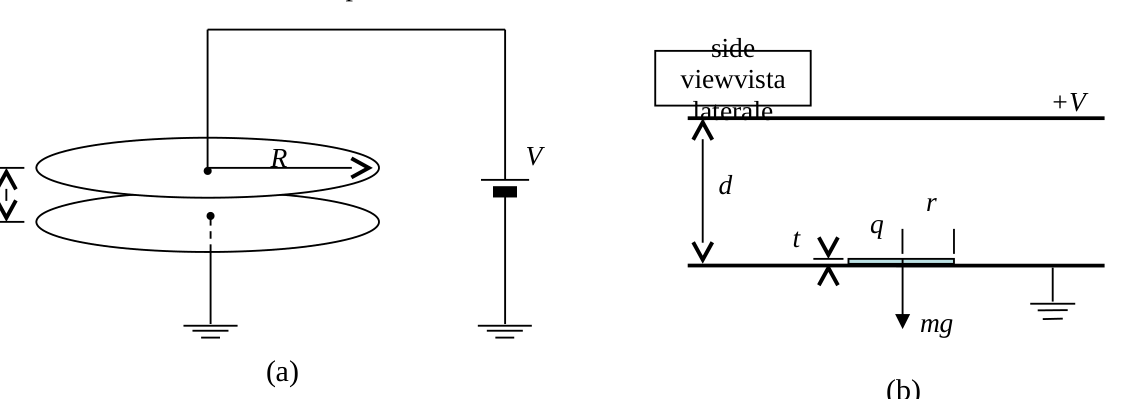
Theoretical Question 1 Page 1/2 Problema teorico n. 1 Conduzione a “Ping-Pong” Un condensatore piano ha armature circolari, di raggio R e separate da una distanza d, con , come mostrato in Fig. 1.1(a). La piastra superiore è mantenuta ad un potenziale elettrico V, costante, mentre la piastra inferiore è messa a terra. Successivamente un disco sottile e piccolo, di massa , raggio r ( ) e spessore ( ), è appoggiato al centro della piastra inferiore, come mostrato in Fig. 1.1(b). Tra le piastre viene fatto il vuoto, che ha una costante dielettrica ; sia le piastre sia il disco sono dei conduttori perfetti; tutti gli effetti ai bordi di natura elettrostatica possono essere trascurati. L’induttanza dell’intero circuito e gli effetti relativistici possono essere sicuramente ignorati. Anche gli effetti di distorsione sul campo elettrico prodotti dalla carica sul disco possono essere trascurati. Figura 1.1 Disegni schematici (a) del condensatore a facce piane e parallele collegato ad una sorgente di potenziale elettrico costante e (b) una vista laterale delle piastre parallele con un piccolo disco inserito nel condensatore. (Leggi il testo per i dettagli.) (a) [1.2 punti] Prima di aver inserito il disco all’interno del condensatore, calcolare la forza elettrostatica tra le piastre, che distano tra loro , come mostrato in Fig. 1.1(a) . (b) [0.8 punti] Dopo che il disco è stato appoggiato sopra la piastra inferiore, la carica elettrica che va sul disco di Fig. 1.1(b) dipende dal potenziale elettrico secondo la relazione . Esprimere in funzione di , ed . (c) [0.5 punti] Le piastre parallele del condensatore giacciono perpendicolarmente ad un (a) d V R mg t r d q +V side viewvista laterale (b)
Theoretical Question 1 Page 2/2 campo gravitazionale uniforme di intensità . Per sollevare il disco, inizialmente fermo, è necessario aumentare il potenziale elettrico applicato alla piastra superiore oltre un valore di soglia . Ricavare in funzione di , , e . (d) [2.3 punti] Nel caso in cui , il disco esegue un movimento su-e-giù tra le due piastre. (Assumere che il disco si muova solamente in verticale senza alcun dondolamento laterale.) Gli urti tra il disco e le piastre sono anelastici e sono caratterizzati da un coefficiente di restituzione , dove e sono rispettivamente le velocità del disco subito prima e subito dopo il singolo urto. Le piastre sono stabilmente fissate nelle loro posizioni. La velocità del disco subito dopo l’urto con la piastra inferiore raggiunge un valore caratteristico di uno “stato stazionario” e che dipende da come segue: . (1.1) Esprimere i coefficienti e in funzione di , , , ed . Assumere che l’intera superficie del disco tocchi la piastra uniformemente e simultaneamente così che in ogni collisione il completo scambio di carica avvenga istantaneamente. (e) [2.2 punti] Dopo che il sistema ha raggiunto lo stato stazionario, la corrente elettrica mediata nel tempo, I, che fluisce attraverso le piastre del condensatore può essere approssimata dalla relazione , nel caso in cui . Esprimere il coefficiente in funzione di , , ed . (f) [3 punti] Quando il potenziale elettrico applicato viene diminuito (in maniera estremamente lenta), esiste un valore critico del potenziale, , al di sotto del quale la carica elettrica cesserà di fluire attraverso le piastre. Esprimere e la corrispondente corrente elettrica in funzione di , , , ed . Attraverso una comparazione di con il valore discusso in (c) del potenziale elettrico di soglia per la salita del disco, , disegnare un grafico approssimato della funzione caratteristica , nel caso in cui è prima aumentato e successivamente diminuito nell’intervallo compreso tra e V = 3 .
p.1 — Condensatore piano con disco e vista laterale
Topic: Electrostatics, Newtonian Mechanics, Conservation of Energy Metodi: Electric Potential Method, Free-Body Diagram, Energy Conservation Method, Kinematic Equations, Impulse-Momentum Theorem Competenze: Mathematical Modeling, Physical Reasoning, Diagrammatic Reasoning Objects: Capacitor, Disk Fonte: Testo (PDF) — p.1
The following conditions shall apply:
Theoretical Question 1 Page 2 and 2 Theoretical problem n. 1 Driving at Ping-Pong A flat capacitor has circular frames, of radius R and separated by a distance d, with , as shown in Fig. 1.1(a). The upper plate is held at a The electrical potential V, constant, while the lower plate is laid down. Subsequently a thin, small, mass-producing disc , radius r ( ) and thickness ( The bottom plate is supported in the centre of the lower plate, as shown in Fig. 1.1(b). The vacuum between the plates is made, which has a constant dielectric both plates; The disc and the other two are perfect conductors; all the effects at the edges are electrostatic in nature. They can be overlooked. The whole circuit’s inductance and relativistic effects can certainly be ignored. The distortion effects on the electric field produced by the charge on the disc can also be neglected. Figure 1.1 Schematic designs (a) of the flat-faced parallel capacitor connected to a constant electric potential source and (b) a side view of the parallel plates with a small disc inserted in the condenser. (Read the text for details.) (a) [1.2 points] Before inserting the disc into the capacitor, calculate the Electrostatic force between the plates, which are spaced apart , as shown in Fig. 1.1(a) . (b) [0.8 points] After the disc has been rested above the lower plate, the charge shall be Electrical It’s on Fig’s disc. 1.1 (b) depends on the electrical potential Second The report . Expressing In accordance with , ed . (c) [0.5 points] The parallel plates of the capacitor lie perpendicular to a (a) d V R mg t r d q +V side viewview Other, of a kind used for the manufacture of goods (b)
Theoretical Question 1 The Commission shall adopt implementing acts in accordance with Article 2 (2) of this Regulation. uniform gravitational field of intensity . To lift the disc, initially If the electrical potential applied to the upper plate is still, it is necessary to increase it further. a threshold value . The following is the list of the following: In accordance with , , e . (d) [2.3 points] Where: , the disk performs an up-and-down motion between the two The plates. (Assuming that the disc moves only vertically without any lateral oscillation.) The collisions between the disc and the plates are anelastic and are characterized by a return coefficient Where e The speed of the disc immediately before and immediately after the single impact. The plates are permanently fixed in their positions. The speed of the disc immediately after impact with the the lower plate reaches a value characteristic of a stationary state and that depends on as follows: . (1.1) Express the coefficients e In accordance with , , , ed . Assuming that The entire surface of the disc touches the plate evenly and simultaneously so that In each collision, the full charge exchange occurs instantaneously. (e) [2.2 points] After the system has reached a steady state, the electric current The average time of the flow through the capacitor plates can be approximated by the ratio of the , in the event that . Express the coefficient In accordance with , , ed . (f) [3 points] When the electric potential applied The number of people who are in the The Commission has also adopted a number of measures to combat the potential of the Community industry. , below which the The electrical charge will stop flowing through the plates. Expressing and the corresponding Electric current In accordance with , , , ed . Through one Comparison of with the value discussed in (c) of the electric potential threshold for the the disc’s rise, , draw an approximate graph of the characteristic function , in the event that It has first increased and then decreased The range between e V = 3 .
**p.1 ** Flat-disc and side view capacitor
Topic: Electrostatics, Newtonian Mechanics, Conservation of Energy Metodi: Electric Potential Method, Free-Body Diagram, Energy Conservation Method, Kinematic Equations, Impulse-Momentum Theorem Competenze: Mathematical Modeling, Physical Reasoning, Diagrammatic Reasoning Objects: Capacitor, Disk Fonte: Testo (PDF) — p.1