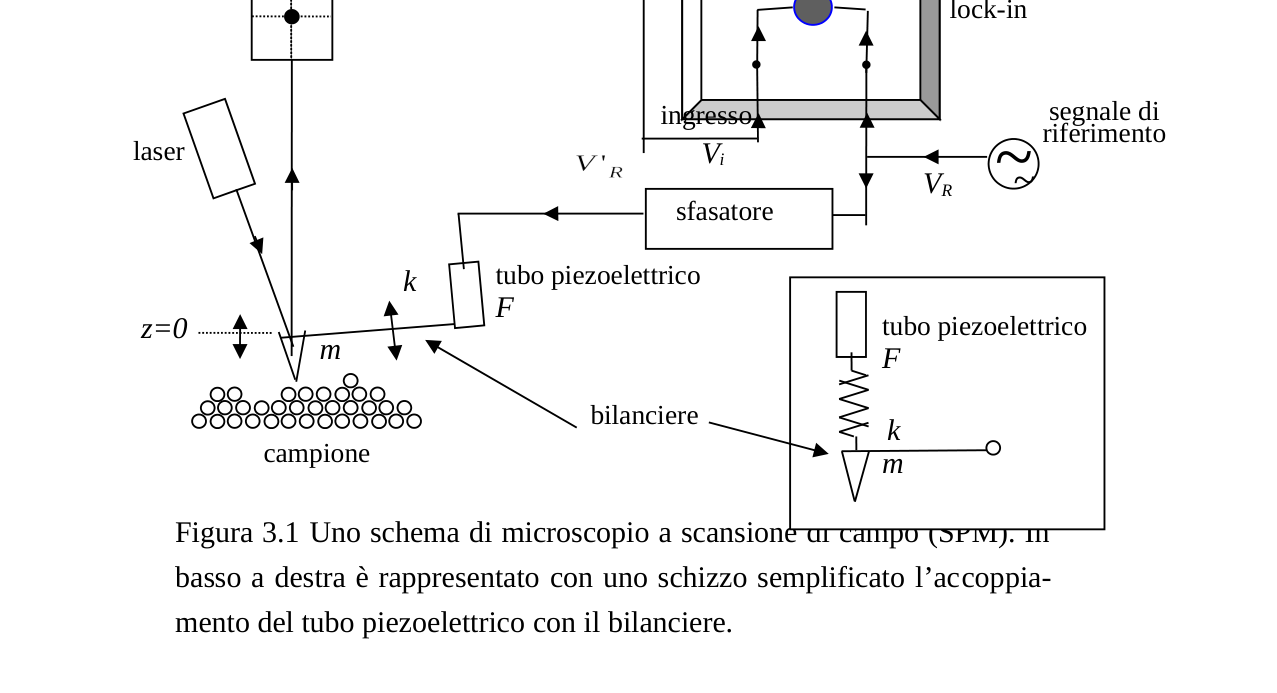
Theoretical Question 3 Page 1/3 Problema Teorico n. 3 Microscopio a Scansione di Campo I microscopi a scansione di campo (SPM) sono strumenti potenti usati nelle nanotecnologie. In un SPM, un fotorivelatore ricevendo il fascio di luce laser riflesso permette di descrivere il moto di un bilanciere, come mostrato in Fig. 3.1. Il bilanciere si può muovere solamente in direzione verticale ed il suo spostamento verticale può essere espresso, in funzione del tempo , dall’equazione
, (3.1) dove è la massa del bilanciere, 2 0
m k è la costante della molla del bilanciere, è un piccolo coefficiente di smorzamento tale che e infine è la spinta esterna di guida del bilanciere prodotta dal tubo piezoelettrico. Figura 3.1 Uno schema di microscopio a scansione di campo (SPM). In basso a destra è rappresentato con uno schizzo semplificato l’accoppiamento del tubo piezoelettrico con il bilanciere. [Parte A] (a) [1.5 punti] Quando , la funzione che soddisfa l’eq. (3.1) può essere scritta nella forma: , dove e . Trovare l’espressione dell’ampiezza e della tangente in funzione di , , , e VR Vi m sfasatore k m k laser z=0 bilanciere ~~ campione tubo piezoelettrico F tubo piezoelettrico F segnale di riferimento Amplificatore lock-in ingresso
Theoretical Question 3 Page 2/3 . Esprimere A e determinare la fase quando la frequenza è quella di risonanza . (b) [1 punto] L’amplificatore lock-in mostrato in Fig.3.1 moltiplica un segnale in ingresso con il suo segnale proprio di riferimento, , e successivamente lascia passare solamente la componente continua (dc) del segnale moltiplicato. Se il segnale in ingresso è espresso da , con , , i e tutte costanti positive date, trovare la condizione a cui deve soddisfare (>0) in modo tale che un segnale in uscita continuo non si anulli mai. Come si può esprimere alla frequenza prima trovata l’ampiezza del segnale continuo in uscita? (c) [1.5 punti] Passando attraverso lo sfasatore, la tensione di riferimento dell’amplificatore diventa . , applicata al tubo piezoelettrico, guida il bilanciere con una forza . In seguito, il fotorivelatore converte lo spostamento verticale z del bilanciere in una tensione , dove e sono costanti. Trovare l’espressione dell’ampiezza del segnale continuo in uscita quando . (d) [2 punti] Una piccola variazione m
della massa del bilanciere sposta la frequenza di risonanza di una quantità e di conseguenza la fase corrispondente alla frequenza originale di risonanza 0 varia di . Trovare la variazione di massa m
che corrisponde alla variazione di fase , che rappresenta una tipica risoluzione nelle misure di fase. I parametri fisici del bilanciere sono: 1.0 10-12 kg, N/m e 1.0 103 s-1. Usare le approssimazioni
e quando . [Parte B] Da ora in avanti consideriamo la situazione in cui qualche forza generata dal campione, mostrato in Fig.3.1, agisce sul bilanciere in aggiunta a quella esterna di guida già discussa nella parte A. (e) [1.5 punti] Supponendo che questa forza aggiuntiva dipenda solamente dalla distanza tra il bilanciere e la superficie del campione, si ha una nuova posizione di equilibrio del bilanciere, . Per valori di h prossimi ad , possiamo scrivere , dove è costante al variare di . Trovare la nuova frequenza di risonanza in funzione di , e .
Theoretical Question 3 Page 3/3 (f) [2.5 punti] Mentre viene eseguita la scansione della superficie muovendo il campione orizzontalmente, la punta del bilanciere che ha una carica incontra un elettrone con carica , intrappolato (localizzato nello spazio) ad una certa distanza sotto la superficie. Durante la scansione intorno all’elettrone si osserva che la massima deviazione della frequenza di risonanza ( ) è molto più piccola di . Quando la deviazione della frequenza di risonanza è massima, esprimere la distanza del bilanciere dall’elettrone intrappolato in funzione di , , , , e della costante di Coulomb . Calcolare in nm (1 nm = m) nel caso in cui s-1. I parametric fisici del bilanciere sono: 1.0 10-12 kg e N/m. Qualsiasi effetto di polarizzazione sia nella punta del bilanciere sia sulla superficie del campione va trascurato. Notare che e C.
p.1 — Schema microscopio a scansione di campo
Topic: Oscillations & Waves, Electrostatics, Newtonian Mechanics Metodi: Simple Harmonic Motion Analysis, Differential Equations, Coulomb’s Law, Approximation & Series Expansion Competenze: Mathematical Modeling, Physical Reasoning, Estimation & Approximation Objects: Spring, Electron Fonte: Testo (PDF) — p.1
Theoretical Question 3 Page 3 Theoretical problem n. 3 Field-scanning microscope Field-scan microscopes (SPM) are powerful tools used in nanotechnology. In a SPM, a photorevelator receiving the laser beam of reflected light allows describe the motion of a balancer, as shown in Figure 1. 3.1. The balance sheet can only move vertically and its vertical movement It can be expressed as a function of time , from the equation
, (3.1) Where It’s the mass of the scalar, 2 0
m k is the constant of the balance sheet spring, It is a small coefficient of attenuation such that And finally, è la the external driving force of the balancer produced by the piezoelectric tube. Figure 3.1 A field scanning microscope (SPM) scheme. In The lower right is a simplified sketch of the piezoelectric tube’s coupling with the balancer. [Part A] (a) [1.5 points] When , the function which satisfies the EQ. (3.1) may be written as follows: Where e . Find the expression of the amplitude and tangent In accordance with , , , e VR Vi m Other, of a kind used for the manufacture of goods k m k Other z=0 Balancing ~~ sample Piezoelectrical pipe F Piezoelectrical pipe F Signal of reference Other, of a kind used for the manufacture of goods Lock-in The entrance
Theoretical Question 3 Page two-thirds . Express A and determine the phase When the frequency is resonance . (b) [1 point] The lock-in amplifier shown in Fig.3.1 multiplies a signal in the entry with its own reference signal, , and then only allows the continuous component (dc) of the multiple signal to pass. Se il The input signal is expressed by , with , , i e All of them The following is the list of the conditions for the calculation of the value of the
0 in such a way That a continuous output signal never goes off. How can we express ourselves in the frequency first found the amplitude of the continuous output signal? (c) [1.5 points] Passing through the excavator, the reference voltage of the amplifier It becomes . , applied to the piezoelectric tube, drives the balancer with a force . Later, the photo detector converts the vertical movement z of the balancer into a voltage Where e They’re constant. Find the expression of the continuous output signal amplitude When . (d) [2 points] A small change m
of the mass of the balancer the frequency is shifted of a quantity and consequently the phase corresponding to the original resonance frequency 0 varies from . Find the mass change m
which corresponds to the phase change , which is a typical resolution the phase measurements. The physical parameters of the balance sheet shall be: 1.0 10-12 kg, N/m e 1.0 103 s-1. Use le Approximations
e When . [Part B] From now on, let’s consider the situation where some force generated by the sample, The vehicle shall be equipped with a control system which is capable of operating at a speed of up to 10 km/h. (e) [1.5 points] Assuming that this additional force is It depends only on the distance The test results shall be obtained by the following test method: balance sheet, . For h values close to We can write Where is constant as the . Finding the New Resonance frequency In accordance with , e .
Theoretical Question 3 The Commission shall adopt implementing acts in accordance with Article 21 of this Regulation. (f) [2.5 points] While the surface scan is performed by moving the sample horizontally, the tip of the balancer that has a load It encounters a charged electron. , trapped (located in space) at a certain distance below the surface. During the scan around the electron, it is observed that the maximum The measurement shall be carried out in accordance with the following conditions: ( ) is much smaller than . When the resonance frequency deviation is maximum, express the distance The electron trapped on the balance sheet is , , , , and of the Coulomb constant . Calculation in nm (1 nm = (m) where: s-1. The physical parameters of the balance sheet are: 1.0 10-12 kg e N/m. Any of the following: Polarization effect both on the tip of the scaffold and on the surface of the sample It’s not worth it. Note that e C.
The following table shows the results of the calculation of the total value of the samples:
Topic: Oscillations & Waves, Electrostatics, Newtonian Mechanics Metodi: Simple Harmonic Motion Analysis, Differential Equations, Coulomb’s Law, Approximation & Series Expansion Competenze: Mathematical Modeling, Physical Reasoning, Estimation & Approximation Objects: Spring, Electron Fonte: Testo (PDF) — p.1