Slow motion
The aim of this work is to study the motion of bodies in a viscous medium.
Equipment List:
- Tripod
- Ruler of 30 cm
- Stopwatch
- Disposable syringes 10 ml
- Liquid Gel (liquid soap) - 20 ml
- Glass tube with the inner diameter – D=4.6 mm
- Wooden sticks (diameter 3 mm)
- A set of metal rods, length 4 cm, diameters d= 2.5; 3.0; 3.5; 4.0 mm
- Disposable glass
- Napkins to wipe the table and hands
Apparatus
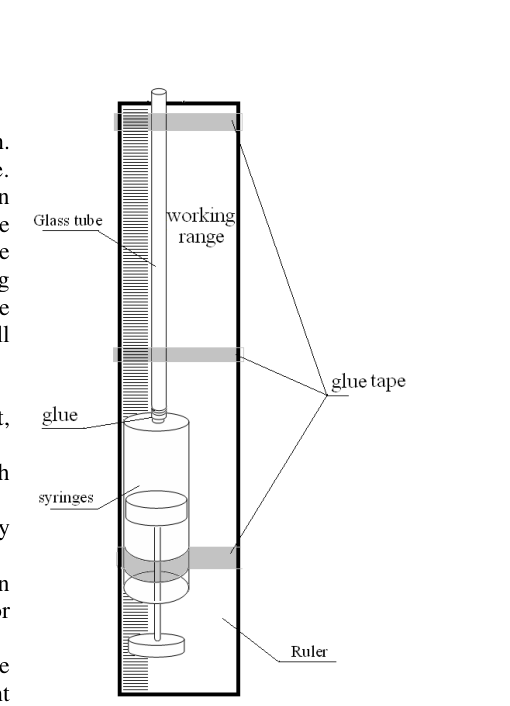
In this experiment use the following installation. The glass tube is glued to the tip of the syringe. Tube with a syringe is attached to the ruler with an adhesive tape. Using the syringe you can fill up the tube with the gel. This setup can be fixed to the tripod vertically, either with the tube pointing upward or downward. Inside the tube you can place metal or wooden rods, the motion of which you will explore.
For successful completion of the experiment, strictly follow the instructions below:
- Make sure that the tube is completely filled with the gel and there are no air bubbles inside it;
- Change the gel in the syringe and the tube only when necessary;
- Once you put a metal rod (or wooden stick) in the receiver, wait until it starts to move steadily, for this it must travel a distance of about 4-5 cm;
- The results of measurements of the characteristics of motion have significant dispersion, so all measurements should be conducted several times;
- Be careful of the sharp edge of the tube!
Part 1. Metal
Place the tube vertically with the open end pointing upward, so that you could put the metal rods into the tube. If necessary, conduct a second experiment, simply overturning the tube: when the rod sinks down, turn the tube upside down and you can repeat the measurement.
-
Prove experimentally that the motion of the rod inside the tube is uniform. Use only metal rod of diameter of in this case. Determine the velocity of the rod sinking in the gel as accurately as possible. Calculate the error of the velocity measured.
-
Measure the dependence of the velocity of the rods (with the same length) on their diameters. Plot a graph of the obtained dependence.
-
Theoretically, we can show that the velocity of the rod depends on the thickness of the gap between the tube walls and the lateral surface of the rod (if the gap is small compared to the radius of the tube) according to the law
where is a constant. Using your experimental data, check whether this dependence holds.
-
Determine the power index in formula (1) which most accurately fits the experimental data. Make error estimation of the obtained value of this power index .
-
Give a brief theoretical justification for the result obtained in Question 4.
Part 2. Wood
Overturn the syringe with the tube pointing downward. Insert a wooden rod into the tube (from below) then it will slowly emerge. You have to study the motion of the wooden rod. The wooden rod should be completely immersed in the fluid when it moves.
-
Prove experimentally that the motion of the rod inside the tube is uniform. Measure the velocity of the rod in the gel as accurately as possible. Make error estimation of the obtained value of the velocity. To conduct this experiment, use stick of maximal length.
-
Investigate a dependence of rod velocity on its length. Plot a graph of the obtained dependence. Make error estimation of the obtained values.
-
Give a brief theoretical explanation of the result obtained in Question 2.
Lento movimento
Lo scopo di questo lavoro è studiare il movimento dei corpi in un mezzo viscoso.
Elenco degli strumenti:
- Treppiede
- Righello da 30 cm
- Cronometro
- Siringhe monouso da 10 ml
- Gel liquido (sapone liquido) - 20 ml
- Tubo di vetro con diametro interno D=4,6 mm
- Stecche di legno (diametro 3 mm)
- Un insieme di barre metalliche, lunghezza 4 cm, diametri d= 2,5; 3,0; 3,5; 4,0 mm
- Vetro monouso
- Fazzoletti per pulire il tavolo e le mani
Apparato sperimentale**
In questo esperimento utilizzate la seguente configurazione: il tubo di vetro viene incollato alla punta della siringa, che a sua volta viene fissata al righello con nastro adesivo. Utilizzando la siringa si può riempire il tubo con il gel. Questa struttura può essere fissata verticalmente sul treppiede, sia con il tubo rivolto verso l’alto che verso il basso. All’interno del tubo si possono inserire barre metalliche o di legno, il movimento delle quali verrà studiato.
Per completare con successo l’esperimento, seguite rigorosamente le istruzioni seguenti:
- Assicuratevi che il tubo sia completamente riempito con il gel e che non ci siano bolle d’aria al suo interno;
- Cambiate il gel nella siringa e nel tubo solo quando necessario;
- Una volta inserita una barra metallica (o di legno) nel tubo, aspettate che inizi a muoversi regolarmente; per questo deve percorrere una distanza di circa 4-5 cm;
- I risultati delle misurazioni presentano notevoli dispersioni, quindi tutte le misurazioni devono essere ripetute più volte;
- Fate attenzione ai bordi taglienti del tubo!
Parte 1. Metallo**
Posizionate il tubo verticalmente con l’estremità aperta rivolta verso l’alto, in modo da poter inserire le barre metalliche al suo interno. Se necessario, eseguite un secondo esperimento semplicemente capovolgendo il tubo: quando la barra inizia a scendere, capovolgete il tubo e potete ripetere la misurazione.
-
Dimostrate sperimentalmente che il movimento della barra all’interno del tubo è uniforme. In questo caso utilizzate esclusivamente barre metalliche di diametro . Determinate con la massima precisione possibile la velocità della barra mentre scende nel gel. Calcolate l’errore nella misurazione della velocità.
-
Misurate la dipendenza della velocità delle barre (con lo stesso lunghezza) dal loro diametro. Disegnate un grafico che rappresenti questa dipendenza.
-
Teoricamente, possiamo dimostrare che la velocità della barra dipende dall’espessore dello spazio tra le pareti del tubo e la superficie laterale della barra (se lo spazio è piccolo rispetto al raggio del tubo) secondo la seguente legge:
dove è una costante. Utilizzando i vostri dati sperimentali, verificate se questa dipendenza corrisponde alla realtà.
-
Determinate l’indice di potenza nella formula (1) che meglio si adatta ai dati sperimentali. Fate un’estimazione dell’errore nel valore ottenuto per questo indice di potenza .
-
Fornisce una breve spiegazione teorica del risultato ottenuto nella Domanda 4.
Parte 2. Legno
Capovolgete la siringa con il tubo rivolto verso il basso. Inserite una barra di legno nel tubo (dall’interno) e osservate come si muove lentamente. La barra di legno deve essere completamente immersa nel fluido durante il movimento.
-
Dimostrate sperimentalmente che il movimento della barra all’interno del tubo è uniforme. Misurate con la massima precisione possibile la velocità della barra nel gel. Fate un’estimazione dell’errore nella misurazione della velocità. Per eseguire questo esperimento, utilizzate una stecca il più lunga possibile.
-
Indaguate sulla dipendenza della velocità della barra dal suo lunghezza. Disegnate un grafico che rappresenti questa dipendenza. Fate un’estimazione dell’errore nei valori ottenuti.
-
Fornisce una breve spiegazione teorica del risultato ottenuto nella Domanda 2.