This problem consists of three unrelated parts.
1A (3 points)
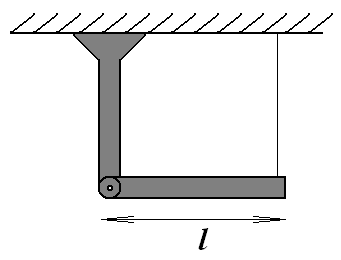
One end of a homogeneous rigid rod with mass and length is suspended on the vertical support by an ideal joint, and the other end hangs on a thread such that the rod is in horizontal position. At a certain time point the thread is cut. Find the dependence of reaction force of the joint on the angle of the rod deviation from the horizontal position.
1B (4 points)
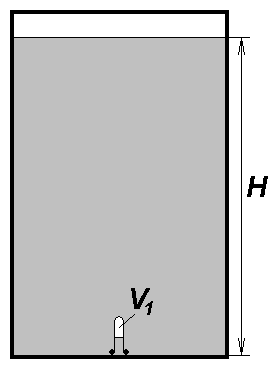
Liquid is poured in a closed cylindrical vessel with thick walls. The height of the liquid level is . The mass density of the liquid decreases linearly with the height from to small value which can be assumed to be equal to zero. Thin layer of vapor is saturated over the liquid surface but its pressure can be neglected with respect to the hydrostatic pressure of the liquid. Inverted test-tube of the volume is placed at the bottom of the vessel. The mass of the test-tube is concentrated at its neck, and its length is small compared to . The gas of volume with negligible mass is placed inside the test-tube. The temperature of the system is kept constant. Can the test-tube stay motionless in the liquid at a certain height from the bottom? If it is possible, what conditions are to be satisfied? What is the height of the test-tube position over the bottom in this case? Is this state stable? The volume of walls of the test-tube is small compared to .
1C (3 points)
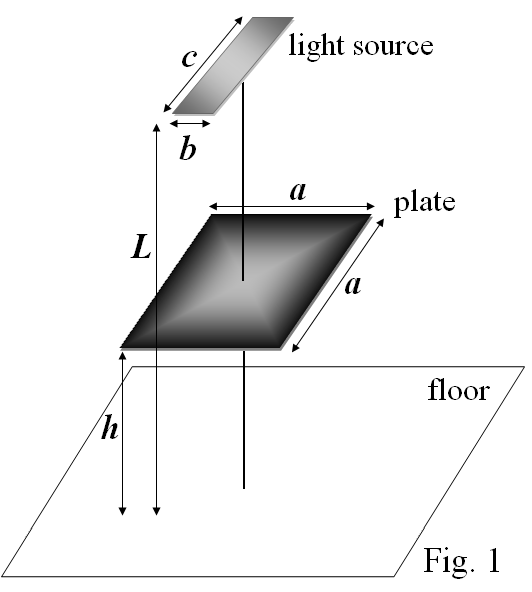
Rectangular light source of size is fixed on the ceiling of the room of height .
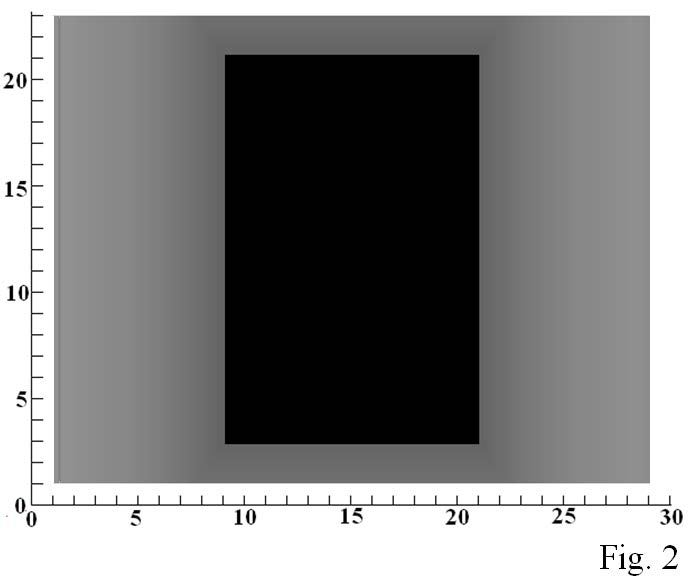
Opaque square plate with side is placed horizontally under the lamp at a height above the floor (Fig. 1). Fig. 2 schematically shows the shape of the shadow casted by the plate on the room floor. The shadow consists of a dark rectangle surrounded by a lighter rectangle, and when approaching the edges of the outer rectangle the shade turns lighter. The value of the scale division in Fig. 2 is . Find the sizes
of the light source and , and the height of the plate position. Specify the exact orientation of the light source with respect to the plate shadow.
Questo problema è composto da tre parti non correlate.
1A (3 punti)
Un’estremità di un’asta rigida omogenea, con massa e lunghezza , è sospesa su un supporto verticale tramite un giunto ideale, mentre l’altra estremità pende da un filo in modo che l’asta rimanga in posizione orizzontale. In un certo momento il filo viene tagliato. Determinare la dipendenza della forza di reazione del giunto dall’angolo con cui l’asta si discosta dalla posizione orizzontale.
1B (4 punti)
Un liquido viene versato in un contenitore cilindrico chiuso con pareti spesse. L’altezza del livello del liquido è . La densità di massa del liquido diminuisce linearmente con l’altezza, da fino a un valore piccolo che può essere considerato nullo. Una sottile pellicola di vapore è saturata sulla superficie del liquido, ma la sua pressione può essere trascurata rispetto alla pressione idrostatica del liquido stesso. Al fondo del contenitore viene posizionata una provetta capovolta, con volume . La massa della provetta è concentrata nella sua parte superiore, e la sua lunghezza è molto inferiore a . All’interno della provetta viene inserito un gas con volume e massa trascurabile. La temperatura del sistema rimane costante. È possibile che la provetta rimanga ferma nel liquido, a una certa altezza dal fondo? Se sì, quali condizioni devono essere soddisfatte? Qual è l’altezza della provetta rispetto al fondo in questo caso? Questo stato è stabile? Il volume delle pareti della provetta è molto inferiore a .
1C (3 punti)
Una sorgente luminosa rettangolare, di dimensioni , è fissata al soffitto di una stanza alta .
Una lastra quadrata opaca, con lato , viene posizionata orizzontalmente sotto la sorgente luminosa, a un’altezza dal pavimento (Fig. 1). La Fig. 2 mostra schematicamente la forma dell’ombra proiettata dalla lastra sul pavimento della stanza. L’ombra è costituita da un rettangolo scuro circondato da un rettangolo più chiaro; avvicinandosi ai bordi del rettangolo esterno, l’ombra diventa meno scura. La scala utilizzata nella Fig. 2 è di . Determinare le dimensioni della sorgente luminosa ( e ) e l’altezza alla quale la lastra è posizionata. Specificare anche l’esatta orientazione della sorgente luminosa rispetto all’ombra proiettata dalla lastra.
The Tolmen-Stewart experiment
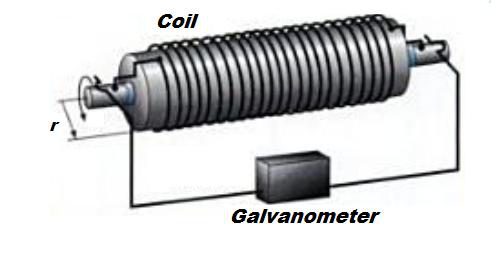
In 1916 Tolmen and Stewart carried out their famous experiment proving that the electric current in metals was caused by freely moving electrons. The sketch of the experimental setup is shown on the left hand side.
A long coil of the radius and the length has an inertia moment . The coil is reeled up by a single layer of the metal wire of the length and mass such that the number of loops on the unit length equals . The both ends of the wire are abridged to the galvanometer by the sliding contacts. The coil together with the wire is set rotating with the angular velocity and, then, the friction force with the torque is applied to stop the coil rotation. The total resistance of the circuit is and its capacity is assumed negligible.
Part 1. In this part of the problem you can neglect the inductance of the coil and assume that the Ohm’s law holds at any time.
- [1 point] Determine the total inertia moment of the coil together with the wire. Express your answer in terms of .
- [1 point] Determine the dependence of the angular velocity of the coil on time . Express your answer in terms of .
- [1 point] Determine the dependence of the electric current strength on time . Express your answer in terms of with being the mass and the electric charge of electron, respectively.
- [2 points] During the experiment the galvanometer has registered the electric charge passed in the circuit. Express the charge-to-mass ratio of the electron in terms of .
Part 2. In this part of the problem you have to take into account the small inductance of the coil which is supposed to be quite long to neglect the side effects.
-
[1 point] Find the maximal electric current strength in the coil. Express your answer in terms of . Plot a qualitative dependence .
-
[1 point] Find the maximal energy stored in the coil during the experiment. Express your answer in terms of and the magnetic constant .
-
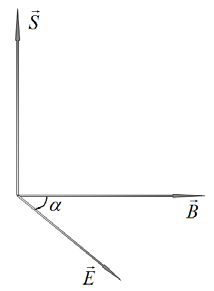
[3 points] The flux of the electromagnetic energy through the unit area is determined by the Pointing vector which is perpendicular to both electric and magnetic fields with the module , where is the electric field strength vector, is the magnetic induction vector and is the angle between them (see the picture on the right). Find the electromagnetic energy passing through the lateral surface for the time period while the electric current increases and the electromagnetic
energy passing through the lateral surface for the time period while the electric current decreases. Express your answer in terms of .
L’esperimento di Tolmen-Stewart
Nel 1916 Tolmen e Stewart condussero il loro famoso esperimento che dimostrò come la corrente elettrica nei metalli fosse causata da elettroni in movimento libero. La schermata dell’impianto sperimentale è mostrata sul lato sinistro.
Una lunga bobina di raggio e lunghezza ha un momento d’inerzia . La bobina è avvolta con un unico strato di filo metallico di lunghezza e massa , in modo che il numero di giri per unità di lunghezza sia pari a . Entrambe le estremità del filo sono collegate al galvanometro tramite contatti scorrevoli. La bobina, insieme al filo, viene fatta ruotare con una velocità angolare iniziale ; successivamente, una forza di attrito applica un momento torcente per fermarne la rotazione. La resistenza totale del circuito è , e si assume che la sua capacità sia trascurabile.
Parte 1. In questa parte del problema si può ignorare l’induttanza della bobina e assumere che la legge di Ohm valga in ogni momento.
- [1 punto] Determinare il momento d’inerzia totale della bobina insieme al filo. Esprimi la tua risposta in termini di .
- [1 punto] Determinare la dipendenza della velocità angolare della bobina in funzione del tempo . Esprimi la tua risposta in termini di .
- [1 punto] Determinare la dipendenza dell’intensità di corrente elettrica in funzione del tempo . Esprimi la tua risposta in termini di , dove rappresentano rispettivamente la massa e la carica elettrica dell’elettrone.
- [2 punti] Durante l’esperimento, il galvanometro ha registrato la carica elettrica che è passata nel circuito. Esprimi il rapporto tra carica e massa dell’elettrone in termini di .
Parte 2. In questa parte del problema si deve tenere conto della piccola induttanza della bobina, che però deve essere abbastanza lunga da poter ignorare gli effetti collaterali.
-
[1 punto] Determinare l’intensità di corrente massima nella bobina. Esprimi la tua risposta in termini di . Disegna una rappresentazione qualitativa della dipendenza di .
-
[1 punto] Determinare l’energia massima immagazzinata nella bobina durante l’esperimento. Esprimi la tua risposta in termini di e della costante magnetica .
-
[3 punti] Il flusso di energia elettromagnetica attraverso un’unità di superficie è determinato dal vettore di Poincaré, che è perpendicolare sia al campo elettrico che a quello magnetico; il modulo di è dato da , dove rappresenta la intensità del campo elettrico, quella della induzione magnetica e l’angolo tra loro (vedi la figura a destra). Determina l’energia elettromagnetica che passa attraverso la superficie laterale nel periodo in cui la corrente aumenta, nonché l’energia che passa attraverso la stessa superficie nel periodo in cui la corrente diminuisce. Esprimi le tue risposte in termini di .
The relic radiation and cosmic rays
According to modern cosmology, our universe is filled with electromagnetic radiation, remained after the Big Bang and called the cosmic relict radiation, or cosmic microwave background (shortly, CMB). With good accuracy, the CMB is homogeneous and isotropic in the reference system associated with our Galaxy which we take as the laboratory reference system. The frequency distribution of the CMB coincides with the spectrum of a blackbody at temperature . Discovery and study of properties of the CMB were awarded Nobel Prizes in Physics in 1978 and 2006.
Relict photons are extremely numerous and, therefore, may affect Galaxy radiation of another nature called cosmic rays (shortly, CR). It is believed that CR are formed in stellar explosions. CR consist mainly of protons whose energy can exceed by many orders the energy of terrestrial accelerators. The mechanism of generation of ultrahigh energy CR is not entirely clear, but the experimentally observed energy distribution of CR is limited above by the energy . In this problem it is assumed that this limitation is caused by energy loss in the process of interaction between protons and the CMB. Protons can participate in the Compton scattering
and cause the reaction
where is a proton, is a relict photon, is the lightest, as compared to the nucleon, baryon with the rest mass , which quickly decays into pi-meson and proton . (-particle decays also to -meson and neutron. Neutron quickly turns into proton by -decay, so the consideration of this reaction channel is not essential in this Problem). Due to the birth of -particles, the probability of interaction of protons with -quanta increases dramatically.
The purpose of this Problem is to determine the upper limit of the observed energy spectrum of CR, supposing that reaction (2) is the main mechanism of energy loss of CR, and compare the loss of energy protons in the reactions (1) and (2).
In the following questions, you have to measure the energy in electron-volts , and momenta in , where is the speed of light in vacuum. The rest mass of the proton is , the rest mass of pi-meson is . Boltzmann constant is .
-
Estimate most probable energy and the corresponding momentum of relict photons, given that they correspond to the blackbody radiation at temperature . It is assumed in the following questions that the initial photon in reactions (1) and (2) has the energy and the momentum found Question 1.
-
The rest mass of a particle is related to the total relativistic energy and momentum of this particle in an arbitrary inertial reference system as . Here, the quantity does not depend on the reference system and is a complete internal energy of the particle. Write a corresponding expression for the total internal energy of a system of two non-interacting particles (i.e. the total energy in the reference frame in which the total
momentum of physical system is equal to zero) having the total energies , and momenta , .
For further analysis you may need the relativistic law of transformation of momentum and energy of the particle. In the transition from the inertial reference system to an inertial system , moving along the positive direction of the axis () with the speed in the reference system, energy and momentum transform like the coordinates of space-time point :
Here,
- Determine the lowest possible energy of the proton at which reaction (2) turns possible:
a) in the center of mass of proton and photon (i.e., the reference system in which the total momentum of the proton and photon is zero);
b) in the Galaxy system of reference.
Starting from the obtained results, determine the maximum energy of protons in cosmic rays.
-
Assuming that in the Galaxy system a proton has the maximum energy and commits a head-to-head collision with a relic photon, determine the momentum of pi-meson in reaction (2) in this frame of reference for the case when the emitted particles move along or against the direction of the initial momentum of the proton. What is the change of the momentum of the proton in this case?
-
What is the value of momentum of the outgoing photon in the Compton scattering (1) under the same conditions as in the Question 4?
-
Is reaction (2) with the cosmic relic radiation possible, if the initial momenta of the proton and the photon are parallel in the Galaxy system? If the reaction is possible, what is the minimum value of the photon momentum in the Galaxy system?
La radiazione residua e i raggi cosmici
Secondo la cosmologia moderna, il nostro universo è pieno di radiazione elettromagnetica rimasta dopo il Big Bang e chiamata radiazione residua cosmica, o radiazione cosmica di fondo a microonde (in breve, CMB). Con buona precisione, la CMB è omogenea e isotropa nel sistema di riferimento associato alla nostra Galassia, che consideriamo come sistema di riferimento del laboratorio. La distribuzione di frequenza della CMB coincide con lo spettro di un corpo nero a temperatura . La scoperta e lo studio delle proprietà della CMB hanno portato alla consegna dei Premi Nobel per la Fisica nel 1978 e nel 2006.
I fotoni residui sono estremamente numerosi e, pertanto, possono influenzare la radiazione della Galassia di altra natura chiamata raggi cosmici (in breve, CR). Si ritiene che i CR si formino nelle esplosioni stellari. I CR sono composti principalmente da protoni il cui energia può superare di molti ordini l’energia degli acceleratori terrestri. Il meccanismo di generazione dei CR ad alta energia non è del tutto chiaro, ma la distribuzione energetica osservata sperimentalmente dei CR è limitata al di sopra dell’energia . In questa domanda si assume che questo limite sia causato dalla perdita di energia nel processo di interazione tra protoni e CMB. I protoni possono partecipare alla diffusione di Compton
e causare la reazione
dove è un protone, è un fotone residuo, è il barione più leggero rispetto ai nucleoni, con una massa restante , che si degrada rapidamente in un mesone pi e un protone . (-particella decade anche in un mesone e un neutrone. Il neutrone si trasforma rapidamente in protone attraverso decadimento , quindi la considerazione di questo canale di reazione non è essenziale in questa domanda). A causa della nascita delle particelle , la probabilità di interazione dei protoni con i quanti aumenta notevolmente.
Lo scopo di questa domanda è determinare il limite superiore dello spettro energetico osservato dei CR, assumendo che la reazione (2) sia il principale meccanismo di perdita di energia dei CR, e confrontare la perdita di energia dei protoni nelle reazioni (1) e (2).
Nelle seguenti domande, dovrai misurare l’energia in elettroni-volt e i momenti in , dove è la velocità della luce nel vuoto. La massa restante del protone è , la massa restante del mesone pi è . La costante di Boltzmann è .
-
Stima l’energia più probabile e il corrispondente momento dei fotoni residui, dato che corrispondono alla radiazione di corpo nero a temperatura . Nelle seguenti domande si assume che il fotone iniziale nelle reazioni (1) e (2) abbia l’energia e il momento trovati nella Domanda 1.
-
La massa restante di una particella è relativa all’energia relativistica totale e al momento di questa particella in un qualsiasi sistema di riferimento inerziale come . Qui, la quantità non dipende dal sistema di riferimento ed è l’energia interna totale della particella. Scrivi un’espressione corrispondente per l’energia interna totale di un sistema costituito da due particelle non interagenti (cioè, l’energia totale nel sistema di riferimento in cui il momento totale del sistema fisico è uguale a zero) che hanno le energie totali , e i momenti , .
Per un’analisi più approfondita, potresti aver bisogno della legge di trasformazione relativistica del momento e dell’energia della particella. Nel passaggio dal sistema di riferimento inerziale a un sistema di riferimento inerziale , che si muove lungo la direzione positiva dell’asse () con la velocità nel sistema di riferimento, energia e momento si trasformano come le coordinate del punto dello spazio-tempo :
Qui,
- Determina l’energia minima possibile del protone per cui la reazione (2) diventa possibile:
a) nel centro di massa del protone e del fotone (cioè, il sistema di riferimento in cui il momento totale del protone e del fotone è zero);
b) nel sistema di riferimento della Galassia.
Partendo dai risultati ottenuti, determina l’energia massima dei protoni nei raggi cosmici.
-
Assumendo che nel sistema di riferimento della Galassia un protone abbia l’energia massima e subisca una collisione frontale con un fotone residuo, determina il momento del mesone pi nella reazione (2) in questo sistema di riferimento per il caso in cui le particelle emesse si muovano lungo o contro la direzione del momento iniziale del protone. Qual è la variazione del momento del protone in questo caso?
-
Qual è il valore del momento del fotone uscente nella diffusione di Compton (1) nelle stesse condizioni della Domanda 4?
-
È possibile la reazione (2) con la radiazione residua cosmica, se i momenti iniziali del protone e del fotone sono paralleli nel sistema di riferimento della Galassia? Se la reazione è possibile, qual è il valore minimo del momento del fotone nel sistema di riferimento della Galassia?